

Technology-Mediated Social Participation Ben Shneiderman  ben@cs.umd.eduTwitter:  @benbendcFounding Director (1983-2000), Human-Computer Interaction LabProfessor, Department of Computer ScienceMember, Institute for Advanced Computer Studies
  Interdisciplinary research community    - Computer Science & Info Studies    - Psych, Socio, Poli Sci & MITH          (www.cs.umd.edu/hcil)
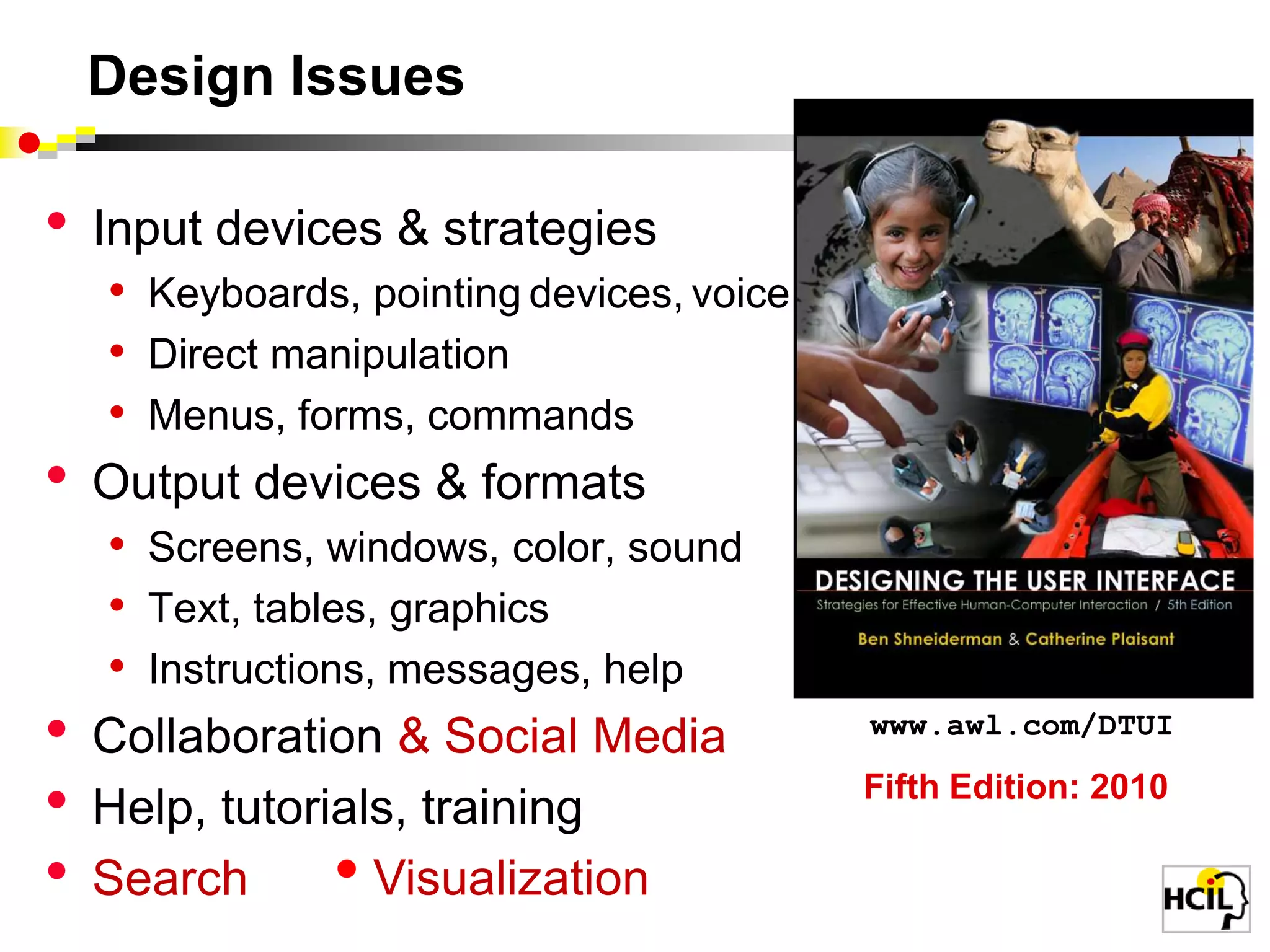
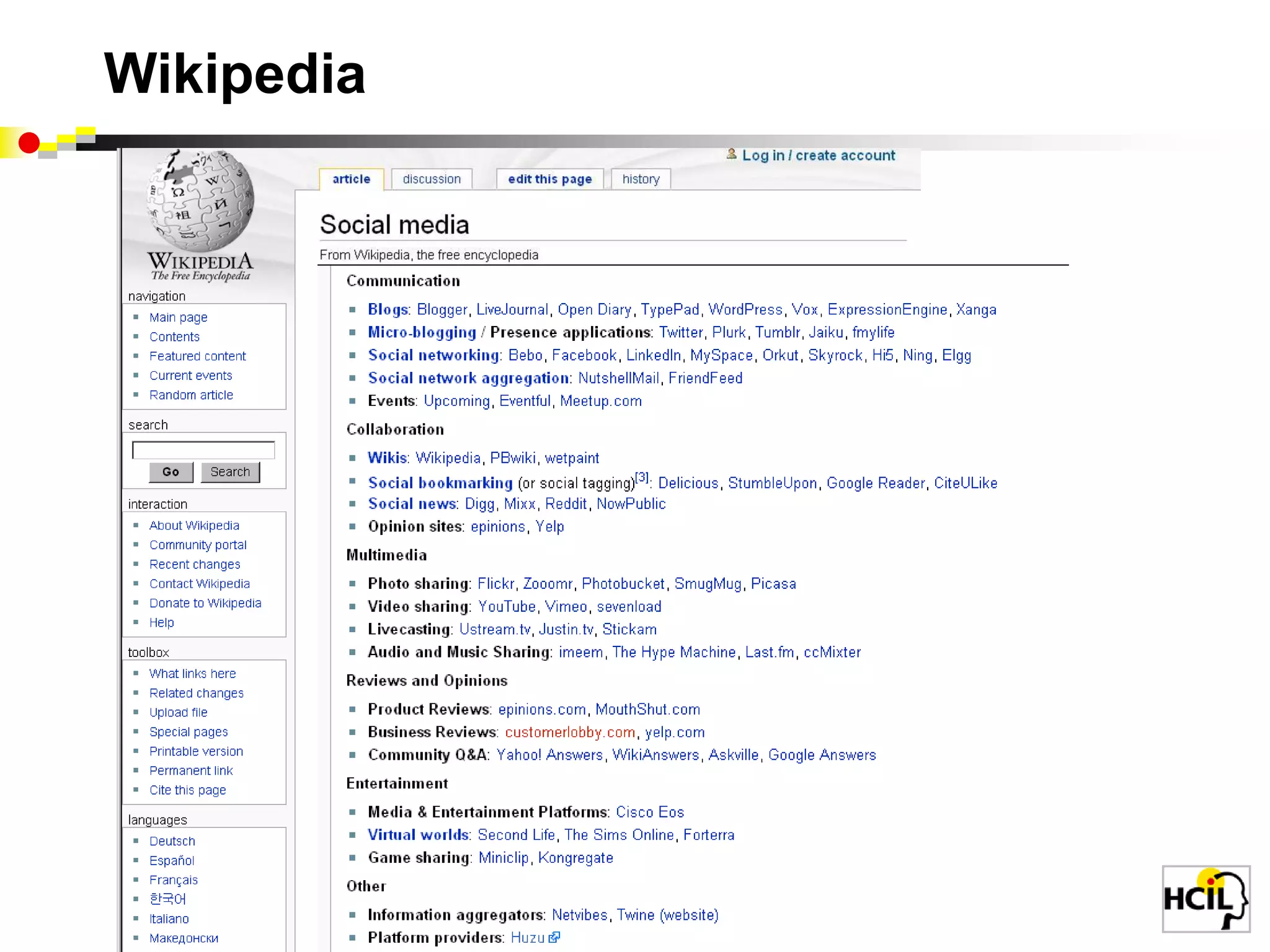
Design IssuesInput devices & strategiesKeyboards, pointingdevices,voiceDirect manipulationMenus, forms, commandsOutput devices & formatsScreens, windows, color, soundText, tables, graphicsInstructions, messages, helpCollaboration &Social MediaHelp, tutorials, trainingSearchwww.awl.com/DTUIFifth Edition: 2010 VisualizationWikipedia
GoalApply social media to transform societyReduce deaths, medical errors, obesity & smokingPromote energy conservationPrevent disasters & terrorismIncrease community safetyImprove education Facilitate good governmentResolve conflicts
ChallengesMalicious attacks Privacy violationsNot trusted Fails to be universalUnreliable when needed Misuse by Terrrorists & criminalsPromoters of racial hatred Political oppressers
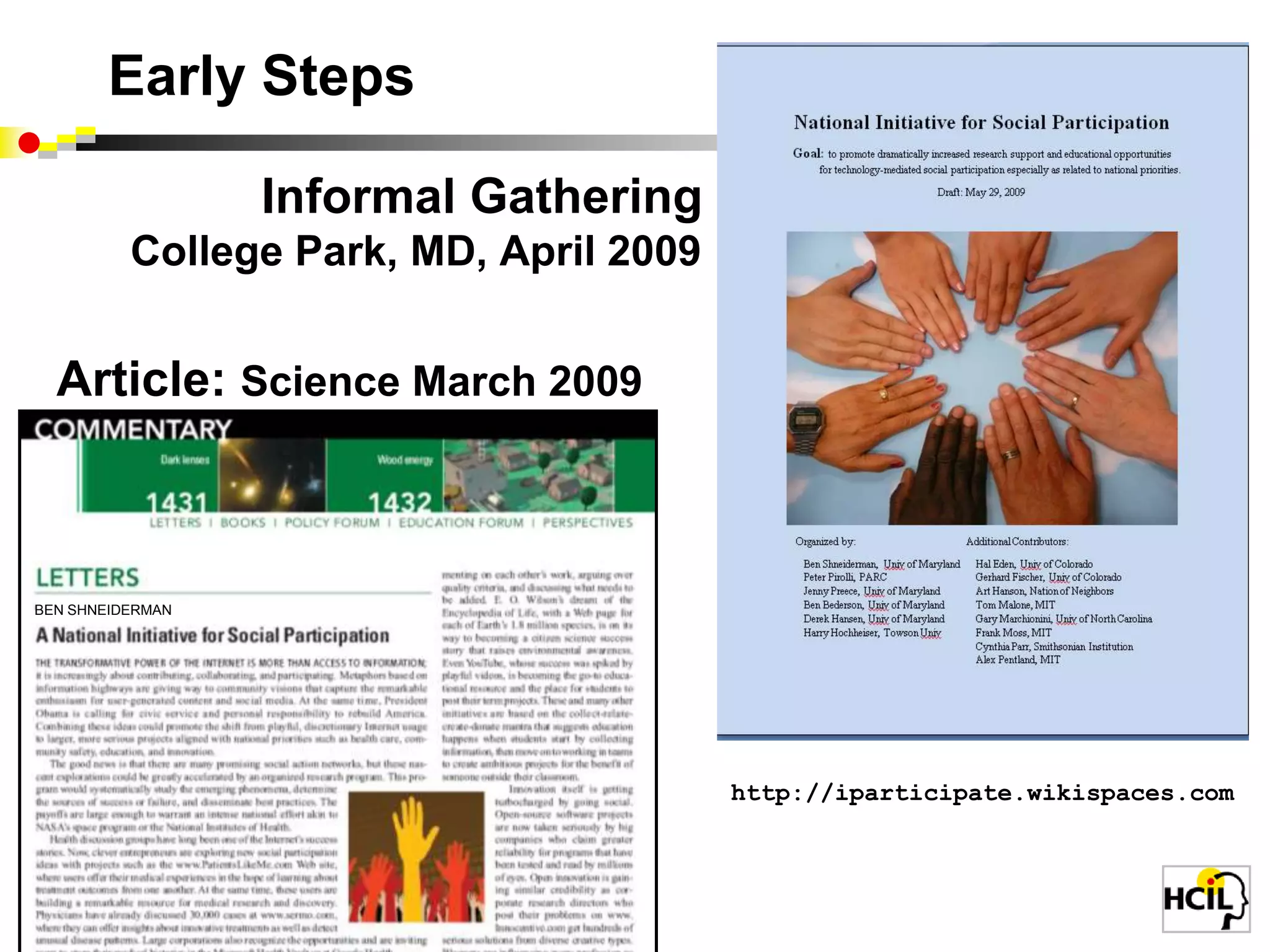
Early Steps               Informal GatheringCollege Park, MD, April 2009Article: Science March 2009BEN SHNEIDERMANhttp://iparticipate.wikispaces.com
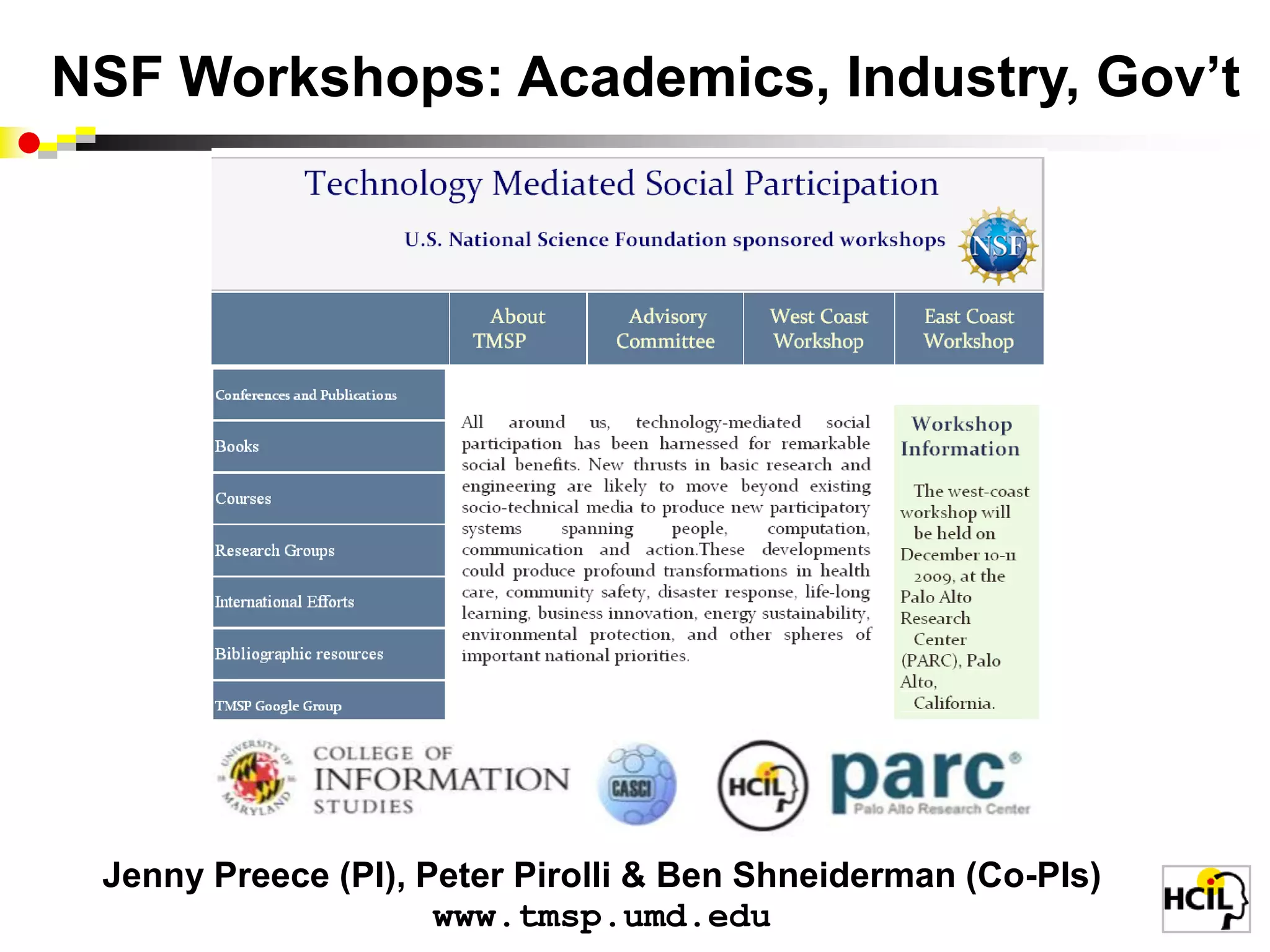
NSF Workshops: Academics, Industry, Gov’tJenny Preece (PI), Peter Pirolli & Ben Shneiderman (Co-PIs)www.tmsp.umd.edu
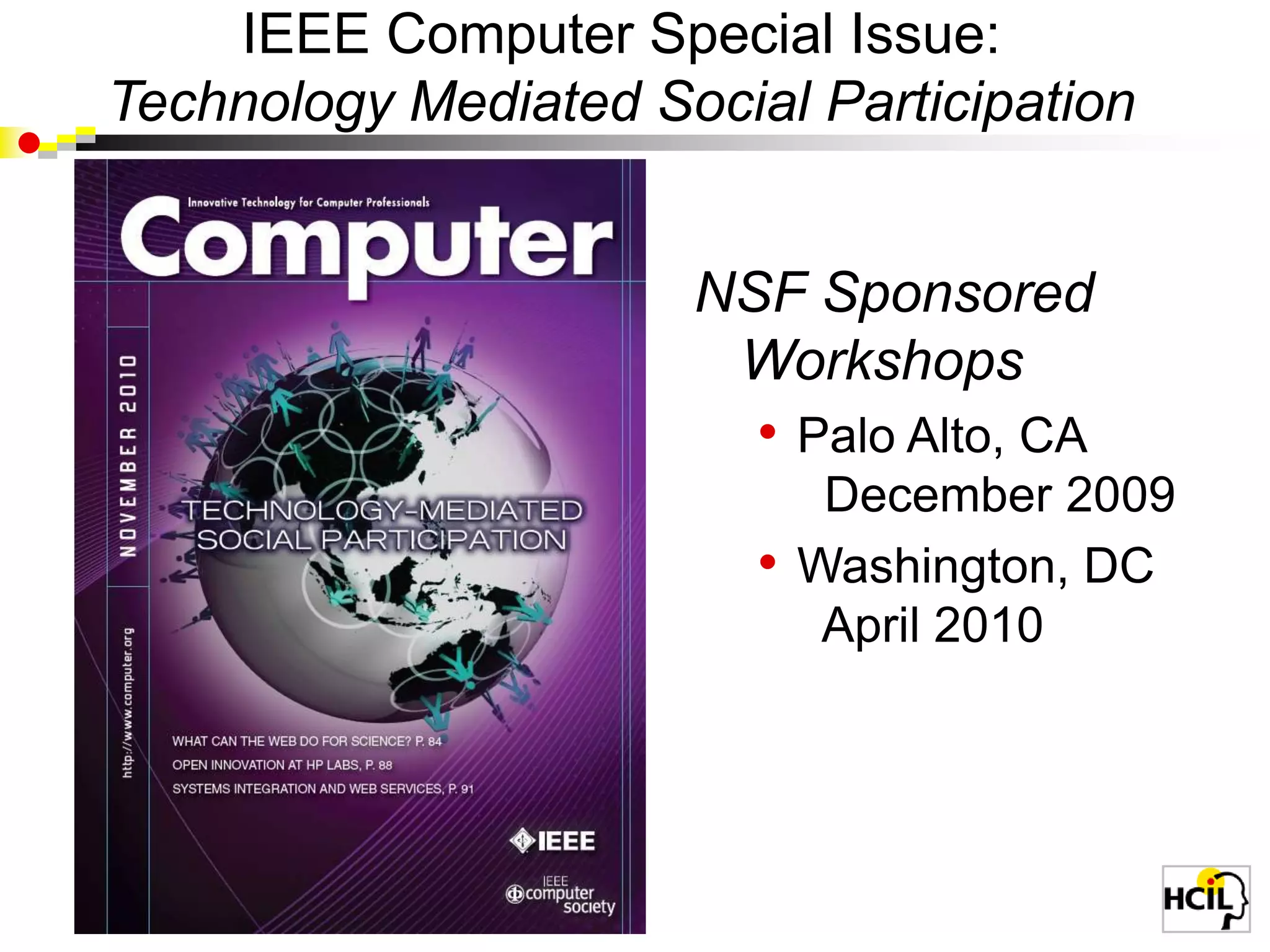
  IEEE Computer Special Issue:Technology Mediated Social ParticipationNSF Sponsored    WorkshopsPalo Alto, CA  December 2009Washington, DC   April 2010
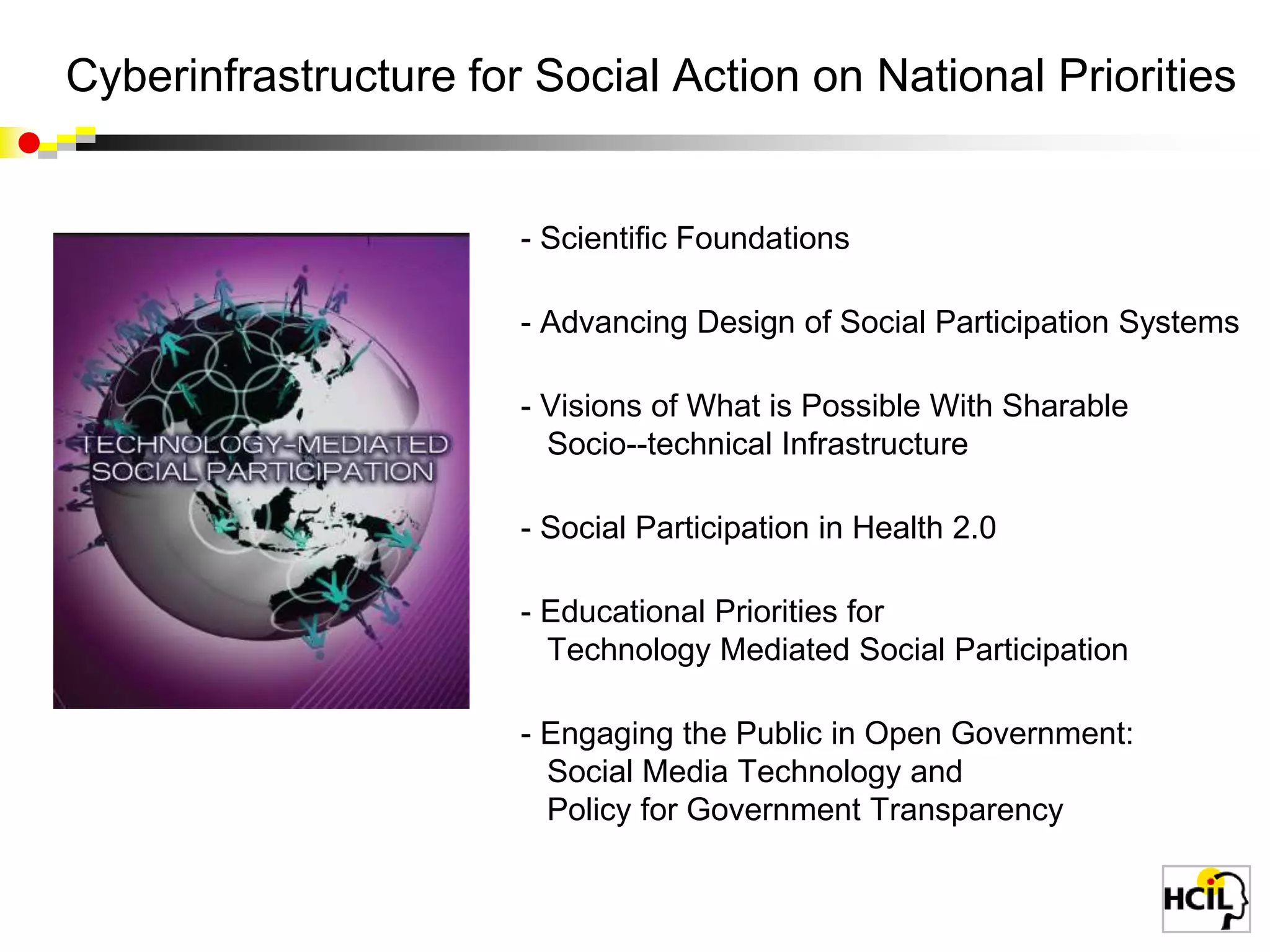
Cyberinfrastructure for Social Action on National Priorities- Scientific Foundations- Advancing Design of Social Participation Systems- Visions of What is Possible With Sharable    Socio-­technical Infrastructure- Social Participation in Health 2.0- Educational Priorities for    Technology Mediated Social Participation- Engaging the Public in Open Government:    Social Media Technology and    Policy for Government Transparency
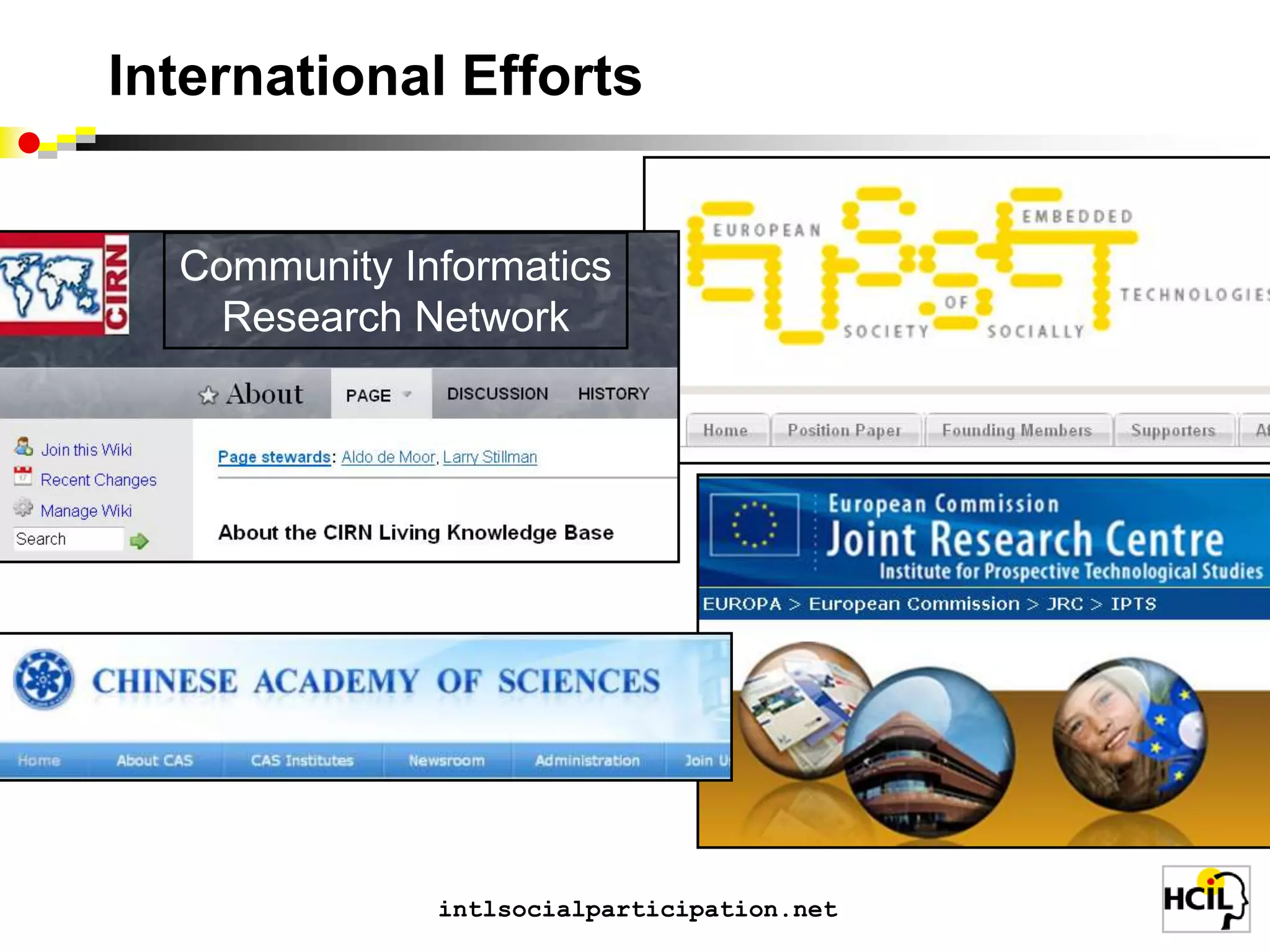
International EffortsCommunity InformaticsResearch Networkintlsocialparticipation.net
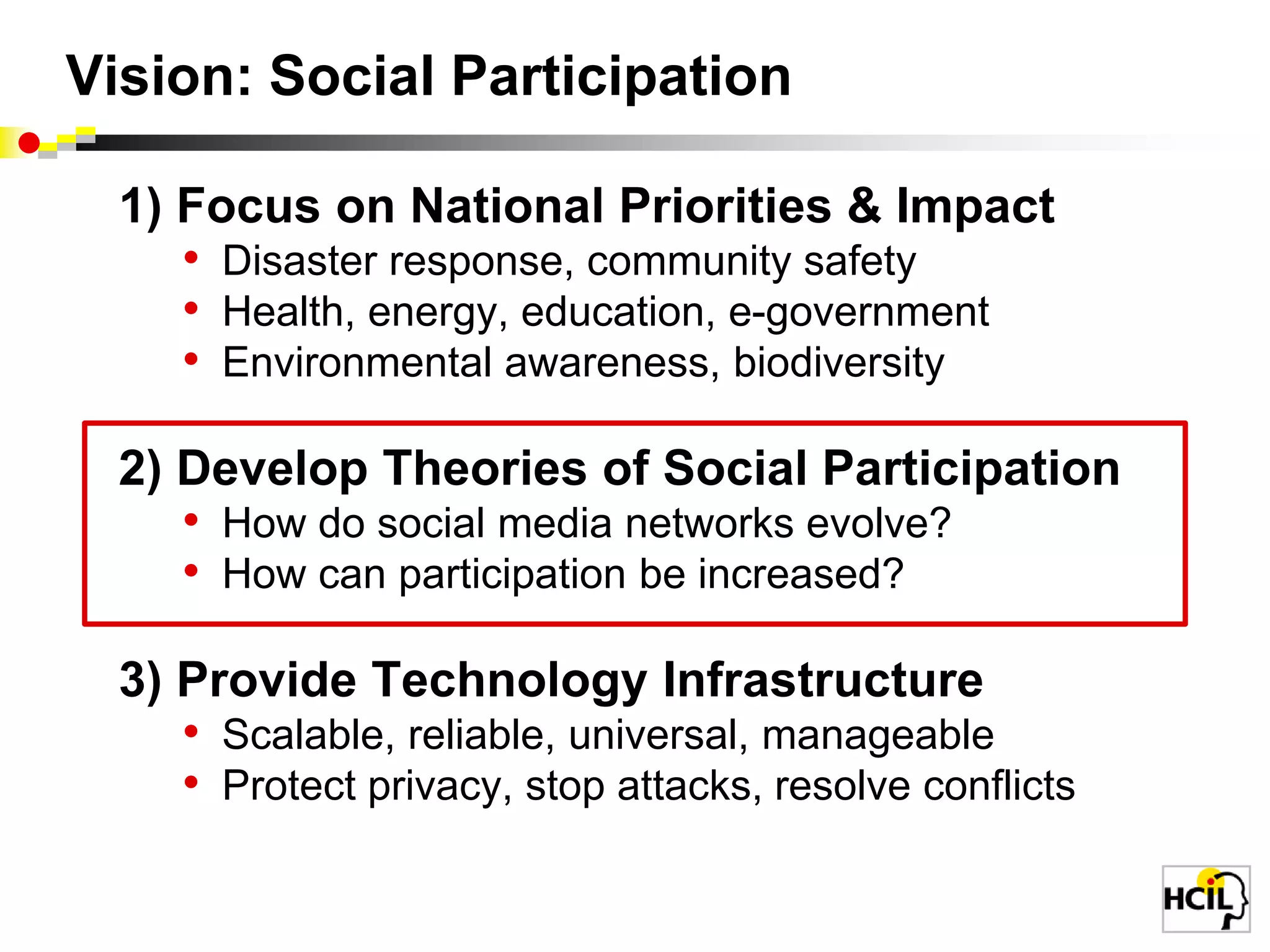
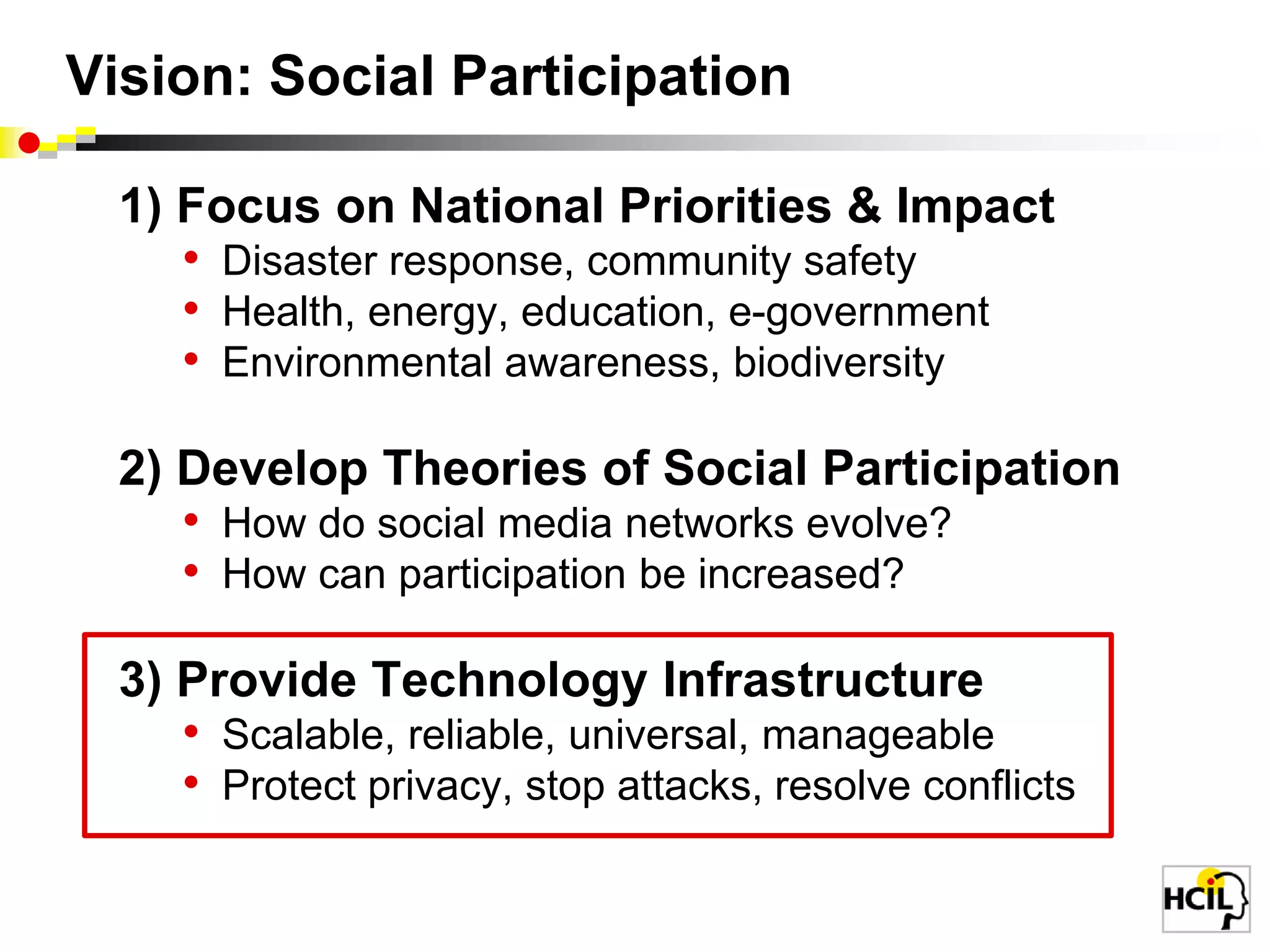
Vision: Social Participation1) Focus on National Priorities & ImpactDisaster response, community safetyHealth, energy, education, e-governmentEnvironmental awareness, biodiversity2) Develop Theories of Social ParticipationHow do social media networks evolve? How can participation be increased?3) Provide Technology InfrastructureScalable, reliable, universal, manageableProtect privacy, stop attacks, resolve conflicts
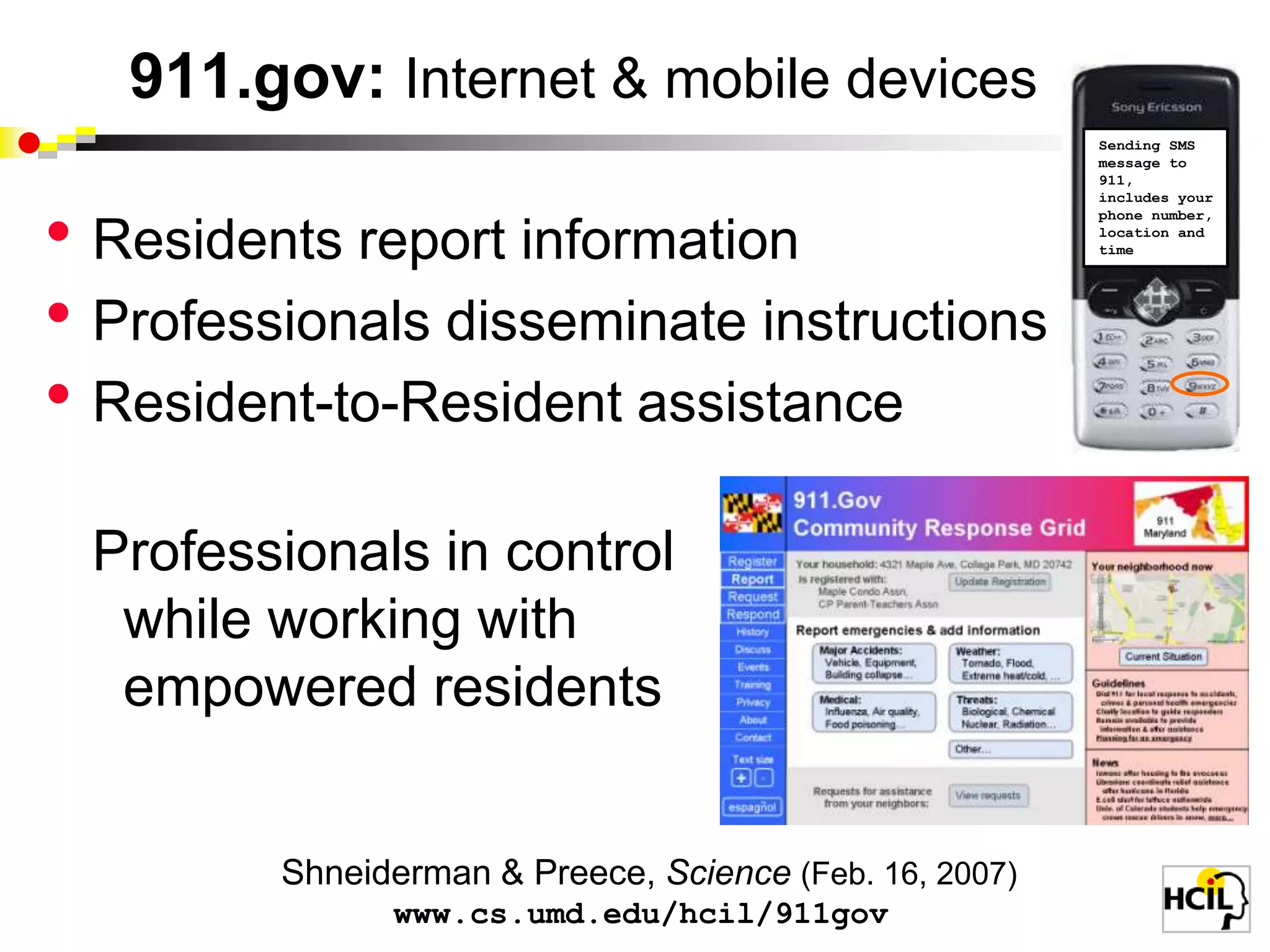
911.gov: Internet & mobile devicesResidents report information Professionals disseminate instructions  Resident-to-Resident assistance Professionals in control   while working with   empowered residents Shneiderman & Preece, Science(Feb. 16, 2007)www.cs.umd.edu/hcil/911gov
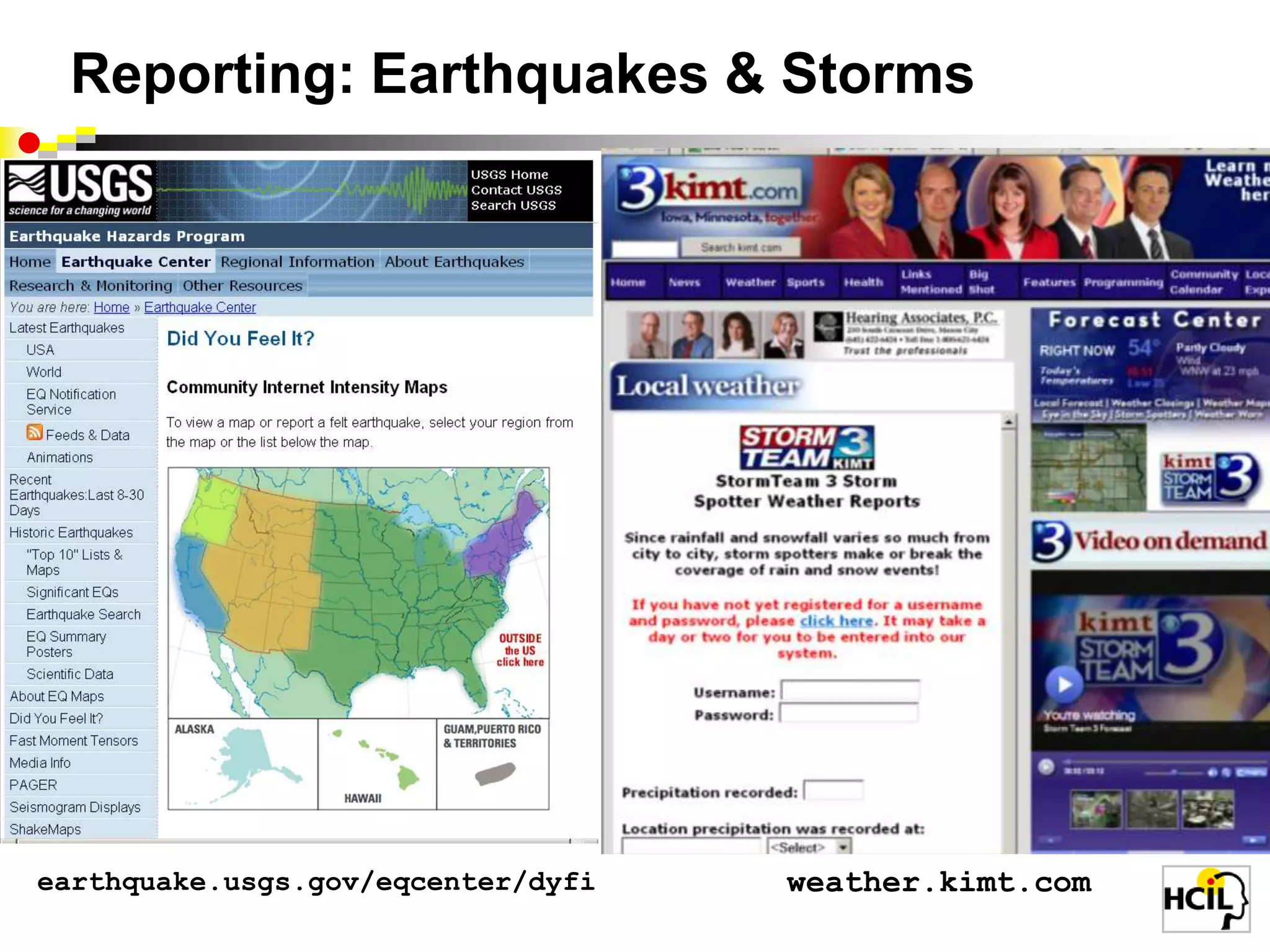
Reporting: Earthquakes & Stormsweather.kimt.comearthquake.usgs.gov/eqcenter/dyfi
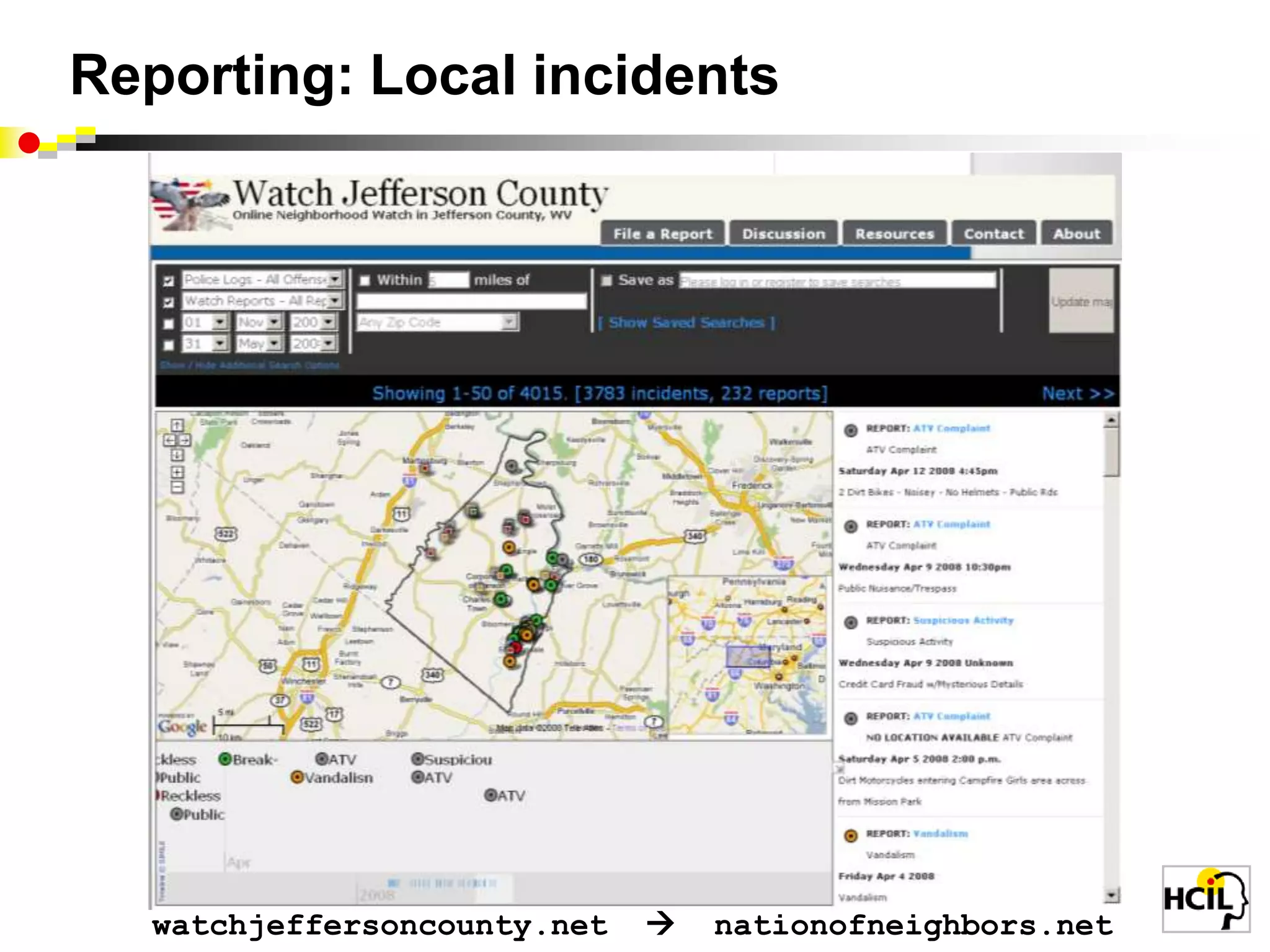
Reporting: Local incidentswatchjeffersoncounty.net    nationofneighbors.net
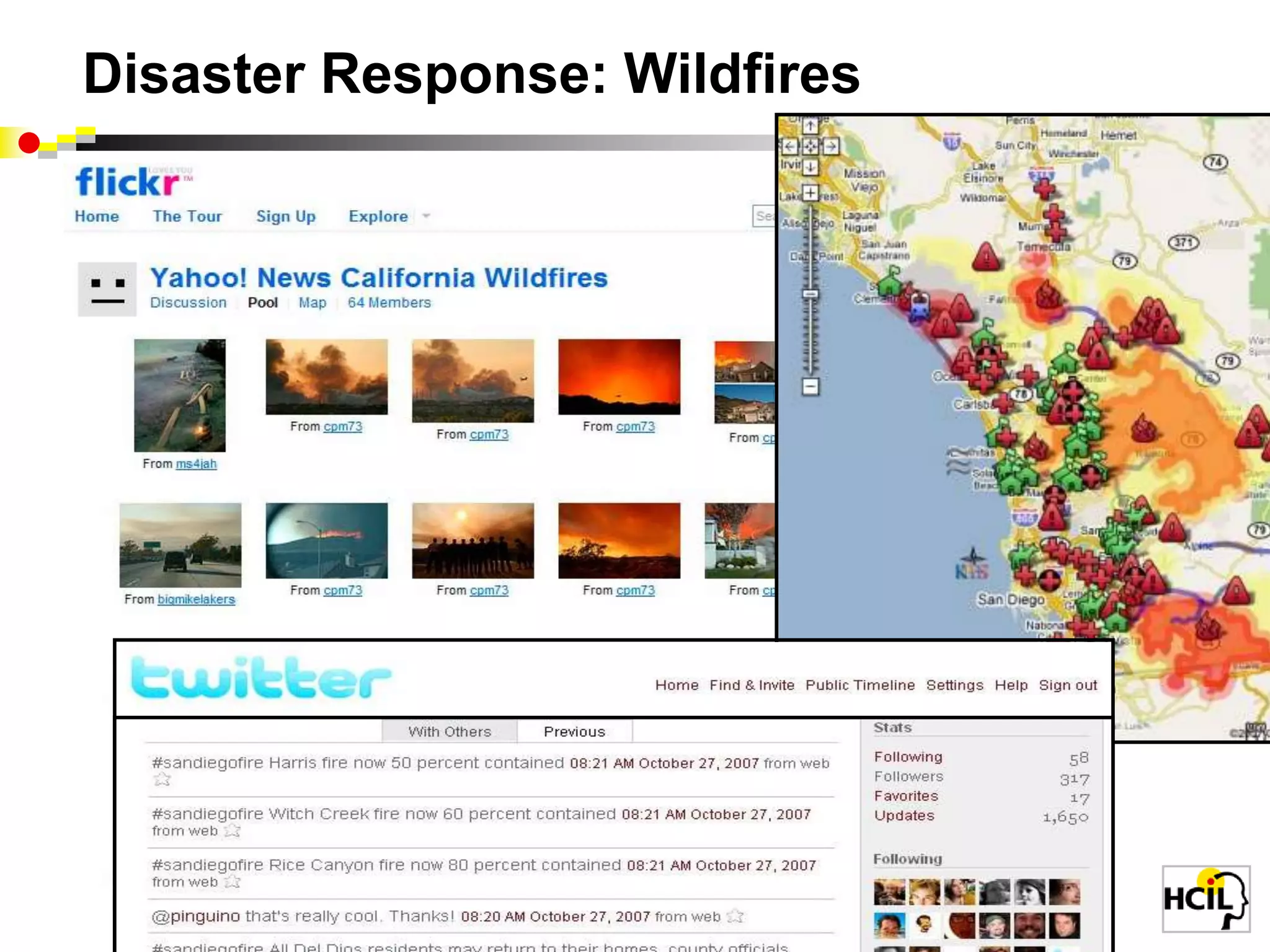
Disaster Response: Wildfires
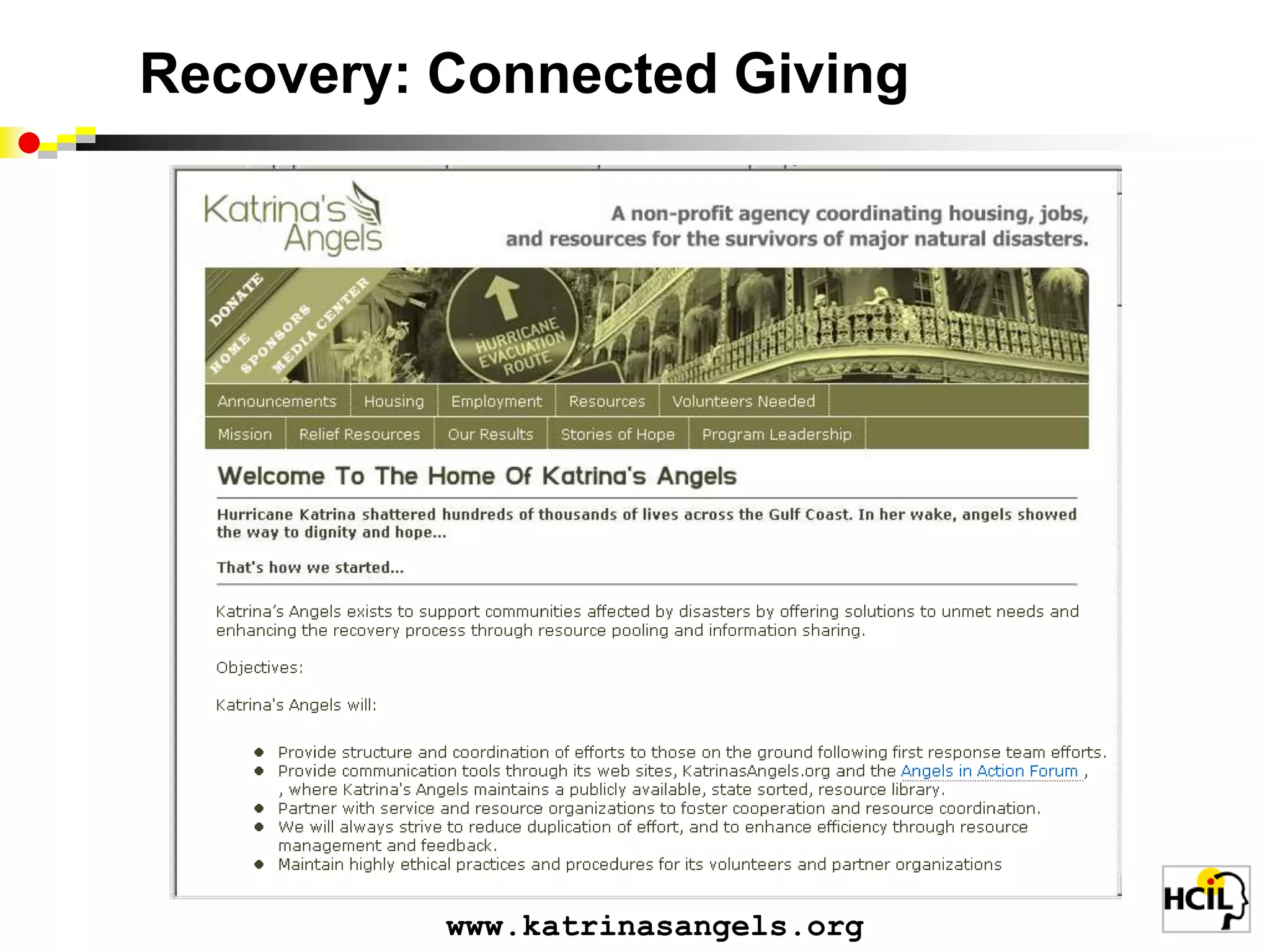
Recovery: Connected Givingwww.katrinasangels.org
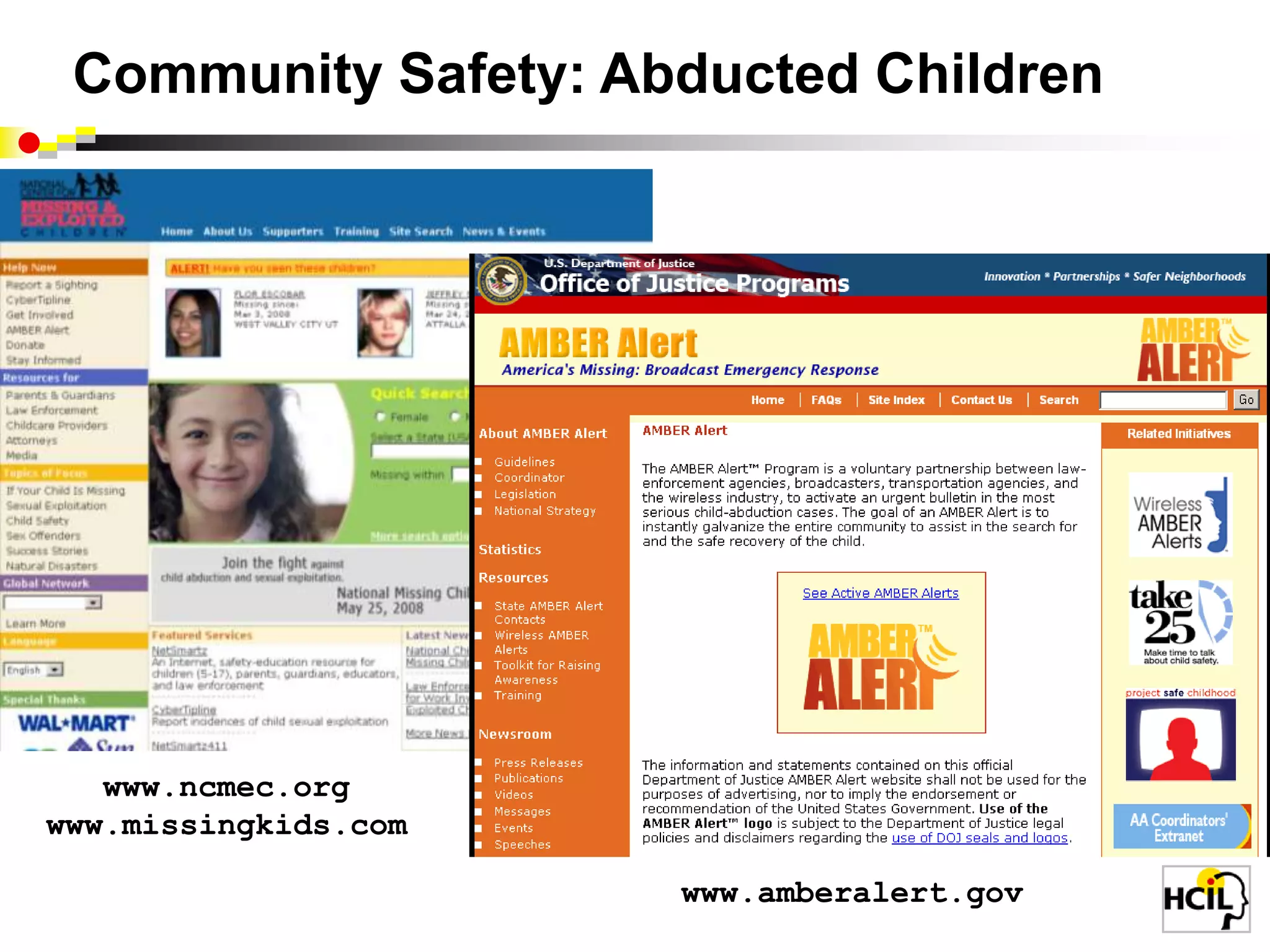
Community Safety: Abducted Childrenwww.ncmec.orgwww.missingkids.comwww.amberalert.gov
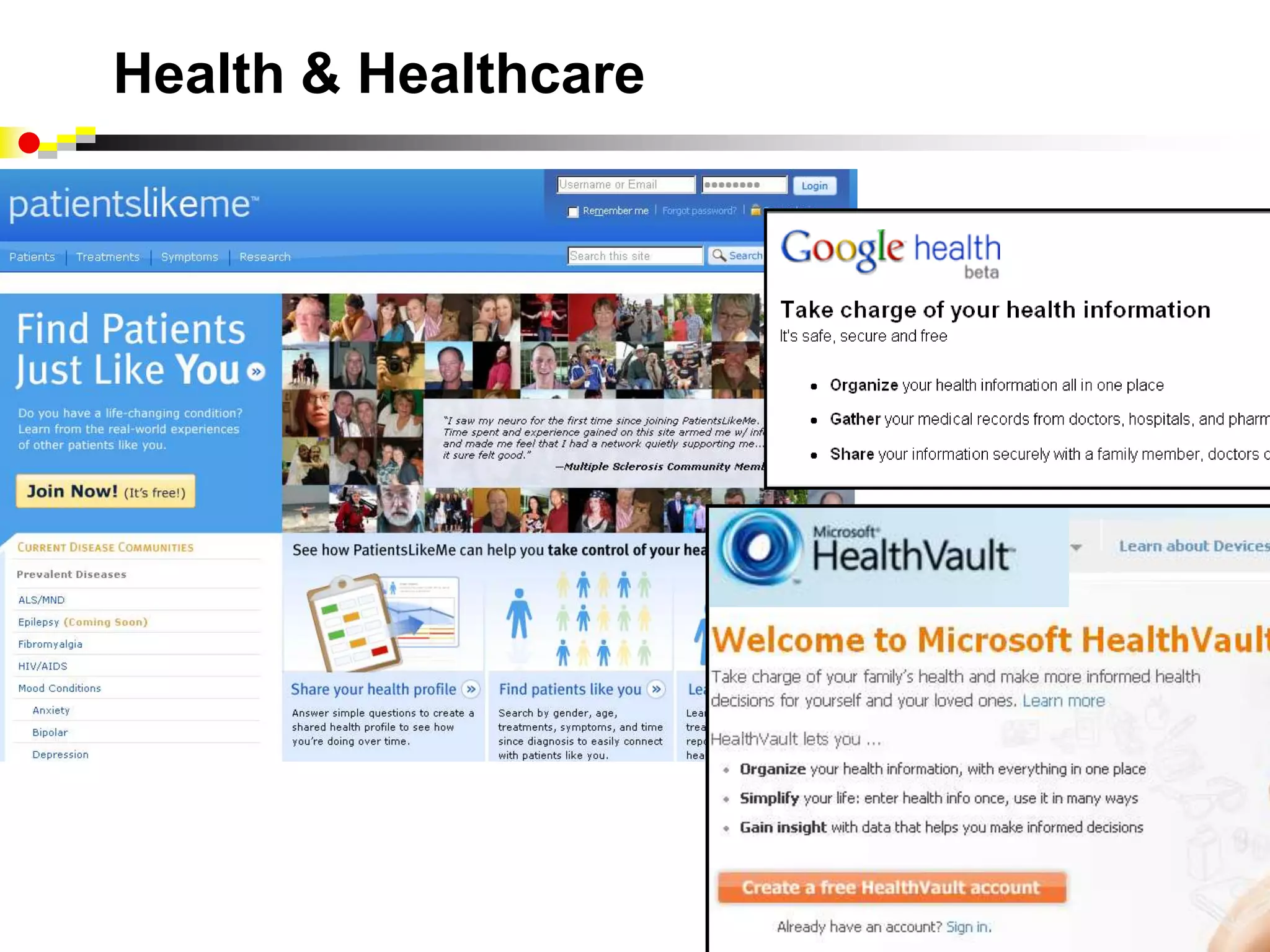
Health & Healthcare
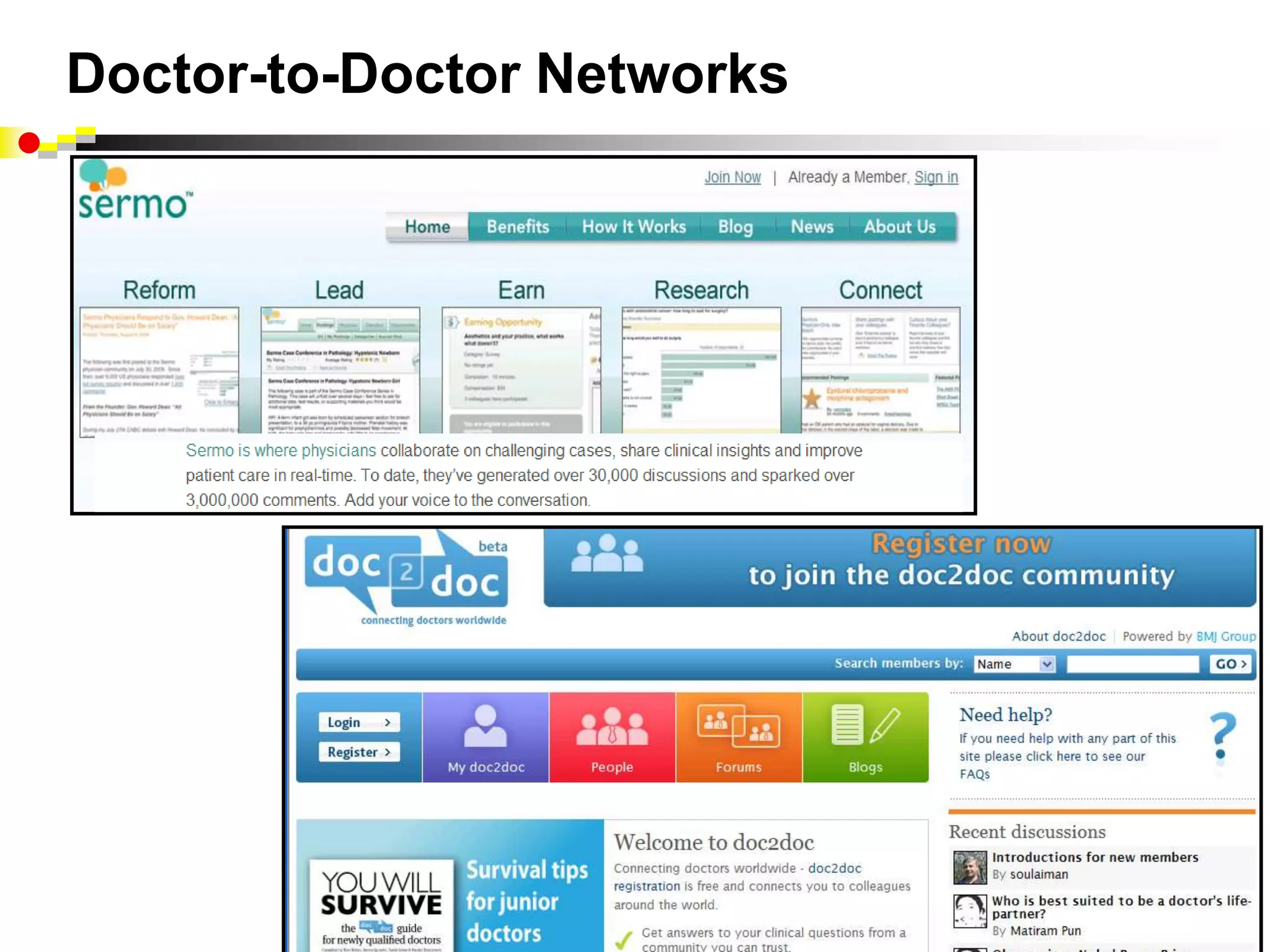
Doctor-to-Doctor Networks
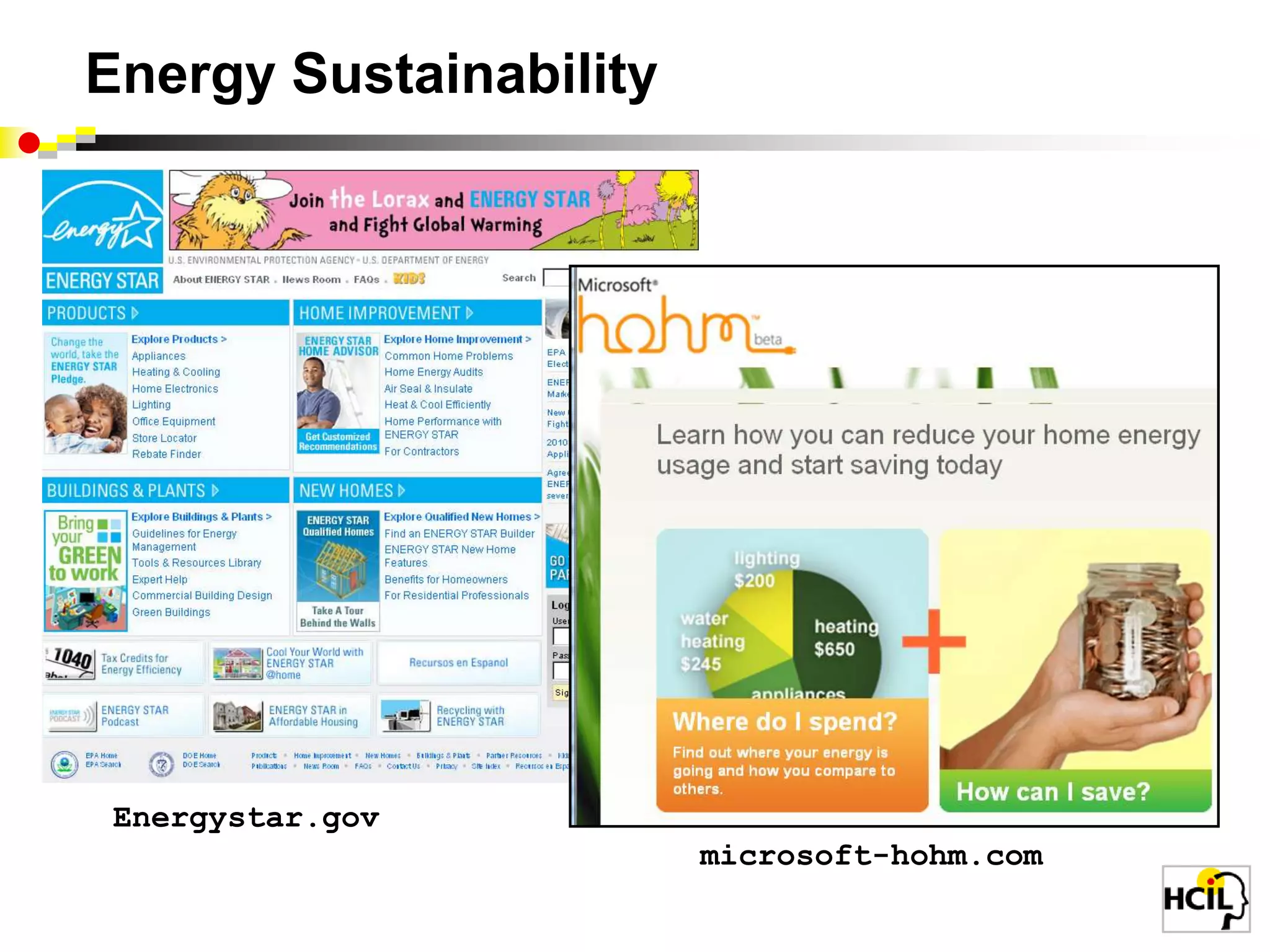
Energy SustainabilityEnergystar.gov                                                                  microsoft-hohm.com
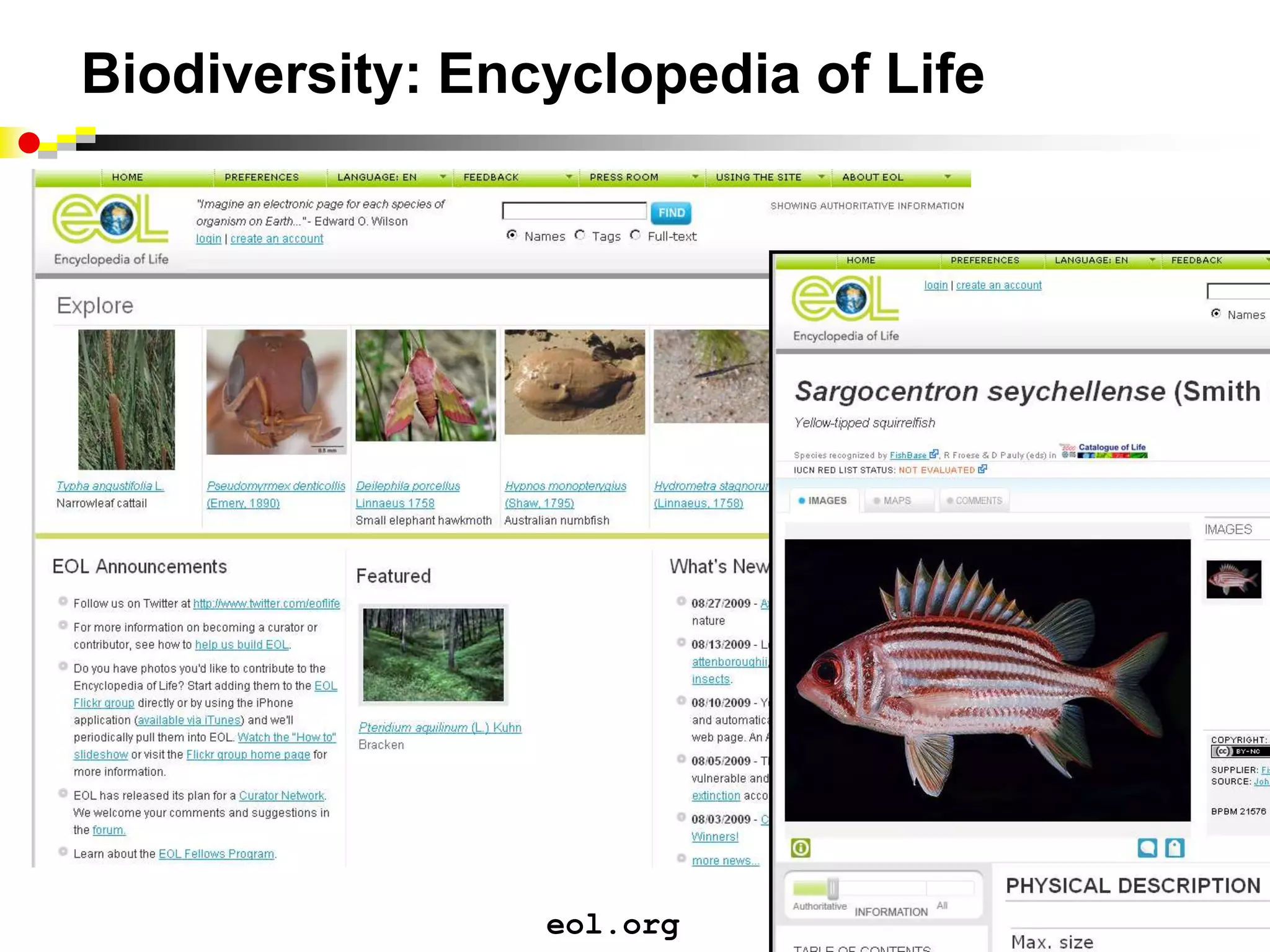
Biodiversity: Encyclopedia of Lifeeol.org
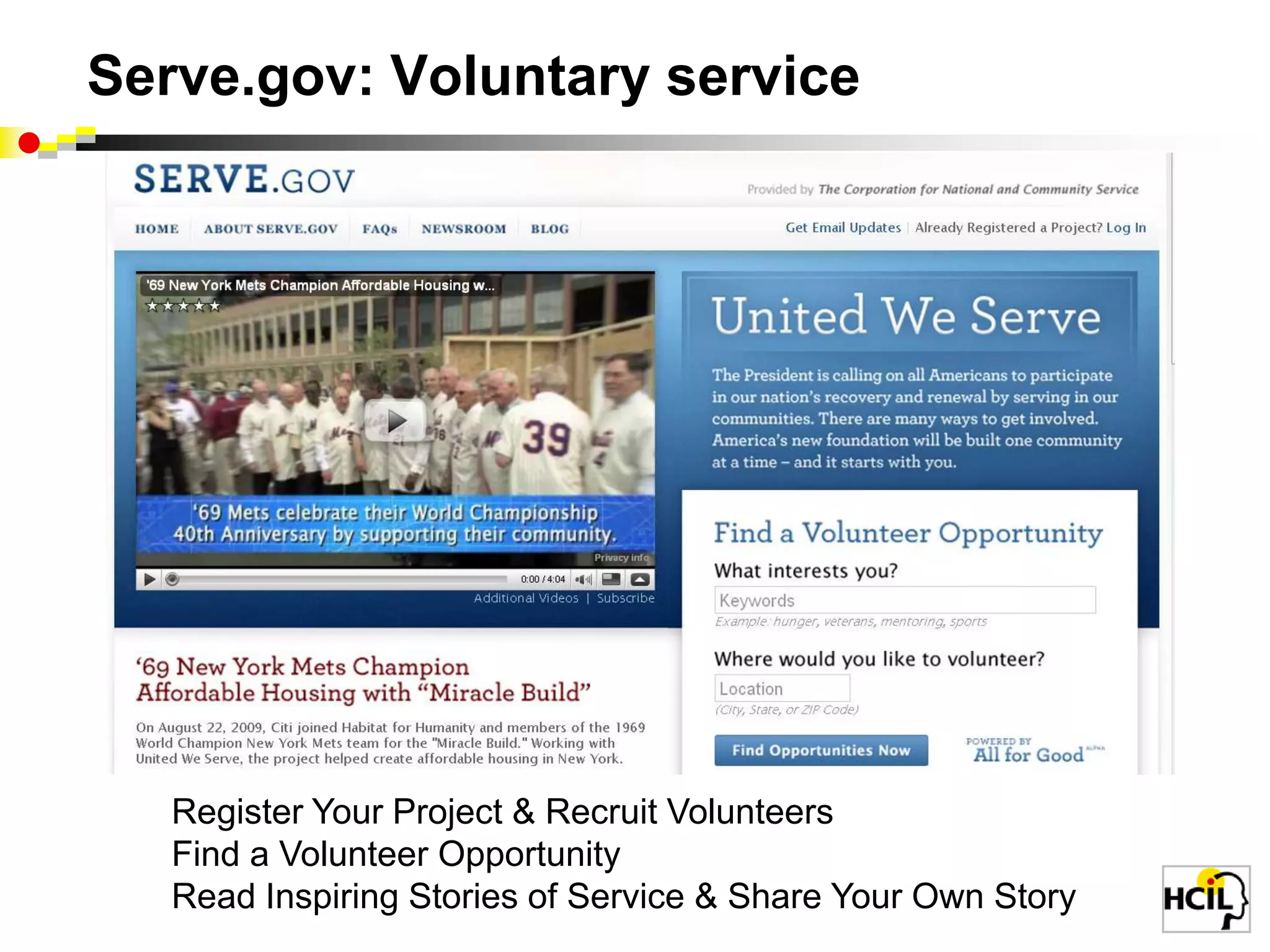
Serve.gov: Voluntary serviceRegister Your Project & Recruit VolunteersFind a Volunteer OpportunityRead Inspiring Stories of Service & Share Your Own Story
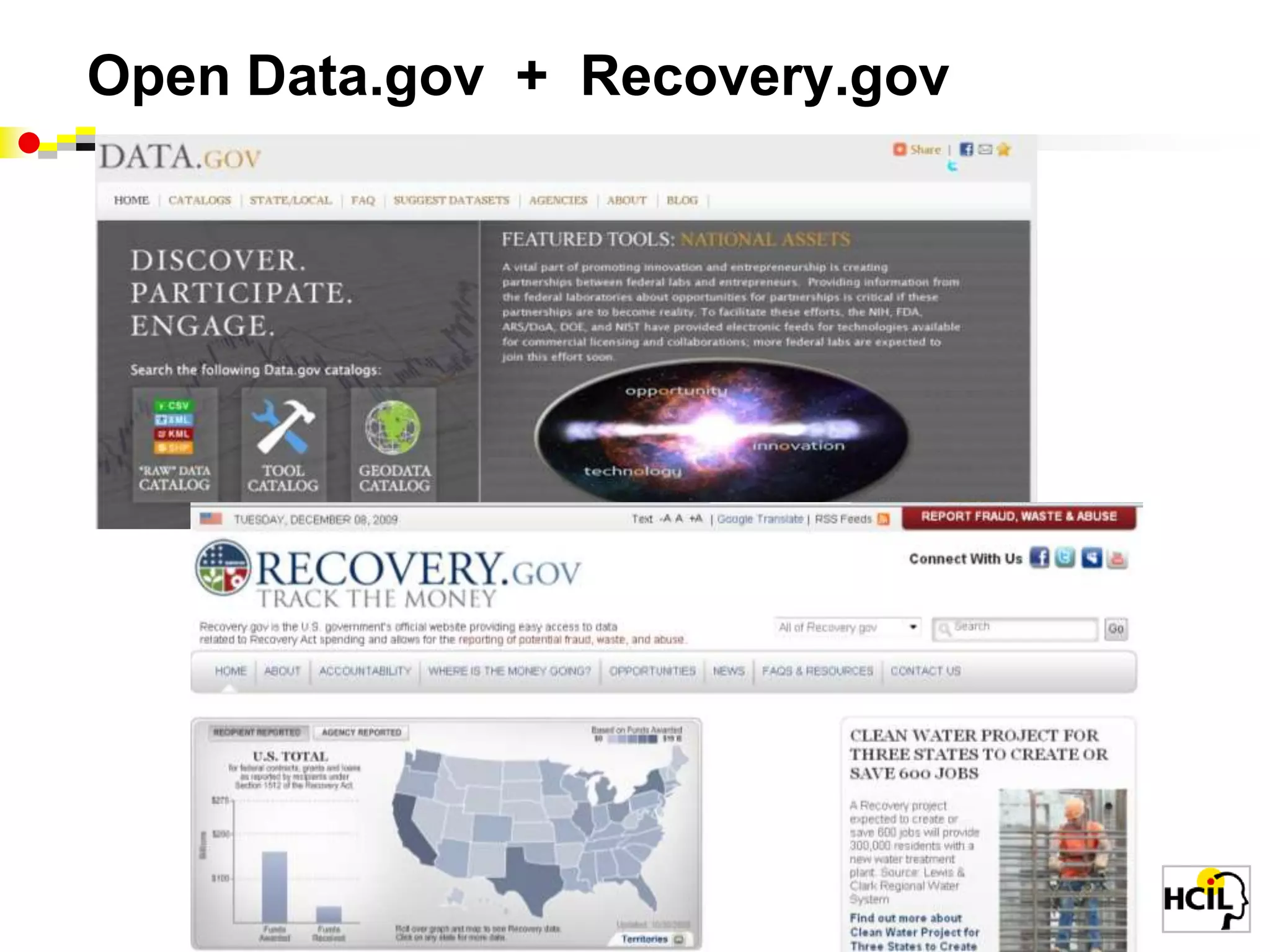
Open Data.gov  +  Recovery.gov
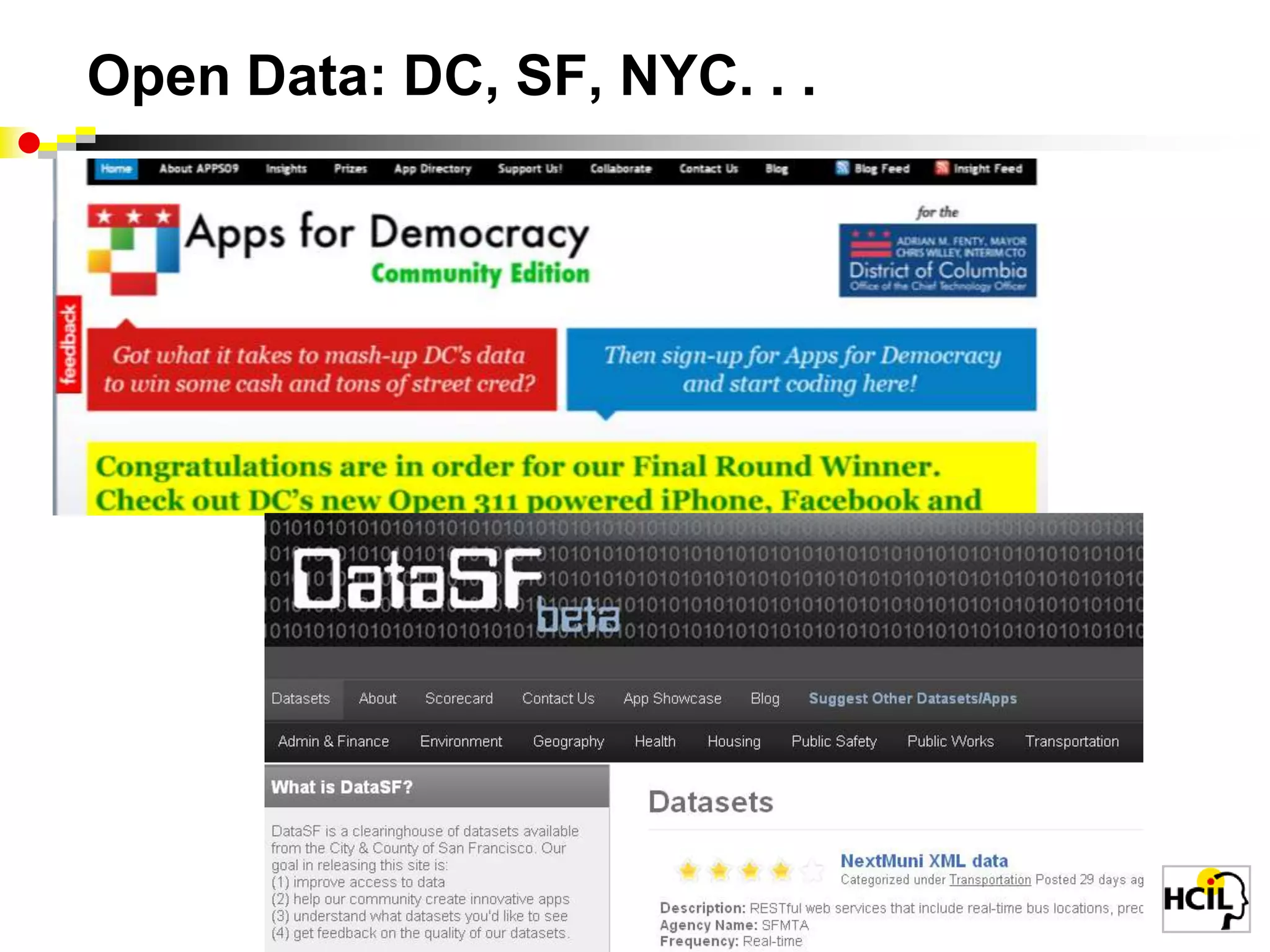
Open Data: DC, SF, NYC. . .
UN Millennium Development GoalsTo be achieved by 2015 Eradicate extreme poverty and hunger
 Achieve universal primary education
 Promote gender equality and empower women
 Reduce child mortality
 Improve maternal health
 Combat HIV/AIDS, malaria and other diseases
 Ensure environmental sustainability
 Develop a global partnership for developmentVision: Social Participation1) Focus on National Priorities & ImpactDisaster response, community safetyHealth, energy, education, e-governmentEnvironmental awareness, biodiversity2) Develop Theories of Social ParticipationHow do social media networks evolve? How can participation be increased?3) Provide Technology InfrastructureScalable, reliable, universal, manageableProtect privacy, stop attacks, resolve conflicts
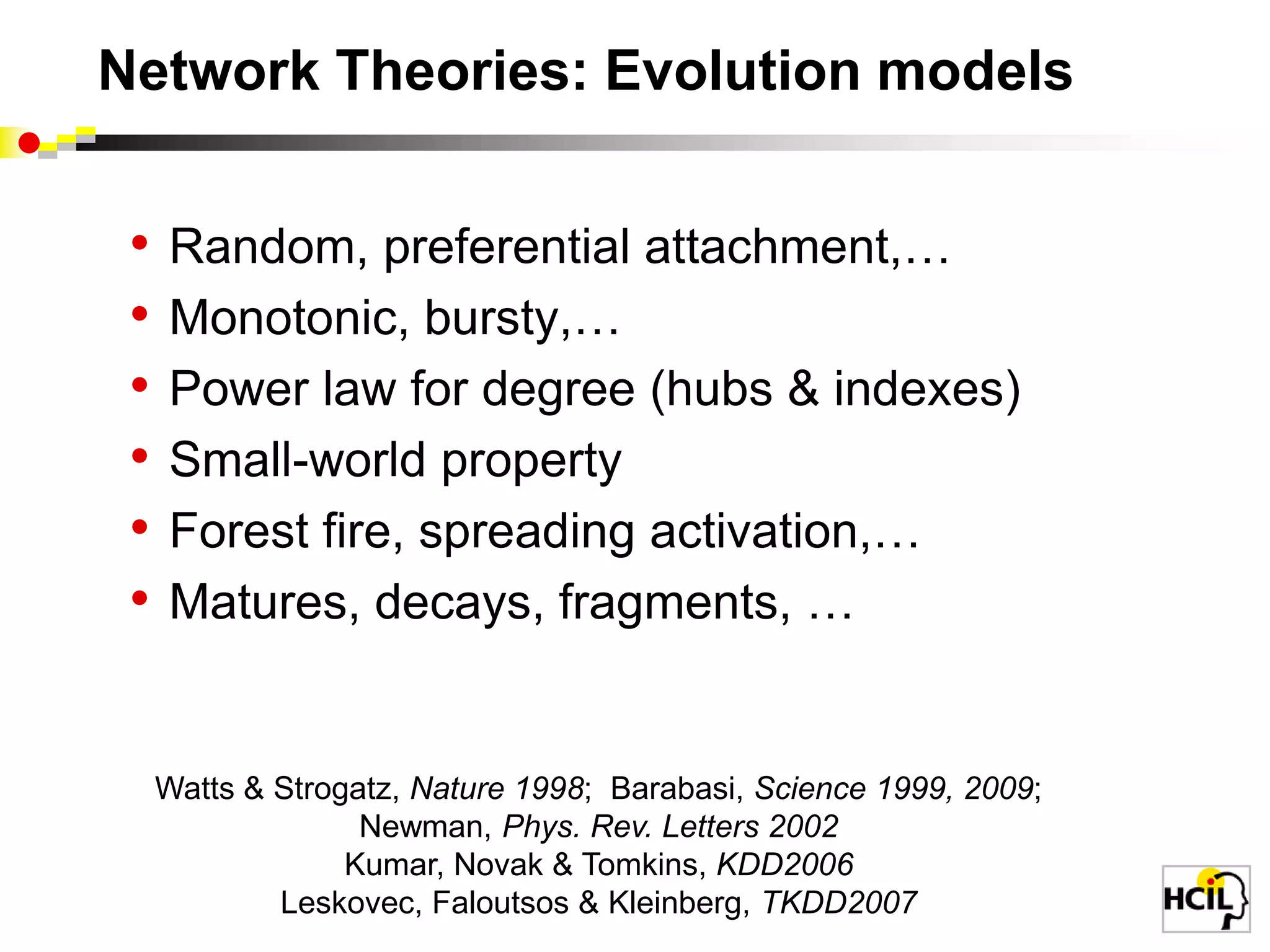
Network Theories: Evolution modelsRandom, preferential attachment,…Monotonic, bursty,…Power law for degree (hubs & indexes)Small-world propertyForest fire, spreading activation,…Matures, decays, fragments, … Watts & Strogatz, Nature 1998;  Barabasi, Science 1999, 2009;Newman, Phys. Rev. Letters 2002Kumar, Novak & Tomkins, KDD2006Leskovec, Faloutsos & Kleinberg, TKDD2007
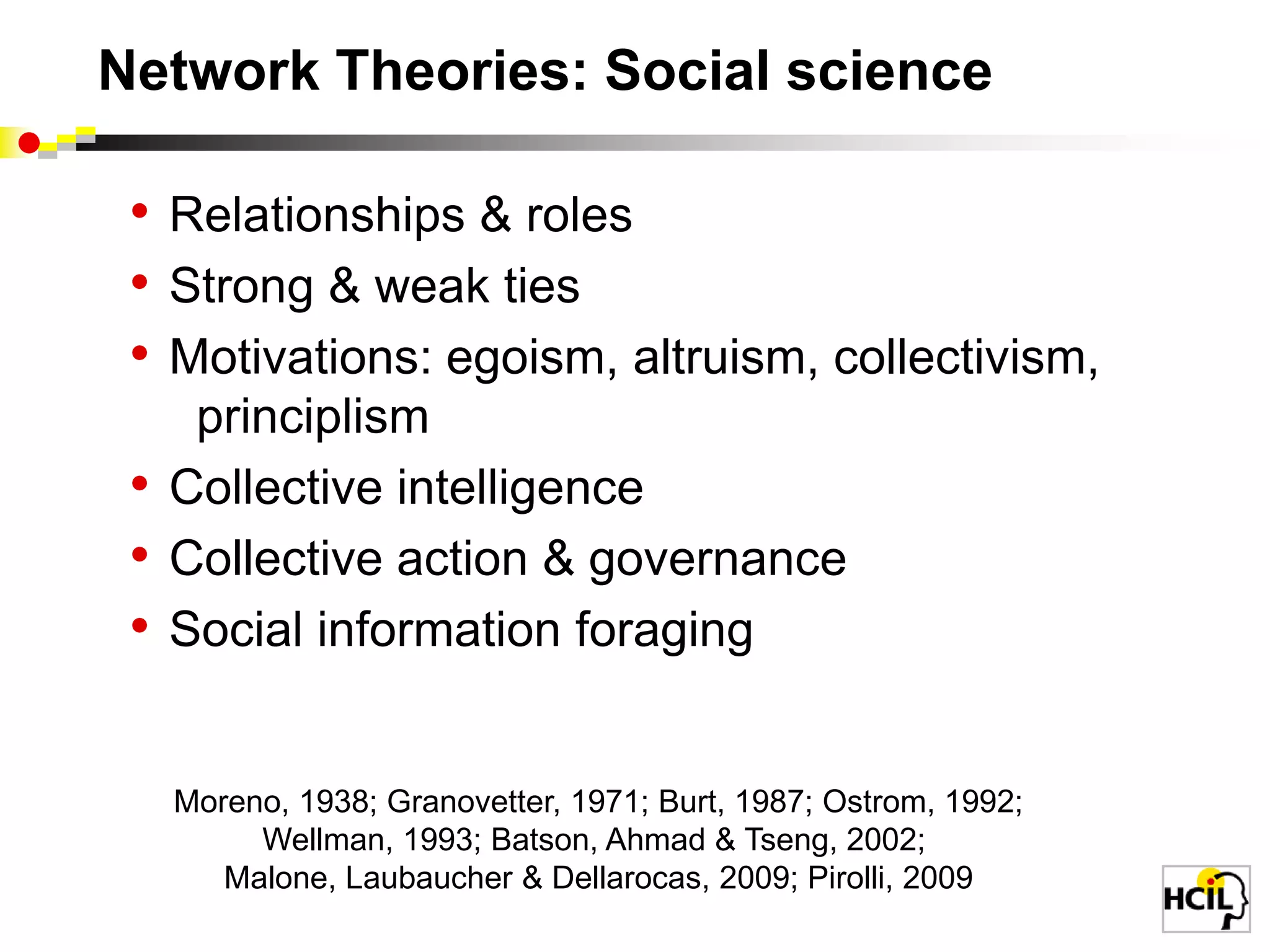
Network Theories: Social scienceRelationships & rolesStrong & weak tiesMotivations: egoism, altruism, collectivism, principlismCollective intelligenceCollective action & governanceSocial information foragingMoreno, 1938; Granovetter, 1971; Burt, 1987; Ostrom, 1992;Wellman, 1993; Batson, Ahmad & Tseng, 2002; Malone, Laubaucher & Dellarocas, 2009; Pirolli, 2009
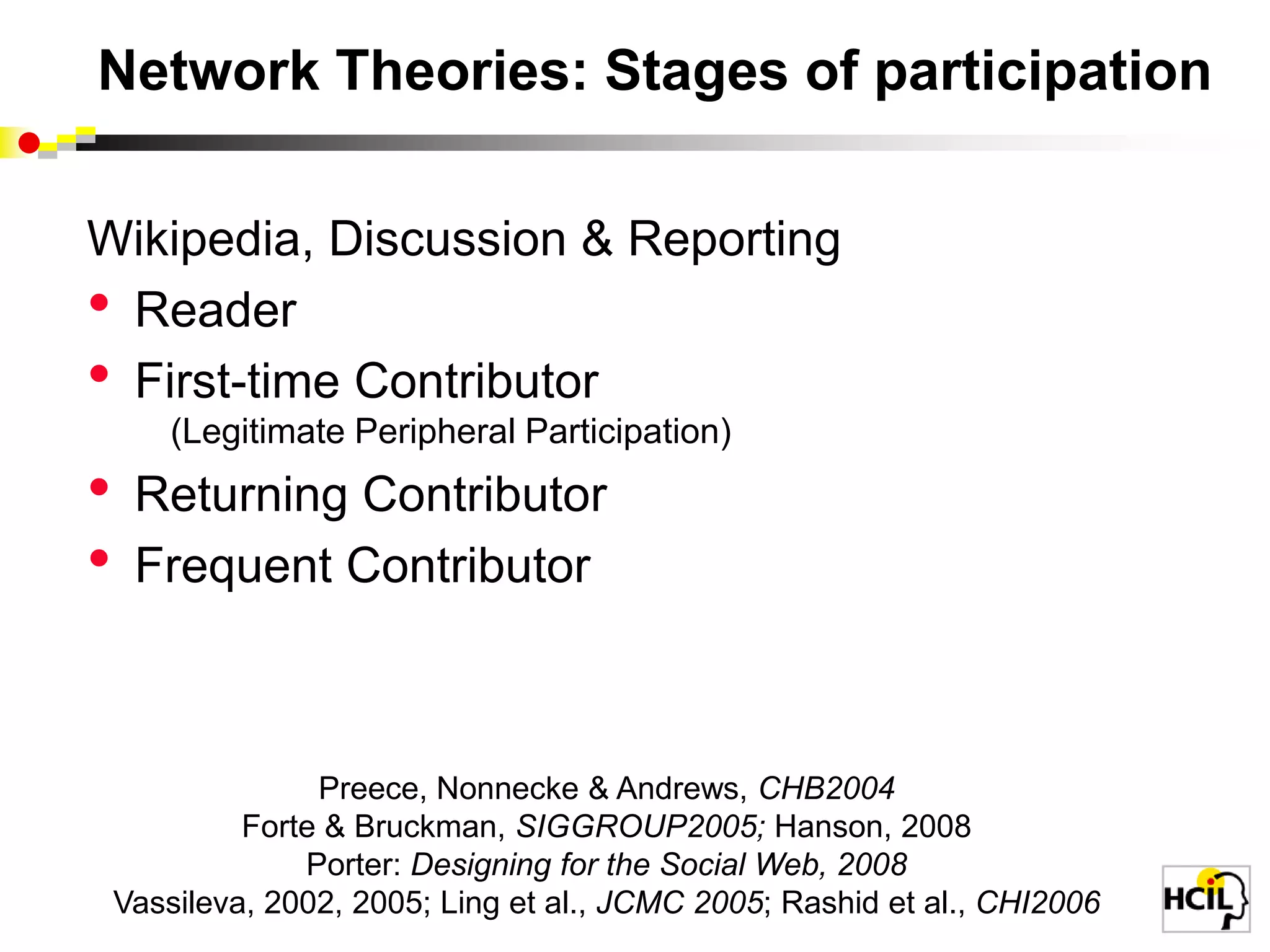
Network Theories: Stages of participationWikipedia, Discussion & ReportingReaderFirst-time Contributor  (Legitimate Peripheral Participation)Returning ContributorFrequent ContributorPreece, Nonnecke & Andrews, CHB2004Forte & Bruckman, SIGGROUP2005; Hanson, 2008Porter: Designing for the Social Web, 2008Vassileva, 2002, 2005; Ling et al., JCMC 2005; Rashid et al., CHI2006
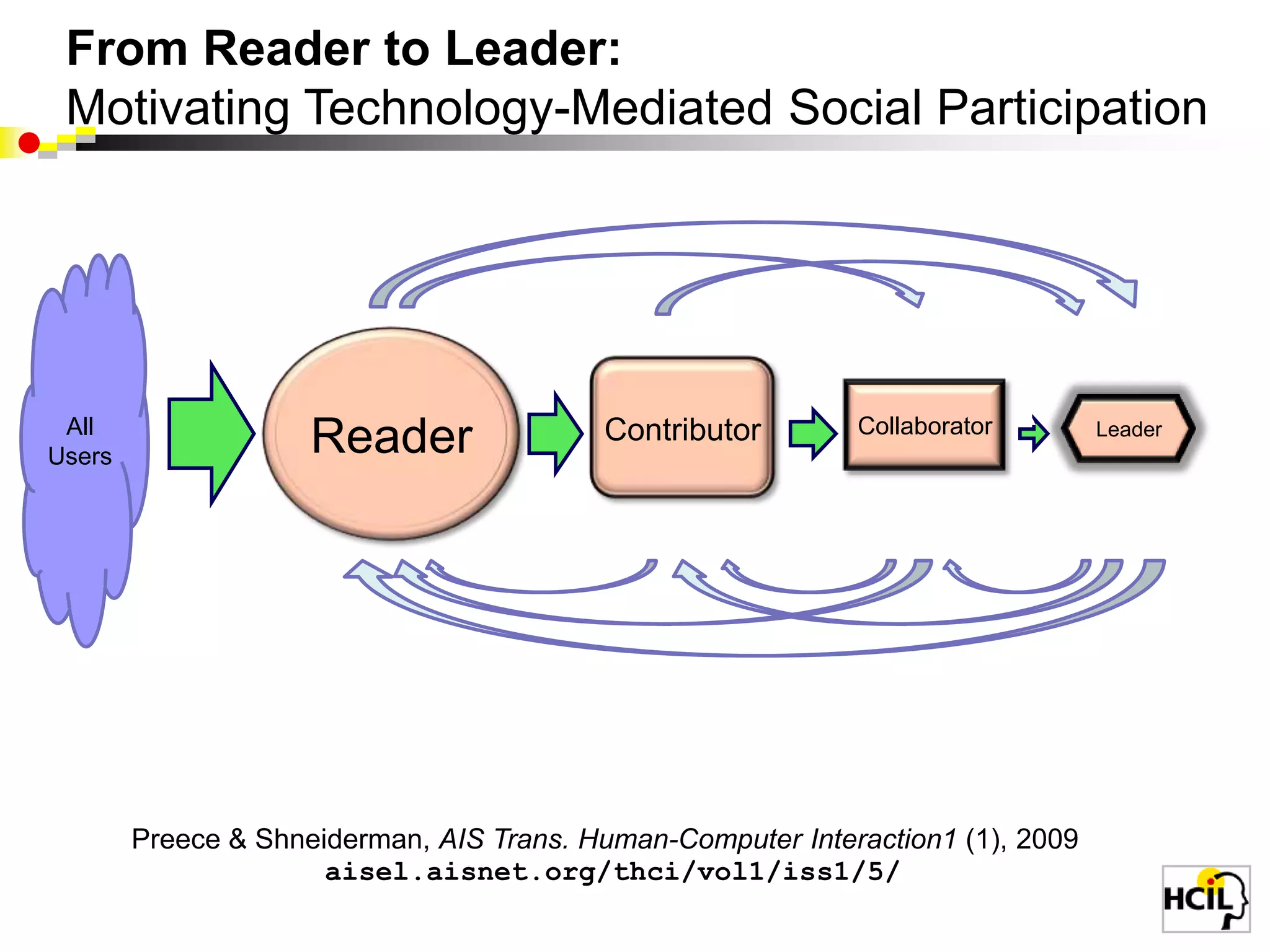
From Reader to Leader:Motivating Technology-Mediated Social ParticipationAllUsersReaderContributorCollaboratorLeader`Preece & Shneiderman, AIS Trans. Human-Computer Interaction1 (1), 2009  aisel.aisnet.org/thci/vol1/iss1/5/
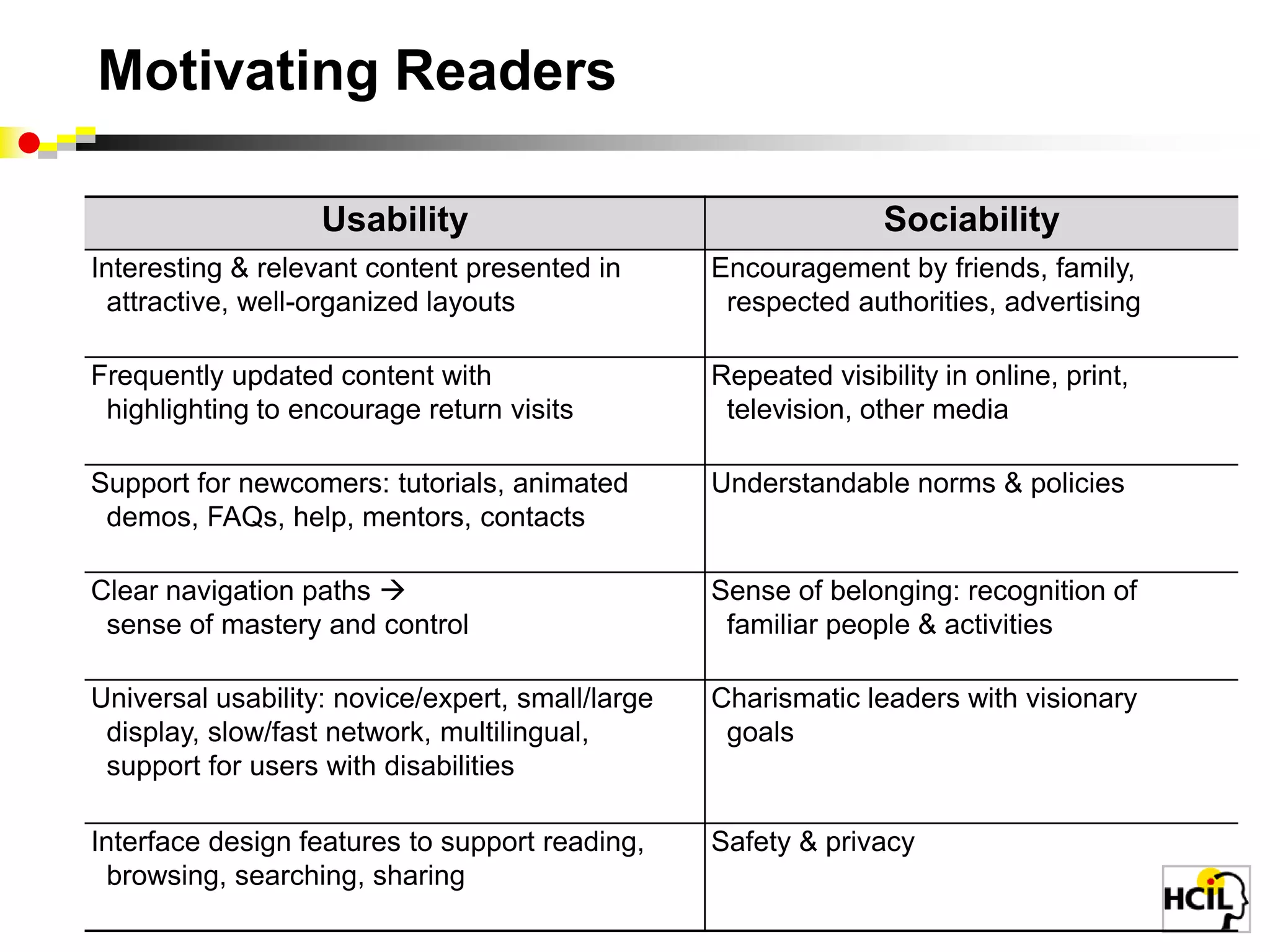
Motivating Readers
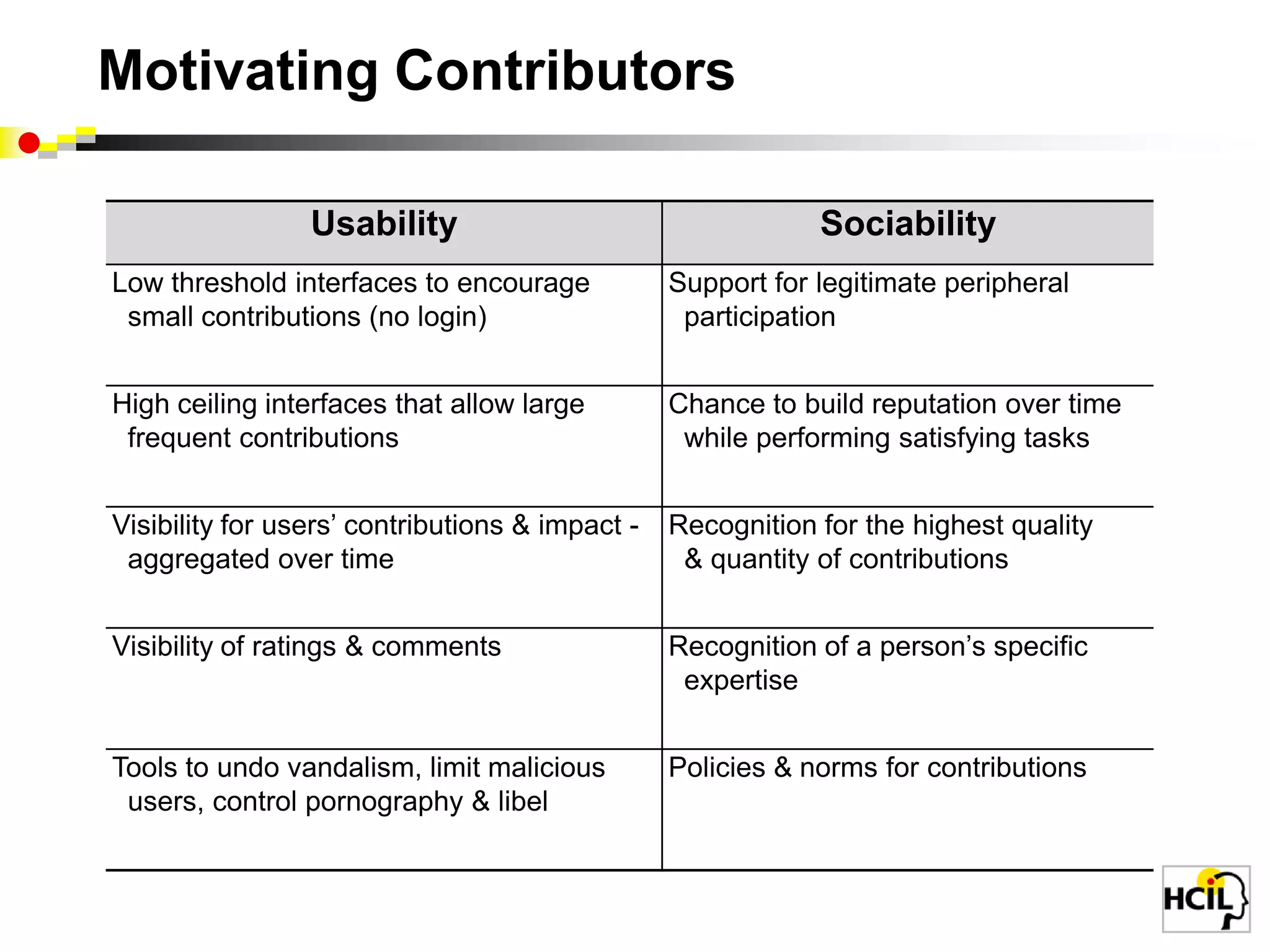
Motivating Contributors
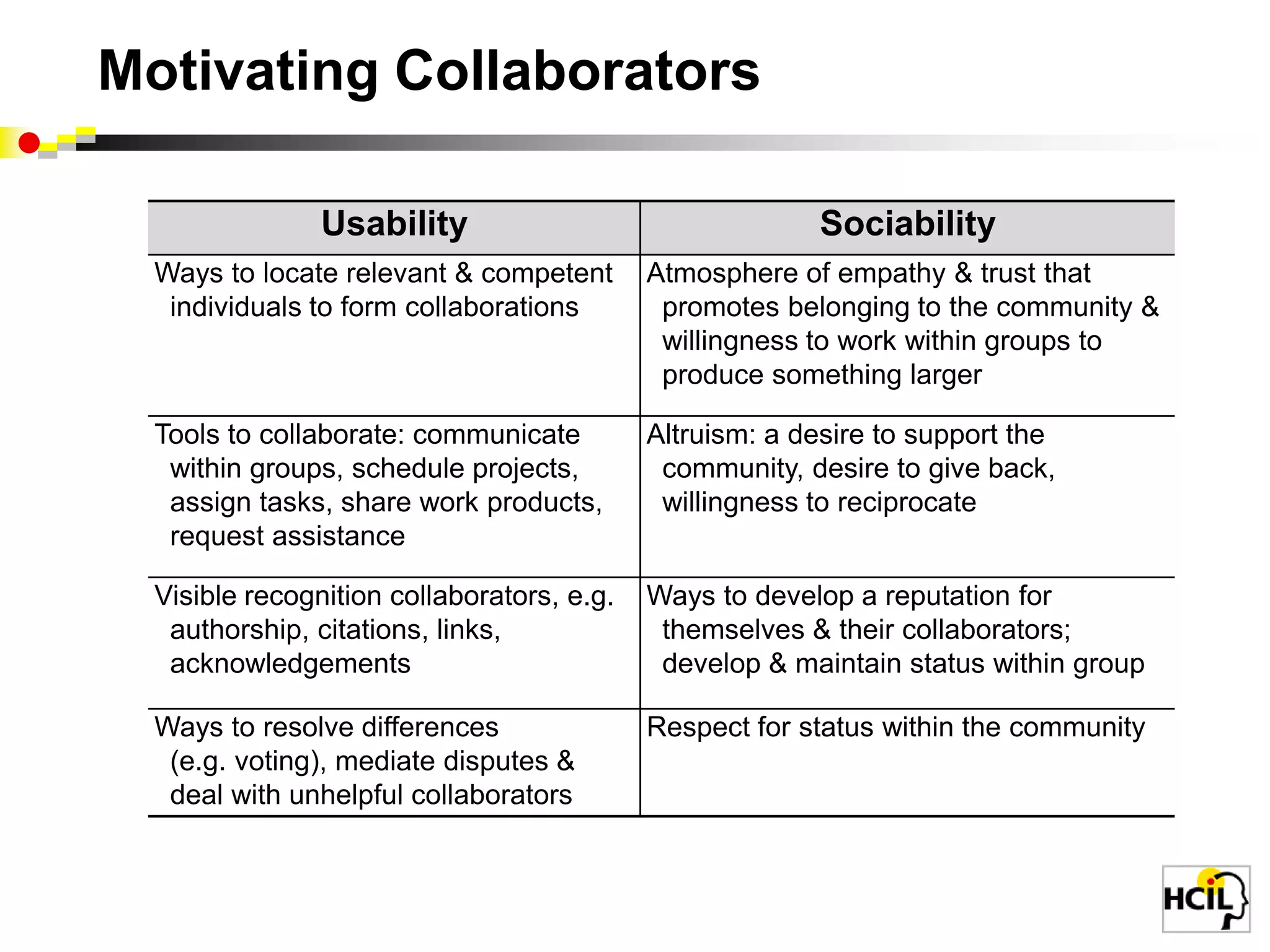
Motivating Collaborators
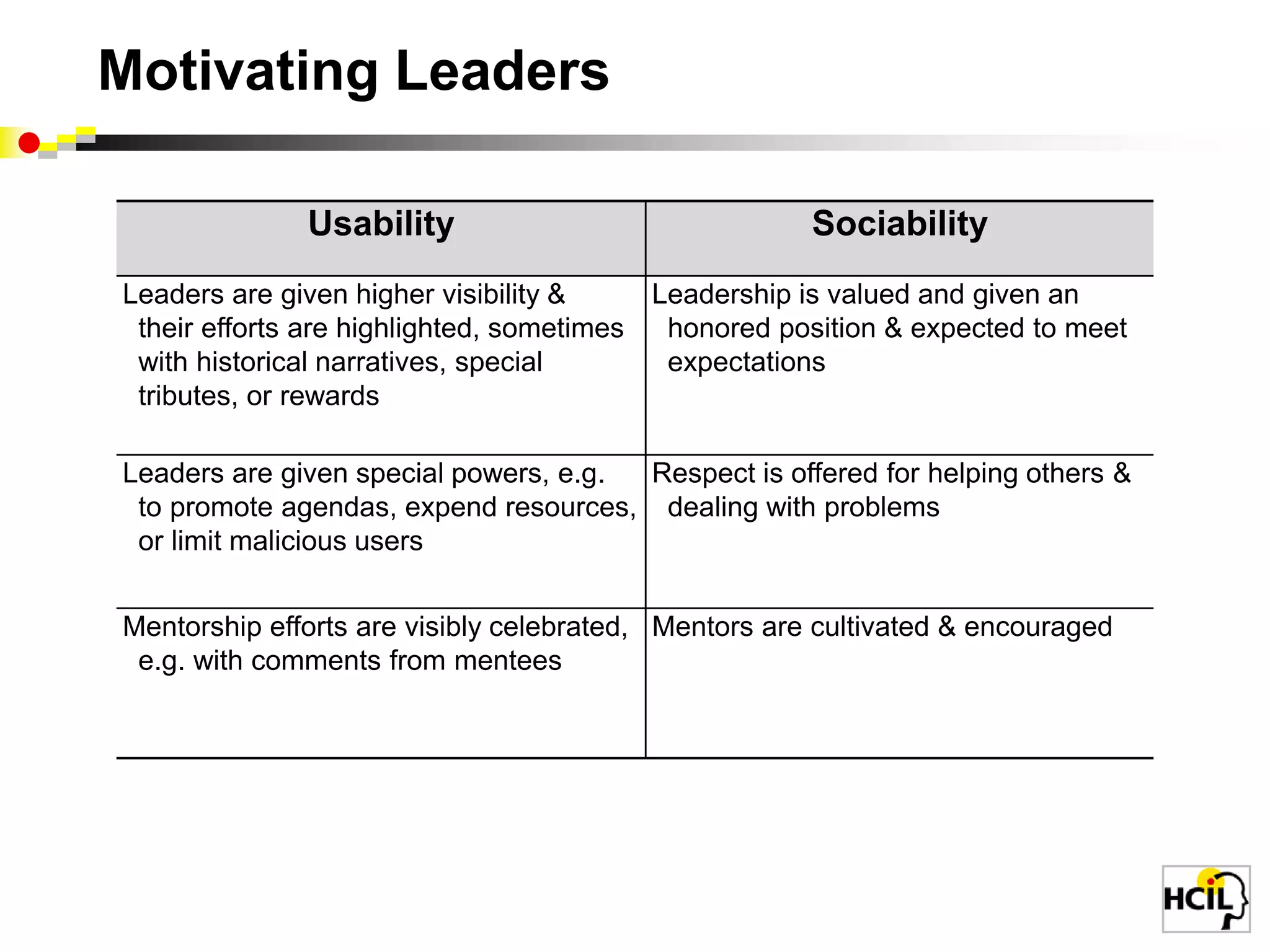
Motivating Leaders
Vision: Social Participation1) Focus on National Priorities & ImpactDisaster response, community safetyHealth, energy, education, e-governmentEnvironmental awareness, biodiversity2) Develop Theories of Social ParticipationHow do social media networks evolve? How can participation be increased?3) Provide Technology InfrastructureScalable, reliable, universal, manageableProtect privacy, stop attacks, resolve conflicts
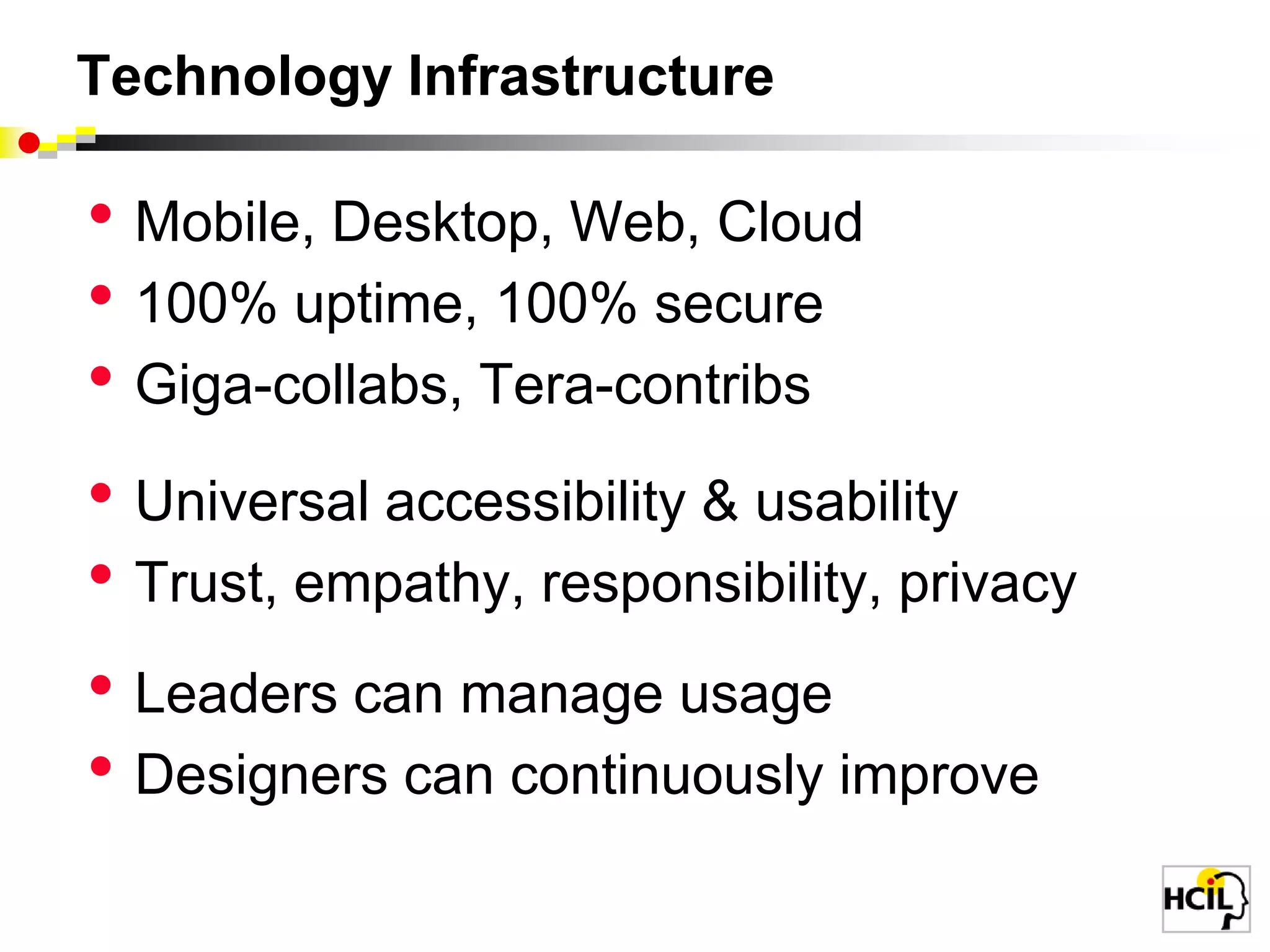
Technology InfrastructureMobile, Desktop, Web, Cloud
100% uptime, 100% secure
Giga-collabs, Tera-contribs
Universal accessibility & usability
Trust, empathy, responsibility, privacy
Leaders can manage usage
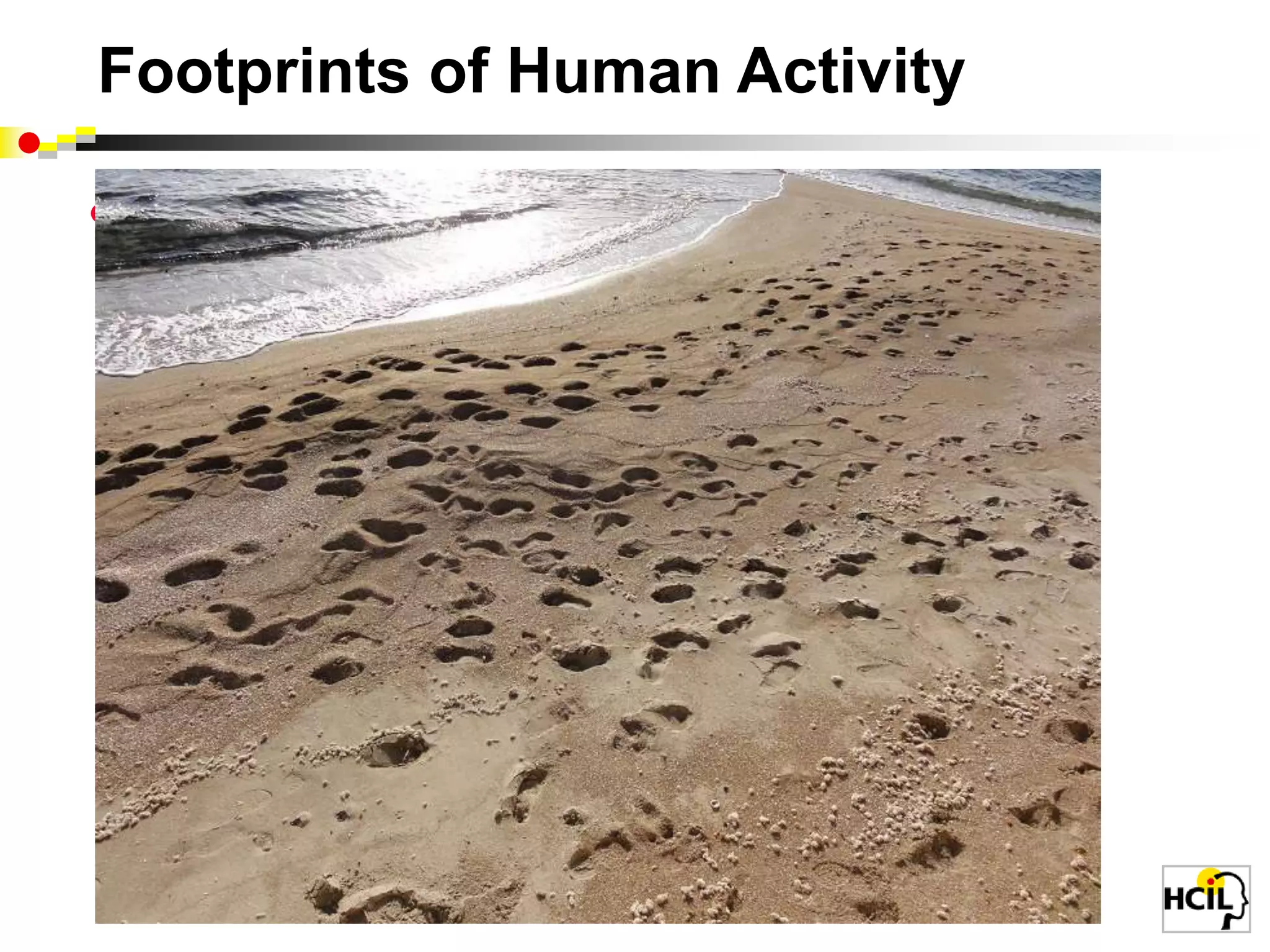
Designers can continuously improve Footprints of Human ActivityFootprints in sand as Caesarea
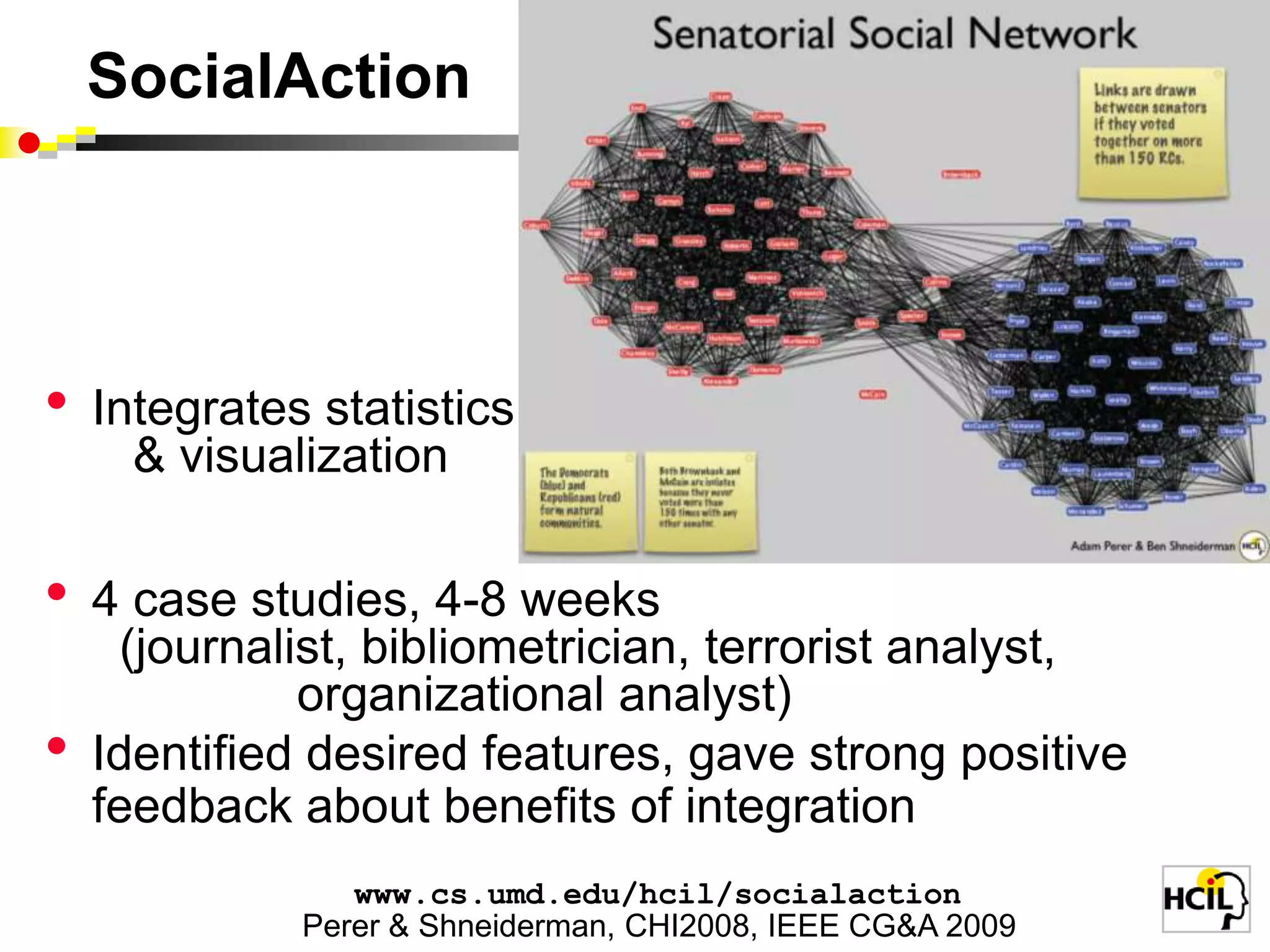
SocialActionIntegrates statistics   & visualization4 case studies, 4-8 weeks   (journalist, bibliometrician, terrorist analyst,                organizational analyst)Identified desired features, gave strong positive feedback about benefits of integrationwww.cs.umd.edu/hcil/socialactionPerer & Shneiderman, CHI2008, IEEE CG&A 2009
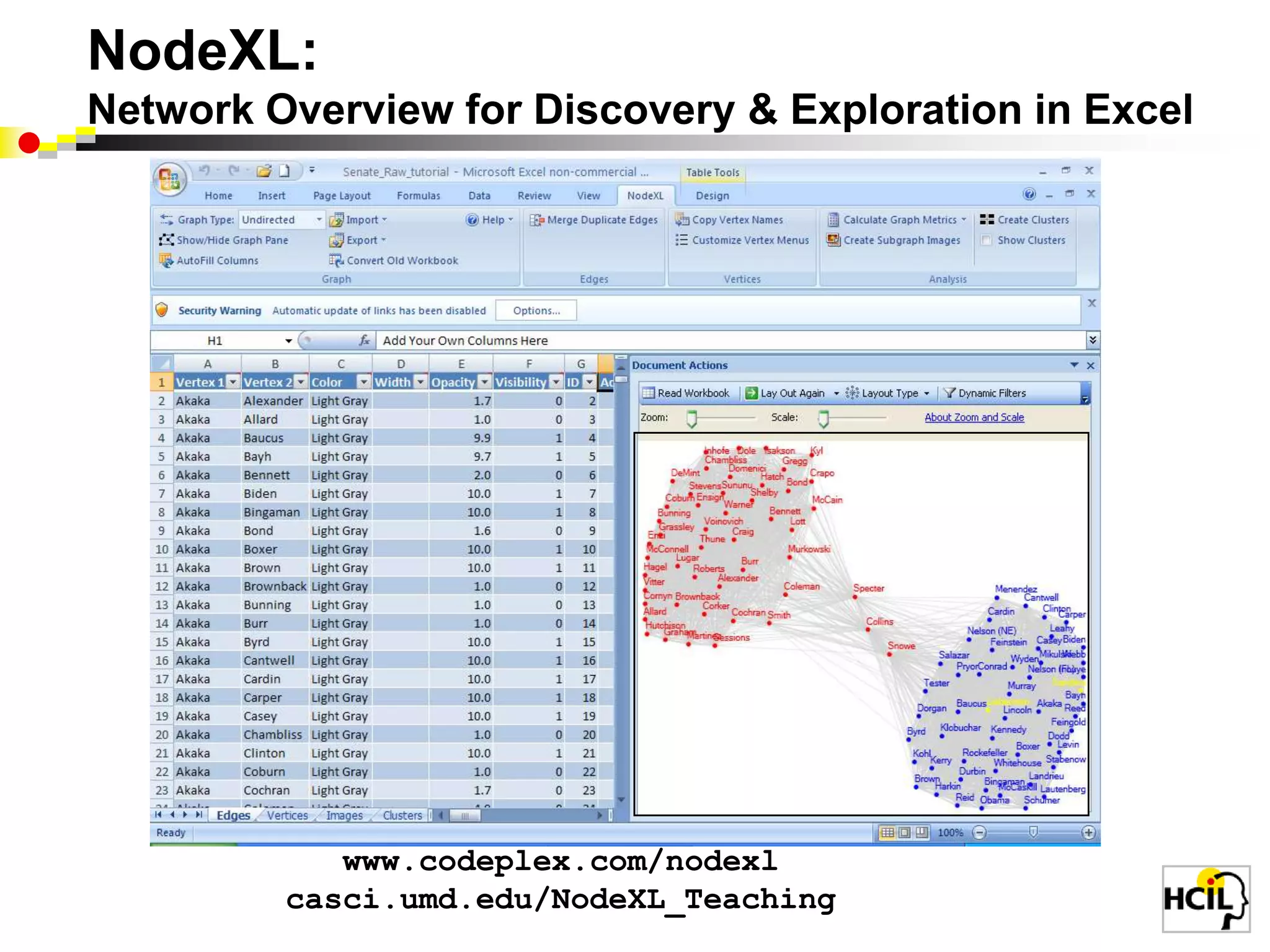
NodeXL: Network Overview for Discovery & Exploration in Excelwww.codeplex.com/nodexlcasci.umd.edu/NodeXL_Teaching
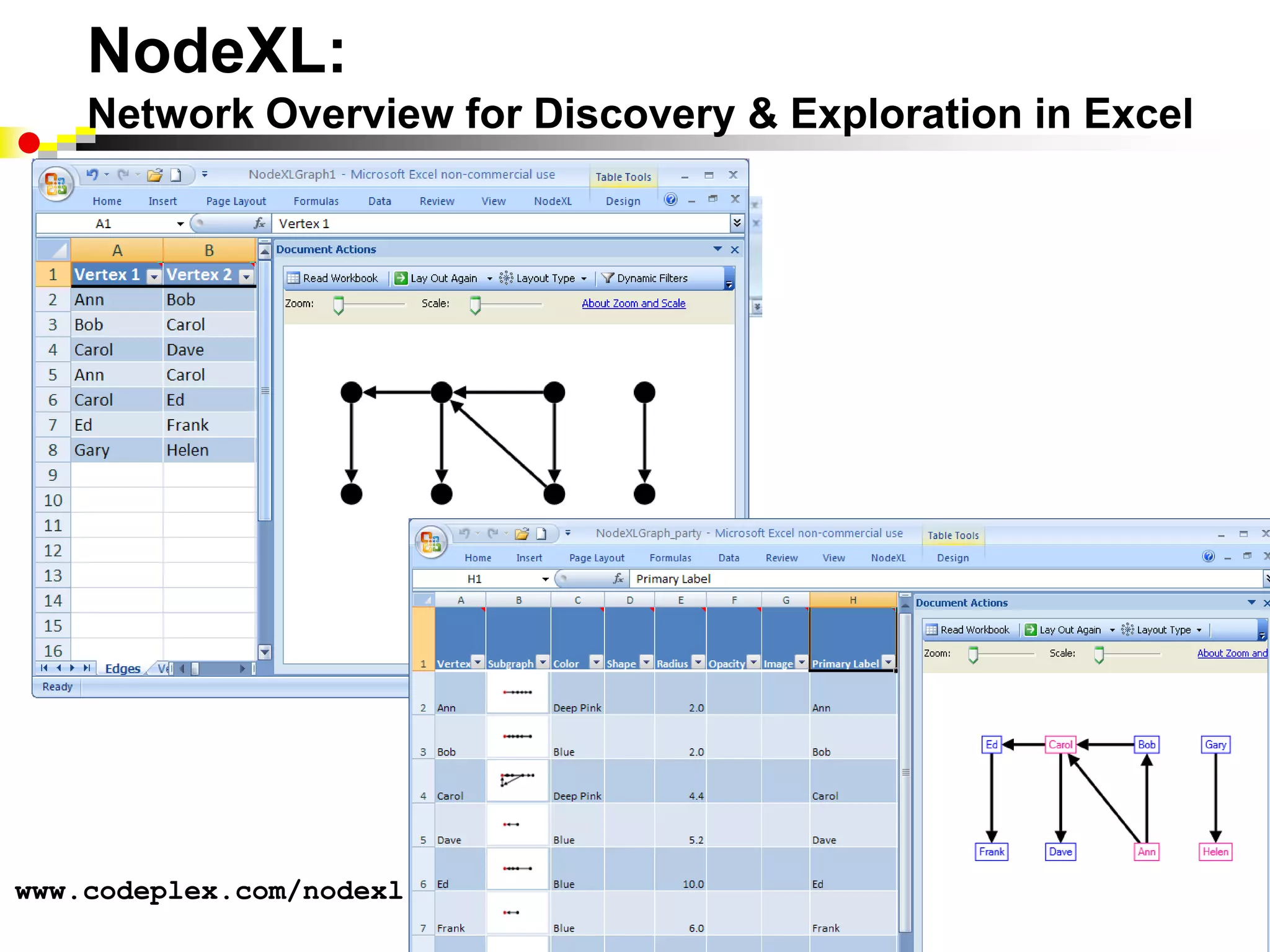
NodeXL:Network Overview for Discovery & Exploration in Excelwww.codeplex.com/nodexl
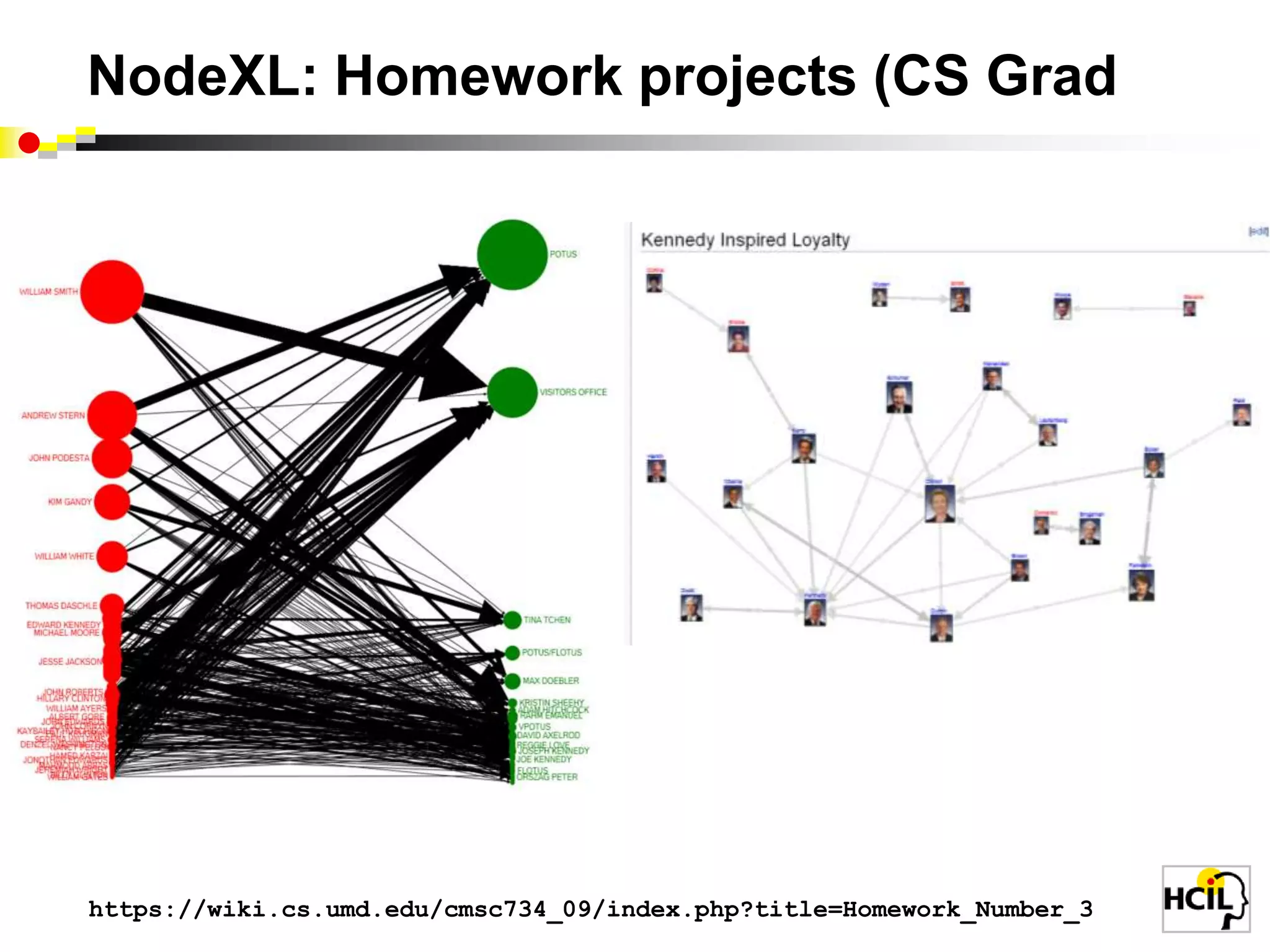
NodeXL: Homework projects (CS Gradhttps://wiki.cs.umd.edu/cmsc734_09/index.php?title=Homework_Number_3
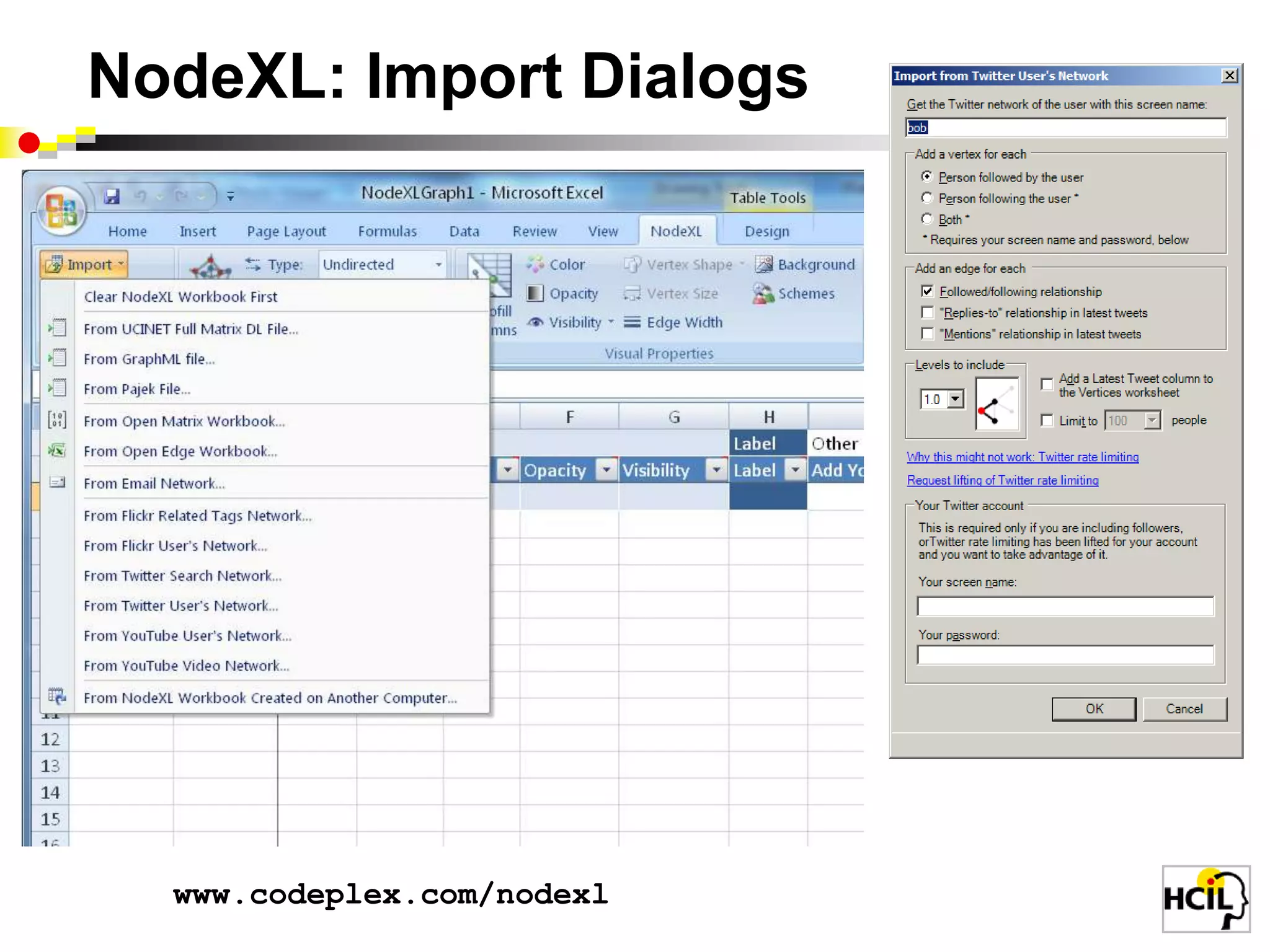
NodeXL: Import Dialogswww.codeplex.com/nodexl
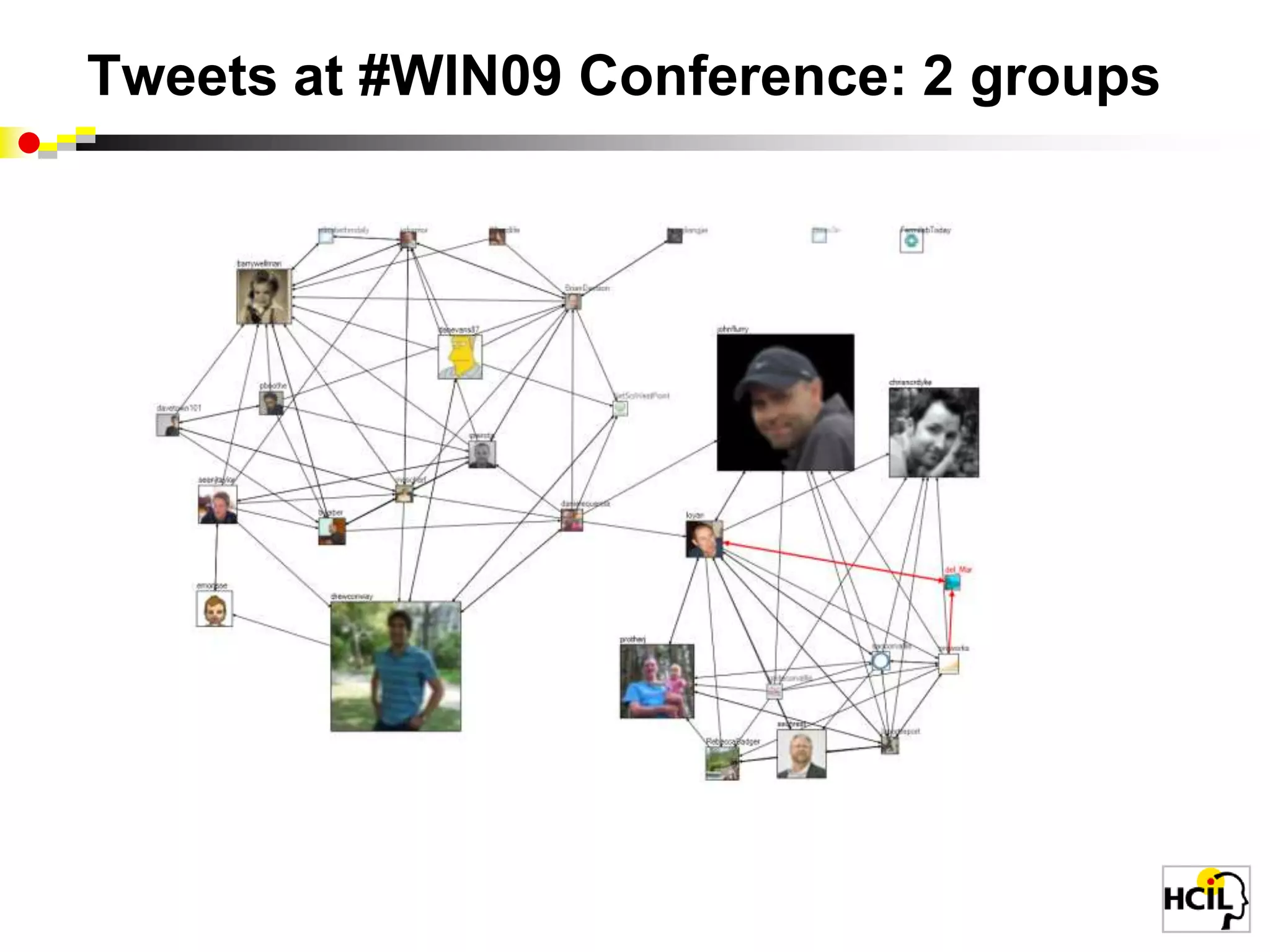
Tweets at #WIN09 Conference: 2 groups
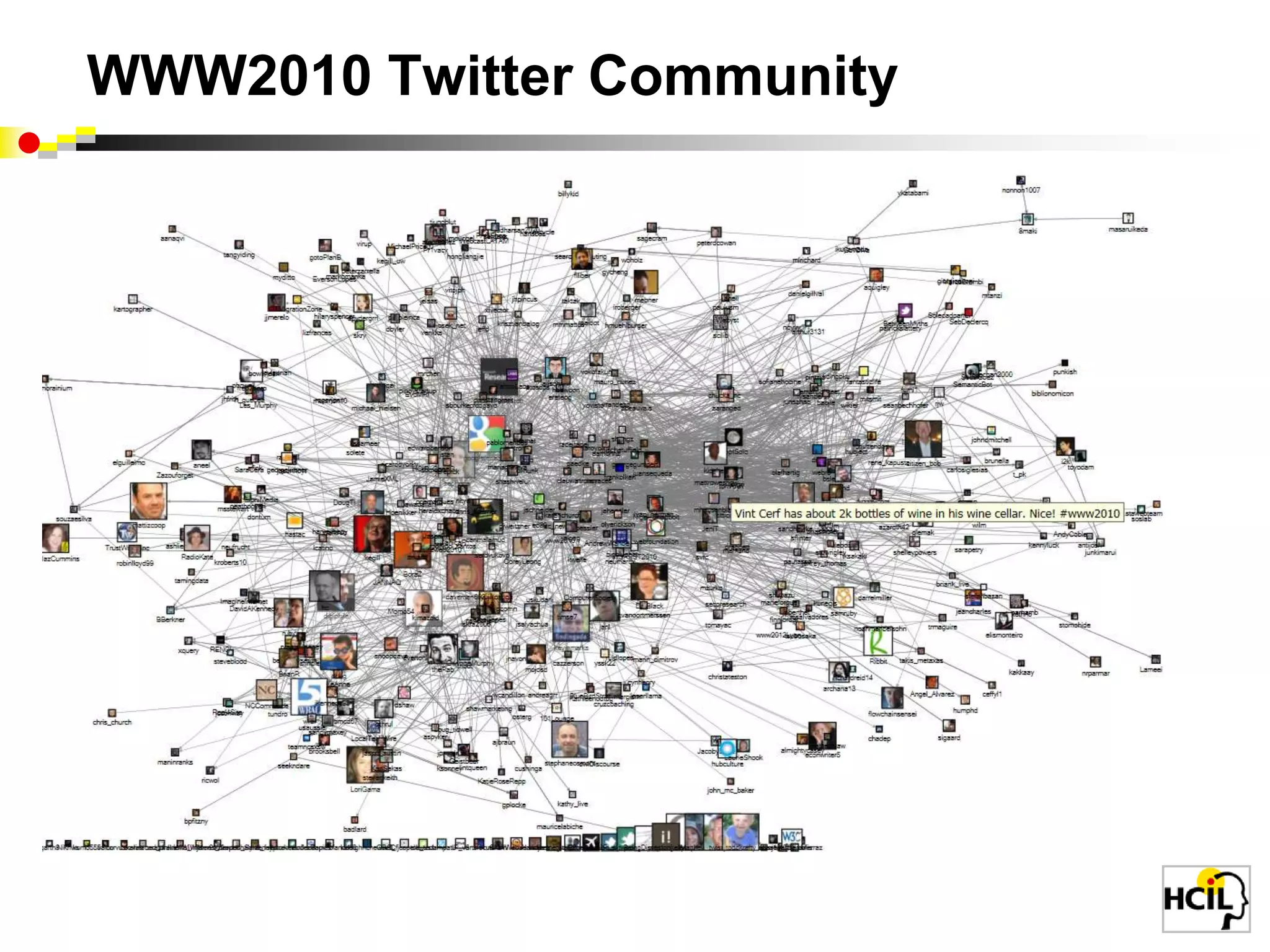
WWW2010 Twitter Community
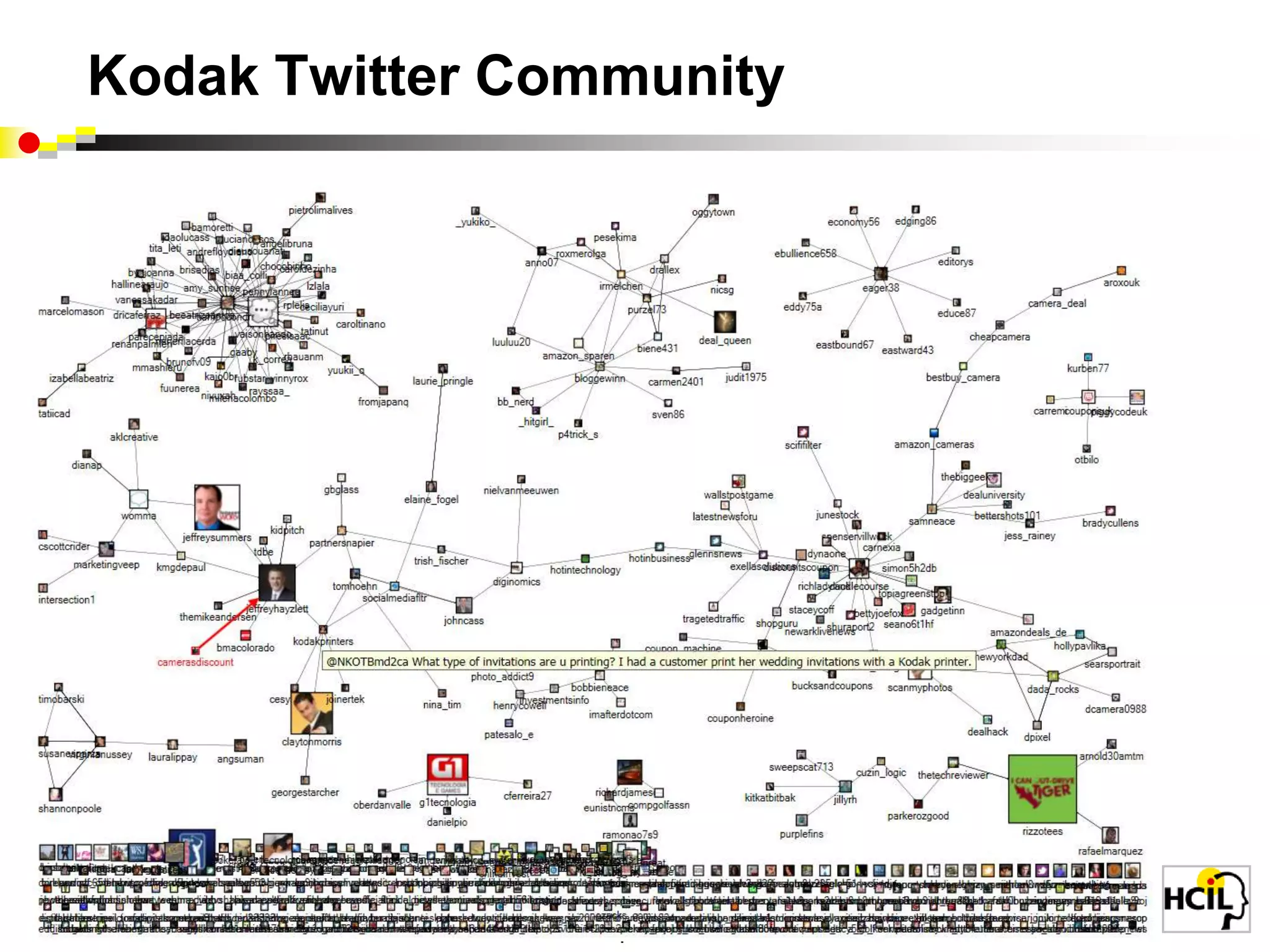
Kodak Twitter Communitywww.codeplex.com/nodexl/
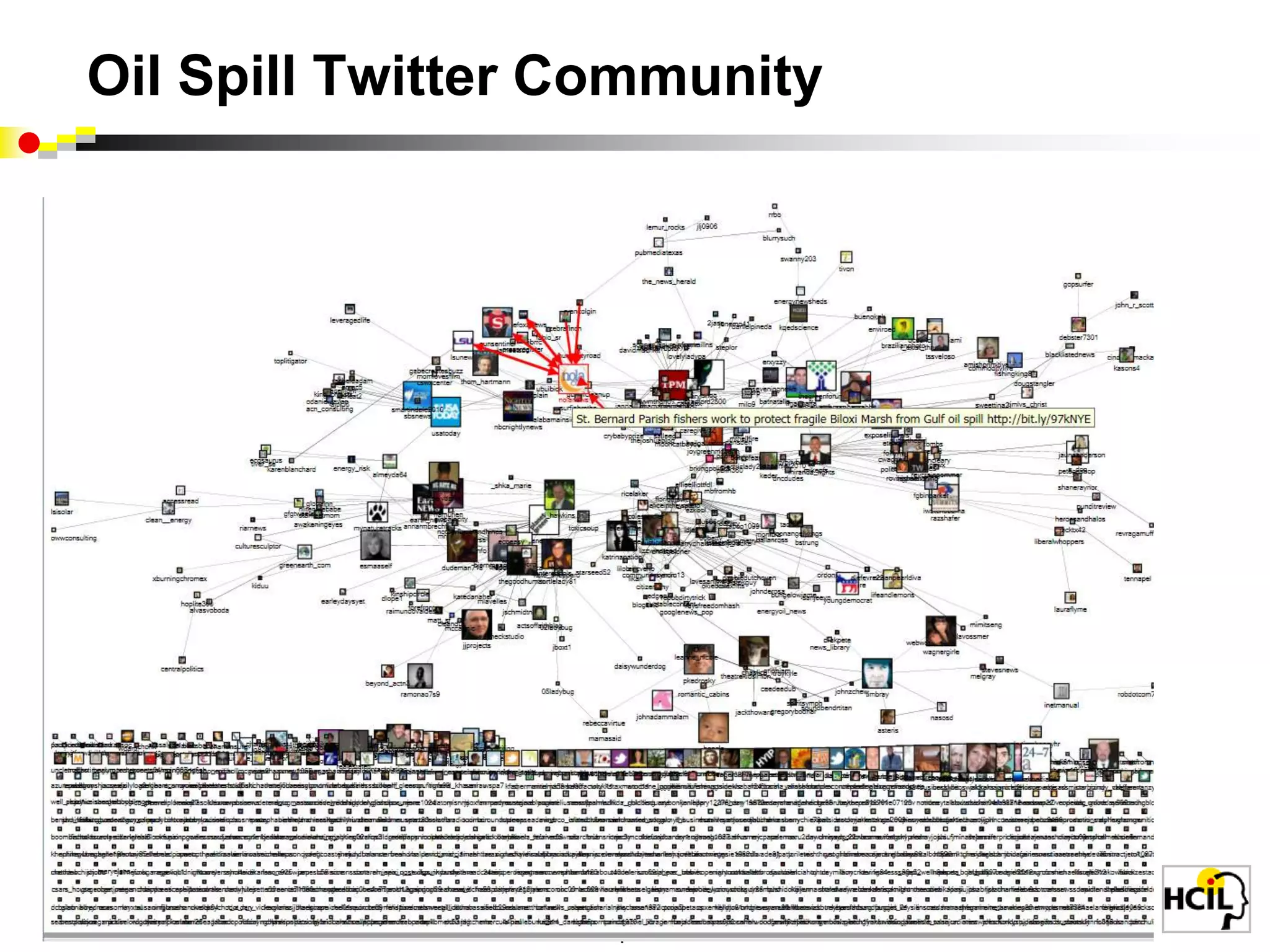
Oil Spill Twitter Communitywww.codeplex.com/nodexl/
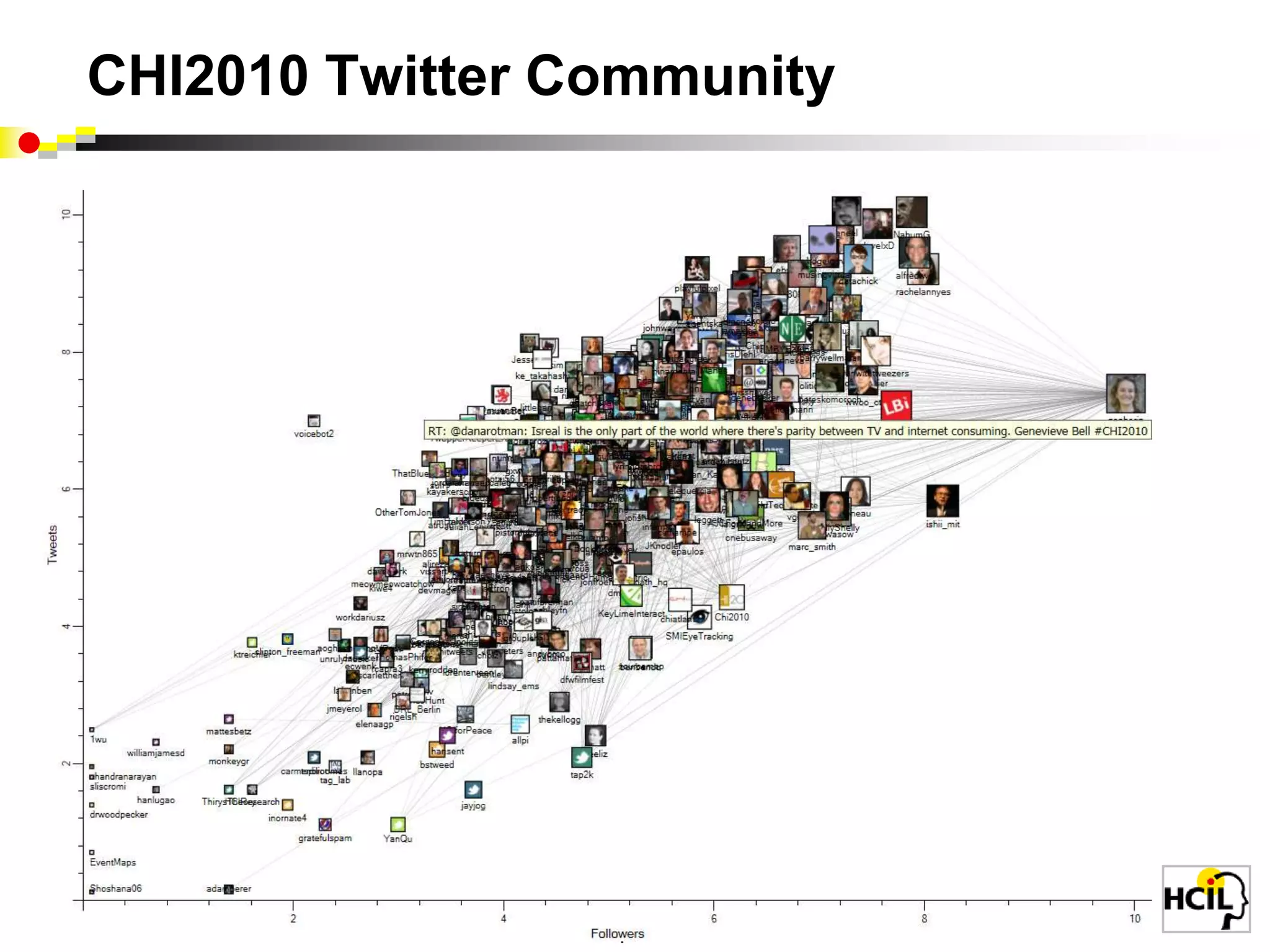
CHI2010 Twitter Communitywww.codeplex.com/nodexl/
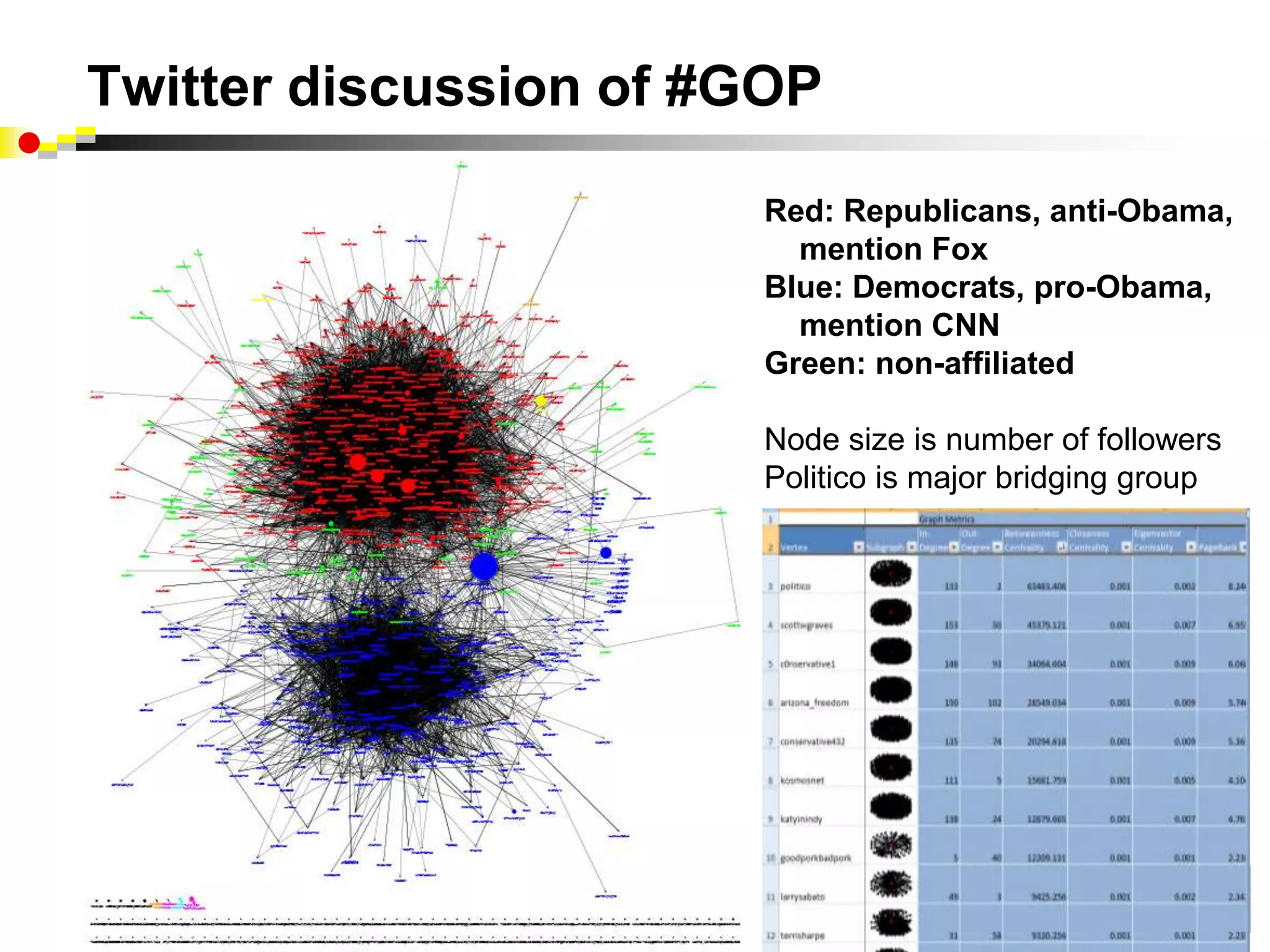
Twitter discussion of #GOPRed: Republicans, anti-Obama,   mention FoxBlue: Democrats, pro-Obama,   mention CNNGreen: non-affiliatedNode size is number of followersPolitico is major bridging group

Ben Sheniderman, Technology-Mediated Social Computing

  • 1.
    Technology-Mediated Social ParticipationBen Shneiderman ben@cs.umd.eduTwitter: @benbendcFounding Director (1983-2000), Human-Computer Interaction LabProfessor, Department of Computer ScienceMember, Institute for Advanced Computer Studies
  • 2.
    Interdisciplinaryresearch community - Computer Science & Info Studies - Psych, Socio, Poli Sci & MITH (www.cs.umd.edu/hcil)
  • 3.
    Design IssuesInput devices& strategiesKeyboards, pointingdevices,voiceDirect manipulationMenus, forms, commandsOutput devices & formatsScreens, windows, color, soundText, tables, graphicsInstructions, messages, helpCollaboration &Social MediaHelp, tutorials, trainingSearchwww.awl.com/DTUIFifth Edition: 2010 VisualizationWikipedia
  • 4.
    GoalApply social mediato transform societyReduce deaths, medical errors, obesity & smokingPromote energy conservationPrevent disasters & terrorismIncrease community safetyImprove education Facilitate good governmentResolve conflicts
  • 5.
    ChallengesMalicious attacks PrivacyviolationsNot trusted Fails to be universalUnreliable when needed Misuse by Terrrorists & criminalsPromoters of racial hatred Political oppressers
  • 6.
    Early Steps Informal GatheringCollege Park, MD, April 2009Article: Science March 2009BEN SHNEIDERMANhttp://iparticipate.wikispaces.com
  • 7.
    NSF Workshops: Academics,Industry, Gov’tJenny Preece (PI), Peter Pirolli & Ben Shneiderman (Co-PIs)www.tmsp.umd.edu
  • 8.
    IEEEComputer Special Issue:Technology Mediated Social ParticipationNSF Sponsored WorkshopsPalo Alto, CA December 2009Washington, DC April 2010
  • 9.
    Cyberinfrastructure for SocialAction on National Priorities- Scientific Foundations- Advancing Design of Social Participation Systems- Visions of What is Possible With Sharable Socio-­technical Infrastructure- Social Participation in Health 2.0- Educational Priorities for Technology Mediated Social Participation- Engaging the Public in Open Government: Social Media Technology and Policy for Government Transparency
  • 10.
    International EffortsCommunity InformaticsResearchNetworkintlsocialparticipation.net
  • 11.
    Vision: Social Participation1)Focus on National Priorities & ImpactDisaster response, community safetyHealth, energy, education, e-governmentEnvironmental awareness, biodiversity2) Develop Theories of Social ParticipationHow do social media networks evolve? How can participation be increased?3) Provide Technology InfrastructureScalable, reliable, universal, manageableProtect privacy, stop attacks, resolve conflicts
  • 12.
    Vision: Social Participation1)Focus on National Priorities & ImpactDisaster response, community safetyHealth, energy, education, e-governmentEnvironmental awareness, biodiversity2) Develop Theories of Social ParticipationHow do social media networks evolve? How can participation be increased?3) Provide Technology InfrastructureScalable, reliable, universal, manageableProtect privacy, stop attacks, resolve conflicts
  • 13.
    911.gov: Internet &mobile devicesResidents report information Professionals disseminate instructions Resident-to-Resident assistance Professionals in control while working with empowered residents Shneiderman & Preece, Science(Feb. 16, 2007)www.cs.umd.edu/hcil/911gov
  • 14.
    Reporting: Earthquakes &Stormsweather.kimt.comearthquake.usgs.gov/eqcenter/dyfi
  • 15.
  • 16.
  • 17.
  • 18.
    Community Safety: AbductedChildrenwww.ncmec.orgwww.missingkids.comwww.amberalert.gov
  • 19.
  • 20.
  • 21.
  • 22.
  • 23.
    Serve.gov: Voluntary serviceRegisterYour Project & Recruit VolunteersFind a Volunteer OpportunityRead Inspiring Stories of Service & Share Your Own Story
  • 24.
    Open Data.gov + Recovery.gov
  • 25.
    Open Data: DC,SF, NYC. . .
  • 26.
    UN Millennium DevelopmentGoalsTo be achieved by 2015 Eradicate extreme poverty and hunger
  • 27.
    Achieve universalprimary education
  • 28.
    Promote genderequality and empower women
  • 29.
    Reduce childmortality
  • 30.
  • 31.
    Combat HIV/AIDS,malaria and other diseases
  • 32.
    Ensure environmentalsustainability
  • 33.
    Develop aglobal partnership for developmentVision: Social Participation1) Focus on National Priorities & ImpactDisaster response, community safetyHealth, energy, education, e-governmentEnvironmental awareness, biodiversity2) Develop Theories of Social ParticipationHow do social media networks evolve? How can participation be increased?3) Provide Technology InfrastructureScalable, reliable, universal, manageableProtect privacy, stop attacks, resolve conflicts
  • 34.
    Network Theories: EvolutionmodelsRandom, preferential attachment,…Monotonic, bursty,…Power law for degree (hubs & indexes)Small-world propertyForest fire, spreading activation,…Matures, decays, fragments, … Watts & Strogatz, Nature 1998; Barabasi, Science 1999, 2009;Newman, Phys. Rev. Letters 2002Kumar, Novak & Tomkins, KDD2006Leskovec, Faloutsos & Kleinberg, TKDD2007
  • 35.
    Network Theories: SocialscienceRelationships & rolesStrong & weak tiesMotivations: egoism, altruism, collectivism, principlismCollective intelligenceCollective action & governanceSocial information foragingMoreno, 1938; Granovetter, 1971; Burt, 1987; Ostrom, 1992;Wellman, 1993; Batson, Ahmad & Tseng, 2002; Malone, Laubaucher & Dellarocas, 2009; Pirolli, 2009
  • 36.
    Network Theories: Stagesof participationWikipedia, Discussion & ReportingReaderFirst-time Contributor (Legitimate Peripheral Participation)Returning ContributorFrequent ContributorPreece, Nonnecke & Andrews, CHB2004Forte & Bruckman, SIGGROUP2005; Hanson, 2008Porter: Designing for the Social Web, 2008Vassileva, 2002, 2005; Ling et al., JCMC 2005; Rashid et al., CHI2006
  • 37.
    From Reader toLeader:Motivating Technology-Mediated Social ParticipationAllUsersReaderContributorCollaboratorLeader`Preece & Shneiderman, AIS Trans. Human-Computer Interaction1 (1), 2009 aisel.aisnet.org/thci/vol1/iss1/5/
  • 38.
  • 39.
  • 40.
  • 41.
  • 42.
    Vision: Social Participation1)Focus on National Priorities & ImpactDisaster response, community safetyHealth, energy, education, e-governmentEnvironmental awareness, biodiversity2) Develop Theories of Social ParticipationHow do social media networks evolve? How can participation be increased?3) Provide Technology InfrastructureScalable, reliable, universal, manageableProtect privacy, stop attacks, resolve conflicts
  • 43.
  • 44.
  • 45.
  • 46.
  • 47.
  • 48.
  • 49.
    Designers can continuouslyimprove Footprints of Human ActivityFootprints in sand as Caesarea
  • 50.
    SocialActionIntegrates statistics & visualization4 case studies, 4-8 weeks (journalist, bibliometrician, terrorist analyst, organizational analyst)Identified desired features, gave strong positive feedback about benefits of integrationwww.cs.umd.edu/hcil/socialactionPerer & Shneiderman, CHI2008, IEEE CG&A 2009
  • 51.
    NodeXL: Network Overviewfor Discovery & Exploration in Excelwww.codeplex.com/nodexlcasci.umd.edu/NodeXL_Teaching
  • 52.
    NodeXL:Network Overview forDiscovery & Exploration in Excelwww.codeplex.com/nodexl
  • 53.
    NodeXL: Homework projects(CS Gradhttps://wiki.cs.umd.edu/cmsc734_09/index.php?title=Homework_Number_3
  • 54.
  • 55.
    Tweets at #WIN09Conference: 2 groups
  • 56.
  • 57.
  • 58.
    Oil Spill TwitterCommunitywww.codeplex.com/nodexl/
  • 59.
  • 60.
    Twitter discussion of#GOPRed: Republicans, anti-Obama, mention FoxBlue: Democrats, pro-Obama, mention CNNGreen: non-affiliatedNode size is number of followersPolitico is major bridging group
  • 61.
  • 62.
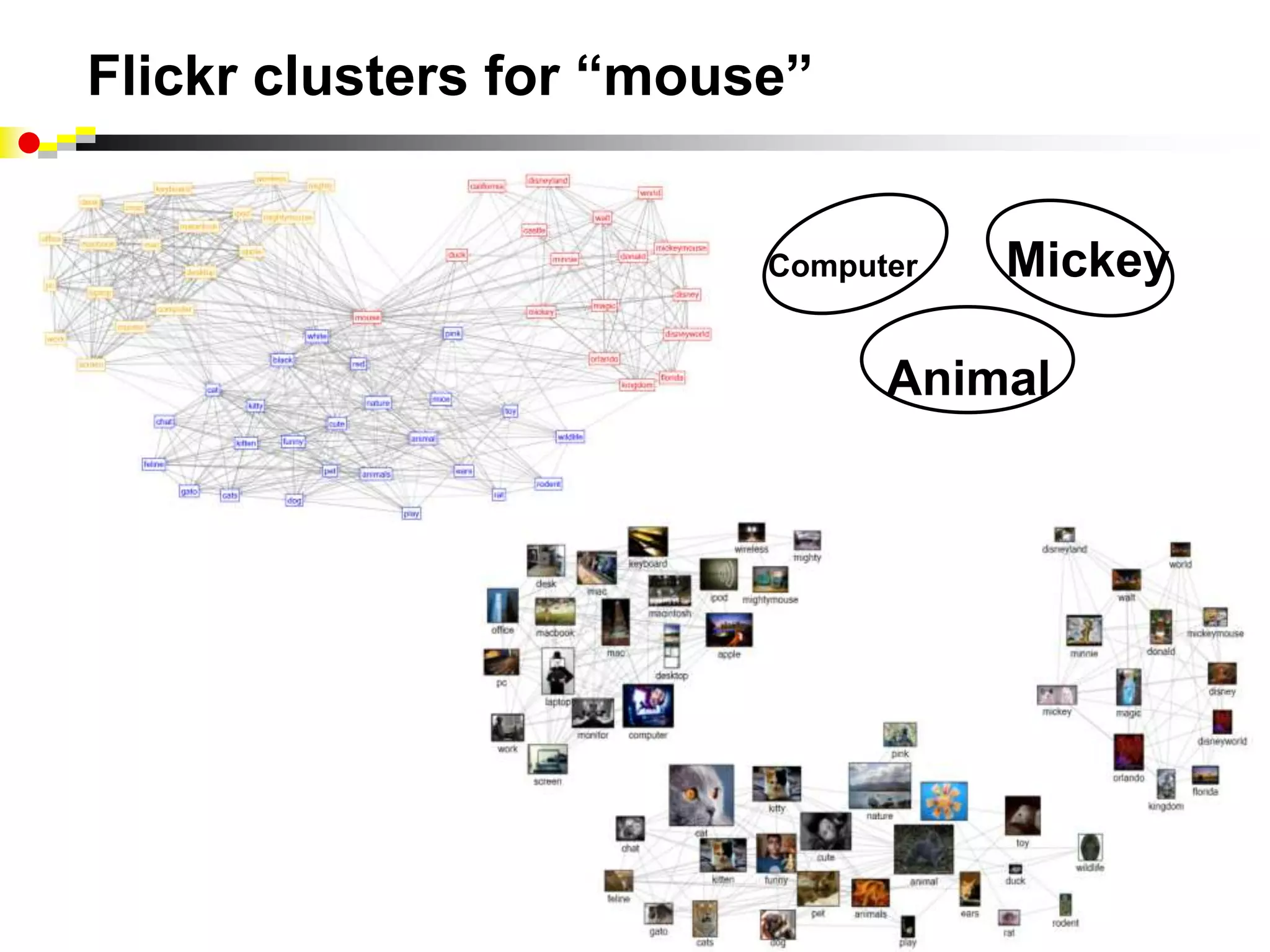
    Flickr clusters for“mouse”Computer MickeyAnimal
  • 63.
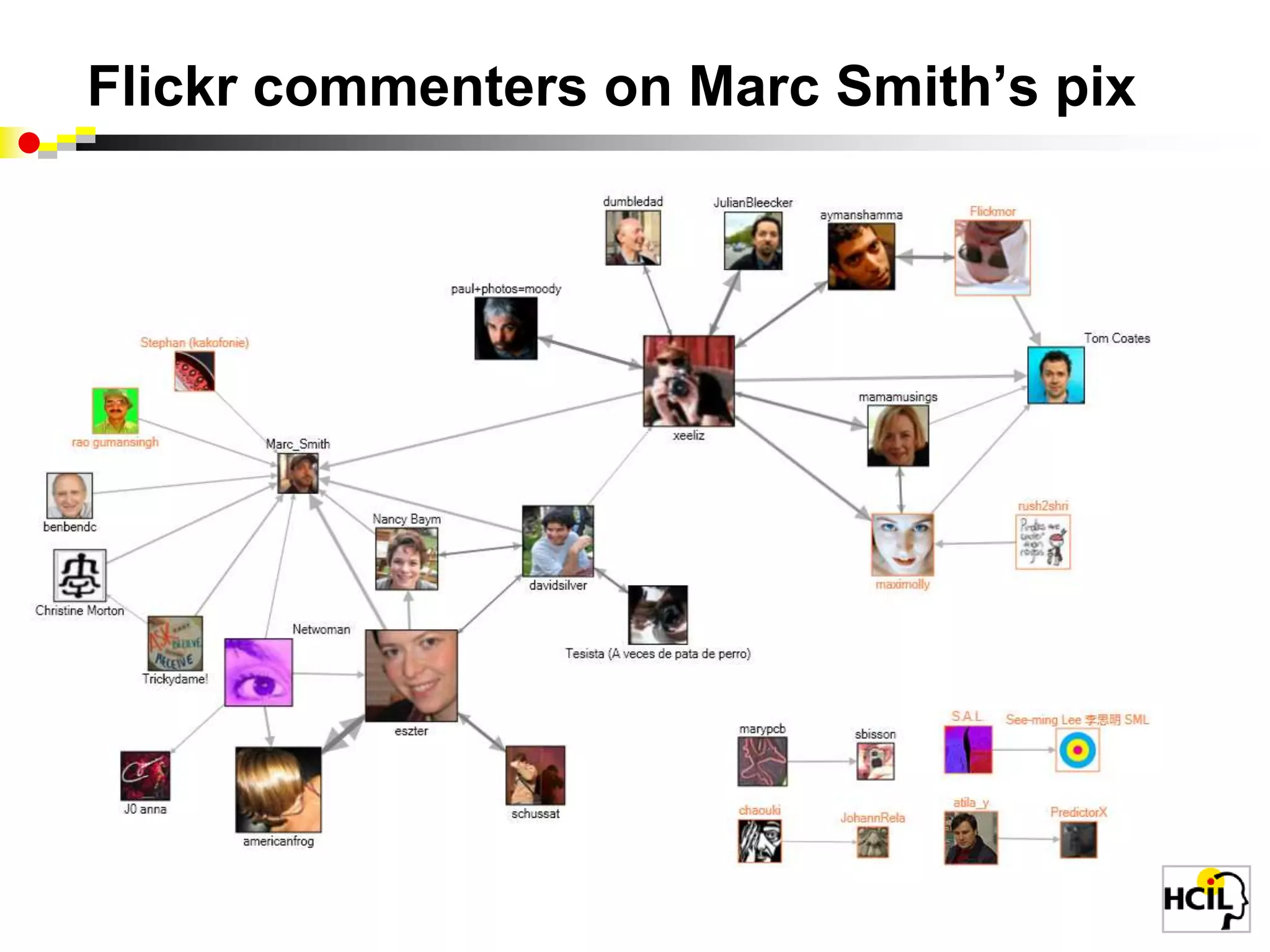
    Flickr commenters onMarc Smith’s pix
  • 64.
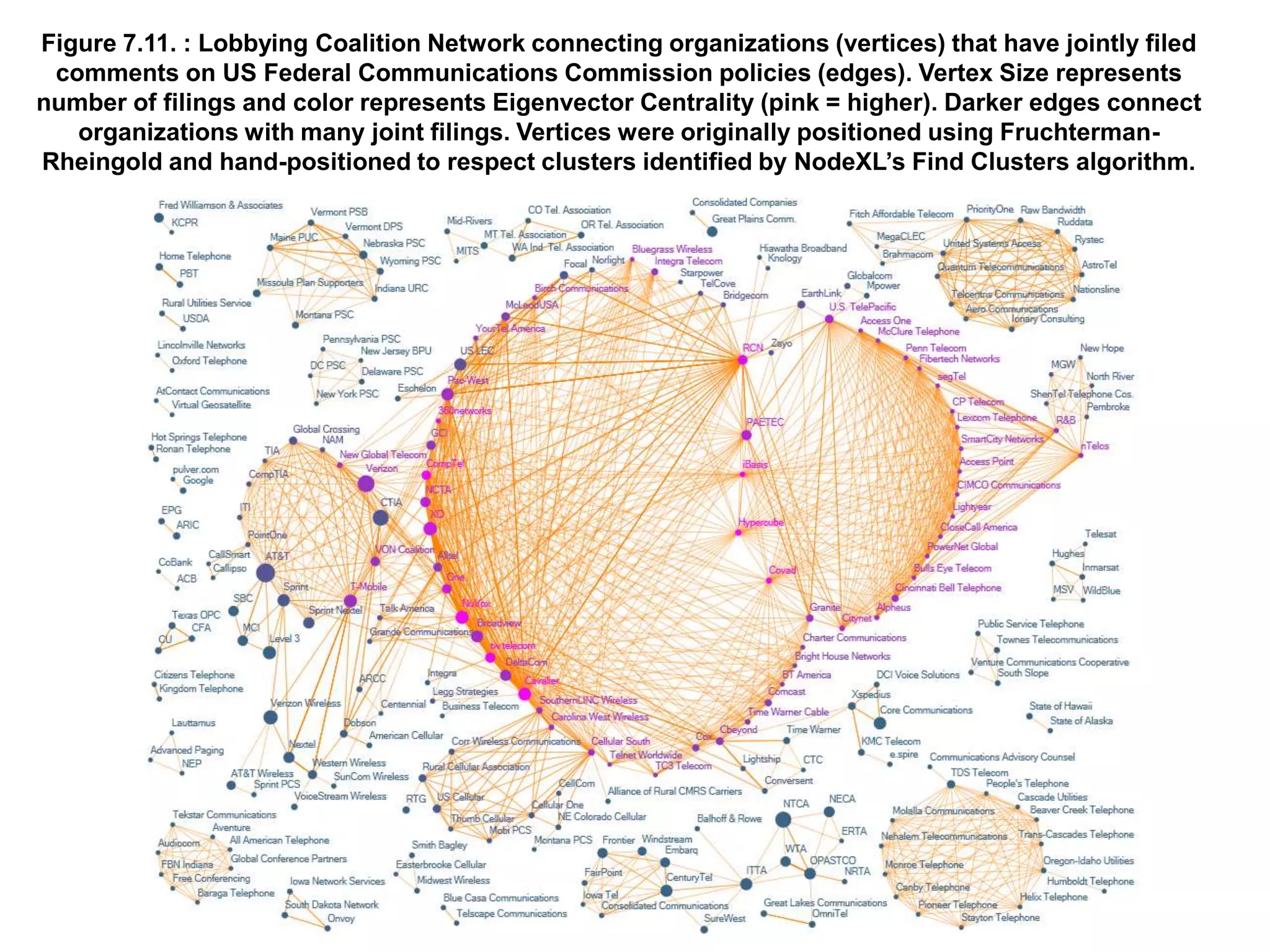
    Figure 7.11. :Lobbying Coalition Network connecting organizations (vertices) that have jointly filed comments on US Federal Communications Commission policies (edges). Vertex Size represents number of filings and color represents Eigenvector Centrality (pink = higher). Darker edges connect organizations with many joint filings. Vertices were originally positioned using Fruchterman-Rheingold and hand-positioned to respect clusters identified by NodeXL’s Find Clusters algorithm.
  • 65.
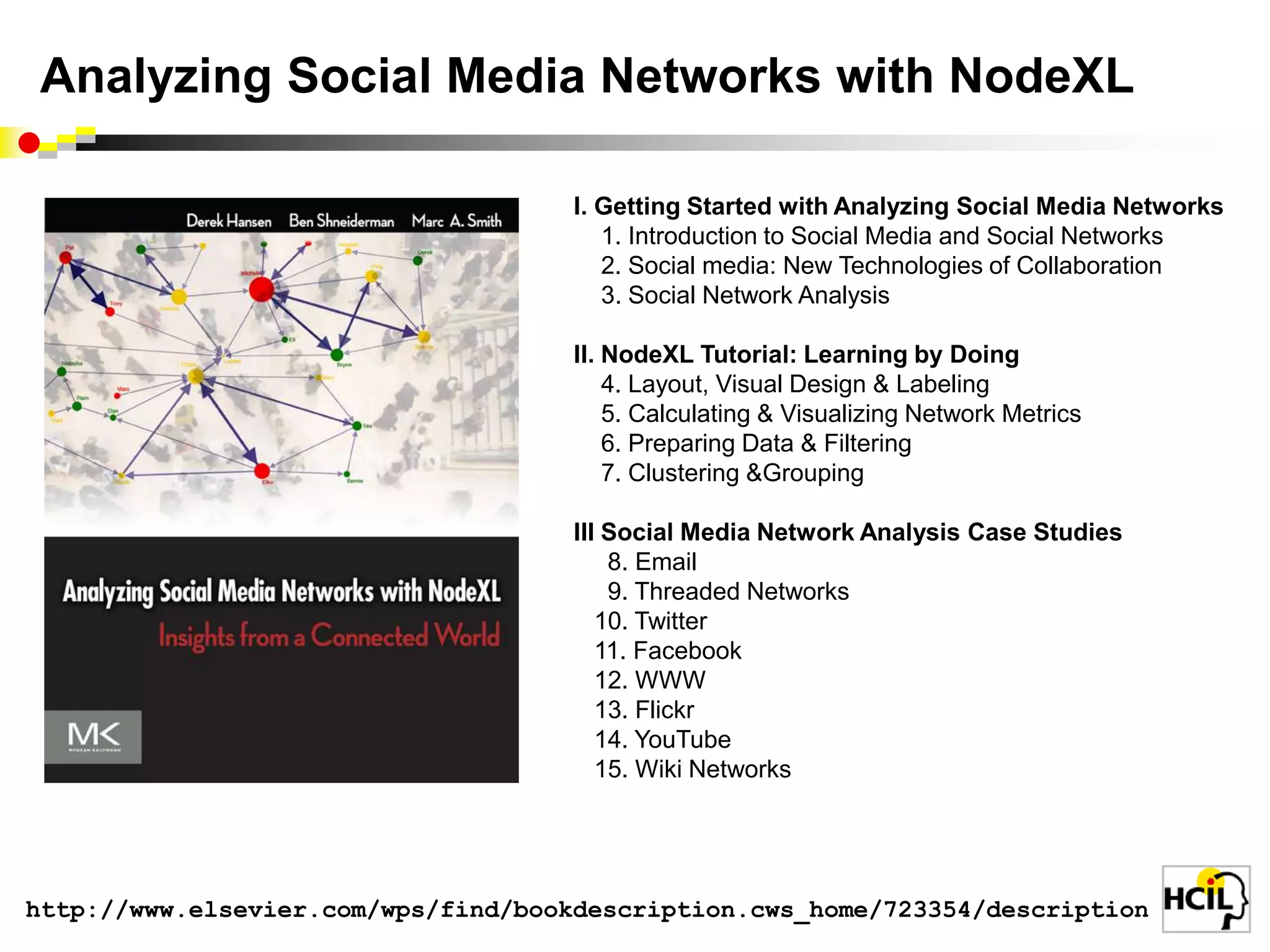
    AnalyzingSocial Media Networks with NodeXLI. Getting Started with Analyzing Social Media Networks 1. Introduction to Social Media and Social Networks 2. Social media: New Technologies of Collaboration 3. Social Network AnalysisII. NodeXL Tutorial: Learning by Doing 4. Layout, Visual Design & Labeling 5. Calculating & Visualizing Network Metrics  6. Preparing Data & Filtering 7. Clustering &GroupingIII Social Media Network Analysis Case Studies 8. Email 9. Threaded Networks 10. Twitter 11. Facebook   12. WWW 13. Flickr 14. YouTube  15. Wiki Networks http://www.elsevier.com/wps/find/bookdescription.cws_home/723354/description
  • 66.
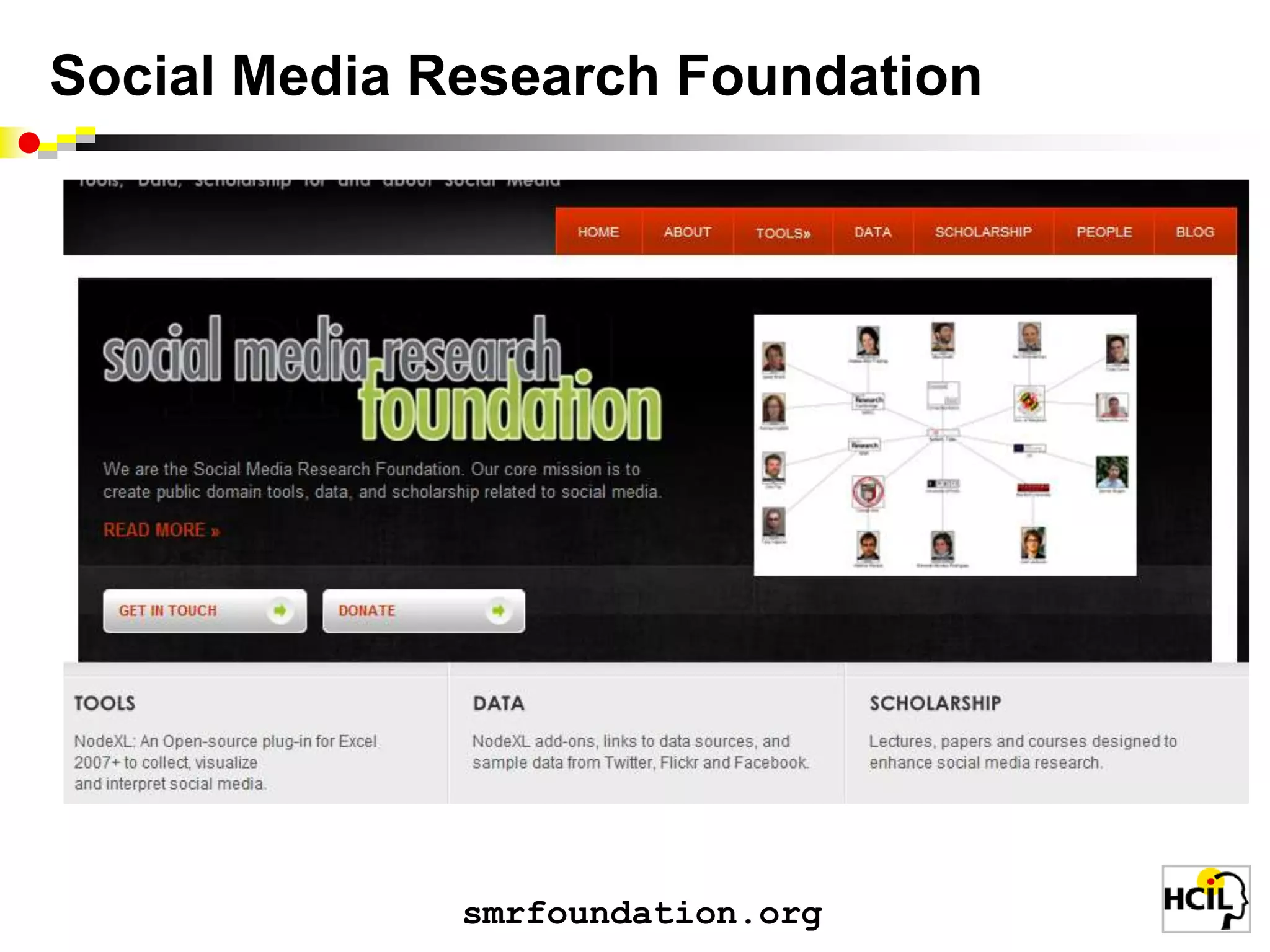
    Social MediaResearch FoundationSocial Media Research Foundationsmrfoundation.orgWe are a group of researchers who want to create open tools, generate and host open data, and support open scholarship related to social media. smrfoundation.org
  • 67.
    Strategy: Take PersonalInitiativesDo great research!!!!  InspirationalUniversitiesAdd courses & degree programsRun workshops for funding agenciesHelp Federal & Local governmentsIndustryOffer researchers access to dataDevelop infrastructure and analysis toolsGovernmentNational Initiative for Social ParticipationDevelop Federal & Local applications
  • 68.
    Strategy: Take PersonalInitiativesLet’s get to work!
  • 69.
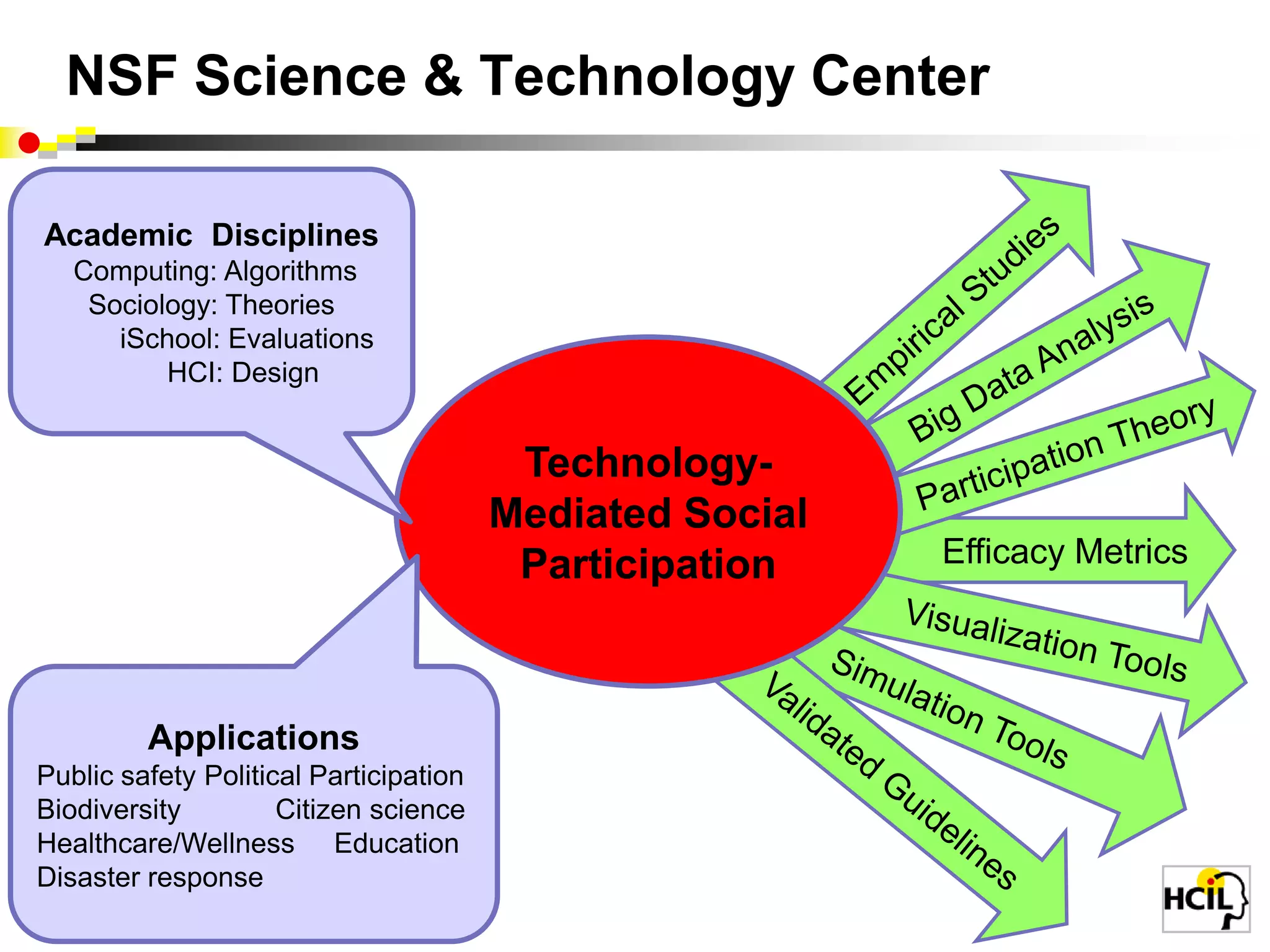
    NSF Science &Technology CenterAcademic DisciplinesComputing: AlgorithmsSociology: TheoriesiSchool: Evaluations HCI: Design Empirical Studies Big Data AnalysisTechnology-Mediated Social Participation Participation Theory Efficacy Metrics Visualization ToolsSimulation ToolsApplicationsPublic safety Political ParticipationBiodiversity Citizen science Healthcare/Wellness Education Disaster response Validated Guidelines
  • 70.
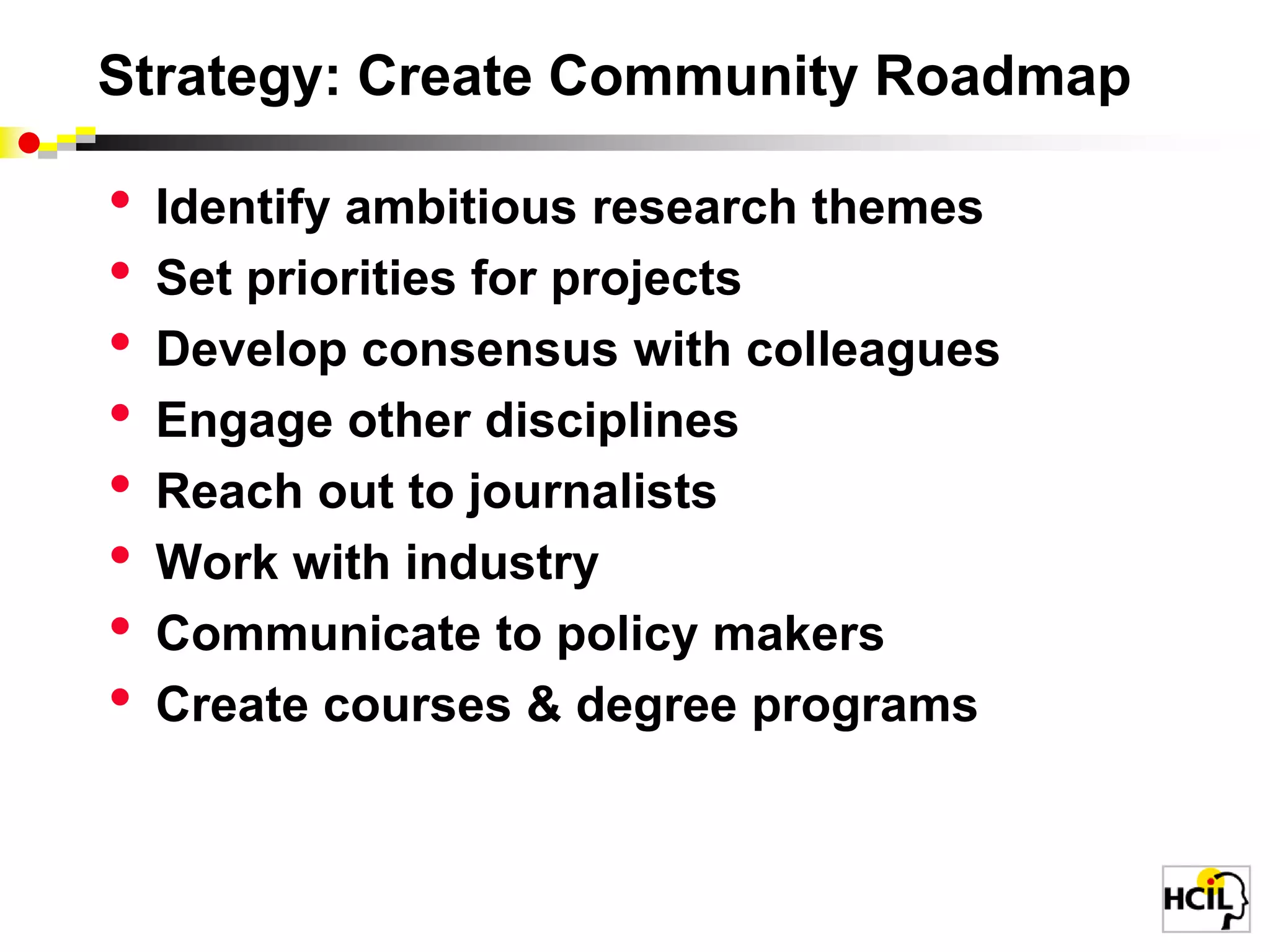
    Strategy: Create CommunityRoadmapIdentify ambitious research themesSet priorities for projectsDevelop consensus with colleaguesEngage other disciplinesReach out to journalistsWork with industryCommunicate to policy makersCreate courses & degree programs

Editor's Notes

  • #8 Todd Beamer – United 93
  • #32 five stages of emotional response: (1) denial, (2) bargaining, (3) anger, (4) despair, (5) acceptance. ...
  • #46 Chapter 3, Figure 1 (page 6). A NodeXL social media network diagram of relationships among Twitter users mentioning the hashtag “#WIN09” used by attendees of a conference on Network Science at NYU in September 2009. Each user’s node is sized proportional to the number of tweets they have ever made to that date.
  • #51 Figure 13.24. NodeXL network of Flickr users who comment on Marc_Smith’s photos (network depth 1.5; edge weight≥4).
  • #52 Chapter 3, Figure 1 (page 6). A NodeXL social media network diagram of relationships among Twitter users mentioning the hashtag “#WIN09” used by attendees of a conference on Network Science at NYU in September 2009. Each user’s node is sized proportional to the number of tweets they have ever made to that date.
  • #53 Figure 13.20. NodeXL cluster visualization showing three Flickr tag clusters, each representing a different context for “mouse”.Figure 13.21. NodeXL display of Isolated clusters for three different contexts for the “mouse” tag in Flickr: mouse animal, computer mouse, and Mickey Mouse Disney character.
  • #54 Figure 13.24. NodeXL network of Flickr users who comment on Marc_Smith’s photos (network depth 1.5; edge weight≥4).