Web - COSI EU FP7 Project
Web-Communities for Statistics for Social Innovation
Kick off Meeting

Web 2.0 Challenges for NSIs
Emanuele Baldacci
Italian National Institute of Statistics (Istat)
Head, Department for Integration, Quality, Research and
Production Networks Development (DIQR)

Rome, 9 January 2014
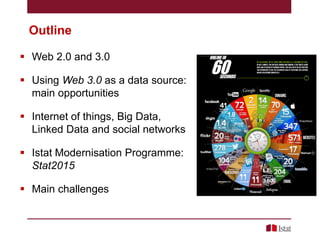
Outline
 Web 2.0 and 3.0
 Using Web 3.0 as a data source:
main opportunities

 Internet of things, Big Data,
Linked Data and social networks
 Istat Modernisation Programme:
Stat2015
 Main challenges
Web 2.0
A Web 2.0 site may allow users to interact and collaborate
with each other in a social media dialogue as creators of
user-generated content in a virtual community.
Examples of Web 2.0 include social networking sites, blogs,
wikis, folksonomies, video sharing sites, hosted services,
web applications, and mash-ups
Wikipedia
Web 3.0: the Semantic Web
The semantic web is not a separate web but an extension of
the current one, in which information is given well-defined
meaning, better enabling computers and people to work in
cooperation
Tim Berners Lee

Web 3.0 is included two main platforms:
1. semantic technologies
2. social computing environment
Using Web 3.0 as a Data Source: Main
Opportunities (1/2)

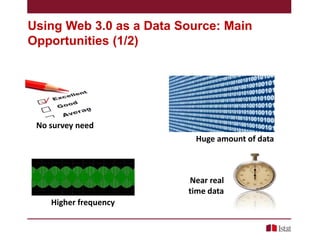
No survey need
Huge amount of data

Near real
time data
Higher frequency
Using Web 3.0 as a Data Source: Main
Opportunities (2/2)
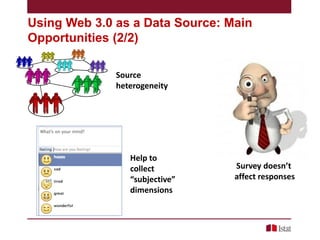
Source
heterogeneity

Help to
collect
“subjective”
dimensions

Survey doesn’t
affect responses
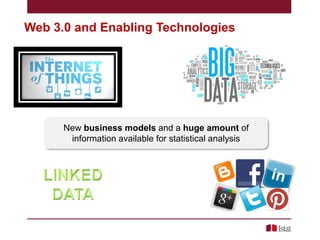
Web 3.0 and Enabling Technologies

New business models and a huge amount of
information available for statistical analysis
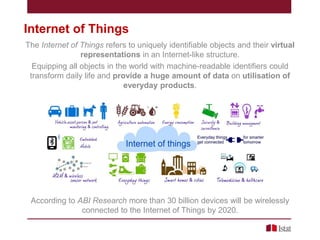
Internet of Things
The Internet of Things refers to uniquely identifiable objects and their virtual
representations in an Internet-like structure.
Equipping all objects in the world with machine-readable identifiers could
transform daily life and provide a huge amount of data on utilisation of
everyday products.

According to ABI Research more than 30 billion devices will be wirelessly
connected to the Internet of Things by 2020.
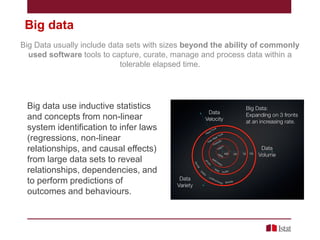
Big data
Big Data usually include data sets with sizes beyond the ability of commonly
used software tools to capture, curate, manage and process data within a
tolerable elapsed time.

Big data use inductive statistics
and concepts from non-linear
system identification to infer laws
(regressions, non-linear
relationships, and causal effects)
from large data sets to reveal
relationships, dependencies, and
to perform predictions of
outcomes and behaviours.
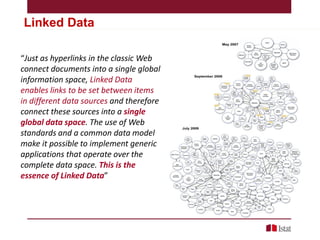
Linked Data
Sea of Linked Data
“Just as hyperlinks in the classic Web
connect documents into a single global
information space, Linked Data
enables links to be set between items
in different data sources and therefore
connect these sources into a single
global data space. The use of Web
standards and a common data model
make it possible to implement generic
applications that operate over the
complete data space. This is the
essence of Linked Data”

10
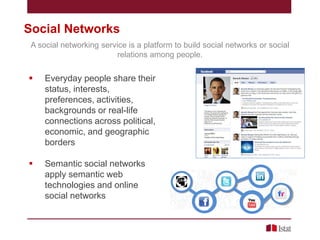
Social Networks
A social networking service is a platform to build social networks or social
relations among people.



Everyday people share their
status, interests,
preferences, activities,
backgrounds or real-life
connections across political,
economic, and geographic
borders



Semantic social networks
apply semantic web
technologies and online
social networks
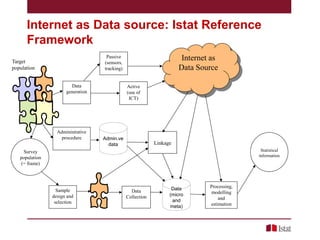
Internet as Data source: Istat Reference
Framework
Internet as
Data Source

Passive
(sensors,
tracking)

Target
population

Data
generation

Administrative
procedure

Active
(use of
ICT)

Admin.ve
data

Linkage
Statistical
information

Survey
population
(= frame)

Sample
design and
selection

Data
Collection

Data
(micro
and
meta)

Processing,
modelling
and
estimation
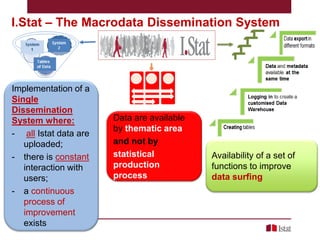
I.Stat – The Macrodata Dissemination System

Implementation of a
Single
Dissemination
System where:
- all Istat data are
uploaded;
- there is constant
interaction with
users;
- a continuous
process of
improvement
exists

Data are available
by thematic area
and not by
statistical
production
process

Availability of a set of
functions to improve
data surfing
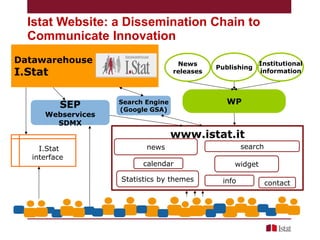
Istat Website: a Dissemination Chain to
Communicate Innovation
www.istat.it

Datawarehouse

News
releases

I.Stat

SEP

Webservices
SDMX

Publishing

Institutional
information

WP

Search Engine
(Google GSA)

www.istat.it
I.Stat
interface

search

news
calendar
Statistics by themes

widget
info

contact
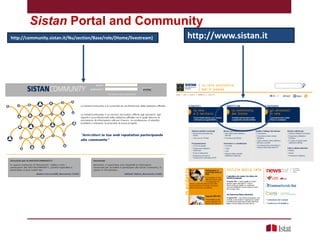
Sistan Portal and Community
http://community.sistan.it/Nu/section/Base/role/(Home/livestream)

http://www.sistan.it
Main General Challenges
 Legislative, i.e. with respect to the access and use of
data
 Privacy, i.e. managing public trust and acceptance
of data re-use and its link to other sources
 Financial, i.e. potential costs of sourcing data vs.
benefits
 Management, e.g. policies and directives about data
management and protection
 Methodological, i.e. data quality and suitability of
statistical methods
 Technological, i.e. issues related to information
technology
Future Challenges for NSIs
 Finding new skills to meet web 2.0 and
3.0 needs
• A balance between traditional statistical skills and web 3.0 skills

 Increasing statistical culture among users
• Users’ awareness on Web 3.0 Data weakness and strengths:
e.g Data Journalism

 Continuing to ensure data quality and integrity
within this innovative framework
 Adding the certification of the processes and
methods used by external bodies for data
production to internal data quality certification
Thank you for your attention

Contacts:
baldacci@istat.it
www.istat.it

Istat web cosi meeting-e.baldacci

  • 1.
    Web - COSIEU FP7 Project Web-Communities for Statistics for Social Innovation Kick off Meeting Web 2.0 Challenges for NSIs Emanuele Baldacci Italian National Institute of Statistics (Istat) Head, Department for Integration, Quality, Research and Production Networks Development (DIQR) Rome, 9 January 2014
  • 2.
    Outline  Web 2.0and 3.0  Using Web 3.0 as a data source: main opportunities  Internet of things, Big Data, Linked Data and social networks  Istat Modernisation Programme: Stat2015  Main challenges
  • 3.
    Web 2.0 A Web2.0 site may allow users to interact and collaborate with each other in a social media dialogue as creators of user-generated content in a virtual community. Examples of Web 2.0 include social networking sites, blogs, wikis, folksonomies, video sharing sites, hosted services, web applications, and mash-ups Wikipedia
  • 4.
    Web 3.0: theSemantic Web The semantic web is not a separate web but an extension of the current one, in which information is given well-defined meaning, better enabling computers and people to work in cooperation Tim Berners Lee Web 3.0 is included two main platforms: 1. semantic technologies 2. social computing environment
  • 5.
    Using Web 3.0as a Data Source: Main Opportunities (1/2) No survey need Huge amount of data Near real time data Higher frequency
  • 6.
    Using Web 3.0as a Data Source: Main Opportunities (2/2) Source heterogeneity Help to collect “subjective” dimensions Survey doesn’t affect responses
  • 7.
    Web 3.0 andEnabling Technologies New business models and a huge amount of information available for statistical analysis
  • 8.
    Internet of Things TheInternet of Things refers to uniquely identifiable objects and their virtual representations in an Internet-like structure. Equipping all objects in the world with machine-readable identifiers could transform daily life and provide a huge amount of data on utilisation of everyday products. According to ABI Research more than 30 billion devices will be wirelessly connected to the Internet of Things by 2020.
  • 9.
    Big data Big Datausually include data sets with sizes beyond the ability of commonly used software tools to capture, curate, manage and process data within a tolerable elapsed time. Big data use inductive statistics and concepts from non-linear system identification to infer laws (regressions, non-linear relationships, and causal effects) from large data sets to reveal relationships, dependencies, and to perform predictions of outcomes and behaviours.
  • 10.
    Linked Data Sea ofLinked Data “Just as hyperlinks in the classic Web connect documents into a single global information space, Linked Data enables links to be set between items in different data sources and therefore connect these sources into a single global data space. The use of Web standards and a common data model make it possible to implement generic applications that operate over the complete data space. This is the essence of Linked Data” 10
  • 11.
    Social Networks A socialnetworking service is a platform to build social networks or social relations among people.  Everyday people share their status, interests, preferences, activities, backgrounds or real-life connections across political, economic, and geographic borders  Semantic social networks apply semantic web technologies and online social networks
  • 12.
    Internet as Datasource: Istat Reference Framework Internet as Data Source Passive (sensors, tracking) Target population Data generation Administrative procedure Active (use of ICT) Admin.ve data Linkage Statistical information Survey population (= frame) Sample design and selection Data Collection Data (micro and meta) Processing, modelling and estimation
  • 13.
    I.Stat – TheMacrodata Dissemination System Implementation of a Single Dissemination System where: - all Istat data are uploaded; - there is constant interaction with users; - a continuous process of improvement exists Data are available by thematic area and not by statistical production process Availability of a set of functions to improve data surfing
  • 14.
    Istat Website: aDissemination Chain to Communicate Innovation www.istat.it Datawarehouse News releases I.Stat SEP Webservices SDMX Publishing Institutional information WP Search Engine (Google GSA) www.istat.it I.Stat interface search news calendar Statistics by themes widget info contact
  • 15.
    Sistan Portal andCommunity http://community.sistan.it/Nu/section/Base/role/(Home/livestream) http://www.sistan.it
  • 16.
    Main General Challenges Legislative, i.e. with respect to the access and use of data  Privacy, i.e. managing public trust and acceptance of data re-use and its link to other sources  Financial, i.e. potential costs of sourcing data vs. benefits  Management, e.g. policies and directives about data management and protection  Methodological, i.e. data quality and suitability of statistical methods  Technological, i.e. issues related to information technology
  • 17.
    Future Challenges forNSIs  Finding new skills to meet web 2.0 and 3.0 needs • A balance between traditional statistical skills and web 3.0 skills  Increasing statistical culture among users • Users’ awareness on Web 3.0 Data weakness and strengths: e.g Data Journalism  Continuing to ensure data quality and integrity within this innovative framework  Adding the certification of the processes and methods used by external bodies for data production to internal data quality certification
  • 18.
    Thank you foryour attention Contacts: baldacci@istat.it www.istat.it