Advance Planning Document Process Overview Class presented by  DHS/OIS/PMO http://egov.oregon.gov/DHS/admin/pmo/
Overview Class This presentation describes basic components of the Advanced Planning Document  (APD) process. High level look at process Introduction to process Other detailed classes Using APD Templates Agency specific
Purpose of an APD  Federal funding for development and implementation of information systems. Systems that support programs under Departments of Health and Human Services and Agriculture.  APD process jointly created by three Federal agencies.
APD Funded Systems  Department of Health and Human Services (DHHS) Administration for Children and Families (ACF) Centers for Medicare & Medicaid Services (CMS) Department of Agriculture (DOA) Food and Nutrition Services (FNS)
APD Primary Objectives Describe and seek approval of the DHS plan.  Establish system and program performance goals. Secure approval for Federal Financial Participation (FFP). Ask for approval.
Advance Planning Document Process Components Preconditions to APD APD Types Planning APD Implementation APD APD Updates (APDU) Process Controls APD Close
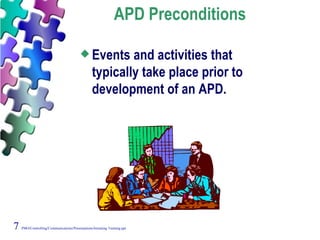
APD Preconditions Events and activities that typically take place prior to development of an APD.
APD Preconditions DHS determines there is a need. New system Change to existing system Where does the request come from? Business request Legislative mandate Federal mandate
APD Preconditions  Determine possibility of Federal funding. Designated Contact Managers Hussain Razzaki – CMS Julie Mallord – ACF & FNS Decision to establish a project and develop an APD.
APD Preconditions  Project is initiated using standard PMO Initiation Process. Project Document Library is created.   Historical record of correspondence. Provides an audit trail. Includes an APD Revision Log containing updates and amendments.
Project Document Library
APD Preconditions  Project Planning Process Project Plan Supports development of APD Guides project execution Communication Plan Establish communication links Keep stakeholders informed
APD Preconditions  Pre-APD review of the Plan Draft presentation Internal stakeholders Federal representative Formal presentation Federal representative Feedback used in preparing APD
APD Preconditions
APD Types There are 3 types of APDs Planning APD  (PAPD) Implementation APD  (IAPD) APD Update  (APDU) Similar requirements, but used for different purposes.
Planning APD (PAPD) Approval for planning costs Written plan of action Need Feasibility Costs and Benefits High-level management statement
Planning APD (PAPD) Brief document – normally 6-10 pages. Focus is describing  how  planning will be done. It’s a plan to plan. Project Plan used to develop APD
Planning APD (PAPD) Statement of Need Section Describe vision (scope & objectives) Define problems and needs Project Management Plan Section Describe project organization Describe activities/milestones
Planning APD (PAPD) There are 4 key deliverables Requirements Analysis Feasibility Study Alternatives Analysis Cost Benefits Analysis  (CBA)
Planning APD PAPD) Budget Section Describe Budget and Cost Allocation for Planning. PMO Estimating Tools. Describe resource needs for Personal Services and Services & Supplies. Contracting, Staff costs, Hardware & software, Space, Supplies, Other … Project Cost Section Provide gross estimate of  total  project costs. Explain formulas used.
PAPD Summary Brief document 4 Major Deliverables Requirements Analysis Feasibility Study Alternatives Analysis Cost/Benefits Analysis Show the Feds a clear plan to plan.
Implementation APD (IAPD) Used to get approval and Federal share of implementation costs. Provide Feds our written plan of action Design, development and implement a system. Implementation of a Transfer system.
Implementation APD (IAPD) IAPD is comprehensive and thorough. Level of detail is commensurate with complexity. Project Manager is responsible for discussing with Feds the level of detail needed.
Implementation APD (IAPD) Statement of Needs and Objectives Section Summarize needs, objectives, and anticipated benefits. Summary of Planning Section Summarize results of requirements analysis, feasibility study, and alternatives analysis. Do  not  include copies of documents.
Implementation APD (IAPD) Cost/Benefits analysis (CBA) Section Summarize results of CBA. Do  include a dated copy of CBA. Project Management Plan Section Summary of PMO Project Plan Describe project activities, deliverables, products,  project organization, and resource needs. Proposed Budget & Cost Allocation Sections
IAPD Summary Comprehensive detailed plan for designing, developing, and implementing the system. Results from the Planning deliverables are used to create the Implementation Plan.
APD Update (APDU) The Feds require APD Updates but vary on requirements. Two types of APD Updates Annual APDU provides project status updates, requests continued project funding, and reports post-implementation costs and benefits. As-Needed APDU is used to report significant changes to the project approach, procurement, methodology, schedule, or costs.
Annual APDU Submitted 60 days prior to APD anniversary. Project status report on major tasks and milestones. Activity schedule with estimated completion dates. Expenditure status of costs incurred. Updated cost/benefit analysis report. Updated budget Anticipated changes including requests for additional Federal funding.
As-Needed APDU Required to report significant changes to schedule or costs. Revised schedule and/or budget to show the change in schedule or cost. Supporting documentation to justify the need for changing a previously approved project schedule or cost. Follows format of original APD. Requirements vary per project.
APD Approval Process Draft Approval Receives verbal approval. Formal Approval Receives signature approval.
Draft Approval Internal Review & Feedback Steering Committee OIS Executive Team Key Stakeholders Federal Review & Feedback Document any revisions. Submit Revised draft APD to Regional representative.
Formal Approval Package Enhanced Federal Participation Request package (APD Package) Cover letter Written by program authority or project manager. APD Signature sheets Other dated attachments ACF requires an Executive Summary.
Formal Approval Package DHS Approval of APD Package CMS requires Program Administrator and Director signatures. ACF only requires Program Administrator signatures. Federal Approval of APD Package FedEx package with signed documents and CD with documents. Also email documents.
Federal Approval Feds have 60 days to review Approve Disapprove Grant conditional approval Ask for more information 60 days starts over with requests for more information. Provisional Approval occurs after 60 days with no response from Feds. DHS could proceed at its own risk.
Contracting Written prior approval is required before releasing RFP, before executing contracts and contract amendments that exceed threshholds for dollar value and time. Federal agency approval Department of Justice (DOJ) and Department of Administrative Services (DAS) approval
Contracting Office of Contracts and Procurement (OCP) Contract Process information on web site http://www.dhs.state.or.us/admin/contracts/
Detailed Implementation Schedule (DIS) Feds require a DIS at same time as APD and it requires prior approval.   Identifies allocated costs for design and development. Schedule and Deliverables Resource Requirements Reporting Requirements Estimated costs
Reporting Degree of reporting is at the discretion of the Federal approving authority.  Annual APDU Monthly status report Project Manager is also responsible for internal reporting. Reports are augmented by onsite visits.
Summary Purpose of an APD is to get Federal funding for the development and implementation of information systems. APD process components Preconditions APD types (Planning, Implementation, APDU) Approval Process Contracting DIS Reports
Conclusion PMO consulting support Documents on PMO web site: www.dhs.state.or.us/admin/ois/pmo Upcoming Classes APD Overview Planning APD Implementation APD APDU   www.dhs.state.or.us/training/index.html

Apd Overview Training

  • 1.
    Advance Planning DocumentProcess Overview Class presented by DHS/OIS/PMO http://egov.oregon.gov/DHS/admin/pmo/
  • 2.
    Overview Class Thispresentation describes basic components of the Advanced Planning Document (APD) process. High level look at process Introduction to process Other detailed classes Using APD Templates Agency specific
  • 3.
    Purpose of anAPD Federal funding for development and implementation of information systems. Systems that support programs under Departments of Health and Human Services and Agriculture. APD process jointly created by three Federal agencies.
  • 4.
    APD Funded Systems Department of Health and Human Services (DHHS) Administration for Children and Families (ACF) Centers for Medicare & Medicaid Services (CMS) Department of Agriculture (DOA) Food and Nutrition Services (FNS)
  • 5.
    APD Primary ObjectivesDescribe and seek approval of the DHS plan. Establish system and program performance goals. Secure approval for Federal Financial Participation (FFP). Ask for approval.
  • 6.
    Advance Planning DocumentProcess Components Preconditions to APD APD Types Planning APD Implementation APD APD Updates (APDU) Process Controls APD Close
  • 7.
    APD Preconditions Eventsand activities that typically take place prior to development of an APD.
  • 8.
    APD Preconditions DHSdetermines there is a need. New system Change to existing system Where does the request come from? Business request Legislative mandate Federal mandate
  • 9.
    APD Preconditions Determine possibility of Federal funding. Designated Contact Managers Hussain Razzaki – CMS Julie Mallord – ACF & FNS Decision to establish a project and develop an APD.
  • 10.
    APD Preconditions Project is initiated using standard PMO Initiation Process. Project Document Library is created. Historical record of correspondence. Provides an audit trail. Includes an APD Revision Log containing updates and amendments.
  • 11.
  • 12.
    APD Preconditions Project Planning Process Project Plan Supports development of APD Guides project execution Communication Plan Establish communication links Keep stakeholders informed
  • 13.
    APD Preconditions Pre-APD review of the Plan Draft presentation Internal stakeholders Federal representative Formal presentation Federal representative Feedback used in preparing APD
  • 14.
  • 15.
    APD Types Thereare 3 types of APDs Planning APD (PAPD) Implementation APD (IAPD) APD Update (APDU) Similar requirements, but used for different purposes.
  • 16.
    Planning APD (PAPD)Approval for planning costs Written plan of action Need Feasibility Costs and Benefits High-level management statement
  • 17.
    Planning APD (PAPD)Brief document – normally 6-10 pages. Focus is describing how planning will be done. It’s a plan to plan. Project Plan used to develop APD
  • 18.
    Planning APD (PAPD)Statement of Need Section Describe vision (scope & objectives) Define problems and needs Project Management Plan Section Describe project organization Describe activities/milestones
  • 19.
    Planning APD (PAPD)There are 4 key deliverables Requirements Analysis Feasibility Study Alternatives Analysis Cost Benefits Analysis (CBA)
  • 20.
    Planning APD PAPD)Budget Section Describe Budget and Cost Allocation for Planning. PMO Estimating Tools. Describe resource needs for Personal Services and Services & Supplies. Contracting, Staff costs, Hardware & software, Space, Supplies, Other … Project Cost Section Provide gross estimate of total project costs. Explain formulas used.
  • 21.
    PAPD Summary Briefdocument 4 Major Deliverables Requirements Analysis Feasibility Study Alternatives Analysis Cost/Benefits Analysis Show the Feds a clear plan to plan.
  • 22.
    Implementation APD (IAPD)Used to get approval and Federal share of implementation costs. Provide Feds our written plan of action Design, development and implement a system. Implementation of a Transfer system.
  • 23.
    Implementation APD (IAPD)IAPD is comprehensive and thorough. Level of detail is commensurate with complexity. Project Manager is responsible for discussing with Feds the level of detail needed.
  • 24.
    Implementation APD (IAPD)Statement of Needs and Objectives Section Summarize needs, objectives, and anticipated benefits. Summary of Planning Section Summarize results of requirements analysis, feasibility study, and alternatives analysis. Do not include copies of documents.
  • 25.
    Implementation APD (IAPD)Cost/Benefits analysis (CBA) Section Summarize results of CBA. Do include a dated copy of CBA. Project Management Plan Section Summary of PMO Project Plan Describe project activities, deliverables, products, project organization, and resource needs. Proposed Budget & Cost Allocation Sections
  • 26.
    IAPD Summary Comprehensivedetailed plan for designing, developing, and implementing the system. Results from the Planning deliverables are used to create the Implementation Plan.
  • 27.
    APD Update (APDU)The Feds require APD Updates but vary on requirements. Two types of APD Updates Annual APDU provides project status updates, requests continued project funding, and reports post-implementation costs and benefits. As-Needed APDU is used to report significant changes to the project approach, procurement, methodology, schedule, or costs.
  • 28.
    Annual APDU Submitted60 days prior to APD anniversary. Project status report on major tasks and milestones. Activity schedule with estimated completion dates. Expenditure status of costs incurred. Updated cost/benefit analysis report. Updated budget Anticipated changes including requests for additional Federal funding.
  • 29.
    As-Needed APDU Requiredto report significant changes to schedule or costs. Revised schedule and/or budget to show the change in schedule or cost. Supporting documentation to justify the need for changing a previously approved project schedule or cost. Follows format of original APD. Requirements vary per project.
  • 30.
    APD Approval ProcessDraft Approval Receives verbal approval. Formal Approval Receives signature approval.
  • 31.
    Draft Approval InternalReview & Feedback Steering Committee OIS Executive Team Key Stakeholders Federal Review & Feedback Document any revisions. Submit Revised draft APD to Regional representative.
  • 32.
    Formal Approval PackageEnhanced Federal Participation Request package (APD Package) Cover letter Written by program authority or project manager. APD Signature sheets Other dated attachments ACF requires an Executive Summary.
  • 33.
    Formal Approval PackageDHS Approval of APD Package CMS requires Program Administrator and Director signatures. ACF only requires Program Administrator signatures. Federal Approval of APD Package FedEx package with signed documents and CD with documents. Also email documents.
  • 34.
    Federal Approval Fedshave 60 days to review Approve Disapprove Grant conditional approval Ask for more information 60 days starts over with requests for more information. Provisional Approval occurs after 60 days with no response from Feds. DHS could proceed at its own risk.
  • 35.
    Contracting Written priorapproval is required before releasing RFP, before executing contracts and contract amendments that exceed threshholds for dollar value and time. Federal agency approval Department of Justice (DOJ) and Department of Administrative Services (DAS) approval
  • 36.
    Contracting Office ofContracts and Procurement (OCP) Contract Process information on web site http://www.dhs.state.or.us/admin/contracts/
  • 37.
    Detailed Implementation Schedule(DIS) Feds require a DIS at same time as APD and it requires prior approval. Identifies allocated costs for design and development. Schedule and Deliverables Resource Requirements Reporting Requirements Estimated costs
  • 38.
    Reporting Degree ofreporting is at the discretion of the Federal approving authority. Annual APDU Monthly status report Project Manager is also responsible for internal reporting. Reports are augmented by onsite visits.
  • 39.
    Summary Purpose ofan APD is to get Federal funding for the development and implementation of information systems. APD process components Preconditions APD types (Planning, Implementation, APDU) Approval Process Contracting DIS Reports
  • 40.
    Conclusion PMO consultingsupport Documents on PMO web site: www.dhs.state.or.us/admin/ois/pmo Upcoming Classes APD Overview Planning APD Implementation APD APDU www.dhs.state.or.us/training/index.html