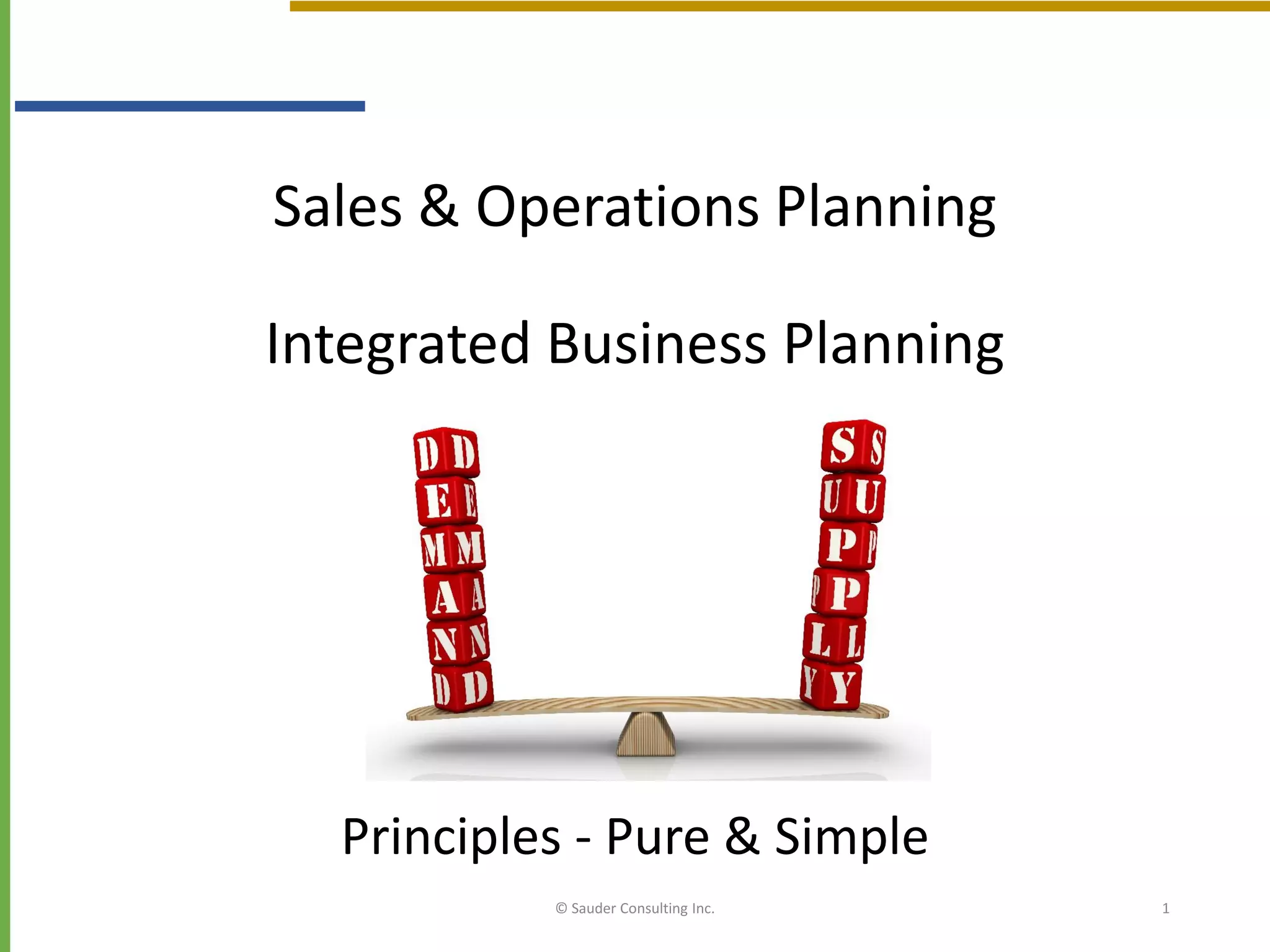
Sales & Operations Planning
Integrated Business Planning
Principles - Pure & Simple
© Sauder Consulting Inc. 1
© Sauder Consulting Inc. 2
Introduction
Sales and Operations Planning was developed in the 1980s to better align production plans, capacity, and inventory
levels with sales forecasts over a determined planning time horizon. It culminated in a monthly S&OP meeting in
which forecast/demand plans were reviewed at specified levels of product aggregation, the resulting supply plans
were presented, and any imbalance issues were discussed. Decisions from this meeting fed into demand or supply
actions.
Over time S&OP evolved to include business strategy input, marketing input, and a more rigorous financial analysis
and view of the organization. Oliver Wight pioneered these advances and appropriately called the new process
Advanced S&OP and most recently Integrated Business Planning (IBP). The monthly process expanded to five
meetings – Business (Executive) Management – Product (Marketing) Management – Demand (Sales) Management –
Supply (Operations/Supply Chain) Management – Financial Integration.
The American Production and Inventory Control Society (APICS) defines S&OP as follows:
Sales and Operations Planning (S&OP) Definition:
“A process to develop tactical plans that provide management the ability to strategically direct its businesses to
achieve competitive advantage on a continuous basis by integrating customer-focused marketing plans for new and
existing products with the management of the supply chain. The process brings together all the plans for the business
(sales, marketing, development, manufacturing, sourcing, and financial) into one integrated set of plans.”
APICS Dictionary, 14th edition
© Sauder Consulting Inc. 3
Introduction
It is interesting to note the following from the APICS definition:
1. APICS was established in 1957 by 20 production control managers. As its title indicates the focus was on
production and inventory control. I believe this was the genesis of Sales & Operations Planning
2. APICS’ most recent definition of S&OP resembles the Oliver Wight Integrated Business Planning model very
closely. It demonstrates the evolution not only of APICS, but also of S&OP.
All of the APICS and S&OP developments started before the emergence of a new discipline, SUPPLY CHAIN
MANAGEMENT. As we show in our supply chain management education, the supply chain can be defined as broadly
as starting with raw materials (in the earth) and ending with final product/service consumption by the consumer.
Managing the supply chain effectively in essence is the same as today’s definition of Sales & Operation Planning,
with one exception:
Supply Chain Management itself does not require the cadence of monthly meetings and decision making processes.
These meetings provide transparency, the opportunity for buy-in to plans, integrated decision making, and broad
communication. They require and instill disciplines that might otherwise not exist in the organization.
It is therefore my strong recommendation to develop a robust supply chain management process first, including the
right organizational structure and software support systems. Then, or at the same time if possible, “bolt on” a
disciplined and comprehensive S&OP/IBP process. I encourage you to use project management to precisely scope out
the S&OP/IBP process you want. In the following pages I will briefly discuss some of the principles of a good
S&OP/IBP process.
© Sauder Consulting Inc. 4
Introduction
The Path to S&OP/IBP
We recommend the following steps to achieve a functioning S&OP/IBP process:
1. Development of a strategic plan, or revision of the existing strategic plan to include S&OP/IBP. We offer a two
day strategic planning workshop. Click on Strategic Planning Workshop .
2. Implement a robust supply chain management program. We offer a three day course/workshop to get started.
Click on Supply Chain Management Course & Workshop .
3. Develop the appropriate S&OP/IBP process for your organization using project management discipline to
properly scope your requirements, develop an implementation plan, and execute the plan. If you are new to
project management we can help with our one day project management course. Click on
Project Management Course .
All of these courses are downloadable and designed for you to do them yourself. If you require facilitation help or
support, we will be pleased to provide it on-site (Canada) or via web.
Tom Sauder , P.Eng. January 2016
© Sauder Consulting Inc. 5
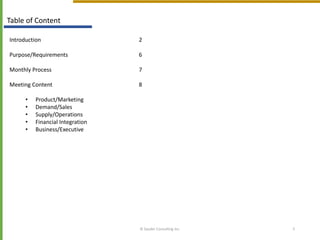
Table of Content
Introduction 2
Purpose/Requirements 6
Monthly Process 7
Meeting Content 8
• Product/Marketing
• Demand/Sales
• Supply/Operations
• Financial Integration
• Business/Executive
© Sauder Consulting Inc. 6
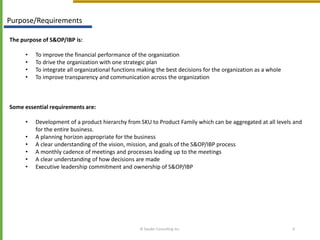
Purpose/Requirements
The purpose of S&OP/IBP is:
• To improve the financial performance of the organization
• To drive the organization with one strategic plan
• To integrate all organizational functions making the best decisions for the organization as a whole
• To improve transparency and communication across the organization
Some essential requirements are:
• Development of a product hierarchy from SKU to Product Family which can be aggregated at all levels and
for the entire business.
• A planning horizon appropriate for the business
• A clear understanding of the vision, mission, and goals of the S&OP/IBP process
• A monthly cadence of meetings and processes leading up to the meetings
• A clear understanding of how decisions are made
• Executive leadership commitment and ownership of S&OP/IBP
© Sauder Consulting Inc. 7
Monthly Process
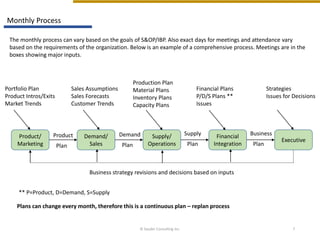
The monthly process can vary based on the goals of S&OP/IBP. Also exact days for meetings and attendance vary
based on the requirements of the organization. Below is an example of a comprehensive process. Meetings are in the
boxes showing major inputs.
Product/
Marketing
Demand/
Sales
Supply/
Operations
Financial
Integration
Executive
Portfolio Plan
Product Intros/Exits
Market Trends
Sales Assumptions
Sales Forecasts
Customer Trends
Production Plan
Material Plans
Inventory Plans
Capacity Plans
Financial Plans
P/D/S Plans **
Issues
Strategies
Issues for Decisions
Business strategy revisions and decisions based on inputs
Product
Plan
Demand
Plan
Supply
Plan
Business
Plan
Plans can change every month, therefore this is a continuous plan – replan process
** P=Product, D=Demand, S=Supply
© Sauder Consulting Inc. 8
Meeting Content
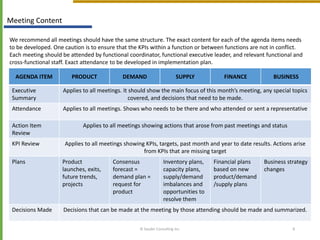
We recommend all meetings should have the same structure. The exact content for each of the agenda items needs
to be developed. One caution is to ensure that the KPIs within a function or between functions are not in conflict.
Each meeting should be attended by functional coordinator, functional executive leader, and relevant functional and
cross-functional staff. Exact attendance to be developed in implementation plan.
AGENDA ITEM PRODUCT DEMAND SUPPLY FINANCE BUSINESS
Executive
Summary
Applies to all meetings. It should show the main focus of this month’s meeting, any special topics
covered, and decisions that need to be made.
Attendance Applies to all meetings. Shows who needs to be there and who attended or sent a representative
Action Item
Review
Applies to all meetings showing actions that arose from past meetings and status
KPI Review Applies to all meetings showing KPIs, targets, past month and year to date results. Actions arise
from KPIs that are missing target
Plans Product
launches, exits,
future trends,
projects
Consensus
forecast =
demand plan =
request for
product
Inventory plans,
capacity plans,
supply/demand
imbalances and
opportunities to
resolve them
Financial plans
based on new
product/demand
/supply plans
Business strategy
changes
Decisions Made Decisions that can be made at the meeting by those attending should be made and summarized.

S&OP_IBP_Principles

  • 1.
    Sales & OperationsPlanning Integrated Business Planning Principles - Pure & Simple © Sauder Consulting Inc. 1
  • 2.
    © Sauder ConsultingInc. 2 Introduction Sales and Operations Planning was developed in the 1980s to better align production plans, capacity, and inventory levels with sales forecasts over a determined planning time horizon. It culminated in a monthly S&OP meeting in which forecast/demand plans were reviewed at specified levels of product aggregation, the resulting supply plans were presented, and any imbalance issues were discussed. Decisions from this meeting fed into demand or supply actions. Over time S&OP evolved to include business strategy input, marketing input, and a more rigorous financial analysis and view of the organization. Oliver Wight pioneered these advances and appropriately called the new process Advanced S&OP and most recently Integrated Business Planning (IBP). The monthly process expanded to five meetings – Business (Executive) Management – Product (Marketing) Management – Demand (Sales) Management – Supply (Operations/Supply Chain) Management – Financial Integration. The American Production and Inventory Control Society (APICS) defines S&OP as follows: Sales and Operations Planning (S&OP) Definition: “A process to develop tactical plans that provide management the ability to strategically direct its businesses to achieve competitive advantage on a continuous basis by integrating customer-focused marketing plans for new and existing products with the management of the supply chain. The process brings together all the plans for the business (sales, marketing, development, manufacturing, sourcing, and financial) into one integrated set of plans.” APICS Dictionary, 14th edition
  • 3.
    © Sauder ConsultingInc. 3 Introduction It is interesting to note the following from the APICS definition: 1. APICS was established in 1957 by 20 production control managers. As its title indicates the focus was on production and inventory control. I believe this was the genesis of Sales & Operations Planning 2. APICS’ most recent definition of S&OP resembles the Oliver Wight Integrated Business Planning model very closely. It demonstrates the evolution not only of APICS, but also of S&OP. All of the APICS and S&OP developments started before the emergence of a new discipline, SUPPLY CHAIN MANAGEMENT. As we show in our supply chain management education, the supply chain can be defined as broadly as starting with raw materials (in the earth) and ending with final product/service consumption by the consumer. Managing the supply chain effectively in essence is the same as today’s definition of Sales & Operation Planning, with one exception: Supply Chain Management itself does not require the cadence of monthly meetings and decision making processes. These meetings provide transparency, the opportunity for buy-in to plans, integrated decision making, and broad communication. They require and instill disciplines that might otherwise not exist in the organization. It is therefore my strong recommendation to develop a robust supply chain management process first, including the right organizational structure and software support systems. Then, or at the same time if possible, “bolt on” a disciplined and comprehensive S&OP/IBP process. I encourage you to use project management to precisely scope out the S&OP/IBP process you want. In the following pages I will briefly discuss some of the principles of a good S&OP/IBP process.
  • 4.
    © Sauder ConsultingInc. 4 Introduction The Path to S&OP/IBP We recommend the following steps to achieve a functioning S&OP/IBP process: 1. Development of a strategic plan, or revision of the existing strategic plan to include S&OP/IBP. We offer a two day strategic planning workshop. Click on Strategic Planning Workshop . 2. Implement a robust supply chain management program. We offer a three day course/workshop to get started. Click on Supply Chain Management Course & Workshop . 3. Develop the appropriate S&OP/IBP process for your organization using project management discipline to properly scope your requirements, develop an implementation plan, and execute the plan. If you are new to project management we can help with our one day project management course. Click on Project Management Course . All of these courses are downloadable and designed for you to do them yourself. If you require facilitation help or support, we will be pleased to provide it on-site (Canada) or via web. Tom Sauder , P.Eng. January 2016
  • 5.
    © Sauder ConsultingInc. 5 Table of Content Introduction 2 Purpose/Requirements 6 Monthly Process 7 Meeting Content 8 • Product/Marketing • Demand/Sales • Supply/Operations • Financial Integration • Business/Executive
  • 6.
    © Sauder ConsultingInc. 6 Purpose/Requirements The purpose of S&OP/IBP is: • To improve the financial performance of the organization • To drive the organization with one strategic plan • To integrate all organizational functions making the best decisions for the organization as a whole • To improve transparency and communication across the organization Some essential requirements are: • Development of a product hierarchy from SKU to Product Family which can be aggregated at all levels and for the entire business. • A planning horizon appropriate for the business • A clear understanding of the vision, mission, and goals of the S&OP/IBP process • A monthly cadence of meetings and processes leading up to the meetings • A clear understanding of how decisions are made • Executive leadership commitment and ownership of S&OP/IBP
  • 7.
    © Sauder ConsultingInc. 7 Monthly Process The monthly process can vary based on the goals of S&OP/IBP. Also exact days for meetings and attendance vary based on the requirements of the organization. Below is an example of a comprehensive process. Meetings are in the boxes showing major inputs. Product/ Marketing Demand/ Sales Supply/ Operations Financial Integration Executive Portfolio Plan Product Intros/Exits Market Trends Sales Assumptions Sales Forecasts Customer Trends Production Plan Material Plans Inventory Plans Capacity Plans Financial Plans P/D/S Plans ** Issues Strategies Issues for Decisions Business strategy revisions and decisions based on inputs Product Plan Demand Plan Supply Plan Business Plan Plans can change every month, therefore this is a continuous plan – replan process ** P=Product, D=Demand, S=Supply
  • 8.
    © Sauder ConsultingInc. 8 Meeting Content We recommend all meetings should have the same structure. The exact content for each of the agenda items needs to be developed. One caution is to ensure that the KPIs within a function or between functions are not in conflict. Each meeting should be attended by functional coordinator, functional executive leader, and relevant functional and cross-functional staff. Exact attendance to be developed in implementation plan. AGENDA ITEM PRODUCT DEMAND SUPPLY FINANCE BUSINESS Executive Summary Applies to all meetings. It should show the main focus of this month’s meeting, any special topics covered, and decisions that need to be made. Attendance Applies to all meetings. Shows who needs to be there and who attended or sent a representative Action Item Review Applies to all meetings showing actions that arose from past meetings and status KPI Review Applies to all meetings showing KPIs, targets, past month and year to date results. Actions arise from KPIs that are missing target Plans Product launches, exits, future trends, projects Consensus forecast = demand plan = request for product Inventory plans, capacity plans, supply/demand imbalances and opportunities to resolve them Financial plans based on new product/demand /supply plans Business strategy changes Decisions Made Decisions that can be made at the meeting by those attending should be made and summarized.