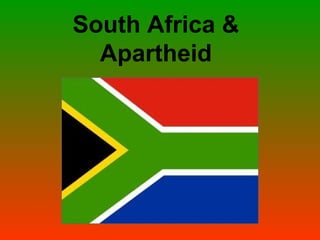
South Africa &
Apartheid
Cultures Clash
• The Dutch were the first
Europeans to settle in
South Africa.
• They set up a trade
station near the Cape of
Good Hope.
• The Europeans who settled
in South Africa called
themselves Afrikaners.
• Eventually, the British took
control of most of South
Africa.
Cultures Clash
• The British and the
Afrikaners (also known as
the Boers) fought each
other for control of South
Africa.
• The British also fought
with the Zulu tribe.
• The British eventually
defeated the Afrikaners
and Zulus and declared
South Africa an
independent country in
1910.
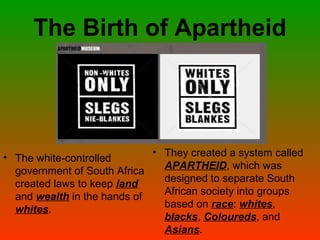
The Birth of Apartheid
• The white-controlled
government of South Africa
created laws to keep land
and wealth in the hands of
whites.
• They created a system called
APARTHEID, which was
designed to separate South
African society into groups
based on race: whites,
blacks, Coloureds, and
Asians.
Apartheid Takes Hold
The Impact of Apartheid
• It forced blacks to move to
poor rural areas called
HOMELANDS.
• Blacks could not vote.
• Blacks were kept in low-
paying jobs.
• Blacks were put in poor
schools.
• Blacks had to carry
identification.
• Separate schools,
restaurants, and
hospitals were created
for whites and blacks.
The Impact of Apartheid
Prohibition of Mixed Marriages Act, Act No
55 of 1949
prohibited marriages between white people and
people of other races.
Population Registration Act, Act No 30 of
1950
led to the creation of a national register in
which every person's race was recorded.
Extension of University Education Act,
Act 45 of 1959
put an end to black students attending
white universities
Group Areas Act, Act No 41 of 1950
forced physical separation between races
by creating different residential areas for
different races
The Struggle to Defeat Apartheid
• After many years of
protests from black South
Africans and pressure from
foreign countries,
APARTHEID was finally
ended by President F.W. de
Klerk.
• In 1994, Nelson Mandela,
who had spent 28 years in
prison for fighting
APARTHEID, was elected
president of South Africa
during the country’s first
multiracial election.
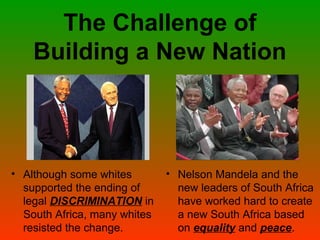
The Challenge of
Building a New Nation
• Although some whites
supported the ending of
legal DISCRIMINATION in
South Africa, many whites
resisted the change.
• Nelson Mandela and the
new leaders of South Africa
have worked hard to create
a new South Africa based
on equality and peace.
The End of Apartheid
Issues Facing South Africa Today
• Although South Africa
has a stable
government and one of
the strongest
economies in Africa, it
still faces many issues:
– economic inequality
(whites still control
most of wealth)
– fear of change
– HIV/AIDS

Apartheid

  • 1.
  • 2.
    Cultures Clash • TheDutch were the first Europeans to settle in South Africa. • They set up a trade station near the Cape of Good Hope. • The Europeans who settled in South Africa called themselves Afrikaners. • Eventually, the British took control of most of South Africa.
  • 3.
    Cultures Clash • TheBritish and the Afrikaners (also known as the Boers) fought each other for control of South Africa. • The British also fought with the Zulu tribe. • The British eventually defeated the Afrikaners and Zulus and declared South Africa an independent country in 1910.
  • 4.
    The Birth ofApartheid • The white-controlled government of South Africa created laws to keep land and wealth in the hands of whites. • They created a system called APARTHEID, which was designed to separate South African society into groups based on race: whites, blacks, Coloureds, and Asians.
  • 5.
  • 6.
    The Impact ofApartheid • It forced blacks to move to poor rural areas called HOMELANDS. • Blacks could not vote. • Blacks were kept in low- paying jobs. • Blacks were put in poor schools. • Blacks had to carry identification. • Separate schools, restaurants, and hospitals were created for whites and blacks.
  • 7.
    The Impact ofApartheid
  • 8.
    The Impact ofApartheid Prohibition of Mixed Marriages Act, Act No 55 of 1949 prohibited marriages between white people and people of other races. Population Registration Act, Act No 30 of 1950 led to the creation of a national register in which every person's race was recorded. Extension of University Education Act, Act 45 of 1959 put an end to black students attending white universities Group Areas Act, Act No 41 of 1950 forced physical separation between races by creating different residential areas for different races
  • 9.
    The Struggle toDefeat Apartheid • After many years of protests from black South Africans and pressure from foreign countries, APARTHEID was finally ended by President F.W. de Klerk. • In 1994, Nelson Mandela, who had spent 28 years in prison for fighting APARTHEID, was elected president of South Africa during the country’s first multiracial election.
  • 10.
    The Challenge of Buildinga New Nation • Although some whites supported the ending of legal DISCRIMINATION in South Africa, many whites resisted the change. • Nelson Mandela and the new leaders of South Africa have worked hard to create a new South Africa based on equality and peace.
  • 11.
    The End ofApartheid
  • 12.
    Issues Facing SouthAfrica Today • Although South Africa has a stable government and one of the strongest economies in Africa, it still faces many issues: – economic inequality (whites still control most of wealth) – fear of change – HIV/AIDS