1 
PRESENTED 
BY 
APARNA.A.L 
MATHEMATICS 
REG: 13973002 
KUCTE KOLLAM
2 
NATURAL 
RESOURCES-CONGRUENCE, 
SIMILARITY
3 
SI: NO. CONTENT PAGE NO. 
1 
INTRODUCTION 
4 
2 
CONTENT 
5-8 
3 
CONCLUSION 
9 
4 
REFERANCE 
10 
INDEX
4 
INTRODUCTION 
Natural resources occur naturally within environments that 
exist relatively undisturbed by humanity, in a natural form. 
A natural resource is often characterized by amounts of 
biodiversity and geodiversity existent in various 
ecosystems. In geometry, two figures or objects are 
congruent if they have the same shape and size, or if one 
has the same shape and size as the mirror image of the 
other. Two geometrical objects are called similar if they 
both have the same shape, or one has the same shape as 
the mirror image of the other. 
CONTENT
5 
In elementary geometry the word congruent is often used 
as follows. The word equal is often used in place of 
congruent for these objects. 
 Two line segments are congruent if they have the same 
length. 
 Two angles are congruent if they have the same 
measure. 
 Two circles are congruent if they have the same 
diameter 
. 
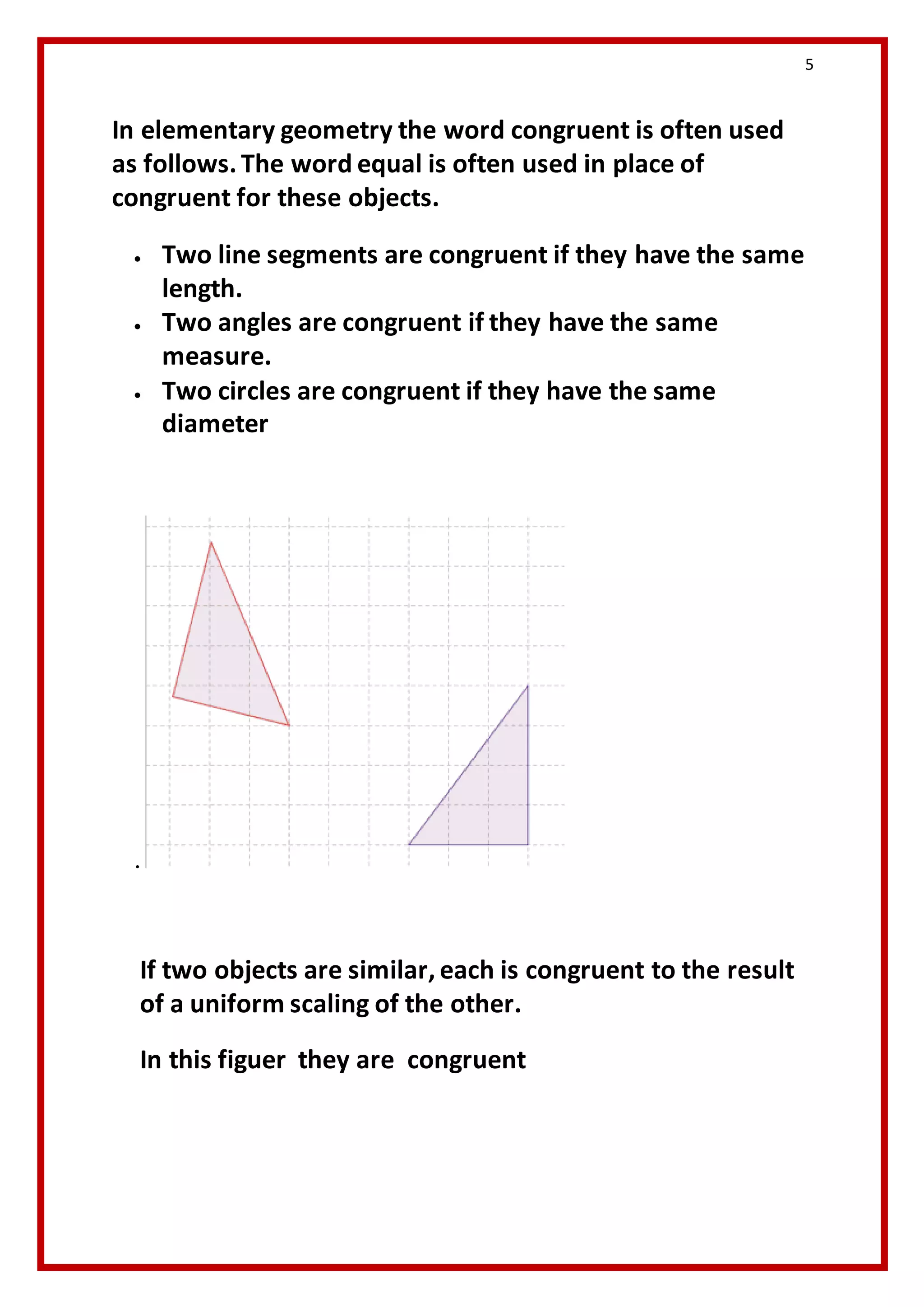
If two objects are similar, each is congruent to the result 
of a uniform scaling of the other. 
In this figuer they are congruent
6 
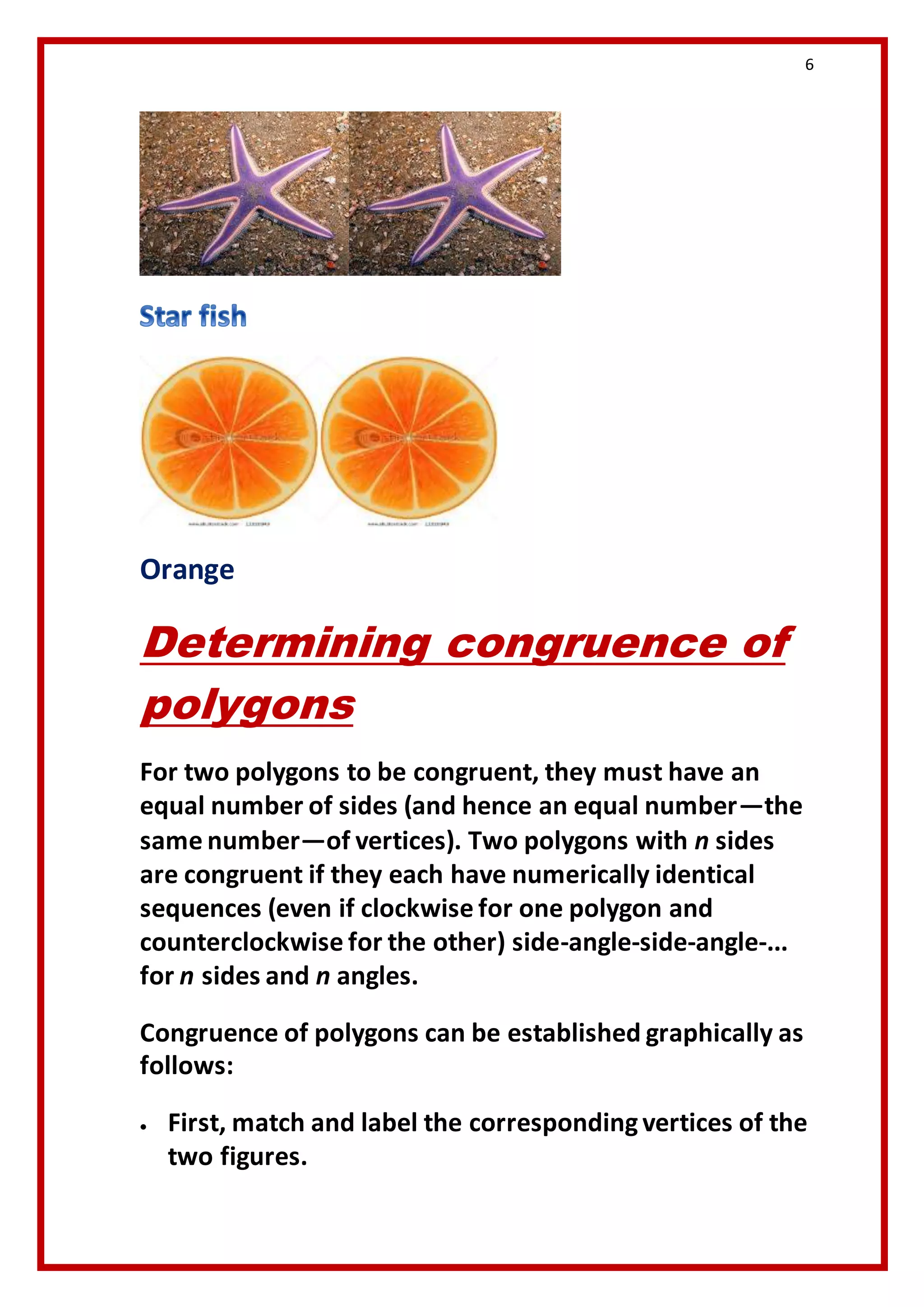
Orange 
Determining congruence of 
polygons 
For two polygons to be congruent, they must have an 
equal number of sides (and hence an equal number—the 
same number—of vertices). Two polygons with n sides 
are congruent if they each have numerically identical 
sequences (even if clockwise for one polygon and 
counterclockwise for the other) side-angle-side-angle-... 
for n sides and n angles. 
Congruence of polygons can be established graphically as 
follows: 
 First, match and label the corresponding vertices of the 
two figures.
7 
 Second, draw a vector from one of the vertices of the 
one of the figures to the corresponding vertex of the 
other figure. Translate the first figure by this vector so 
that these two vertices match. 
 Third, rotate the translated figure about the matched 
vertex until one pair of corresponding sides matches. 
 Fourth, reflect the rotated figure about this matched 
side until the figures match. 
If at anytime the step cannot be completed, the polygons 
are not congruent. 
Similarity 
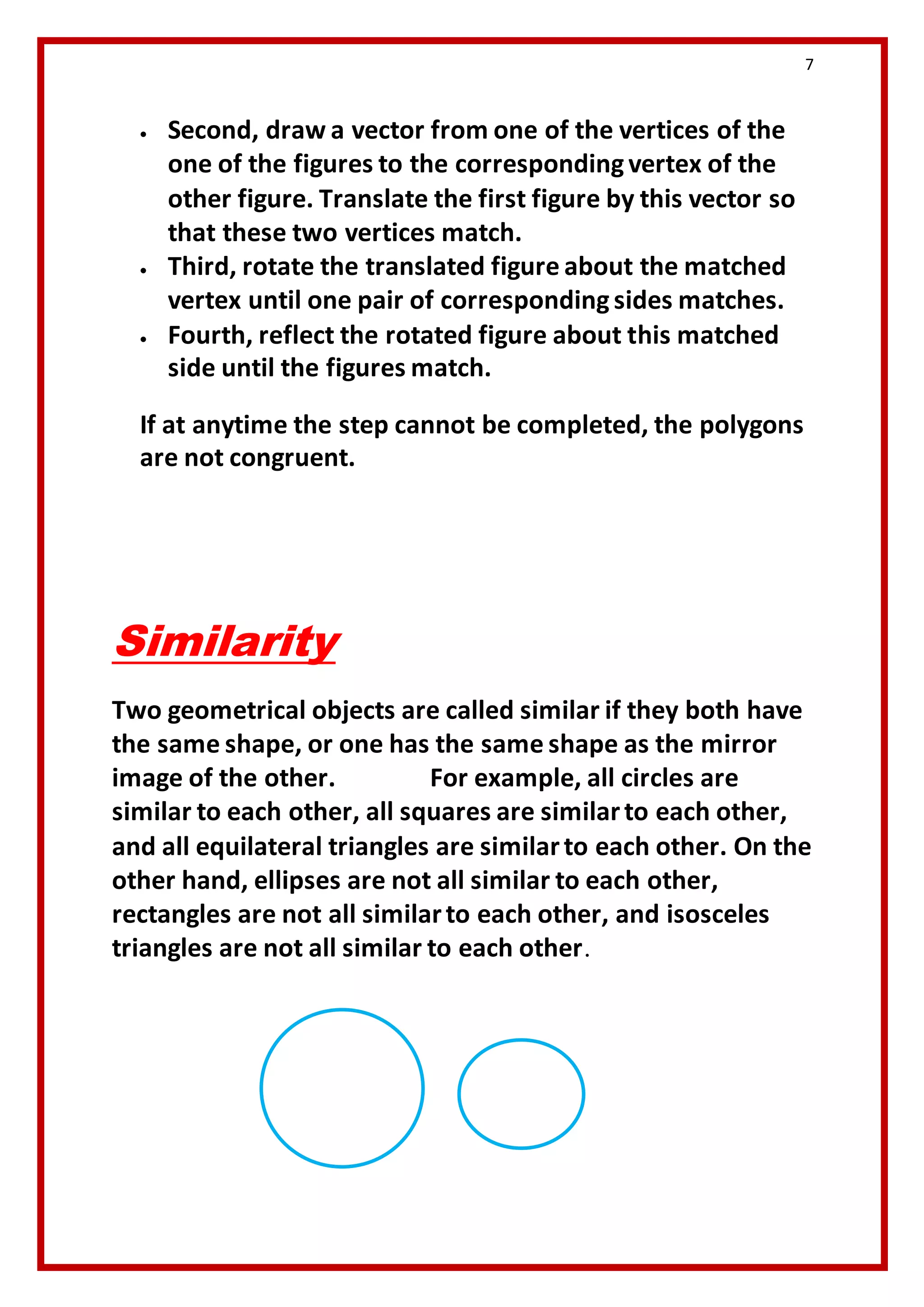
Two geometrical objects are called similar if they both have 
the same shape, or one has the same shape as the mirror 
image of the other. For example, all circles are 
similar to each other, all squares are similar to each other, 
and all equilateral triangles are similar to each other. On the 
other hand, ellipses are not all similar to each other, 
rectangles are not all similar to each other, and isosceles 
triangles are not all similar to each other. 
Two 
geometrical 
objects are 
called 
similar if 
they both 
have the 
same shape, 
or one has 
the same 
shape as the 
mirror 
Two 
geometr 
ical 
objects 
are 
called 
similar if 
they 
both 
have the 
same
8 
These are similar circle. 
Orange 
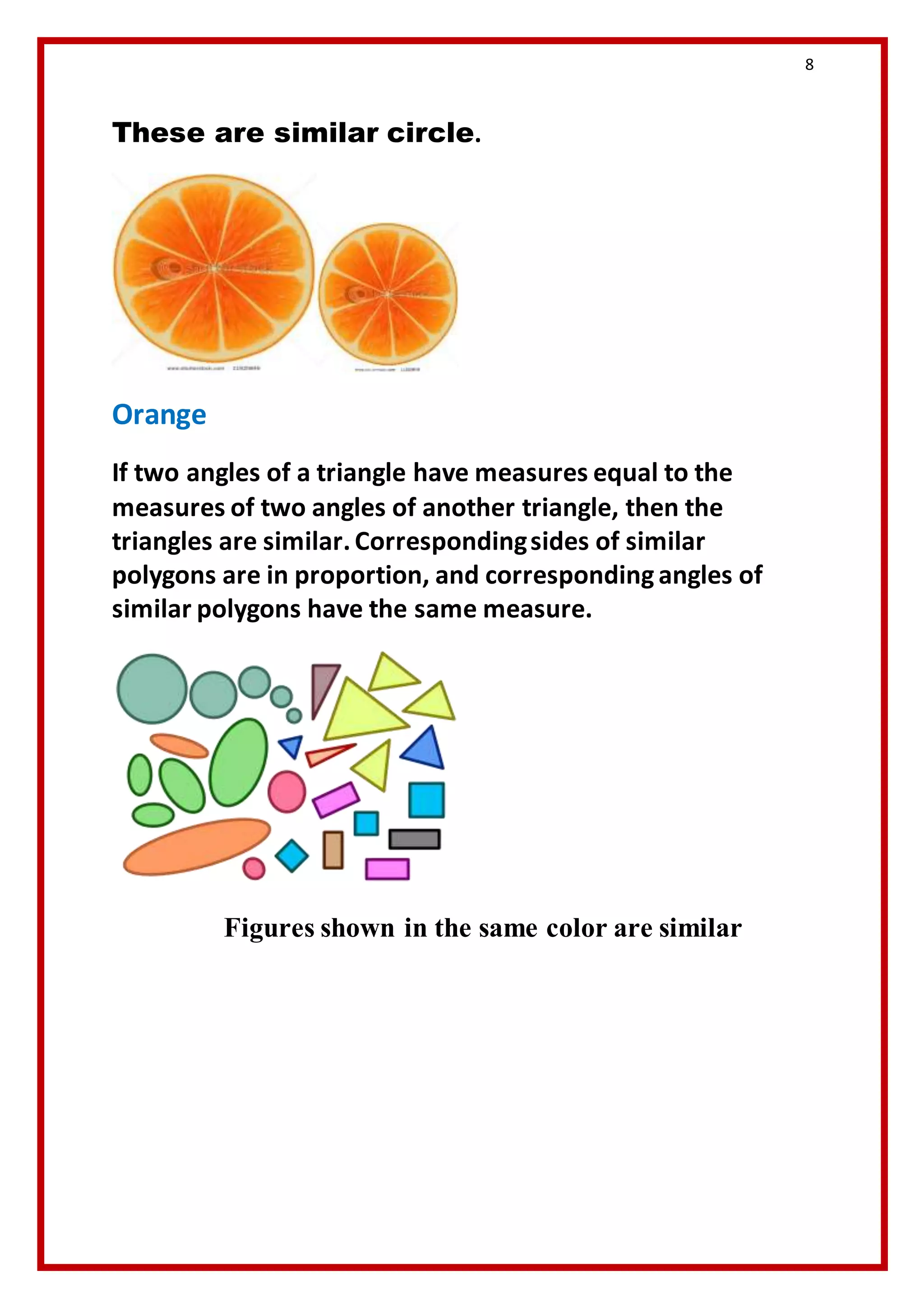
If two angles of a triangle have measures equal to the 
measures of two angles of another triangle, then the 
triangles are similar. Corresponding sides of similar 
polygons are in proportion, and corresponding angles of 
similar polygons have the same measure. 
Figures shown in the same color are similar
9 
Conclusion 
Two triangles are congruent if their corresponding sides are 
equal in length and their corresponding angles are equal in 
size. Either object can be rescaled, repositioned, and 
reflected, so as to coincide precisely with the other object. 
If two objects are similar, each is congruent to the result of 
a uniform scaling of the other. Two geometrical objects are 
called similar if they both have the same Two geometrical 
objects are called similar if they both have the same shape, 
or one has the same shape as the mirror image of the other, 
or one has the same shape as the mirror image of the other.
10 
1. http://www.mathsisfun.com/congruence/similar 
ity.html 
2. http://en.wikipedia.org/wiki/Similarity 
3. http://en.wikipedia.org/wiki/congruence

Aparna assignment

  • 1.
    1 PRESENTED BY APARNA.A.L MATHEMATICS REG: 13973002 KUCTE KOLLAM
  • 2.
  • 3.
    3 SI: NO.CONTENT PAGE NO. 1 INTRODUCTION 4 2 CONTENT 5-8 3 CONCLUSION 9 4 REFERANCE 10 INDEX
  • 4.
    4 INTRODUCTION Naturalresources occur naturally within environments that exist relatively undisturbed by humanity, in a natural form. A natural resource is often characterized by amounts of biodiversity and geodiversity existent in various ecosystems. In geometry, two figures or objects are congruent if they have the same shape and size, or if one has the same shape and size as the mirror image of the other. Two geometrical objects are called similar if they both have the same shape, or one has the same shape as the mirror image of the other. CONTENT
  • 5.
    5 In elementarygeometry the word congruent is often used as follows. The word equal is often used in place of congruent for these objects.  Two line segments are congruent if they have the same length.  Two angles are congruent if they have the same measure.  Two circles are congruent if they have the same diameter . If two objects are similar, each is congruent to the result of a uniform scaling of the other. In this figuer they are congruent
  • 6.
    6 Orange Determiningcongruence of polygons For two polygons to be congruent, they must have an equal number of sides (and hence an equal number—the same number—of vertices). Two polygons with n sides are congruent if they each have numerically identical sequences (even if clockwise for one polygon and counterclockwise for the other) side-angle-side-angle-... for n sides and n angles. Congruence of polygons can be established graphically as follows:  First, match and label the corresponding vertices of the two figures.
  • 7.
    7  Second,draw a vector from one of the vertices of the one of the figures to the corresponding vertex of the other figure. Translate the first figure by this vector so that these two vertices match.  Third, rotate the translated figure about the matched vertex until one pair of corresponding sides matches.  Fourth, reflect the rotated figure about this matched side until the figures match. If at anytime the step cannot be completed, the polygons are not congruent. Similarity Two geometrical objects are called similar if they both have the same shape, or one has the same shape as the mirror image of the other. For example, all circles are similar to each other, all squares are similar to each other, and all equilateral triangles are similar to each other. On the other hand, ellipses are not all similar to each other, rectangles are not all similar to each other, and isosceles triangles are not all similar to each other. Two geometrical objects are called similar if they both have the same shape, or one has the same shape as the mirror Two geometr ical objects are called similar if they both have the same
  • 8.
    8 These aresimilar circle. Orange If two angles of a triangle have measures equal to the measures of two angles of another triangle, then the triangles are similar. Corresponding sides of similar polygons are in proportion, and corresponding angles of similar polygons have the same measure. Figures shown in the same color are similar
  • 9.
    9 Conclusion Twotriangles are congruent if their corresponding sides are equal in length and their corresponding angles are equal in size. Either object can be rescaled, repositioned, and reflected, so as to coincide precisely with the other object. If two objects are similar, each is congruent to the result of a uniform scaling of the other. Two geometrical objects are called similar if they both have the same Two geometrical objects are called similar if they both have the same shape, or one has the same shape as the mirror image of the other, or one has the same shape as the mirror image of the other.
  • 10.
    10 1. http://www.mathsisfun.com/congruence/similar ity.html 2. http://en.wikipedia.org/wiki/Similarity 3. http://en.wikipedia.org/wiki/congruence