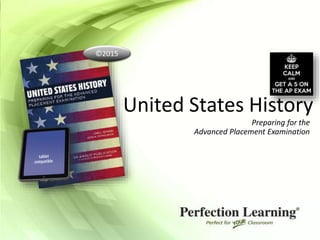
United States History
Preparing for the
Advanced Placement Examination
©2015
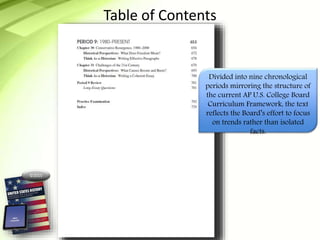
Table of Contents
©2015
Divided into nine chronological
periods mirroring the structure of
the current AP U.S. College Board
Curriculum Framework, the text
reflects the Board’s effort to focus
on trends rather than isolated
facts.
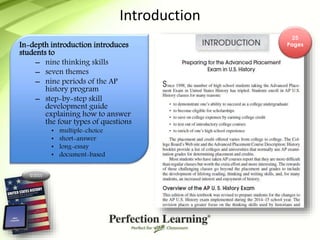
In-depth introduction introduces
students to
– nine thinking skills
– seven themes
– nine periods of the AP
history program
– step-by-step skill
development guide
explaining how to answer
the four types of questions
• multiple-choice
• short-answer
• long-essay
• document-based
©2015
Introduction
25
Pages
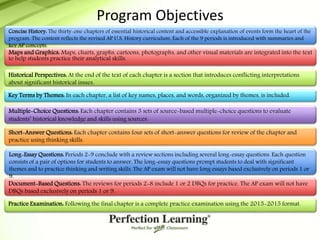
Program Objectives
Concise History: The thirty-one chapters of essential historical content and accessible explanation of events form the heart of the
program. The content reflects the revised AP U.S. History curriculum. Each of the 9 periods is introduced with summaries and
key AP concepts.
Maps and Graphics: Maps, charts, graphs, cartoons, photographs, and other visual materials are integrated into the text
to help students practice their analytical skills.
Historical Perspectives: At the end of the text of each chapter is a section that introduces conflicting interpretations
about significant historical issues.
Key Terms by Themes: In each chapter, a list of key names, places, and words, organized by themes, is included.
Multiple-Choice Questions: Each chapter contains 3 sets of source-based multiple-choice questions to evaluate
students’ historical knowledge and skills using sources.
Short-Answer Questions: Each chapter contains four sets of short-answer questions for review of the chapter and
practice using thinking skills.
Long-Essay Questions: Periods 2-9 conclude with a review sections including several long-essay questions. Each question
consists of a pair of options for students to answer. The long-essay questions prompt students to deal with significant
themes and to practice thinking and writing skills. The AP exam will not have long essays based exclusively on periods 1 or
9.
Document-Based Questions: The reviews for periods 2-8 include 1 or 2 DBQs for practice. The AP exam will not have
DBQs based exclusively on periods 1 or 9.
Practice Examination: Following the final chapter is a complete practice examination using the 2015-2015 format.
©2015
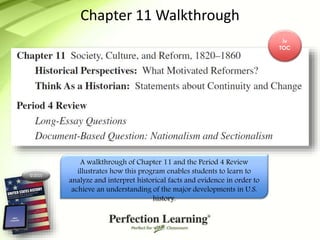
Chapter 11 Walkthrough
iv
TOC
A walkthrough of Chapter 11 and the Period 4 Review
illustrates how this program enables students to learn to
analyze and interpret historical facts and evidence in order to
achieve an understanding of the major developments in U.S.
history.
©2015
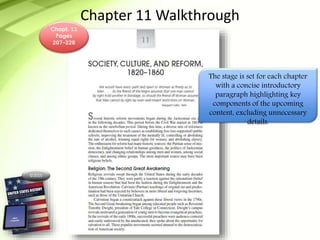
Chapter 11 Walkthrough
Chapt. 11
Pages
207-228
The stage is set for each chapter
with a concise introductory
paragraph highlighting key
components of the upcoming
content, excluding unnecessary
details.
©2015
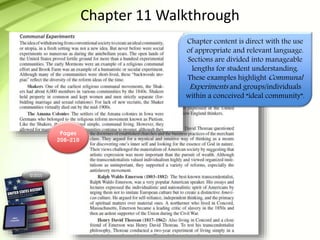
Chapter 11 Walkthrough
Chapter content is direct with the use
of appropriate and relevant language.
Sections are divided into manageable
lengths for student understanding.
These examples highlight Communal
Experiments and groups/individuals
within a conceived “ideal community”.
Pages
208-210
©2015
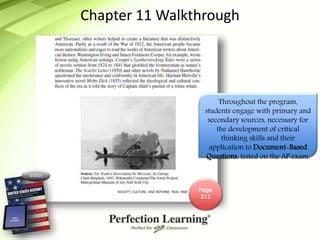
Chapter 11 Walkthrough
Throughout the program,
students engage with primary and
secondary sources, necessary for
the development of critical
thinking skills and their
application to Document-Based
Questions, tested on the AP exam.
Page
211
©2015
Chapter 11 Walkthrough
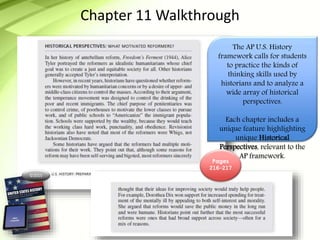
The AP U.S. History
framework calls for students
to practice the kinds of
thinking skills used by
historians and to analyze a
wide array of historical
perspectives.
Each chapter includes a
unique feature highlighting
unique Historical
Perspectives, relevant to the
AP framework.
Pages
216-217
©2015
Chapter 11 Walkthrough
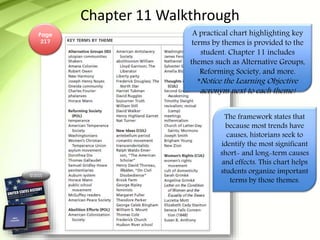
A practical chart highlighting key
terms by themes is provided to the
student. Chapter 11 includes
themes such as Alternative Groups,
Reforming Society, and more.
*Notice the Learning Objective
acronym next to each theme!
Page
217
The framework states that
because most trends have
causes, historians seek to
identify the most significant
short- and long-term causes
and effects. This chart helps
students organize important
terms by those themes.
©2015
Chapter 11 Walkthrough
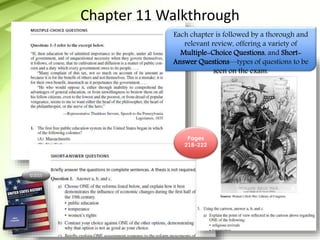
Each chapter is followed by a thorough and
relevant review, offering a variety of
Multiple-Choice Questions, and Short-
Answer Questions—types of questions to be
seen on the exam.
Pages
218-222
©2015
Chapter 11 Walkthrough
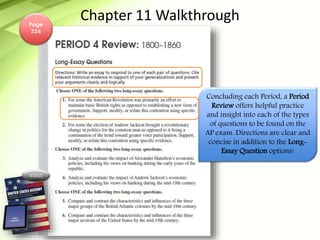
Concluding each Period, a Period
Review offers helpful practice
and insight into each of the types
of questions to be found on the
AP exam. Directions are clear and
concise in addition to the Long-
Essay Question options!
Page
224
©2015
Chapter 11 Walkthrough
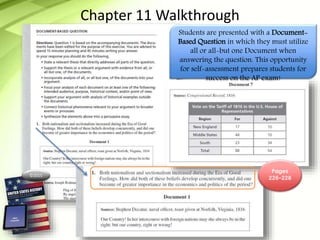
Students are presented with a Document-
Based Question in which they must utilize
all or all-but one Document when
answering the question. This opportunity
for self-assessment prepares students for
success on the AP exam!
Pages
226-228
©2015
Answer Key with Teacher Support
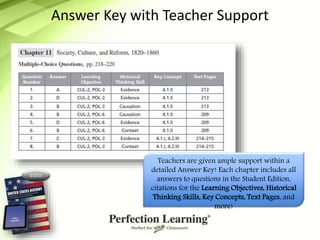
Teachers are given ample support within a
detailed Answer Key! Each chapter includes all
answers to questions in the Student Edition,
citations for the Learning Objectives, Historical
Thinking Skills, Key Concepts, Text Pages, and
more!
©2015
Answer Key with Teacher Support
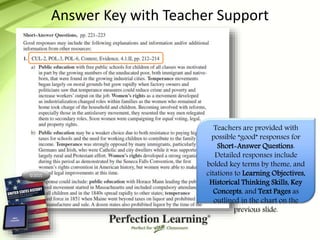
Teachers are provided with
possible “good” responses for
Short-Answer Questions.
Detailed responses include
bolded key terms by theme, and
citations to Learning Objectives,
Historical Thinking Skills, Key
Concepts, and Text Pages as
outlined in the chart on the
previous slide.
©2015
Answer Key with Teacher Support
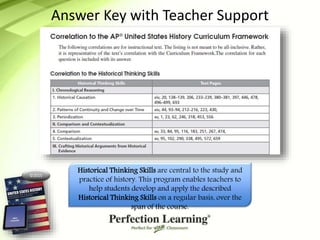
Historical Thinking Skills are central to the study and
practice of history. This program enables teachers to
help students develop and apply the described
Historical Thinking Skills on a regular basis, over the
span of the course.
Kim Moore| Consultant
kmoore@perfectionlearning.com
Toll Free: (866) 252-6580 ext. 1165
Fun & valuable programs, perfect for your classroom!
More information on these
programs and other Social Studies
programs can be found at
www.perfectionlearning.com!
To access the online version of
these programs, please contact
Kim Moore.
AMSCO AP U.S. & World History
©2015
©2015
Megan Hartman | Regional Sales Manager
mhartman@perfectionlearning.com
Toll Free: (866) 252-6580 ext. 1161

AP US History Resource Book

  • 1.
    United States History Preparingfor the Advanced Placement Examination ©2015
  • 2.
    Table of Contents ©2015 Dividedinto nine chronological periods mirroring the structure of the current AP U.S. College Board Curriculum Framework, the text reflects the Board’s effort to focus on trends rather than isolated facts.
  • 3.
    In-depth introduction introduces studentsto – nine thinking skills – seven themes – nine periods of the AP history program – step-by-step skill development guide explaining how to answer the four types of questions • multiple-choice • short-answer • long-essay • document-based ©2015 Introduction 25 Pages
  • 4.
    Program Objectives Concise History:The thirty-one chapters of essential historical content and accessible explanation of events form the heart of the program. The content reflects the revised AP U.S. History curriculum. Each of the 9 periods is introduced with summaries and key AP concepts. Maps and Graphics: Maps, charts, graphs, cartoons, photographs, and other visual materials are integrated into the text to help students practice their analytical skills. Historical Perspectives: At the end of the text of each chapter is a section that introduces conflicting interpretations about significant historical issues. Key Terms by Themes: In each chapter, a list of key names, places, and words, organized by themes, is included. Multiple-Choice Questions: Each chapter contains 3 sets of source-based multiple-choice questions to evaluate students’ historical knowledge and skills using sources. Short-Answer Questions: Each chapter contains four sets of short-answer questions for review of the chapter and practice using thinking skills. Long-Essay Questions: Periods 2-9 conclude with a review sections including several long-essay questions. Each question consists of a pair of options for students to answer. The long-essay questions prompt students to deal with significant themes and to practice thinking and writing skills. The AP exam will not have long essays based exclusively on periods 1 or 9. Document-Based Questions: The reviews for periods 2-8 include 1 or 2 DBQs for practice. The AP exam will not have DBQs based exclusively on periods 1 or 9. Practice Examination: Following the final chapter is a complete practice examination using the 2015-2015 format.
  • 5.
    ©2015 Chapter 11 Walkthrough iv TOC Awalkthrough of Chapter 11 and the Period 4 Review illustrates how this program enables students to learn to analyze and interpret historical facts and evidence in order to achieve an understanding of the major developments in U.S. history.
  • 6.
    ©2015 Chapter 11 Walkthrough Chapt.11 Pages 207-228 The stage is set for each chapter with a concise introductory paragraph highlighting key components of the upcoming content, excluding unnecessary details.
  • 7.
    ©2015 Chapter 11 Walkthrough Chaptercontent is direct with the use of appropriate and relevant language. Sections are divided into manageable lengths for student understanding. These examples highlight Communal Experiments and groups/individuals within a conceived “ideal community”. Pages 208-210
  • 8.
    ©2015 Chapter 11 Walkthrough Throughoutthe program, students engage with primary and secondary sources, necessary for the development of critical thinking skills and their application to Document-Based Questions, tested on the AP exam. Page 211
  • 9.
    ©2015 Chapter 11 Walkthrough TheAP U.S. History framework calls for students to practice the kinds of thinking skills used by historians and to analyze a wide array of historical perspectives. Each chapter includes a unique feature highlighting unique Historical Perspectives, relevant to the AP framework. Pages 216-217
  • 10.
    ©2015 Chapter 11 Walkthrough Apractical chart highlighting key terms by themes is provided to the student. Chapter 11 includes themes such as Alternative Groups, Reforming Society, and more. *Notice the Learning Objective acronym next to each theme! Page 217 The framework states that because most trends have causes, historians seek to identify the most significant short- and long-term causes and effects. This chart helps students organize important terms by those themes.
  • 11.
    ©2015 Chapter 11 Walkthrough Eachchapter is followed by a thorough and relevant review, offering a variety of Multiple-Choice Questions, and Short- Answer Questions—types of questions to be seen on the exam. Pages 218-222
  • 12.
    ©2015 Chapter 11 Walkthrough Concludingeach Period, a Period Review offers helpful practice and insight into each of the types of questions to be found on the AP exam. Directions are clear and concise in addition to the Long- Essay Question options! Page 224
  • 13.
    ©2015 Chapter 11 Walkthrough Studentsare presented with a Document- Based Question in which they must utilize all or all-but one Document when answering the question. This opportunity for self-assessment prepares students for success on the AP exam! Pages 226-228
  • 14.
    ©2015 Answer Key withTeacher Support Teachers are given ample support within a detailed Answer Key! Each chapter includes all answers to questions in the Student Edition, citations for the Learning Objectives, Historical Thinking Skills, Key Concepts, Text Pages, and more!
  • 15.
    ©2015 Answer Key withTeacher Support Teachers are provided with possible “good” responses for Short-Answer Questions. Detailed responses include bolded key terms by theme, and citations to Learning Objectives, Historical Thinking Skills, Key Concepts, and Text Pages as outlined in the chart on the previous slide.
  • 16.
    ©2015 Answer Key withTeacher Support Historical Thinking Skills are central to the study and practice of history. This program enables teachers to help students develop and apply the described Historical Thinking Skills on a regular basis, over the span of the course.
  • 17.
    Kim Moore| Consultant kmoore@perfectionlearning.com TollFree: (866) 252-6580 ext. 1165 Fun & valuable programs, perfect for your classroom! More information on these programs and other Social Studies programs can be found at www.perfectionlearning.com! To access the online version of these programs, please contact Kim Moore. AMSCO AP U.S. & World History ©2015 ©2015 Megan Hartman | Regional Sales Manager mhartman@perfectionlearning.com Toll Free: (866) 252-6580 ext. 1161