AP WORLD HISTORY:  MAKING OPEN-ENROLLMENT WORK Longwood High School: Middle Island, NY
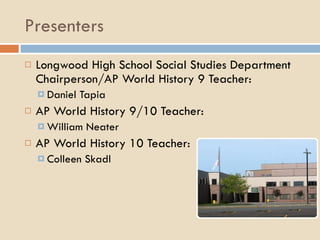
Presenters Longwood High School Social Studies Department Chairperson/AP World History 9 Teacher: Daniel Tapia AP World History 9/10 Teacher: William Neater AP World History 10 Teacher: Colleen Skadl
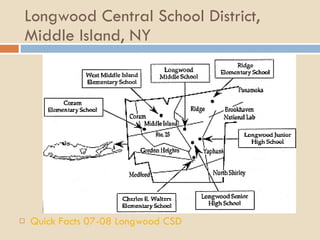
Longwood Central School District, Middle Island, NY  Quick Facts 07-08 Longwood CSD
Social Studies at Longwood HS 9 th  Grade Regents Global History and Geography 9 AP World History 9 10 th  Grade Regents Global History and Geography 10 Block AP World History 10 Block 11 th  Grade Regents US History and Government AP US History Participation in Government Offerings (as desired)
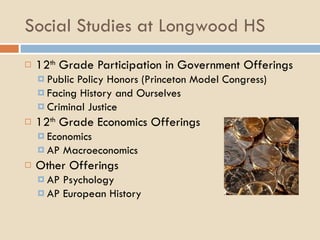
Social Studies at Longwood HS 12 th  Grade Participation in Government Offerings Public Policy Honors (Princeton Model Congress) Facing History and Ourselves Criminal Justice 12 th  Grade Economics Offerings Economics AP Macroeconomics Other Offerings AP Psychology AP European History
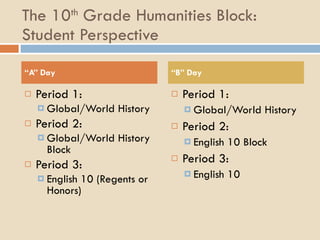
The 10 th  Grade Humanities Block: Student Perspective Period 1:  Global/World History Period 2: Global/World History Block Period 3: English 10 (Regents or Honors) Period 1: Global/World History Period 2: English 10 Block Period 3:  English 10 “ A” Day “ B” Day
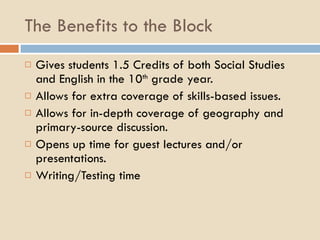
The Benefits to the Block Gives students 1.5 Credits of both Social Studies and English in the 10 th  grade year. Allows for extra coverage of skills-based issues. Allows for in-depth coverage of geography and primary-source discussion. Opens up time for guest lectures and/or presentations. Writing/Testing time
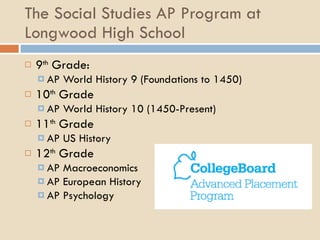
The Social Studies AP Program at Longwood High School  9 th  Grade: AP World History 9 (Foundations to 1450) 10 th  Grade AP World History 10 (1450-Present) 11 th  Grade AP US History 12 th  Grade AP Macroeconomics AP European History AP Psychology
Vertical Integration The Social Studies program at Longwood High School offer key characteristics of a vertically integrated approach towards the Advanced Placement Curriculum: Use of 8 th  Grade Junior High School Social Studies Standardized Test Scores Constant evaluation by core team of AP teachers (8 of 25) Rolling evaluation on a year-by-year basis Professional Development Common Planning Rating AP Workshops
Open-Enrollment (ish) The key characteristic is that the student has to “want to” be in the AP track. We have placed some controls on the open-enrollment floodgate: Minimum scores from Regents to AP Minimum scores from AP to AP Regents exam scores should be at Mastery Teacher Recommendation Satisfactory completion of Summer Assignment
The “New” AP Student Motivated INVOLVED in clubs/activities/sports Not necessarily the top 5-10% Varying work ethic Needs to be modeled/taught Some attendance issues Varying degrees of support at home Connected to the Web…but not as much as we would like
The Sand-Sifter… Using test scores, or even student/parent motivation often leaves students out. We want our program to be exposed to as many as can benefit from it. Every year, we review Regents students from 9 th  to 10 th  and from Regents 10 th  to 11 th  . Primary motivator is student interest and teacher recommendation Round-table discussion of student GPA, writing, work ethic, interest, etc. However, every teacher is different! What 90% means in one class is different in other classes!
Transitional Strategies AP Teacher Guest Informational Lectures in Regents classes. Open-House for incoming 9 th  Graders 8R Transition Document Open-House for transitioning 10 th  Graders Discuss work ethic, expectations, etc. 9R Transition Document Work with 10 th  grade students to help build knowledge from the APW9 course Extra-Help
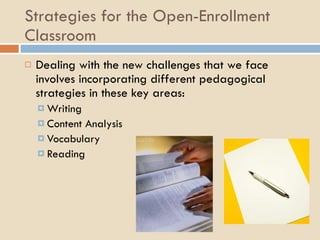
Strategies for the Open-Enrollment Classroom Dealing with the new challenges that we face involves incorporating different pedagogical strategies in these key areas: Writing Content Analysis Vocabulary Reading
Writing Breakdown the Rubrics Rubric Breakdown Document Use of mini-DBQ’s Breaking down POV Breaking down the additional document Teaching in a comparative manner Using Global Historical Context as part of the approach towards the course Analyzing concepts as opposed to introducing facts
Content Analysis Use of Cloze Notes technique  Allows the instructor to manage more information Keeps students engaged Encourages use of technology in the delivery of content Using cloze note technique to accomplish reading comprehension Working in the Chronological/Geographical model
The Chronological/Geographical Model Use of the AP World History Time Periods: Foundations – 600 CE 600-1450 1450-1750 1750-1914 1914-Present Then, use geo-political model within the time periods Americas, The West, Africa, South Asia, Middle East, East Asia/Southeast Asia, Central Asia
Cloze Notes Chapter 6  notes Qing  Dynasty Notes Chapter 6 PPT Chapter 26 PPT (PT 3) Use of Geography in Notes Africa PPT
Vocabulary Building Every Chapter/Unit has vocabulary words that have to be identified, not defined Development of test-based verbiage as vocabulary Breaking student habits of asking vocabulary based questions on tests/quizzes Use tests/quizzes as the method of determining words/concepts/ideas that need attention throughout the course. Chapter 19 terms and  concepts.doc
Reading Comprehension Reading the text does NOT come naturally to the new AP student. Develop strategies that are unique and understandable to help facilitate reading comprehension. Multi-tiered approach in getting students to read: Dividing the chapters conceptually Straight-forward Reading Comprehension Essential Questions
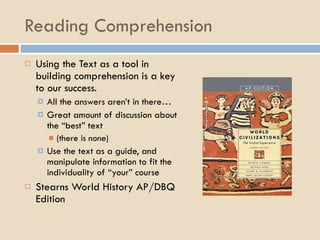
Reading Comprehension Using the Text as a tool in building comprehension is a key to our success. All the answers aren’t in there… Great amount of discussion about the “best” text (there is none) Use the text as a guide, and manipulate information to fit the individuality of “your” course Stearns World History AP/DBQ Edition
Reading Comprehension Question and answer from the text Designed to keep students moving through the text Chapter 28 Reading Comp Essential Questions Big, Conceptual questions designed to get students to read/write in the models necessitated by the AP World History Exam Chapter 24 Essential Questions and Terms Chapter 25 Chronology
The Summer Assignment The summer assignment has developed into a school-wide base assignment that has served as a model for the other disciplines. Three components: Historical Book Review Biography/Interview with historical figure Making a case for someone NOT included on the list Email submission during the summer to prove interest and technological capabilities Becomes subject for discussion throughout the year.
The Summer Assignment The Summer Assignment and subsequent quarterly assignments become a TOOL in the integration of global historical context throughout the course. Summer Assignment 9 Summer Assignment 10 APW9 Reading List APW10 Reading List ALL Summer Reading Lists
Extra-Help The review season is an intense time-period designed to assist students who may have fallen behind at any point in the transition Requires a lot of time Requires a lot of teamwork Requires a lot of patience! Designed to meet the needs of the different types of students we interact with Sports Clubs Activities
Extra-Help After-school Evenings (7:00-9:00) Weekends On-Line Chat rooms Webinars Review Calendar
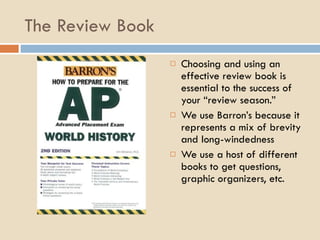
The Review Book Choosing and using an effective review book is essential to the success of your “review season.” We use Barron’s because it represents a mix of brevity and long-windedness We use a host of different books to get questions, graphic organizers, etc.
The AP World History Rating A TREMENDOUS professional-development opportunity Use of skills, techniques, and concepts for the mid-term and all other free-response tests. 2008 Midterm CCOT 2008 Midterm CCOT Score Sheet
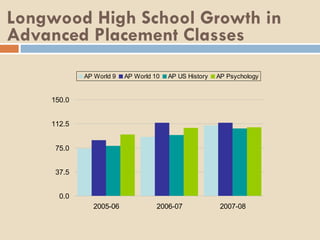
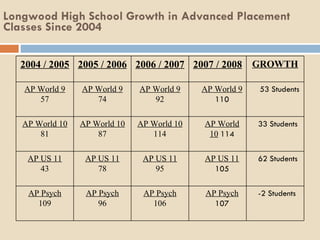
Longwood High School Growth in Advanced Placement Classes
Longwood High School Growth in Advanced Placement Classes Since 2004 -2 Students AP Psych   107 AP Psych 106 AP Psych 96 AP Psych 109 62 Students AP US 11   105 AP US 11 95 AP US 11 78 AP US 11 43 33 Students AP World 10   114 AP World 10 114 AP World 10 87 AP World 10 81 53 Students AP World 9   110 AP World 9 92 AP World 9 74 AP World 9 57 GROWTH 2007 / 2008 2006 / 2007 2005 / 2006 2004 / 2005
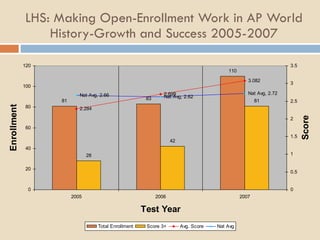
LHS: Making Open-Enrollment Work in AP World History-Growth and Success 2005-2007
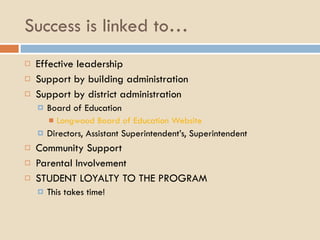
Success is linked to… Effective leadership Support by building administration Support by district administration Board of Education Longwood Board of Education Website Directors, Assistant Superintendent’s, Superintendent Community Support Parental Involvement STUDENT LOYALTY TO THE PROGRAM This takes time!
Thank You! Information from today’s workshop can be found at  http://forums.longwoodteachers.com/viewforum.php?f=155 Additionally, you may contact us at the following email addresses: Bill Neater:  [email_address] Dan Tapia:  [email_address] Colleen Skadl:  [email_address] Longwood Website www.longwood.k12.ny.us

Apw making open enrollment work 2008-1

  • 1.
    AP WORLD HISTORY: MAKING OPEN-ENROLLMENT WORK Longwood High School: Middle Island, NY
  • 2.
    Presenters Longwood HighSchool Social Studies Department Chairperson/AP World History 9 Teacher: Daniel Tapia AP World History 9/10 Teacher: William Neater AP World History 10 Teacher: Colleen Skadl
  • 3.
    Longwood Central SchoolDistrict, Middle Island, NY Quick Facts 07-08 Longwood CSD
  • 4.
    Social Studies atLongwood HS 9 th Grade Regents Global History and Geography 9 AP World History 9 10 th Grade Regents Global History and Geography 10 Block AP World History 10 Block 11 th Grade Regents US History and Government AP US History Participation in Government Offerings (as desired)
  • 5.
    Social Studies atLongwood HS 12 th Grade Participation in Government Offerings Public Policy Honors (Princeton Model Congress) Facing History and Ourselves Criminal Justice 12 th Grade Economics Offerings Economics AP Macroeconomics Other Offerings AP Psychology AP European History
  • 6.
    The 10 th Grade Humanities Block: Student Perspective Period 1: Global/World History Period 2: Global/World History Block Period 3: English 10 (Regents or Honors) Period 1: Global/World History Period 2: English 10 Block Period 3: English 10 “ A” Day “ B” Day
  • 7.
    The Benefits tothe Block Gives students 1.5 Credits of both Social Studies and English in the 10 th grade year. Allows for extra coverage of skills-based issues. Allows for in-depth coverage of geography and primary-source discussion. Opens up time for guest lectures and/or presentations. Writing/Testing time
  • 8.
    The Social StudiesAP Program at Longwood High School 9 th Grade: AP World History 9 (Foundations to 1450) 10 th Grade AP World History 10 (1450-Present) 11 th Grade AP US History 12 th Grade AP Macroeconomics AP European History AP Psychology
  • 9.
    Vertical Integration TheSocial Studies program at Longwood High School offer key characteristics of a vertically integrated approach towards the Advanced Placement Curriculum: Use of 8 th Grade Junior High School Social Studies Standardized Test Scores Constant evaluation by core team of AP teachers (8 of 25) Rolling evaluation on a year-by-year basis Professional Development Common Planning Rating AP Workshops
  • 10.
    Open-Enrollment (ish) Thekey characteristic is that the student has to “want to” be in the AP track. We have placed some controls on the open-enrollment floodgate: Minimum scores from Regents to AP Minimum scores from AP to AP Regents exam scores should be at Mastery Teacher Recommendation Satisfactory completion of Summer Assignment
  • 11.
    The “New” APStudent Motivated INVOLVED in clubs/activities/sports Not necessarily the top 5-10% Varying work ethic Needs to be modeled/taught Some attendance issues Varying degrees of support at home Connected to the Web…but not as much as we would like
  • 12.
    The Sand-Sifter… Usingtest scores, or even student/parent motivation often leaves students out. We want our program to be exposed to as many as can benefit from it. Every year, we review Regents students from 9 th to 10 th and from Regents 10 th to 11 th . Primary motivator is student interest and teacher recommendation Round-table discussion of student GPA, writing, work ethic, interest, etc. However, every teacher is different! What 90% means in one class is different in other classes!
  • 13.
    Transitional Strategies APTeacher Guest Informational Lectures in Regents classes. Open-House for incoming 9 th Graders 8R Transition Document Open-House for transitioning 10 th Graders Discuss work ethic, expectations, etc. 9R Transition Document Work with 10 th grade students to help build knowledge from the APW9 course Extra-Help
  • 14.
    Strategies for theOpen-Enrollment Classroom Dealing with the new challenges that we face involves incorporating different pedagogical strategies in these key areas: Writing Content Analysis Vocabulary Reading
  • 15.
    Writing Breakdown theRubrics Rubric Breakdown Document Use of mini-DBQ’s Breaking down POV Breaking down the additional document Teaching in a comparative manner Using Global Historical Context as part of the approach towards the course Analyzing concepts as opposed to introducing facts
  • 16.
    Content Analysis Useof Cloze Notes technique Allows the instructor to manage more information Keeps students engaged Encourages use of technology in the delivery of content Using cloze note technique to accomplish reading comprehension Working in the Chronological/Geographical model
  • 17.
    The Chronological/Geographical ModelUse of the AP World History Time Periods: Foundations – 600 CE 600-1450 1450-1750 1750-1914 1914-Present Then, use geo-political model within the time periods Americas, The West, Africa, South Asia, Middle East, East Asia/Southeast Asia, Central Asia
  • 18.
    Cloze Notes Chapter6 notes Qing Dynasty Notes Chapter 6 PPT Chapter 26 PPT (PT 3) Use of Geography in Notes Africa PPT
  • 19.
    Vocabulary Building EveryChapter/Unit has vocabulary words that have to be identified, not defined Development of test-based verbiage as vocabulary Breaking student habits of asking vocabulary based questions on tests/quizzes Use tests/quizzes as the method of determining words/concepts/ideas that need attention throughout the course. Chapter 19 terms and concepts.doc
  • 20.
    Reading Comprehension Readingthe text does NOT come naturally to the new AP student. Develop strategies that are unique and understandable to help facilitate reading comprehension. Multi-tiered approach in getting students to read: Dividing the chapters conceptually Straight-forward Reading Comprehension Essential Questions
  • 21.
    Reading Comprehension Usingthe Text as a tool in building comprehension is a key to our success. All the answers aren’t in there… Great amount of discussion about the “best” text (there is none) Use the text as a guide, and manipulate information to fit the individuality of “your” course Stearns World History AP/DBQ Edition
  • 22.
    Reading Comprehension Questionand answer from the text Designed to keep students moving through the text Chapter 28 Reading Comp Essential Questions Big, Conceptual questions designed to get students to read/write in the models necessitated by the AP World History Exam Chapter 24 Essential Questions and Terms Chapter 25 Chronology
  • 23.
    The Summer AssignmentThe summer assignment has developed into a school-wide base assignment that has served as a model for the other disciplines. Three components: Historical Book Review Biography/Interview with historical figure Making a case for someone NOT included on the list Email submission during the summer to prove interest and technological capabilities Becomes subject for discussion throughout the year.
  • 24.
    The Summer AssignmentThe Summer Assignment and subsequent quarterly assignments become a TOOL in the integration of global historical context throughout the course. Summer Assignment 9 Summer Assignment 10 APW9 Reading List APW10 Reading List ALL Summer Reading Lists
  • 25.
    Extra-Help The reviewseason is an intense time-period designed to assist students who may have fallen behind at any point in the transition Requires a lot of time Requires a lot of teamwork Requires a lot of patience! Designed to meet the needs of the different types of students we interact with Sports Clubs Activities
  • 26.
    Extra-Help After-school Evenings(7:00-9:00) Weekends On-Line Chat rooms Webinars Review Calendar
  • 27.
    The Review BookChoosing and using an effective review book is essential to the success of your “review season.” We use Barron’s because it represents a mix of brevity and long-windedness We use a host of different books to get questions, graphic organizers, etc.
  • 28.
    The AP WorldHistory Rating A TREMENDOUS professional-development opportunity Use of skills, techniques, and concepts for the mid-term and all other free-response tests. 2008 Midterm CCOT 2008 Midterm CCOT Score Sheet
  • 29.
    Longwood High SchoolGrowth in Advanced Placement Classes
  • 30.
    Longwood High SchoolGrowth in Advanced Placement Classes Since 2004 -2 Students AP Psych 107 AP Psych 106 AP Psych 96 AP Psych 109 62 Students AP US 11 105 AP US 11 95 AP US 11 78 AP US 11 43 33 Students AP World 10 114 AP World 10 114 AP World 10 87 AP World 10 81 53 Students AP World 9 110 AP World 9 92 AP World 9 74 AP World 9 57 GROWTH 2007 / 2008 2006 / 2007 2005 / 2006 2004 / 2005
  • 31.
    LHS: Making Open-EnrollmentWork in AP World History-Growth and Success 2005-2007
  • 32.
    Success is linkedto… Effective leadership Support by building administration Support by district administration Board of Education Longwood Board of Education Website Directors, Assistant Superintendent’s, Superintendent Community Support Parental Involvement STUDENT LOYALTY TO THE PROGRAM This takes time!
  • 33.
    Thank You! Informationfrom today’s workshop can be found at http://forums.longwoodteachers.com/viewforum.php?f=155 Additionally, you may contact us at the following email addresses: Bill Neater: [email_address] Dan Tapia: [email_address] Colleen Skadl: [email_address] Longwood Website www.longwood.k12.ny.us