SIOP: Sheltered
Instruction Observation
Protocol
Dr. April Salerno
Fulbright Scholar, USA
Agenda
 Introductions
 What is SIOP?
 “Information gap” activity
 SIOP Video
 Lesson plan analysis
Who I am …
 April Salerno
 USA: University of Virginia
 Moldova: Fulbright Scholar at Ion
Creanga State Pedagogical University,
2015-2016
 States where I’ve lived: South
Carolina, North Carolina, New
Mexico, Virginia
 Peace Corps volunteer, 2003-2005 in
Cuhurestii de Sus, r. Floresti
Introductions
 Tell us:
 Your name
 Your School
 What grades you teach
 How long you’ve been
teaching
SIOP “stands for” …
 S – Sheltered
 I – Instruction
 O – Observation
 P - Protocol
Sheltered Instruction
Echevarria, Vogt, & Short:
“Teachers would employ techniques
that make the content concepts
accessible and also develop the
students’ skills in the new language.”
“Information gap” activity
 Only look at your paper!
 Your partner has information you need,
and you have information he/she needs.
 Tell each other what you need to know
to complete your sheets.
8 Components
1. Lesson Preparation
2. Building Background
3. Comprehensible Input
4. Strategies
5. Interaction
6. Practice and Application
7. Lesson Delivery
8. Review & Assessment
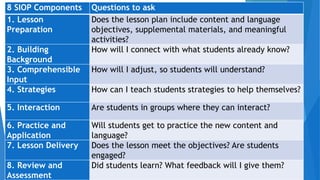
8 SIOP Components Questions to ask
1. Lesson
Preparation
Does the lesson plan include content and language
objectives, supplemental materials, and meaningful
activities?
2. Building
Background
How will I connect with what students already know?
3. Comprehensible
Input
How will I adjust, so students will understand?
4. Strategies How can I teach students strategies to help themselves?
5. Interaction Are students in groups where they can interact?
6. Practice and
Application
Will students get to practice the new content and
language?
7. Lesson Delivery Does the lesson meet the objectives? Are students
engaged?
8. Review and
Assessment
Did students learn? What feedback will I give them?
Checklist for SIOP Lesson Plans
 Look over this checklist with a
partner.
 Talk about it with each other.
 Do you understand them all? Which
ones do you need help
understanding?
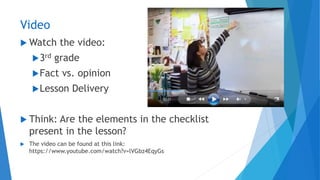
Video
 Watch the video:
3rd grade
Fact vs. opinion
Lesson Delivery
 Think: Are the elements in the checklist
present in the lesson?
 The video can be found at this link:
https://www.youtube.com/watch?v=lVGbz4EqyGs
Discuss with a Partner
 Were the elements of the checklist
present in the lesson?
 What do you think was effective
about the lesson?
 What do you think was ineffective?
SIOP Lesson Plan Study
 In groups look at one of the four lesson plans.
 (Hint: Notice the abbreviation key.)
 First, try to talk through what is happening in
the lesson:
 K-2: T-chart, signal words, sentence frames
 3-5: 4-Corners Vocabulary
 6-8: Anticipation Guide
 9-12: Character Map
 Second, see if you can identify the SIOP
elements.
 Finally, think about ways these approaches could
be used with the national curriculum.
Group sharing
Tell about the
activities in your lesson
plan.
What was interesting
for you about the
lesson plan you saw?
What questions do you
still have about it?
Contact Information
April Salerno, University of
Virginia, Fulbright Scholar
april.simun.salerno@gmail.com
Questions
What questions do you have?

Siop presentation

  • 1.
    SIOP: Sheltered Instruction Observation Protocol Dr.April Salerno Fulbright Scholar, USA
  • 2.
    Agenda  Introductions  Whatis SIOP?  “Information gap” activity  SIOP Video  Lesson plan analysis
  • 3.
    Who I am…  April Salerno  USA: University of Virginia  Moldova: Fulbright Scholar at Ion Creanga State Pedagogical University, 2015-2016  States where I’ve lived: South Carolina, North Carolina, New Mexico, Virginia  Peace Corps volunteer, 2003-2005 in Cuhurestii de Sus, r. Floresti
  • 4.
    Introductions  Tell us: Your name  Your School  What grades you teach  How long you’ve been teaching
  • 5.
    SIOP “stands for”…  S – Sheltered  I – Instruction  O – Observation  P - Protocol
  • 6.
    Sheltered Instruction Echevarria, Vogt,& Short: “Teachers would employ techniques that make the content concepts accessible and also develop the students’ skills in the new language.”
  • 7.
    “Information gap” activity Only look at your paper!  Your partner has information you need, and you have information he/she needs.  Tell each other what you need to know to complete your sheets.
  • 8.
    8 Components 1. LessonPreparation 2. Building Background 3. Comprehensible Input 4. Strategies 5. Interaction 6. Practice and Application 7. Lesson Delivery 8. Review & Assessment
  • 9.
    8 SIOP ComponentsQuestions to ask 1. Lesson Preparation Does the lesson plan include content and language objectives, supplemental materials, and meaningful activities? 2. Building Background How will I connect with what students already know? 3. Comprehensible Input How will I adjust, so students will understand? 4. Strategies How can I teach students strategies to help themselves? 5. Interaction Are students in groups where they can interact? 6. Practice and Application Will students get to practice the new content and language? 7. Lesson Delivery Does the lesson meet the objectives? Are students engaged? 8. Review and Assessment Did students learn? What feedback will I give them?
  • 10.
    Checklist for SIOPLesson Plans  Look over this checklist with a partner.  Talk about it with each other.  Do you understand them all? Which ones do you need help understanding?
  • 11.
    Video  Watch thevideo: 3rd grade Fact vs. opinion Lesson Delivery  Think: Are the elements in the checklist present in the lesson?  The video can be found at this link: https://www.youtube.com/watch?v=lVGbz4EqyGs
  • 12.
    Discuss with aPartner  Were the elements of the checklist present in the lesson?  What do you think was effective about the lesson?  What do you think was ineffective?
  • 13.
    SIOP Lesson PlanStudy  In groups look at one of the four lesson plans.  (Hint: Notice the abbreviation key.)  First, try to talk through what is happening in the lesson:  K-2: T-chart, signal words, sentence frames  3-5: 4-Corners Vocabulary  6-8: Anticipation Guide  9-12: Character Map  Second, see if you can identify the SIOP elements.  Finally, think about ways these approaches could be used with the national curriculum.
  • 14.
    Group sharing Tell aboutthe activities in your lesson plan. What was interesting for you about the lesson plan you saw? What questions do you still have about it?
  • 15.
    Contact Information April Salerno,University of Virginia, Fulbright Scholar april.simun.salerno@gmail.com
  • 16.

Editor's Notes

  • #2 Plan for 15 people
  • #3 Maybe do a jigsaw?
  • #8 Or, I could do this as a sort activity with definitions and words.
  • #17 Ask questions that might benefit the whole group. Or, ask me after class if it’s a particular question.