L.O: STUDENTS WILL
REVIEW BIG IDEA 6: THE
INTERNET
DO NOW:
READ PAGE 91-95
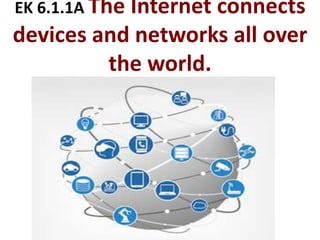
EK 6.1.1A The Internet connects
devices and networks all over
the world.
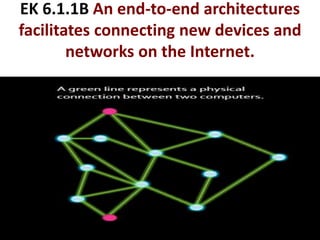
EK 6.1.1B An end-to-end architectures
facilitates connecting new devices and
networks on the Internet.
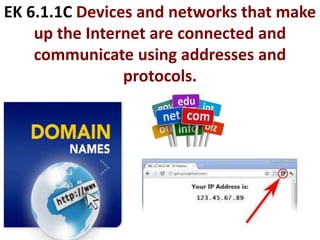
EK 6.1.1C Devices and networks that make
up the Internet are connected and
communicate using addresses and
protocols.
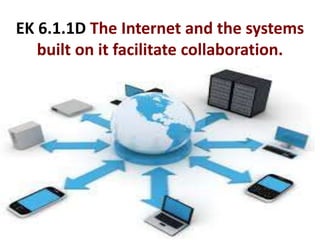
EK 6.1.1D The Internet and the systems
built on it facilitate collaboration.
The
architecture
of the
internet
allows all
of us to
work
together!
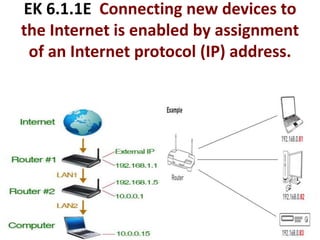
EK 6.1.1E Connecting new devices to
the Internet is enabled by assignment
of an Internet protocol (IP) address.
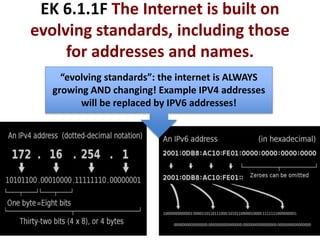
EK 6.1.1F The Internet is built on
evolving standards, including those
for addresses and names.
“evolving standards”: the internet is ALWAYS
growing AND changing! Example IPV4 addresses
will be replaced by IPV6 addresses!
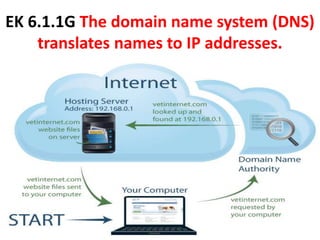
EK 6.1.1G The domain name system (DNS)
translates names to IP addresses.
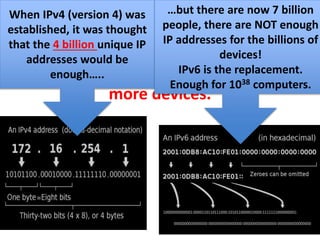
EK 6.1.1H The number of devices that
could use an IP address has grown so fast
that a new protocol (IPv6) has been
established to handle routing of many
more devices.
When IPv4 (version 4) was
established, it was thought
that the 4 billion unique IP
addresses would be
enough…..
…but there are now 7 billion
people, there are NOT enough
IP addresses for the billions of
devices!
IPv6 is the replacement.
Enough for 1038 computers.
EK 6.1.1I Standards such as hypertext
transfer protocol (HTTP), IP, and simple
mail transfer protocol (SMTP) are
developed and overseen by the Internet
Engineering Task Force (IETF).
Turns HTML into a
website that you can
view.
Used to
received emails
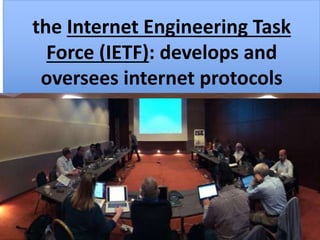
the Internet Engineering Task
Force (IETF): develops and
oversees internet protocols
EK 6.2.1A The Internet and the systems
built on it are hierarchical and redundant.
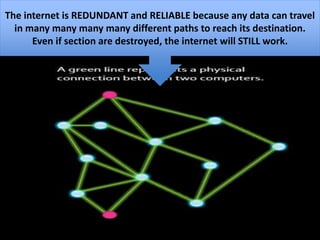
The internet is REDUNDANT and RELIABLE because any data can travel
in many many many many different paths to reach its destination.
Even if section are destroyed, the internet will STILL work.
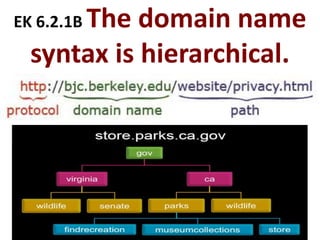
EK 6.2.1B The domain name
syntax is hierarchical.
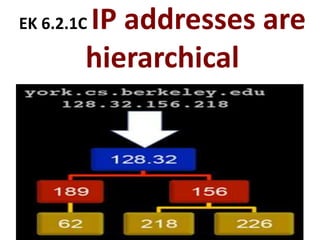
EK 6.2.1C IP addresses are
hierarchical
EK 6.2.1D Routing on the Internet is
fault tolerant and redundant.
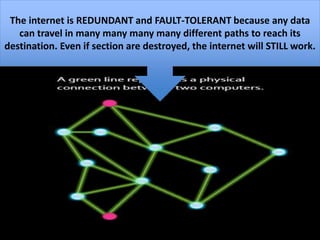
The internet is REDUNDANT and FAULT-TOLERANT because any data
can travel in many many many many different paths to reach its
destination. Even if section are destroyed, the internet will STILL work.
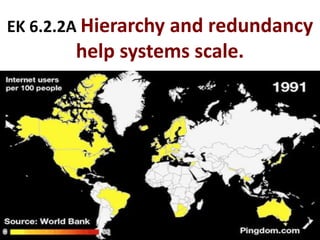
EK 6.2.2A Hierarchy and redundancy
help systems scale.
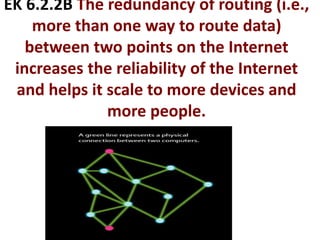
EK 6.2.2B The redundancy of routing (i.e.,
more than one way to route data)
between two points on the Internet
increases the reliability of the Internet
and helps it scale to more devices and
more people.
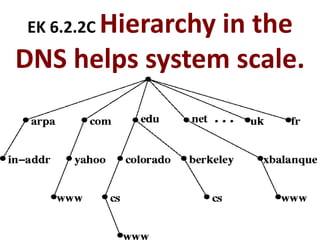
EK 6.2.2C Hierarchy in the
DNS helps system scale.
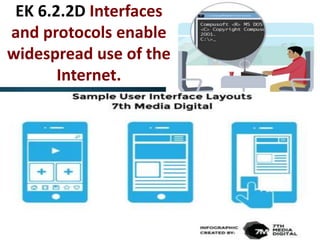
EK 6.2.2D Interfaces
and protocols enable
widespread use of the
Internet.
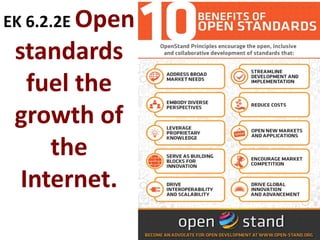
EK 6.2.2E Open
standards
fuel the
growth of
the
Internet.
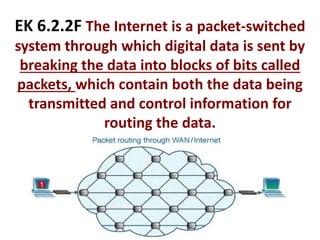
EK 6.2.2F The Internet is a packet-switched
system through which digital data is sent by
breaking the data into blocks of bits called
packets, which contain both the data being
transmitted and control information for
routing the data.
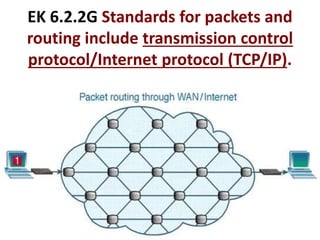
EK 6.2.2G Standards for packets and
routing include transmission control
protocol/Internet protocol (TCP/IP).
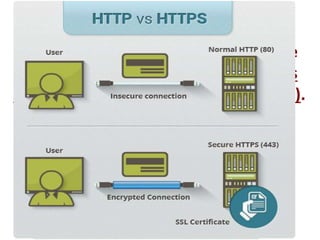
EK 6.2.2H Standards for sharing
information and communicating
between browsers and servers on the
Web include HTTP and secure sockets
layer/transport layer security (SSL/TLS).
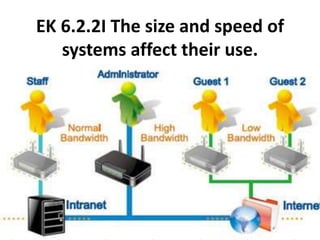
EK 6.2.2I The size and speed of
systems affect their use.
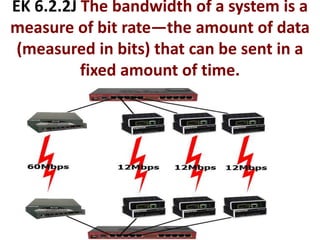
EK 6.2.2J The bandwidth of a system is a
measure of bit rate—the amount of data
(measured in bits) that can be sent in a
fixed amount of time.
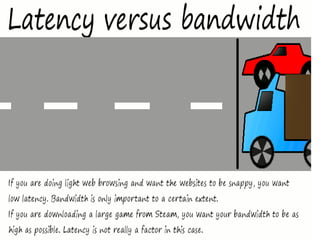
EK 6.2.2K The latency of a system is the
time elapsed between the transmission
and the receipt of a request.
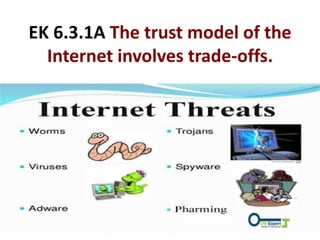
EK 6.3.1A The trust model of the
Internet involves trade-offs.
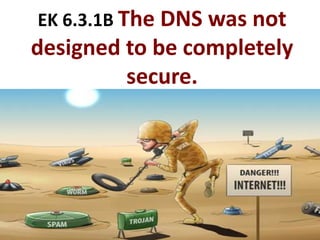
EK 6.3.1B The DNS was not
designed to be completely
secure.
EK 6.3.1C Implementing
cybersecurity has software,
hardware, and human
components.
EK 6.3.1D Cyber warfare and cyber crime
have widespread and potentially
devastating effects
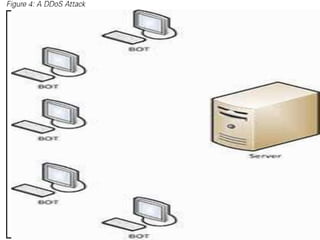
EK 6.3.1E Distributed denial of service
attacks (DDoS) compromise a target by
flooding it with requests from multiple
systems.
EK 6.3.1F Phishing, viruses, and other
attacks have human and software
components.
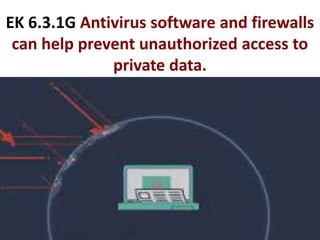
EK 6.3.1G Antivirus software and firewalls
can help prevent unauthorized access to
private data.
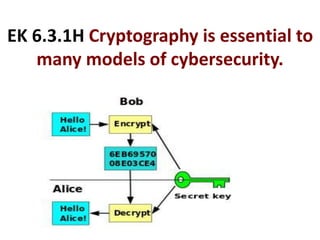
EK 6.3.1H Cryptography is essential to
many models of cybersecurity.
EK 6.3.1I Cryptography has a
mathematical foundation.
EK 6.3.1J Open standards help ensure
cryptography is secure.
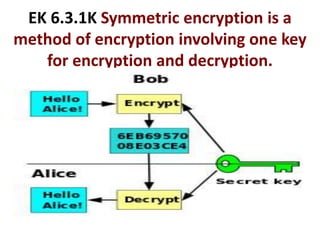
EK 6.3.1K Symmetric encryption is a
method of encryption involving one key
for encryption and decryption.
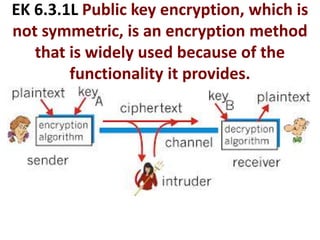
EK 6.3.1L Public key encryption, which is
not symmetric, is an encryption method
that is widely used because of the
functionality it provides.
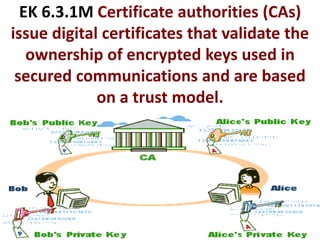
EK 6.3.1M Certificate authorities (CAs)
issue digital certificates that validate the
ownership of encrypted keys used in
secured communications and are based
on a trust model.
Complete the internet questions

Ap exam big idea 6 the internet

  • 1.
    L.O: STUDENTS WILL REVIEWBIG IDEA 6: THE INTERNET DO NOW: READ PAGE 91-95
  • 2.
    EK 6.1.1A TheInternet connects devices and networks all over the world.
  • 3.
    EK 6.1.1B Anend-to-end architectures facilitates connecting new devices and networks on the Internet.
  • 4.
    EK 6.1.1C Devicesand networks that make up the Internet are connected and communicate using addresses and protocols.
  • 5.
    EK 6.1.1D TheInternet and the systems built on it facilitate collaboration. The architecture of the internet allows all of us to work together!
  • 6.
    EK 6.1.1E Connectingnew devices to the Internet is enabled by assignment of an Internet protocol (IP) address.
  • 7.
    EK 6.1.1F TheInternet is built on evolving standards, including those for addresses and names. “evolving standards”: the internet is ALWAYS growing AND changing! Example IPV4 addresses will be replaced by IPV6 addresses!
  • 8.
    EK 6.1.1G Thedomain name system (DNS) translates names to IP addresses.
  • 9.
    EK 6.1.1H Thenumber of devices that could use an IP address has grown so fast that a new protocol (IPv6) has been established to handle routing of many more devices. When IPv4 (version 4) was established, it was thought that the 4 billion unique IP addresses would be enough….. …but there are now 7 billion people, there are NOT enough IP addresses for the billions of devices! IPv6 is the replacement. Enough for 1038 computers.
  • 10.
    EK 6.1.1I Standardssuch as hypertext transfer protocol (HTTP), IP, and simple mail transfer protocol (SMTP) are developed and overseen by the Internet Engineering Task Force (IETF). Turns HTML into a website that you can view. Used to received emails the Internet Engineering Task Force (IETF): develops and oversees internet protocols
  • 11.
    EK 6.2.1A TheInternet and the systems built on it are hierarchical and redundant. The internet is REDUNDANT and RELIABLE because any data can travel in many many many many different paths to reach its destination. Even if section are destroyed, the internet will STILL work.
  • 12.
    EK 6.2.1B Thedomain name syntax is hierarchical.
  • 13.
    EK 6.2.1C IPaddresses are hierarchical
  • 14.
    EK 6.2.1D Routingon the Internet is fault tolerant and redundant. The internet is REDUNDANT and FAULT-TOLERANT because any data can travel in many many many many different paths to reach its destination. Even if section are destroyed, the internet will STILL work.
  • 15.
    EK 6.2.2A Hierarchyand redundancy help systems scale.
  • 16.
    EK 6.2.2B Theredundancy of routing (i.e., more than one way to route data) between two points on the Internet increases the reliability of the Internet and helps it scale to more devices and more people.
  • 17.
    EK 6.2.2C Hierarchyin the DNS helps system scale.
  • 18.
    EK 6.2.2D Interfaces andprotocols enable widespread use of the Internet.
  • 19.
    EK 6.2.2E Open standards fuelthe growth of the Internet.
  • 20.
    EK 6.2.2F TheInternet is a packet-switched system through which digital data is sent by breaking the data into blocks of bits called packets, which contain both the data being transmitted and control information for routing the data.
  • 21.
    EK 6.2.2G Standardsfor packets and routing include transmission control protocol/Internet protocol (TCP/IP).
  • 22.
    EK 6.2.2H Standardsfor sharing information and communicating between browsers and servers on the Web include HTTP and secure sockets layer/transport layer security (SSL/TLS).
  • 23.
    EK 6.2.2I Thesize and speed of systems affect their use.
  • 24.
    EK 6.2.2J Thebandwidth of a system is a measure of bit rate—the amount of data (measured in bits) that can be sent in a fixed amount of time.
  • 25.
    EK 6.2.2K Thelatency of a system is the time elapsed between the transmission and the receipt of a request.
  • 26.
    EK 6.3.1A Thetrust model of the Internet involves trade-offs.
  • 27.
    EK 6.3.1B TheDNS was not designed to be completely secure.
  • 28.
    EK 6.3.1C Implementing cybersecurityhas software, hardware, and human components.
  • 29.
    EK 6.3.1D Cyberwarfare and cyber crime have widespread and potentially devastating effects
  • 30.
    EK 6.3.1E Distributeddenial of service attacks (DDoS) compromise a target by flooding it with requests from multiple systems.
  • 31.
    EK 6.3.1F Phishing,viruses, and other attacks have human and software components.
  • 32.
    EK 6.3.1G Antivirussoftware and firewalls can help prevent unauthorized access to private data.
  • 33.
    EK 6.3.1H Cryptographyis essential to many models of cybersecurity.
  • 34.
    EK 6.3.1I Cryptographyhas a mathematical foundation.
  • 35.
    EK 6.3.1J Openstandards help ensure cryptography is secure.
  • 36.
    EK 6.3.1K Symmetricencryption is a method of encryption involving one key for encryption and decryption.
  • 37.
    EK 6.3.1L Publickey encryption, which is not symmetric, is an encryption method that is widely used because of the functionality it provides.
  • 38.
    EK 6.3.1M Certificateauthorities (CAs) issue digital certificates that validate the ownership of encrypted keys used in secured communications and are based on a trust model.
  • 39.