

‘I CAN PROVIDEYOU WITH FEEDBACK...THE
DREADED STUDENT EXPERIENCE - INSIGHTS
FROMTHE IRISH HIGHER EDUCATION
EXPERIENCE'
Aoife Prendergast
POWER
“ If our aim is to improve student performance, not just
measure it, we must ensure that students know the
performances expected of them, the standards against
which they will be judged, and have opportunities to learn
from the assessment in future assessments.” (Grant
Wiggins, 2002)
What exactly is “Feedback”?
• Information about how one performs in relation to a stated goal
• Effective Feedback provides
1. Information about what happened/ was done
2. An evaluation of how well or otherwise the task was performed
3. Guidance as to how performance can be improved
Purpose of Feedback
• Essential tool in teaching-learning process
• Empower students as self-regulating independent learners
• Foster a deep approach to learning
• Increase motivational beliefs and self-esteem
• Improves practice educators/tutors satisfaction
The Student Experience
• Prominence of feedback in pedagogic theory: as Laurillard (1993, p. 61) has said,
'action without feedback is completely unproductive for the learner'.This principle
applies throughout our lives as well as in educational settings: we use intrinsic and
extrinsic feedback to guide our actions and the development of our thoughts,
values and ways-of-being.
• Feedback has a central role to play: as reinforcement; as information from which
to correct 'errors'; as guidance on socially-constructed standards; or as an
indicator of appropriate discourse (Askew and Lodge, 2000; Fenwick, 2000).
• Feedback is essential to our lifelong development but its importance is perhaps
greatest (and most visible) during periods of formal education: at these times,
students are primed to expect assessment feedback from knowledgeable others,
and to develop skills of self-assessment for themselves.
• Feedback raises more questions than it answers (Lillis andTurner, 2001).
• Feedback may also be dismissed as irrelevant.
• Some students, in order to protect the integrity of their beliefs and knowledge,
will reject corrective feedback and find ways to devalue it (Chinn and Brewer,
1993).
• The unfortunate reality is that “it is not inevitable that students will read and pay
attention to feedback even when that feedback is lovingly crafted and provided
promptly” (Gibbs and Simpson, 2002, p. 20).
The Reality
• Avoidance
• Pussyfooting/ Sledgehammer
• Smiling demolition
• Putdown
• Too much information
• Lack of follow-up
What's to Fear ?Why the Dread
• Misunderstanding of the nature of feedback
• Students did not know how to construct a dialogue (a point also raised by some
members of staff).
• The implication was that students preferred the apparent informality and non-
threatening nature of a spontaneous exchange where no ‘deep’ questions would
be expected
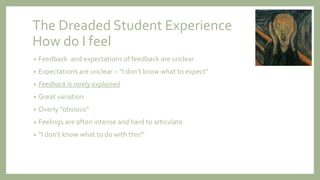
The Dreaded Student Experience
How do I feel
• Feedback and expectations of feedback are unclear
• Expectations are unclear – “I don’t know what to expect”
• Feedback is rarely explained
• Great variation
• Overly "obvious”
• Feelings are often intense and hard to articulate
• “I don’t know what to do with this!”
Important Considerations
•Not reserved for poor performance
•Performance specific vs person specific
•Link with learning styles
•Continuous and regular process
• Continued support and respect
Recommendations
Be as specific as possible
The sooner the better
Address the learner's advancement toward a goal
Present feedback carefully
Involve learners in the process
Characteristics of Feedback
• Timely
• “The more delay that occurs in giving feedback, the less improvement there is in achievement.”
(Marzano(1), p. 97)
• As often as possible, for all assignments
• Constructive/Corrective
• What students are doing that is correct
• What students are doing that is not correct
• Choose areas of feedback based on those that relate to major learning goals and essential elements of
the assignment
• Should be encouraging and help students realize that effort on their part results in more learning
(Marzano(2), p. 105)
• Specific to a Criterion
• Precise language on what to do to improve
• Reference where a student stands in relation to a specific learning target/goal
• Also specific to the learning at hand
• Based on personal observations
Characteristics of Feedback
• Focused on the product/behaviour – not on the student
• Verified
• Did the student understand the feedback?
• Opportunities are provided to modify assignments, products, etc. based on the
feedback
• What is my follow up plan to monitor and assist the student in these areas?)
Effective Feedback
• 3 conditions necessary for students to benefit from feedback
• Possess a concept of the goal/ standard or reference being aimed for
• Compare the actual (current) level of performance with that goal or standard
• Engage in appropriate action which leads to some closure of the gap (Sadler, 1989)
Learning the Language of Assessment
• “As a result of understanding the learning destination and appreciating what
quality work and success look like, students:
• Begin to learn the language of assessment. This means students learn to talk about
and reflect on their own work using the language of criteria and learning
destinations.
• Gain the knowledge they need to make decisions that help close the gap between where
they are in their learning and where they need to be.”
~ Anne Davies, p. 38

HE Course and Module Evaluation Conference - Aoife Prendergast

  • 1.
    ‘I CAN PROVIDEYOUWITH FEEDBACK...THE DREADED STUDENT EXPERIENCE - INSIGHTS FROMTHE IRISH HIGHER EDUCATION EXPERIENCE' Aoife Prendergast
  • 2.
  • 3.
    “ If ouraim is to improve student performance, not just measure it, we must ensure that students know the performances expected of them, the standards against which they will be judged, and have opportunities to learn from the assessment in future assessments.” (Grant Wiggins, 2002)
  • 4.
    What exactly is“Feedback”? • Information about how one performs in relation to a stated goal • Effective Feedback provides 1. Information about what happened/ was done 2. An evaluation of how well or otherwise the task was performed 3. Guidance as to how performance can be improved
  • 5.
    Purpose of Feedback •Essential tool in teaching-learning process • Empower students as self-regulating independent learners • Foster a deep approach to learning • Increase motivational beliefs and self-esteem • Improves practice educators/tutors satisfaction
  • 6.
    The Student Experience •Prominence of feedback in pedagogic theory: as Laurillard (1993, p. 61) has said, 'action without feedback is completely unproductive for the learner'.This principle applies throughout our lives as well as in educational settings: we use intrinsic and extrinsic feedback to guide our actions and the development of our thoughts, values and ways-of-being. • Feedback has a central role to play: as reinforcement; as information from which to correct 'errors'; as guidance on socially-constructed standards; or as an indicator of appropriate discourse (Askew and Lodge, 2000; Fenwick, 2000). • Feedback is essential to our lifelong development but its importance is perhaps greatest (and most visible) during periods of formal education: at these times, students are primed to expect assessment feedback from knowledgeable others, and to develop skills of self-assessment for themselves.
  • 7.
    • Feedback raisesmore questions than it answers (Lillis andTurner, 2001). • Feedback may also be dismissed as irrelevant. • Some students, in order to protect the integrity of their beliefs and knowledge, will reject corrective feedback and find ways to devalue it (Chinn and Brewer, 1993). • The unfortunate reality is that “it is not inevitable that students will read and pay attention to feedback even when that feedback is lovingly crafted and provided promptly” (Gibbs and Simpson, 2002, p. 20).
  • 8.
    The Reality • Avoidance •Pussyfooting/ Sledgehammer • Smiling demolition • Putdown • Too much information • Lack of follow-up
  • 9.
    What's to Fear?Why the Dread • Misunderstanding of the nature of feedback • Students did not know how to construct a dialogue (a point also raised by some members of staff). • The implication was that students preferred the apparent informality and non- threatening nature of a spontaneous exchange where no ‘deep’ questions would be expected
  • 10.
    The Dreaded StudentExperience How do I feel • Feedback and expectations of feedback are unclear • Expectations are unclear – “I don’t know what to expect” • Feedback is rarely explained • Great variation • Overly "obvious” • Feelings are often intense and hard to articulate • “I don’t know what to do with this!”
  • 11.
    Important Considerations •Not reservedfor poor performance •Performance specific vs person specific •Link with learning styles •Continuous and regular process • Continued support and respect
  • 12.
    Recommendations Be as specificas possible The sooner the better Address the learner's advancement toward a goal Present feedback carefully Involve learners in the process
  • 13.
    Characteristics of Feedback •Timely • “The more delay that occurs in giving feedback, the less improvement there is in achievement.” (Marzano(1), p. 97) • As often as possible, for all assignments • Constructive/Corrective • What students are doing that is correct • What students are doing that is not correct • Choose areas of feedback based on those that relate to major learning goals and essential elements of the assignment • Should be encouraging and help students realize that effort on their part results in more learning (Marzano(2), p. 105) • Specific to a Criterion • Precise language on what to do to improve • Reference where a student stands in relation to a specific learning target/goal • Also specific to the learning at hand • Based on personal observations
  • 14.
    Characteristics of Feedback •Focused on the product/behaviour – not on the student • Verified • Did the student understand the feedback? • Opportunities are provided to modify assignments, products, etc. based on the feedback • What is my follow up plan to monitor and assist the student in these areas?)
  • 15.
    Effective Feedback • 3conditions necessary for students to benefit from feedback • Possess a concept of the goal/ standard or reference being aimed for • Compare the actual (current) level of performance with that goal or standard • Engage in appropriate action which leads to some closure of the gap (Sadler, 1989)
  • 16.
    Learning the Languageof Assessment • “As a result of understanding the learning destination and appreciating what quality work and success look like, students: • Begin to learn the language of assessment. This means students learn to talk about and reflect on their own work using the language of criteria and learning destinations. • Gain the knowledge they need to make decisions that help close the gap between where they are in their learning and where they need to be.” ~ Anne Davies, p. 38