

So, you want to do work-
based learning at your
school?
Kent ISD Career Readiness Webinar
March 24, 2015
Welcome!
• Trudy Ngo-Brown
• Kent ISD - Career Readiness Consultant
• Carol Deuling-Ravell
• Sparta High School – Career Internship Program Coordinator
• Mike Kelley, Michael Spagnuolo
• Kent Transition Center – Work-Based Learning Facilitators
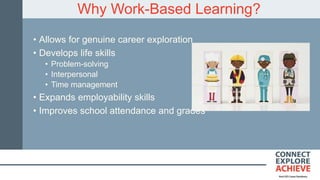
Why Work-Based Learning?
• Allows for genuine career exploration
• Develops life skills
• Problem-solving
• Interpersonal
• Time management
• Expands employability skills
• Improves school attendance and grades
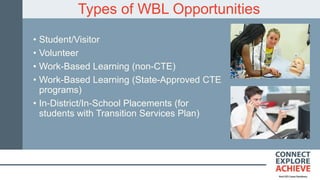
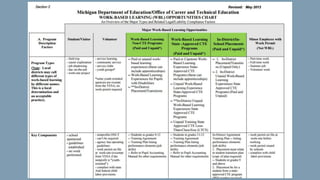
Types of WBL Opportunities
• Student/Visitor
• Volunteer
• Work-Based Learning (non-CTE)
• Work-Based Learning (State-Approved CTE
programs)
• In-District/In-School Placements (for
students with Transition Services Plan)
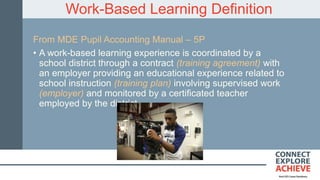
Work-Based Learning Definition
From MDE Pupil Accounting Manual – 5P
• A work-based learning experience is coordinated by a
school district through a contract (training agreement) with
an employer providing an educational experience related to
school instruction (training plan) involving supervised work
(employer) and monitored by a certificated teacher
employed by the district.
Work-Based Learning Definition
IS
• Individual pupil placed at a
job-site – paid or unpaid
• Working independently under
employer supervision with
periodic monitoring by
teacher
IS NOT
• Experience with a group and
teacher present
• Periodic job shadowing
Key Components
• Students in grades 9-12 for Non-CTE; 11-12 for CTE
• Certified teacher (vocationally certified for CTE)
• EDP alignment
• Experience must generate high school credit, but no more than ½
FTE*
• Documentation
• Training Agreement*
• Training Plan*
• Certificated Teacher Worksite Visitation Records* (9 weeks, gen-ed; 30 days,
SPED)
• Pupil Time Sheets/Attendance Records from the Worksite*
• Safety Instruction (provided by the school district)
• Verify workers compensation/general liability
How does it look in Kent
County?
Staff from Sparta High School and Kent Transition Center share highlights
Overview of Work Based Learning at Sparta High School
• Carol Deuling-Ravell
• Career Intern Coordinator at Sparta HS (10+ years)
• ~50 students each year in non-CTE placements
• Pharmacy Technician at local pharmacy
• Physical Therapy and Athletic Training interns at local PT offices
• Financial Intern with Village of Sparta
• Veterinary Interns at local Veterinary offices
• Agricultural Interns working at local farms (crop and dairy)
• Health Care Interns at Spectrum and Mercy Health (Kent ISD Health
Internship)
Career Internship Logistics
• Juniors and Seniors may take the Internship class
• Placements tied to career pathway and EDP
• Students locate their own placement
• Release time to sites is typically at the end of their day
• In the past we have had Internship at beginning and end of day
Career Internship Timeline
• Sparta HS students select Internship as a course
• Meet with students typically in semester before they have
Internship
• Discuss what kind of placement qualifies as an Internship
• Students fill out Internship Program Application
• Student shares sponsor contact information and I visit sponsor
• At start of semester:
• We meet the entire first week of the semester
• We discuss topics like perception, dealing with others, learning styles, journaling,
retirement, etc.
My role as Career Intern Coordinator at Sparta High
School
• Site visits with students and partners (40%)
• Management of paperwork (30%)
• Training agreements
• Training plans
• Collecting time sheets
• Grade reporting
• Partnership development (30%)
• Release time per day
• Officially I am assigned to Internship 1 class period per day
Top Things to Know/Consider with WBL
• It takes time, typically more than you anticipate (especially in
the beginning) and more than your Administrators know about.
• It is as important for a student to find out what they don’t want to
do as what they do want to do.
• This is one of the coolest experiences I have had teaching. It is
exciting to watch a student who was drifting find focus and
excitement about the future.
Overview of WBL at Kent Transition
Center
• Staff:
• Mike Kelley and Michael Spagnuolo- (WBL-Facilitator)
• Brenda Brower, Robin Loughrin, Holly Nichols and Lori Patow-(WBL-
ETS)
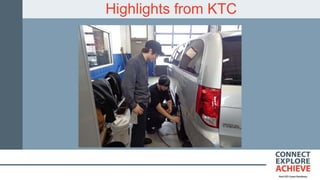
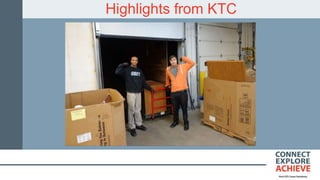
• KTC Areas of Study & Placement
• 115 students
• Automotive
• Business/Child Care
• Culinary/ Hospitality
• Facilities /Maintenance
• Retail
How do students participate in WBL?
• Age 17 and a senior- not older than 20;
• Attends an LEA within Kent ISD
• If the student is receiving special education services, he/she is
assigned to a special education teacher employed by the
educating district
• Release time at site is 2 to 2 ½ hours-AM or PM
• Semester or trimester (based on home school of student)
Breakdown of our roles at KTC
• Collaboration meetings
• with KTC team, parents/guardians, sending schools, employer sites
• Site visits with students and partners
• Daily to meet requirement of visits every 30 calendar days
• Management of paperwork
• Training agreements
• Training plans
• Collecting time sheets
• Grade reporting
• Partnership development
• Release time of staff per day: Full-day
Top Things to Know/Consider with WBL
• There must be a buy in/cooperation from the students, parents,
and WBL sites.
• It takes a lot of time to set up quality WBL sites according to
each learner’s needs.
• Students need to be taught about expectations and should have
some sort of training before they start WBL.
• Maintaining a quality program requires a lot of organization
• Paperwork
• Communication with students, employers, district staff, parents
Highlights from KTC
Highlights from KTC
Highlights from KTC
Highlights from KTC
Resources
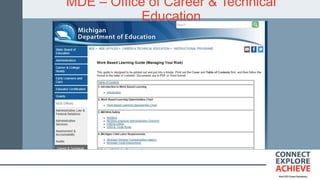
MDE – Office of Career & Technical
Education
Resources
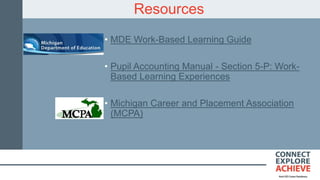
• MDE Work-Based Learning Guide
• Pupil Accounting Manual - Section 5-P: Work-
Based Learning Experiences
• Michigan Career and Placement Association
(MCPA)
What now?
• Reference the documents and websites provided
• Kent County Pupil Accounting Auditor, Emily Taylor
• emilytaylor@kentisd.org
• MCPA Fall Conference
• October 26 or 27 - Mt. Pleasant
• KOMAC Spring Meeting- April 22
• noon-2:30PM at Kent Transition Center
• Email trudyngobrown@kentisd.org for a registration link
Questions?

So, you want to do work-based learning at your school?

  • 1.
    So, you wantto do work- based learning at your school? Kent ISD Career Readiness Webinar March 24, 2015
  • 2.
    Welcome! • Trudy Ngo-Brown •Kent ISD - Career Readiness Consultant • Carol Deuling-Ravell • Sparta High School – Career Internship Program Coordinator • Mike Kelley, Michael Spagnuolo • Kent Transition Center – Work-Based Learning Facilitators
  • 3.
    Why Work-Based Learning? •Allows for genuine career exploration • Develops life skills • Problem-solving • Interpersonal • Time management • Expands employability skills • Improves school attendance and grades
  • 4.
    Types of WBLOpportunities • Student/Visitor • Volunteer • Work-Based Learning (non-CTE) • Work-Based Learning (State-Approved CTE programs) • In-District/In-School Placements (for students with Transition Services Plan)
  • 5.
    Work-Based Learning Definition FromMDE Pupil Accounting Manual – 5P • A work-based learning experience is coordinated by a school district through a contract (training agreement) with an employer providing an educational experience related to school instruction (training plan) involving supervised work (employer) and monitored by a certificated teacher employed by the district.
  • 6.
    Work-Based Learning Definition IS •Individual pupil placed at a job-site – paid or unpaid • Working independently under employer supervision with periodic monitoring by teacher IS NOT • Experience with a group and teacher present • Periodic job shadowing
  • 7.
    Key Components • Studentsin grades 9-12 for Non-CTE; 11-12 for CTE • Certified teacher (vocationally certified for CTE) • EDP alignment • Experience must generate high school credit, but no more than ½ FTE* • Documentation • Training Agreement* • Training Plan* • Certificated Teacher Worksite Visitation Records* (9 weeks, gen-ed; 30 days, SPED) • Pupil Time Sheets/Attendance Records from the Worksite* • Safety Instruction (provided by the school district) • Verify workers compensation/general liability
  • 8.
    How does itlook in Kent County? Staff from Sparta High School and Kent Transition Center share highlights
  • 9.
    Overview of WorkBased Learning at Sparta High School • Carol Deuling-Ravell • Career Intern Coordinator at Sparta HS (10+ years) • ~50 students each year in non-CTE placements • Pharmacy Technician at local pharmacy • Physical Therapy and Athletic Training interns at local PT offices • Financial Intern with Village of Sparta • Veterinary Interns at local Veterinary offices • Agricultural Interns working at local farms (crop and dairy) • Health Care Interns at Spectrum and Mercy Health (Kent ISD Health Internship)
  • 10.
    Career Internship Logistics •Juniors and Seniors may take the Internship class • Placements tied to career pathway and EDP • Students locate their own placement • Release time to sites is typically at the end of their day • In the past we have had Internship at beginning and end of day
  • 11.
    Career Internship Timeline •Sparta HS students select Internship as a course • Meet with students typically in semester before they have Internship • Discuss what kind of placement qualifies as an Internship • Students fill out Internship Program Application • Student shares sponsor contact information and I visit sponsor • At start of semester: • We meet the entire first week of the semester • We discuss topics like perception, dealing with others, learning styles, journaling, retirement, etc.
  • 12.
    My role asCareer Intern Coordinator at Sparta High School • Site visits with students and partners (40%) • Management of paperwork (30%) • Training agreements • Training plans • Collecting time sheets • Grade reporting • Partnership development (30%) • Release time per day • Officially I am assigned to Internship 1 class period per day
  • 13.
    Top Things toKnow/Consider with WBL • It takes time, typically more than you anticipate (especially in the beginning) and more than your Administrators know about. • It is as important for a student to find out what they don’t want to do as what they do want to do. • This is one of the coolest experiences I have had teaching. It is exciting to watch a student who was drifting find focus and excitement about the future.
  • 14.
    Overview of WBLat Kent Transition Center • Staff: • Mike Kelley and Michael Spagnuolo- (WBL-Facilitator) • Brenda Brower, Robin Loughrin, Holly Nichols and Lori Patow-(WBL- ETS) • KTC Areas of Study & Placement • 115 students • Automotive • Business/Child Care • Culinary/ Hospitality • Facilities /Maintenance • Retail
  • 15.
    How do studentsparticipate in WBL? • Age 17 and a senior- not older than 20; • Attends an LEA within Kent ISD • If the student is receiving special education services, he/she is assigned to a special education teacher employed by the educating district • Release time at site is 2 to 2 ½ hours-AM or PM • Semester or trimester (based on home school of student)
  • 16.
    Breakdown of ourroles at KTC • Collaboration meetings • with KTC team, parents/guardians, sending schools, employer sites • Site visits with students and partners • Daily to meet requirement of visits every 30 calendar days • Management of paperwork • Training agreements • Training plans • Collecting time sheets • Grade reporting • Partnership development • Release time of staff per day: Full-day
  • 17.
    Top Things toKnow/Consider with WBL • There must be a buy in/cooperation from the students, parents, and WBL sites. • It takes a lot of time to set up quality WBL sites according to each learner’s needs. • Students need to be taught about expectations and should have some sort of training before they start WBL. • Maintaining a quality program requires a lot of organization • Paperwork • Communication with students, employers, district staff, parents
  • 18.
  • 19.
  • 20.
  • 21.
  • 22.
  • 23.
    MDE – Officeof Career & Technical Education
  • 25.
    Resources • MDE Work-BasedLearning Guide • Pupil Accounting Manual - Section 5-P: Work- Based Learning Experiences • Michigan Career and Placement Association (MCPA)
  • 26.
    What now? • Referencethe documents and websites provided • Kent County Pupil Accounting Auditor, Emily Taylor • emilytaylor@kentisd.org • MCPA Fall Conference • October 26 or 27 - Mt. Pleasant • KOMAC Spring Meeting- April 22 • noon-2:30PM at Kent Transition Center • Email trudyngobrown@kentisd.org for a registration link
  • 27.

Editor's Notes

  • #6 A pupil earning high school credit in a work-based learning experience may be counted for membership FTE if the requirements that pertain to that particular program type are met.
  • #10 Overview of who you are and how many kids are served through your WBL program Samples of some of your student placements (site names can be left out if you prefer)
  • #12 High-level picture of how students enroll, are scheduled, requirements, etc.
  • #13 How do your responsibilities get broken down into these (and other?) areas?
  • #14 What do you feel are 2-3 things schools need to take into consideration/have in place before embarking on WBL
  • #15 Overview of who you are and how many kids are served through your WBL program Samples of some of your student placements (site names can be left out if you prefer)
  • #16 High-level picture of how students enroll, are scheduled, requirements, etc.
  • #17 How do your responsibilities get broken down into these (and other?) areas?
  • #18 What do you feel are 2-3 things schools need to take into consideration/have in place before embarking on WBL
  • #26 In case you are feeling like you are under water and about ready to drown – we have some help for you – some resources