provided by
Mahmood .I. Albrifkany
About
Connection to Habitat
SUSTAINABILITY IN INTERIOR DESIGN
2022
Connection to habitat
– The design strategies found in “Connection to Habitat” address sustainability through an
architectural correlation with a regional definition of place.
– The determination of a regional condition is geographic but broadly scaled, whether drawn
from solar angles at a particular latitude, local meteorological conditions, or a specific
architectural vernacular.
– In each case, the habitat maintains a close relationship with its external environment by
adapting to and learning from its locality.
– The differences between various climactic and cultural contexts is not emphasized here so
much as the variety of the methods attuned to regional conditions, since these residences are,
in fact, all located in the northern and southern temperate zones.
–
– Bioregionalism carries a broader implication beyond architectural practices.
– Often it refers to the cultural and political economy of a specific geographical location and
applies to large scale issues of dwelling,including the social and economic .
– A bioregional approach to sustainable residential design considers local origin as fundamental
to its architectural methodologies,played out especially in the types of construction materials
used and the source of these materials.
– Of critical importance is the building`s involvement with the local economy through labor ,
production ,and consumption .
– At its simplest , it can be understood as using environmentally harvested wood grown on
native soil and purchased at a local lumberyard , thus minimizing pollution from transport and
stimulating the local building trades.
Bioregionalism
• Vernacular language
• Contextualism
• Local economy
• Building traditions
• Regional typologies
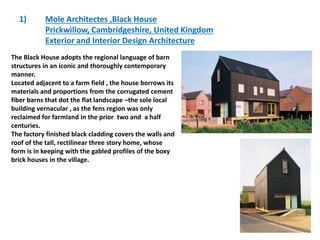
1) Mole Architectes ,Black House
Prickwillow, Cambridgeshire, United Kingdom
Exterior and Interior Design Architecture
The Black House adopts the regional language of barn
structures in an iconic and thoroughly contemporary
manner.
Located adjacent to a farm field , the house borrows its
materials and proportions from the corrugated cement
fiber barns that dot the flat landscape –the sole local
building vernacular , as the fens region was only
reclaimed for farmland in the prior two and a half
centuries.
The factory finished black cladding covers the walls and
roof of the tall, rectilinear three story home, whose
form is in keeping with the gabled profiles of the boxy
brick houses in the village.
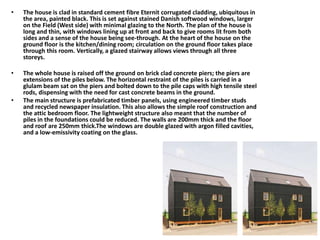
• The house is clad in standard cement fibre Eternit corrugated cladding, ubiquitous in
the area, painted black. This is set against stained Danish softwood windows, larger
on the Field (West side) with minimal glazing to the North. The plan of the house is
long and thin, with windows lining up at front and back to give rooms lit from both
sides and a sense of the house being see-through. At the heart of the house on the
ground floor is the kitchen/dining room; circulation on the ground floor takes place
through this room. Vertically, a glazed stairway allows views through all three
storeys.
• The whole house is raised off the ground on brick clad concrete piers; the piers are
extensions of the piles below. The horizontal restraint of the piles is carried in a
glulam beam sat on the piers and bolted down to the pile caps with high tensile steel
rods, dispensing with the need for cast concrete beams in the ground.
• The main structure is prefabricated timber panels, using engineered timber studs
and recycled newspaper insulation. This also allows the simple roof construction and
the attic bedroom floor. The lightweight structure also meant that the number of
piles in the foundations could be reduced. The walls are 200mm thick and the floor
and roof are 250mm thick.The windows are double glazed with argon filled cavities,
and a low-emissivity coating on the glass.
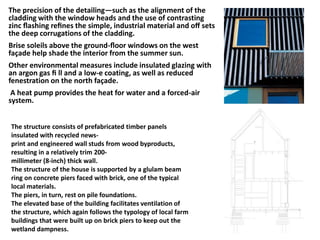
The precision of the detailing—such as the alignment of the
cladding with the window heads and the use of contrasting
zinc flashing refines the simple, industrial material and off sets
the deep corrugations of the cladding.
Brise soleils above the ground-floor windows on the west
façade help shade the interior from the summer sun.
Other environmental measures include insulated glazing with
an argon gas fi ll and a low-e coating, as well as reduced
fenestration on the north façade.
A heat pump provides the heat for water and a forced-air
system.
The structure consists of prefabricated timber panels
insulated with recycled news-
print and engineered wall studs from wood byproducts,
resulting in a relatively trim 200-
millimeter (8-inch) thick wall.
The structure of the house is supported by a glulam beam
ring on concrete piers faced with brick, one of the typical
local materials.
The piers, in turn, rest on pile foundations.
The elevated base of the building facilitates ventilation of
the structure, which again follows the typology of local farm
buildings that were built up on brick piers to keep out the
wetland dampness.
2) Architectural design: Herman Hertzberger, Amsterdam
Water Villa
Location: residential "Feather Poort", Middelburg , Metherlands
Year of completion: 2001
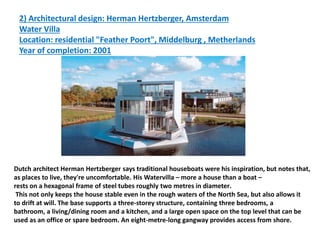
Dutch architect Herman Hertzberger says traditional houseboats were his inspiration, but notes that,
as places to live, they're uncomfortable. His Watervilla – more a house than a boat –
.
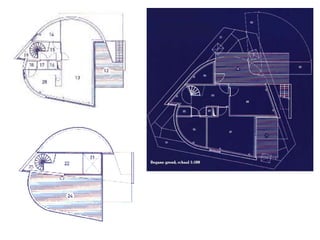
rests on a hexagonal frame of steel tubes roughly two metres in diameter
This not only keeps the house stable even in the rough waters of the North Sea, but also allows it
to drift at will. The base supports a three-storey structure, containing three bedrooms, a
bathroom, a living/dining room and a kitchen, and a large open space on the top level that can be
used as an office or spare bedroom. An eight-metre-long gangway provides access from shore.
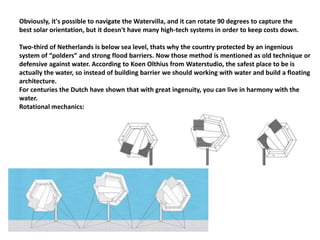
Obviously, it's possible to navigate the Watervilla, and it can rotate 90 degrees to capture the
best solar orientation, but it doesn't have many high-tech systems in order to keep costs down.
Two-third of Netherlands is below sea level, thats why the country protected by an ingenious
system of “polders” and strong flood barriers. Now those method is mentioned as old technique or
defensive against water. According to Koen Olthius from Waterstudio, the safest place to be is
actually the water, so instead of building barrier we should working with water and build a floating
architecture.
For centuries the Dutch have shown that with great ingenuity, you can live in harmony with the
water.
Rotational mechanics:
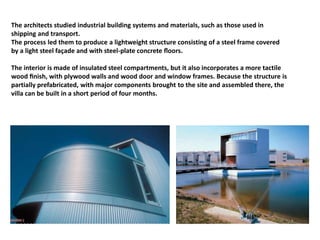
The architects studied industrial building systems and materials, such as those used in
shipping and transport.
The process led them to produce a lightweight structure consisting of a steel frame covered
by a light steel façade and with steel-plate concrete floors.
The interior is made of insulated steel compartments, but it also incorporates a more tactile
wood finish, with plywood walls and wood door and window frames. Because the structure is
partially prefabricated, with major components brought to the site and assembled there, the
villa can be built in a short period of four months.
3-Designer: Yung Ho Chang (Mainland China)
Classification: boutique hotel
Location: Great Wall, Beijing
Size: 449.136m2
Structure: wood frame, compressed earth
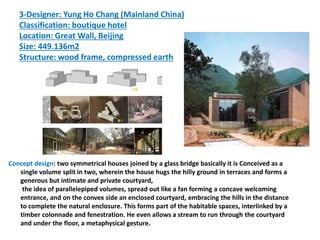
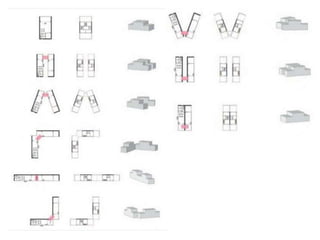
Concept design: two symmetrical houses joined by a glass bridge basically it is Conceived as a
single volume split in two, wherein the house hugs the hilly ground in terraces and forms a
generous but intimate and private courtyard,
the idea of parallelepiped volumes, spread out like a fan forming a concave welcoming
entrance, and on the convex side an enclosed courtyard, embracing the hills in the distance
to complete the natural enclosure. This forms part of the habitable spaces, interlinked by a
timber colonnade and fenestration. He even allows a stream to run through the courtyard
and under the floor, a metaphysical gesture.
Set in a mountainous region near the great wall,the house introduces several layers of
sustainability through adaptions to context and siting.
The parti of the house is based on the traditional Beijing courtyard home ,but is transformed
through its angled layout, which opens on one side to the mountains .
More over, a natural stream meanders through the site under the house ,creating a shan shui
siye yuan, a courtyard house with mountain and water.
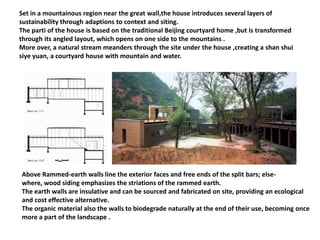
Above Rammed-earth walls line the exterior faces and free ends of the split bars; else-
where, wood siding emphasizes the striations of the rammed earth.
The earth walls are insulative and can be sourced and fabricated on site, providing an ecological
and cost effective alternative.
The organic material also the walls to biodegrade naturally at the end of their use, becoming once
more a part of the landscape .
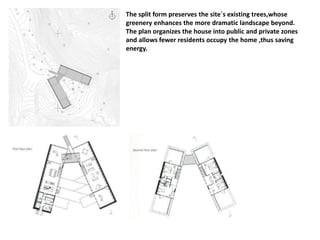
The split form preserves the site`s existing trees,whose
greenery enhances the more dramatic landscape beyond.
The plan organizes the house into public and private zones
and allows fewer residents occupy the home ,thus saving
energy.
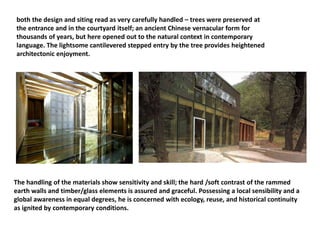
both the design and siting read as very carefully handled – trees were preserved at
the entrance and in the courtyard itself; an ancient Chinese vernacular form for
thousands of years, but here opened out to the natural context in contemporary
language. The lightsome cantilevered stepped entry by the tree provides heightened
architectonic enjoyment.
The handling of the materials show sensitivity and skill; the hard /soft contrast of the rammed
earth walls and timber/glass elements is assured and graceful. Possessing a local sensibility and a
global awareness in equal degrees, he is concerned with ecology, reuse, and historical continuity
as ignited by contemporary conditions.
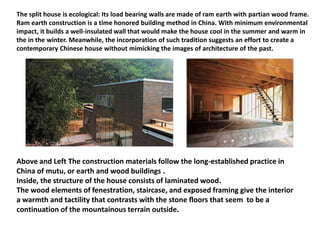
The split house is ecological: Its load bearing walls are made of ram earth with partian wood frame.
Ram earth construction is a time honored building method in China. With minimum environmental
impact, it builds a well-insulated wall that would make the house cool in the summer and warm in
the in the winter. Meanwhile, the incorporation of such tradition suggests an effort to create a
contemporary Chinese house without mimicking the images of architecture of the past.
Above and Left The construction materials follow the long-established practice in
China of mutu, or earth and wood buildings .
Inside, the structure of the house consists of laminated wood.
The wood elements of fenestration, staircase, and exposed framing give the interior
a warmth and tactility that contrasts with the stone floors that seem to be a
continuation of the mountainous terrain outside.
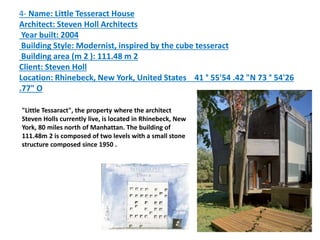
4- Name: Little Tesseract House
Architect: Steven Holl Architects
Year built: 2004
Building Style: Modernist, inspired by the cube tesseract
Building area (m 2 ): 111.48 m 2
Client: Steven Holl
Location: Rhinebeck, New York, United States 41 ° 55'54 .42 "N 73 ° 54'26
.77" O
"Little Tessaract", the property where the architect
Steven Holls currently live, is located in Rhinebeck, New
York, 80 miles north of Manhattan. The building of
111.48m 2 is composed of two levels with a small stone
structure composed since 1950 .
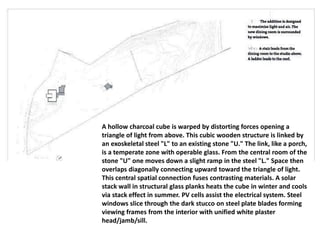
A hollow charcoal cube is warped by distorting forces opening a
triangle of light from above. This cubic wooden structure is linked by
an exoskeletal steel "L" to an existing stone "U." The link, like a porch,
is a temperate zone with operable glass. From the central room of the
stone "U" one moves down a slight ramp in the steel "L." Space then
overlaps diagonally connecting upward toward the triangle of light.
This central spatial connection fuses contrasting materials. A solar
stack wall in structural glass planks heats the cube in winter and cools
via stack effect in summer. PV cells assist the electrical system. Steel
windows slice through the dark stucco on steel plate blades forming
viewing frames from the interior with unified white plaster
head/jamb/sill.
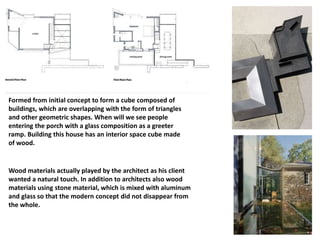
Formed from initial concept to form a cube composed of
buildings, which are overlapping with the form of triangles
and other geometric shapes. When will we see people
entering the porch with a glass composition as a greeter
ramp. Building this house has an interior space cube made
of wood.
Wood materials actually played by the architect as his client
wanted a natural touch. In addition to architects also wood
materials using stone material, which is mixed with aluminum
and glass so that the modern concept did not disappear from
the whole.
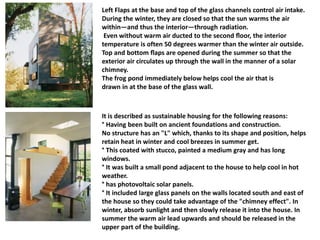
Left Flaps at the base and top of the glass channels control air intake.
During the winter, they are closed so that the sun warms the air
within—and thus the interior—through radiation.
Even without warm air ducted to the second floor, the interior
temperature is often 50 degrees warmer than the winter air outside.
Top and bottom flaps are opened during the summer so that the
exterior air circulates up through the wall in the manner of a solar
chimney.
The frog pond immediately below helps cool the air that is
drawn in at the base of the glass wall.
It is described as sustainable housing for the following reasons:
° Having been built on ancient foundations and construction.
No structure has an "L" which, thanks to its shape and position, helps
retain heat in winter and cool breezes in summer get.
° This coated with stucco, painted a medium gray and has long
windows.
° It was built a small pond adjacent to the house to help cool in hot
weather.
° has photovoltaic solar panels.
° It included large glass panels on the walls located south and east of
the house so they could take advantage of the "chimney effect". In
winter, absorb sunlight and then slowly release it into the house. In
summer the warm air lead upwards and should be released in the
upper part of the building.
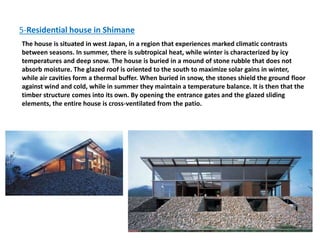
5-Residential house in Shimane
The house is situated in west Japan, in a region that experiences marked climatic contrasts
between seasons. In summer, there is subtropical heat, while winter is characterized by icy
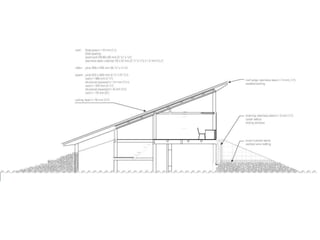
temperatures and deep snow. The house is buried in a mound of stone rubble that does not
absorb moisture. The glazed roof is oriented to the south to maximize solar gains in winter,
while air cavities form a thermal buffer. When buried in snow, the stones shield the ground floor
against wind and cold, while in summer they maintain a temperature balance. It is then that the
timber structure comes into its own. By opening the entrance gates and the glazed sliding
elements, the entire house is cross-ventilated from the patio.
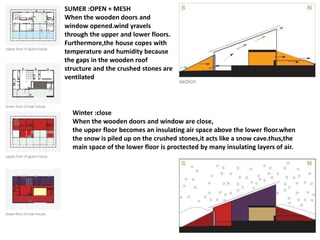
SUMER :OPEN + MESH
When the wooden doors and
window opened.wind yravels
through the upper and lower floors.
Furthermore,the house copes with
temperature and humidity because
the gaps in the wooden roof
structure and the crushed stones are
ventilated
Winter :close
When the wooden doors and window are close,
the upper floor becomes an insulating air space above the lower floor.when
the snow is piled up on the crushed stones,it acts like a snow cave.thus,the
main space of the lower floor is proctected by many insulating layers of air.
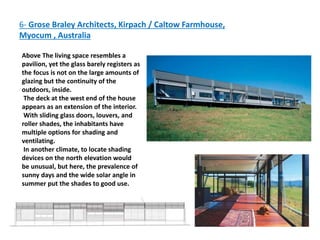
6- Grose Braley Architects, Kirpach / Caltow Farmhouse,
Myocum , Australia
Above The living space resembles a
pavilion, yet the glass barely registers as
the focus is not on the large amounts of
glazing but the continuity of the
outdoors, inside.
The deck at the west end of the house
appears as an extension of the interior.
With sliding glass doors, louvers, and
roller shades, the inhabitants have
multiple options for shading and
ventilating.
In another climate, to locate shading
devices on the north elevation would
be unusual, but here, the prevalence of
sunny days and the wide solar angle in
summer put the shades to good use.
Conclusions
The four projects gathered under (bioregionalism) however more specifically demonstrate the influence of
the vernacular in contemporary design.
Each intergrates traditional architectural details , building practices , and materials in ways that ground the
home in a particular place , yet respond to the needs of inhabitants of the twenty first century.
And each projects adds to the experiential and connotative , the environmental dimension.
The split and black houses and kropach / catlow farmhouse make use, respectively ,of earthen walls ,
cement fiber ,and corrugated metal enclosures as common , locally available materials that draw on local
building traditions.
The layout of the split house shows clearly how this adaptation can unfold from regional housing
typologies.
The black house and the water villa ,as outgrowths of the building typologies of the barn and the
houseboat , are unmistakably contextual.
Architecturally responsive to the conditions of their agrarian and marine landscapes,these homes
nonetheless possess identities quite distinct from other interpretations of their types, as they avoid any
literal rendition.
Such work vehemently opposes the interpretation of the vernacular on a purely representational level
(found in so many tract houses in Europe and north america) as a stylistic application that ignores the
climate and material basis of the original forms.
All projects feature passive solar design through shading devices, building orientation, and solar radiation,
A House for the Future is a purer demonstration of traditional passive solar techniques, with its massive
walls and stone floors that reradiate heat, while the other Residence exemplifies the solar-tempered
house that uses solar gain as heat but does not store it.
Often using low technological means, the projects of “Environmental Interface”
immerse their inhabitants in the natural environmental conditions in which they live.
As Hiroshi Sambuichi, the architect of the Stone House, would say, these methods are
a way of “picturing the Earth’s details through architecture.
References
•Contemporary Design in Detail (Sustainable Environments),Yenna Chan
•http://passivehouseplus.ie/ci/articles/international-green-buildings/international-
selections/Page-6.html
•http://archivio.archphoto.it/2007/09/09/yung-ho-chang/
•http://eartharchitecture.org/index.php?/archives/642-Split-House.html
•http://eng.sohochina.com/medReport/contenten/id/41703
•http://www.austriaarchitects.com/en/projects/1764_split_house/all/indexAll?lang=en-gb
•http://blog.kineticarchitecture.net/2008/08/water-villa/

Sustainability in interior design, Architecture

  • 1.
    provided by Mahmood .I.Albrifkany About Connection to Habitat SUSTAINABILITY IN INTERIOR DESIGN 2022
  • 2.
    Connection to habitat –The design strategies found in “Connection to Habitat” address sustainability through an architectural correlation with a regional definition of place. – The determination of a regional condition is geographic but broadly scaled, whether drawn from solar angles at a particular latitude, local meteorological conditions, or a specific architectural vernacular. – In each case, the habitat maintains a close relationship with its external environment by adapting to and learning from its locality. – The differences between various climactic and cultural contexts is not emphasized here so much as the variety of the methods attuned to regional conditions, since these residences are, in fact, all located in the northern and southern temperate zones. – – Bioregionalism carries a broader implication beyond architectural practices. – Often it refers to the cultural and political economy of a specific geographical location and applies to large scale issues of dwelling,including the social and economic . – A bioregional approach to sustainable residential design considers local origin as fundamental to its architectural methodologies,played out especially in the types of construction materials used and the source of these materials. – Of critical importance is the building`s involvement with the local economy through labor , production ,and consumption . – At its simplest , it can be understood as using environmentally harvested wood grown on native soil and purchased at a local lumberyard , thus minimizing pollution from transport and stimulating the local building trades.
  • 3.
    Bioregionalism • Vernacular language •Contextualism • Local economy • Building traditions • Regional typologies
  • 4.
    1) Mole Architectes,Black House Prickwillow, Cambridgeshire, United Kingdom Exterior and Interior Design Architecture The Black House adopts the regional language of barn structures in an iconic and thoroughly contemporary manner. Located adjacent to a farm field , the house borrows its materials and proportions from the corrugated cement fiber barns that dot the flat landscape –the sole local building vernacular , as the fens region was only reclaimed for farmland in the prior two and a half centuries. The factory finished black cladding covers the walls and roof of the tall, rectilinear three story home, whose form is in keeping with the gabled profiles of the boxy brick houses in the village.
  • 5.
    • The houseis clad in standard cement fibre Eternit corrugated cladding, ubiquitous in the area, painted black. This is set against stained Danish softwood windows, larger on the Field (West side) with minimal glazing to the North. The plan of the house is long and thin, with windows lining up at front and back to give rooms lit from both sides and a sense of the house being see-through. At the heart of the house on the ground floor is the kitchen/dining room; circulation on the ground floor takes place through this room. Vertically, a glazed stairway allows views through all three storeys. • The whole house is raised off the ground on brick clad concrete piers; the piers are extensions of the piles below. The horizontal restraint of the piles is carried in a glulam beam sat on the piers and bolted down to the pile caps with high tensile steel rods, dispensing with the need for cast concrete beams in the ground. • The main structure is prefabricated timber panels, using engineered timber studs and recycled newspaper insulation. This also allows the simple roof construction and the attic bedroom floor. The lightweight structure also meant that the number of piles in the foundations could be reduced. The walls are 200mm thick and the floor and roof are 250mm thick.The windows are double glazed with argon filled cavities, and a low-emissivity coating on the glass.
  • 6.
    The precision ofthe detailing—such as the alignment of the cladding with the window heads and the use of contrasting zinc flashing refines the simple, industrial material and off sets the deep corrugations of the cladding. Brise soleils above the ground-floor windows on the west façade help shade the interior from the summer sun. Other environmental measures include insulated glazing with an argon gas fi ll and a low-e coating, as well as reduced fenestration on the north façade. A heat pump provides the heat for water and a forced-air system. The structure consists of prefabricated timber panels insulated with recycled news- print and engineered wall studs from wood byproducts, resulting in a relatively trim 200- millimeter (8-inch) thick wall. The structure of the house is supported by a glulam beam ring on concrete piers faced with brick, one of the typical local materials. The piers, in turn, rest on pile foundations. The elevated base of the building facilitates ventilation of the structure, which again follows the typology of local farm buildings that were built up on brick piers to keep out the wetland dampness.
  • 7.
    2) Architectural design:Herman Hertzberger, Amsterdam Water Villa Location: residential "Feather Poort", Middelburg , Metherlands Year of completion: 2001 Dutch architect Herman Hertzberger says traditional houseboats were his inspiration, but notes that, as places to live, they're uncomfortable. His Watervilla – more a house than a boat – . rests on a hexagonal frame of steel tubes roughly two metres in diameter This not only keeps the house stable even in the rough waters of the North Sea, but also allows it to drift at will. The base supports a three-storey structure, containing three bedrooms, a bathroom, a living/dining room and a kitchen, and a large open space on the top level that can be used as an office or spare bedroom. An eight-metre-long gangway provides access from shore.
  • 8.
    Obviously, it's possibleto navigate the Watervilla, and it can rotate 90 degrees to capture the best solar orientation, but it doesn't have many high-tech systems in order to keep costs down. Two-third of Netherlands is below sea level, thats why the country protected by an ingenious system of “polders” and strong flood barriers. Now those method is mentioned as old technique or defensive against water. According to Koen Olthius from Waterstudio, the safest place to be is actually the water, so instead of building barrier we should working with water and build a floating architecture. For centuries the Dutch have shown that with great ingenuity, you can live in harmony with the water. Rotational mechanics:
  • 9.
    The architects studiedindustrial building systems and materials, such as those used in shipping and transport. The process led them to produce a lightweight structure consisting of a steel frame covered by a light steel façade and with steel-plate concrete floors. The interior is made of insulated steel compartments, but it also incorporates a more tactile wood finish, with plywood walls and wood door and window frames. Because the structure is partially prefabricated, with major components brought to the site and assembled there, the villa can be built in a short period of four months.
  • 11.
    3-Designer: Yung HoChang (Mainland China) Classification: boutique hotel Location: Great Wall, Beijing Size: 449.136m2 Structure: wood frame, compressed earth Concept design: two symmetrical houses joined by a glass bridge basically it is Conceived as a single volume split in two, wherein the house hugs the hilly ground in terraces and forms a generous but intimate and private courtyard, the idea of parallelepiped volumes, spread out like a fan forming a concave welcoming entrance, and on the convex side an enclosed courtyard, embracing the hills in the distance to complete the natural enclosure. This forms part of the habitable spaces, interlinked by a timber colonnade and fenestration. He even allows a stream to run through the courtyard and under the floor, a metaphysical gesture.
  • 12.
    Set in amountainous region near the great wall,the house introduces several layers of sustainability through adaptions to context and siting. The parti of the house is based on the traditional Beijing courtyard home ,but is transformed through its angled layout, which opens on one side to the mountains . More over, a natural stream meanders through the site under the house ,creating a shan shui siye yuan, a courtyard house with mountain and water. Above Rammed-earth walls line the exterior faces and free ends of the split bars; else- where, wood siding emphasizes the striations of the rammed earth. The earth walls are insulative and can be sourced and fabricated on site, providing an ecological and cost effective alternative. The organic material also the walls to biodegrade naturally at the end of their use, becoming once more a part of the landscape .
  • 13.
    The split formpreserves the site`s existing trees,whose greenery enhances the more dramatic landscape beyond. The plan organizes the house into public and private zones and allows fewer residents occupy the home ,thus saving energy.
  • 15.
    both the designand siting read as very carefully handled – trees were preserved at the entrance and in the courtyard itself; an ancient Chinese vernacular form for thousands of years, but here opened out to the natural context in contemporary language. The lightsome cantilevered stepped entry by the tree provides heightened architectonic enjoyment. The handling of the materials show sensitivity and skill; the hard /soft contrast of the rammed earth walls and timber/glass elements is assured and graceful. Possessing a local sensibility and a global awareness in equal degrees, he is concerned with ecology, reuse, and historical continuity as ignited by contemporary conditions.
  • 16.
    The split houseis ecological: Its load bearing walls are made of ram earth with partian wood frame. Ram earth construction is a time honored building method in China. With minimum environmental impact, it builds a well-insulated wall that would make the house cool in the summer and warm in the in the winter. Meanwhile, the incorporation of such tradition suggests an effort to create a contemporary Chinese house without mimicking the images of architecture of the past. Above and Left The construction materials follow the long-established practice in China of mutu, or earth and wood buildings . Inside, the structure of the house consists of laminated wood. The wood elements of fenestration, staircase, and exposed framing give the interior a warmth and tactility that contrasts with the stone floors that seem to be a continuation of the mountainous terrain outside.
  • 17.
    4- Name: LittleTesseract House Architect: Steven Holl Architects Year built: 2004 Building Style: Modernist, inspired by the cube tesseract Building area (m 2 ): 111.48 m 2 Client: Steven Holl Location: Rhinebeck, New York, United States 41 ° 55'54 .42 "N 73 ° 54'26 .77" O "Little Tessaract", the property where the architect Steven Holls currently live, is located in Rhinebeck, New York, 80 miles north of Manhattan. The building of 111.48m 2 is composed of two levels with a small stone structure composed since 1950 .
  • 18.
    A hollow charcoalcube is warped by distorting forces opening a triangle of light from above. This cubic wooden structure is linked by an exoskeletal steel "L" to an existing stone "U." The link, like a porch, is a temperate zone with operable glass. From the central room of the stone "U" one moves down a slight ramp in the steel "L." Space then overlaps diagonally connecting upward toward the triangle of light. This central spatial connection fuses contrasting materials. A solar stack wall in structural glass planks heats the cube in winter and cools via stack effect in summer. PV cells assist the electrical system. Steel windows slice through the dark stucco on steel plate blades forming viewing frames from the interior with unified white plaster head/jamb/sill.
  • 19.
    Formed from initialconcept to form a cube composed of buildings, which are overlapping with the form of triangles and other geometric shapes. When will we see people entering the porch with a glass composition as a greeter ramp. Building this house has an interior space cube made of wood. Wood materials actually played by the architect as his client wanted a natural touch. In addition to architects also wood materials using stone material, which is mixed with aluminum and glass so that the modern concept did not disappear from the whole.
  • 20.
    Left Flaps atthe base and top of the glass channels control air intake. During the winter, they are closed so that the sun warms the air within—and thus the interior—through radiation. Even without warm air ducted to the second floor, the interior temperature is often 50 degrees warmer than the winter air outside. Top and bottom flaps are opened during the summer so that the exterior air circulates up through the wall in the manner of a solar chimney. The frog pond immediately below helps cool the air that is drawn in at the base of the glass wall. It is described as sustainable housing for the following reasons: ° Having been built on ancient foundations and construction. No structure has an "L" which, thanks to its shape and position, helps retain heat in winter and cool breezes in summer get. ° This coated with stucco, painted a medium gray and has long windows. ° It was built a small pond adjacent to the house to help cool in hot weather. ° has photovoltaic solar panels. ° It included large glass panels on the walls located south and east of the house so they could take advantage of the "chimney effect". In winter, absorb sunlight and then slowly release it into the house. In summer the warm air lead upwards and should be released in the upper part of the building.
  • 21.
    5-Residential house inShimane The house is situated in west Japan, in a region that experiences marked climatic contrasts between seasons. In summer, there is subtropical heat, while winter is characterized by icy temperatures and deep snow. The house is buried in a mound of stone rubble that does not absorb moisture. The glazed roof is oriented to the south to maximize solar gains in winter, while air cavities form a thermal buffer. When buried in snow, the stones shield the ground floor against wind and cold, while in summer they maintain a temperature balance. It is then that the timber structure comes into its own. By opening the entrance gates and the glazed sliding elements, the entire house is cross-ventilated from the patio.
  • 22.
    SUMER :OPEN +MESH When the wooden doors and window opened.wind yravels through the upper and lower floors. Furthermore,the house copes with temperature and humidity because the gaps in the wooden roof structure and the crushed stones are ventilated Winter :close When the wooden doors and window are close, the upper floor becomes an insulating air space above the lower floor.when the snow is piled up on the crushed stones,it acts like a snow cave.thus,the main space of the lower floor is proctected by many insulating layers of air.
  • 24.
    6- Grose BraleyArchitects, Kirpach / Caltow Farmhouse, Myocum , Australia Above The living space resembles a pavilion, yet the glass barely registers as the focus is not on the large amounts of glazing but the continuity of the outdoors, inside. The deck at the west end of the house appears as an extension of the interior. With sliding glass doors, louvers, and roller shades, the inhabitants have multiple options for shading and ventilating. In another climate, to locate shading devices on the north elevation would be unusual, but here, the prevalence of sunny days and the wide solar angle in summer put the shades to good use.
  • 25.
    Conclusions The four projectsgathered under (bioregionalism) however more specifically demonstrate the influence of the vernacular in contemporary design. Each intergrates traditional architectural details , building practices , and materials in ways that ground the home in a particular place , yet respond to the needs of inhabitants of the twenty first century. And each projects adds to the experiential and connotative , the environmental dimension. The split and black houses and kropach / catlow farmhouse make use, respectively ,of earthen walls , cement fiber ,and corrugated metal enclosures as common , locally available materials that draw on local building traditions. The layout of the split house shows clearly how this adaptation can unfold from regional housing typologies. The black house and the water villa ,as outgrowths of the building typologies of the barn and the houseboat , are unmistakably contextual. Architecturally responsive to the conditions of their agrarian and marine landscapes,these homes nonetheless possess identities quite distinct from other interpretations of their types, as they avoid any literal rendition. Such work vehemently opposes the interpretation of the vernacular on a purely representational level (found in so many tract houses in Europe and north america) as a stylistic application that ignores the climate and material basis of the original forms. All projects feature passive solar design through shading devices, building orientation, and solar radiation, A House for the Future is a purer demonstration of traditional passive solar techniques, with its massive walls and stone floors that reradiate heat, while the other Residence exemplifies the solar-tempered house that uses solar gain as heat but does not store it. Often using low technological means, the projects of “Environmental Interface” immerse their inhabitants in the natural environmental conditions in which they live. As Hiroshi Sambuichi, the architect of the Stone House, would say, these methods are a way of “picturing the Earth’s details through architecture.
  • 26.
    References •Contemporary Design inDetail (Sustainable Environments),Yenna Chan •http://passivehouseplus.ie/ci/articles/international-green-buildings/international- selections/Page-6.html •http://archivio.archphoto.it/2007/09/09/yung-ho-chang/ •http://eartharchitecture.org/index.php?/archives/642-Split-House.html •http://eng.sohochina.com/medReport/contenten/id/41703 •http://www.austriaarchitects.com/en/projects/1764_split_house/all/indexAll?lang=en-gb •http://blog.kineticarchitecture.net/2008/08/water-villa/