Presented By Parikh
Jay
M.Pharm sem 2
Shree B.M.Shah
College of
pharmaceutical
Education & research
MODASA
INTRODUCTION
CONCEPT
ADVANTAGE & DISADVANTAGE
METHOD OF PREPARATION
CHARACTERIZATION
EVALUTATION
APPLICATION
INTRODUCTION
» DEFINITION:
» Nanoparticles are subnanosized colloidal drug delivery
systems
» particle size ranges from 10-1000 nm in diameter.
» They are composed of synthetic or
semi synthetic polymers carrying
drugs or proteinaceous substances,
i.e. antigen(s).»
» The basic Concept involved
is :
» Selective and Effective Localization of
pharmacologically active moiety at preselected
target(s) in therapeutic concentrations,
» Providedrestriction of it’s access to non-target normal
tissues and cells.
» Nanoparticles are mainly taken by :
Reticulo Endothelial System (RES),
After the administration;
» Hence are useful to carry drugs to the liver
and to cells that are phagocytically active.
» By modifying the surface characteristics of the
nanoparticles it is possible to enhance the
delivery of drugs to spleen relative to the liver.
» Distribution of the nanoparticles in the body
may be achieved possibly by :
» Coating of nanoparticles with certain
Serum components, Attachment of
antibodies or sulfoxide groups and the
use of Magnetic nanoparticles.
» Reduction in the frequency of the
dosages taken by the patient
» More uniform effect of the drug
» Reduction of drug Side Effects
» Reduced fluctuation in circulating drug
levels
» Avoids hepatic first pass metabolism
Reduced ability to adjust thedose
Highly sophisticatedtechnology
Requires skills tomanufacture
Difficult to maintain stability of dosage form.
E.g.: Resealed erythrocytes stored at 40C
High cost
Productivity more difficult
» It should be biochemical inert , non toxic
and non-immunogenic.
» It should be stable both physically and
chemically in Invivo & invitro conditions.
» Restrict drug distribution to non-target cells
or tissues or organs & should have uniform
distribution.
» Controllable & Predicate rate of drug
release.
» Drug release should not effect drug
action
» Specific Therapeutic amount of drug release must
be possessed
» Carriers used must be biodegradable or readily
eliminated from the body without any problem and
no carrier induced modulation in disease state.
» The preparation of the delivery system should be
easy or reasonable
» simple, reproducible & cost effective.
A : Cross Linking
Methods
» 1) By Cross-linking of Amphiphilic Macromolecules.
» 2) By Crosslinkingin W/O Emulsion
» 3) By Emulsion chemical dehydration
» 4) By Phase Separation
» 5) By pH lnduced Aggregation
B : Polymerization Methods
» 1) Emulsion polymerization
» 2) Dispersion polymerization
» Nanoparticles can be prepared from Amphiphilic
macromolecules, proteins and polysaccharides (which have
affinity for aqueous and lipid solvents).
» The method involves Aggregationof Amphiphilesfollowed
by stabilization either by heat denaturation or chemical
cross-linking
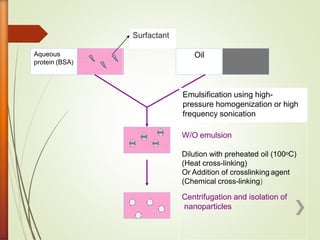
2) By cross linking of W/O Emulsion:
Emulsification of bovine serum albumin (BSA) OR Protein
aqueous solution in oil using high- pressure homogenization
or high frequency sonication.
Aqueous
protein (BSA)
Oil
W/O emulsion
Dilution with preheated oil (100oC)
(Heat cross-linking)
Or Addition of crosslinking agent
(Chemical cross-linking)
Centrifugation and isolation of
nanoparticles
Emulsification using high-
pressure homogenization or high
frequency sonication
Surfactant
» Stabilization can also be achieved by emulsion
chemical dehydration.
» Hydroxy propyl cellulose solution in chloroform is
used as a continuous phase,
» while a chemical dehydrating agent,
» 2,2, di-methyl propane is used to disperseinto
the internal aqueous phase to form an
Emulsion.
» ADV:The method avoid coalescence of
droplets and could produce
nanoparticles of smaller size (300nm),
» The protein or polysaccharide from an aqueous phase
can be desolvated by:
1) PH change
2) Change in temperature
3) Addition of appropriate counter ions. e.g Alginate
Aqueous phase(protein aqueous solution)
Protein aggregates (Coacervates)
Protein colloidal dispersion
Nanoparticles dispersion
(External aqueous phase) 200nm
Desolvation
Resolvation
Cross-linking
Heat to 40o C , subsequent cooling to 4O C
for 24h.
» Gelatin Nanospheres were prepared
by :
Gelatin & tween 20 were dissolved in aq. phase & pH
of the solution was adjusted to optimum value.
The clear solution so obtained was heated to 400C
followed by its quenching at 40C for 24hrs &
subsequently left at ambient temperature for 48hrs.
The sequential temperature treatment resulted into a
colloidal dispersion of aggregated gelatin. The aggregates
were finally cross linked using glutaraldehyde as cross
linking agent the optimum pH was 5.5- 6.5.values
below 5.5 produced no aggregation while above 6.5 an
uncontrolled aggregation led to the formation of larger
nanospheres
1) Emulsion polymerization
» It consists of:
» A] Micellar nucleation and polymerization :
Monomer is insoluble in continuous phase.(O/W phase)
Aqueous phase
» B] Homogenous nucleation and polymerization:
Monomer is soluble in continuous phase.(W/O phase)
Organic phase.
Nucleated micelle Stabilized polymeric micelle
Catalyst
Monomer dropletCatalystDrug Monomer
monomer
supply
Monomer bearing
nanospheres
(micelle) (Nano
lsolation of nanospheres
Oligomers aggregate &
precipitates
Further, By chemical initiation
(ammonium or potassium per oxo disulphate)
(Acrylamide or Methyl methacrylate) Monomer is dissolved
in an aqueous medium
Heated to above 65 C
Solvent Evaporation
Method
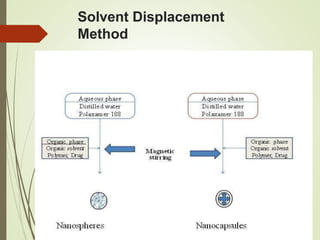
Solvent Displacement
Method
2
3Salting out of
Polymer
Characterization and
evaluation of nanoparticles
 Parameter Method
1) particle size spectroscopy - photon correlation
 2) Molecular weight - Gel chromatography
 3) Charge determination - Laser Doppler
- Anemometry,
- Zeta potentiometer
4) Density - Helium compression
pynometry
5) Crystallinity - X-ray diffraction &
Differential scanning
Calorimetry,
Thermogravimetry
6) Hydrophobicity - Hydrophobic
interaction,
Chromatography
7) Surface element analysis - X-ray, photon
electron
1) Widely used in case of Cancer
Therapy.
2) In Intracellular Targeting.
3) Used for prolonged systemic
circulation.
4) As a vaccine Adjuvant.
5) In case of ocular delivery.
6) Used in DNA Delivery.
7) Enzyme immunoassays
8) Radio- imaging.
9) To cross BBB.
31

Nanoparticles

  • 1.
    Presented By Parikh Jay M.Pharmsem 2 Shree B.M.Shah College of pharmaceutical Education & research MODASA
  • 2.
    INTRODUCTION CONCEPT ADVANTAGE & DISADVANTAGE METHODOF PREPARATION CHARACTERIZATION EVALUTATION APPLICATION
  • 3.
    INTRODUCTION » DEFINITION: » Nanoparticlesare subnanosized colloidal drug delivery systems » particle size ranges from 10-1000 nm in diameter. » They are composed of synthetic or semi synthetic polymers carrying drugs or proteinaceous substances, i.e. antigen(s).»
  • 4.
    » The basicConcept involved is : » Selective and Effective Localization of pharmacologically active moiety at preselected target(s) in therapeutic concentrations, » Providedrestriction of it’s access to non-target normal tissues and cells. » Nanoparticles are mainly taken by : Reticulo Endothelial System (RES), After the administration;
  • 5.
    » Hence areuseful to carry drugs to the liver and to cells that are phagocytically active. » By modifying the surface characteristics of the nanoparticles it is possible to enhance the delivery of drugs to spleen relative to the liver. » Distribution of the nanoparticles in the body may be achieved possibly by : » Coating of nanoparticles with certain Serum components, Attachment of antibodies or sulfoxide groups and the use of Magnetic nanoparticles.
  • 6.
    » Reduction inthe frequency of the dosages taken by the patient » More uniform effect of the drug » Reduction of drug Side Effects » Reduced fluctuation in circulating drug levels » Avoids hepatic first pass metabolism
  • 7.
    Reduced ability toadjust thedose Highly sophisticatedtechnology Requires skills tomanufacture Difficult to maintain stability of dosage form. E.g.: Resealed erythrocytes stored at 40C High cost Productivity more difficult
  • 8.
    » It shouldbe biochemical inert , non toxic and non-immunogenic. » It should be stable both physically and chemically in Invivo & invitro conditions. » Restrict drug distribution to non-target cells or tissues or organs & should have uniform distribution. » Controllable & Predicate rate of drug release.
  • 9.
    » Drug releaseshould not effect drug action » Specific Therapeutic amount of drug release must be possessed » Carriers used must be biodegradable or readily eliminated from the body without any problem and no carrier induced modulation in disease state. » The preparation of the delivery system should be easy or reasonable » simple, reproducible & cost effective.
  • 10.
    A : CrossLinking Methods » 1) By Cross-linking of Amphiphilic Macromolecules. » 2) By Crosslinkingin W/O Emulsion » 3) By Emulsion chemical dehydration » 4) By Phase Separation » 5) By pH lnduced Aggregation B : Polymerization Methods » 1) Emulsion polymerization » 2) Dispersion polymerization
  • 11.
    » Nanoparticles canbe prepared from Amphiphilic macromolecules, proteins and polysaccharides (which have affinity for aqueous and lipid solvents). » The method involves Aggregationof Amphiphilesfollowed by stabilization either by heat denaturation or chemical cross-linking 2) By cross linking of W/O Emulsion: Emulsification of bovine serum albumin (BSA) OR Protein aqueous solution in oil using high- pressure homogenization or high frequency sonication.
  • 12.
    Aqueous protein (BSA) Oil W/O emulsion Dilutionwith preheated oil (100oC) (Heat cross-linking) Or Addition of crosslinking agent (Chemical cross-linking) Centrifugation and isolation of nanoparticles Emulsification using high- pressure homogenization or high frequency sonication Surfactant
  • 13.
    » Stabilization canalso be achieved by emulsion chemical dehydration. » Hydroxy propyl cellulose solution in chloroform is used as a continuous phase, » while a chemical dehydrating agent, » 2,2, di-methyl propane is used to disperseinto the internal aqueous phase to form an Emulsion. » ADV:The method avoid coalescence of droplets and could produce nanoparticles of smaller size (300nm),
  • 14.
    » The proteinor polysaccharide from an aqueous phase can be desolvated by: 1) PH change 2) Change in temperature 3) Addition of appropriate counter ions. e.g Alginate
  • 15.
    Aqueous phase(protein aqueoussolution) Protein aggregates (Coacervates) Protein colloidal dispersion Nanoparticles dispersion (External aqueous phase) 200nm Desolvation Resolvation Cross-linking Heat to 40o C , subsequent cooling to 4O C for 24h.
  • 16.
    » Gelatin Nanosphereswere prepared by : Gelatin & tween 20 were dissolved in aq. phase & pH of the solution was adjusted to optimum value. The clear solution so obtained was heated to 400C followed by its quenching at 40C for 24hrs & subsequently left at ambient temperature for 48hrs. The sequential temperature treatment resulted into a colloidal dispersion of aggregated gelatin. The aggregates were finally cross linked using glutaraldehyde as cross linking agent the optimum pH was 5.5- 6.5.values below 5.5 produced no aggregation while above 6.5 an uncontrolled aggregation led to the formation of larger nanospheres
  • 17.
    1) Emulsion polymerization »It consists of: » A] Micellar nucleation and polymerization : Monomer is insoluble in continuous phase.(O/W phase) Aqueous phase » B] Homogenous nucleation and polymerization: Monomer is soluble in continuous phase.(W/O phase) Organic phase.
  • 18.
    Nucleated micelle Stabilizedpolymeric micelle Catalyst Monomer dropletCatalystDrug Monomer monomer supply Monomer bearing nanospheres (micelle) (Nano
  • 20.
    lsolation of nanospheres Oligomersaggregate & precipitates Further, By chemical initiation (ammonium or potassium per oxo disulphate) (Acrylamide or Methyl methacrylate) Monomer is dissolved in an aqueous medium Heated to above 65 C
  • 21.
  • 22.
  • 23.
  • 24.
    Characterization and evaluation ofnanoparticles  Parameter Method 1) particle size spectroscopy - photon correlation  2) Molecular weight - Gel chromatography  3) Charge determination - Laser Doppler - Anemometry, - Zeta potentiometer
  • 25.
    4) Density -Helium compression pynometry 5) Crystallinity - X-ray diffraction & Differential scanning Calorimetry, Thermogravimetry 6) Hydrophobicity - Hydrophobic interaction, Chromatography 7) Surface element analysis - X-ray, photon electron
  • 26.
    1) Widely usedin case of Cancer Therapy. 2) In Intracellular Targeting. 3) Used for prolonged systemic circulation. 4) As a vaccine Adjuvant. 5) In case of ocular delivery. 6) Used in DNA Delivery. 7) Enzyme immunoassays 8) Radio- imaging. 9) To cross BBB.
  • 27.