PREGNANCY AND HEART DISEASE Prof.S.Sundar’s Unit Dr.R.Ganesan  PG Internal medicine
Incidince and changing pattern of  heart disease   Incidence 0.1-4% Advances in medical and surgical management of congenital heart disease resulted an increase survival to reproductive age Sharp decline in incidence of chronic Rheumatic heart disease
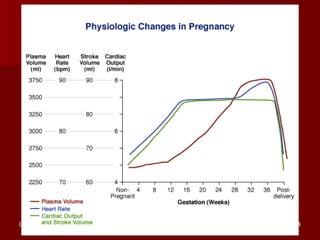
Hemodynamics During Pregnancy Peripheral resistance-decrease Blood volume-increase40-45% Heart rate-increase10-20% Cardiac output-increase30% BP-normal or decrease Venous pressure in LL-increase Pulmonary vascular resistance-decrease
05/18/10 Dr.Uma  Dr.NK Gupta
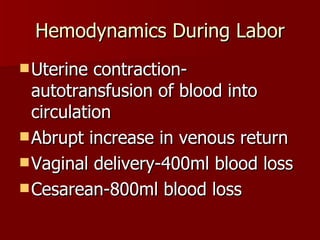
Hemodynamics During Labor Uterine contraction-autotransfusion of blood into circulation Abrupt increase in venous return Vaginal delivery-400ml blood loss Cesarean-800ml blood loss
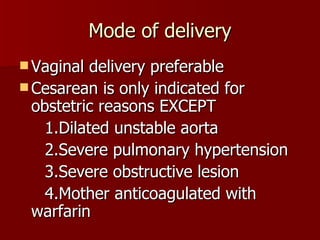
Mode of delivery Vaginal delivery preferable Cesarean is only indicated for obstetric reasons EXCEPT 1.Dilated unstable aorta 2.Severe pulmonary hypertension 3.Severe obstructive lesion 4.Mother anticoagulated with warfarin
Physical examination Pulse volume increase JVP-may elevated Apical impulse is more prominent First heart sound appear loud Third heart sound common ESM grade3/6 left sternal edge Continuous murmur[cervical venous hum,mammary suffle] may heard NO DIASTOLIC MURMUR
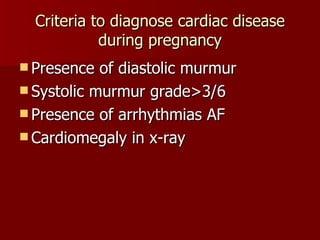
Criteria to diagnose cardiac disease during pregnancy Presence of diastolic murmur Systolic murmur grade>3/6 Presence of arrhythmias AF Cardiomegaly in x-ray
Risk index Prior cardiac events [HF,TIA,Stroke] or Arrhythmias Baseline NYHA class>2 or cyanosis LVOT obstruction:  [MVA<2cm2,AVA<1.5cm2,Peak LVOTpressure gradient>30mmhg] LVEF<40%
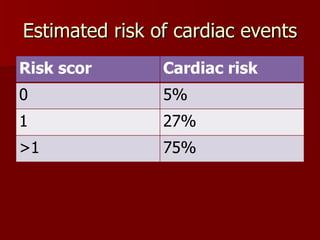
Estimated risk of cardiac events Risk scor Cardiac risk 0 5% 1 27% >1 75%
Risk factors for HF in pregnancy Anaemia Infections Hypertension Obesity Hyperthyroidism Multiple pregnancy
Mortality associated specific cardiac disease Low risk of mortality<1% ASD/VSD NYHA class I and II PDA Pulmonary and tricuspid lesion
Moderate risk of mortality [5-15%] NYHA class III and IV Mitral stenosis Severe aortic stenosis Marfan syndrome with normal aorta Uncomplicated coarctation of aorta Past h/o myocardial infarction
Highrisk of mortality[25-50%] Eissenmenger’s syndrome Pulmonary hypertension Marfan syndrome with abnormal aorta Peripartum cardiomyopathy
Transthoracic Echocardiography Valve  area calculation,pressure half time measurement more usefull than simple measurement of transvalvular gradient Valvular regurgitation will appear to be accentuated because of ↑ stroke volume Serial ECHO: Mechanical valve prosthesis vulnerable to thrombosis
Medical management NYHA class I & II: bed rest,low salt diet iron and vitamins to minimize anaemia. regular cardiac obstetric evaluations NYHA ClassIII&IV: Need hospital admission, close monitoring early delivery if maternal haemodynamic compromise
Surgical management I-trimester: High risk of fetal malformation and loss  if cardiopulmonary bypass performed Last-timester: High risk of premature labor Optimal time surgery: 20-28 weeks of gestation
Cardiopulmonary bypass technique Normothermic High pump flows High pressure MAP>60mmhg Short bypass time as possible Inspite of these interventions current risk of fetal loss 10% ,even higher when cardiac surgery  is emergency
ASD : Maternal risk is low Paradoxical embolism Augmentation of R ->  L shunt  during postpartum blood loss Coarctation of aorta:  risk of aortic  reptur,intracerebral aneurysm repture
Cynotic heart disease MATERNAL RISK 1.Augments right to left shunt 2.Propensity to thrombosis 3.Paradoxical embolism FETAL RISK 1.Inherit congenital heart disease-conotruncal abnormalities-AD 22q11  2.IUGR, Fetal loss
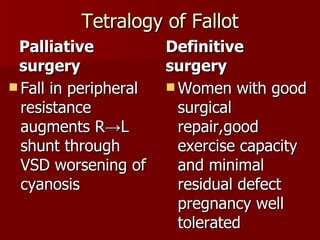
Tetralogy of Fallot Palliative surgery Fall in peripheral resistance augments R->L shunt through VSD worsening of cyanosis Definitive surgery Women with good surgical repair,good exercise capacity and minimal residual defect pregnancy well tolerated
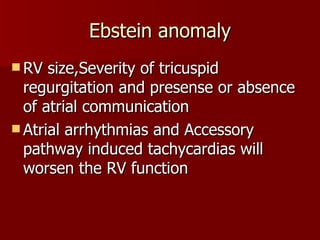
Ebstein anomaly RV size,Severity of tricuspid regurgitation and presense or absence of atrial communication Atrial arrhythmias and Accessory pathway induced tachycardias will worsen the RV function
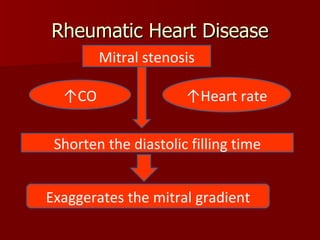
Rheumatic Heart Disease Mitral stenosis ↑ Heart rate ↑ CO Shorten the diastolic filling time Exaggerates the mitral gradient
Beta blockade to reduce heart rate Diuretics to reduce pulmonary edema Anticoagulation if AF present If refractory to medical therapy-Balloon valvuloplasty  Moderate  MR/AR well tolerated in pregnancy
Aortic Stenosis All most always secondary to bicuspid aorti valve Bicuspid Aortic valve is associated with AORTOPATHY even with functinally normal valve Pregnancy is contraindicated if aortic dimension>4.5cm
Severe Aortic Stenosis AVA<1cm2 or mean pressure gradient >50mmhg is contraindication for pregnancy Decreased peripheral vascular resistance during pregnancy will exaggerate the aortic gradient and precipitate symptoms Percutaneous aortic balloon valvuloplasty to be considered
Pulmonary stenosis Well tolerated during pregnancy if RV pressure less than 70% of  systemic pressure and sinus rhythm maintained If necessary balloon valvuloplasty can be performed
Pulmonary Hypertension Pulmonary hypertension regardless of the cause carries HIGH MORTALITY 50% Pulmonary hypertension >60% of systemic pressure more likely to be associated with complications Volume overload precipitate HF Fall in peripheral resistance augment R->L shunt and cyanosis
Marfan Syndrome AD, disorder of fibrillin Pregnancy contraindicated if ascending aorta>40mm Associated cardiac problems:MVP, Aortic regurgitation Periodic ECHO surveillance every 6-8 weeks to monitor aortic root size Any chest pain should rule out dissection
Coronary Artery Disease Uncommon in women of child-bearing age but may occur in the setting of DM Smoking The most common cause is coronary artery  dissection,most common site is LAD Urgent angiography and stenting is treatment of choice Vulnerability to dissection during pregnancy due to hormonal effect on elastin and collagen synthesis
Cardiomyopathies Dilated cardiomyopathy:If LVEF<40% pregnancy  contraindicated Hypertrophic cardiomathy: AD inheritance, genitic counseling  preior to pregnancy Pregnancy is well tolerated
Peripartum Cardiomathy Common during last month of pregnancy or within 5 months of delivery Incidence 1 in 3000 Risk factors:Preeclampsia, multiparity, older maternal age, black race Normalization of LV function occurs in 50% of pt if LVEF>30% at the time diagnosis PPCM will recurin 30% cases
Arrhythmias Risk factors for arrhythmias (1)↑ in preload causing myocardial irritability (2)↑HR which affect refractory period (3)Fluid and electrolyte shift (4)Change in catecholamine level
The most common arrhythmia is atrial reentry tachycardia Treatment is same as non-pregnant women Electrical cardioversion is not harmful to fetus VPC  are common in pregnancy ,Rx not required
ACA/AHA recommendations for Rx of SVT during pregnancy Acute conversion of SVT Vagal maneuver Adenosine DC cardioversion Prophylactic therapy Digoxin Metoprolol-(avoid in first trimester)
ACA/AHA guide-line for management of AF  during pregnancy Ventricular rate control with Digoxin,Verapamil,Beta blockers Electrical cardioversion if patient hemodynamically unstable Anticoagulation throughtout pregnancy
Prosthetic Valves Bioprostheteses Less thrombogenic No anticoagulation risk Less longevity<10 years Mechanical prostheses Greater longevity Require anticoagulation Higher risk of fetal loss,placental hemarrhage, prosthetic valve thrombosis
Unfractionated Heparin Advantages Dose not cross placenta Disadvantage Poor anticoagulation effect in pregnancy Risk of prosthetic valve thrombosis 9% Thrombocytopenia Osteoporosis
Warfarin I-trimester exposure leads to fetal embryopathy-6% (1)Chondrodysplasia punctata (2)Nasal hypoplasia (3)Optic atrophy (4)Menral retardation Risk reduced by initiating  heparin before 6 weeks of pregnancy
High Risk For Thrombosis The risk of fetal embryopathy is dose-related and risk is very low if dose <5mg Pregnant women high risk of thrombosis like tilting disc mitral prosthesis, in AF safer approach is treat with warfarin for first 36 weeks of pregnancy if her dose <5mg
Low Risk For Thrombosis Low risk for thrombosis heparin selected as soon as pregnancy diagnosed Warfarin substituted at 13-14 weeks  Heparin restarted at 36 weeks in anticipation to delivery
Anticoagulation therapy At week 36 : *Discontinue warfarin *Change to UFH titrated to a therapeutic aPTT or anti-factor Xa level. At Delivery: *Restart heparin therapy 4 to 6 hr after delivery if no contraindications *Resume warfarin therapy the night after delivery if no bleeding complications #if labor begins while the woman is receiving warfarin, anticoagulation should be reversed and caesarean delivery performed
Anticoagulation therapy Monitoring With LMWH administered sc. twice daily maintain anti-Xa level between 0.7 and  1.2 U/ml 4 hours after admn. With dose adjusted UFH, the aPTT should be at least twice control. those on warfarin, the INR goal should be 3.0(range 2.5 to 3.5)
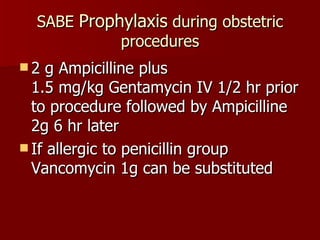
SABE  Prophylaxis  during obstetric procedures 2 g Ampicilline plus  1.5 mg/kg Gentamycin IV 1/2 hr prior to procedure followed by Ampicilline 2g 6 hr later If allergic to penicillin group Vancomycin 1g can be substituted
Dr.Uma  Dr.NK Gupta
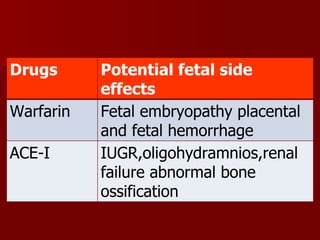
IUGR,oligohydramnios,renal failure abnormal bone ossification ACE-I Fetal embryopathy placental and fetal hemorrhage Warfarin Potential fetal side effects Drugs
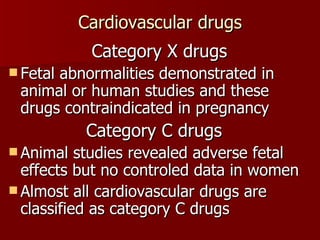
Cardiovascular drugs Category X drugs Fetal abnormalities demonstrated in animal or human studies and these drugs contraindicated in pregnancy Category C drugs Animal studies revealed adverse fetal effects but no controled data in women Almost all cardiovascular drugs are classified as category C drugs
Contraception Barrier method-Failure rate 15preg/100 women years Intrauterine device-Failure rate 3preg/100 women years, vagal shock may occur in  IPAH pt, Antibiotic prophylaxis should be used at the time of insertion
Oral Contraceptives Extremely low failure rate But ↑ risk of VTE,HT,IHD,Dyslipidemia Avoid in pt with cyanosis,AF,mechanical prosthetic valve,LVEF<40% Tubal Sterilization : Best met hod
Conclusion Pregnancy causes significant haemodynamic changes and imposes an additional burden on the cardiac patient, especially around the time of labour and in the immediate puerperium.  To achieve a successful pregnancy outcome, a clear understanding of these haemodynamic adaptations as well as meticulous maternal and foetal surveillance for risk factors and complications throughout the pregnancy is essential.
THANK YOU

Pregnancy and Heart Disease

  • 1.
    PREGNANCY AND HEARTDISEASE Prof.S.Sundar’s Unit Dr.R.Ganesan PG Internal medicine
  • 2.
    Incidince and changingpattern of heart disease Incidence 0.1-4% Advances in medical and surgical management of congenital heart disease resulted an increase survival to reproductive age Sharp decline in incidence of chronic Rheumatic heart disease
  • 3.
    Hemodynamics During PregnancyPeripheral resistance-decrease Blood volume-increase40-45% Heart rate-increase10-20% Cardiac output-increase30% BP-normal or decrease Venous pressure in LL-increase Pulmonary vascular resistance-decrease
  • 4.
    05/18/10 Dr.Uma Dr.NK Gupta
  • 5.
    Hemodynamics During LaborUterine contraction-autotransfusion of blood into circulation Abrupt increase in venous return Vaginal delivery-400ml blood loss Cesarean-800ml blood loss
  • 6.
    Mode of deliveryVaginal delivery preferable Cesarean is only indicated for obstetric reasons EXCEPT 1.Dilated unstable aorta 2.Severe pulmonary hypertension 3.Severe obstructive lesion 4.Mother anticoagulated with warfarin
  • 7.
    Physical examination Pulsevolume increase JVP-may elevated Apical impulse is more prominent First heart sound appear loud Third heart sound common ESM grade3/6 left sternal edge Continuous murmur[cervical venous hum,mammary suffle] may heard NO DIASTOLIC MURMUR
  • 8.
    Criteria to diagnosecardiac disease during pregnancy Presence of diastolic murmur Systolic murmur grade>3/6 Presence of arrhythmias AF Cardiomegaly in x-ray
  • 9.
    Risk index Priorcardiac events [HF,TIA,Stroke] or Arrhythmias Baseline NYHA class>2 or cyanosis LVOT obstruction: [MVA<2cm2,AVA<1.5cm2,Peak LVOTpressure gradient>30mmhg] LVEF<40%
  • 10.
    Estimated risk ofcardiac events Risk scor Cardiac risk 0 5% 1 27% >1 75%
  • 11.
    Risk factors forHF in pregnancy Anaemia Infections Hypertension Obesity Hyperthyroidism Multiple pregnancy
  • 12.
    Mortality associated specificcardiac disease Low risk of mortality<1% ASD/VSD NYHA class I and II PDA Pulmonary and tricuspid lesion
  • 13.
    Moderate risk ofmortality [5-15%] NYHA class III and IV Mitral stenosis Severe aortic stenosis Marfan syndrome with normal aorta Uncomplicated coarctation of aorta Past h/o myocardial infarction
  • 14.
    Highrisk of mortality[25-50%]Eissenmenger’s syndrome Pulmonary hypertension Marfan syndrome with abnormal aorta Peripartum cardiomyopathy
  • 15.
    Transthoracic Echocardiography Valve area calculation,pressure half time measurement more usefull than simple measurement of transvalvular gradient Valvular regurgitation will appear to be accentuated because of ↑ stroke volume Serial ECHO: Mechanical valve prosthesis vulnerable to thrombosis
  • 16.
    Medical management NYHAclass I & II: bed rest,low salt diet iron and vitamins to minimize anaemia. regular cardiac obstetric evaluations NYHA ClassIII&IV: Need hospital admission, close monitoring early delivery if maternal haemodynamic compromise
  • 17.
    Surgical management I-trimester:High risk of fetal malformation and loss if cardiopulmonary bypass performed Last-timester: High risk of premature labor Optimal time surgery: 20-28 weeks of gestation
  • 18.
    Cardiopulmonary bypass techniqueNormothermic High pump flows High pressure MAP>60mmhg Short bypass time as possible Inspite of these interventions current risk of fetal loss 10% ,even higher when cardiac surgery is emergency
  • 19.
    ASD : Maternalrisk is low Paradoxical embolism Augmentation of R -> L shunt during postpartum blood loss Coarctation of aorta: risk of aortic reptur,intracerebral aneurysm repture
  • 20.
    Cynotic heart diseaseMATERNAL RISK 1.Augments right to left shunt 2.Propensity to thrombosis 3.Paradoxical embolism FETAL RISK 1.Inherit congenital heart disease-conotruncal abnormalities-AD 22q11 2.IUGR, Fetal loss
  • 21.
    Tetralogy of FallotPalliative surgery Fall in peripheral resistance augments R->L shunt through VSD worsening of cyanosis Definitive surgery Women with good surgical repair,good exercise capacity and minimal residual defect pregnancy well tolerated
  • 22.
    Ebstein anomaly RVsize,Severity of tricuspid regurgitation and presense or absence of atrial communication Atrial arrhythmias and Accessory pathway induced tachycardias will worsen the RV function
  • 23.
    Rheumatic Heart DiseaseMitral stenosis ↑ Heart rate ↑ CO Shorten the diastolic filling time Exaggerates the mitral gradient
  • 24.
    Beta blockade toreduce heart rate Diuretics to reduce pulmonary edema Anticoagulation if AF present If refractory to medical therapy-Balloon valvuloplasty Moderate MR/AR well tolerated in pregnancy
  • 25.
    Aortic Stenosis Allmost always secondary to bicuspid aorti valve Bicuspid Aortic valve is associated with AORTOPATHY even with functinally normal valve Pregnancy is contraindicated if aortic dimension>4.5cm
  • 26.
    Severe Aortic StenosisAVA<1cm2 or mean pressure gradient >50mmhg is contraindication for pregnancy Decreased peripheral vascular resistance during pregnancy will exaggerate the aortic gradient and precipitate symptoms Percutaneous aortic balloon valvuloplasty to be considered
  • 27.
    Pulmonary stenosis Welltolerated during pregnancy if RV pressure less than 70% of systemic pressure and sinus rhythm maintained If necessary balloon valvuloplasty can be performed
  • 28.
    Pulmonary Hypertension Pulmonaryhypertension regardless of the cause carries HIGH MORTALITY 50% Pulmonary hypertension >60% of systemic pressure more likely to be associated with complications Volume overload precipitate HF Fall in peripheral resistance augment R->L shunt and cyanosis
  • 29.
    Marfan Syndrome AD,disorder of fibrillin Pregnancy contraindicated if ascending aorta>40mm Associated cardiac problems:MVP, Aortic regurgitation Periodic ECHO surveillance every 6-8 weeks to monitor aortic root size Any chest pain should rule out dissection
  • 30.
    Coronary Artery DiseaseUncommon in women of child-bearing age but may occur in the setting of DM Smoking The most common cause is coronary artery dissection,most common site is LAD Urgent angiography and stenting is treatment of choice Vulnerability to dissection during pregnancy due to hormonal effect on elastin and collagen synthesis
  • 31.
    Cardiomyopathies Dilated cardiomyopathy:IfLVEF<40% pregnancy contraindicated Hypertrophic cardiomathy: AD inheritance, genitic counseling preior to pregnancy Pregnancy is well tolerated
  • 32.
    Peripartum Cardiomathy Commonduring last month of pregnancy or within 5 months of delivery Incidence 1 in 3000 Risk factors:Preeclampsia, multiparity, older maternal age, black race Normalization of LV function occurs in 50% of pt if LVEF>30% at the time diagnosis PPCM will recurin 30% cases
  • 33.
    Arrhythmias Risk factorsfor arrhythmias (1)↑ in preload causing myocardial irritability (2)↑HR which affect refractory period (3)Fluid and electrolyte shift (4)Change in catecholamine level
  • 34.
    The most commonarrhythmia is atrial reentry tachycardia Treatment is same as non-pregnant women Electrical cardioversion is not harmful to fetus VPC are common in pregnancy ,Rx not required
  • 35.
    ACA/AHA recommendations forRx of SVT during pregnancy Acute conversion of SVT Vagal maneuver Adenosine DC cardioversion Prophylactic therapy Digoxin Metoprolol-(avoid in first trimester)
  • 36.
    ACA/AHA guide-line formanagement of AF during pregnancy Ventricular rate control with Digoxin,Verapamil,Beta blockers Electrical cardioversion if patient hemodynamically unstable Anticoagulation throughtout pregnancy
  • 37.
    Prosthetic Valves BioprosthetesesLess thrombogenic No anticoagulation risk Less longevity<10 years Mechanical prostheses Greater longevity Require anticoagulation Higher risk of fetal loss,placental hemarrhage, prosthetic valve thrombosis
  • 38.
    Unfractionated Heparin AdvantagesDose not cross placenta Disadvantage Poor anticoagulation effect in pregnancy Risk of prosthetic valve thrombosis 9% Thrombocytopenia Osteoporosis
  • 39.
    Warfarin I-trimester exposureleads to fetal embryopathy-6% (1)Chondrodysplasia punctata (2)Nasal hypoplasia (3)Optic atrophy (4)Menral retardation Risk reduced by initiating heparin before 6 weeks of pregnancy
  • 40.
    High Risk ForThrombosis The risk of fetal embryopathy is dose-related and risk is very low if dose <5mg Pregnant women high risk of thrombosis like tilting disc mitral prosthesis, in AF safer approach is treat with warfarin for first 36 weeks of pregnancy if her dose <5mg
  • 41.
    Low Risk ForThrombosis Low risk for thrombosis heparin selected as soon as pregnancy diagnosed Warfarin substituted at 13-14 weeks Heparin restarted at 36 weeks in anticipation to delivery
  • 42.
    Anticoagulation therapy Atweek 36 : *Discontinue warfarin *Change to UFH titrated to a therapeutic aPTT or anti-factor Xa level. At Delivery: *Restart heparin therapy 4 to 6 hr after delivery if no contraindications *Resume warfarin therapy the night after delivery if no bleeding complications #if labor begins while the woman is receiving warfarin, anticoagulation should be reversed and caesarean delivery performed
  • 43.
    Anticoagulation therapy MonitoringWith LMWH administered sc. twice daily maintain anti-Xa level between 0.7 and 1.2 U/ml 4 hours after admn. With dose adjusted UFH, the aPTT should be at least twice control. those on warfarin, the INR goal should be 3.0(range 2.5 to 3.5)
  • 44.
    SABE Prophylaxis during obstetric procedures 2 g Ampicilline plus 1.5 mg/kg Gentamycin IV 1/2 hr prior to procedure followed by Ampicilline 2g 6 hr later If allergic to penicillin group Vancomycin 1g can be substituted
  • 45.
  • 46.
    IUGR,oligohydramnios,renal failure abnormalbone ossification ACE-I Fetal embryopathy placental and fetal hemorrhage Warfarin Potential fetal side effects Drugs
  • 47.
    Cardiovascular drugs CategoryX drugs Fetal abnormalities demonstrated in animal or human studies and these drugs contraindicated in pregnancy Category C drugs Animal studies revealed adverse fetal effects but no controled data in women Almost all cardiovascular drugs are classified as category C drugs
  • 48.
    Contraception Barrier method-Failurerate 15preg/100 women years Intrauterine device-Failure rate 3preg/100 women years, vagal shock may occur in IPAH pt, Antibiotic prophylaxis should be used at the time of insertion
  • 49.
    Oral Contraceptives Extremelylow failure rate But ↑ risk of VTE,HT,IHD,Dyslipidemia Avoid in pt with cyanosis,AF,mechanical prosthetic valve,LVEF<40% Tubal Sterilization : Best met hod
  • 50.
    Conclusion Pregnancy causessignificant haemodynamic changes and imposes an additional burden on the cardiac patient, especially around the time of labour and in the immediate puerperium. To achieve a successful pregnancy outcome, a clear understanding of these haemodynamic adaptations as well as meticulous maternal and foetal surveillance for risk factors and complications throughout the pregnancy is essential.
  • 51.