ANTIRETROVIRAL THERAPY
PRESENTER DR B ROHITH
MODERATOR DR VISHNU SHANKER SHUKLA
1
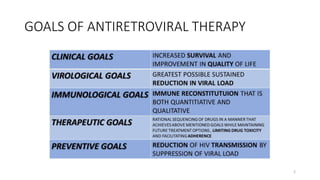
GOALS OF ANTIRETROVIRAL THERAPY
2
When to start ART
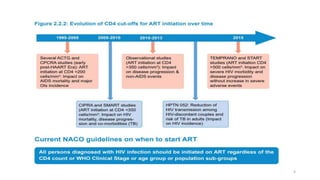
• The guidelines on when to start ART have evolved over the years
towards early and rapid initiation of ART.
• The current recommendation to TREAT ALL, regardless of the clinical
stage or CD4 count is in the National Programme since 2017.
3
4
5
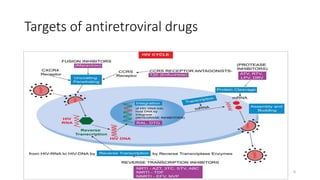
Targets of antiretroviral drugs
6
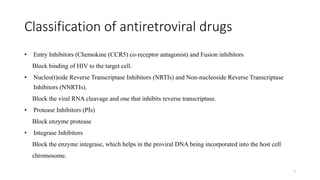
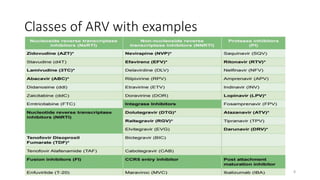
Classification of antiretroviral drugs
• Entry Inhibitors (Chemokine (CCR5) co-receptor antagonist) and Fusion inhibitors
Block binding of HIV to the target cell.
• Nucleo(t)side Reverse Transcriptase Inhibitors (NRTIs) and Non-nucleoside Reverse Transcriptase
Inhibitors (NNRTIs).
Block the viral RNA cleavage and one that inhibits reverse transcriptase.
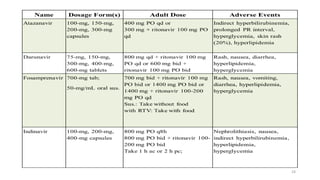
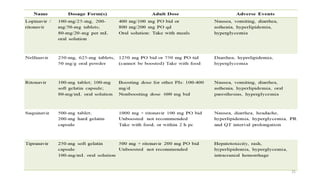
• Protease Inhibitors (PIs)
Block enzyme protease
• Integrase Inhibitors
Block the enzyme integrase, which helps in the proviral DNA being incorporated into the host cell
chromosome.
7
Classes of ARV with examples
8
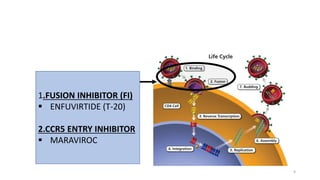
1.FUSION INHIBITOR (FI)
 ENFUVIRTIDE (T-20)
2.CCR5 ENTRY INHIBITOR
 MARAVIROC
9
Fusion inhibitors
• Enfuvirtide –
• First approved entry inhibitor, not available now.
Dose : 90 mg SC bid
ADRs : Injection-site reactions (eg, pain, erythema, induration, nodules) diarrhoea, nausea,
fatigue, hypersensitivity reactions, increased rate of bacterial pneumonia.
10
Entry inhibitor
• Maraviroc –
CCR5 antagonist
150 – 600 mg bd (PO)
Hepatotoxicity, fever, abdominal pain, cough, dizziness, rash, musculoskeletal symptoms
• Fostemsavir –
Recently approved attachment entry inhibitor for multidrug resistant HIV in adults.
• Ibalizumab
Anti CD4 monoclonal antibody
Single loading dose of 2000mg followed by 800mg every 2 weeks
Rash, nausea, diarrhoea
11
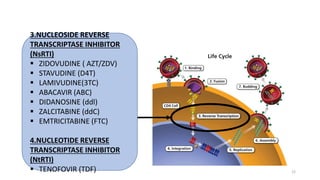
3.NUCLEOSIDE REVERSE
TRANSCRIPTASE INHIBITOR
(NsRTI)
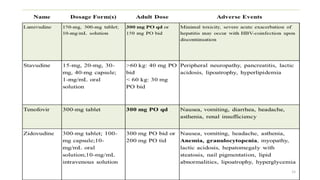
 ZIDOVUDINE ( AZT/ZDV)
 STAVUDINE (D4T)
 LAMIVUDINE(3TC)
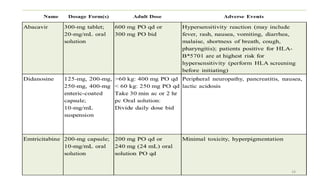
 ABACAVIR (ABC)
 DIDANOSINE (ddl)
 ZALCITABINE (ddC)
 EMTRICITABINE (FTC)
4.NUCLEOTIDE REVERSE
TRANSCRIPTASE INHIBITOR
(NtRTI)
 TENOFOVIR (TDF) 12
Nucleo(t)side Reverse Transcriptase Inhibitors (NRTIs)
• First agents available for HIV Infection.
• Less potent than NNRTIs and PIs
• They act by incorporating themselves into the DNA of the virus,
thereby stopping the building process. The resulting DNA is
incomplete and cannot create new viruses.
• Nucleotide analogues work in the same way as nucleosides, but they
have a non-peptidic chemical structure.
13
14
15
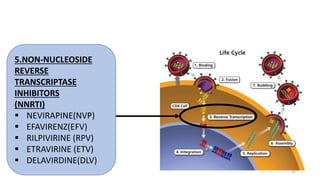
5.NON-NUCLEOSIDE
REVERSE
TRANSCRIPTASE
INHIBITORS
(NNRTI)
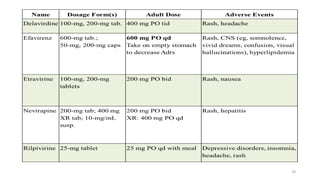
 NEVIRAPINE(NVP)
 EFAVIRENZ(EFV)
 RILPIVIRINE (RPV)
 ETRAVIRINE (ETV)
 DELAVIRDINE(DLV)
16
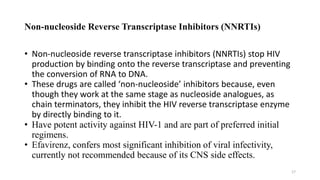
Non-nucleoside Reverse Transcriptase Inhibitors (NNRTIs)
• Non-nucleoside reverse transcriptase inhibitors (NNRTIs) stop HIV
production by binding onto the reverse transcriptase and preventing
the conversion of RNA to DNA.
• These drugs are called ‘non-nucleoside’ inhibitors because, even
though they work at the same stage as nucleoside analogues, as
chain terminators, they inhibit the HIV reverse transcriptase enzyme
by directly binding to it.
• Have potent activity against HIV-1 and are part of preferred initial
regimens.
• Efavirenz, confers most significant inhibition of viral infectivity,
currently not recommended because of its CNS side effects.
17
18
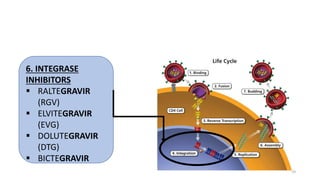
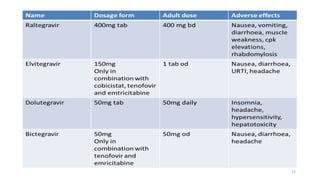
6. INTEGRASE
INHIBITORS
 RALTEGRAVIR
(RGV)
 ELVITEGRAVIR
(EVG)
 DOLUTEGRAVIR
(DTG)
 BICTEGRAVIR
19
Integrase inhibitors
• Integrase inhibitors are a class of ART drugs designed to block the
action of integrase, a viral enzyme that inserts the viral genome into
the DNA of the host cell.
• Since integration is a vital step in retroviral replication, blocking it can
halt further replication of the virus.
20
21
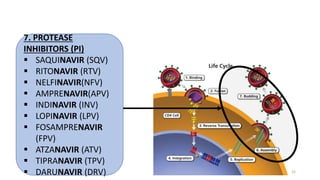
7. PROTEASE
INHIBITORS (PI)
 SAQUINAVIR (SQV)
 RITONAVIR (RTV)
 NELFINAVIR(NFV)
 AMPRENAVIR(APV)
 INDINAVIR (INV)
 LOPINAVIR (LPV)
 FOSAMPRENAVIR
(FPV)
 ATZANAVIR (ATV)
 TIPRANAVIR (TPV)
 DARUNAVIR (DRV) 22
Protease inhibitors
• Protease inhibitors (PIs) work at the last stage of the viral
reproduction cycle.
• They prevent HIV from being successfully assembled and released
from the infected CD4 cell.
23
24
25
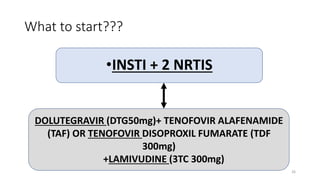
What to start???
•INSTI + 2 NRTIS
DOLUTEGRAVIR (DTG50mg)+ TENOFOVIR ALAFENAMIDE
(TAF) OR TENOFOVIR DISOPROXIL FUMARATE (TDF
300mg)
+LAMIVUDINE (3TC 300mg)
26
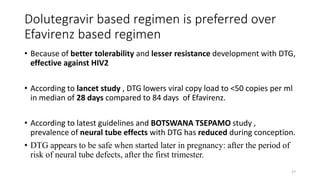
Dolutegravir based regimen is preferred over
Efavirenz based regimen
• Because of better tolerability and lesser resistance development with DTG,
effective against HIV2
• According to lancet study , DTG lowers viral copy load to <50 copies per ml
in median of 28 days compared to 84 days of Efavirenz.
• According to latest guidelines and BOTSWANA TSEPAMO study ,
prevalence of neural tube effects with DTG has reduced during conception.
• DTG appears to be safe when started later in pregnancy: after the period of
risk of neural tube defects, after the first trimester.
27
Advantages of DTG over EFZ
• Lower potential for drug interactions
• A shorter median time to viral suppression
• Higher genetic barrier to developing drug resistance
• Low cost
• Low dose
• Long half life
DTG in TB
• Increase the dose to 50mg bd when given with rifampicin
• Because of drug interaction with rifampicin
28
DIETARY CONSIDERATIONS FOR TAKING DTG
• DTG could be taken at a fixed time everyday without regard to meals.
• DTG interact with calcium and iron and few other medicines.
• If these are prescribed to patient, DTG can be taken 2 hours before or 6
hours after antacids ( which contain magnesium/ aluminium ) or
laxatives, sucralfate, oral supplements containing iron or calcium
29
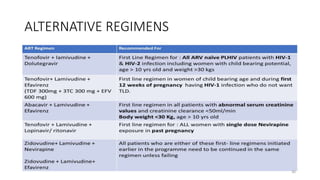
ALTERNATIVE REGIMENS
30
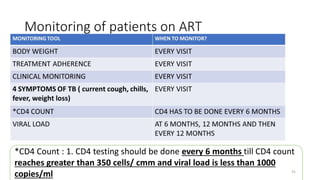
Monitoring of patients on ART
*CD4 Count : 1. CD4 testing should be done every 6 months till CD4 count
reaches greater than 350 cells/ cmm and viral load is less than 1000
copies/ml 31
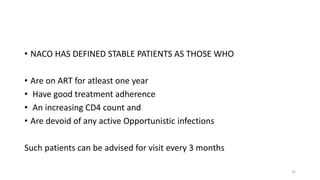
• NACO HAS DEFINED STABLE PATIENTS AS THOSE WHO
• Are on ART for atleast one year
• Have good treatment adherence
• An increasing CD4 count and
• Are devoid of any active Opportunistic infections
Such patients can be advised for visit every 3 months
32
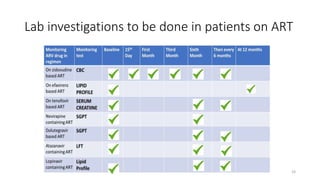
Lab investigations to be done in patients on ART
33
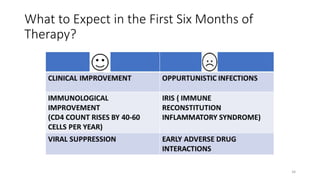
What to Expect in the First Six Months of
Therapy?
34
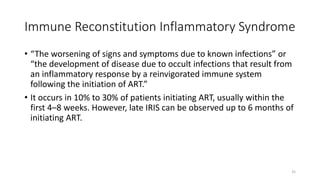
Immune Reconstitution Inflammatory Syndrome
• “The worsening of signs and symptoms due to known infections” or
“the development of disease due to occult infections that result from
an inflammatory response by a reinvigorated immune system
following the initiation of ART.”
• It occurs in 10% to 30% of patients initiating ART, usually within the
first 4–8 weeks. However, late IRIS can be observed up to 6 months of
initiating ART.
35
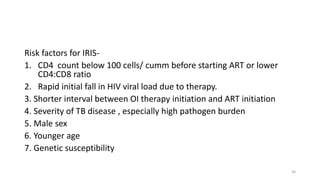
Risk factors for IRIS-
1. CD4 count below 100 cells/ cumm before starting ART or lower
CD4:CD8 ratio
2. Rapid initial fall in HIV viral load due to therapy.
3. Shorter interval between OI therapy initiation and ART initiation
4. Severity of TB disease , especially high pathogen burden
5. Male sex
6. Younger age
7. Genetic susceptibility
36
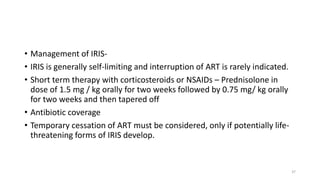
• Management of IRIS-
• IRIS is generally self-limiting and interruption of ART is rarely indicated.
• Short term therapy with corticosteroids or NSAIDs – Prednisolone in
dose of 1.5 mg / kg orally for two weeks followed by 0.75 mg/ kg orally
for two weeks and then tapered off
• Antibiotic coverage
• Temporary cessation of ART must be considered, only if potentially life-
threatening forms of IRIS develop.
37
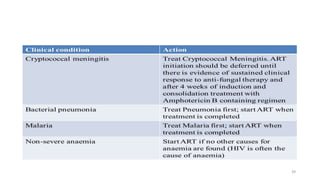
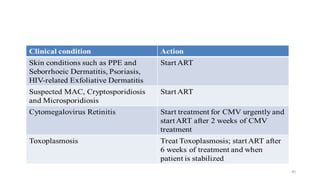
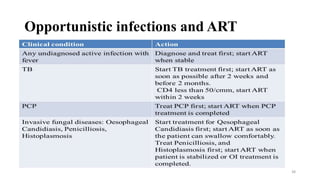
Opportunistic infections and ART
38
39
40
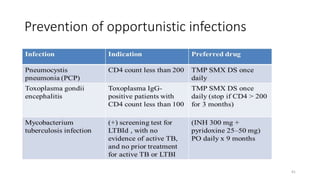
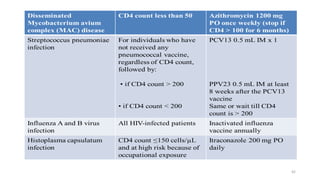
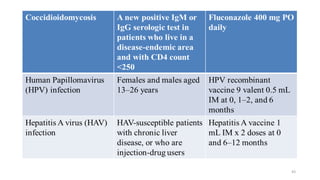
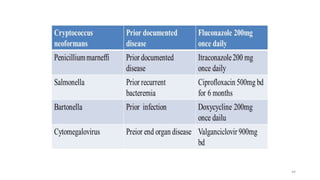
Prevention of opportunistic infections
41
42
43
44
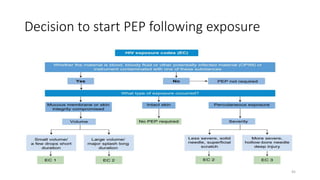
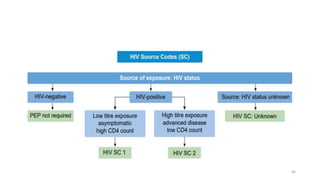
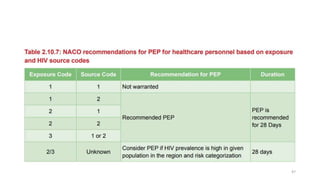
Decision to start PEP following exposure
45
46
47
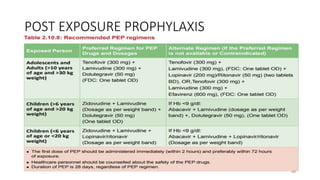
POST EXPOSURE PROPHYLAXIS
48
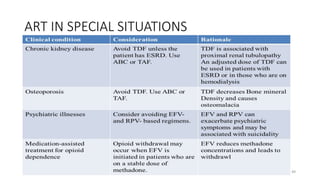
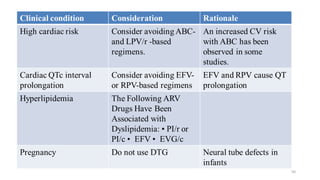
ART IN SPECIAL SITUATIONS
49
50
51
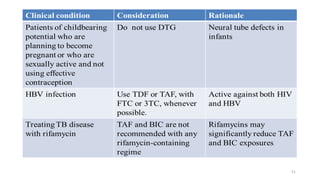
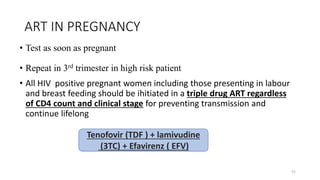
ART IN PREGNANCY
• Test as soon as pregnant
• Repeat in 3rd trimester in high risk patient
• All HIV positive pregnant women including those presenting in labour
and breast feeding should be ihitiated in a triple drug ART regardless
of CD4 count and clinical stage for preventing transmission and
continue lifelong
Tenofovir (TDF ) + lamivudine
(3TC) + Efavirenz ( EFV)
52
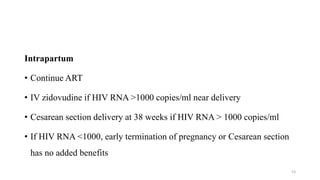
Intrapartum
• Continue ART
• IV zidovudine if HIV RNA >1000 copies/ml near delivery
• Cesarean section delivery at 38 weeks if HIV RNA > 1000 copies/ml
• If HIV RNA <1000, early termination of pregnancy or Cesarean section
has no added benefits
53
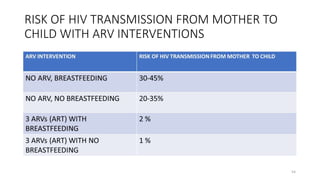
RISK OF HIV TRANSMISSION FROM MOTHER TO
CHILD WITH ARV INTERVENTIONS
54
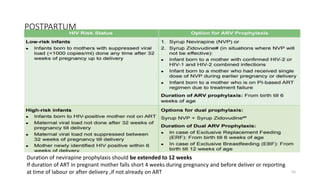
POSTPARTUM
55
Duration of nevirapine prophylaxis should be extended to 12 weeks
If duration of ART in pregnant mother falls short 4 weeks during pregnancy and before deliver or reporting
at time of labour or after delivery ,if not already on ART
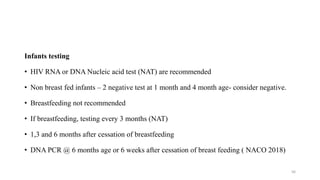
Infants testing
• HIV RNA or DNA Nucleic acid test (NAT) are recommended
• Non breast fed infants – 2 negative test at 1 month and 4 month age- consider negative.
• Breastfeeding not recommended
• If breastfeeding, testing every 3 months (NAT)
• 1,3 and 6 months after cessation of breastfeeding
• DNA PCR @ 6 months age or 6 weeks after cessation of breast feeding ( NACO 2018)
56
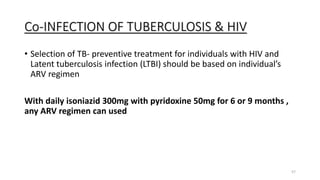
Co-INFECTION OF TUBERCULOSIS & HIV
• Selection of TB- preventive treatment for individuals with HIV and
Latent tuberculosis infection (LTBI) should be based on individual’s
ARV regimen
With daily isoniazid 300mg with pyridoxine 50mg for 6 or 9 months ,
any ARV regimen can used
57
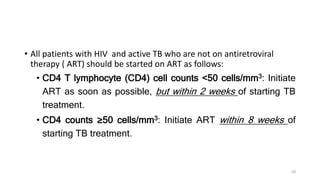
• All patients with HIV and active TB who are not on antiretroviral
therapy ( ART) should be started on ART as follows:
• CD4 T lymphocyte (CD4) cell counts <50 cells/mm3: Initiate
ART as soon as possible, but within 2 weeks of starting TB
treatment.
• CD4 counts ≥50 cells/mm3: Initiate ART within 8 weeks of
starting TB treatment.
58
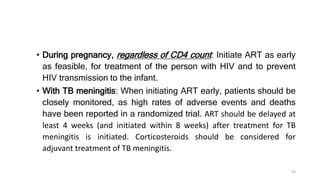
• During pregnancy, regardless of CD4 count: Initiate ART as early
as feasible, for treatment of the person with HIV and to prevent
HIV transmission to the infant.
• With TB meningitis: When initiating ART early, patients should be
closely monitored, as high rates of adverse events and deaths
have been reported in a randomized trial. ART should be delayed at
least 4 weeks (and initiated within 8 weeks) after treatment for TB
meningitis is initiated. Corticosteroids should be considered for
adjuvant treatment of TB meningitis.
59
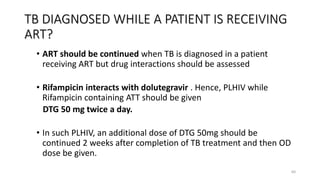
TB DIAGNOSED WHILE A PATIENT IS RECEIVING
ART?
• ART should be continued when TB is diagnosed in a patient
receiving ART but drug interactions should be assessed
• Rifampicin interacts with dolutegravir . Hence, PLHIV while
Rifampicin containing ATT should be given
DTG 50 mg twice a day.
• In such PLHIV, an additional dose of DTG 50mg should be
continued 2 weeks after completion of TB treatment and then OD
dose be given.
60
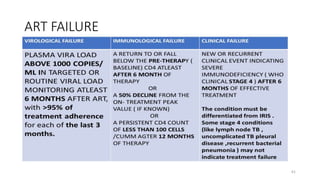
ART FAILURE
61
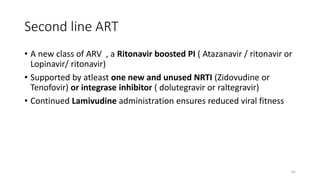
Second line ART
• A new class of ARV , a Ritonavir boosted PI ( Atazanavir / ritonavir or
Lopinavir/ ritonavir)
• Supported by atleast one new and unused NRTI (Zidovudine or
Tenofovir) or integrase inhibitor ( dolutegravir or raltegravir)
• Continued Lamivudine administration ensures reduced viral fitness
62
63

ANTIRETROVIRAL THERAPY.pptx

  • 1.
    ANTIRETROVIRAL THERAPY PRESENTER DRB ROHITH MODERATOR DR VISHNU SHANKER SHUKLA 1
  • 2.
  • 3.
    When to startART • The guidelines on when to start ART have evolved over the years towards early and rapid initiation of ART. • The current recommendation to TREAT ALL, regardless of the clinical stage or CD4 count is in the National Programme since 2017. 3
  • 4.
  • 5.
  • 6.
  • 7.
    Classification of antiretroviraldrugs • Entry Inhibitors (Chemokine (CCR5) co-receptor antagonist) and Fusion inhibitors Block binding of HIV to the target cell. • Nucleo(t)side Reverse Transcriptase Inhibitors (NRTIs) and Non-nucleoside Reverse Transcriptase Inhibitors (NNRTIs). Block the viral RNA cleavage and one that inhibits reverse transcriptase. • Protease Inhibitors (PIs) Block enzyme protease • Integrase Inhibitors Block the enzyme integrase, which helps in the proviral DNA being incorporated into the host cell chromosome. 7
  • 8.
    Classes of ARVwith examples 8
  • 9.
    1.FUSION INHIBITOR (FI) ENFUVIRTIDE (T-20) 2.CCR5 ENTRY INHIBITOR  MARAVIROC 9
  • 10.
    Fusion inhibitors • Enfuvirtide– • First approved entry inhibitor, not available now. Dose : 90 mg SC bid ADRs : Injection-site reactions (eg, pain, erythema, induration, nodules) diarrhoea, nausea, fatigue, hypersensitivity reactions, increased rate of bacterial pneumonia. 10
  • 11.
    Entry inhibitor • Maraviroc– CCR5 antagonist 150 – 600 mg bd (PO) Hepatotoxicity, fever, abdominal pain, cough, dizziness, rash, musculoskeletal symptoms • Fostemsavir – Recently approved attachment entry inhibitor for multidrug resistant HIV in adults. • Ibalizumab Anti CD4 monoclonal antibody Single loading dose of 2000mg followed by 800mg every 2 weeks Rash, nausea, diarrhoea 11
  • 12.
    3.NUCLEOSIDE REVERSE TRANSCRIPTASE INHIBITOR (NsRTI) ZIDOVUDINE ( AZT/ZDV)  STAVUDINE (D4T)  LAMIVUDINE(3TC)  ABACAVIR (ABC)  DIDANOSINE (ddl)  ZALCITABINE (ddC)  EMTRICITABINE (FTC) 4.NUCLEOTIDE REVERSE TRANSCRIPTASE INHIBITOR (NtRTI)  TENOFOVIR (TDF) 12
  • 13.
    Nucleo(t)side Reverse TranscriptaseInhibitors (NRTIs) • First agents available for HIV Infection. • Less potent than NNRTIs and PIs • They act by incorporating themselves into the DNA of the virus, thereby stopping the building process. The resulting DNA is incomplete and cannot create new viruses. • Nucleotide analogues work in the same way as nucleosides, but they have a non-peptidic chemical structure. 13
  • 14.
  • 15.
  • 16.
  • 17.
    Non-nucleoside Reverse TranscriptaseInhibitors (NNRTIs) • Non-nucleoside reverse transcriptase inhibitors (NNRTIs) stop HIV production by binding onto the reverse transcriptase and preventing the conversion of RNA to DNA. • These drugs are called ‘non-nucleoside’ inhibitors because, even though they work at the same stage as nucleoside analogues, as chain terminators, they inhibit the HIV reverse transcriptase enzyme by directly binding to it. • Have potent activity against HIV-1 and are part of preferred initial regimens. • Efavirenz, confers most significant inhibition of viral infectivity, currently not recommended because of its CNS side effects. 17
  • 18.
  • 19.
    6. INTEGRASE INHIBITORS  RALTEGRAVIR (RGV) ELVITEGRAVIR (EVG)  DOLUTEGRAVIR (DTG)  BICTEGRAVIR 19
  • 20.
    Integrase inhibitors • Integraseinhibitors are a class of ART drugs designed to block the action of integrase, a viral enzyme that inserts the viral genome into the DNA of the host cell. • Since integration is a vital step in retroviral replication, blocking it can halt further replication of the virus. 20
  • 21.
  • 22.
    7. PROTEASE INHIBITORS (PI) SAQUINAVIR (SQV)  RITONAVIR (RTV)  NELFINAVIR(NFV)  AMPRENAVIR(APV)  INDINAVIR (INV)  LOPINAVIR (LPV)  FOSAMPRENAVIR (FPV)  ATZANAVIR (ATV)  TIPRANAVIR (TPV)  DARUNAVIR (DRV) 22
  • 23.
    Protease inhibitors • Proteaseinhibitors (PIs) work at the last stage of the viral reproduction cycle. • They prevent HIV from being successfully assembled and released from the infected CD4 cell. 23
  • 24.
  • 25.
  • 26.
    What to start??? •INSTI+ 2 NRTIS DOLUTEGRAVIR (DTG50mg)+ TENOFOVIR ALAFENAMIDE (TAF) OR TENOFOVIR DISOPROXIL FUMARATE (TDF 300mg) +LAMIVUDINE (3TC 300mg) 26
  • 27.
    Dolutegravir based regimenis preferred over Efavirenz based regimen • Because of better tolerability and lesser resistance development with DTG, effective against HIV2 • According to lancet study , DTG lowers viral copy load to <50 copies per ml in median of 28 days compared to 84 days of Efavirenz. • According to latest guidelines and BOTSWANA TSEPAMO study , prevalence of neural tube effects with DTG has reduced during conception. • DTG appears to be safe when started later in pregnancy: after the period of risk of neural tube defects, after the first trimester. 27
  • 28.
    Advantages of DTGover EFZ • Lower potential for drug interactions • A shorter median time to viral suppression • Higher genetic barrier to developing drug resistance • Low cost • Low dose • Long half life DTG in TB • Increase the dose to 50mg bd when given with rifampicin • Because of drug interaction with rifampicin 28
  • 29.
    DIETARY CONSIDERATIONS FORTAKING DTG • DTG could be taken at a fixed time everyday without regard to meals. • DTG interact with calcium and iron and few other medicines. • If these are prescribed to patient, DTG can be taken 2 hours before or 6 hours after antacids ( which contain magnesium/ aluminium ) or laxatives, sucralfate, oral supplements containing iron or calcium 29
  • 30.
  • 31.
    Monitoring of patientson ART *CD4 Count : 1. CD4 testing should be done every 6 months till CD4 count reaches greater than 350 cells/ cmm and viral load is less than 1000 copies/ml 31
  • 32.
    • NACO HASDEFINED STABLE PATIENTS AS THOSE WHO • Are on ART for atleast one year • Have good treatment adherence • An increasing CD4 count and • Are devoid of any active Opportunistic infections Such patients can be advised for visit every 3 months 32
  • 33.
    Lab investigations tobe done in patients on ART 33
  • 34.
    What to Expectin the First Six Months of Therapy? 34
  • 35.
    Immune Reconstitution InflammatorySyndrome • “The worsening of signs and symptoms due to known infections” or “the development of disease due to occult infections that result from an inflammatory response by a reinvigorated immune system following the initiation of ART.” • It occurs in 10% to 30% of patients initiating ART, usually within the first 4–8 weeks. However, late IRIS can be observed up to 6 months of initiating ART. 35
  • 36.
    Risk factors forIRIS- 1. CD4 count below 100 cells/ cumm before starting ART or lower CD4:CD8 ratio 2. Rapid initial fall in HIV viral load due to therapy. 3. Shorter interval between OI therapy initiation and ART initiation 4. Severity of TB disease , especially high pathogen burden 5. Male sex 6. Younger age 7. Genetic susceptibility 36
  • 37.
    • Management ofIRIS- • IRIS is generally self-limiting and interruption of ART is rarely indicated. • Short term therapy with corticosteroids or NSAIDs – Prednisolone in dose of 1.5 mg / kg orally for two weeks followed by 0.75 mg/ kg orally for two weeks and then tapered off • Antibiotic coverage • Temporary cessation of ART must be considered, only if potentially life- threatening forms of IRIS develop. 37
  • 38.
  • 39.
  • 40.
  • 41.
  • 42.
  • 43.
  • 44.
  • 45.
    Decision to startPEP following exposure 45
  • 46.
  • 47.
  • 48.
  • 49.
    ART IN SPECIALSITUATIONS 49
  • 50.
  • 51.
  • 52.
    ART IN PREGNANCY •Test as soon as pregnant • Repeat in 3rd trimester in high risk patient • All HIV positive pregnant women including those presenting in labour and breast feeding should be ihitiated in a triple drug ART regardless of CD4 count and clinical stage for preventing transmission and continue lifelong Tenofovir (TDF ) + lamivudine (3TC) + Efavirenz ( EFV) 52
  • 53.
    Intrapartum • Continue ART •IV zidovudine if HIV RNA >1000 copies/ml near delivery • Cesarean section delivery at 38 weeks if HIV RNA > 1000 copies/ml • If HIV RNA <1000, early termination of pregnancy or Cesarean section has no added benefits 53
  • 54.
    RISK OF HIVTRANSMISSION FROM MOTHER TO CHILD WITH ARV INTERVENTIONS 54
  • 55.
    POSTPARTUM 55 Duration of nevirapineprophylaxis should be extended to 12 weeks If duration of ART in pregnant mother falls short 4 weeks during pregnancy and before deliver or reporting at time of labour or after delivery ,if not already on ART
  • 56.
    Infants testing • HIVRNA or DNA Nucleic acid test (NAT) are recommended • Non breast fed infants – 2 negative test at 1 month and 4 month age- consider negative. • Breastfeeding not recommended • If breastfeeding, testing every 3 months (NAT) • 1,3 and 6 months after cessation of breastfeeding • DNA PCR @ 6 months age or 6 weeks after cessation of breast feeding ( NACO 2018) 56
  • 57.
    Co-INFECTION OF TUBERCULOSIS& HIV • Selection of TB- preventive treatment for individuals with HIV and Latent tuberculosis infection (LTBI) should be based on individual’s ARV regimen With daily isoniazid 300mg with pyridoxine 50mg for 6 or 9 months , any ARV regimen can used 57
  • 58.
    • All patientswith HIV and active TB who are not on antiretroviral therapy ( ART) should be started on ART as follows: • CD4 T lymphocyte (CD4) cell counts <50 cells/mm3: Initiate ART as soon as possible, but within 2 weeks of starting TB treatment. • CD4 counts ≥50 cells/mm3: Initiate ART within 8 weeks of starting TB treatment. 58
  • 59.
    • During pregnancy,regardless of CD4 count: Initiate ART as early as feasible, for treatment of the person with HIV and to prevent HIV transmission to the infant. • With TB meningitis: When initiating ART early, patients should be closely monitored, as high rates of adverse events and deaths have been reported in a randomized trial. ART should be delayed at least 4 weeks (and initiated within 8 weeks) after treatment for TB meningitis is initiated. Corticosteroids should be considered for adjuvant treatment of TB meningitis. 59
  • 60.
    TB DIAGNOSED WHILEA PATIENT IS RECEIVING ART? • ART should be continued when TB is diagnosed in a patient receiving ART but drug interactions should be assessed • Rifampicin interacts with dolutegravir . Hence, PLHIV while Rifampicin containing ATT should be given DTG 50 mg twice a day. • In such PLHIV, an additional dose of DTG 50mg should be continued 2 weeks after completion of TB treatment and then OD dose be given. 60
  • 61.
  • 62.
    Second line ART •A new class of ARV , a Ritonavir boosted PI ( Atazanavir / ritonavir or Lopinavir/ ritonavir) • Supported by atleast one new and unused NRTI (Zidovudine or Tenofovir) or integrase inhibitor ( dolutegravir or raltegravir) • Continued Lamivudine administration ensures reduced viral fitness 62
  • 63.