ANTI-NEOPLASTIC AGENTS
PHARMACEUTICAL CHEMISTRY
D. Pharm 1st year
2022-2023
MISS NIKITA J. BHUTE
Assistant professor
Nagpur college of Pharmacy, Wanadogari,
Higna road, Nagpur 441 110
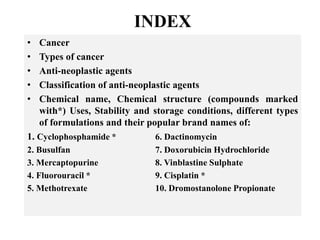
INDEX
• Cancer
• Types of cancer
• Anti-neoplastic agents
• Classification of anti-neoplastic agents
• Chemical name, Chemical structure (compounds marked
with*) Uses, Stability and storage conditions, different types
of formulations and their popular brand names of:
1. Cyclophosphamide * 6. Dactinomycin
2. Busulfan 7. Doxorubicin Hydrochloride
3. Mercaptopurine 8. Vinblastine Sulphate
4. Fluorouracil * 9. Cisplatin *
5. Methotrexate 10. Dromostanolone Propionate
CANCER
• Cancer is a disease characterized by abnormal and uncontrolled cell division
attacking the surrounding tissues and organs, and also the distant body parts by
circulating with blood and lymph.
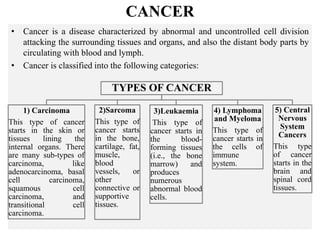
• Cancer is classified into the following categories:
TYPES OF CANCER
1) Carcinoma
This type of cancer
starts in the skin or
tissues lining the
internal organs. There
are many sub-types of
carcinoma, like
adenocarcinoma, basal
cell carcinoma,
squamous cell
carcinoma, and
transitional cell
carcinoma.
2)Sarcoma
This type of
cancer starts
in the bone,
cartilage, fat,
muscle,
blood
vessels, or
other
connective or
supportive
tissues.
3)Leukaemia
This type of
cancer starts in
the blood-
forming tissues
(i.e., the bone
marrow) and
produces
numerous
abnormal blood
cells.
4) Lymphoma
and Myeloma
This type of
cancer starts in
the cells of
immune
system.
5) Central
Nervous
System
Cancers
This type
of cancer
starts in the
brain and
spinal cord
tissues.
ANTI-NEOPLASTIC AGENTS
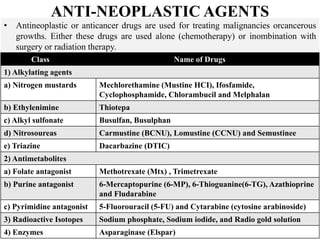
• Antineoplastic or anticancer drugs are used for treating malignancies orcancerous
growths. Either these drugs are used alone (chemotherapy) or inombination with
surgery or radiation therapy.
Class Name of Drugs
1) Alkylating agents
a) Nitrogen mustards Mechlorethamine (Mustine HCI), Ifosfamide,
Cyclophosphamide, Chlorambucil and Melphalan
b) Ethylenimine Thiotepa
c) Alkyl sulfonate Busulfan, Busulphan
d) Nitrosoureas Carmustine (BCNU), Lomustine (CCNU) and Semustinee
e) Triazine Dacarbazine (DTIC)
2) Antimetabolites
a) Folate antagonist Methotrexate (Mtx) , Trimetrexate
b) Purine antagonist 6-Mercaptopurine (6-MP), 6-Thioguanine(6-TG), Azathioprine
and Fludarabine
c) Pyrimidine antagonist 5-Fluorouracil (5-FU) and Cytarabine (cytosine arabinoside)
3) Radioactive Isotopes Sodium phosphate, Sodium iodide, and Radio gold solution
4) Enzymes Asparaginase (Elspar)
Class Name of Drugs
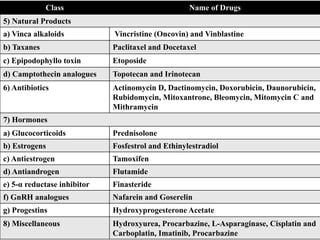
5) Natural Products
a) Vinca alkaloids Vincristine (Oncovin) and Vinblastine
b) Taxanes Paclitaxel and Docetaxel
c) Epipodophyllo toxin Etoposide
d) Camptothecin analogues Topotecan and Irinotecan
6) Antibiotics Actinomycin D, Dactinomycin, Doxorubicin, Daunorubicin,
Rubidomycin, Mitoxantrone, Bleomycin, Mitomycin C and
Mithramycin
7) Hormones
a) Glucocorticoids Prednisolone
b) Estrogens Fosfestrol and Ethinylestradiol
c) Antiestrogen Tamoxifen
d) Antiandrogen Flutamide
e) 5-α reductase inhibitor Finasteride
f) GnRH analogues Nafarein and Goserelin
g) Progestins Hydroxyprogesterone Acetate
8) Miscellaneous Hydroxyurea, Procarbazine, L-Asparaginase, Cisplatin and
Carboplatin, Imatinib, Procarbazine
1. Cyclophosphamide
• Structure:
• Chemical name:
2-[bis(2-chloroethyl)amino]-1,3,2λ-oxazaphosphinan-2-one
• Uses:
1) It is used in the treatment of malignant lymphomas, multiple myeloma,
leukaemia, mycosis fungoides, neuroblastoma, adenocarcinoma of the
ovary, retinoblastoma, and carcinoma of breast.
2) It is also used in biopsy-proven minimal change nephrotic syndrome in
paediatrics.
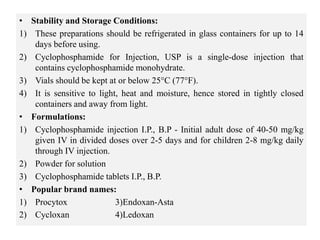
• Stability and Storage Conditions:
1) These preparations should be refrigerated in glass containers for up to 14
days before using.
2) Cyclophosphamide for Injection, USP is a single-dose injection that
contains cyclophosphamide monohydrate.
3) Vials should be kept at or below 25°C (77°F).
4) It is sensitive to light, heat and moisture, hence stored in tightly closed
containers and away from light.
• Formulations:
1) Cyclophosphamide injection I.P., B.P - Initial adult dose of 40-50 mg/kg
given IV in divided doses over 2-5 days and for children 2-8 mg/kg daily
through IV injection.
2) Powder for solution
3) Cyclophosphamide tablets I.P., B.P.
• Popular brand names:
1) Procytox 3)Endoxan-Asta
2) Cycloxan 4)Ledoxan
2. Busulfan
• Chemical name:
Butane-1,4-diyl dimethanesulfonate
• Uses:
1) It is used with cyclophosphamide as a conditioning regimen before allogeneic
hematopoietic progenitor cell transplantation for chronic myelogenous (myeloid,
myelocytic, and granulocytic) leukemia.
2) It is also a component of pre-transplant conditioning regimen in bone marrow
transplantation for acute myeloid leukemia and non-malignant diseases.
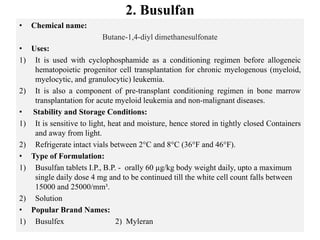
• Stability and Storage Conditions:
1) It is sensitive to light, heat and moisture, hence stored in tightly closed Containers
and away from light.
2) Refrigerate intact vials between 2°C and 8°C (36°F and 46°F).
• Type of Formulation:
1) Busulfan tablets I.P., B.P. - orally 60 µg/kg body weight daily, upto a maximum
single daily dose 4 mg and to be continued till the white cell count falls between
15000 and 25000/mm³.
2) Solution
• Popular Brand Names:
1) Busulfex 2) Myleran
3. Mercaptopurine
• Chemical name:
3,7-dihydropurine-6-thione
• Uses:
1) It is used for remission induction and maintenance therapy of acute
lymphatic leukaemia.
2) It is used in the treatment of acute monocytic leukaemia,
lymphobastomas, myeloblastoma leucosis, and to treat neuroleukemia.
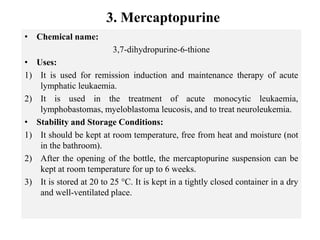
• Stability and Storage Conditions:
1) It should be kept at room temperature, free from heat and moisture (not
in the bathroom).
2) After the opening of the bottle, the mercaptopurine suspension can be
kept at room temperature for up to 6 weeks.
3) It is stored at 20 to 25 °C. It is kept in a tightly closed container in a dry
and well-ventilated place.
• Type of Formulation:
1) Tablet
2) Suspension
3) Initial oral dose for children and adult is 2.5 mg/kg body weight
daily but dose varies as per individual response and tolerance.
• Popular Brand Names;
1) Purixan
2) Purinethol
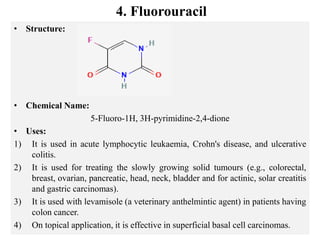
4. Fluorouracil
• Structure:
• Chemical Name:
5-Fluoro-1H, 3H-pyrimidine-2,4-dione
• Uses:
1) It is used in acute lymphocytic leukaemia, Crohn's disease, and ulcerative
colitis.
2) It is used for treating the slowly growing solid tumours (e.g., colorectal,
breast, ovarian, pancreatic, head, neck, bladder and for actinic, solar creatitis
and gastric carcinomas).
3) It is used with levamisole (a veterinary anthelmintic agent) in patients having
colon cancer.
4) On topical application, it is effective in superficial basal cell carcinomas.
• Stability and Storage Conditions:
1) 5-fluorouracil's stability has been evaluated in a variety of liquids and
containers at temperatures ranging from 4°C to 35°C. When 5-fluorouracil
was synthesized in NS and stored in polyolefin bags at 5°C 3°C for 28
days, it remained stable.
2) It is stored at 25°C (77°F) in tightly closed light resistant containers as it is
affected by air and light.
• Types of Formulations:
1) Fluorouracil injection I.P - 1.2 mg per kg body weight daily to a maximum
of1 gm daily for 3 or 4 days.
2) Solutions
3) Fluorouracil cream B.P.
• Popular Brand Names:
1) Actikerall 5) Fluoroplex
2) Carac 6) Tolak
3) Efudex 7) Fivoflu
4) Flocil 8) Florac
5. Methotrexate
• Chemical name:
(2S)-2-[[4-[(2,4-diaminopteridin-6-yl)methyl-
methylamino]benzoyl]amino]pentane dioic acid
• Uses:
1) It is effectively used with other drugs in acute lymphocytic leukaemia,
choriocarcinoma, Burkitt lymphoma in children, breast cancer, and head
and neck carcinomas.
2) It is alone effective in low doses against certain inflammatory diseases
(e.g., severe psoriasis).
• Stability and Storage Conditions :
1) Multidose vials of methotrexate injection USP (with benzyl alcohol as a
preservative) should be stored at temperatures between 15°C and 25°C.
2) The vials should be stored between 2°C and 8°C for a maximum of four
weeks after being punctured (30 days).
3) It should be protected from light and freezing.
• Type of Formulation:
1) Methotrexate injection I.P., B.P.,
2) Powder for injection
3) Methotrexate tablets I.P., B.P.
4) For the maintenance therapy of acute lymphoblastic leukaemia, the
dose is 15-30 mg/m² body surface once or twice weekly either orally
or intramuscularly, with other agents such as mercaptopurine.
• Popular Brand Names;
1) Trexall
2) Xatmep
6. Dactinomycin
• Chemical name:
2-Amino-N,N′- bis[(6S,9R,10S,13R,18aS)-6,13-diisopropyl-2,5,9-
trimethyl-1,4,7,11,14-pentaoxohexadecahydro-1H-pyrrolo
[2,1-i][1,4,7,10,13] oxatetraazacyclohexadecin-10-yl]-4,6-
dimethyl-3- oxo-3H-phenoxazine-1,9-dicarboxamide
• Uses:
1) It is used in the treatment or rhabdomyosarcoma in children and
methotrexate-resistant choricarcinoma in women.
2) It has also been used to inhibit immunoligical response particularly the
rejection of renal transplants.
3) It is used as a part of combination chemotherapy and/or multi-modality
treatment regimen for treating Wilms' tumour, childhood
rhabdomyosarcoma, Ewing's sarcoma and metastatic, non-seminomatous
testicular cancer.
• Stability and Storage Conditions:
1) Temperatures should be kept between 20° and 25° Celsius (68° and 77
°F) and away from light and humidity.
2) It is caustic to the skin, irritating to the eyes and mucous membranes of
the respiratory tract, and highly poisonous when taken orally, according
to animal studies.
3) It is kept in tightly closed container under an inert atmosphere, and
stored under ambient temperatures.
• Type of Formulation:
1) Powder for injection- Adults, IV, 0.01 mg (10 mcg) per kg body weight;
Children: 0.015 mg/kg body weight for not more than 5 days.
• Popular Brand Names:
1) Cosmegen
2) Dactinogen
3) Dacmogen
7. Doxorubicin Hydrochloride
• Chemical name:
(7S,9S)-7-[(2R,4S,5S,6S)-4-Amino-5-hydroxy-6-methyloxan-2-yl] oxy-
6,9,11-trihydroxy-9-(2-hydroxyacetyl)-4-methoxy
-8,10-dihydro-7H-tetracene-5,12-dione
• Uses:
1) It is used for producing regression in disseminated neoplastic conditions
such as acute lymphoblastic leukaemia, acute myeloblastic leukaemia,
Wilms' tumour, neuroblastoma, soft tissue and bone sarcomas, breast
carcinoma; ovarian carcinoma, transitional cell bladder carcinoma, thyroid
carcinoma, gastric carcinoma, Hodgkin's disease, malignant lymphoma and
bronchogenic carcinoma in which the small cell histologic type is the most
responsive.
2) It is also used as a part of adjuvant therapy in women showing signs of
axillary lymph node involvement after the resection of primary breast
cancer.
3) It is mainly used in combination with other drugs for treating solid tumors.
• Stability and Storage Conditions:
1) It is kept in tightly closed container under an inert atmosphere, and
stored under ambient temperatures.
2) It should be stored at a temperature of 2° to 8°C.
• Formulations:
1) Powder for injection: 60 - 75 mg/m² BSA slow I.V. injection every
3 weeks.
1) Doxorubicin HCI injection I.P.,
2) Doxorubicin Injection B.P.
3) Doxorubicin HCI tablets IP.
4) Solution
• Popular brand names:
1) Adriamycin RDF
2) Adriamycin PFS
3) Adriamycin
4) Rubex
8. Vinblastine Sulphate
• Uses:
1) It is used in the treatment of breast cancer, testicular cancer, lymphomas,
neuroblastoma, Hodgkin's and non-Hodgkin's lymphomas, mycosis fungoides.
histiocytosis, and Kaposi's sarcoma.
2) It is combined with vincristine in the treatment of lymphocytic and
myeloblastic leukemia in children.
• Stability and Storage Conditions:
1) It is should be refrigerated between 2° and 8 °C.
2) The vial should be kept in the outer carton to ensure safety from light.
3) It is kept in tightly closed container under an inert atmosphere, and stored under
ambient temperatures.
• Formulations:
1) Injection solution
2) Powder
3) Intravenously as a solution containing 1 mg per ml in sodium chloride injection.
• Popular brand names:
1) Velban 2)Biocristin
9. Cisplatin
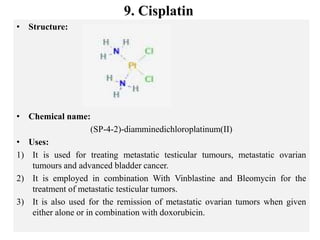
• Structure:
• Chemical name:
(SP-4-2)-diamminedichloroplatinum(II)
• Uses:
1) It is used for treating metastatic testicular tumours, metastatic ovarian
tumours and advanced bladder cancer.
2) It is employed in combination With Vinblastine and Bleomycin for the
treatment of metastatic testicular tumors.
3) It is also used for the remission of metastatic ovarian tumors when given
either alone or in combination with doxorubicin.
4) It also exhibits activity against a host of other tumors, such as: cervical cancer,
neck and head cancer, penile cancer, bladder cancer and small-cell cancer of the
lung.
5) It is highly reactive with carcinomas of the testicles, ovaries, heat, neck, spleen
lungs.
• Stability and Storage Conditions:
1) It is physically and chemically stable, when stored in glass containers or diluted
with 0.9 % sodium chloride in PE bags at a concentration of 10 mg/ml at room
temperature (15-25°C) for at least 30 days.
2) It is kept in tightly closed container under an inert atmosphere, and stored under
ambient temperatures.
• Formulations:
1) Cisplatin injection B.P. : for metastatic testicular tumors 20 mg/m² IV daily for
five days, followed every 3 weeks for 3 courses., and for metastatic ovarian
tumors 50 mg/m² IV once every 3 weeks.
2) Solution
• Popular brand names:
1) Platinol 3)Cytoxan Lyophilized
2) Cytoxan 4) Neosar
10. Dromostanolone Propionate
• Uses:
1) It is prescribed for the treatment of breast cancer in women, but it has been
withdrawn from the market.
2) It can also be used as to administer injection in the muscle.
3) It is used to treat ovarian cancer, gestational trophoblastic neoplasm, metastatic
testicular tumors, gestational trophoblastic neoplasm and locally recurrent or
locoregional solid tumors (sarcomas, carcinomas and adenocarcinomas).
• Stability and Storage Conditions:
1) It should be stored at 0°-4°C for short-term (days to weeks) or at -20°C for
long- term (months to years) in dry and dark places.
2) It is kept in tightly closed container under an inert atmosphere, and stored
under ambient temperatures.
• Formulations:
1) Injection
2) Solutions
• Popular brand names:
1) Drolban Masteril 2) Masteron
THANK YOU

ANTI-NEOPLASTIC AGENTS.pptx

  • 1.
    ANTI-NEOPLASTIC AGENTS PHARMACEUTICAL CHEMISTRY D.Pharm 1st year 2022-2023 MISS NIKITA J. BHUTE Assistant professor Nagpur college of Pharmacy, Wanadogari, Higna road, Nagpur 441 110
  • 2.
    INDEX • Cancer • Typesof cancer • Anti-neoplastic agents • Classification of anti-neoplastic agents • Chemical name, Chemical structure (compounds marked with*) Uses, Stability and storage conditions, different types of formulations and their popular brand names of: 1. Cyclophosphamide * 6. Dactinomycin 2. Busulfan 7. Doxorubicin Hydrochloride 3. Mercaptopurine 8. Vinblastine Sulphate 4. Fluorouracil * 9. Cisplatin * 5. Methotrexate 10. Dromostanolone Propionate
  • 3.
    CANCER • Cancer isa disease characterized by abnormal and uncontrolled cell division attacking the surrounding tissues and organs, and also the distant body parts by circulating with blood and lymph. • Cancer is classified into the following categories: TYPES OF CANCER 1) Carcinoma This type of cancer starts in the skin or tissues lining the internal organs. There are many sub-types of carcinoma, like adenocarcinoma, basal cell carcinoma, squamous cell carcinoma, and transitional cell carcinoma. 2)Sarcoma This type of cancer starts in the bone, cartilage, fat, muscle, blood vessels, or other connective or supportive tissues. 3)Leukaemia This type of cancer starts in the blood- forming tissues (i.e., the bone marrow) and produces numerous abnormal blood cells. 4) Lymphoma and Myeloma This type of cancer starts in the cells of immune system. 5) Central Nervous System Cancers This type of cancer starts in the brain and spinal cord tissues.
  • 4.
    ANTI-NEOPLASTIC AGENTS • Antineoplasticor anticancer drugs are used for treating malignancies orcancerous growths. Either these drugs are used alone (chemotherapy) or inombination with surgery or radiation therapy. Class Name of Drugs 1) Alkylating agents a) Nitrogen mustards Mechlorethamine (Mustine HCI), Ifosfamide, Cyclophosphamide, Chlorambucil and Melphalan b) Ethylenimine Thiotepa c) Alkyl sulfonate Busulfan, Busulphan d) Nitrosoureas Carmustine (BCNU), Lomustine (CCNU) and Semustinee e) Triazine Dacarbazine (DTIC) 2) Antimetabolites a) Folate antagonist Methotrexate (Mtx) , Trimetrexate b) Purine antagonist 6-Mercaptopurine (6-MP), 6-Thioguanine(6-TG), Azathioprine and Fludarabine c) Pyrimidine antagonist 5-Fluorouracil (5-FU) and Cytarabine (cytosine arabinoside) 3) Radioactive Isotopes Sodium phosphate, Sodium iodide, and Radio gold solution 4) Enzymes Asparaginase (Elspar)
  • 5.
    Class Name ofDrugs 5) Natural Products a) Vinca alkaloids Vincristine (Oncovin) and Vinblastine b) Taxanes Paclitaxel and Docetaxel c) Epipodophyllo toxin Etoposide d) Camptothecin analogues Topotecan and Irinotecan 6) Antibiotics Actinomycin D, Dactinomycin, Doxorubicin, Daunorubicin, Rubidomycin, Mitoxantrone, Bleomycin, Mitomycin C and Mithramycin 7) Hormones a) Glucocorticoids Prednisolone b) Estrogens Fosfestrol and Ethinylestradiol c) Antiestrogen Tamoxifen d) Antiandrogen Flutamide e) 5-α reductase inhibitor Finasteride f) GnRH analogues Nafarein and Goserelin g) Progestins Hydroxyprogesterone Acetate 8) Miscellaneous Hydroxyurea, Procarbazine, L-Asparaginase, Cisplatin and Carboplatin, Imatinib, Procarbazine
  • 6.
    1. Cyclophosphamide • Structure: •Chemical name: 2-[bis(2-chloroethyl)amino]-1,3,2λ-oxazaphosphinan-2-one • Uses: 1) It is used in the treatment of malignant lymphomas, multiple myeloma, leukaemia, mycosis fungoides, neuroblastoma, adenocarcinoma of the ovary, retinoblastoma, and carcinoma of breast. 2) It is also used in biopsy-proven minimal change nephrotic syndrome in paediatrics.
  • 7.
    • Stability andStorage Conditions: 1) These preparations should be refrigerated in glass containers for up to 14 days before using. 2) Cyclophosphamide for Injection, USP is a single-dose injection that contains cyclophosphamide monohydrate. 3) Vials should be kept at or below 25°C (77°F). 4) It is sensitive to light, heat and moisture, hence stored in tightly closed containers and away from light. • Formulations: 1) Cyclophosphamide injection I.P., B.P - Initial adult dose of 40-50 mg/kg given IV in divided doses over 2-5 days and for children 2-8 mg/kg daily through IV injection. 2) Powder for solution 3) Cyclophosphamide tablets I.P., B.P. • Popular brand names: 1) Procytox 3)Endoxan-Asta 2) Cycloxan 4)Ledoxan
  • 8.
    2. Busulfan • Chemicalname: Butane-1,4-diyl dimethanesulfonate • Uses: 1) It is used with cyclophosphamide as a conditioning regimen before allogeneic hematopoietic progenitor cell transplantation for chronic myelogenous (myeloid, myelocytic, and granulocytic) leukemia. 2) It is also a component of pre-transplant conditioning regimen in bone marrow transplantation for acute myeloid leukemia and non-malignant diseases. • Stability and Storage Conditions: 1) It is sensitive to light, heat and moisture, hence stored in tightly closed Containers and away from light. 2) Refrigerate intact vials between 2°C and 8°C (36°F and 46°F). • Type of Formulation: 1) Busulfan tablets I.P., B.P. - orally 60 µg/kg body weight daily, upto a maximum single daily dose 4 mg and to be continued till the white cell count falls between 15000 and 25000/mm³. 2) Solution • Popular Brand Names: 1) Busulfex 2) Myleran
  • 9.
    3. Mercaptopurine • Chemicalname: 3,7-dihydropurine-6-thione • Uses: 1) It is used for remission induction and maintenance therapy of acute lymphatic leukaemia. 2) It is used in the treatment of acute monocytic leukaemia, lymphobastomas, myeloblastoma leucosis, and to treat neuroleukemia. • Stability and Storage Conditions: 1) It should be kept at room temperature, free from heat and moisture (not in the bathroom). 2) After the opening of the bottle, the mercaptopurine suspension can be kept at room temperature for up to 6 weeks. 3) It is stored at 20 to 25 °C. It is kept in a tightly closed container in a dry and well-ventilated place.
  • 10.
    • Type ofFormulation: 1) Tablet 2) Suspension 3) Initial oral dose for children and adult is 2.5 mg/kg body weight daily but dose varies as per individual response and tolerance. • Popular Brand Names; 1) Purixan 2) Purinethol
  • 11.
    4. Fluorouracil • Structure: •Chemical Name: 5-Fluoro-1H, 3H-pyrimidine-2,4-dione • Uses: 1) It is used in acute lymphocytic leukaemia, Crohn's disease, and ulcerative colitis. 2) It is used for treating the slowly growing solid tumours (e.g., colorectal, breast, ovarian, pancreatic, head, neck, bladder and for actinic, solar creatitis and gastric carcinomas). 3) It is used with levamisole (a veterinary anthelmintic agent) in patients having colon cancer. 4) On topical application, it is effective in superficial basal cell carcinomas.
  • 12.
    • Stability andStorage Conditions: 1) 5-fluorouracil's stability has been evaluated in a variety of liquids and containers at temperatures ranging from 4°C to 35°C. When 5-fluorouracil was synthesized in NS and stored in polyolefin bags at 5°C 3°C for 28 days, it remained stable. 2) It is stored at 25°C (77°F) in tightly closed light resistant containers as it is affected by air and light. • Types of Formulations: 1) Fluorouracil injection I.P - 1.2 mg per kg body weight daily to a maximum of1 gm daily for 3 or 4 days. 2) Solutions 3) Fluorouracil cream B.P. • Popular Brand Names: 1) Actikerall 5) Fluoroplex 2) Carac 6) Tolak 3) Efudex 7) Fivoflu 4) Flocil 8) Florac
  • 13.
    5. Methotrexate • Chemicalname: (2S)-2-[[4-[(2,4-diaminopteridin-6-yl)methyl- methylamino]benzoyl]amino]pentane dioic acid • Uses: 1) It is effectively used with other drugs in acute lymphocytic leukaemia, choriocarcinoma, Burkitt lymphoma in children, breast cancer, and head and neck carcinomas. 2) It is alone effective in low doses against certain inflammatory diseases (e.g., severe psoriasis). • Stability and Storage Conditions : 1) Multidose vials of methotrexate injection USP (with benzyl alcohol as a preservative) should be stored at temperatures between 15°C and 25°C. 2) The vials should be stored between 2°C and 8°C for a maximum of four weeks after being punctured (30 days). 3) It should be protected from light and freezing.
  • 14.
    • Type ofFormulation: 1) Methotrexate injection I.P., B.P., 2) Powder for injection 3) Methotrexate tablets I.P., B.P. 4) For the maintenance therapy of acute lymphoblastic leukaemia, the dose is 15-30 mg/m² body surface once or twice weekly either orally or intramuscularly, with other agents such as mercaptopurine. • Popular Brand Names; 1) Trexall 2) Xatmep
  • 15.
    6. Dactinomycin • Chemicalname: 2-Amino-N,N′- bis[(6S,9R,10S,13R,18aS)-6,13-diisopropyl-2,5,9- trimethyl-1,4,7,11,14-pentaoxohexadecahydro-1H-pyrrolo [2,1-i][1,4,7,10,13] oxatetraazacyclohexadecin-10-yl]-4,6- dimethyl-3- oxo-3H-phenoxazine-1,9-dicarboxamide • Uses: 1) It is used in the treatment or rhabdomyosarcoma in children and methotrexate-resistant choricarcinoma in women. 2) It has also been used to inhibit immunoligical response particularly the rejection of renal transplants. 3) It is used as a part of combination chemotherapy and/or multi-modality treatment regimen for treating Wilms' tumour, childhood rhabdomyosarcoma, Ewing's sarcoma and metastatic, non-seminomatous testicular cancer.
  • 16.
    • Stability andStorage Conditions: 1) Temperatures should be kept between 20° and 25° Celsius (68° and 77 °F) and away from light and humidity. 2) It is caustic to the skin, irritating to the eyes and mucous membranes of the respiratory tract, and highly poisonous when taken orally, according to animal studies. 3) It is kept in tightly closed container under an inert atmosphere, and stored under ambient temperatures. • Type of Formulation: 1) Powder for injection- Adults, IV, 0.01 mg (10 mcg) per kg body weight; Children: 0.015 mg/kg body weight for not more than 5 days. • Popular Brand Names: 1) Cosmegen 2) Dactinogen 3) Dacmogen
  • 17.
    7. Doxorubicin Hydrochloride •Chemical name: (7S,9S)-7-[(2R,4S,5S,6S)-4-Amino-5-hydroxy-6-methyloxan-2-yl] oxy- 6,9,11-trihydroxy-9-(2-hydroxyacetyl)-4-methoxy -8,10-dihydro-7H-tetracene-5,12-dione • Uses: 1) It is used for producing regression in disseminated neoplastic conditions such as acute lymphoblastic leukaemia, acute myeloblastic leukaemia, Wilms' tumour, neuroblastoma, soft tissue and bone sarcomas, breast carcinoma; ovarian carcinoma, transitional cell bladder carcinoma, thyroid carcinoma, gastric carcinoma, Hodgkin's disease, malignant lymphoma and bronchogenic carcinoma in which the small cell histologic type is the most responsive. 2) It is also used as a part of adjuvant therapy in women showing signs of axillary lymph node involvement after the resection of primary breast cancer. 3) It is mainly used in combination with other drugs for treating solid tumors.
  • 18.
    • Stability andStorage Conditions: 1) It is kept in tightly closed container under an inert atmosphere, and stored under ambient temperatures. 2) It should be stored at a temperature of 2° to 8°C. • Formulations: 1) Powder for injection: 60 - 75 mg/m² BSA slow I.V. injection every 3 weeks. 1) Doxorubicin HCI injection I.P., 2) Doxorubicin Injection B.P. 3) Doxorubicin HCI tablets IP. 4) Solution • Popular brand names: 1) Adriamycin RDF 2) Adriamycin PFS 3) Adriamycin 4) Rubex
  • 19.
    8. Vinblastine Sulphate •Uses: 1) It is used in the treatment of breast cancer, testicular cancer, lymphomas, neuroblastoma, Hodgkin's and non-Hodgkin's lymphomas, mycosis fungoides. histiocytosis, and Kaposi's sarcoma. 2) It is combined with vincristine in the treatment of lymphocytic and myeloblastic leukemia in children. • Stability and Storage Conditions: 1) It is should be refrigerated between 2° and 8 °C. 2) The vial should be kept in the outer carton to ensure safety from light. 3) It is kept in tightly closed container under an inert atmosphere, and stored under ambient temperatures. • Formulations: 1) Injection solution 2) Powder 3) Intravenously as a solution containing 1 mg per ml in sodium chloride injection. • Popular brand names: 1) Velban 2)Biocristin
  • 20.
    9. Cisplatin • Structure: •Chemical name: (SP-4-2)-diamminedichloroplatinum(II) • Uses: 1) It is used for treating metastatic testicular tumours, metastatic ovarian tumours and advanced bladder cancer. 2) It is employed in combination With Vinblastine and Bleomycin for the treatment of metastatic testicular tumors. 3) It is also used for the remission of metastatic ovarian tumors when given either alone or in combination with doxorubicin.
  • 21.
    4) It alsoexhibits activity against a host of other tumors, such as: cervical cancer, neck and head cancer, penile cancer, bladder cancer and small-cell cancer of the lung. 5) It is highly reactive with carcinomas of the testicles, ovaries, heat, neck, spleen lungs. • Stability and Storage Conditions: 1) It is physically and chemically stable, when stored in glass containers or diluted with 0.9 % sodium chloride in PE bags at a concentration of 10 mg/ml at room temperature (15-25°C) for at least 30 days. 2) It is kept in tightly closed container under an inert atmosphere, and stored under ambient temperatures. • Formulations: 1) Cisplatin injection B.P. : for metastatic testicular tumors 20 mg/m² IV daily for five days, followed every 3 weeks for 3 courses., and for metastatic ovarian tumors 50 mg/m² IV once every 3 weeks. 2) Solution • Popular brand names: 1) Platinol 3)Cytoxan Lyophilized 2) Cytoxan 4) Neosar
  • 22.
    10. Dromostanolone Propionate •Uses: 1) It is prescribed for the treatment of breast cancer in women, but it has been withdrawn from the market. 2) It can also be used as to administer injection in the muscle. 3) It is used to treat ovarian cancer, gestational trophoblastic neoplasm, metastatic testicular tumors, gestational trophoblastic neoplasm and locally recurrent or locoregional solid tumors (sarcomas, carcinomas and adenocarcinomas). • Stability and Storage Conditions: 1) It should be stored at 0°-4°C for short-term (days to weeks) or at -20°C for long- term (months to years) in dry and dark places. 2) It is kept in tightly closed container under an inert atmosphere, and stored under ambient temperatures. • Formulations: 1) Injection 2) Solutions • Popular brand names: 1) Drolban Masteril 2) Masteron
  • 23.