IMMUNOLOGY: Antigen
Processing & Presentation
By:
Dr. Riaz M
Department of Microbiology
Abasyn University Peshawar
Antigens and “foreignness”
• Antigens (or, more properly, immunogens)
have a series of features which confer
immunogenicity.
• One of these features is “foreignness.”
• So, we can infer that – most often – antigens
– ultimately – originate externally.
• (There are exceptions, of course. Some cells
become transformed by disease [e. g.,
cancer] or by aging. In such instances, the
antigens have an internal origin.)
What is the significance of these premises?
They indicate that antigens are processed and
presented.
There are two presentation systems…
• Are there two processing systems?
• Yes: CYTOSOLIC and ENDOCYTOTIC
• Does this imply that there are different degrees
of foreignness?
• And that there are different cells for different
degrees of foreignnness?
Cytosolic:
• Uses MHC-I
• Processes ENDOGENOUS proteins
(e. g., viral proteins, proteins from
bacteria which invade cells, parasites,
and normal cellular constituents [!])
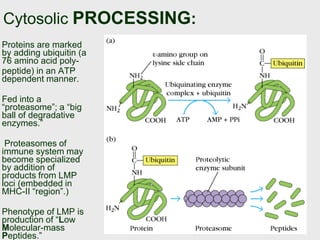
Cytosolic PROCESSING:
• Proteins are marked by adding ubiquitin (a 76 amino
acid polypeptide) in an ATP dependent manner.
• Fed into a “proteasome”; a “big ball of degradative
enzymes.”
• Proteasomes of immune system may become
specialized by addition of products from LMP loci
(embedded in MHC-II “region”.)
• Phenotype of LMP is production of “Low Molecular-
mass Peptides.”
• LMP’s are polymorphic.
Cytosolic PROCESSING:
Proteins are marked
by adding ubiquitin (a
76 amino acid poly-
peptide) in an ATP
dependent manner.
Fed into a
“proteasome”; a “big
ball of degradative
enzymes.”
Proteasomes of
immune system may
become specialized
by addition of
products from LMP
loci (embedded in
MHC-II “region”.)
Phenotype of LMP is
production of “Low
Molecular-mass
Peptides.”
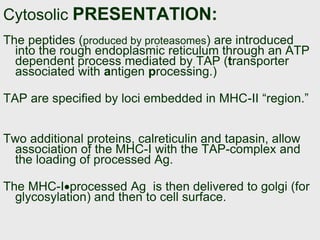
Cytosolic PRESENTATION:
The peptides (produced by proteasomes) are introduced
into the rough endoplasmic reticulum through an ATP
dependent process mediated by TAP (transporter
associated with antigen processing.)
TAP are specified by loci embedded in MHC-II “region.”
Two additional proteins, calreticulin and tapasin, allow
association of the MHC-I with the TAP-complex and
the loading of processed Ag.
The MHC-Iprocessed Ag is then delivered to golgi (for
glycosylation) and then to cell surface.
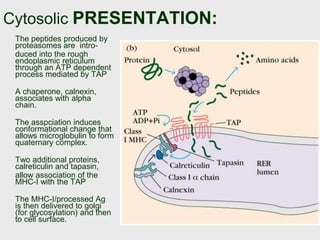
Cytosolic PRESENTATION:
The peptides produced by
proteasomes are intro-
duced into the rough
endoplasmic reticulum
through an ATP dependent
process mediated by TAP
A chaperone, calnexin,
associates with alpha
chain.
The asspciation induces
conformational change that
allows microglobulin to form
quaternary complex.
Two additional proteins,
calreticulin and tapasin,
allow association of the
MHC-I with the TAP
The MHC-I/processed Ag
is then delivered to golgi
(for glycosylation) and then
to cell surface.
Endocytotic:
• Uses MHC-II
• Processes EXOGENOUS proteins
(viz., foreign antigens.)
• Uses APC’s
(esp., “professional” antigen presenting cells)
• How do the APC’s acquire antigens to process?
Endocytotic PROCESSING:
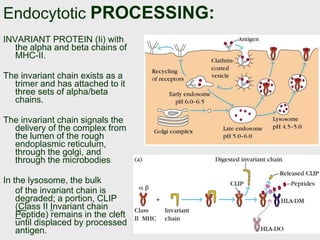
The antigen is introduced into cell by phagocytosis
or endocytosis (receptor mediated or pinocytotic).
The Ag passes through a series of vesicles that
have increasing acidity
early endosomes (pH 6.0-6.5)
late endosomes (pH 5.0-6.0)
and lysosome (pH 4.5-5.0).
Lysosomes contain ~140 acid dependent hydrolases
including proteases, nucleases, lipases,
glycosidases, phospholipases, phosphatases...
Endocytotic PROCESSING:
KEY is the presence of the INVARIANT PROTEIN (Ii)
synthesized with the alpha and beta chains of MHC-II.
The invariant chain exists as a trimer and has attached
to it three sets of alpha/beta chains.
The invariant chain has a series of signals that
contribute to the delivery of the complex from the
lumen of the rough endoplasmic reticulum, through the
golgi, and through the microbodies (early endosome, late
endosome, lysosome).
In the lysosome, the bulk of the invariant chain is
degraded; a portion, CLIP (Class II Invariant chain
Peptide) remains in the cleft until displaced by
processed antigen.
Endocytotic PROCESSING:
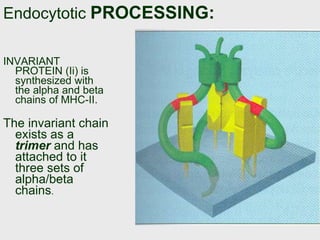
INVARIANT
PROTEIN (Ii) is
synthesized with
the alpha and beta
chains of MHC-II.
The invariant chain
exists as a
trimer and has
attached to it
three sets of
alpha/beta
chains.
Endocytotic PROCESSING:
INVARIANT PROTEIN (Ii) with
the alpha and beta chains of
MHC-II.
The invariant chain exists as a
trimer and has attached to it
three sets of alpha/beta
chains.
The invariant chain signals the
delivery of the complex from
the lumen of the rough
endoplasmic reticulum,
through the golgi, and
through the microbodies
In the lysosome, the bulk
of the invariant chain is
degraded; a portion, CLIP
(Class II Invariant chain
Peptide) remains in the cleft
until displaced by processed
antigen.
Antigen presenting cells…
Dendritic cells:
Langerhans cells found in epidermis and mucous membranes.
Interstitial dendritic cells which populate most organs.
Interdigitating dendritic cells present in T-cell areas of secondary lymphoid
tissue and the thymic medulla
Circulating dendritic cells… in the blood… and lymph (known as veiled
cells.)
Cross-talk…
What is the consequence?
But not all immunogens are proteins…
There may be specialized systems for
presentation of non-peptide antigens.
There are non-protein antigens which do
not require presentation.
Instead they stimulate B-cells
directly without T-cell intervention.

Antigens processing and presentation MID

  • 1.
    IMMUNOLOGY: Antigen Processing &Presentation By: Dr. Riaz M Department of Microbiology Abasyn University Peshawar
  • 2.
    Antigens and “foreignness” •Antigens (or, more properly, immunogens) have a series of features which confer immunogenicity. • One of these features is “foreignness.” • So, we can infer that – most often – antigens – ultimately – originate externally. • (There are exceptions, of course. Some cells become transformed by disease [e. g., cancer] or by aging. In such instances, the antigens have an internal origin.)
  • 3.
    What is thesignificance of these premises? They indicate that antigens are processed and presented.
  • 4.
    There are twopresentation systems… • Are there two processing systems? • Yes: CYTOSOLIC and ENDOCYTOTIC • Does this imply that there are different degrees of foreignness? • And that there are different cells for different degrees of foreignnness?
  • 5.
    Cytosolic: • Uses MHC-I •Processes ENDOGENOUS proteins (e. g., viral proteins, proteins from bacteria which invade cells, parasites, and normal cellular constituents [!])
  • 6.
    Cytosolic PROCESSING: • Proteinsare marked by adding ubiquitin (a 76 amino acid polypeptide) in an ATP dependent manner. • Fed into a “proteasome”; a “big ball of degradative enzymes.” • Proteasomes of immune system may become specialized by addition of products from LMP loci (embedded in MHC-II “region”.) • Phenotype of LMP is production of “Low Molecular- mass Peptides.” • LMP’s are polymorphic.
  • 7.
    Cytosolic PROCESSING: Proteins aremarked by adding ubiquitin (a 76 amino acid poly- peptide) in an ATP dependent manner. Fed into a “proteasome”; a “big ball of degradative enzymes.” Proteasomes of immune system may become specialized by addition of products from LMP loci (embedded in MHC-II “region”.) Phenotype of LMP is production of “Low Molecular-mass Peptides.”
  • 8.
    Cytosolic PRESENTATION: The peptides(produced by proteasomes) are introduced into the rough endoplasmic reticulum through an ATP dependent process mediated by TAP (transporter associated with antigen processing.) TAP are specified by loci embedded in MHC-II “region.” Two additional proteins, calreticulin and tapasin, allow association of the MHC-I with the TAP-complex and the loading of processed Ag. The MHC-Iprocessed Ag is then delivered to golgi (for glycosylation) and then to cell surface.
  • 9.
    Cytosolic PRESENTATION: The peptidesproduced by proteasomes are intro- duced into the rough endoplasmic reticulum through an ATP dependent process mediated by TAP A chaperone, calnexin, associates with alpha chain. The asspciation induces conformational change that allows microglobulin to form quaternary complex. Two additional proteins, calreticulin and tapasin, allow association of the MHC-I with the TAP The MHC-I/processed Ag is then delivered to golgi (for glycosylation) and then to cell surface.
  • 10.
    Endocytotic: • Uses MHC-II •Processes EXOGENOUS proteins (viz., foreign antigens.) • Uses APC’s (esp., “professional” antigen presenting cells) • How do the APC’s acquire antigens to process?
  • 11.
    Endocytotic PROCESSING: The antigenis introduced into cell by phagocytosis or endocytosis (receptor mediated or pinocytotic). The Ag passes through a series of vesicles that have increasing acidity early endosomes (pH 6.0-6.5) late endosomes (pH 5.0-6.0) and lysosome (pH 4.5-5.0). Lysosomes contain ~140 acid dependent hydrolases including proteases, nucleases, lipases, glycosidases, phospholipases, phosphatases...
  • 12.
    Endocytotic PROCESSING: KEY isthe presence of the INVARIANT PROTEIN (Ii) synthesized with the alpha and beta chains of MHC-II. The invariant chain exists as a trimer and has attached to it three sets of alpha/beta chains. The invariant chain has a series of signals that contribute to the delivery of the complex from the lumen of the rough endoplasmic reticulum, through the golgi, and through the microbodies (early endosome, late endosome, lysosome). In the lysosome, the bulk of the invariant chain is degraded; a portion, CLIP (Class II Invariant chain Peptide) remains in the cleft until displaced by processed antigen.
  • 13.
    Endocytotic PROCESSING: INVARIANT PROTEIN (Ii)is synthesized with the alpha and beta chains of MHC-II. The invariant chain exists as a trimer and has attached to it three sets of alpha/beta chains.
  • 14.
    Endocytotic PROCESSING: INVARIANT PROTEIN(Ii) with the alpha and beta chains of MHC-II. The invariant chain exists as a trimer and has attached to it three sets of alpha/beta chains. The invariant chain signals the delivery of the complex from the lumen of the rough endoplasmic reticulum, through the golgi, and through the microbodies In the lysosome, the bulk of the invariant chain is degraded; a portion, CLIP (Class II Invariant chain Peptide) remains in the cleft until displaced by processed antigen.
  • 15.
    Antigen presenting cells… Dendriticcells: Langerhans cells found in epidermis and mucous membranes. Interstitial dendritic cells which populate most organs. Interdigitating dendritic cells present in T-cell areas of secondary lymphoid tissue and the thymic medulla Circulating dendritic cells… in the blood… and lymph (known as veiled cells.)
  • 16.
  • 17.
    But not allimmunogens are proteins… There may be specialized systems for presentation of non-peptide antigens. There are non-protein antigens which do not require presentation. Instead they stimulate B-cells directly without T-cell intervention.