1
ANTHELMINTIC DRUGS
DR.ABDUL LATIF MAHESAR
Department of Medical Pharmacology
KSU
2
INTRODUCTION
 Humans are the primary hosts for the most of
helminthic infections.
 Most worms produce in human sexually by producing
eggs and larvae
 These pass out of body and infect the secondary host
 Imature forms invade humans via skin or GIT and
mature to adult worms with characterstic tissue
distribution.
3
Types (clinical)
1. Worms live in hosts alimentary canal.
2. Worms or larvae live in other tissues of
host
body like muscles , viscera , menninges ,
lungs, subcutaneous tissues.
4
INTESTINAL WORMS CON’D
A) INTESTINAL ROUND WORMS
(NEMATODES)
 Ascaris lmubricods (common round worm)
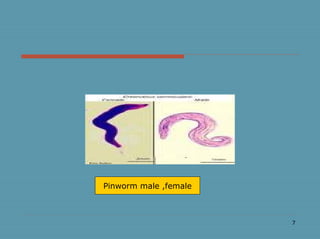
 Enterobius vermicularis (pin worm)
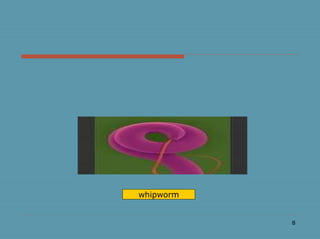
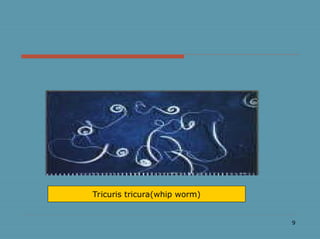
 Trichuris trichuria ( whip worm)
 Strongyloids stercoralis ( thread worm)
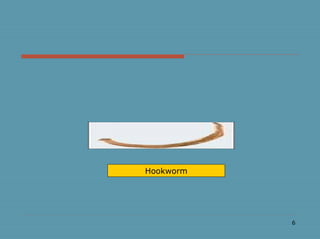
 Ankylostoma dudenale (hook worm)
5
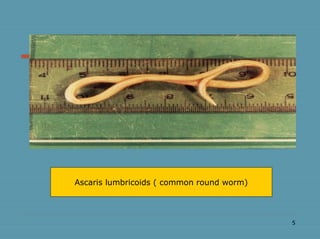
Ascaris lumbricoids ( common round worm)
6
Hookworm
7
Pinworm male ,female
8
whipworm
9
Tricuris tricura(whip worm)
10
1. Alimentary canal(intestinal tape worms)
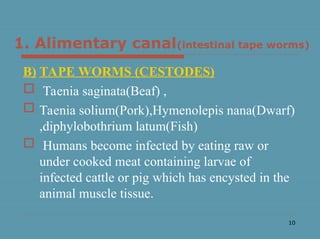
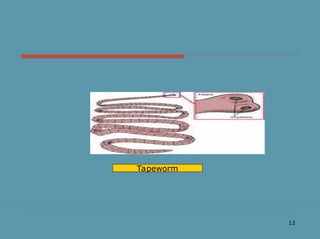
B) TAPE WORMS (CESTODES)
 Taenia saginata(Beaf) ,
 Taenia solium(Pork),Hymenolepis nana(Dwarf)
,diphylobothrium latum(Fish)
 Humans become infected by eating raw or
under cooked meat containing larvae of
infected cattle or pig which has encysted in the
animal muscle tissue.
11
Cestodes con’d
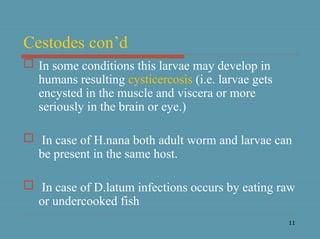
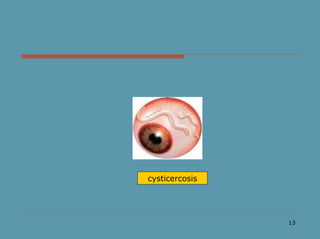
 In some conditions this larvae may develop in
humans resulting cysticercosis (i.e. larvae gets
encysted in the muscle and viscera or more
seriously in the brain or eye.)
 In case of H.nana both adult worm and larvae can
be present in the same host.
 In case of D.latum infections occurs by eating raw
or undercooked fish
12
Tapeworm
13
cysticercosis
14
2. TISSUE WORMS
A.TREMATODES(Schisotomes)OR FLUKES(leaf
like)
 Schistosoma haematobium
 Schistosoma Japonicum
 Schistosoma mansoni
(These cause SCHISTASOMIASIS) also called
(BILHARZIA) means disease of blood vessels.
Adult worms of both sex live and mate in veins or
venules of the gut wall or the bladder, eggs pass into
the bladder or gut and produce inflammation of these
organs , resulting in haematuria or loss of blood in
feces.
15
Tremtodes (flukes) con’d
 Eggs hatch in water and develop in to miracidia(1st
stage of
larva of trematode and further develop in the body of snail),
which enter to 2ndry host a particular species of snail ,where
it develops to free swimming cercarae (final free-swimming
stage of a trematode),These infect humans by penetrating to
skin
 Paragonimus westermani (lung fluke)
disease is caused by eating raw crab or fish ,
larvae move from intestine to blood and settle in
lungs
 Clonorchis sinensis(liver fluke)
disease is caused by eating raw fish and worm
settle in the biliary tract
16
17
Tissue worms cont’d
 B. TISSUE ROUND WORMS
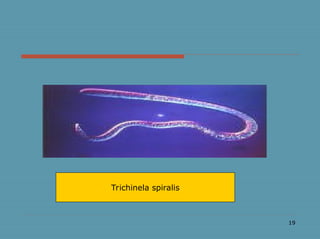
Trichnella spiralis.
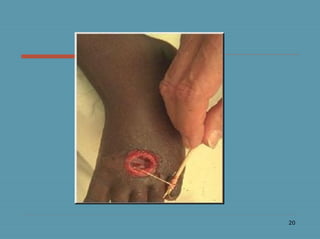
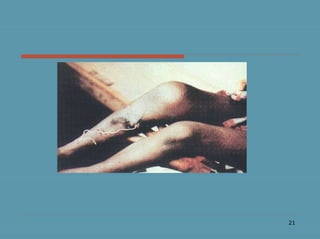
Dracunulus medinensis (guinea worm)larva
migrate from intestine to tissue of leg or foot and
protrude out by making ulcer
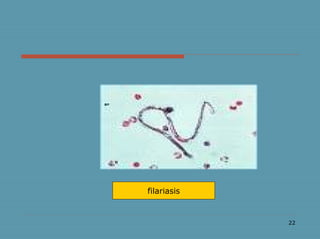
FILARIAE includes
Wuchereria bancrofti
Loa loa
Onchocerera volvulus
Brugia malayi
18
19
Trichinela spiralis
20
21
22
filariasis
23
Wuchereria or Brugia obstructs lymphatic vessels
producing elephantiasis
elephantiasis
24
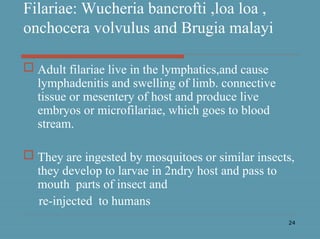
Filariae: Wucheria bancrofti ,loa loa ,
onchocera volvulus and Brugia malayi
 Adult filariae live in the lymphatics,and cause
lymphadenitis and swelling of limb. connective
tissue or mesentery of host and produce live
embryos or microfilariae, which goes to blood
stream.
 They are ingested by mosquitoes or similar insects,
they develop to larvae in 2ndry host and pass to
mouth parts of insect and
re-injected to humans
25
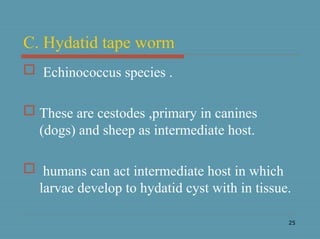
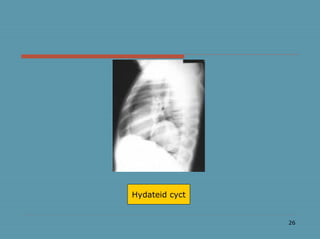
C. Hydatid tape worm
 Echinococcus species .
 These are cestodes ,primary in canines
(dogs) and sheep as intermediate host.
 humans can act intermediate host in which
larvae develop to hydatid cyst with in tissue.
26
Hydateid cyct
27
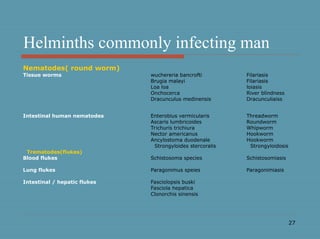
Helminths commonly infecting man
Nematodes( round worm)
Tissue worms wuchereria bancrofti Filariasis
Brugia malayi Filariasis
Loa loa loiasis
Onchocerca River blindness
Dracunculus medinensis Dracunculiaiss
Intestinal human nematodes Enterobius vermicularis Threadworm
Ascaris lumbricoides Roundworm
Trichuris trichiura Whipworm
Nector americanus Hookworm
Ancylostoma duodenale Hookworm
Strongyloides stercoralis Strongyloidosis
Trematodes(flukes)
Blood flukes Schistosoma species Schistosomiasis
Lung flukes Paragonimus speies Paragonimiasis
Intestinal / hepatic flukes Fasciolopsis buski
Fasciola hepatica
Clonorchis sinensis
28
Helminths commonly infecting man cont’d
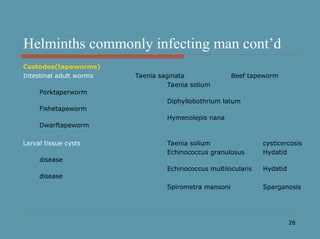
Cestodes(tapeworms)
Intestinal adult worms Taenia saginata Beef tapeworm
Taenia solium
Porktaperworm
Diphyllobothrium latum
Fishetapeworm
Hymenolepis nana
Dwarftapeworm
Larval tissue cysts Taenia solium cysticercosis
Echinococcus granulosus Hydatid
disease
Echinococcus multilocularis Hydatid
disease
Spirometra mansoni Sparganosis
29
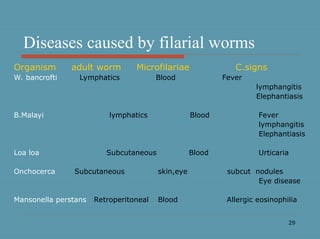
Diseases caused by filarial worms
Organism adult worm Microfilariae C.signs
W. bancrofti Lymphatics Blood Fever
lymphangitis
Elephantiasis
B.Malayi lymphatics Blood Fever
lymphangitis
Elephantiasis
Loa loa Subcutaneous Blood Urticaria
Onchocerca Subcutaneous skin,eye subcut nodules
Eye disease
Mansonella perstans Retroperitoneal Blood Allergic eosinophilia
30
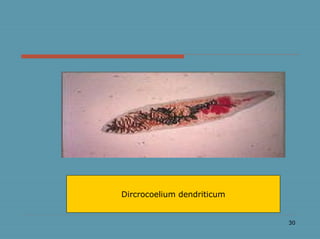
Dircrocoelium dendriticum
31
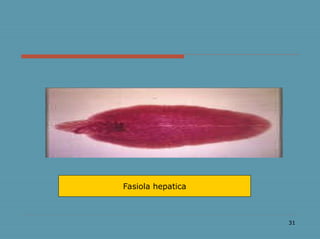
Fasiola hepatica
32
ANTHELMINTIC DRUGS
BENZIMIDAZOLES
1.ALBENDAZOLE:
 It is a broad spectrum
 It is a drug of choice (primary therapeutic
application) for treatment of hydatid disease
and cystecercosis, it is also used for the
treatment of (intestinal nematodes) ascariasis
,tricurasis and strongyloidiasis , pinworm,
hookworm
33
Albendazole con;d
 Mechanism of action: It inhibits microtubule
synthesis in nematodes(intestinal round worms)
that irreversibly impairs glucose uptake,
intestinal parasites are immobilized and die
slowly.
 It is larvicidal in hydatid ,cysticercosis ,
ascariasis and hook worm infection.
 Also ovicidal in ascariasis ,
ancyclostomiasis(hookworm) , tricurasis
34
Pharmacokinetics (Albendazole)
 It is benzimidazole carbamate
 it is adminstered orally , and absorbed
erratically (unpredictable) , absorption can
be increased with fatty meal
 It is metabolized in the liver rapidly to
active metabolite albendazole sulphoxide
35
Pharmacokinetics (Albendazole)
 It has a plasma half life of 8-12 hours
 Sulphoxide is mostly protein bound ,
distributes well to tissues and enters
bile, csf, hydated cyst
 Metabolites are excreted in urine
36
Clinical uses (albendazole)
 used on empty stomach when used against
intraluminal parasites but with fatty meal when against
tissue parasites.
 In ascariasis ,tricurasis ,hookworm, pin worm infection
: children under 2 years 400 mg orally as a single dose
repeated for 2-3 days in heavy ascariasis ,repeated
after 2-3 wks for pin worm
2. Hydated diseases:
drug of choice ,400 mg twice with meals for 1 month
or longer.
37
Albendazole con’d
3. Neurocysticercosis: It is controversial as it has not
proved superior to corticosteroid alone.
It is used along with cotricosteroid to decrease the
inflammation caused by dying organism and it
also reduces the duration of course i.e. 400 mg
twice daily for 21 days
4. Other infections: Drug of choice in cutaneous and
visceral larvea migrans , intestinal cappillariasis
and others
38
Albendazole con’d
Adverse effects:
 In short term: use no significant adverse effects.
 In long term use : as used in hydatid cyst and
cysticercosis, abdominal distress, headache ,fever ,
fatigue, alopecia , increased liver enzymes ,
pancytopenia. Blood counts and LFT should be followed.
 Not given during pregnancy and in hypersensitive
people.
39
MEBENDAZOLE(Vermox)
 it is a synthetic benzimidazole
 it has wider spectrum and is more safer than
albendazole
Mechanism of action:
It inhibits microtubule synthesis in nematodes that
irreversibly impairs glucose uptake.Intestinal parasites
are immobilized and die slowy.
It kills hook worm, pin worm , ascariasis and trichuris
eggs.
40
Mebendazole con’t
Pharmacokinetics:
 less than 10% of orally administered drug is absorbed
 Absorption increases with fatty meal.
 Absorbed drug is 90 % protein bound
 It is converted to inactive metabolites rapidly in liver.
 It has half life of 2-6 hours
 It is primarily excreted in urine.
41
Mebendazole con’t
Clinical uses:
 It is taken orally before or after meal tablets should be
chewed before swallowing.
 Pinworm infection: 100 mg as a single dose, to be repeated
after 2-3 weeks.
 Ascaris lumricoides , trichuris trichura , hookworm and
trichstrongtlus; 100 mg /twice daily for 3 days to repeated
in 2-3 weeks
 in adults and children over 2 years cure rate is 90-100 %
except hook worm but there occurs marked reduction
42
Mebendazole con’d
 Intestinal cappilliaris: 400 mg /day in
divided doses for 21 day or more.
 Trichinosis :it has limited efficacy
against adult worm.200-300 mg for 3
days ,then 400-500 mg for 10 days
with fatty meal and co-administration
with corticosteroids in sever infection
43
Mebendazole con’d
Adverse effects and precautions:
 No adverse effects in short term therapy.Mild GI disturbance.
 With high dose Hypersensitivity reactions,agranulocytosis ,
alopecia ,elevation of liver enzymes .
 used with caution under 2ys of age may cause convulsion in
this group.
 enzyme inducers and inhibitors affect plasma level of the drug.
 hepatic parenchymal disease
44
Thiabendazole
 it is benzimidazole
 it is chelating agent and form stable complexes with
metals including iron, but does not bind with calcium.
 it is rapidly absorbed
 it has half life of 1.2 hrs
 It is completely metabolized in liver and 90% is
excreted in urine
 it can also get absorbed through skin
45
Thiabendazole con’d:
 mechanism of action: similar to other benzimidazoles.It
is ovicidal for some paracites
 clinical uses:
 should be given after meals .and tablets should be chewed
 for strongyloides(thread worms) infections: 25 mg /kg
( not more than 1.5 grams) twice daily for 2 days ,can be
repeated after 2 week. In hyper infection syndrome drug is
continued twice daily for 5-7 days.
 for cutaneous larval migrans thiabendazole cream is
applied topically or drug can be given orally for 2 days.
46
Thiabendazole con’d
 adverse reactions and contraindications:
 It is more toxic than other benzamidazoles
 GI disturbances
 Pruritus ,headache, drowsiness , psychoneurotic
symptoms.
 Irreversible live failure.
 Fatal Steven –Johnson syndrome(inflammation of skin)
 Not used in children below 15 kg weight. pregnancy,
hepatic and renal diseases.
47
PYRANTEL PAMOATE
 It is a broad specturm anthelmintic
 but it is not effective against tricuriasis(whip worms), and
trichostrongylus orientalis infections. Oxalate pamoate is
effective
 Pharmacokinetics:
 It is poorly absorbed orally ,
 Half of the drug is excreted unchanged in the feces.
 Mechanism of action:
 It is a depolrazing neuromuscular blocking agent that
causes release of acetylcholine and inhibition of
cholinestrase leads to paralizes of worms.
48
Pyrantel pamoate con’d
Efficacy and clinical uses:
 it is very effective against luminal organisms.
 It is not effective against migratory stages in the tissues or against
ova
 Entrobius vermicularis (pin worm) 11 mg /kg as a single dose to
be repeated in 2 wks.
 Ascariasis lumbricoids (common round worm).single dose to be
repeated after 2wks
 Ankylostoma dudenale (hook worm) single dose for light infection
but a 3 days course is necessary for heavy infection.especially N
amerianus.
49
Pyrental pamoate con’d
 Adverse Effects .
 Infrequent mild transient GI disturbance
 drowsiness , headache ,insomnia.
 Rash ,fever
Contraindciations
 Should not be used in liver diseases.
 Pregnancy
 and child under 2 years of age
50
PIPERAZINE
 Only recommended for the treatment of
ascariasis.
 it is readily absorbed orally and excreted in urine
 Mechanism of action:
it causes paralysis of ascaris by blocking
acetylcholine at myoneural junction ,expelling the
live worm by normal peristalsis.
Not recommended for other helminth infections
51
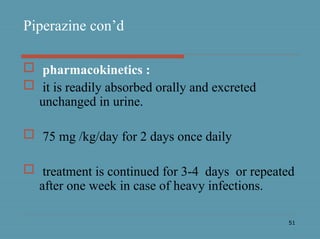
Piperazine con’d
 pharmacokinetics :
 it is readily absorbed orally and excreted
unchanged in urine.
 75 mg /kg/day for 2 days once daily
 treatment is continued for 3-4 days or repeated
after one week in case of heavy infections.
52
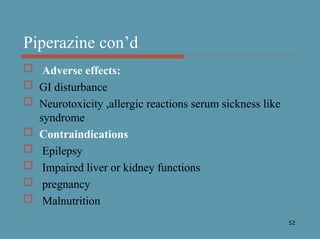
Piperazine con’d
 Adverse effects:
 GI disturbance
 Neurotoxicity ,allergic reactions serum sickness like
syndrome
 Contraindications
 Epilepsy
 Impaired liver or kidney functions
 pregnancy
 Malnutrition
53
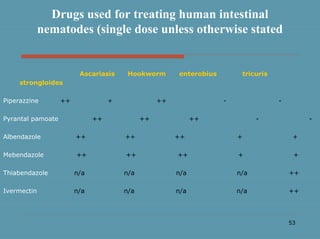
Drugs used for treating human intestinal
nematodes (single dose unless otherwise stated
Ascariasis Hookworm enterobius tricuris
strongloides
Piperazzine ++ + ++ - -
Pyrantal pamoate ++ ++ ++ - -
Albendazole ++ ++ ++ + +
Mebendazole ++ ++ ++ + +
Thiabendazole n/a n/a n/a n/a ++
Ivermectin n/a n/a n/a n/a ++
54
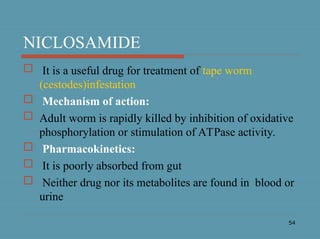
NICLOSAMIDE
 It is a useful drug for treatment of tape worm
(cestodes)infestation
 Mechanism of action:
 Adult worm is rapidly killed by inhibition of oxidative
phosphorylation or stimulation of ATPase activity.
 Pharmacokinetics:
 It is poorly absorbed from gut
 Neither drug nor its metabolites are found in blood or
urine
55
Niclosamide con’d
 Clinical uses:
 T.Saginata( Beef tape worm),T.solium( pork tape
worm), Diphyllobothrium latum (fish tape worm)
 2 gram of single dose is given in the morning on
the empty stomach.
 not effective against cysticercosis or hydatic
disease.
 Hymenolepis nana: It is effective against adult
parasite
56
Niclosamide con’d
 Adverse effects:
 Mild ,infrequent and transitory GI
disturbance
 Alcohol consumption should be
avoided
 not indicated in children under 2
years of age.
57
DIETHYLCARBAMAZINE
 Is a drug of choice for the treatment of
filariasis ,loiasis and tropical eosinophillia.
 Pharmacokinetics:
 It is synthetic peprazine derivative
 Rapidly absorbed from gut
 It has a half life of 2-3 hours which increases in
alkaline urine to 10 hours.
 It is excreted in urine unchanged.
 dosage is reduced in urinary alkalosis and renal
impairment.
58
DIETHYLCARBAMAZINE con’d
 Mechanism of action:
 It immobilizes microfilariae and alters its surface
structure ,making them susceptible to destruction by
host defense mechanis
 It is not teratogenic
59
DIETHYLCARBAMAZINE con’d
 It is a drug of choice for the treatment of W.bancrofti,
B.malayi,B.timori, loa loa
 Microfiliariae are rapidly killed .adult worms are killed
slowly requiring several course of treatment
 It is highly effective against L.loa. for these infections the
dose is 2mg/kg three times a day for 2-3 weeks.
 for W.bancrofti infections to reduce the incidence of
allergic reactions to dying microfilariae a single dose is
administered on the first day , two doses on the second day
and three doses on the 3rd
day.
60
DIETHYLCARBAMAZINE con’d
 For loa ( with risk of encephalopathy) or B.malayi infections ,individual
doses should start at 1 mg /kg once on the first day and gradually
increased over 5-6 days
 Anti histamines and corticosteroids are given in allergic manifestations.
 Complete Cure may be require several courses of treatment over 1-2 years.
 The drug may be used in prohylaxis
300 mg weekly or 300 mg on 3 successive day each month for loiasis.
50 mg monthly for bancrofitan and malayan filariasis
 Tropical eosinophilia 2 mg /kg tree time daily for 7 days
61
DIETHYLCARBAMAZINE con’d
 Reactions induced by Dying parasites:
 Fever , mailase, papular rash, headache, GI
disturbance,cough, chest,muscle,joint pain
 Leucocytosis
 Retinal haemorrhage
 Encephalopathy
 lymphangitis and lymphadenopathy.
62
DIETHYLCARBAMAZINE con’d
 contraindications and precautions
Hypertension
Renal disease
Patient suspected of malaria
patient with lymphangitis
63
IVERMECTIN
 It is drug of choice for treatment of filaria and
onchoceriais,elephantiasis
 it is a macrocyclic lactone
 It is used orally and is rapidly absorbed, posses
wide volume of distribution.
 It has a half life of 16 hrs
 It is exclusively excreted in urine
64
IVERMECTIN con’d
 Mechanism of action:64
it intensifies GABA –mediated transmission of
singals in peripheral neverse
 In onchoceriasis it is microfilaricidal
 It does not kill adult worm
65
IVERMECTIN con’d
 Clinical uses:
 Onchoceriasis: a single dose of 150 mg/kg with
water on empty stomach,repeated after every 3
months for one year,after this it is repeated
yearly untill adult worm dies which may take a
year or more
66
IVERMECTIN con’d
 Strongyloidiasis: 200mg for 2 days in
immunosuppresed patient ,repeated treatment is
often needed.
 Bancrofti filaricidal: as it is mirofilaricidal
 It is also used for scabies and cutaneous larva
migrains.
67
IVERMECTIN con’d
 Adverse effects:
 Fatigue ,dizziness, GI disturbance
 In onchoceriasis:
 Mazotti reaction i.e. fever, headache, dizziness,
somonlence, weekness, rash ,diarrhea, arthralagia,
hypotension, lymphadenitis, peripheral edema due to
killing of microfiliariae, for this steroids may be
necessary for several days
 Swelling and abscess at site of adult worm
 Punctuate corneal opacities.
68
IVERMECTIN con’d
 Contraindication: other drugs that enhance
GABA
e.g Barbiturates, bnezodiazepines, valproaic acid.
 pregnancy
 Imparied blood brain barrier
 Children under 5 years of age.
69
BITHIONOL
 it is drug of choice for the treatment of
fasioliasis ( sheep liver fluke)
 It is also alternative drug for pulmonary
paragonimiasis
 Pharmacokinetics:
 It is orally administered and excreted in urine.
70
BITHIONOL
 Clinical uses:
 30-50 mg /kg in 2-3 divided doses administered orally
after meals on alternate day for 10 – 15 days.
 Adverse effects:
GI disturbance
Dizziness,headache
Pruriuts ,urticaria,Leucopenia
 Contraindications and precautions:
hepatitis ,leucopenia
Used with caution under 8 years of age.
ANTHELMINTIC DRUGS MOA classification uses

  • 1.
    1 ANTHELMINTIC DRUGS DR.ABDUL LATIFMAHESAR Department of Medical Pharmacology KSU
  • 2.
    2 INTRODUCTION  Humans arethe primary hosts for the most of helminthic infections.  Most worms produce in human sexually by producing eggs and larvae  These pass out of body and infect the secondary host  Imature forms invade humans via skin or GIT and mature to adult worms with characterstic tissue distribution.
  • 3.
    3 Types (clinical) 1. Wormslive in hosts alimentary canal. 2. Worms or larvae live in other tissues of host body like muscles , viscera , menninges , lungs, subcutaneous tissues.
  • 4.
    4 INTESTINAL WORMS CON’D A)INTESTINAL ROUND WORMS (NEMATODES)  Ascaris lmubricods (common round worm)  Enterobius vermicularis (pin worm)  Trichuris trichuria ( whip worm)  Strongyloids stercoralis ( thread worm)  Ankylostoma dudenale (hook worm)
  • 5.
    5 Ascaris lumbricoids (common round worm)
  • 6.
  • 7.
  • 8.
  • 9.
  • 10.
    10 1. Alimentary canal(intestinaltape worms) B) TAPE WORMS (CESTODES)  Taenia saginata(Beaf) ,  Taenia solium(Pork),Hymenolepis nana(Dwarf) ,diphylobothrium latum(Fish)  Humans become infected by eating raw or under cooked meat containing larvae of infected cattle or pig which has encysted in the animal muscle tissue.
  • 11.
    11 Cestodes con’d  Insome conditions this larvae may develop in humans resulting cysticercosis (i.e. larvae gets encysted in the muscle and viscera or more seriously in the brain or eye.)  In case of H.nana both adult worm and larvae can be present in the same host.  In case of D.latum infections occurs by eating raw or undercooked fish
  • 12.
  • 13.
  • 14.
    14 2. TISSUE WORMS A.TREMATODES(Schisotomes)ORFLUKES(leaf like)  Schistosoma haematobium  Schistosoma Japonicum  Schistosoma mansoni (These cause SCHISTASOMIASIS) also called (BILHARZIA) means disease of blood vessels. Adult worms of both sex live and mate in veins or venules of the gut wall or the bladder, eggs pass into the bladder or gut and produce inflammation of these organs , resulting in haematuria or loss of blood in feces.
  • 15.
    15 Tremtodes (flukes) con’d Eggs hatch in water and develop in to miracidia(1st stage of larva of trematode and further develop in the body of snail), which enter to 2ndry host a particular species of snail ,where it develops to free swimming cercarae (final free-swimming stage of a trematode),These infect humans by penetrating to skin
  • 16.
     Paragonimus westermani(lung fluke) disease is caused by eating raw crab or fish , larvae move from intestine to blood and settle in lungs  Clonorchis sinensis(liver fluke) disease is caused by eating raw fish and worm settle in the biliary tract 16
  • 17.
    17 Tissue worms cont’d B. TISSUE ROUND WORMS Trichnella spiralis. Dracunulus medinensis (guinea worm)larva migrate from intestine to tissue of leg or foot and protrude out by making ulcer
  • 18.
    FILARIAE includes Wuchereria bancrofti Loaloa Onchocerera volvulus Brugia malayi 18
  • 19.
  • 20.
  • 21.
  • 22.
  • 23.
    23 Wuchereria or Brugiaobstructs lymphatic vessels producing elephantiasis elephantiasis
  • 24.
    24 Filariae: Wucheria bancrofti,loa loa , onchocera volvulus and Brugia malayi  Adult filariae live in the lymphatics,and cause lymphadenitis and swelling of limb. connective tissue or mesentery of host and produce live embryos or microfilariae, which goes to blood stream.  They are ingested by mosquitoes or similar insects, they develop to larvae in 2ndry host and pass to mouth parts of insect and re-injected to humans
  • 25.
    25 C. Hydatid tapeworm  Echinococcus species .  These are cestodes ,primary in canines (dogs) and sheep as intermediate host.  humans can act intermediate host in which larvae develop to hydatid cyst with in tissue.
  • 26.
  • 27.
    27 Helminths commonly infectingman Nematodes( round worm) Tissue worms wuchereria bancrofti Filariasis Brugia malayi Filariasis Loa loa loiasis Onchocerca River blindness Dracunculus medinensis Dracunculiaiss Intestinal human nematodes Enterobius vermicularis Threadworm Ascaris lumbricoides Roundworm Trichuris trichiura Whipworm Nector americanus Hookworm Ancylostoma duodenale Hookworm Strongyloides stercoralis Strongyloidosis Trematodes(flukes) Blood flukes Schistosoma species Schistosomiasis Lung flukes Paragonimus speies Paragonimiasis Intestinal / hepatic flukes Fasciolopsis buski Fasciola hepatica Clonorchis sinensis
  • 28.
    28 Helminths commonly infectingman cont’d Cestodes(tapeworms) Intestinal adult worms Taenia saginata Beef tapeworm Taenia solium Porktaperworm Diphyllobothrium latum Fishetapeworm Hymenolepis nana Dwarftapeworm Larval tissue cysts Taenia solium cysticercosis Echinococcus granulosus Hydatid disease Echinococcus multilocularis Hydatid disease Spirometra mansoni Sparganosis
  • 29.
    29 Diseases caused byfilarial worms Organism adult worm Microfilariae C.signs W. bancrofti Lymphatics Blood Fever lymphangitis Elephantiasis B.Malayi lymphatics Blood Fever lymphangitis Elephantiasis Loa loa Subcutaneous Blood Urticaria Onchocerca Subcutaneous skin,eye subcut nodules Eye disease Mansonella perstans Retroperitoneal Blood Allergic eosinophilia
  • 30.
  • 31.
  • 32.
    32 ANTHELMINTIC DRUGS BENZIMIDAZOLES 1.ALBENDAZOLE:  Itis a broad spectrum  It is a drug of choice (primary therapeutic application) for treatment of hydatid disease and cystecercosis, it is also used for the treatment of (intestinal nematodes) ascariasis ,tricurasis and strongyloidiasis , pinworm, hookworm
  • 33.
    33 Albendazole con;d  Mechanismof action: It inhibits microtubule synthesis in nematodes(intestinal round worms) that irreversibly impairs glucose uptake, intestinal parasites are immobilized and die slowly.  It is larvicidal in hydatid ,cysticercosis , ascariasis and hook worm infection.  Also ovicidal in ascariasis , ancyclostomiasis(hookworm) , tricurasis
  • 34.
    34 Pharmacokinetics (Albendazole)  Itis benzimidazole carbamate  it is adminstered orally , and absorbed erratically (unpredictable) , absorption can be increased with fatty meal  It is metabolized in the liver rapidly to active metabolite albendazole sulphoxide
  • 35.
    35 Pharmacokinetics (Albendazole)  Ithas a plasma half life of 8-12 hours  Sulphoxide is mostly protein bound , distributes well to tissues and enters bile, csf, hydated cyst  Metabolites are excreted in urine
  • 36.
    36 Clinical uses (albendazole) used on empty stomach when used against intraluminal parasites but with fatty meal when against tissue parasites.  In ascariasis ,tricurasis ,hookworm, pin worm infection : children under 2 years 400 mg orally as a single dose repeated for 2-3 days in heavy ascariasis ,repeated after 2-3 wks for pin worm 2. Hydated diseases: drug of choice ,400 mg twice with meals for 1 month or longer.
  • 37.
    37 Albendazole con’d 3. Neurocysticercosis:It is controversial as it has not proved superior to corticosteroid alone. It is used along with cotricosteroid to decrease the inflammation caused by dying organism and it also reduces the duration of course i.e. 400 mg twice daily for 21 days 4. Other infections: Drug of choice in cutaneous and visceral larvea migrans , intestinal cappillariasis and others
  • 38.
    38 Albendazole con’d Adverse effects: In short term: use no significant adverse effects.  In long term use : as used in hydatid cyst and cysticercosis, abdominal distress, headache ,fever , fatigue, alopecia , increased liver enzymes , pancytopenia. Blood counts and LFT should be followed.  Not given during pregnancy and in hypersensitive people.
  • 39.
    39 MEBENDAZOLE(Vermox)  it isa synthetic benzimidazole  it has wider spectrum and is more safer than albendazole Mechanism of action: It inhibits microtubule synthesis in nematodes that irreversibly impairs glucose uptake.Intestinal parasites are immobilized and die slowy. It kills hook worm, pin worm , ascariasis and trichuris eggs.
  • 40.
    40 Mebendazole con’t Pharmacokinetics:  lessthan 10% of orally administered drug is absorbed  Absorption increases with fatty meal.  Absorbed drug is 90 % protein bound  It is converted to inactive metabolites rapidly in liver.  It has half life of 2-6 hours  It is primarily excreted in urine.
  • 41.
    41 Mebendazole con’t Clinical uses: It is taken orally before or after meal tablets should be chewed before swallowing.  Pinworm infection: 100 mg as a single dose, to be repeated after 2-3 weeks.  Ascaris lumricoides , trichuris trichura , hookworm and trichstrongtlus; 100 mg /twice daily for 3 days to repeated in 2-3 weeks  in adults and children over 2 years cure rate is 90-100 % except hook worm but there occurs marked reduction
  • 42.
    42 Mebendazole con’d  Intestinalcappilliaris: 400 mg /day in divided doses for 21 day or more.  Trichinosis :it has limited efficacy against adult worm.200-300 mg for 3 days ,then 400-500 mg for 10 days with fatty meal and co-administration with corticosteroids in sever infection
  • 43.
    43 Mebendazole con’d Adverse effectsand precautions:  No adverse effects in short term therapy.Mild GI disturbance.  With high dose Hypersensitivity reactions,agranulocytosis , alopecia ,elevation of liver enzymes .  used with caution under 2ys of age may cause convulsion in this group.  enzyme inducers and inhibitors affect plasma level of the drug.  hepatic parenchymal disease
  • 44.
    44 Thiabendazole  it isbenzimidazole  it is chelating agent and form stable complexes with metals including iron, but does not bind with calcium.  it is rapidly absorbed  it has half life of 1.2 hrs  It is completely metabolized in liver and 90% is excreted in urine  it can also get absorbed through skin
  • 45.
    45 Thiabendazole con’d:  mechanismof action: similar to other benzimidazoles.It is ovicidal for some paracites  clinical uses:  should be given after meals .and tablets should be chewed  for strongyloides(thread worms) infections: 25 mg /kg ( not more than 1.5 grams) twice daily for 2 days ,can be repeated after 2 week. In hyper infection syndrome drug is continued twice daily for 5-7 days.  for cutaneous larval migrans thiabendazole cream is applied topically or drug can be given orally for 2 days.
  • 46.
    46 Thiabendazole con’d  adversereactions and contraindications:  It is more toxic than other benzamidazoles  GI disturbances  Pruritus ,headache, drowsiness , psychoneurotic symptoms.  Irreversible live failure.  Fatal Steven –Johnson syndrome(inflammation of skin)  Not used in children below 15 kg weight. pregnancy, hepatic and renal diseases.
  • 47.
    47 PYRANTEL PAMOATE  Itis a broad specturm anthelmintic  but it is not effective against tricuriasis(whip worms), and trichostrongylus orientalis infections. Oxalate pamoate is effective  Pharmacokinetics:  It is poorly absorbed orally ,  Half of the drug is excreted unchanged in the feces.  Mechanism of action:  It is a depolrazing neuromuscular blocking agent that causes release of acetylcholine and inhibition of cholinestrase leads to paralizes of worms.
  • 48.
    48 Pyrantel pamoate con’d Efficacyand clinical uses:  it is very effective against luminal organisms.  It is not effective against migratory stages in the tissues or against ova  Entrobius vermicularis (pin worm) 11 mg /kg as a single dose to be repeated in 2 wks.  Ascariasis lumbricoids (common round worm).single dose to be repeated after 2wks  Ankylostoma dudenale (hook worm) single dose for light infection but a 3 days course is necessary for heavy infection.especially N amerianus.
  • 49.
    49 Pyrental pamoate con’d Adverse Effects .  Infrequent mild transient GI disturbance  drowsiness , headache ,insomnia.  Rash ,fever Contraindciations  Should not be used in liver diseases.  Pregnancy  and child under 2 years of age
  • 50.
    50 PIPERAZINE  Only recommendedfor the treatment of ascariasis.  it is readily absorbed orally and excreted in urine  Mechanism of action: it causes paralysis of ascaris by blocking acetylcholine at myoneural junction ,expelling the live worm by normal peristalsis. Not recommended for other helminth infections
  • 51.
    51 Piperazine con’d  pharmacokinetics:  it is readily absorbed orally and excreted unchanged in urine.  75 mg /kg/day for 2 days once daily  treatment is continued for 3-4 days or repeated after one week in case of heavy infections.
  • 52.
    52 Piperazine con’d  Adverseeffects:  GI disturbance  Neurotoxicity ,allergic reactions serum sickness like syndrome  Contraindications  Epilepsy  Impaired liver or kidney functions  pregnancy  Malnutrition
  • 53.
    53 Drugs used fortreating human intestinal nematodes (single dose unless otherwise stated Ascariasis Hookworm enterobius tricuris strongloides Piperazzine ++ + ++ - - Pyrantal pamoate ++ ++ ++ - - Albendazole ++ ++ ++ + + Mebendazole ++ ++ ++ + + Thiabendazole n/a n/a n/a n/a ++ Ivermectin n/a n/a n/a n/a ++
  • 54.
    54 NICLOSAMIDE  It isa useful drug for treatment of tape worm (cestodes)infestation  Mechanism of action:  Adult worm is rapidly killed by inhibition of oxidative phosphorylation or stimulation of ATPase activity.  Pharmacokinetics:  It is poorly absorbed from gut  Neither drug nor its metabolites are found in blood or urine
  • 55.
    55 Niclosamide con’d  Clinicaluses:  T.Saginata( Beef tape worm),T.solium( pork tape worm), Diphyllobothrium latum (fish tape worm)  2 gram of single dose is given in the morning on the empty stomach.  not effective against cysticercosis or hydatic disease.  Hymenolepis nana: It is effective against adult parasite
  • 56.
    56 Niclosamide con’d  Adverseeffects:  Mild ,infrequent and transitory GI disturbance  Alcohol consumption should be avoided  not indicated in children under 2 years of age.
  • 57.
    57 DIETHYLCARBAMAZINE  Is adrug of choice for the treatment of filariasis ,loiasis and tropical eosinophillia.  Pharmacokinetics:  It is synthetic peprazine derivative  Rapidly absorbed from gut  It has a half life of 2-3 hours which increases in alkaline urine to 10 hours.  It is excreted in urine unchanged.  dosage is reduced in urinary alkalosis and renal impairment.
  • 58.
    58 DIETHYLCARBAMAZINE con’d  Mechanismof action:  It immobilizes microfilariae and alters its surface structure ,making them susceptible to destruction by host defense mechanis  It is not teratogenic
  • 59.
    59 DIETHYLCARBAMAZINE con’d  Itis a drug of choice for the treatment of W.bancrofti, B.malayi,B.timori, loa loa  Microfiliariae are rapidly killed .adult worms are killed slowly requiring several course of treatment  It is highly effective against L.loa. for these infections the dose is 2mg/kg three times a day for 2-3 weeks.  for W.bancrofti infections to reduce the incidence of allergic reactions to dying microfilariae a single dose is administered on the first day , two doses on the second day and three doses on the 3rd day.
  • 60.
    60 DIETHYLCARBAMAZINE con’d  Forloa ( with risk of encephalopathy) or B.malayi infections ,individual doses should start at 1 mg /kg once on the first day and gradually increased over 5-6 days  Anti histamines and corticosteroids are given in allergic manifestations.  Complete Cure may be require several courses of treatment over 1-2 years.  The drug may be used in prohylaxis 300 mg weekly or 300 mg on 3 successive day each month for loiasis. 50 mg monthly for bancrofitan and malayan filariasis  Tropical eosinophilia 2 mg /kg tree time daily for 7 days
  • 61.
    61 DIETHYLCARBAMAZINE con’d  Reactionsinduced by Dying parasites:  Fever , mailase, papular rash, headache, GI disturbance,cough, chest,muscle,joint pain  Leucocytosis  Retinal haemorrhage  Encephalopathy  lymphangitis and lymphadenopathy.
  • 62.
    62 DIETHYLCARBAMAZINE con’d  contraindicationsand precautions Hypertension Renal disease Patient suspected of malaria patient with lymphangitis
  • 63.
    63 IVERMECTIN  It isdrug of choice for treatment of filaria and onchoceriais,elephantiasis  it is a macrocyclic lactone  It is used orally and is rapidly absorbed, posses wide volume of distribution.  It has a half life of 16 hrs  It is exclusively excreted in urine
  • 64.
    64 IVERMECTIN con’d  Mechanismof action:64 it intensifies GABA –mediated transmission of singals in peripheral neverse  In onchoceriasis it is microfilaricidal  It does not kill adult worm
  • 65.
    65 IVERMECTIN con’d  Clinicaluses:  Onchoceriasis: a single dose of 150 mg/kg with water on empty stomach,repeated after every 3 months for one year,after this it is repeated yearly untill adult worm dies which may take a year or more
  • 66.
    66 IVERMECTIN con’d  Strongyloidiasis:200mg for 2 days in immunosuppresed patient ,repeated treatment is often needed.  Bancrofti filaricidal: as it is mirofilaricidal  It is also used for scabies and cutaneous larva migrains.
  • 67.
    67 IVERMECTIN con’d  Adverseeffects:  Fatigue ,dizziness, GI disturbance  In onchoceriasis:  Mazotti reaction i.e. fever, headache, dizziness, somonlence, weekness, rash ,diarrhea, arthralagia, hypotension, lymphadenitis, peripheral edema due to killing of microfiliariae, for this steroids may be necessary for several days  Swelling and abscess at site of adult worm  Punctuate corneal opacities.
  • 68.
    68 IVERMECTIN con’d  Contraindication:other drugs that enhance GABA e.g Barbiturates, bnezodiazepines, valproaic acid.  pregnancy  Imparied blood brain barrier  Children under 5 years of age.
  • 69.
    69 BITHIONOL  it isdrug of choice for the treatment of fasioliasis ( sheep liver fluke)  It is also alternative drug for pulmonary paragonimiasis  Pharmacokinetics:  It is orally administered and excreted in urine.
  • 70.
    70 BITHIONOL  Clinical uses: 30-50 mg /kg in 2-3 divided doses administered orally after meals on alternate day for 10 – 15 days.  Adverse effects: GI disturbance Dizziness,headache Pruriuts ,urticaria,Leucopenia  Contraindications and precautions: hepatitis ,leucopenia Used with caution under 8 years of age.