B Y
D R A L K A B A N S A L
A S S O C I A T E P R O F E S S O R
D E P A R T M E N T O F P H A R M A C O L O G Y , S M S M C ,
J A I P U R
Pharmacogenomics- Part I
Significance of Pharmacogenomics
 A step towards personalized medicine.
 Useful in
diagnosis
prognosis
prediction
deciding the treatment
History
 April 1953- Watson and Crick gave double stranded
model of DNA
 April2003- DNA sequence was first identified
 2006- importance of micro DNA miniatures (junk
DNA)was shown
 Central dogma: DNA- RNA- Protein
 Expressed trait= phenotype (e.g. PTC taste)
 Total genes=3 billions
Important terms
 Differences between
A- Pharmacogenetics and Pharmacogenomics.
B –Mutation(<1% of population) and
Polymorphism(>1%)
C –Exon(coding areas) and Intron (non coding areas
removed through RNA splcing))
D- Junk DNA= non coding DNA
E- Wild allele( most common allele in population
which encodes phenotype , shown as +) and Mutant
allele
Cond..
F- Regulatory( control the expression of one or more other
genes) and Housekeeping genes( constitutive genes
responsible for maintaining basal cell functions,
expressed in all cells)
G- cDNA, cRNA, mi RNA (are 18-24 nucleotide long non
coding RNA which regulate gene expression on a post-
transcriptional level and have role in development,
differentiation, proliferation and apoptosis; 400 micro
RNA control 30,000 genes).
microRNA are
H- Transcriptonomics, Proteonomics, Metabolonomics,
Neutragenomics
Effects of mutation and polymorphism
 Pharmacokinetics of drugs is changed by altering-
ADME (like CYP, TPMT, NAT, UGT enzymes- slow
and fast metabolizers); DDI.
 Pharmacodynamic action of drugs is changed by
affecting receptors, ion channels, immune system,
enzymes other than metabolizing enzymes. This type
of polymorphisms affect the efficacy.( like G6 PD
deficiency).
Contd..
 E.g. Roche –Amplichip-CYP450 is FDA approved
array test for analysing CYP2D6 and CYP2C19 from
genetic DNA sample.
Steps to study genomics
 1- Sample Collection – blood , tissue, germline
 2-DNA /RNA/ Protein extraction , isolation,
purification using kits or manually. Manual method
is time consuming but give good results.
We have different kit based methods for extraction
like SILICA or column extraction for DNA( elution
has DNA), chloroform – ethanol method for DNA (
pellet has DNA).
 For DNA/ RNA extraction,we have to first lyse RBCs,
WBCs , proteins using lysates and proteases. This is
called cell lysis.
Then homogenisation and isolation- by centrifuge.
Finally concentration of sample is required.
(Sample required is saved by using DNAase or RNAase
inhibiting reagents) .
Discard the impurities and final DNA, RNA is used for
study.
Contd…
3-Amplification( or gene expression analysis of whole or part of genome )
Methods are-
 -PCR for DNA samples, RT- PCR for RNA samples , RT- qPCR *to make and quantify
cDNA after every cycle using cDNA synthesis kit.
PCR machine controls temperature. In PCR tube add dNTs, primers**, DNA polymerase,
buffer.
*q PCR for known mutations and sequencing for unknown mutations.
**primers for amplification of selective genes
Contd..
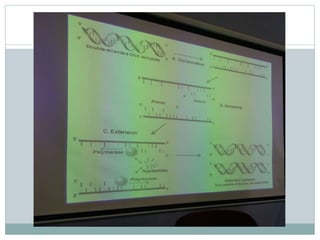
In PCR machine DNA sample undergoes through-
denaturation , (Tm=melting temprature at which
half DNA is double stranded and half is single
stranded)
annealing ( ssDNA combined with primers)
and amplification
 Purify PCR product on agarose gel, sodium acetate
precipitation method etc. ( exosap, gel) ).
 4-Assess Quality &/or quantity of DNA/ RNA/
Protein. e.g.
a-DNA quantitative assessment by absorbance at
260/280 nm
b- DNA qualitative assessment by electrophoresis
using 0.3% agarose gel
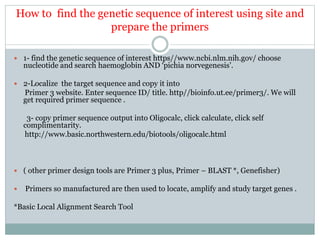
How to find the genetic sequence of interest using site and
prepare the primers
 1- find the genetic sequence of interest https//www.ncbi.nlm.nih.gov/ choose
nucleotide and search haemoglobin AND ‘pichia norvegenesis’.
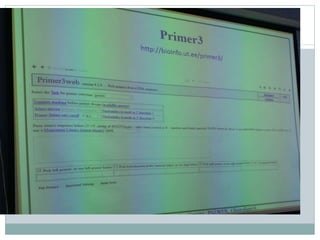
 2-Localize the target sequence and copy it into
Primer 3 website. Enter sequence ID/ title. http//bioinfo.ut.ee/primer3/. We will
get required primer sequence .
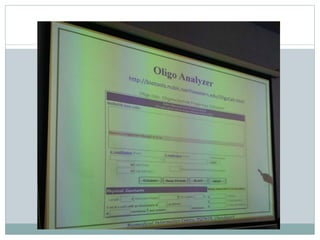
3- copy primer sequence output into Oligocalc, click calculate, click self
complimentarity.
http://www.basic.northwestern.edu/biotools/oligocalc.html
 ( other primer design tools are Primer 3 plus, Primer – BLAST *, Genefisher)
 Primers so manufactured are then used to locate, amplify and study target genes .
*Basic Local Alignment Search Tool
Sequencing to find and study mutation/polymorphism/ genetic
make up for known and unknown mutations both
 For sequencing load the samples along with positive
standards in 96 well plate and run the sequencing protocol.
Chromatogram will be uploaded for the analysis of results.
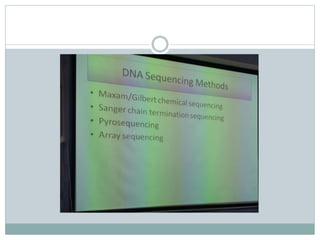
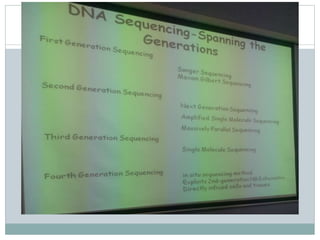
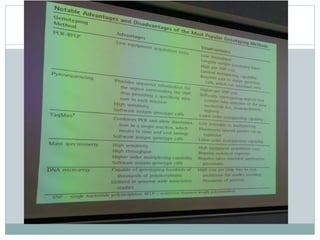
 Types of sequencing are
Sangers – gold standard,
Amplify known target sequence using PCR –TaqMan,
Molecular Beacon
Pyrosequencing ( sequencing by synthesis so detected by
pyrophosphate release; highly sensitive with99.9% accuracy),
Contd..
Microarrays- recent , advantage detection and
discrimination with quantification also,
Mass spectrometry- not used now
PCR-RFLP- not used now
 7- Results are analysed in CODONCODE Aligner tool
and compared with standard.
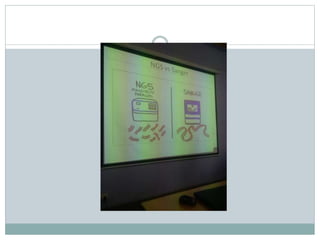
Advantage of NGS
 Cheaper, quicker, reliable, more accurate, requires
less DNA. NGS can sequence whole genome in one
day.
Pharmacogenomics   part I

Pharmacogenomics part I

  • 1.
    B Y D RA L K A B A N S A L A S S O C I A T E P R O F E S S O R D E P A R T M E N T O F P H A R M A C O L O G Y , S M S M C , J A I P U R Pharmacogenomics- Part I
  • 2.
    Significance of Pharmacogenomics A step towards personalized medicine.  Useful in diagnosis prognosis prediction deciding the treatment
  • 3.
    History  April 1953-Watson and Crick gave double stranded model of DNA  April2003- DNA sequence was first identified  2006- importance of micro DNA miniatures (junk DNA)was shown  Central dogma: DNA- RNA- Protein  Expressed trait= phenotype (e.g. PTC taste)  Total genes=3 billions
  • 4.
    Important terms  Differencesbetween A- Pharmacogenetics and Pharmacogenomics. B –Mutation(<1% of population) and Polymorphism(>1%) C –Exon(coding areas) and Intron (non coding areas removed through RNA splcing)) D- Junk DNA= non coding DNA E- Wild allele( most common allele in population which encodes phenotype , shown as +) and Mutant allele
  • 5.
    Cond.. F- Regulatory( controlthe expression of one or more other genes) and Housekeeping genes( constitutive genes responsible for maintaining basal cell functions, expressed in all cells) G- cDNA, cRNA, mi RNA (are 18-24 nucleotide long non coding RNA which regulate gene expression on a post- transcriptional level and have role in development, differentiation, proliferation and apoptosis; 400 micro RNA control 30,000 genes). microRNA are H- Transcriptonomics, Proteonomics, Metabolonomics, Neutragenomics
  • 6.
    Effects of mutationand polymorphism  Pharmacokinetics of drugs is changed by altering- ADME (like CYP, TPMT, NAT, UGT enzymes- slow and fast metabolizers); DDI.  Pharmacodynamic action of drugs is changed by affecting receptors, ion channels, immune system, enzymes other than metabolizing enzymes. This type of polymorphisms affect the efficacy.( like G6 PD deficiency).
  • 7.
    Contd..  E.g. Roche–Amplichip-CYP450 is FDA approved array test for analysing CYP2D6 and CYP2C19 from genetic DNA sample.
  • 8.
    Steps to studygenomics  1- Sample Collection – blood , tissue, germline  2-DNA /RNA/ Protein extraction , isolation, purification using kits or manually. Manual method is time consuming but give good results. We have different kit based methods for extraction like SILICA or column extraction for DNA( elution has DNA), chloroform – ethanol method for DNA ( pellet has DNA).
  • 9.
     For DNA/RNA extraction,we have to first lyse RBCs, WBCs , proteins using lysates and proteases. This is called cell lysis. Then homogenisation and isolation- by centrifuge. Finally concentration of sample is required. (Sample required is saved by using DNAase or RNAase inhibiting reagents) . Discard the impurities and final DNA, RNA is used for study.
  • 10.
    Contd… 3-Amplification( or geneexpression analysis of whole or part of genome ) Methods are-  -PCR for DNA samples, RT- PCR for RNA samples , RT- qPCR *to make and quantify cDNA after every cycle using cDNA synthesis kit. PCR machine controls temperature. In PCR tube add dNTs, primers**, DNA polymerase, buffer. *q PCR for known mutations and sequencing for unknown mutations. **primers for amplification of selective genes
  • 11.
    Contd.. In PCR machineDNA sample undergoes through- denaturation , (Tm=melting temprature at which half DNA is double stranded and half is single stranded) annealing ( ssDNA combined with primers) and amplification  Purify PCR product on agarose gel, sodium acetate precipitation method etc. ( exosap, gel) ).
  • 13.
     4-Assess Quality&/or quantity of DNA/ RNA/ Protein. e.g. a-DNA quantitative assessment by absorbance at 260/280 nm b- DNA qualitative assessment by electrophoresis using 0.3% agarose gel
  • 14.
    How to findthe genetic sequence of interest using site and prepare the primers  1- find the genetic sequence of interest https//www.ncbi.nlm.nih.gov/ choose nucleotide and search haemoglobin AND ‘pichia norvegenesis’.  2-Localize the target sequence and copy it into Primer 3 website. Enter sequence ID/ title. http//bioinfo.ut.ee/primer3/. We will get required primer sequence . 3- copy primer sequence output into Oligocalc, click calculate, click self complimentarity. http://www.basic.northwestern.edu/biotools/oligocalc.html  ( other primer design tools are Primer 3 plus, Primer – BLAST *, Genefisher)  Primers so manufactured are then used to locate, amplify and study target genes . *Basic Local Alignment Search Tool
  • 17.
    Sequencing to findand study mutation/polymorphism/ genetic make up for known and unknown mutations both  For sequencing load the samples along with positive standards in 96 well plate and run the sequencing protocol. Chromatogram will be uploaded for the analysis of results.  Types of sequencing are Sangers – gold standard, Amplify known target sequence using PCR –TaqMan, Molecular Beacon Pyrosequencing ( sequencing by synthesis so detected by pyrophosphate release; highly sensitive with99.9% accuracy),
  • 18.
    Contd.. Microarrays- recent ,advantage detection and discrimination with quantification also, Mass spectrometry- not used now PCR-RFLP- not used now  7- Results are analysed in CODONCODE Aligner tool and compared with standard.
  • 22.
    Advantage of NGS Cheaper, quicker, reliable, more accurate, requires less DNA. NGS can sequence whole genome in one day.