
ANTECEDENTS AND CONSEQUENCES OF EMPLOYEES’
JOB STRESS IN A FOODSERVICE INDUSTRY :
FOCUSED ON EMOTIONAL LABOR AND TURNOVER INTENT
Carrine Kezia Aulia : 102183022
OUTLINE
 Introduction
 Literature Review
 Methodology
 Result
 Conclusions and Implications
INTRODUCTION
INTRODUCTION
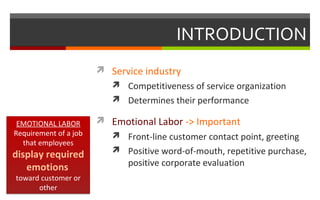
 Service industry
 Competitiveness of service organization
 Determines their performance
 Emotional Labor -> Important
 Front-line customer contact point, greeting
 Positive word-of-mouth, repetitive purchase,
positive corporate evaluation
EMOTIONAL LABOR
Requirement of a job
that employees
display required
emotions
toward customer or
other
EMOTIONAL LABOR
Requirement of a job
that employees
display required
emotions
toward customer or
other
INTRODUCTION
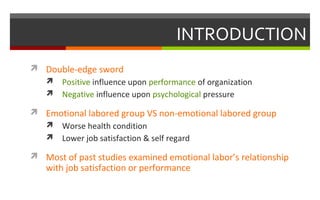
 Double-edge sword
 Positive influence upon performance of organization
 Negative influence upon psychological pressure
 Emotional labored group VS non-emotional labored group
 Worse health condition
 Lower job satisfaction & self regard
 Most of past studies examined emotional labor’s relationship
with job satisfaction or performance
INTRODUCTION
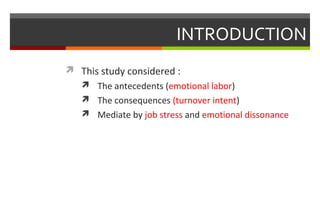
 This study considered :
 The antecedents (emotional labor)
 The consequences (turnover intent)
 Mediate by job stress and emotional dissonance
LITERATURE REVIEW
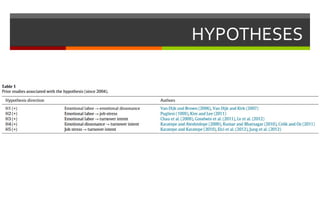
HYPOTHESES
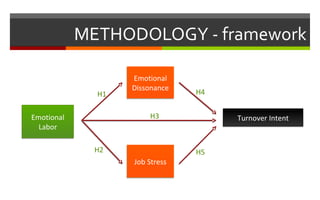
METHODOLOGY - framework
Emotional
Labor
Emotional
Labor
Emotional
Dissonance
Emotional
Dissonance
Job StressJob Stress
Turnover IntentTurnover Intent
H1
H2
H3
H4
H5
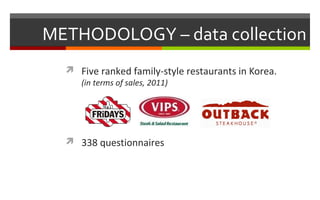
METHODOLOGY – data collection
 Five ranked family-style restaurants in Korea.
(in terms of sales, 2011)
 338 questionnaires
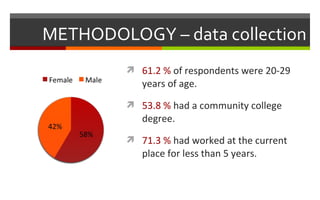
METHODOLOGY – data collection
 61.2 % of respondents were 20-29
years of age.
 53.8 % had a community college
degree.
 71.3 % had worked at the current
place for less than 5 years.
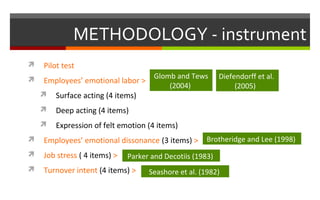
METHODOLOGY - instrument
 Pilot test
 Employees’ emotional labor >
 Surface acting (4 items)
 Deep acting (4 items)
 Expression of felt emotion (4 items)
 Employees’ emotional dissonance (3 items) >
 Job stress ( 4 items) >
 Turnover intent (4 items) >
Glomb and Tews
(2004)
Diefendorff et al.
(2005)
Brotheridge and Lee (1998)
Parker and Decotiis (1983)
Seashore et al. (1982)
RESULT
RESULT
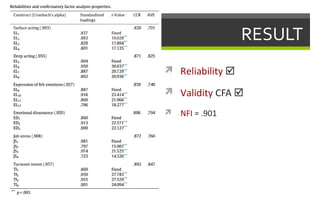
 Reliability 
 Validity CFA 
 NFI = .901
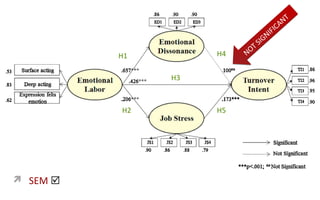
 SEM 
NOT SIGNIFICANT
NOT SIGNIFICANT
H1
H2
H3
H4
H5
RESULT
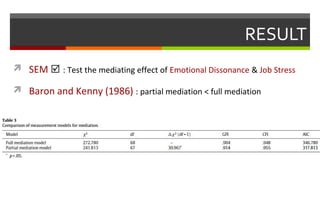
 SEM  : Test the mediating effect of Emotional Dissonance & Job Stress
 Baron and Kenny (1986) : partial mediation < full mediation
RESULT





CONCLUSION &
IMPLICATIONS
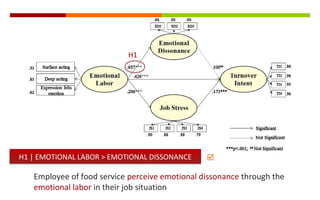
Employee of food service perceive emotional dissonance through the
emotional labor in their job situation
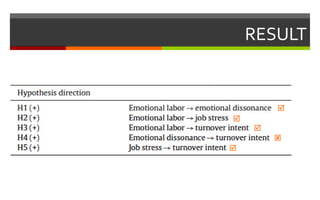
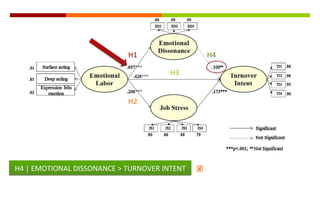
H1 | EMOTIONAL LABOR > EMOTIONAL DISSONANCEH1 | EMOTIONAL LABOR > EMOTIONAL DISSONANCE 
H1
H1
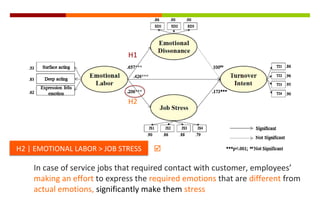
In case of service jobs that required contact with customer, employees’
making an effort to express the required emotions that are different from
actual emotions, significantly make them stress
H2 | EMOTIONAL LABOR > JOB STRESSH2 | EMOTIONAL LABOR > JOB STRESS 
H2
H1
H2
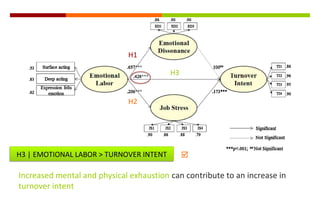
H3 | EMOTIONAL LABOR > TURNOVER INTENTH3 | EMOTIONAL LABOR > TURNOVER INTENT 
Increased mental and physical exhaustion can contribute to an increase in
turnover intent
H3
H1
H2
H3
H4 | EMOTIONAL DISSONANCE > TURNOVER INTENTH4 | EMOTIONAL DISSONANCE > TURNOVER INTENT 
H4
H1
H2
H3
H4
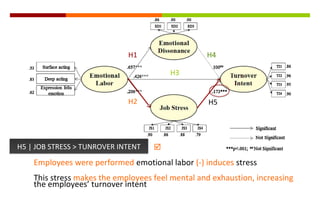
H5 | JOB STRESS > TUNROVER INTENTH5 | JOB STRESS > TUNROVER INTENT 
Employees were performed emotional labor (-) induces stress
This stress makes the employees feel mental and exhaustion, increasing
the employees’ turnover intent
H5
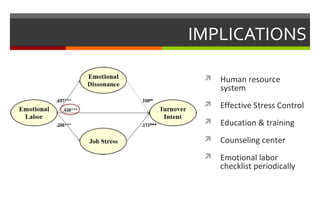
IMPLICATIONS
 Human resource
system
 Effective Stress Control
 Education & training
 Counseling center
 Emotional labor
checklist periodically
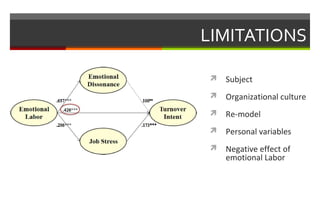
LIMITATIONS
 Subject
 Organizational culture
 Re-model
 Personal variables
 Negative effect of
emotional Labor
THANK
YOU

Paper Presentation - Human Resources

  • 1.
     ANTECEDENTS AND CONSEQUENCESOF EMPLOYEES’ JOB STRESS IN A FOODSERVICE INDUSTRY : FOCUSED ON EMOTIONAL LABOR AND TURNOVER INTENT Carrine Kezia Aulia : 102183022
  • 2.
    OUTLINE  Introduction  LiteratureReview  Methodology  Result  Conclusions and Implications
  • 4.
  • 5.
    INTRODUCTION  Service industry Competitiveness of service organization  Determines their performance  Emotional Labor -> Important  Front-line customer contact point, greeting  Positive word-of-mouth, repetitive purchase, positive corporate evaluation EMOTIONAL LABOR Requirement of a job that employees display required emotions toward customer or other EMOTIONAL LABOR Requirement of a job that employees display required emotions toward customer or other
  • 6.
    INTRODUCTION  Double-edge sword Positive influence upon performance of organization  Negative influence upon psychological pressure  Emotional labored group VS non-emotional labored group  Worse health condition  Lower job satisfaction & self regard  Most of past studies examined emotional labor’s relationship with job satisfaction or performance
  • 7.
    INTRODUCTION  This studyconsidered :  The antecedents (emotional labor)  The consequences (turnover intent)  Mediate by job stress and emotional dissonance
  • 8.
  • 9.
  • 10.
  • 11.
    METHODOLOGY – datacollection  Five ranked family-style restaurants in Korea. (in terms of sales, 2011)  338 questionnaires
  • 12.
    METHODOLOGY – datacollection  61.2 % of respondents were 20-29 years of age.  53.8 % had a community college degree.  71.3 % had worked at the current place for less than 5 years.
  • 13.
    METHODOLOGY - instrument Pilot test  Employees’ emotional labor >  Surface acting (4 items)  Deep acting (4 items)  Expression of felt emotion (4 items)  Employees’ emotional dissonance (3 items) >  Job stress ( 4 items) >  Turnover intent (4 items) > Glomb and Tews (2004) Diefendorff et al. (2005) Brotheridge and Lee (1998) Parker and Decotiis (1983) Seashore et al. (1982)
  • 14.
  • 15.
    RESULT  Reliability  Validity CFA   NFI = .901
  • 16.
     SEM  NOTSIGNIFICANT NOT SIGNIFICANT H1 H2 H3 H4 H5
  • 17.
    RESULT  SEM : Test the mediating effect of Emotional Dissonance & Job Stress  Baron and Kenny (1986) : partial mediation < full mediation
  • 18.
  • 19.
  • 20.
    Employee of foodservice perceive emotional dissonance through the emotional labor in their job situation H1 | EMOTIONAL LABOR > EMOTIONAL DISSONANCEH1 | EMOTIONAL LABOR > EMOTIONAL DISSONANCE  H1
  • 21.
    H1 In case ofservice jobs that required contact with customer, employees’ making an effort to express the required emotions that are different from actual emotions, significantly make them stress H2 | EMOTIONAL LABOR > JOB STRESSH2 | EMOTIONAL LABOR > JOB STRESS  H2
  • 22.
    H1 H2 H3 | EMOTIONALLABOR > TURNOVER INTENTH3 | EMOTIONAL LABOR > TURNOVER INTENT  Increased mental and physical exhaustion can contribute to an increase in turnover intent H3
  • 23.
    H1 H2 H3 H4 | EMOTIONALDISSONANCE > TURNOVER INTENTH4 | EMOTIONAL DISSONANCE > TURNOVER INTENT  H4
  • 24.
    H1 H2 H3 H4 H5 | JOBSTRESS > TUNROVER INTENTH5 | JOB STRESS > TUNROVER INTENT  Employees were performed emotional labor (-) induces stress This stress makes the employees feel mental and exhaustion, increasing the employees’ turnover intent H5
  • 25.
    IMPLICATIONS  Human resource system Effective Stress Control  Education & training  Counseling center  Emotional labor checklist periodically
  • 26.
    LIMITATIONS  Subject  Organizationalculture  Re-model  Personal variables  Negative effect of emotional Labor
  • 27.

Editor's Notes

  • #25 Employees were under mental stress when they were experiencing emotional labor in their duties and this stress had partial mediating effect of leading to turnover intent
  • #26 The largest influence on employee turnover is emotional labor, some programs ……………………. should be held to improve employees’ work and emotional balance