Top 10 Ansible Tips – Jan 2018
Viresh Doshi’s top tips based on 1
year working as an DevOps Engineer
for a container shipping company.
About me
• Over 20 years IT experience
• Started my career working on Air Traffic Systems
with Lockheed Martin
• I have three young kids who hopefully have no
interest in computing!
• I remember life when social meant going down
the pub with your mates
• I love the challenge of making a positive change
• Enjoy getting muddy
Recent work history
Maersk Schlumberger ARM
Grass Valley
What is Ansible?
• Ansible is a tool that works over SSH to
configure servers and software in a reliable
and repeatable way.
• It satisfies the principle DevOps practice of
Infrastructure as Code (IaC)
Other IT automation tools?
• Puppet
• Chef
• Salt
• DSC ( on windows)
The top 10 list
Add a README.md
Unit test your Ansible Role using Molecule
Use name and debug modules
Connect your roles to a Jenkins CI server
Use python virtualenv
Use Jina2 templates
Abide by idempotent state
Use variables for everything
Split your tasks up into individual files
Share with the open source community
TOP 10
Lets go through the top 10 in some more detail
10
README
• Scenario: you have a repository in github that
you have knocked up quickly to satisfy your
immediate goal that is wired into your CD tool
• Problem: you come back to that repo or a
team member has to modify it but they don’t
know what it does because there isn’t the
basic README.
README
• README.md files are like the index.html files
of a website.
• It’s the first landing page for a repo
• It uses markup language for annotation
• Add images/diagrams
• Improves the overall quality
• Makes you look like a devops professional
9
UNIT TEST USING MOLECULE
• Scenario: when we write code, we always (
cough, cough) create an associated unit test.
• Problem: Where is your unittest for your
ansible role?
UNIT TEST USING MOLECULE
What is molecule?
• https://molecule.readthedocs.io/en/latest/
• A framework that helps with the development
and test of ansible roles
• Works really well with testinfra which is a python
module that helps test software and services on
servers.
• https://testinfra.readthedocs.io/en/latest/index.h
tml
UNIT TEST USING MOLECULE
Benefits:
• Assert that the service is started
• Assert that the configuration file is created
• Assert that the permissions are correct
• Assert that the version installed is correct
• Assert that the network interfaces are correct
• …
UNIT TEST USING MOLECULE
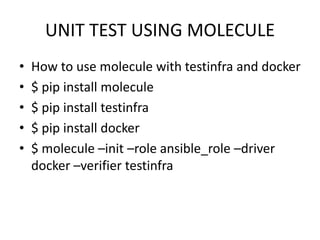
• How to use molecule with testinfra and docker
• $ pip install molecule
• $ pip install testinfra
• $ pip install docker
• $ molecule –init –role ansible_role –driver
docker –verifier testinfra
UNIT TEST USING MOLECULE
• What is covered?
• Ansible linting
• Flake 8 and pep8
• Idempotence
• Unit test through testinfra
8
Use name and debug modules
Don’t do this:
Do this:
- name: install unzip
package:
name: "{{ item }}"
with_items:
- unzip
- vim
- package:
name: "{{ item }}"
with_items:
- unzip
- vim
Add the name
section for better
readability
Use name and debug modules
• Debug statements are harmless and can
improve the confidence in execution
-name:Display all variables/facts known for a host
debug:
var:hostvars[inventory_hostname]
verbosity:4
7
Connect your roles to a Jenkins CI
server
• Your role will likely sit inside a git repository.
• Consider connecting the role to Jenkins CI and
run molecule test and assert on the successful
execution
6
Use python virtualenv
• You can install Ansible simply by running a couple
of commands in your Bash shell but how can you
be sure that the versions, packages,
dependencies are correct for when you want to
reliably repeat the execution?
• $ pip install virtualenv
• $ virtualenv env1 – will create a new env
• $ source env1/bin/activate
• $ pip install ansible==2.4.3
• $ which ansible
5
Use Jina2 templates
• Dynamic settings files using variables
tasks/main.yml
- name: template test
template:
src=myTemplateFile.j2
dest={{ item }}
with_dict: some_dict
vars/main.yml
some_dict:
/path/to/dest1:
var1: 1
var2: 2
/path/to/dest2:
var1: 3
var2: 4
templates/myTemplateFile.j2
test_variable = {{ item.value.var1 }}
test_var_2= {{ item.value.var2 }}
4
Abide by idempotent state
An operation is idempotent if the result of
performing it once is exactly the same as the
result of performing it repeatedly without any
intervening actions.
• specify a final state
• Command or shell module
• Molecule will test for idempotency
3
Use variables for everything
• Simple advice
• Don’t hardcode variables
• Split out variables that contain say versions
• program_linux_version_1.3.1.rpm
• Extract {{platform}} , {{version_num}}
2
Split your tasks up into individual files
• Very long playbooks are a bad practice
• Consider splitting up common tasks into
separate files and use the include module to
slurp them in
1
Share with the open source
community
• Upload your role to github
• Share on ansible-galaxy
• Create a README
• Hook up to Travis CI
Bonus list
1. Write your own Ansible module
2. Explore the usage of filters
3. Use galaxy Ansible
4. Use inventories
5. love Python
6. Drink coffee

Ansible top 10 - 2018

  • 1.
    Top 10 AnsibleTips – Jan 2018 Viresh Doshi’s top tips based on 1 year working as an DevOps Engineer for a container shipping company.
  • 2.
    About me • Over20 years IT experience • Started my career working on Air Traffic Systems with Lockheed Martin • I have three young kids who hopefully have no interest in computing! • I remember life when social meant going down the pub with your mates • I love the challenge of making a positive change • Enjoy getting muddy
  • 3.
    Recent work history MaerskSchlumberger ARM Grass Valley
  • 4.
    What is Ansible? •Ansible is a tool that works over SSH to configure servers and software in a reliable and repeatable way. • It satisfies the principle DevOps practice of Infrastructure as Code (IaC)
  • 5.
    Other IT automationtools? • Puppet • Chef • Salt • DSC ( on windows)
  • 6.
    The top 10list Add a README.md Unit test your Ansible Role using Molecule Use name and debug modules Connect your roles to a Jenkins CI server Use python virtualenv Use Jina2 templates Abide by idempotent state Use variables for everything Split your tasks up into individual files Share with the open source community
  • 7.
    TOP 10 Lets gothrough the top 10 in some more detail
  • 8.
  • 9.
    README • Scenario: youhave a repository in github that you have knocked up quickly to satisfy your immediate goal that is wired into your CD tool • Problem: you come back to that repo or a team member has to modify it but they don’t know what it does because there isn’t the basic README.
  • 10.
    README • README.md filesare like the index.html files of a website. • It’s the first landing page for a repo • It uses markup language for annotation • Add images/diagrams • Improves the overall quality • Makes you look like a devops professional
  • 11.
  • 12.
    UNIT TEST USINGMOLECULE • Scenario: when we write code, we always ( cough, cough) create an associated unit test. • Problem: Where is your unittest for your ansible role?
  • 13.
    UNIT TEST USINGMOLECULE What is molecule? • https://molecule.readthedocs.io/en/latest/ • A framework that helps with the development and test of ansible roles • Works really well with testinfra which is a python module that helps test software and services on servers. • https://testinfra.readthedocs.io/en/latest/index.h tml
  • 14.
    UNIT TEST USINGMOLECULE Benefits: • Assert that the service is started • Assert that the configuration file is created • Assert that the permissions are correct • Assert that the version installed is correct • Assert that the network interfaces are correct • …
  • 15.
    UNIT TEST USINGMOLECULE • How to use molecule with testinfra and docker • $ pip install molecule • $ pip install testinfra • $ pip install docker • $ molecule –init –role ansible_role –driver docker –verifier testinfra
  • 16.
    UNIT TEST USINGMOLECULE • What is covered? • Ansible linting • Flake 8 and pep8 • Idempotence • Unit test through testinfra
  • 17.
  • 18.
    Use name anddebug modules Don’t do this: Do this: - name: install unzip package: name: "{{ item }}" with_items: - unzip - vim - package: name: "{{ item }}" with_items: - unzip - vim Add the name section for better readability
  • 19.
    Use name anddebug modules • Debug statements are harmless and can improve the confidence in execution -name:Display all variables/facts known for a host debug: var:hostvars[inventory_hostname] verbosity:4
  • 20.
  • 21.
    Connect your rolesto a Jenkins CI server • Your role will likely sit inside a git repository. • Consider connecting the role to Jenkins CI and run molecule test and assert on the successful execution
  • 22.
  • 23.
    Use python virtualenv •You can install Ansible simply by running a couple of commands in your Bash shell but how can you be sure that the versions, packages, dependencies are correct for when you want to reliably repeat the execution? • $ pip install virtualenv • $ virtualenv env1 – will create a new env • $ source env1/bin/activate • $ pip install ansible==2.4.3 • $ which ansible
  • 24.
  • 25.
    Use Jina2 templates •Dynamic settings files using variables tasks/main.yml - name: template test template: src=myTemplateFile.j2 dest={{ item }} with_dict: some_dict vars/main.yml some_dict: /path/to/dest1: var1: 1 var2: 2 /path/to/dest2: var1: 3 var2: 4 templates/myTemplateFile.j2 test_variable = {{ item.value.var1 }} test_var_2= {{ item.value.var2 }}
  • 26.
  • 27.
    Abide by idempotentstate An operation is idempotent if the result of performing it once is exactly the same as the result of performing it repeatedly without any intervening actions. • specify a final state • Command or shell module • Molecule will test for idempotency
  • 28.
  • 29.
    Use variables foreverything • Simple advice • Don’t hardcode variables • Split out variables that contain say versions • program_linux_version_1.3.1.rpm • Extract {{platform}} , {{version_num}}
  • 30.
  • 31.
    Split your tasksup into individual files • Very long playbooks are a bad practice • Consider splitting up common tasks into separate files and use the include module to slurp them in
  • 32.
  • 33.
    Share with theopen source community • Upload your role to github • Share on ansible-galaxy • Create a README • Hook up to Travis CI
  • 34.
    Bonus list 1. Writeyour own Ansible module 2. Explore the usage of filters 3. Use galaxy Ansible 4. Use inventories 5. love Python 6. Drink coffee