Codecoon
A Technical Case Study
Michael Lihs
@kaktusmimi
lihs@codecoon.com
Fabian Stein
@docmak
stein@codecoon.com
Outline
→ Continuous Integration Workflow
→ The Codecoon Vision
→ Codecoon Components
→ Usage of TYPO3 Flow
→ Integration of 3rd-party Applications
→ Outlook & Résumé
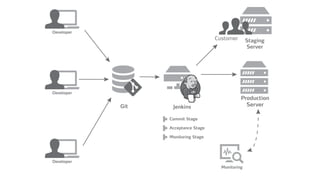
Developer
Developer
Staging
Server
Production
Server
Customer
Developer
Git Jenkins
Monitoring
Commit Stage
Acceptance Stage
Monitoring Stage
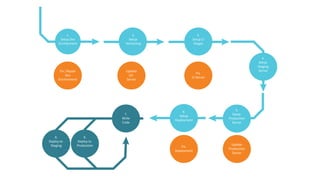
How does your 

Project Lifecycle


look like?
1.
Setup Dev
Environment
2.
Setup
Versioning
3.
Setup CI
Stages
4.
Setup
Staging
Server
5.
Setup
Production
Server
6.
Setup
Deployment
7.
Write
Code
Fix / Repair
Dev
Environment
Fix
CI Server
Update
Production
Server
9.
Deploy to
Production
8.
Deploy to
Staging
Update
Git
Server
Fix
Deployment
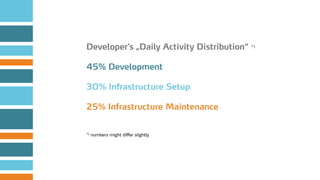
Developer’s „Daily Activity Distribution“ *)
45% Development
30% Infrastructure Setup
25% Infrastructure Maintenance
*) numbers might differ slightly
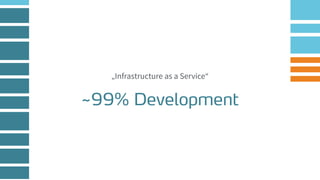
„Infrastructure as a Service“
~99% Development
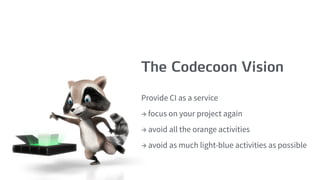
The Codecoon Vision
Provide CI as a service
→ focus on your project again
→ avoid all the orange activities
→ avoid as much light-blue activities as possible
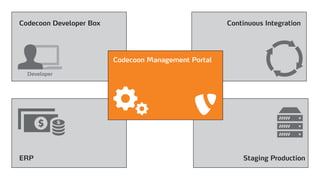
Codecoon Management Portal
Continuous IntegrationCodecoon Developer Box
Staging ProductionERP
Developer
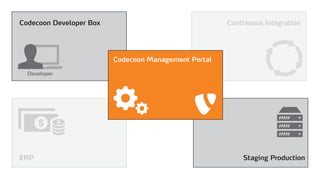
Staging Production
Continuous Integration
Codecoon Management Portal
Codecoon Developer Box
ERP
Developer
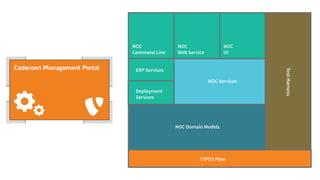
NOC
Command Line
Test-Harness
NOC
Web Service
NOC Services
ERP Services
Deployment
Services
NOC Domain Models
TYPO3 Flow
NOC
UI
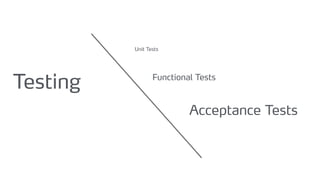
Testing
Unit Tests
Functional Tests
Acceptance Tests
export PPH_OUTPUT=JSON
PHYSICALSERVER_ID=`flow physicalServer:create
'{"serialNumber" : "0815-2",
"nodeName": "shared1.live.codecoon.com",
"externalNodeName": "shared1.codecoon.com",
"isAvailable" : true,
"interfaces" : {
"Management Interface" : {
"macAddress" : "bla:bla:bla",
"ipAddresses" : ["a.b.c.d","a.b.c.d"]
}
}
}'
| jq -r .uuid`
http://stedolan.github.io/jq/
{"uuid" : "89259562398239",
...
}
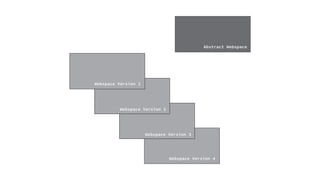
Webspace Version 4
Webspace Version 4
Webspace Version 1
Abstract Webspace
Webspace Version 3
Webspace Version 2
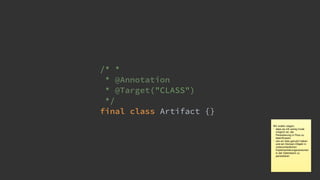
/* *
* @Annotation

* @Target("CLASS")

*/

final class Artifact {}
Wir wollen zeigen, 

* dass es mit wenig Code
möglich ist, die
Persistierung in Flow zu
beeinflussen

* wie wir dies genutzt haben
und ein Domain-Objekt in
unterschiedlichen
Implementierungsversionen
in der Datenbank zu
persistieren
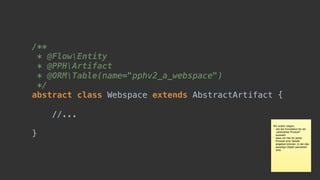
/**

* @FlowEntity

* @PPHArtifact

* @ORMTable(name="pphv2_a_webspace")

*/

abstract class Webspace extends AbstractArtifact {
//...
}
Wir wollen zeigen, 

* wie die Annotation für ein
„abstraktes Produkt“
aussieht

* dass wir hier für jedes
Produkt eine Tabelle
angeben können, in der das
jeweilige Objekt persistiert
wird
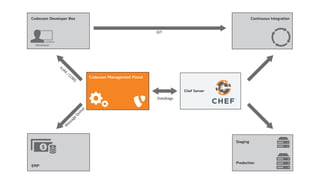
Codecoon Management Portal
Codecoon Developer Box
Developer
ERP
Continuous Integration
Chef Server
Staging
Production
GIT
Motivation for a mobile
Development Environment
• Work wherever you are
• Development = Production
• Don’t touch your system
• Distribute environments & cooperate with others
http://www.die-mobile-gesellschaft.de/presse/fotos/themen/03_Mobil_arbeiten/10_Mobil_arbeiten_2.jpg
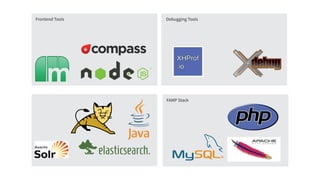
Debugging Tools
FAMP Stack
Frontend Tools
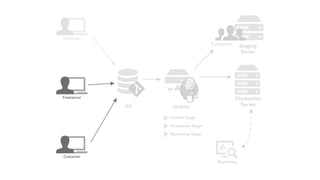
Developer
Freelancer
Staging
Server
Production
Server
Customer
Customer
Git Jenkins
Monitoring
Commit Stage
Acceptance Stage
Monitoring Stage
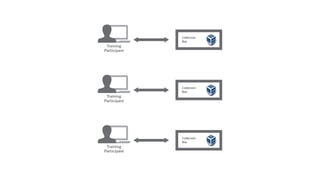
Training
Participant
Codecoon
Box
Training
Participant
Codecoon
Box
Training
Participant
Codecoon
Box
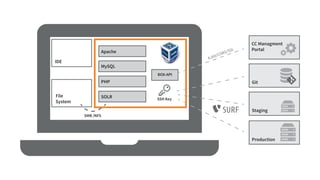
IDE
Apache
CC Managment
Portal
Git
Staging
Production
MySQL
PHP
SOLRFile
System
SSH Key
BOX-API
SURF
SMB /NFS
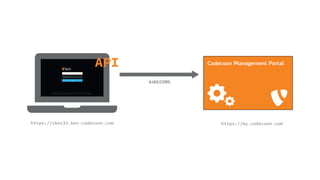
https://vbox33.box.codecoon.com https://my.codecoon.com
API
AJAX/CORS
Codecoon Management Portal
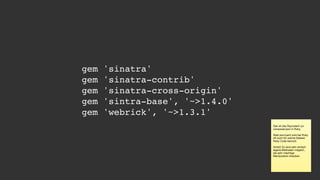
gem 'sinatra'
gem 'sinatra-contrib'
gem 'sinatra-cross-origin'
gem 'sintra-base', '~>1.4.0'
gem 'webrick', '~>1.3.1'
Das ist das Äquivalent zur
composer.json in Ruby.

Statt json/yaml wird bei Ruby
oft auch für solche Dateien
Ruby Code benutzt.

Vorteil: Es sind sehr einfach
eigene Methoden möglich,
die sehr mächtige
Manipulation erlauben.
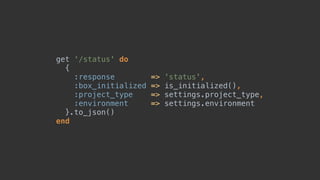
get '/status' do

{

:response => 'status',

:box_initialized => is_initialized(),

:project_type => settings.project_type,

:environment => settings.environment

}.to_json()

end
webrick_options = {

:Port => 4567,

:AccessLog => [],

:Logger => WEBrick::Log::new($stderr, WEBrick::Log::DEBUG),

:DocumentRoot => DOCUMENT_ROOT,

:SSLEnable => true,

:SSLVerifyClient => OpenSSL::SSL::VERIFY_NONE,

:SSLCertificate => OpenSSL::X509::Certificate.new( File.open(File.join(CERT_PATH, "vbox33.box.codecoon.com.crt")).read),

:SSLPrivateKey => OpenSSL::PKey::RSA.new( File.open(File.join(CERT_PATH, "vbox33.box.codecoon.com.key")).read),

:SSLCertName => [ [ "CN",WEBrick::Utils::getservername ] ],

:app => BoxManagementApi

}

Rack::Server.start webrick_options
Gesamte Webserver -
Konfiguration mit Sinatra.

Das ist alles, was man
braucht, um

* einen eigenen Webservice

* mit eigenem Webserver

* mit SSL Verschlüsselung

* mit eigenem Logging

* auf einem eigenen HTTP
Port

laufen zu lassen.
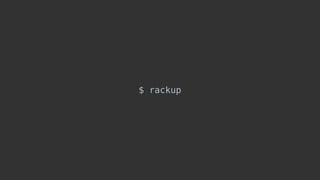
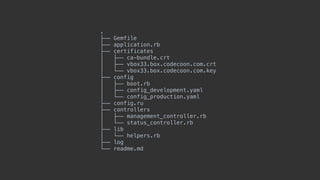
$ rackup
.
├── Gemfile
├── application.rb
├── certificates
│   ├── ca-bundle.crt
│   ├── vbox33.box.codecoon.com.crt
│   └── vbox33.box.codecoon.com.key
├── config
│   ├── boot.rb
│   ├── config_development.yaml
│   └── config_production.yaml
├── config.ru
├── controllers
│   ├── management_controller.rb
│   └── status_controller.rb
├── lib
│   └── helpers.rb
├── log
└── readme.md
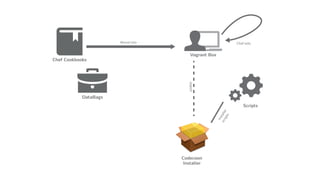
Vagrant Box
Chef Cookbooks
DataBags
Codecoon
Installer
Scripts
Mount into Chef solo
4. Shared Host
• Acts as Chef Node
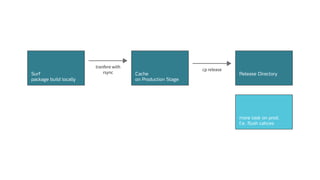
• Deployed with Surf using rsync over ssh
• Holds git repository for each project
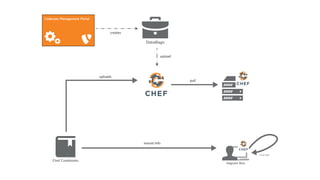
Codecoon Management Portal
DataBags
Chef Cookbooks
Vagrant Box
Chef solo
creates
uploads
pull
mount info
upload
Surf
package build locally
Cache
on Production Stage
Release Directory
more task on prod.
f.e. flush cahces
tranfere with
rsync
cp release
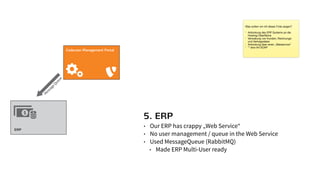
5. ERP
• Our ERP has crappy „Web Service“
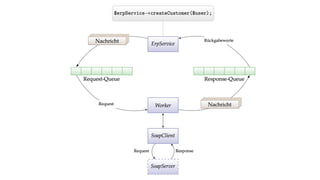
• No user management / queue in the Web Service
• Used MessageQueue (RabbitMQ)
• Made ERP Multi-User ready
Was wollen wir mit dieser Folie zeigen?

* Anbindung des ERP Systems an die
Hosting-Oberfläche

* Verwaltung von Kunden, Rechnungs-
und Vertragsdaten

* Anbindung über einen „Webservice“

* ** eine Art SOAP
Codecoon Management Portal
ERP
Outlook
• Implement the missing parts of our vision
• Jenkins and Gitlab as integrated services
• Production Stage
• User driven development
• 10 Early Adopters
Flow - the good things
* Fluid is a great Template Engine
* Functional testing with Flow is pure fun
* Business (Domain) Logic can be implemented with very little
Framework overhead
* Command Controllers are great
FLOW
Flow - the not so nice things
* Flow Packages are not modular
* „Everything or nothing“
* Code-Rewrite makes feedback cycles during development slow
* Remote Debugging in proxy classes can be annoying
* All the „magic things in the background“ and declarative stuff
makes understanding hard
* Code-Completion and IDE tools not very helpful
* Webservices (REST) are not easy to implement
* There is no ready-to-use Controller à la Sinatra
* Not much „Best-Practices“ on Google…
FLOW
Resume
• Flow is a powerful Framework
• Integrates well with 3rd party components
• Don’t use it „unreflected“
• Best detail solution vs. smoothes integration
• Duplicated configuration
• Duplicated functionality
We will go out
and try it with you!
Thank you!
We hope you had fun!
If you want to stay in contact:
Michael Lihs: @kaktusmimi
Fabian Stein: @docmac
@codceoon
Or outside at our booth

Codecoon - A technical Case Study