Ano ang mga paniniwala ng mga
sinaunang Pilipino?
Diyos ng mga
Tagalog/Bathala
In ancient Tagalog indigenous religion,
Bathala Maykapal is
the transcendent Supreme Being, the
originator and ruler of the universe. He is
commonly known and referred to
as Bathala; a term or title which, in earlier
times, also applied to lesser beings such
as personal tutelary spirits, omen birds,
comets, and other heavenly bodies which
the early Tagalog people believed
predicted events. It was after the arrival of
the Spanish missionaries in
the Philippines in the 16th century
that Bathala Maykapal came to be
identified as the Christian God, thus its
synonymy with Diyos. Over the course of
the 19th century, the term Bathala was
totally replaced by Panginoon (Lord)
and Diyos (God).
Diyos ng mga
Bisaya/Kaptan
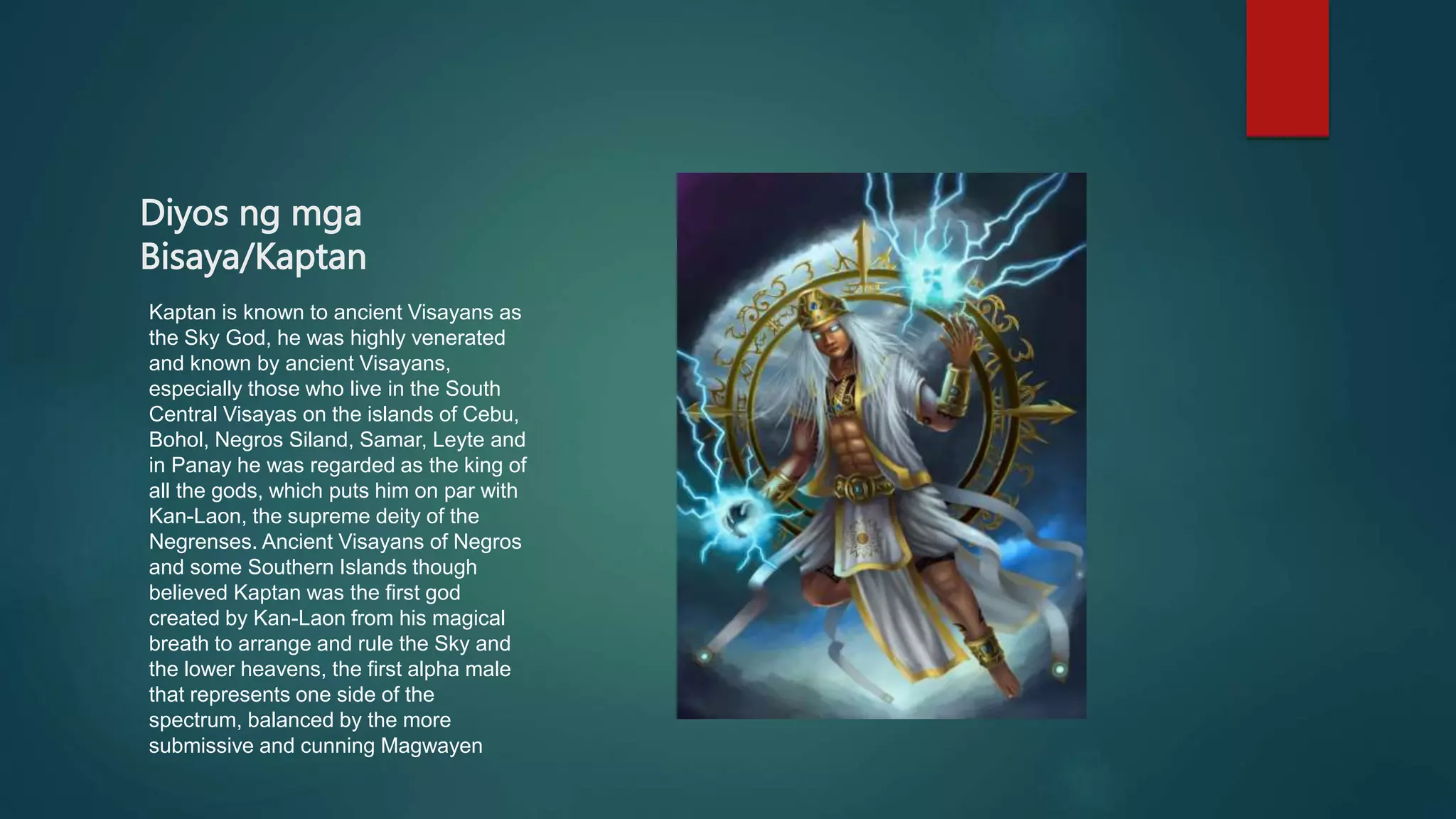
Kaptan is known to ancient Visayans as
the Sky God, he was highly venerated
and known by ancient Visayans,
especially those who live in the South
Central Visayas on the islands of Cebu,
Bohol, Negros Siland, Samar, Leyte and
in Panay he was regarded as the king of
all the gods, which puts him on par with
Kan-Laon, the supreme deity of the
Negrenses. Ancient Visayans of Negros
and some Southern Islands though
believed Kaptan was the first god
created by Kan-Laon from his magical
breath to arrange and rule the Sky and
the lower heavens, the first alpha male
that represents one side of the
spectrum, balanced by the more
submissive and cunning Magwayen
Diyos ng mga
ibaloi/Kabunian
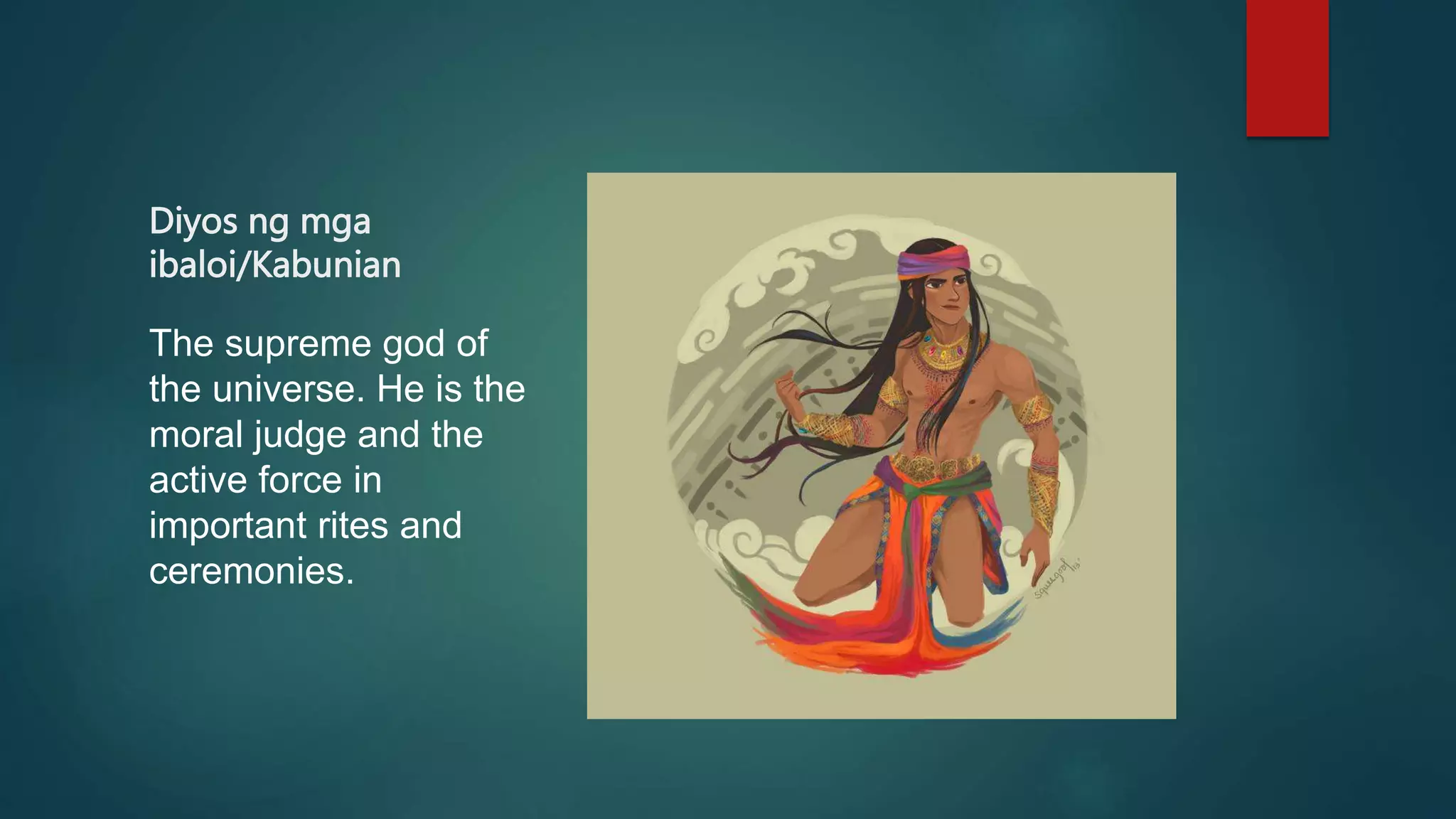
The supreme god of
the universe. He is the
moral judge and the
active force in
important rites and
ceremonies.
Diyos ng
Pagtatanim/Idiyanale
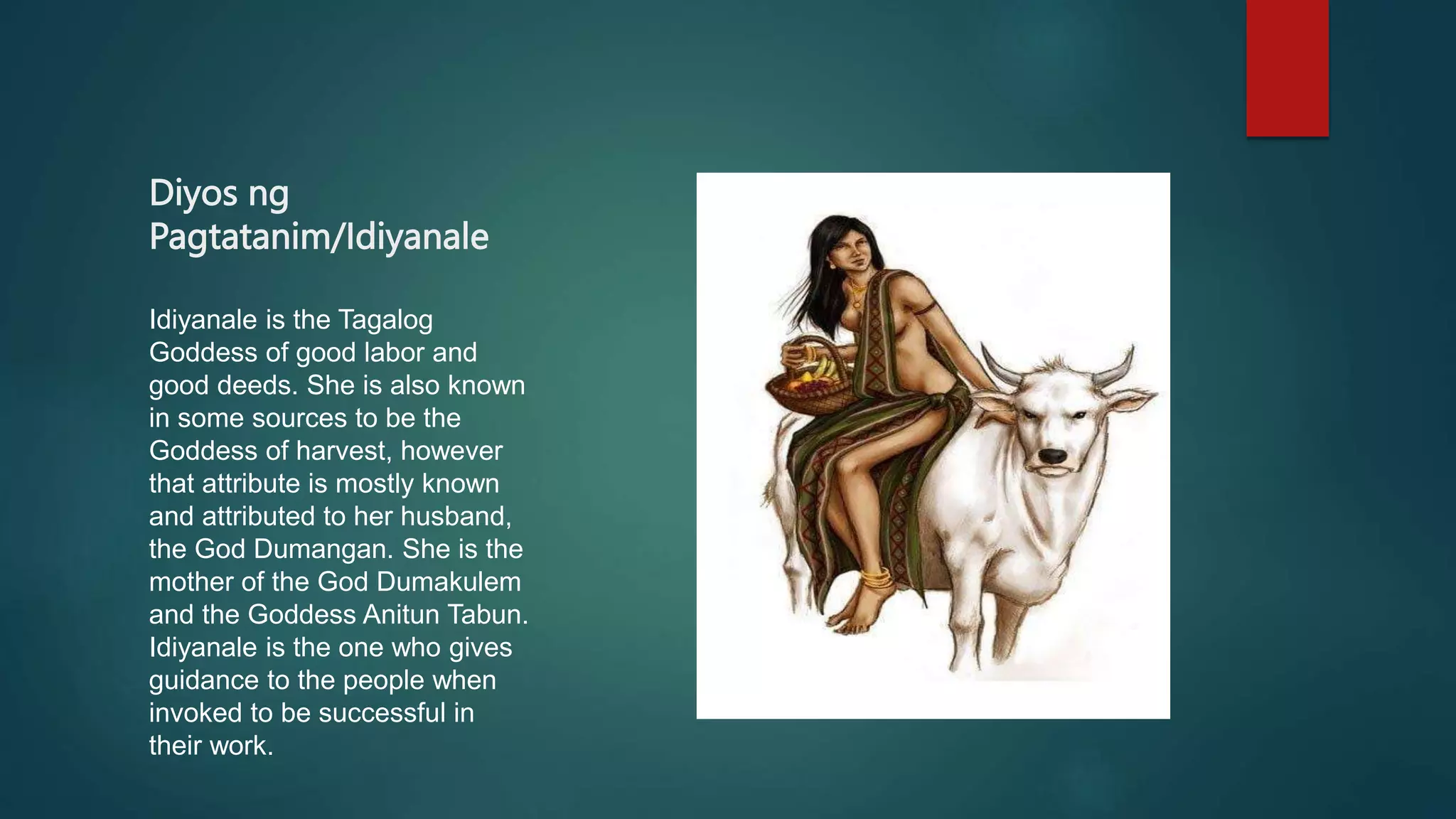
Idiyanale is the Tagalog
Goddess of good labor and
good deeds. She is also known
in some sources to be the
Goddess of harvest, however
that attribute is mostly known
and attributed to her husband,
the God Dumangan. She is the
mother of the God Dumakulem
and the Goddess Anitun Tabun.
Idiyanale is the one who gives
guidance to the people when
invoked to be successful in
their work.
Diyos ng
digmaan/Mandaragan
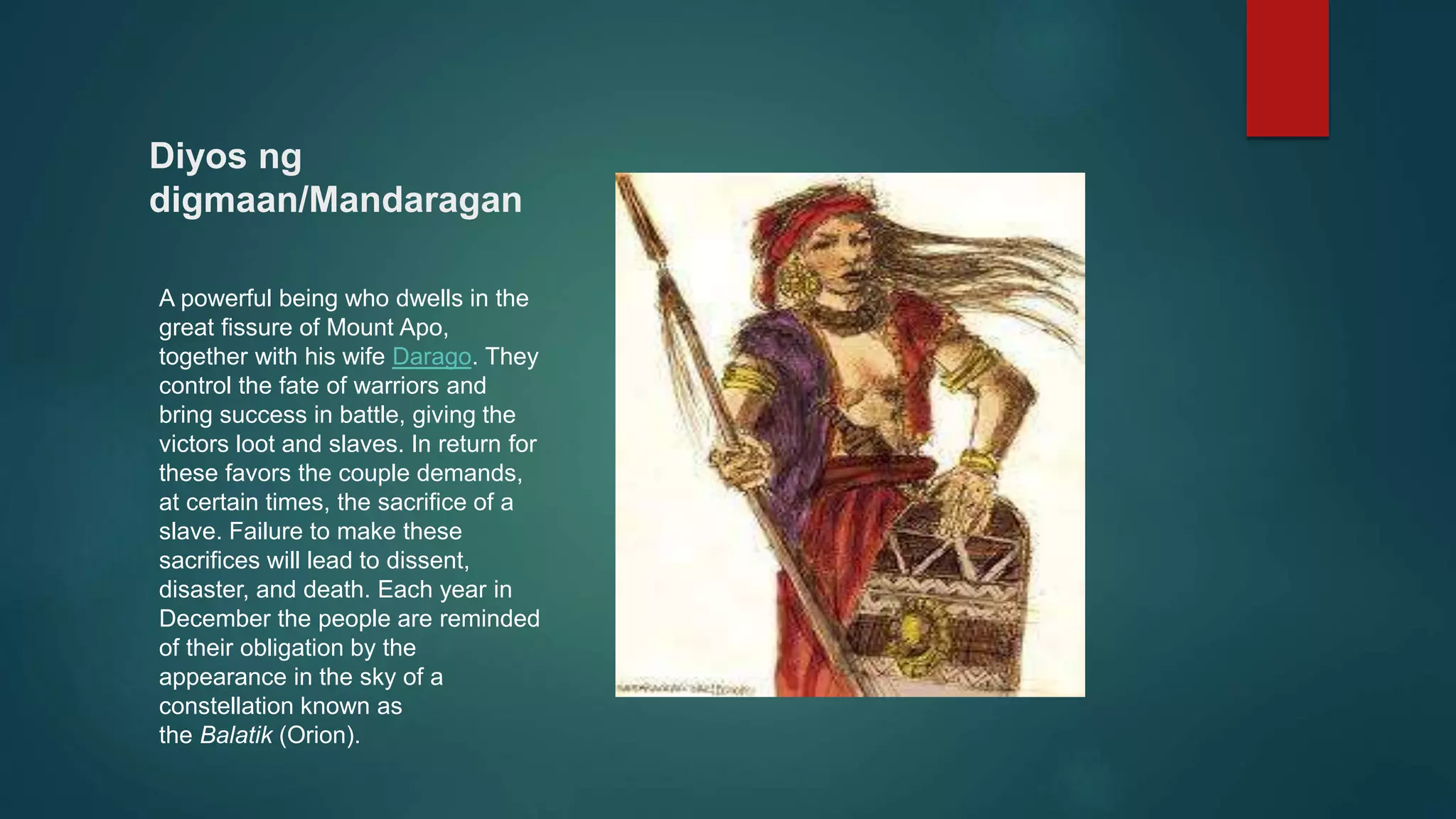
A powerful being who dwells in the
great fissure of Mount Apo,
together with his wife Darago. They
control the fate of warriors and
bring success in battle, giving the
victors loot and slaves. In return for
these favors the couple demands,
at certain times, the sacrifice of a
slave. Failure to make these
sacrifices will lead to dissent,
disaster, and death. Each year in
December the people are reminded
of their obligation by the
appearance in the sky of a
constellation known as
the Balatik (Orion).
Diyos ng Apoy/Agni
Agni (English: /ˈəɡni/ AG-nee,[4]
Sanskrit: अग्नि, romanized: Agni) is a
Sanskrit word meaning fire and
connotes the Vedic fire deity of
Hinduism.[5][6][7] He is also the
guardian deity of the southeast
direction and is typically found in
southeast corners of Hindu
temples.[8] In the classical
cosmology of the Indian religions,
Agni as fire is one of the five inert
impermanent elements
(pañcabhūtá) along with space
(ākāśa), water (ap), air (vāyu) and
earth (pṛthvī), the five combining to
form the empirically perceived
material existence

Ano ang mga paniniwala ng mga sinaunang Pilipino.pptx

  • 1.
    Ano ang mgapaniniwala ng mga sinaunang Pilipino?
  • 2.
    Diyos ng mga Tagalog/Bathala Inancient Tagalog indigenous religion, Bathala Maykapal is the transcendent Supreme Being, the originator and ruler of the universe. He is commonly known and referred to as Bathala; a term or title which, in earlier times, also applied to lesser beings such as personal tutelary spirits, omen birds, comets, and other heavenly bodies which the early Tagalog people believed predicted events. It was after the arrival of the Spanish missionaries in the Philippines in the 16th century that Bathala Maykapal came to be identified as the Christian God, thus its synonymy with Diyos. Over the course of the 19th century, the term Bathala was totally replaced by Panginoon (Lord) and Diyos (God).
  • 3.
    Diyos ng mga Bisaya/Kaptan Kaptanis known to ancient Visayans as the Sky God, he was highly venerated and known by ancient Visayans, especially those who live in the South Central Visayas on the islands of Cebu, Bohol, Negros Siland, Samar, Leyte and in Panay he was regarded as the king of all the gods, which puts him on par with Kan-Laon, the supreme deity of the Negrenses. Ancient Visayans of Negros and some Southern Islands though believed Kaptan was the first god created by Kan-Laon from his magical breath to arrange and rule the Sky and the lower heavens, the first alpha male that represents one side of the spectrum, balanced by the more submissive and cunning Magwayen
  • 4.
    Diyos ng mga ibaloi/Kabunian Thesupreme god of the universe. He is the moral judge and the active force in important rites and ceremonies.
  • 5.
    Diyos ng Pagtatanim/Idiyanale Idiyanale isthe Tagalog Goddess of good labor and good deeds. She is also known in some sources to be the Goddess of harvest, however that attribute is mostly known and attributed to her husband, the God Dumangan. She is the mother of the God Dumakulem and the Goddess Anitun Tabun. Idiyanale is the one who gives guidance to the people when invoked to be successful in their work.
  • 6.
    Diyos ng digmaan/Mandaragan A powerfulbeing who dwells in the great fissure of Mount Apo, together with his wife Darago. They control the fate of warriors and bring success in battle, giving the victors loot and slaves. In return for these favors the couple demands, at certain times, the sacrifice of a slave. Failure to make these sacrifices will lead to dissent, disaster, and death. Each year in December the people are reminded of their obligation by the appearance in the sky of a constellation known as the Balatik (Orion).
  • 7.
    Diyos ng Apoy/Agni Agni(English: /ˈəɡni/ AG-nee,[4] Sanskrit: अग्नि, romanized: Agni) is a Sanskrit word meaning fire and connotes the Vedic fire deity of Hinduism.[5][6][7] He is also the guardian deity of the southeast direction and is typically found in southeast corners of Hindu temples.[8] In the classical cosmology of the Indian religions, Agni as fire is one of the five inert impermanent elements (pañcabhūtá) along with space (ākāśa), water (ap), air (vāyu) and earth (pṛthvī), the five combining to form the empirically perceived material existence