IHD- MI / UNSTABLE ANGINA
Dr.Sabu Augustine,
Associate Professor,
Dept of General Medicine,
Dr S.M C.S.I Medical College,
Karakonam, Trivandrum.
OBJECTIVES
 Coronary Artery Diseases
 Angina
 Types
 Mechanism
 Causes
 Clinical manifestation
 Complications
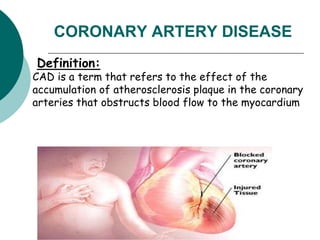
CORONARY ARTERY DISEASE
Definition:
CAD is a term that refers to the effect of the
accumulation of atherosclerosis plaque in the coronary
arteries that obstructs blood flow to the myocardium
Cont.
conditions result from CAD
1. Angina Pectoris
2. Myocardial Infarction
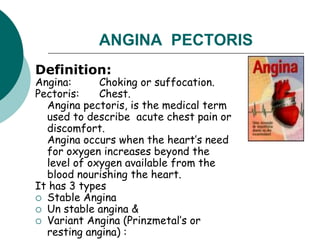
ANGINA PECTORIS
Definition:
Angina: Choking or suffocation.
Pectoris: Chest.
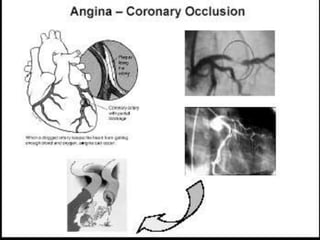
Angina pectoris, is the medical term
used to describe acute chest pain or
discomfort.
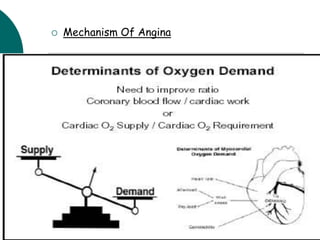
Angina occurs when the heart’s need
for oxygen increases beyond the
level of oxygen available from the
blood nourishing the heart.
It has 3 types
 Stable Angina
 Un stable angina &
 Variant Angina (Prinzmetal’s or
resting angina) :
Cont.
Types of Angina
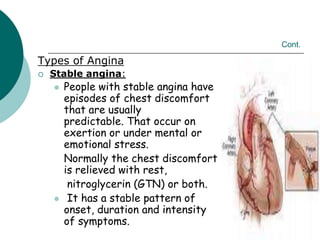
 Stable angina:
 People with stable angina have
episodes of chest discomfort
that are usually
predictable. That occur on
exertion or under mental or
emotional stress.
Normally the chest discomfort
is relieved with rest,
nitroglycerin (GTN) or both.
 It has a stable pattern of
onset, duration and intensity
of symptoms.
Cont.
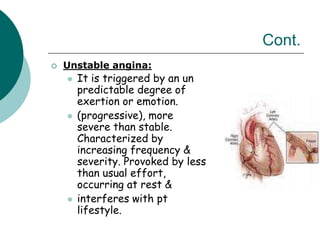
 Unstable angina:
 It is triggered by an un
predictable degree of
exertion or emotion.
 (progressive), more
severe than stable.
Characterized by
increasing frequency &
severity. Provoked by less
than usual effort,
occurring at rest &
 interferes with pt
lifestyle.
Cont.
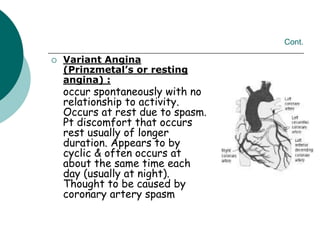
 Variant Angina
(Prinzmetal’s or resting
angina) :
occur spontaneously with no
relationship to activity.
Occurs at rest due to spasm.
Pt discomfort that occurs
rest usually of longer
duration. Appears to by
cyclic & often occurs at
about the same time each
day (usually at night).
Thought to be caused by
coronary artery spasm
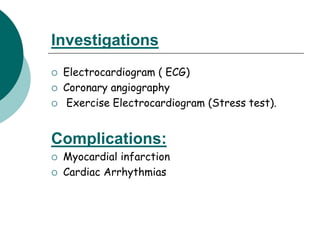
 Mechanism Of Angina
CAUSES
 Coronary atherosclerosis (atheroma )
 Factors increasing preload :
 Hyperthyroidism
 Exercise
 Anemia
 Factors increasing after load:
 Hypertension
 Aortic stenosis
 Obstructive cardio myopathy
 Coronary artery spasm
CLINICAL MANIFESTATIONS
 Characteristics: Squeezing, burning, pressing,
choking, or bursting pressure.
 Onset: Quickly or slowly
 Location: Chest, right or left arms,
shoulder, or neck, jaw.
 Duration: Less then 5 minutes.
 Associated: Dyspnea, Sweating, faintness,
palpitation, dizziness ect.
 Relieving: GTN and rest.
 Aggravating: exertion, exercise, heavy meal,
emotional upset, and anger.
Investigations
 Electrocardiogram ( ECG)
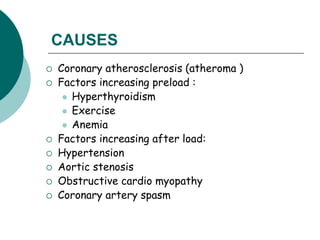
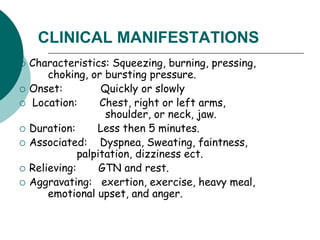
 Coronary angiography
 Exercise Electrocardiogram (Stress test).
Complications:
 Myocardial infarction
 Cardiac Arrhythmias
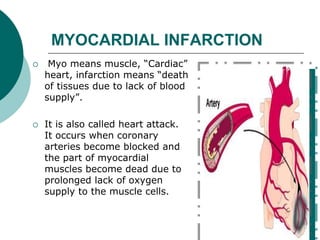
MYOCARDIAL INFARCTION
 Myo means muscle, “Cardiac”
heart, infarction means “death
of tissues due to lack of blood
supply”.
 It is also called heart attack.
It occurs when coronary
arteries become blocked and
the part of myocardial
muscles become dead due to
prolonged lack of oxygen
supply to the muscle cells.
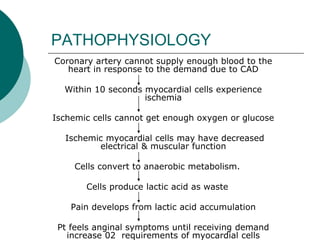
PATHOPHYSIOLOGY
Coronary artery cannot supply enough blood to the
heart in response to the demand due to CAD
Within 10 seconds myocardial cells experience
ischemia
Ischemic cells cannot get enough oxygen or glucose
Ischemic myocardial cells may have decreased
electrical & muscular function
Cells convert to anaerobic metabolism.
Cells produce lactic acid as waste
Pain develops from lactic acid accumulation
Pt feels anginal symptoms until receiving demand
increase 02 requirements of myocardial cells
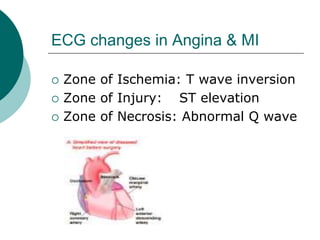
ECG changes in Angina & MI
 Zone of Ischemia: T wave inversion
 Zone of Injury: ST elevation
 Zone of Necrosis: Abnormal Q wave
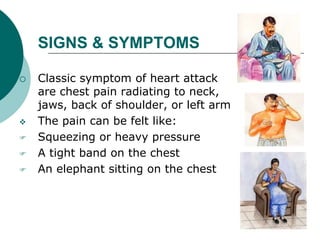
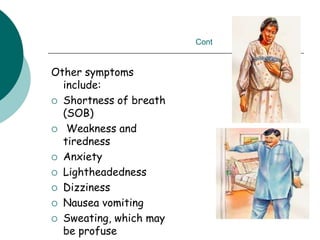
SIGNS & SYMPTOMS
 Classic symptom of heart attack
are chest pain radiating to neck,
jaws, back of shoulder, or left arm
 The pain can be felt like:
 Squeezing or heavy pressure
 A tight band on the chest
 An elephant sitting on the chest
Cont
Other symptoms
include:
 Shortness of breath
(SOB)
 Weakness and
tiredness
 Anxiety
 Lightheadedness
 Dizziness
 Nausea vomiting
 Sweating, which may
be profuse
COLLABORATIVE MANAGEMENT
 Assessment:
 History
 Clinical manifestation
 Cardiovascular assessment
 Laboratory assessment
 Troponin T & I
 CK-MB
ASSESSMENT
ECG
Stress Test
Myocardial perfusion imaging
MRI
Cardiac Catheterization
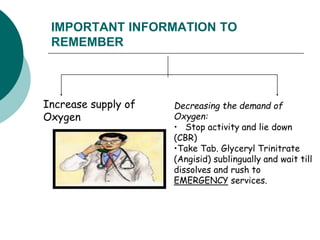
IMPORTANT INFORMATION TO
REMEMBER
Increase supply of
Oxygen
Decreasing the demand of
Oxygen:
• Stop activity and lie down
(CBR)
•Take Tab. Glyceryl Trinitrate
(Angisid) sublingually and wait till
dissolves and rush to
EMERGENCY services.
IMMEDIATE MANAGEMENT OF MI:
GOALS:
 To prolong life.
 Minimize infarct size.
 Reverse ischemia.
 Reduce cardiac work.
 Prevent and treat complications.
A) INITIAL TREATMENT:
 Rapid triage.
 OMI (oxygen, monitor and I/V line).
 Check vital signs and O2 saturation.
 ECG within 10 minutes and repeat ECG.
 Blood samples for enymes, CBC, lytes, and lipid
profile.
INTERVENTION
 Medication:
Morphine Sulphate
Nitrates (GTN)
Beta blockers
Calcium Channel Blocker
Anti platelets / Anti coagulant
Thrombolytic therapy
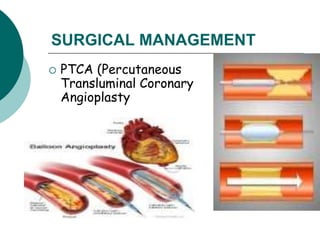
SURGICAL MANAGEMENT
 PTCA (Percutaneous
Transluminal Coronary
Angioplasty
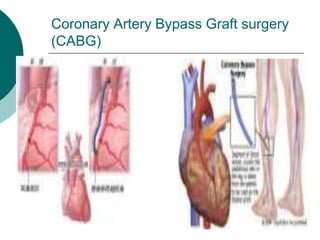
Coronary Artery Bypass Graft surgery
(CABG)
PREVENTION
 Recognize the symptoms
 Reduce your risk factors:
 Lose weight
 Quit Smoking
 Keep your cholesterol at a normal level.
 Keep your blood pressure under control.
 Use techniques to ease stress.
 Control blood sugar level.
 Eat Right
 REGULAR EXERCISE
COMPLICATIONS OF MI:
 Arrhythmias
 Atrial arrhythmias.
 Ventricular arrhythmias.
 Bradycardia and heart block.
 Asystol.
 Hypertension.
 LV failure.
 Cardiogenic shock.
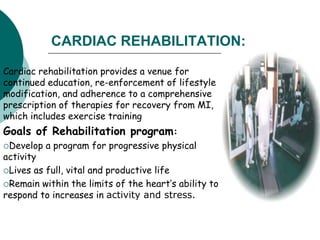
CARDIAC REHABILITATION:
Cardiac rehabilitation provides a venue for
continued education, re-enforcement of lifestyle
modification, and adherence to a comprehensive
prescription of therapies for recovery from MI,
which includes exercise training
Goals of Rehabilitation program:
Develop a program for progressive physical
activity
Lives as full, vital and productive life
Remain within the limits of the heart’s ability to
respond to increases in activity and stress.
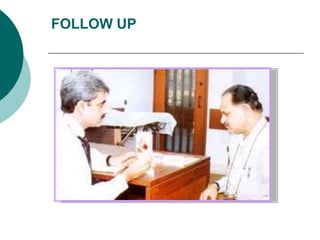
FOLLOW UP
THANK YOU

IHD- MI,Unstable Angina- Dr Sabu Augustine

  • 1.
    IHD- MI /UNSTABLE ANGINA Dr.Sabu Augustine, Associate Professor, Dept of General Medicine, Dr S.M C.S.I Medical College, Karakonam, Trivandrum.
  • 2.
    OBJECTIVES  Coronary ArteryDiseases  Angina  Types  Mechanism  Causes  Clinical manifestation  Complications
  • 3.
    CORONARY ARTERY DISEASE Definition: CADis a term that refers to the effect of the accumulation of atherosclerosis plaque in the coronary arteries that obstructs blood flow to the myocardium
  • 4.
    Cont. conditions result fromCAD 1. Angina Pectoris 2. Myocardial Infarction
  • 5.
    ANGINA PECTORIS Definition: Angina: Chokingor suffocation. Pectoris: Chest. Angina pectoris, is the medical term used to describe acute chest pain or discomfort. Angina occurs when the heart’s need for oxygen increases beyond the level of oxygen available from the blood nourishing the heart. It has 3 types  Stable Angina  Un stable angina &  Variant Angina (Prinzmetal’s or resting angina) :
  • 6.
    Cont. Types of Angina Stable angina:  People with stable angina have episodes of chest discomfort that are usually predictable. That occur on exertion or under mental or emotional stress. Normally the chest discomfort is relieved with rest, nitroglycerin (GTN) or both.  It has a stable pattern of onset, duration and intensity of symptoms.
  • 7.
    Cont.  Unstable angina: It is triggered by an un predictable degree of exertion or emotion.  (progressive), more severe than stable. Characterized by increasing frequency & severity. Provoked by less than usual effort, occurring at rest &  interferes with pt lifestyle.
  • 8.
    Cont.  Variant Angina (Prinzmetal’sor resting angina) : occur spontaneously with no relationship to activity. Occurs at rest due to spasm. Pt discomfort that occurs rest usually of longer duration. Appears to by cyclic & often occurs at about the same time each day (usually at night). Thought to be caused by coronary artery spasm
  • 9.
  • 11.
    CAUSES  Coronary atherosclerosis(atheroma )  Factors increasing preload :  Hyperthyroidism  Exercise  Anemia  Factors increasing after load:  Hypertension  Aortic stenosis  Obstructive cardio myopathy  Coronary artery spasm
  • 12.
    CLINICAL MANIFESTATIONS  Characteristics:Squeezing, burning, pressing, choking, or bursting pressure.  Onset: Quickly or slowly  Location: Chest, right or left arms, shoulder, or neck, jaw.  Duration: Less then 5 minutes.  Associated: Dyspnea, Sweating, faintness, palpitation, dizziness ect.  Relieving: GTN and rest.  Aggravating: exertion, exercise, heavy meal, emotional upset, and anger.
  • 13.
    Investigations  Electrocardiogram (ECG)  Coronary angiography  Exercise Electrocardiogram (Stress test). Complications:  Myocardial infarction  Cardiac Arrhythmias
  • 14.
    MYOCARDIAL INFARCTION  Myomeans muscle, “Cardiac” heart, infarction means “death of tissues due to lack of blood supply”.  It is also called heart attack. It occurs when coronary arteries become blocked and the part of myocardial muscles become dead due to prolonged lack of oxygen supply to the muscle cells.
  • 15.
    PATHOPHYSIOLOGY Coronary artery cannotsupply enough blood to the heart in response to the demand due to CAD Within 10 seconds myocardial cells experience ischemia Ischemic cells cannot get enough oxygen or glucose Ischemic myocardial cells may have decreased electrical & muscular function Cells convert to anaerobic metabolism. Cells produce lactic acid as waste Pain develops from lactic acid accumulation Pt feels anginal symptoms until receiving demand increase 02 requirements of myocardial cells
  • 16.
    ECG changes inAngina & MI  Zone of Ischemia: T wave inversion  Zone of Injury: ST elevation  Zone of Necrosis: Abnormal Q wave
  • 17.
    SIGNS & SYMPTOMS Classic symptom of heart attack are chest pain radiating to neck, jaws, back of shoulder, or left arm  The pain can be felt like:  Squeezing or heavy pressure  A tight band on the chest  An elephant sitting on the chest
  • 18.
    Cont Other symptoms include:  Shortnessof breath (SOB)  Weakness and tiredness  Anxiety  Lightheadedness  Dizziness  Nausea vomiting  Sweating, which may be profuse
  • 19.
    COLLABORATIVE MANAGEMENT  Assessment: History  Clinical manifestation  Cardiovascular assessment  Laboratory assessment  Troponin T & I  CK-MB
  • 20.
    ASSESSMENT ECG Stress Test Myocardial perfusionimaging MRI Cardiac Catheterization
  • 21.
    IMPORTANT INFORMATION TO REMEMBER Increasesupply of Oxygen Decreasing the demand of Oxygen: • Stop activity and lie down (CBR) •Take Tab. Glyceryl Trinitrate (Angisid) sublingually and wait till dissolves and rush to EMERGENCY services.
  • 22.
    IMMEDIATE MANAGEMENT OFMI: GOALS:  To prolong life.  Minimize infarct size.  Reverse ischemia.  Reduce cardiac work.  Prevent and treat complications. A) INITIAL TREATMENT:  Rapid triage.  OMI (oxygen, monitor and I/V line).  Check vital signs and O2 saturation.  ECG within 10 minutes and repeat ECG.  Blood samples for enymes, CBC, lytes, and lipid profile.
  • 23.
    INTERVENTION  Medication: Morphine Sulphate Nitrates(GTN) Beta blockers Calcium Channel Blocker Anti platelets / Anti coagulant Thrombolytic therapy
  • 24.
    SURGICAL MANAGEMENT  PTCA(Percutaneous Transluminal Coronary Angioplasty
  • 25.
    Coronary Artery BypassGraft surgery (CABG)
  • 26.
    PREVENTION  Recognize thesymptoms  Reduce your risk factors:  Lose weight  Quit Smoking  Keep your cholesterol at a normal level.  Keep your blood pressure under control.  Use techniques to ease stress.  Control blood sugar level.  Eat Right  REGULAR EXERCISE
  • 27.
    COMPLICATIONS OF MI: Arrhythmias  Atrial arrhythmias.  Ventricular arrhythmias.  Bradycardia and heart block.  Asystol.  Hypertension.  LV failure.  Cardiogenic shock.
  • 28.
    CARDIAC REHABILITATION: Cardiac rehabilitationprovides a venue for continued education, re-enforcement of lifestyle modification, and adherence to a comprehensive prescription of therapies for recovery from MI, which includes exercise training Goals of Rehabilitation program: Develop a program for progressive physical activity Lives as full, vital and productive life Remain within the limits of the heart’s ability to respond to increases in activity and stress.
  • 29.
  • 30.