Organizational Communication
Prepared by - Omkar Tembe 1
Communication –
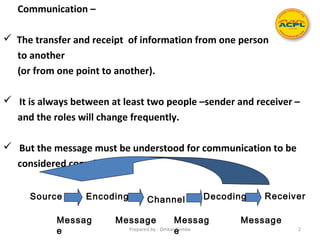
 The transfer and receipt of information from one person
to another
(or from one point to another).
 It is always between at least two people –sender and receiver –
and the roles will change frequently.
 But the message must be understood for communication to be
considered complete.
Source Encoding Channel Decoding Receiver
Messag
e
Message Messag
e
Message
Prepared by - Omkar Tembe 2
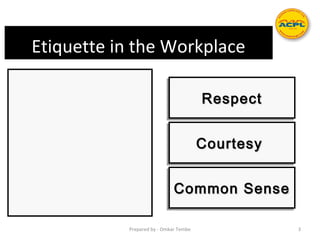
Etiquette in the WorkplaceEtiquette in the Workplace
RespectRespectRespectRespect
CourtesyCourtesyCourtesyCourtesy
Common SenseCommon SenseCommon SenseCommon Sense
Prepared by - Omkar Tembe 3
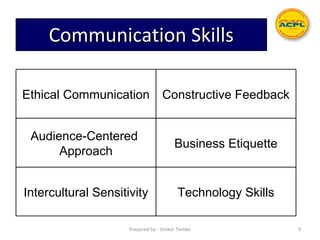
Ethical Communication
Audience-Centered
Approach
Intercultural Sensitivity
Constructive Feedback
Business Etiquette
Technology Skills
Communication SkillsCommunication Skills
Prepared by - Omkar Tembe 4
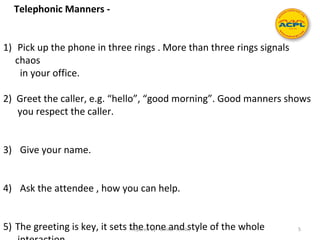
Telephonic Manners -
1) Pick up the phone in three rings . More than three rings signals
chaos
in your office.
2) Greet the caller, e.g. “hello”, “good morning”. Good manners shows
you respect the caller.
3) Give your name.
4) Ask the attendee , how you can help.
5) The greeting is key, it sets the tone and style of the wholePrepared by - Omkar Tembe 5
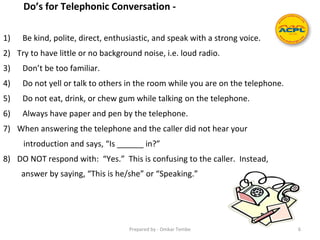
Do’s for Telephonic Conversation -
1) Be kind, polite, direct, enthusiastic, and speak with a strong voice.
2) Try to have little or no background noise, i.e. loud radio.
3) Don’t be too familiar.
4) Do not yell or talk to others in the room while you are on the telephone.
5) Do not eat, drink, or chew gum while talking on the telephone.
6) Always have paper and pen by the telephone.
7) When answering the telephone and the caller did not hear your
introduction and says, “Is ______ in?”
8) DO NOT respond with: “Yes.” This is confusing to the caller. Instead,
answer by saying, “This is he/she” or “Speaking.”
Prepared by - Omkar Tembe 6
Written Communication:-
Written Communication process is as follow –
1. In first mail :-
To - Keep Respective or concern branch/Hub/Head Office – Executive.
2. In Second Mail :- If problem is not solved
To:- Keep Reporting Authority in To & branch/Hub/Head Office - Executive in Cc.
3. In Third Mail : - If problem is not solved
To:- Keep Area/Cluster Manager in To& Concern branch/Hub/Head Office - Executive,
Reporting Authority in Cc
4. In Fourth Mail : - If problem is not solved
To:-Keep Management in To & Concern branch/Hub/Head Office - Executive, Reporting
Authority in Cc.
Prepared by - Omkar Tembe 7
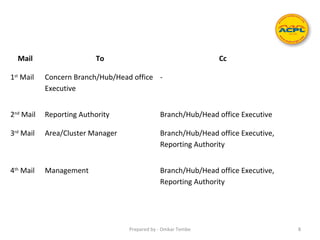
Mail To Cc
1st
Mail Concern Branch/Hub/Head office
Executive
-
2nd
Mail Reporting Authority Branch/Hub/Head office Executive
3rd
Mail Area/Cluster Manager Branch/Hub/Head office Executive,
Reporting Authority
4th
Mail Management Branch/Hub/Head office Executive,
Reporting Authority
Prepared by - Omkar Tembe 8
Thank you !!!
Prepared by - Omkar Tembe 9
Thank you !!!
Prepared by - Omkar Tembe 9

Organizational Communication

  • 1.
  • 2.
    Communication –  Thetransfer and receipt of information from one person to another (or from one point to another).  It is always between at least two people –sender and receiver – and the roles will change frequently.  But the message must be understood for communication to be considered complete. Source Encoding Channel Decoding Receiver Messag e Message Messag e Message Prepared by - Omkar Tembe 2
  • 3.
    Etiquette in theWorkplaceEtiquette in the Workplace RespectRespectRespectRespect CourtesyCourtesyCourtesyCourtesy Common SenseCommon SenseCommon SenseCommon Sense Prepared by - Omkar Tembe 3
  • 4.
    Ethical Communication Audience-Centered Approach Intercultural Sensitivity ConstructiveFeedback Business Etiquette Technology Skills Communication SkillsCommunication Skills Prepared by - Omkar Tembe 4
  • 5.
    Telephonic Manners - 1)Pick up the phone in three rings . More than three rings signals chaos in your office. 2) Greet the caller, e.g. “hello”, “good morning”. Good manners shows you respect the caller. 3) Give your name. 4) Ask the attendee , how you can help. 5) The greeting is key, it sets the tone and style of the wholePrepared by - Omkar Tembe 5
  • 6.
    Do’s for TelephonicConversation - 1) Be kind, polite, direct, enthusiastic, and speak with a strong voice. 2) Try to have little or no background noise, i.e. loud radio. 3) Don’t be too familiar. 4) Do not yell or talk to others in the room while you are on the telephone. 5) Do not eat, drink, or chew gum while talking on the telephone. 6) Always have paper and pen by the telephone. 7) When answering the telephone and the caller did not hear your introduction and says, “Is ______ in?” 8) DO NOT respond with: “Yes.” This is confusing to the caller. Instead, answer by saying, “This is he/she” or “Speaking.” Prepared by - Omkar Tembe 6
  • 7.
    Written Communication:- Written Communicationprocess is as follow – 1. In first mail :- To - Keep Respective or concern branch/Hub/Head Office – Executive. 2. In Second Mail :- If problem is not solved To:- Keep Reporting Authority in To & branch/Hub/Head Office - Executive in Cc. 3. In Third Mail : - If problem is not solved To:- Keep Area/Cluster Manager in To& Concern branch/Hub/Head Office - Executive, Reporting Authority in Cc 4. In Fourth Mail : - If problem is not solved To:-Keep Management in To & Concern branch/Hub/Head Office - Executive, Reporting Authority in Cc. Prepared by - Omkar Tembe 7
  • 8.
    Mail To Cc 1st MailConcern Branch/Hub/Head office Executive - 2nd Mail Reporting Authority Branch/Hub/Head office Executive 3rd Mail Area/Cluster Manager Branch/Hub/Head office Executive, Reporting Authority 4th Mail Management Branch/Hub/Head office Executive, Reporting Authority Prepared by - Omkar Tembe 8
  • 9.
    Thank you !!! Preparedby - Omkar Tembe 9
  • 10.
    Thank you !!! Preparedby - Omkar Tembe 9