Business Intelligence.
Paper by : Omkar S. Tembe
Misbah M.H Shaikh
BCA III
D.G.College of Commerce , Satara.
Prepared by - Mr. Omkar Tembe 1
 Skills, processes, technologies, applications and practices used to
support decision making.
 Broad category of applications and technologies for gathering,
storing, analyzing, and providing access to data to help clients
make better business decisions.
 A system that collects, integrates, analyses and presents business
information to support better business decision making.
 Culture , processes and technologies used to improve decision
making for stakeholders .
 Introduction :-
Prepared by - Mr. Omkar Tembe 2
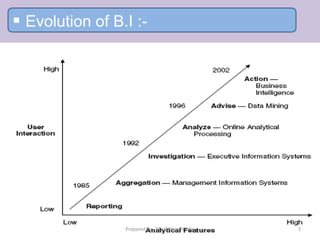
 Evolution of B.I :-
Prepared by - Mr. Omkar Tembe 3
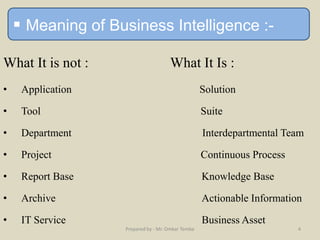
 Meaning of Business Intelligence :-
What It is not : What It Is :
• Application Solution
• Tool Suite
• Department Interdepartmental Team
• Project Continuous Process
• Report Base Knowledge Base
• Archive Actionable Information
• IT Service Business Asset
Prepared by - Mr. Omkar Tembe 4
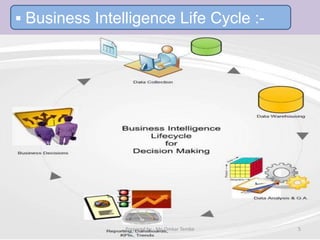
 Business Intelligence Life Cycle :-
Prepared by - Mr. Omkar Tembe 5
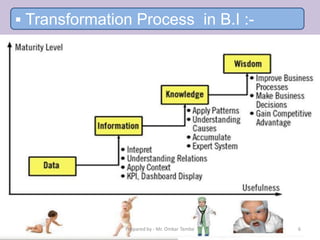
 Transformation Process in B.I :-
Prepared by - Mr. Omkar Tembe 6
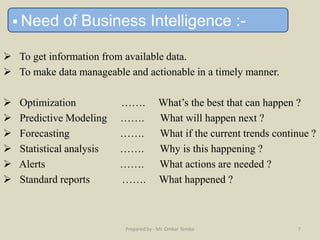
 To get information from available data.
 To make data manageable and actionable in a timely manner.
 Optimization ……. What’s the best that can happen ?
 Predictive Modeling ……. What will happen next ?
 Forecasting ……. What if the current trends continue ?
 Statistical analysis ……. Why is this happening ?
 Alerts ……. What actions are needed ?
 Standard reports ……. What happened ?
 Need of Business Intelligence :-
Prepared by - Mr. Omkar Tembe 7
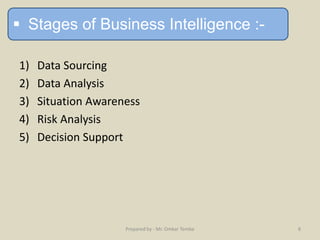
1) Data Sourcing
2) Data Analysis
3) Situation Awareness
4) Risk Analysis
5) Decision Support
 Stages of Business Intelligence :-
Prepared by - Mr. Omkar Tembe 8
 Practical Examples of B.I :-
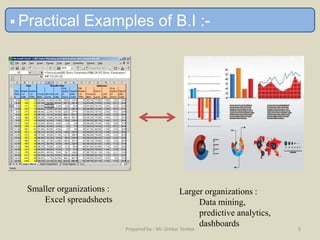
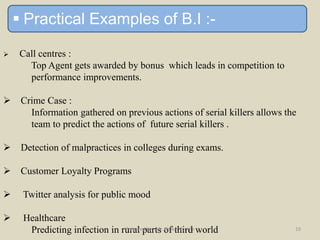
Smaller organizations :
Excel spreadsheets
Larger organizations :
Data mining,
predictive analytics,
dashboards
Prepared by - Mr. Omkar Tembe 9
 Practical Examples of B.I :-
 Call centres :
Top Agent gets awarded by bonus which leads in competition to
performance improvements.
 Crime Case :
Information gathered on previous actions of serial killers allows the
team to predict the actions of future serial killers .
 Detection of malpractices in colleges during exams.
 Customer Loyalty Programs
 Twitter analysis for public mood
 Healthcare
Predicting infection in rural parts of third worldPrepared by - Mr. Omkar Tembe 10
 Tools used to Implement B.I :-
 Multidimensional Analysis or Online Analytical Processing (OLAP)
 Data Mining
 Decision Support Systems
 Data Mart
 Enterprise Data Warehouse
 Dashboards
 Data Visualization Technologies (G.I.S)
 Score Cards
Prepared by - Mr. Omkar Tembe 11
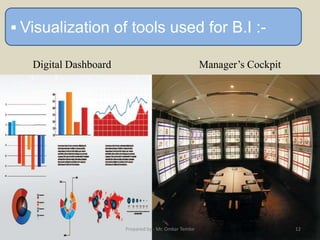
 Visualization of tools used for B.I :-
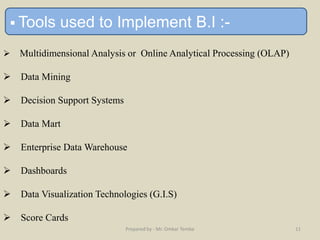
Digital Dashboard Manager’s Cockpit
Prepared by - Mr. Omkar Tembe 12
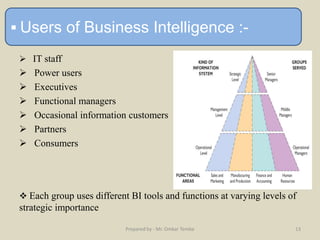
 Users of Business Intelligence :-
 IT staff
 Power users
 Executives
 Functional managers
 Occasional information customers
 Partners
 Consumers
 Each group uses different BI tools and functions at varying levels of
strategic importance
Prepared by - Mr. Omkar Tembe 13
 Predictive Analytics
 Visualization/Dashboards
 Master Data Management
 The Cloud
 Analytic Databases
 Mobile BI
 Open Source
 Text Analytics
 Mobile , Cloud , Social Media , Advanced Analysis
 Trends / Technologies used in B.I :-
Prepared by - Mr. Omkar Tembe 14
 Rules to be followed while implementing
B.I :-
 Strong support from executive management
 Trustworthy and value added
 Clear view and vision
 Iterative success criteria
 Right technology to the right people at the right time
 Understandable documentation
 Accessible
 Flexible Prepared by - Mr. Omkar Tembe 15
 Time savings
 Improved strategies and plans
 Improved tactical decisions
 More efficient processes
 Cost savings
 Faster, more accurate reporting
 Improved decision making
 Improved customer service
 Increased revenue
 Advantages of Business Intelligence
:-
Prepared by - Mr. Omkar Tembe 16
 References :-
www.maia-intelligence.com
www.microsoft.com/bi
www.pragmaticworks.com
www.wekipedia.com
www.cio.com
Prepared by - Mr. Omkar Tembe 17
Thank you !!!
Prepared by - Mr. Omkar Tembe 18

Business Intelligence

  • 1.
    Business Intelligence. Paper by: Omkar S. Tembe Misbah M.H Shaikh BCA III D.G.College of Commerce , Satara. Prepared by - Mr. Omkar Tembe 1
  • 2.
     Skills, processes,technologies, applications and practices used to support decision making.  Broad category of applications and technologies for gathering, storing, analyzing, and providing access to data to help clients make better business decisions.  A system that collects, integrates, analyses and presents business information to support better business decision making.  Culture , processes and technologies used to improve decision making for stakeholders .  Introduction :- Prepared by - Mr. Omkar Tembe 2
  • 3.
     Evolution ofB.I :- Prepared by - Mr. Omkar Tembe 3
  • 4.
     Meaning ofBusiness Intelligence :- What It is not : What It Is : • Application Solution • Tool Suite • Department Interdepartmental Team • Project Continuous Process • Report Base Knowledge Base • Archive Actionable Information • IT Service Business Asset Prepared by - Mr. Omkar Tembe 4
  • 5.
     Business IntelligenceLife Cycle :- Prepared by - Mr. Omkar Tembe 5
  • 6.
     Transformation Processin B.I :- Prepared by - Mr. Omkar Tembe 6
  • 7.
     To getinformation from available data.  To make data manageable and actionable in a timely manner.  Optimization ……. What’s the best that can happen ?  Predictive Modeling ……. What will happen next ?  Forecasting ……. What if the current trends continue ?  Statistical analysis ……. Why is this happening ?  Alerts ……. What actions are needed ?  Standard reports ……. What happened ?  Need of Business Intelligence :- Prepared by - Mr. Omkar Tembe 7
  • 8.
    1) Data Sourcing 2)Data Analysis 3) Situation Awareness 4) Risk Analysis 5) Decision Support  Stages of Business Intelligence :- Prepared by - Mr. Omkar Tembe 8
  • 9.
     Practical Examplesof B.I :- Smaller organizations : Excel spreadsheets Larger organizations : Data mining, predictive analytics, dashboards Prepared by - Mr. Omkar Tembe 9
  • 10.
     Practical Examplesof B.I :-  Call centres : Top Agent gets awarded by bonus which leads in competition to performance improvements.  Crime Case : Information gathered on previous actions of serial killers allows the team to predict the actions of future serial killers .  Detection of malpractices in colleges during exams.  Customer Loyalty Programs  Twitter analysis for public mood  Healthcare Predicting infection in rural parts of third worldPrepared by - Mr. Omkar Tembe 10
  • 11.
     Tools usedto Implement B.I :-  Multidimensional Analysis or Online Analytical Processing (OLAP)  Data Mining  Decision Support Systems  Data Mart  Enterprise Data Warehouse  Dashboards  Data Visualization Technologies (G.I.S)  Score Cards Prepared by - Mr. Omkar Tembe 11
  • 12.
     Visualization oftools used for B.I :- Digital Dashboard Manager’s Cockpit Prepared by - Mr. Omkar Tembe 12
  • 13.
     Users ofBusiness Intelligence :-  IT staff  Power users  Executives  Functional managers  Occasional information customers  Partners  Consumers  Each group uses different BI tools and functions at varying levels of strategic importance Prepared by - Mr. Omkar Tembe 13
  • 14.
     Predictive Analytics Visualization/Dashboards  Master Data Management  The Cloud  Analytic Databases  Mobile BI  Open Source  Text Analytics  Mobile , Cloud , Social Media , Advanced Analysis  Trends / Technologies used in B.I :- Prepared by - Mr. Omkar Tembe 14
  • 15.
     Rules tobe followed while implementing B.I :-  Strong support from executive management  Trustworthy and value added  Clear view and vision  Iterative success criteria  Right technology to the right people at the right time  Understandable documentation  Accessible  Flexible Prepared by - Mr. Omkar Tembe 15
  • 16.
     Time savings Improved strategies and plans  Improved tactical decisions  More efficient processes  Cost savings  Faster, more accurate reporting  Improved decision making  Improved customer service  Increased revenue  Advantages of Business Intelligence :- Prepared by - Mr. Omkar Tembe 16
  • 17.
  • 18.
    Thank you !!! Preparedby - Mr. Omkar Tembe 18