Android
Development
Name : Rahul Maurya
Branch : EC-2, 4th Year
Roll no : 1714331040
Table of Content
• Introduction of Android
• Open Handset Alliance
• Application of Android
• Android Architecture
• Tool for Android development
• Advancement
• Advantages
• Disadvantages
• Conclusion
• Reference
Introduction of Android
• Android began in 2003, Android Inc.
• Google bought it in 2005.
• At Google, they developed a mobile device platform powered
by the Linux kernel.
• On November 5, 2007, the Open Handset Alliance came with
a goal to develop open standard for mobile device.
Open Handset Alliance
• OHA is a business alliance that created for
developing device standard
• OHA have 80+ member companies like HTC,
Samsung, Google etc
• Devoted to advancing open standard for mobile
device.
Application of Android
• Phones
• Application on mobile
• Game Console
• Cameras
• Other gadgets
Tool for Android Development
• Android Studio
• User Interface
• Java/Kotlin code completion
• Stability of System
• Gradle built system
• Availability of Drag and Drop
Android Architecture
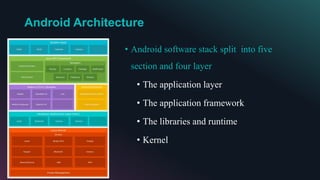
• Android software stack split into five
section and four layer
• The application layer
• The application framework
• The libraries and runtime
• Kernel
Application layer
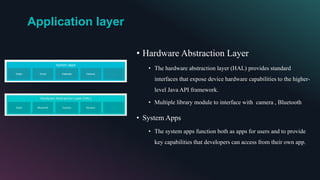
• Hardware Abstraction Layer
• The hardware abstraction layer (HAL) provides standard
interfaces that expose device hardware capabilities to the higher-
level Java API framework.
• Multiple library module to interface with camera , Bluetooth
• System Apps
• The system apps function both as apps for users and to provide
key capabilities that developers can access from their own app.
Native libraries
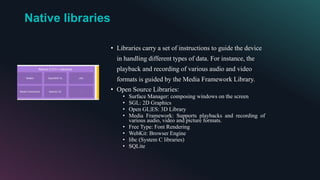
• Libraries carry a set of instructions to guide the device
in handling different types of data. For instance, the
playback and recording of various audio and video
formats is guided by the Media Framework Library.
• Open Source Libraries:
• Surface Manager: composing windows on the screen
• SGL: 2D Graphics
• Open GL|ES: 3D Library
• Media Framework: Supports playbacks and recording of
various audio, video and picture formats.
• Free Type: Font Rendering
• WebKit: Browser Engine
• libc (System C libraries)
• SQLite
Linux Kernel
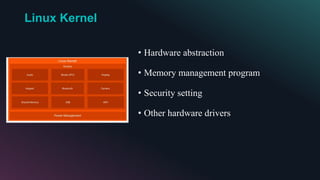
• Hardware abstraction
• Memory management program
• Security setting
• Other hardware drivers
Runtime layer
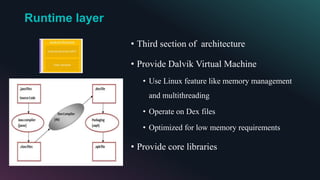
• Third section of architecture
• Provide Dalvik Virtual Machine
• Use Linux feature like memory management
and multithreading
• Operate on Dex files
• Optimized for low memory requirements
• Provide core libraries
Advancement In Android
• Watches
• Smart Television
• Home Appliances
• Cars
• Homes
Advantages
• High ROI with lower costs
• Faster Development
• Target Multiple Platform
• Versability and scalability
• Customization
• Easy adoption
Disadvantages
• Low security
• High device fragmentation
• More code
• More testing more cost
Conclusion
• Android is truly open, free development platform based on Linux
and open source without paying any royalty.
• Android is growing very fast.
• Android not only focusing on mobile device while expanding on
other gadgets also.
• Learning Android development is still great thing to do because it
will open lots of opportunity.
Reference
• Google : www.developer.android.com/developer-guide
• SlideShare : https://www.slideshare.net/zeelpatel0504/introduction-
to-android-16084192
• SlideShare : https://www.slideshare.net/snhlata7/my-presentation-
on-android-in-my-college
Android development

Android development

  • 1.
    Android Development Name : RahulMaurya Branch : EC-2, 4th Year Roll no : 1714331040
  • 2.
    Table of Content •Introduction of Android • Open Handset Alliance • Application of Android • Android Architecture • Tool for Android development • Advancement • Advantages • Disadvantages • Conclusion • Reference
  • 3.
    Introduction of Android •Android began in 2003, Android Inc. • Google bought it in 2005. • At Google, they developed a mobile device platform powered by the Linux kernel. • On November 5, 2007, the Open Handset Alliance came with a goal to develop open standard for mobile device.
  • 4.
    Open Handset Alliance •OHA is a business alliance that created for developing device standard • OHA have 80+ member companies like HTC, Samsung, Google etc • Devoted to advancing open standard for mobile device.
  • 5.
    Application of Android •Phones • Application on mobile • Game Console • Cameras • Other gadgets
  • 6.
    Tool for AndroidDevelopment • Android Studio • User Interface • Java/Kotlin code completion • Stability of System • Gradle built system • Availability of Drag and Drop
  • 7.
    Android Architecture • Androidsoftware stack split into five section and four layer • The application layer • The application framework • The libraries and runtime • Kernel
  • 8.
    Application layer • HardwareAbstraction Layer • The hardware abstraction layer (HAL) provides standard interfaces that expose device hardware capabilities to the higher- level Java API framework. • Multiple library module to interface with camera , Bluetooth • System Apps • The system apps function both as apps for users and to provide key capabilities that developers can access from their own app.
  • 9.
    Native libraries • Librariescarry a set of instructions to guide the device in handling different types of data. For instance, the playback and recording of various audio and video formats is guided by the Media Framework Library. • Open Source Libraries: • Surface Manager: composing windows on the screen • SGL: 2D Graphics • Open GL|ES: 3D Library • Media Framework: Supports playbacks and recording of various audio, video and picture formats. • Free Type: Font Rendering • WebKit: Browser Engine • libc (System C libraries) • SQLite
  • 10.
    Linux Kernel • Hardwareabstraction • Memory management program • Security setting • Other hardware drivers
  • 11.
    Runtime layer • Thirdsection of architecture • Provide Dalvik Virtual Machine • Use Linux feature like memory management and multithreading • Operate on Dex files • Optimized for low memory requirements • Provide core libraries
  • 12.
    Advancement In Android •Watches • Smart Television • Home Appliances • Cars • Homes
  • 13.
    Advantages • High ROIwith lower costs • Faster Development • Target Multiple Platform • Versability and scalability • Customization • Easy adoption
  • 14.
    Disadvantages • Low security •High device fragmentation • More code • More testing more cost
  • 15.
    Conclusion • Android istruly open, free development platform based on Linux and open source without paying any royalty. • Android is growing very fast. • Android not only focusing on mobile device while expanding on other gadgets also. • Learning Android development is still great thing to do because it will open lots of opportunity.
  • 16.
    Reference • Google :www.developer.android.com/developer-guide • SlideShare : https://www.slideshare.net/zeelpatel0504/introduction- to-android-16084192 • SlideShare : https://www.slideshare.net/snhlata7/my-presentation- on-android-in-my-college

Editor's Notes

  • #5 The Open Handset Alliance (OHA) is a business alliance that was created for the purpose of developing open mobile device standards. The OHA has approximately 80 member companies, including HTC, Dell, Intel, Motorola, Qualcomm and Google. The OHA's main product is the Android platform - the world's most popular smartphone platform Lower overall handset costs: Opens up resources, which facilitates the focus on creating innovative applications, solutions and services. Developer-friendly environment: In the open-source community, developers share notes to expedite application development. Post-development: Provides an ideal channel for application marketing and distribution.
  • #10 OpenSSL is a software library for applications that secure communications over computer networks against eavesdropping or need to identify the party at the other end. It is widely used by Internet servers, including the majority of HTTPS websites