Why institutions?
• Transition to a low-carbon economy
  will be constrained by many factors:
  – structure and rate of growth of the
    economy
  – resource endowment and existing
    infrastructure
  – and the governance of the energy sector
• >>>>>>>>>>INSTITUTIONS
Questions
• What elements in the manner in
  which China’s energy sector is
  governed are likely to assist or
  constrain the nation’s transition to a
  low-carbon economy?
• What are the implications for China's
  transition to a low-carbon economy?
Aims
• To explore how the study of institutions may
  help to elaborate on the challenges lying at
  the heart of transition management
• To apply these ideas to the case of China
• See:
  – Short report from Transatlantic Academy
  http://www.transatlanticacademy.org/publications
  – Book: Governance of Energy in China. Transition
    to a Low-Carbon Economy (Palgrave Macmillan)
    September 2012
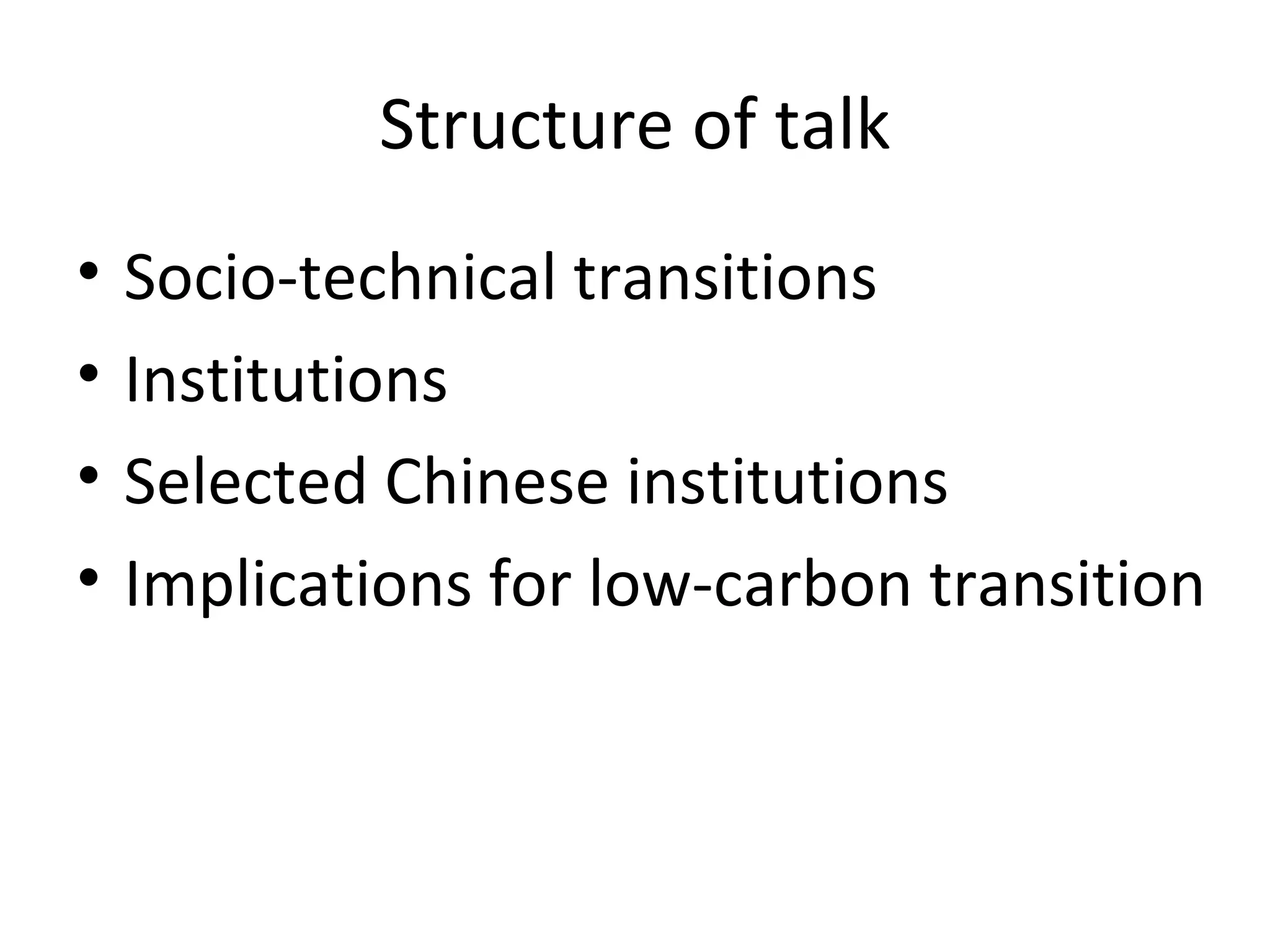
Structure of talk
•   Socio-technical transitions
•   Institutions
•   Selected Chinese institutions
•   Implications for low-carbon transition
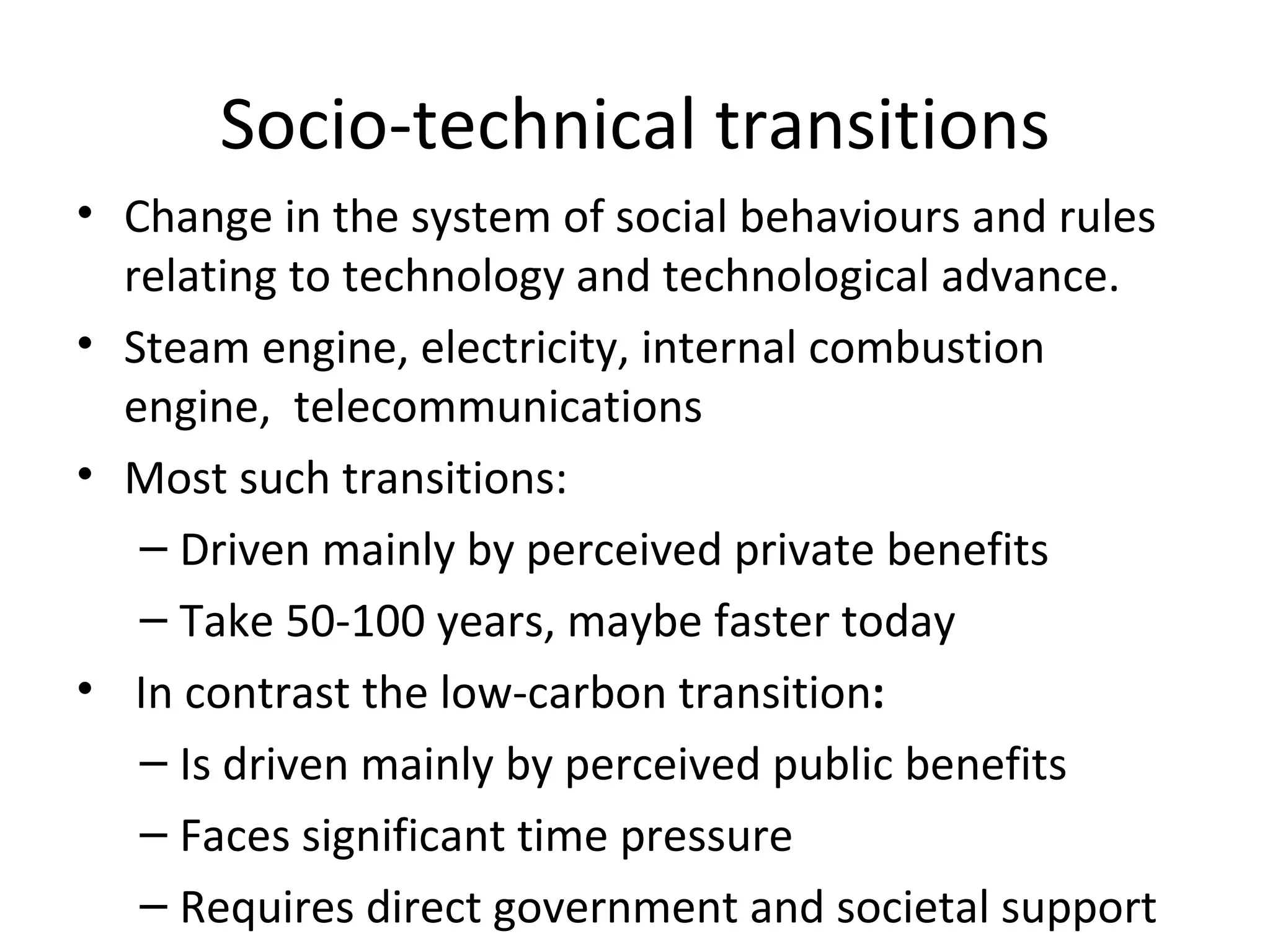
Socio-technical transitions
• Change in the system of social behaviours and rules
  relating to technology and technological advance.
• Steam engine, electricity, internal combustion
  engine, telecommunications
• Most such transitions:
   – Driven mainly by perceived private benefits
   – Take 50-100 years, maybe faster today
• In contrast the low-carbon transition:
   – Is driven mainly by perceived public benefits
   – Faces significant time pressure
   – Requires direct government and societal support
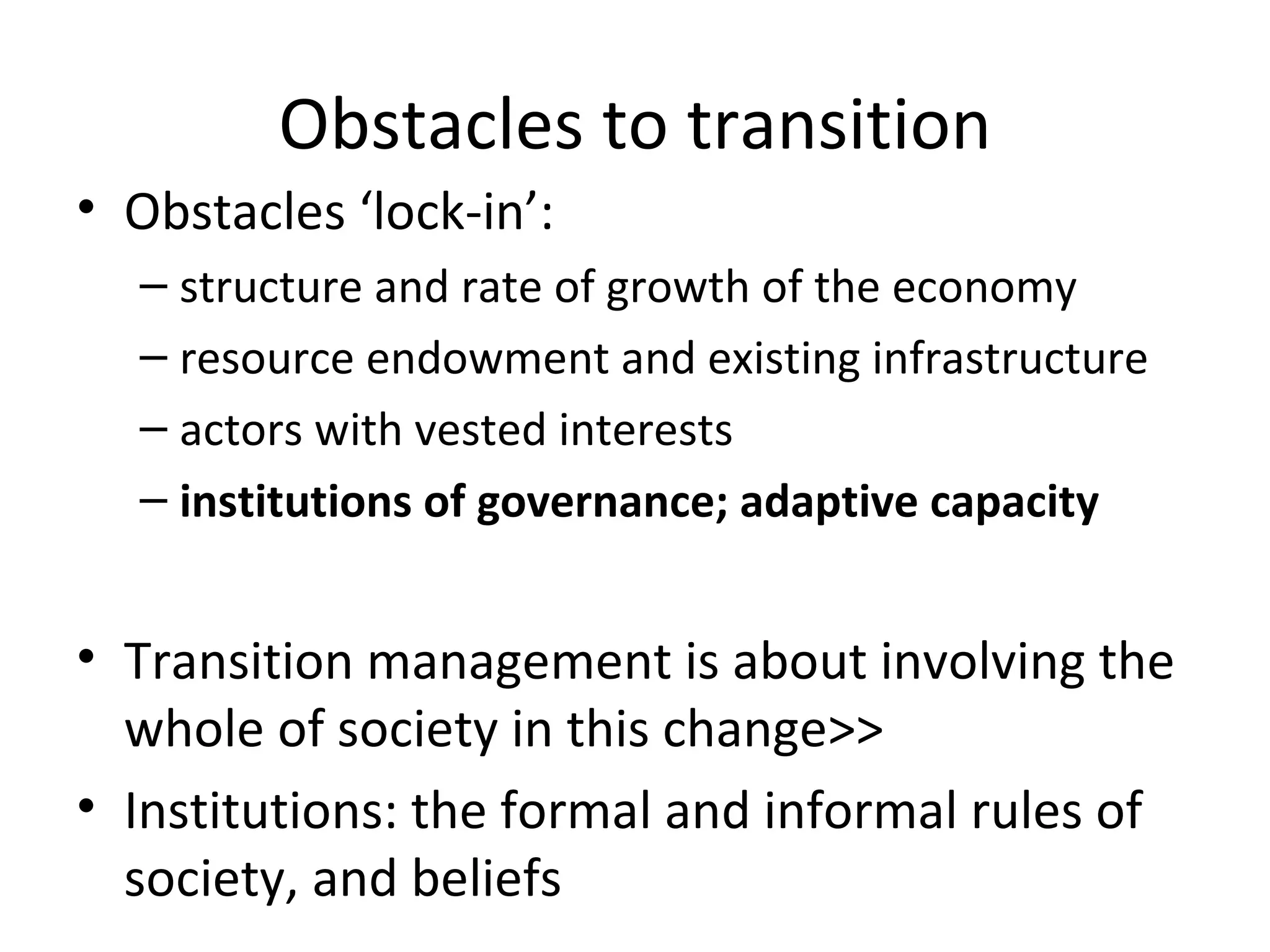
Obstacles to transition
• Obstacles ‘lock-in’:
  – structure and rate of growth of the economy
  – resource endowment and existing infrastructure
  – actors with vested interests
  – institutions of governance; adaptive capacity


• Transition management is about involving the
  whole of society in this change>>
• Institutions: the formal and informal rules of
  society, and beliefs
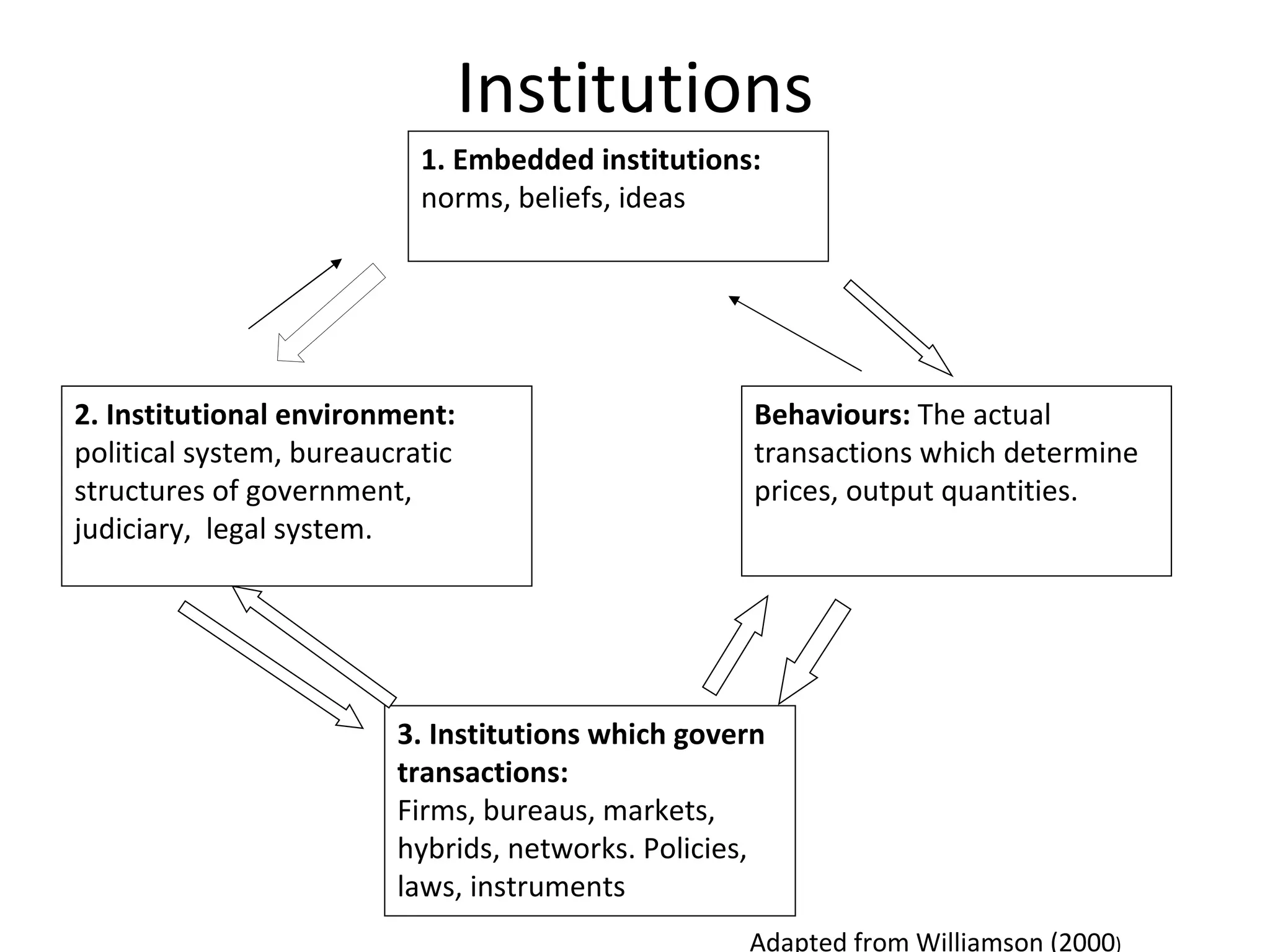
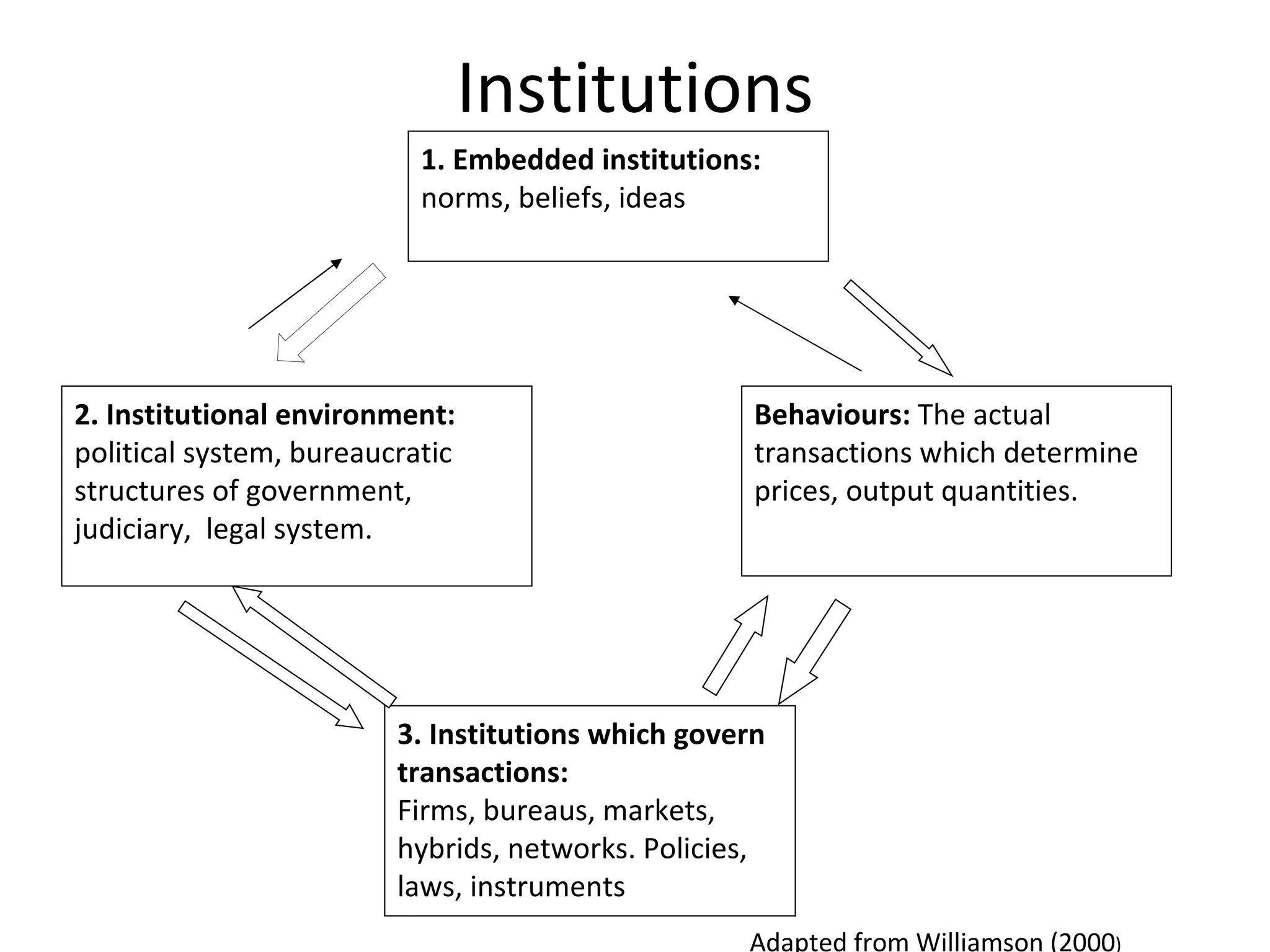
Institutions
                           1. Embedded institutions:
                           norms, beliefs, ideas


2. Institutional environment:                       Behaviours: The actual
political system, bureaucratic                      transactions which determine
structures of government,                           prices, output quantities.
judiciary, legal system.


                         3. Institutions which govern
                         transactions:
                         Firms, bureaus, markets,
                         hybrids, networks. Policies,
                         laws, instruments
                                                   Adapted from Williamson (2000)
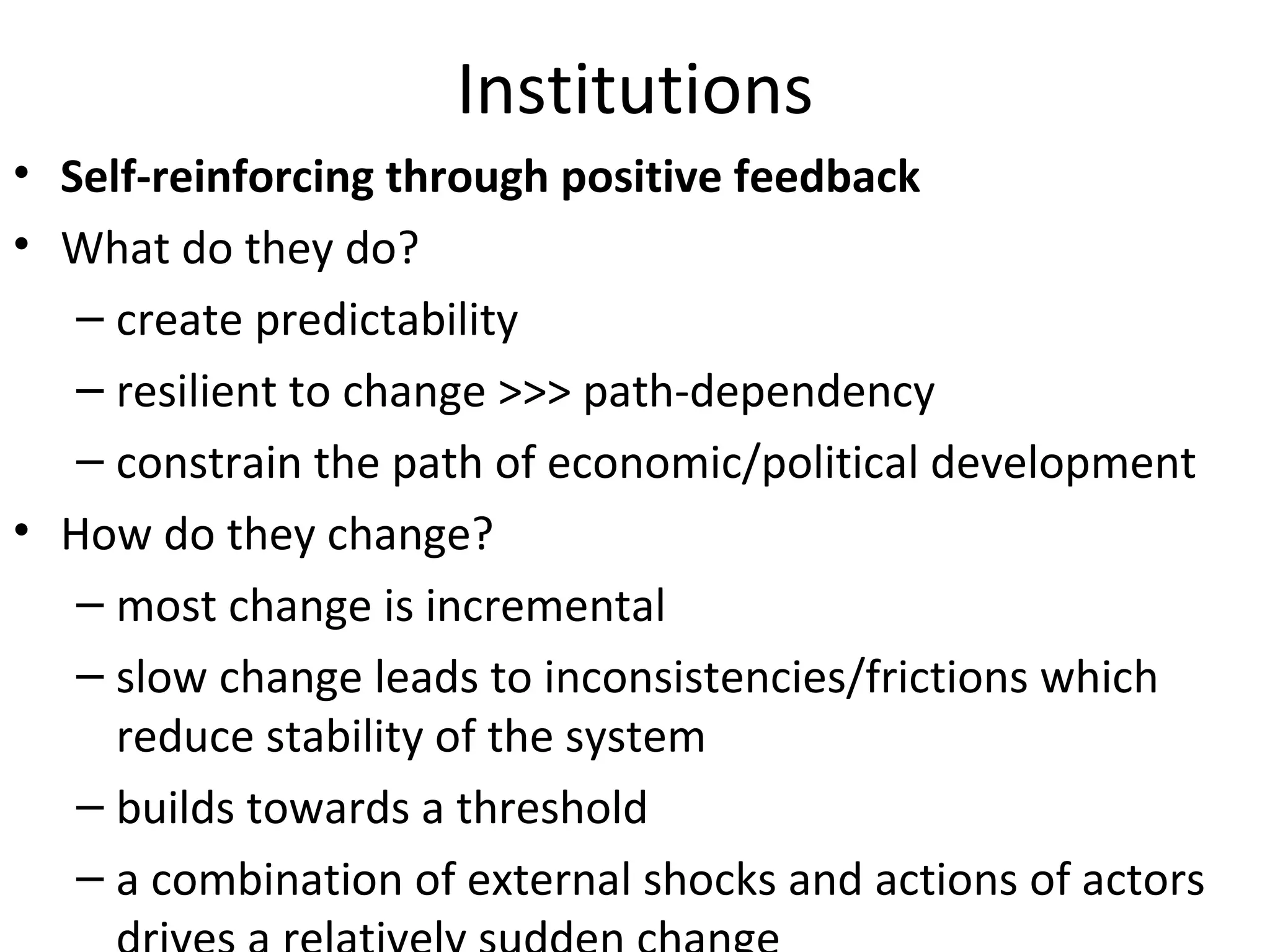
Institutions
• Self-reinforcing through positive feedback
• What do they do?
   – create predictability
   – resilient to change >>> path-dependency
   – constrain the path of economic/political development
• How do they change?
   – most change is incremental
   – slow change leads to inconsistencies/frictions which
     reduce stability of the system
   – builds towards a threshold
   – a combination of external shocks and actions of actors
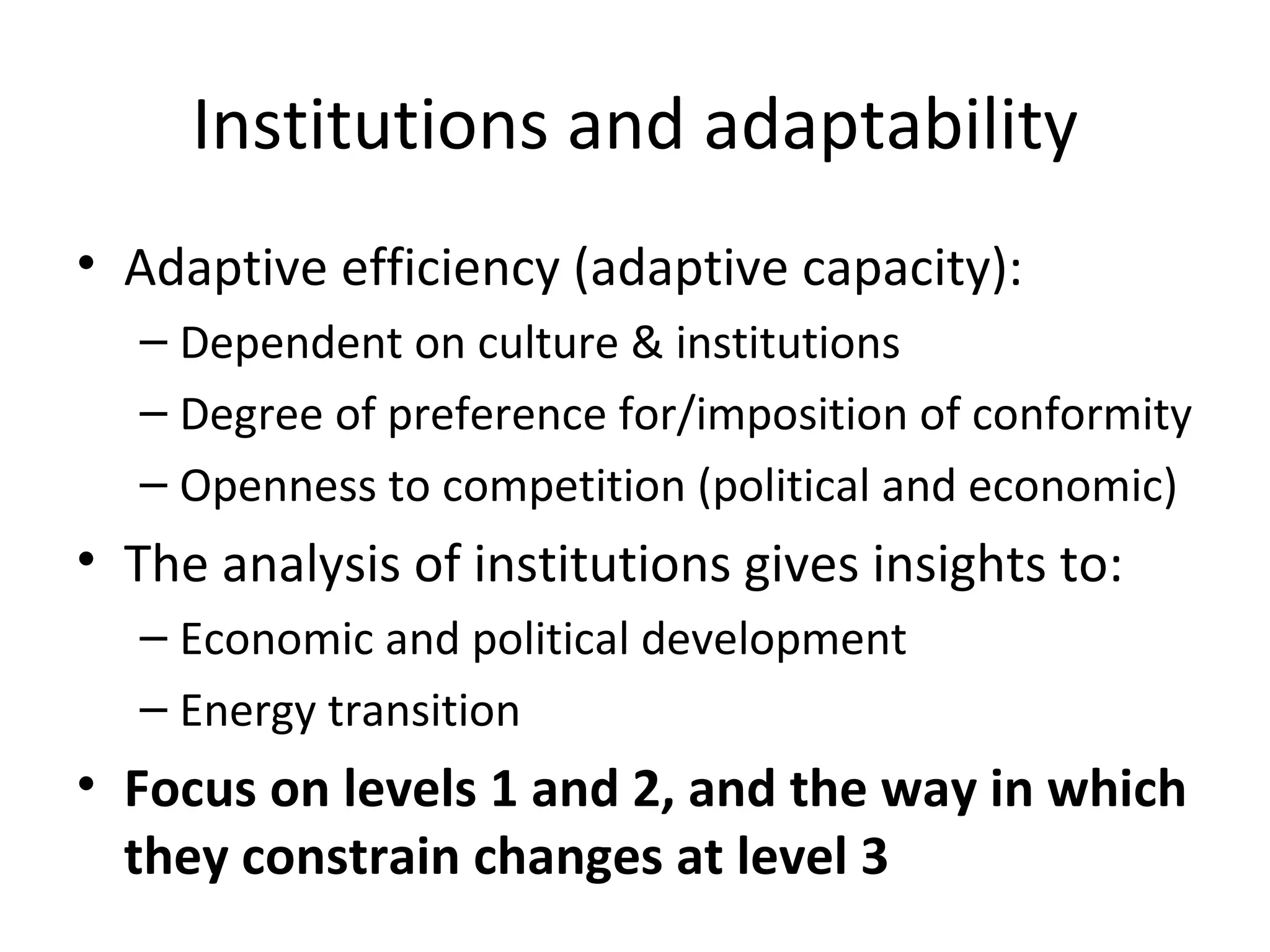
Institutions and adaptability
• Adaptive efficiency (adaptive capacity):
  – Dependent on culture & institutions
  – Degree of preference for/imposition of conformity
  – Openness to competition (political and economic)
• The analysis of institutions gives insights to:
  – Economic and political development
  – Energy transition
• Focus on levels 1 and 2, and the way in which
  they constrain changes at level 3
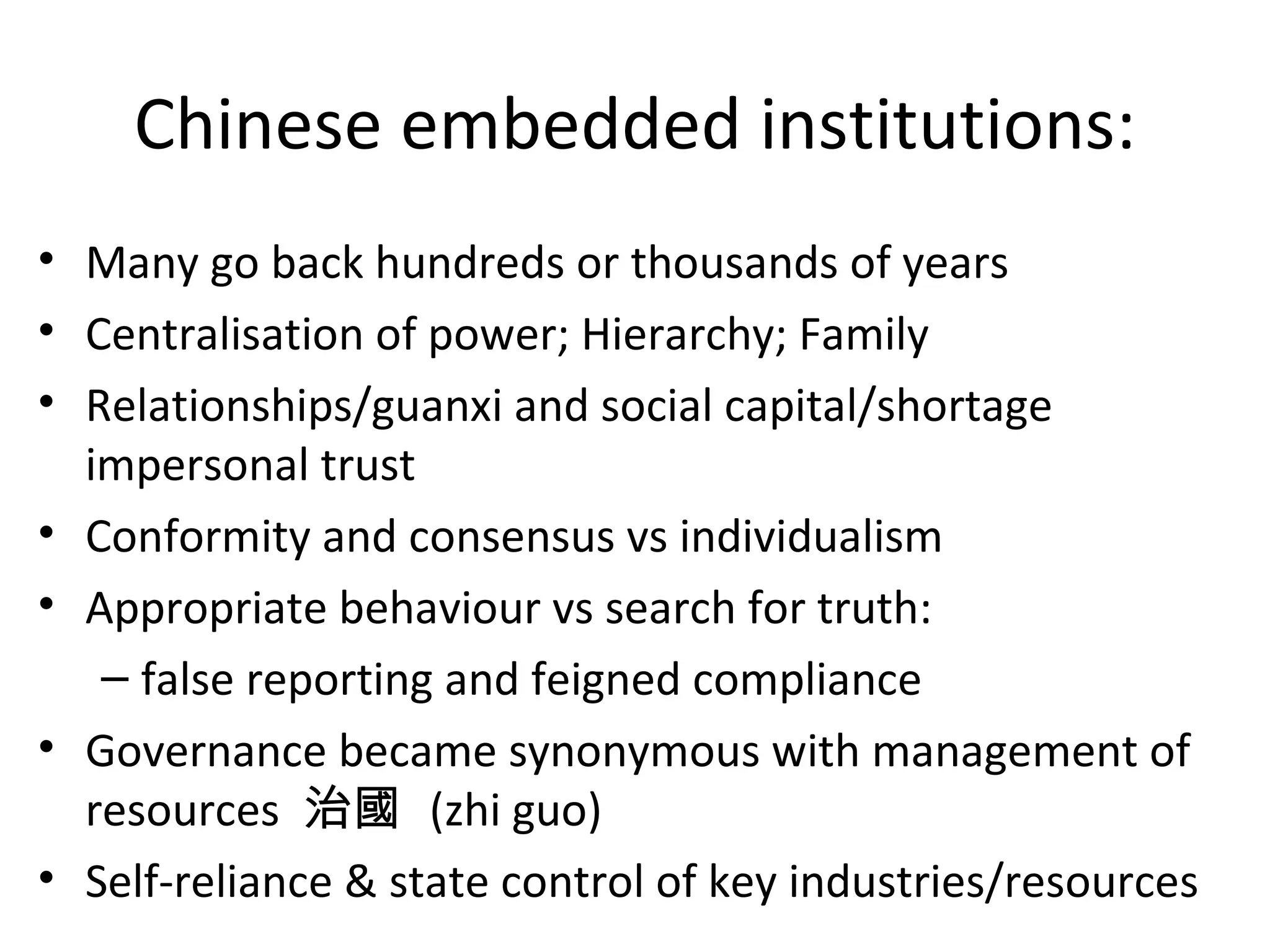
Chinese embedded institutions:
• Many go back hundreds or thousands of years
• Centralisation of power; Hierarchy; Family
• Relationships/guanxi and social capital/shortage
  impersonal trust
• Conformity and consensus vs individualism
• Appropriate behaviour vs search for truth:
   – false reporting and feigned compliance
• Governance became synonymous with management of
  resources 治國 (zhi guo)
• Self-reliance & state control of key industries/resources
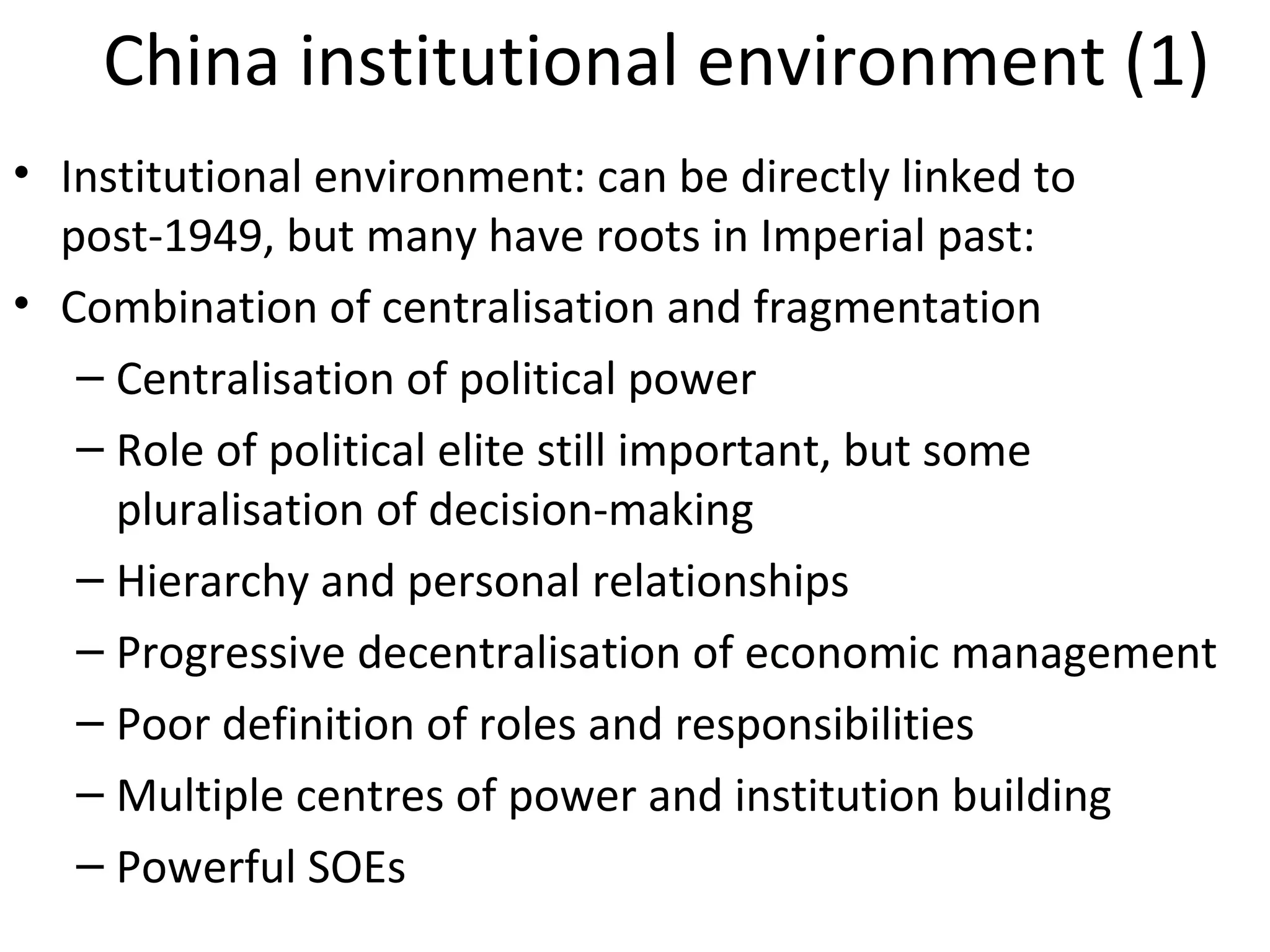
China institutional environment (1)
• Institutional environment: can be directly linked to
  post-1949, but many have roots in Imperial past:
• Combination of centralisation and fragmentation
   – Centralisation of political power
   – Role of political elite still important, but some
     pluralisation of decision-making
   – Hierarchy and personal relationships
   – Progressive decentralisation of economic management
   – Poor definition of roles and responsibilities
   – Multiple centres of power and institution building
   – Powerful SOEs
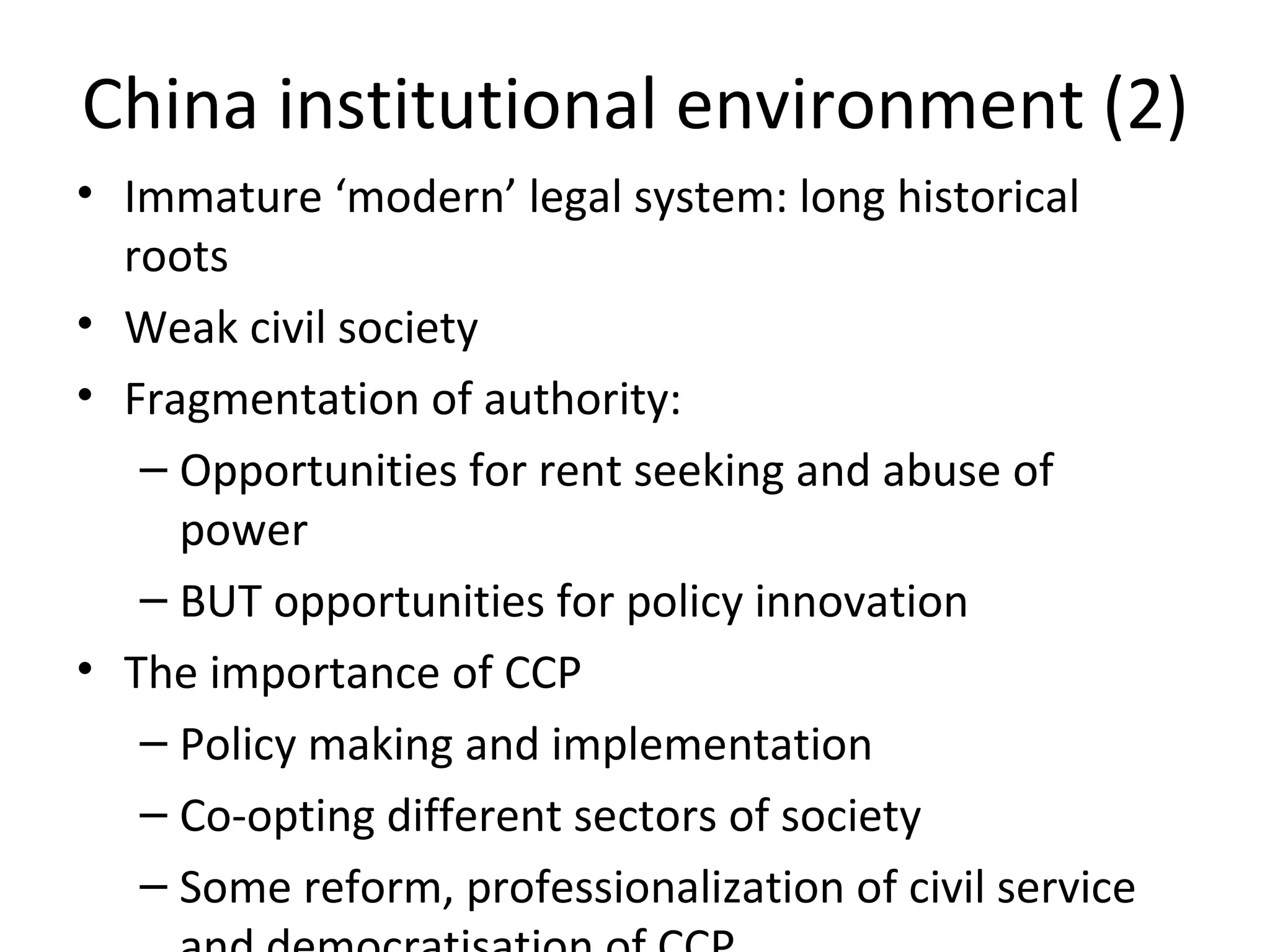
China institutional environment (2)
• Immature ‘modern’ legal system: long historical
  roots
• Weak civil society
• Fragmentation of authority:
   – Opportunities for rent seeking and abuse of
     power
   – BUT opportunities for policy innovation
• The importance of CCP
   – Policy making and implementation
   – Co-opting different sectors of society
   – Some reform, professionalization of civil service
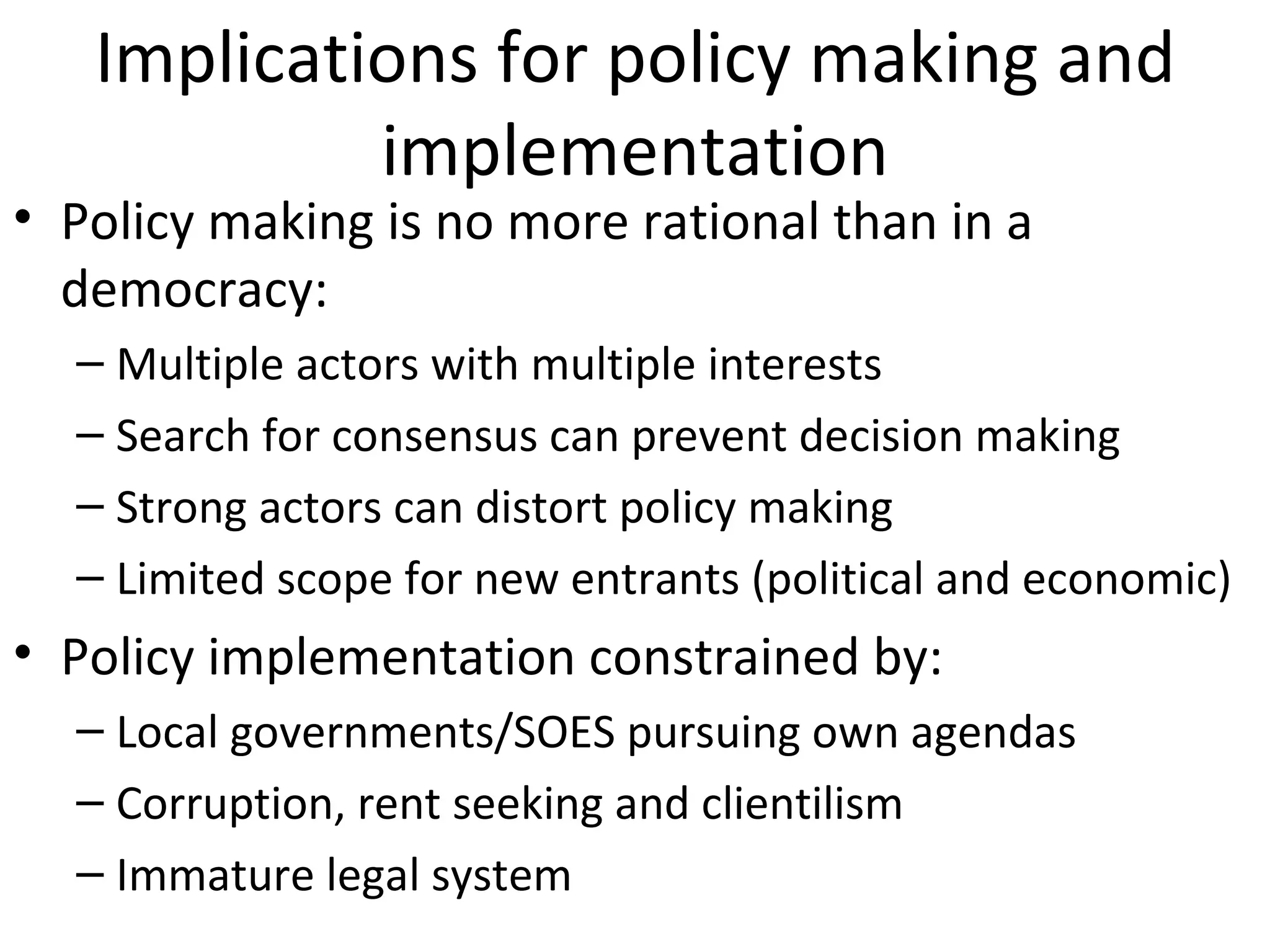
Implications for policy making and
            implementation
• Policy making is no more rational than in a
  democracy:
  – Multiple actors with multiple interests
  – Search for consensus can prevent decision making
  – Strong actors can distort policy making
  – Limited scope for new entrants (political and economic)
• Policy implementation constrained by:
  – Local governments/SOES pursuing own agendas
  – Corruption, rent seeking and clientilism
  – Immature legal system
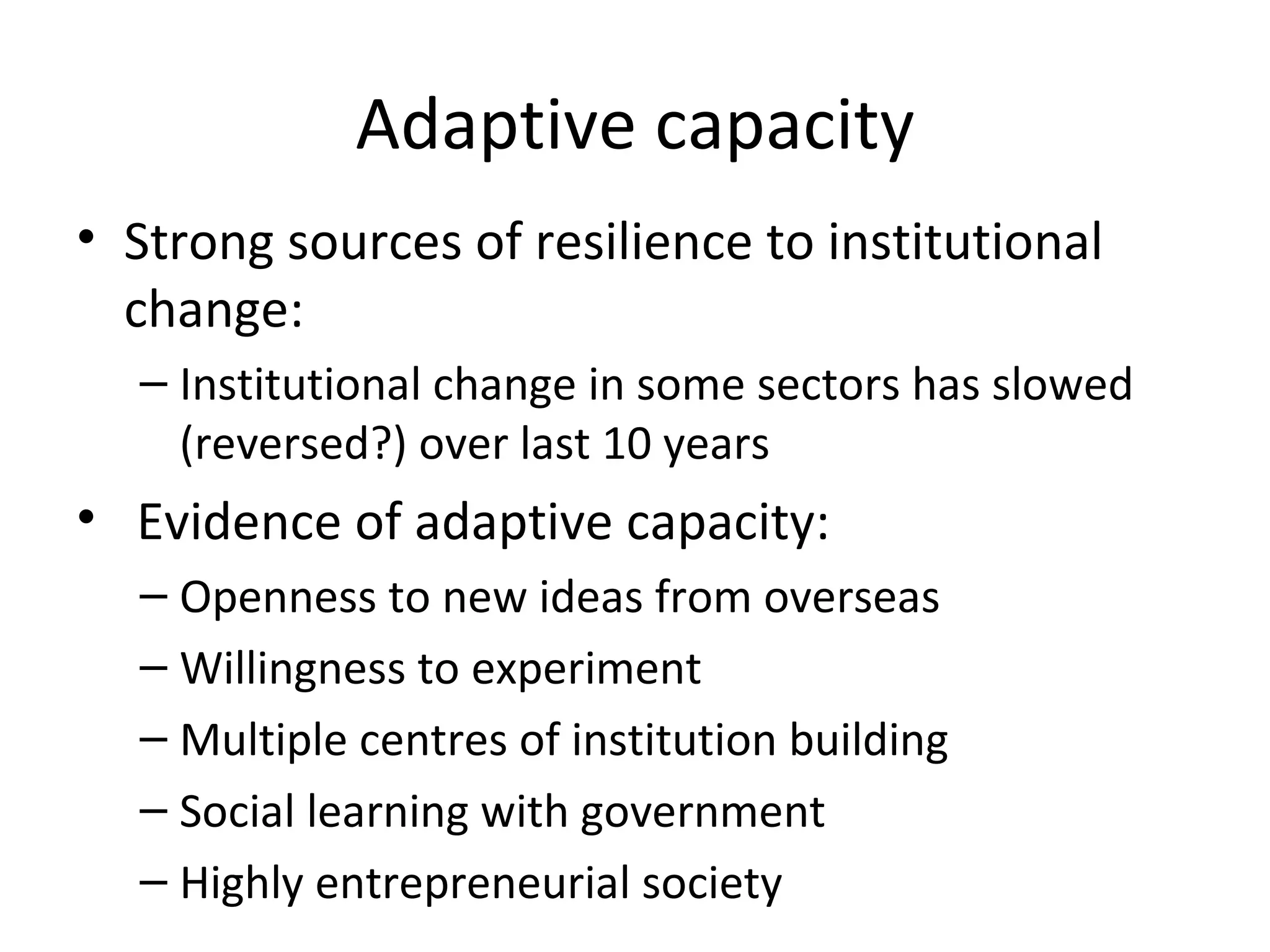
Adaptive capacity
• Strong sources of resilience to institutional
  change:
  – Institutional change in some sectors has slowed
    (reversed?) over last 10 years
• Evidence of adaptive capacity:
  – Openness to new ideas from overseas
  – Willingness to experiment
  – Multiple centres of institution building
  – Social learning with government
  – Highly entrepreneurial society
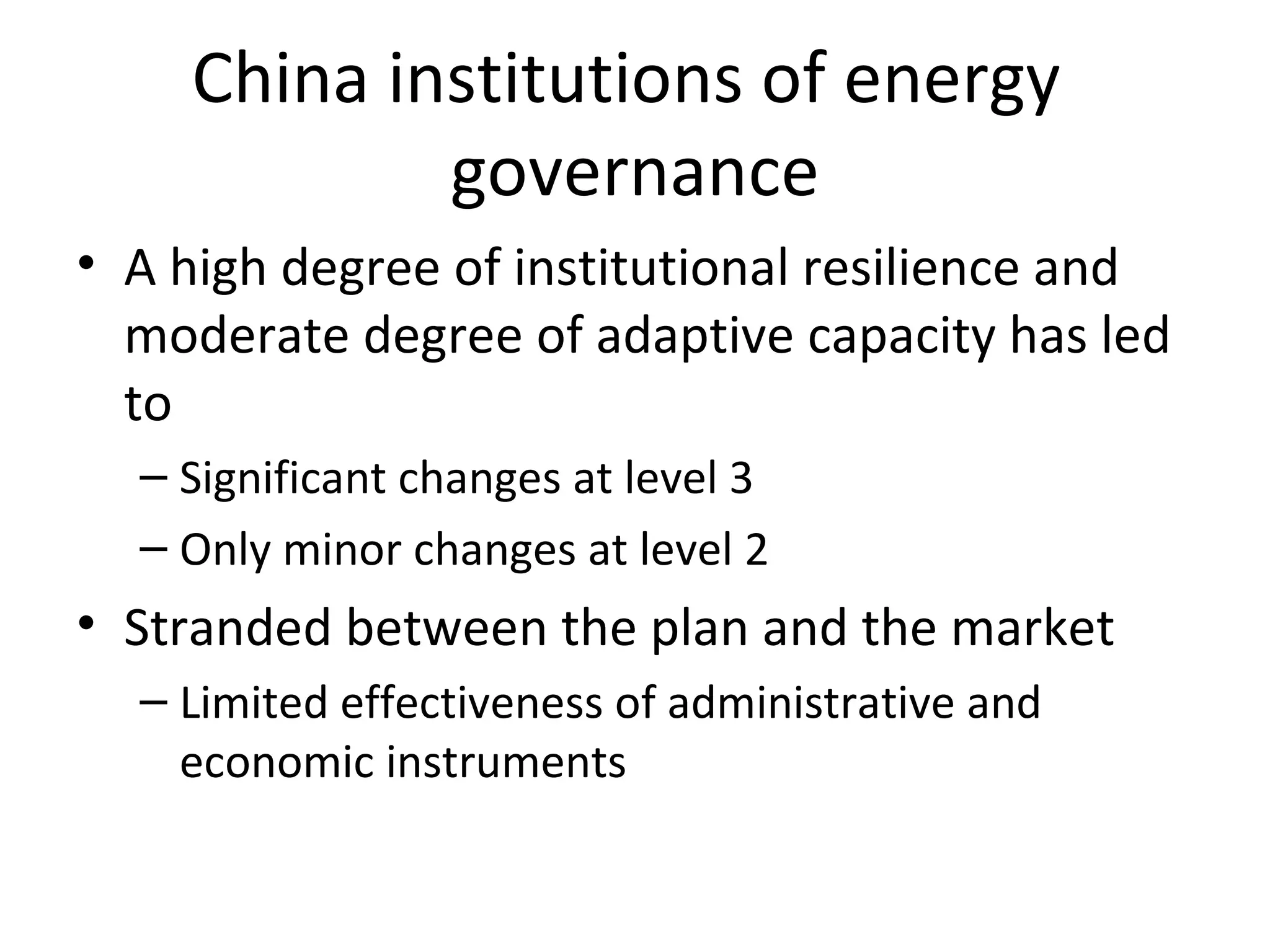
China institutions of energy
            governance
• A high degree of institutional resilience and
  moderate degree of adaptive capacity has led
  to
  – Significant changes at level 3
  – Only minor changes at level 2
• Stranded between the plan and the market
  – Limited effectiveness of administrative and
    economic instruments
Institutions
                           1. Embedded institutions:
                           norms, beliefs, ideas


2. Institutional environment:                       Behaviours: The actual
political system, bureaucratic                      transactions which determine
structures of government,                           prices, output quantities.
judiciary, legal system.


                         3. Institutions which govern
                         transactions:
                         Firms, bureaus, markets,
                         hybrids, networks. Policies,
                         laws, instruments
                                                   Adapted from Williamson (2000)
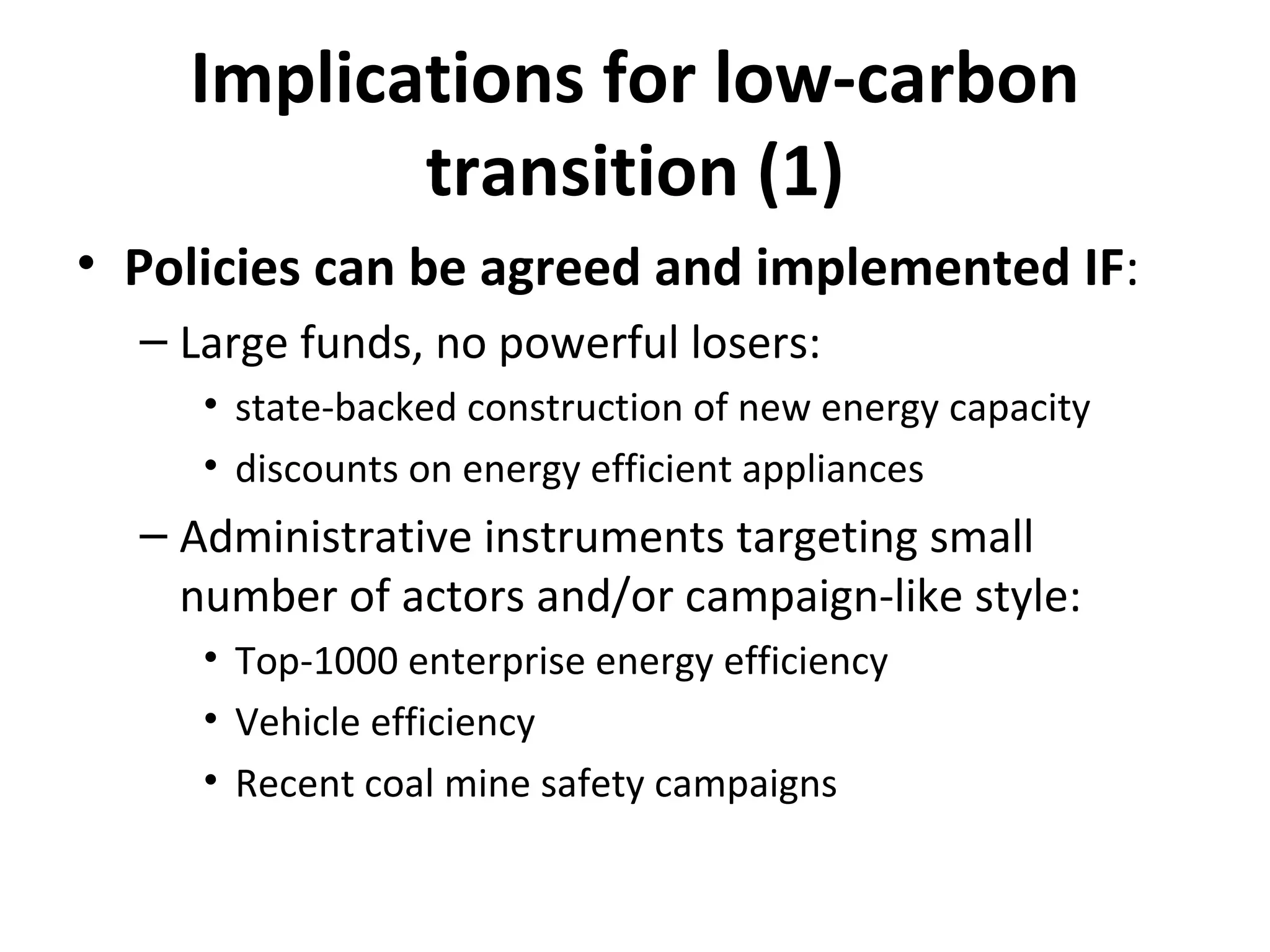
Implications for low-carbon
           transition (1)
• Policies can be agreed and implemented IF:
  – Large funds, no powerful losers:
     • state-backed construction of new energy capacity
     • discounts on energy efficient appliances
  – Administrative instruments targeting small
    number of actors and/or campaign-like style:
     • Top-1000 enterprise energy efficiency
     • Vehicle efficiency
     • Recent coal mine safety campaigns
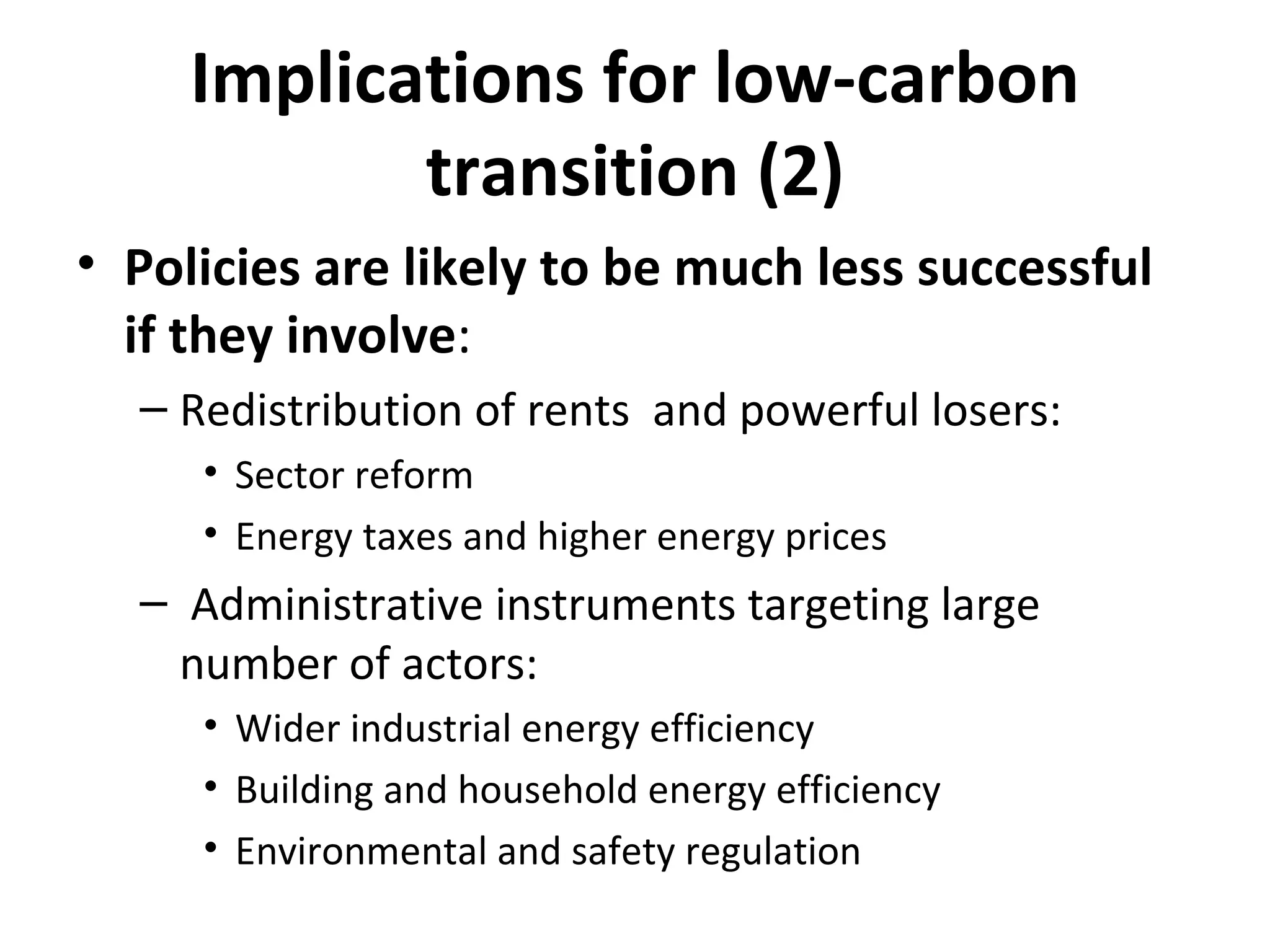
Implications for low-carbon
            transition (2)
• Policies are likely to be much less successful
  if they involve:
  – Redistribution of rents and powerful losers:
     • Sector reform
     • Energy taxes and higher energy prices
  – Administrative instruments targeting large
    number of actors:
     • Wider industrial energy efficiency
     • Building and household energy efficiency
     • Environmental and safety regulation
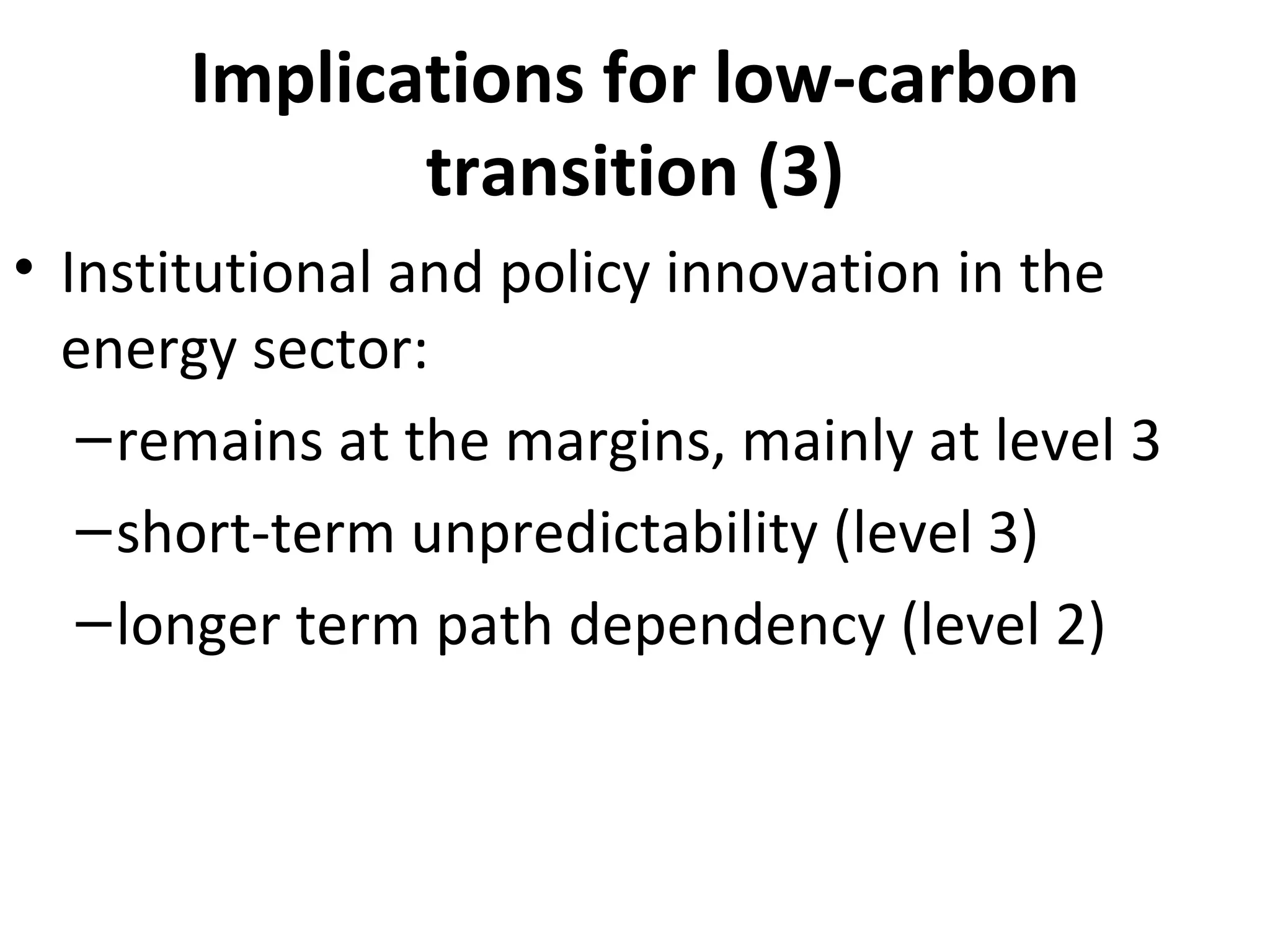
Implications for low-carbon
              transition (3)
• Institutional and policy innovation in the
  energy sector:
   – remains at the margins, mainly at level 3
   – short-term unpredictability (level 3)
   – longer term path dependency (level 2)
Conclusions (1)
• In the absence of a major slowdown in
  economic growth and/or a political
  transformation:
• Construction of new capacity to produce and
  deliver low carbon energy of all types will
  continue
• But will be almost matched by growth of fossil
  fuel capacity
• Efforts to promote energy efficiency and
  energy conservation will continue to face
  major obstacles
Conclusions (2)
• In this, China is little different from many
  other energy intensive economies, but:
  – Sheer size
  – Large population, growing middle class
  – Rapid economic growth, albeit slowing
  – Coal is dominant fuel
  – Role of industry in the economy
• Implications for global climate change: Get
  out the lifeboats

China's Long Road to a Low-Carbon Economy, Andrews-Speed (July 2012)

  • 2.
    Why institutions? • Transitionto a low-carbon economy will be constrained by many factors: – structure and rate of growth of the economy – resource endowment and existing infrastructure – and the governance of the energy sector • >>>>>>>>>>INSTITUTIONS
  • 3.
    Questions • What elementsin the manner in which China’s energy sector is governed are likely to assist or constrain the nation’s transition to a low-carbon economy? • What are the implications for China's transition to a low-carbon economy?
  • 4.
    Aims • To explorehow the study of institutions may help to elaborate on the challenges lying at the heart of transition management • To apply these ideas to the case of China • See: – Short report from Transatlantic Academy http://www.transatlanticacademy.org/publications – Book: Governance of Energy in China. Transition to a Low-Carbon Economy (Palgrave Macmillan) September 2012
  • 5.
    Structure of talk • Socio-technical transitions • Institutions • Selected Chinese institutions • Implications for low-carbon transition
  • 6.
    Socio-technical transitions • Changein the system of social behaviours and rules relating to technology and technological advance. • Steam engine, electricity, internal combustion engine, telecommunications • Most such transitions: – Driven mainly by perceived private benefits – Take 50-100 years, maybe faster today • In contrast the low-carbon transition: – Is driven mainly by perceived public benefits – Faces significant time pressure – Requires direct government and societal support
  • 7.
    Obstacles to transition •Obstacles ‘lock-in’: – structure and rate of growth of the economy – resource endowment and existing infrastructure – actors with vested interests – institutions of governance; adaptive capacity • Transition management is about involving the whole of society in this change>> • Institutions: the formal and informal rules of society, and beliefs
  • 8.
    Institutions 1. Embedded institutions: norms, beliefs, ideas 2. Institutional environment: Behaviours: The actual political system, bureaucratic transactions which determine structures of government, prices, output quantities. judiciary, legal system. 3. Institutions which govern transactions: Firms, bureaus, markets, hybrids, networks. Policies, laws, instruments Adapted from Williamson (2000)
  • 9.
    Institutions • Self-reinforcing throughpositive feedback • What do they do? – create predictability – resilient to change >>> path-dependency – constrain the path of economic/political development • How do they change? – most change is incremental – slow change leads to inconsistencies/frictions which reduce stability of the system – builds towards a threshold – a combination of external shocks and actions of actors
  • 10.
    Institutions and adaptability •Adaptive efficiency (adaptive capacity): – Dependent on culture & institutions – Degree of preference for/imposition of conformity – Openness to competition (political and economic) • The analysis of institutions gives insights to: – Economic and political development – Energy transition • Focus on levels 1 and 2, and the way in which they constrain changes at level 3
  • 11.
    Chinese embedded institutions: •Many go back hundreds or thousands of years • Centralisation of power; Hierarchy; Family • Relationships/guanxi and social capital/shortage impersonal trust • Conformity and consensus vs individualism • Appropriate behaviour vs search for truth: – false reporting and feigned compliance • Governance became synonymous with management of resources 治國 (zhi guo) • Self-reliance & state control of key industries/resources
  • 12.
    China institutional environment(1) • Institutional environment: can be directly linked to post-1949, but many have roots in Imperial past: • Combination of centralisation and fragmentation – Centralisation of political power – Role of political elite still important, but some pluralisation of decision-making – Hierarchy and personal relationships – Progressive decentralisation of economic management – Poor definition of roles and responsibilities – Multiple centres of power and institution building – Powerful SOEs
  • 13.
    China institutional environment(2) • Immature ‘modern’ legal system: long historical roots • Weak civil society • Fragmentation of authority: – Opportunities for rent seeking and abuse of power – BUT opportunities for policy innovation • The importance of CCP – Policy making and implementation – Co-opting different sectors of society – Some reform, professionalization of civil service
  • 14.
    Implications for policymaking and implementation • Policy making is no more rational than in a democracy: – Multiple actors with multiple interests – Search for consensus can prevent decision making – Strong actors can distort policy making – Limited scope for new entrants (political and economic) • Policy implementation constrained by: – Local governments/SOES pursuing own agendas – Corruption, rent seeking and clientilism – Immature legal system
  • 15.
    Adaptive capacity • Strongsources of resilience to institutional change: – Institutional change in some sectors has slowed (reversed?) over last 10 years • Evidence of adaptive capacity: – Openness to new ideas from overseas – Willingness to experiment – Multiple centres of institution building – Social learning with government – Highly entrepreneurial society
  • 16.
    China institutions ofenergy governance • A high degree of institutional resilience and moderate degree of adaptive capacity has led to – Significant changes at level 3 – Only minor changes at level 2 • Stranded between the plan and the market – Limited effectiveness of administrative and economic instruments
  • 17.
    Institutions 1. Embedded institutions: norms, beliefs, ideas 2. Institutional environment: Behaviours: The actual political system, bureaucratic transactions which determine structures of government, prices, output quantities. judiciary, legal system. 3. Institutions which govern transactions: Firms, bureaus, markets, hybrids, networks. Policies, laws, instruments Adapted from Williamson (2000)
  • 18.
    Implications for low-carbon transition (1) • Policies can be agreed and implemented IF: – Large funds, no powerful losers: • state-backed construction of new energy capacity • discounts on energy efficient appliances – Administrative instruments targeting small number of actors and/or campaign-like style: • Top-1000 enterprise energy efficiency • Vehicle efficiency • Recent coal mine safety campaigns
  • 19.
    Implications for low-carbon transition (2) • Policies are likely to be much less successful if they involve: – Redistribution of rents and powerful losers: • Sector reform • Energy taxes and higher energy prices – Administrative instruments targeting large number of actors: • Wider industrial energy efficiency • Building and household energy efficiency • Environmental and safety regulation
  • 20.
    Implications for low-carbon transition (3) • Institutional and policy innovation in the energy sector: – remains at the margins, mainly at level 3 – short-term unpredictability (level 3) – longer term path dependency (level 2)
  • 21.
    Conclusions (1) • Inthe absence of a major slowdown in economic growth and/or a political transformation: • Construction of new capacity to produce and deliver low carbon energy of all types will continue • But will be almost matched by growth of fossil fuel capacity • Efforts to promote energy efficiency and energy conservation will continue to face major obstacles
  • 22.
    Conclusions (2) • Inthis, China is little different from many other energy intensive economies, but: – Sheer size – Large population, growing middle class – Rapid economic growth, albeit slowing – Coal is dominant fuel – Role of industry in the economy • Implications for global climate change: Get out the lifeboats