Beyond GDP: From Measurement to
Politics and Policy
Integrated and innovative policy making
Paris 24 March 2014
1. The challenge
2. Components of the programme
3. Questions and next steps
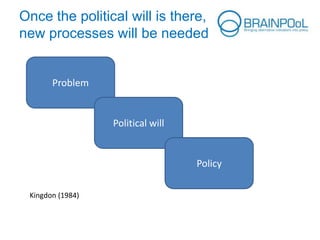
Once the political will is there,
new processes will be needed
Problem
Political will
Policy
Kingdon (1984)
What’s different with Beyond
GDP?
• Beyond GDP is by definition more multi-dimensional than GDP,
requiring multiple goals to be pursued at the same time.
• The existing growth narrative provides a very useful set of
simplifying assumptions, which can be turned into rules of thumb
• Without this we have to accept greater complexity, and perhaps an
alternative set of simplifying assumptions based on a new narrative
• So how do we break the hold of the existing simplifying
assumptions?
• How do we manage the resulting complexity?
• The answer (we suggest) is a coherent organisational change
programme with a range of different elements
1. The challenge
2. Components of the programme
3. Questions and next steps
Only a combination of actions
led from the top will work
• The system is a system – can’t change one component without at
least a plan for changing others
• The broad aim is to open up economic policy making to new
‘Beyond GDP’ ideas, to admit the multi-dimensionality of progress
• Political and official leadership essential: a critical task for all
advocates of Beyond GDP is to get this leadership on board
• Then we will need a co-ordinated programme…
…including changes focussed
on people and organisations …
• Human resources and training
– Training to create awareness of existing simplifying assumptions
– Recruitment of more diverse range of specialisms into economics ministries –
e.g. psychology (wellbeing), environmental sciences (sustainability), systems
theory
– Personal performance targets reflecting the new priorities – e.g. for Ministers
and senior civil servants
• Structural changes
– New departments or cross cutting units where a specific issue to address – e.g.
New Zealand cross-ministerial mandate on biosecurity; UK Department for
Energy and Climate Change; possibly use liaison officers
– Consider functions of finance and economics ministries (reduce or expand) –
e.g. New Zealand Treasury’s Living Standards Framework
… and on the policy making
process.
• New formal tools
– Analytical tools which weaken the grip of existing tools – e.g. Multiple-Criteria
Analysis, wellbeing Cost Benefit Analysis, environmental impact assessment
– Making this participatory – techniques based on SROI
– Budgeting tools and targets – e.g. carbon budgets in the UK
• New processes
– Processes to facilitate innovation, bringing diverse perspectives to the table –
e.g. Policy Labs in Denmark, Finland, UK
– Re-looking at the boundaries between official and political decision making
– New forms of reporting to create accountability mechanisms and momentum
• Engagement with and support for new ideas from outside
– Eg heterodox economics
1. The challenge
2. Components of the programme
3. Next steps
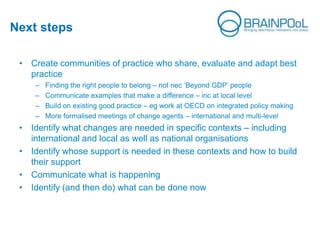
Next steps
• Create communities of practice who share, evaluate and adapt best
practice
– Finding the right people to belong – not nec ‘Beyond GDP’ people
– Communicate examples that make a difference – inc at local level
– Build on existing good practice – eg work at OECD on integrated policy making
– More formalised meetings of change agents – international and multi-level
• Identify what changes are needed in specific contexts – including
international and local as well as national organisations
• Identify whose support is needed in these contexts and how to build
their support
• Communicate what is happening
• Identify (and then do) what can be done now

BRAINPOoL Final Conference: Integrated & Innovative Policy Making

  • 1.
    Beyond GDP: FromMeasurement to Politics and Policy Integrated and innovative policy making Paris 24 March 2014
  • 2.
    1. The challenge 2.Components of the programme 3. Questions and next steps
  • 3.
    Once the politicalwill is there, new processes will be needed Problem Political will Policy Kingdon (1984)
  • 4.
    What’s different withBeyond GDP? • Beyond GDP is by definition more multi-dimensional than GDP, requiring multiple goals to be pursued at the same time. • The existing growth narrative provides a very useful set of simplifying assumptions, which can be turned into rules of thumb • Without this we have to accept greater complexity, and perhaps an alternative set of simplifying assumptions based on a new narrative • So how do we break the hold of the existing simplifying assumptions? • How do we manage the resulting complexity? • The answer (we suggest) is a coherent organisational change programme with a range of different elements
  • 5.
    1. The challenge 2.Components of the programme 3. Questions and next steps
  • 6.
    Only a combinationof actions led from the top will work • The system is a system – can’t change one component without at least a plan for changing others • The broad aim is to open up economic policy making to new ‘Beyond GDP’ ideas, to admit the multi-dimensionality of progress • Political and official leadership essential: a critical task for all advocates of Beyond GDP is to get this leadership on board • Then we will need a co-ordinated programme…
  • 7.
    …including changes focussed onpeople and organisations … • Human resources and training – Training to create awareness of existing simplifying assumptions – Recruitment of more diverse range of specialisms into economics ministries – e.g. psychology (wellbeing), environmental sciences (sustainability), systems theory – Personal performance targets reflecting the new priorities – e.g. for Ministers and senior civil servants • Structural changes – New departments or cross cutting units where a specific issue to address – e.g. New Zealand cross-ministerial mandate on biosecurity; UK Department for Energy and Climate Change; possibly use liaison officers – Consider functions of finance and economics ministries (reduce or expand) – e.g. New Zealand Treasury’s Living Standards Framework
  • 8.
    … and onthe policy making process. • New formal tools – Analytical tools which weaken the grip of existing tools – e.g. Multiple-Criteria Analysis, wellbeing Cost Benefit Analysis, environmental impact assessment – Making this participatory – techniques based on SROI – Budgeting tools and targets – e.g. carbon budgets in the UK • New processes – Processes to facilitate innovation, bringing diverse perspectives to the table – e.g. Policy Labs in Denmark, Finland, UK – Re-looking at the boundaries between official and political decision making – New forms of reporting to create accountability mechanisms and momentum • Engagement with and support for new ideas from outside – Eg heterodox economics
  • 9.
    1. The challenge 2.Components of the programme 3. Next steps
  • 10.
    Next steps • Createcommunities of practice who share, evaluate and adapt best practice – Finding the right people to belong – not nec ‘Beyond GDP’ people – Communicate examples that make a difference – inc at local level – Build on existing good practice – eg work at OECD on integrated policy making – More formalised meetings of change agents – international and multi-level • Identify what changes are needed in specific contexts – including international and local as well as national organisations • Identify whose support is needed in these contexts and how to build their support • Communicate what is happening • Identify (and then do) what can be done now