Beyond GDP: From Measurement to
Politics and Policy
An introduction to BRAINPOoL
Paris 24 March 2014
BRAINPOoL is an EU funded
project
BRAINPOoL is an FP7 funded project aimed at identifying and
overcoming the barriers to ‘alternative’ indicators being used in policy.
During the project we have:
• carried out research and interviews,
• conducted seven action research case studies to explore ways to
improve uptake of Beyond GDP indicators,
• and organised a knowledge-brokerage event to jointly explore ways to
overcome the barriers
1. Objectives
2. What is the problem?
3. Findings
4. Recommendations
What will it take to get ‘Beyond
GDP’ indicators used?
• Maximising GDP and market efficiency no longer do the job – we
need ‘good growth’ not just growth
• New indicators that reduce the prominence of GDP are part of the
answer – hence the Stiglitz Commission
• But what else is needed to achieve change? That is, what will it take
to get new indicators of this kind used in policy making?
• BRAINPOoL set up to stimulate interactions between indicator
developers and users to start to answer this question
1. Objectives
2. What is the problem?
3. Findings
4. Recommendations
We found the problem needed
clearer definition
• The issue is not how do we get social and environmental indicators
used in social and environmental policy making
We found the problem needed
clearer definition
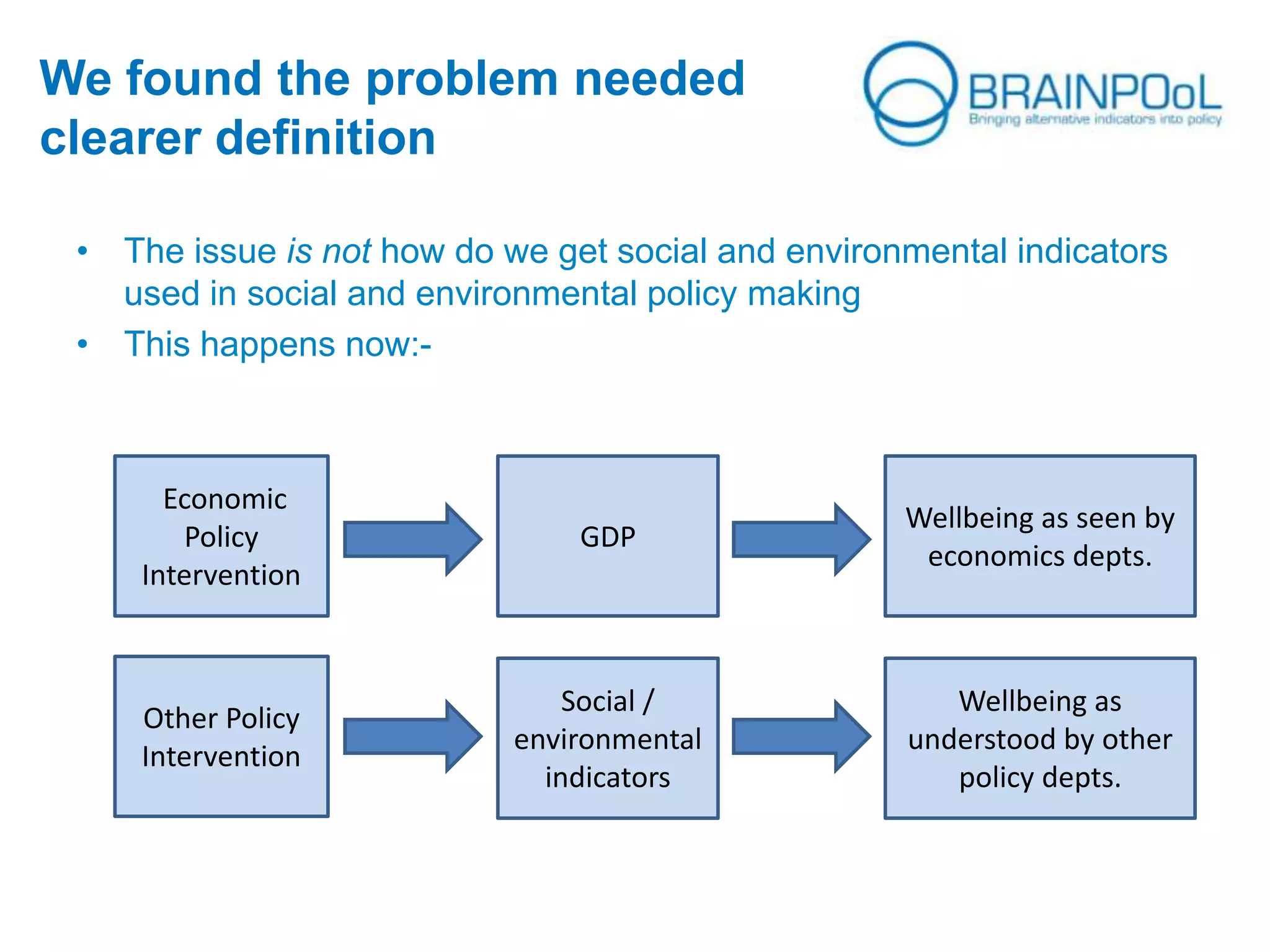
• The issue is not how do we get social and environmental indicators
used in social and environmental policy making
• This happens now:-
Economic
Policy
Intervention
GDP
Wellbeing as seen by
economics depts.
Other Policy
Intervention
Social /
environmental
indicators
Wellbeing as
understood by other
policy depts.
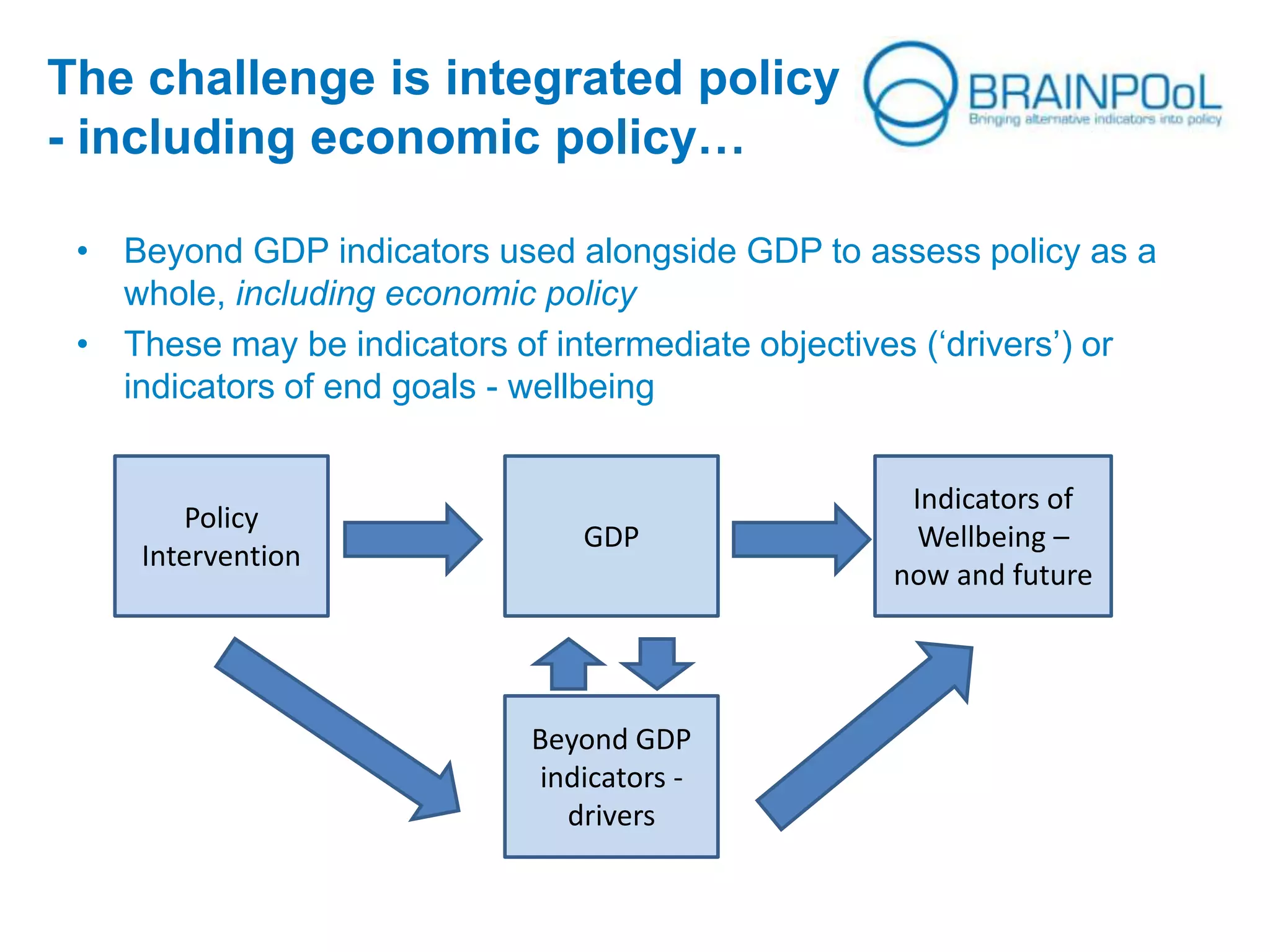
The challenge is integrated policy
- including economic policy…
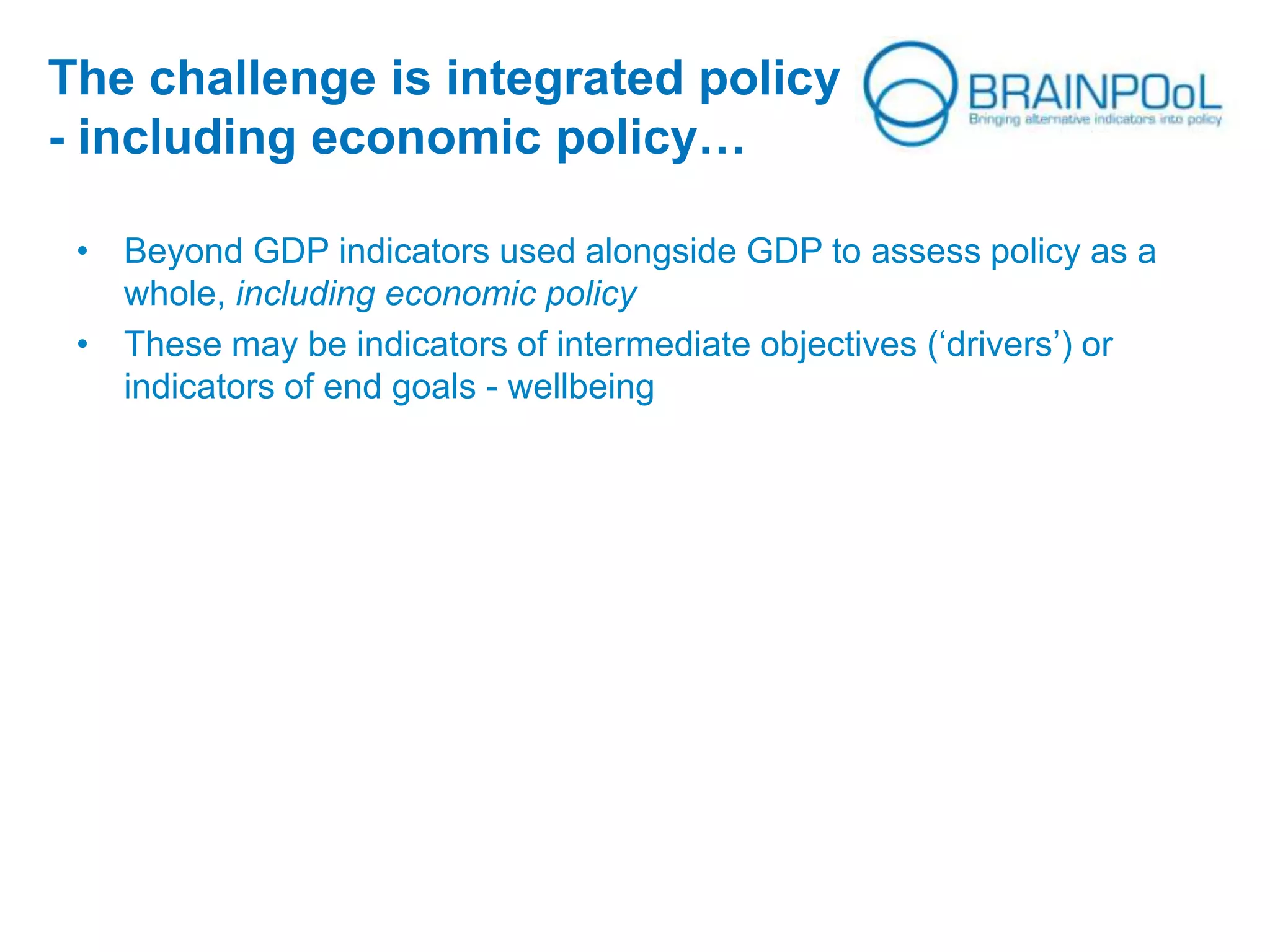
• Beyond GDP indicators used alongside GDP to assess policy as a
whole, including economic policy
• These may be indicators of intermediate objectives (‘drivers’) or
indicators of end goals - wellbeing
The challenge is integrated policy
- including economic policy…
• Beyond GDP indicators used alongside GDP to assess policy as a
whole, including economic policy
• These may be indicators of intermediate objectives (‘drivers’) or
indicators of end goals - wellbeing
Policy
Intervention
GDP
Indicators of
Wellbeing –
now and future
Beyond GDP
indicators -
drivers
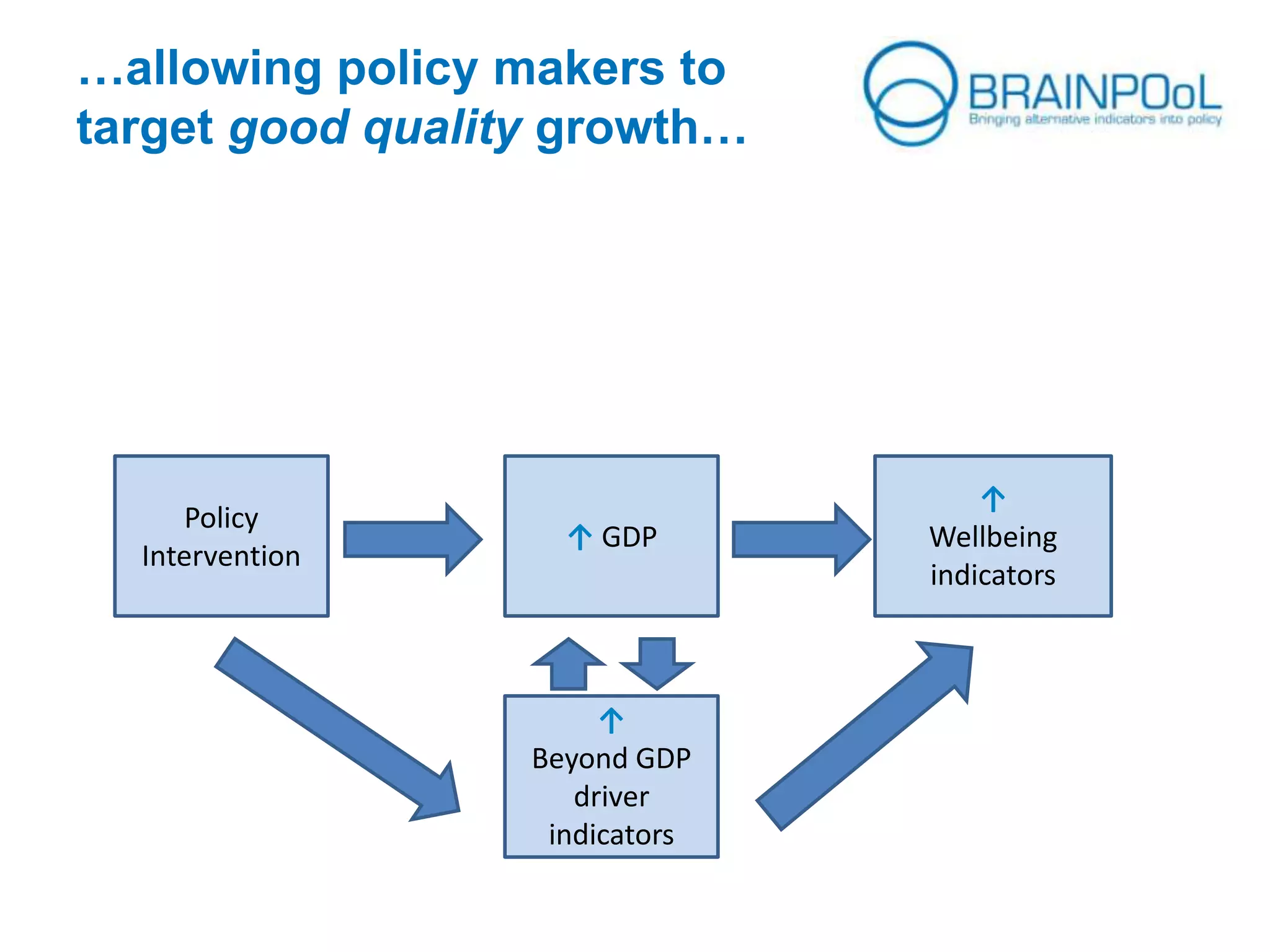
…allowing policy makers to
target good quality growth…
Policy
Intervention
↑ GDP
↑
Wellbeing
indicators
↑
Beyond GDP
driver
indicators
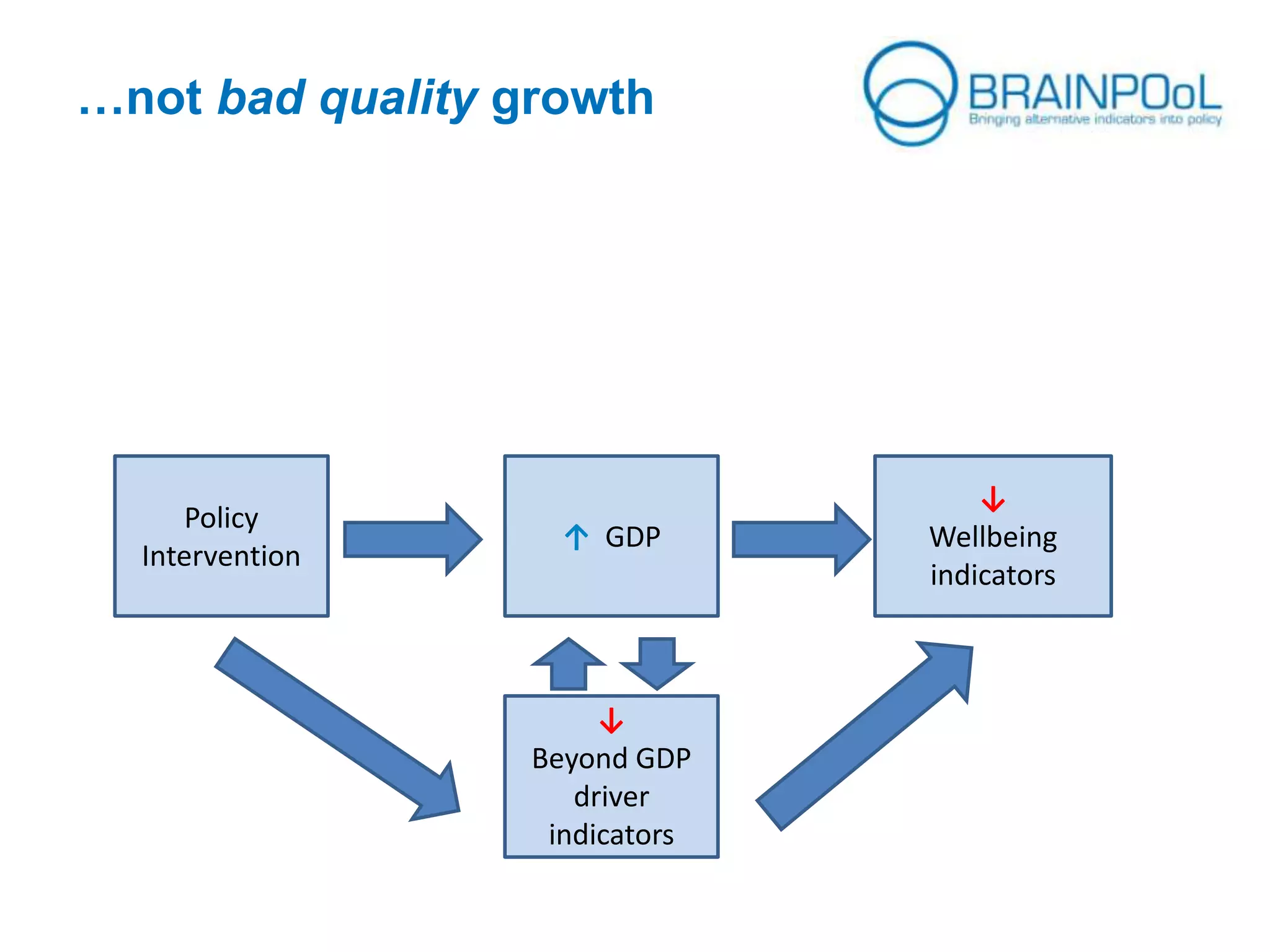
…not bad quality growth
Policy
Intervention
↑ GDP
↓
Wellbeing
indicators
↓
Beyond GDP
driver
indicators
1. Objectives
2. What is the problem?
3. Findings
4. Recommendations
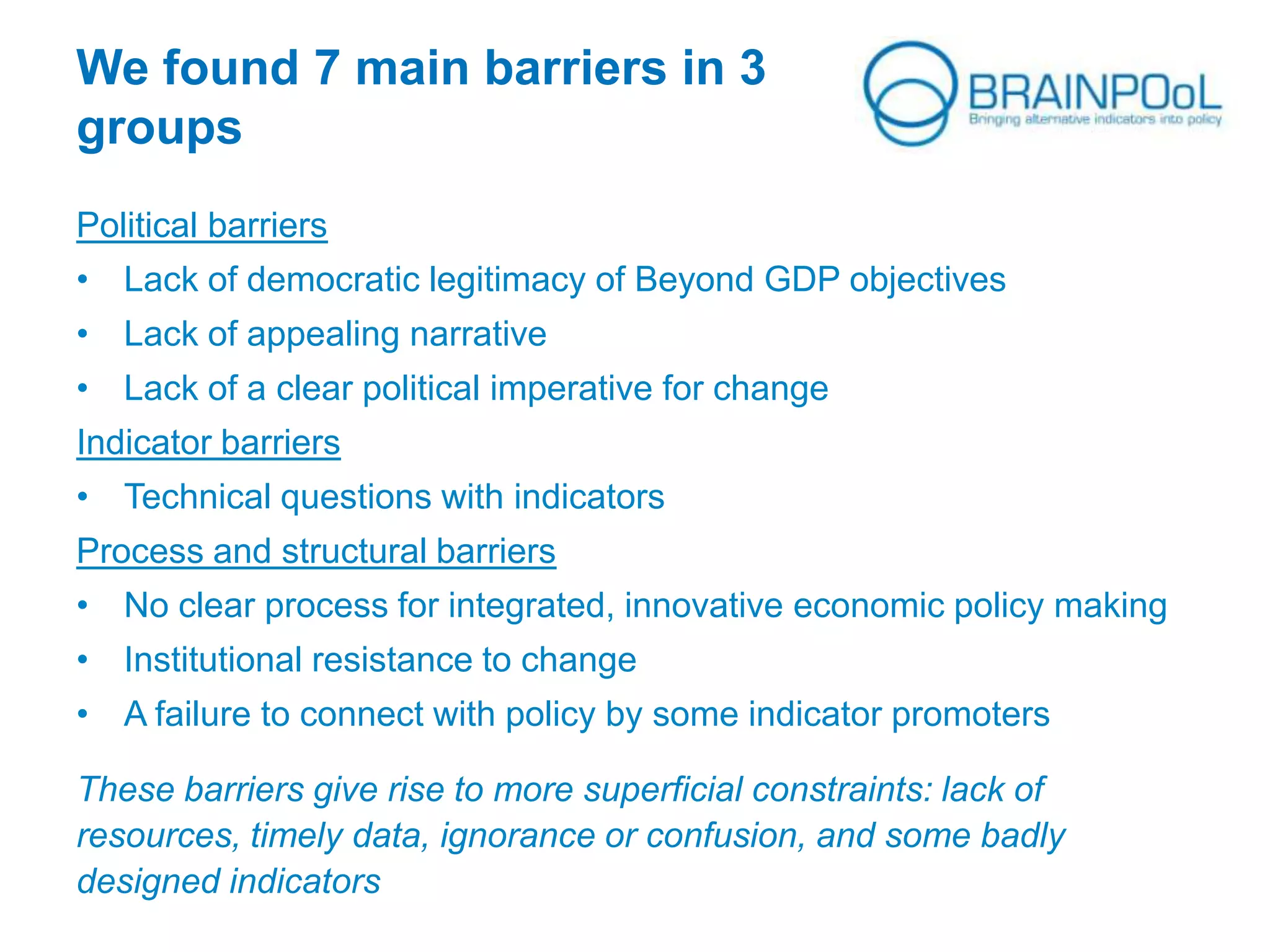
We found 7 main barriers in 3
groups
Political barriers
• Lack of democratic legitimacy of Beyond GDP objectives
• Lack of appealing narrative
• Lack of a clear political imperative for change
Indicator barriers
• Technical questions with indicators
Process and structural barriers
• No clear process for integrated, innovative economic policy making
• Institutional resistance to change
• A failure to connect with policy by some indicator promoters
These barriers give rise to more superficial constraints: lack of
resources, timely data, ignorance or confusion, and some badly
designed indicators
1. Objectives
2. What is the problem?
3. Findings
4. Recommendations
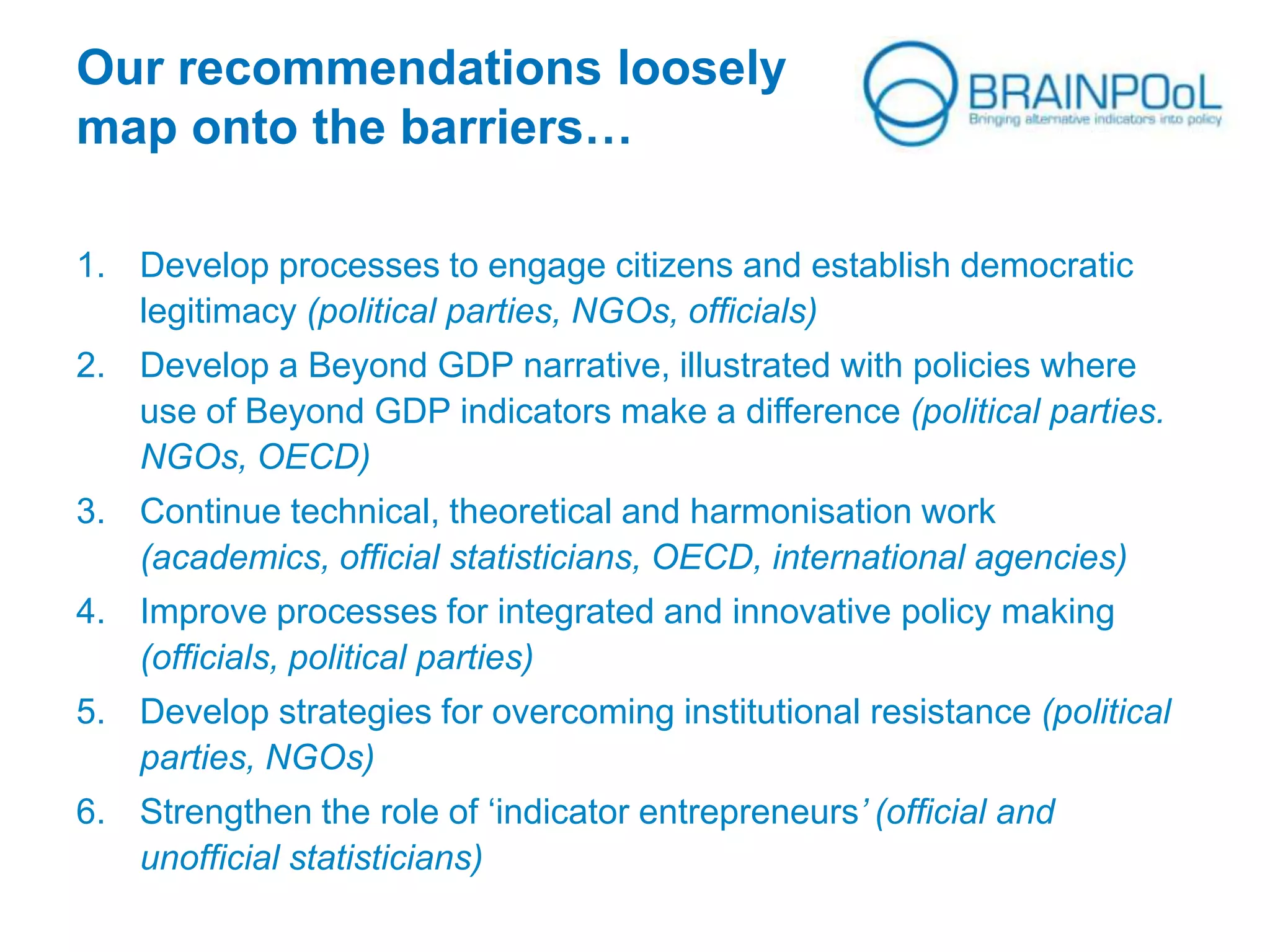
Our recommendations loosely
map onto the barriers…
1. Develop processes to engage citizens and establish democratic
legitimacy (political parties, NGOs, officials)
2. Develop a Beyond GDP narrative, illustrated with policies where
use of Beyond GDP indicators make a difference (political parties.
NGOs, OECD)
3. Continue technical, theoretical and harmonisation work
(academics, official statisticians, OECD, international agencies)
4. Improve processes for integrated and innovative policy making
(officials, political parties)
5. Develop strategies for overcoming institutional resistance (political
parties, NGOs)
6. Strengthen the role of ‘indicator entrepreneurs’ (official and
unofficial statisticians)
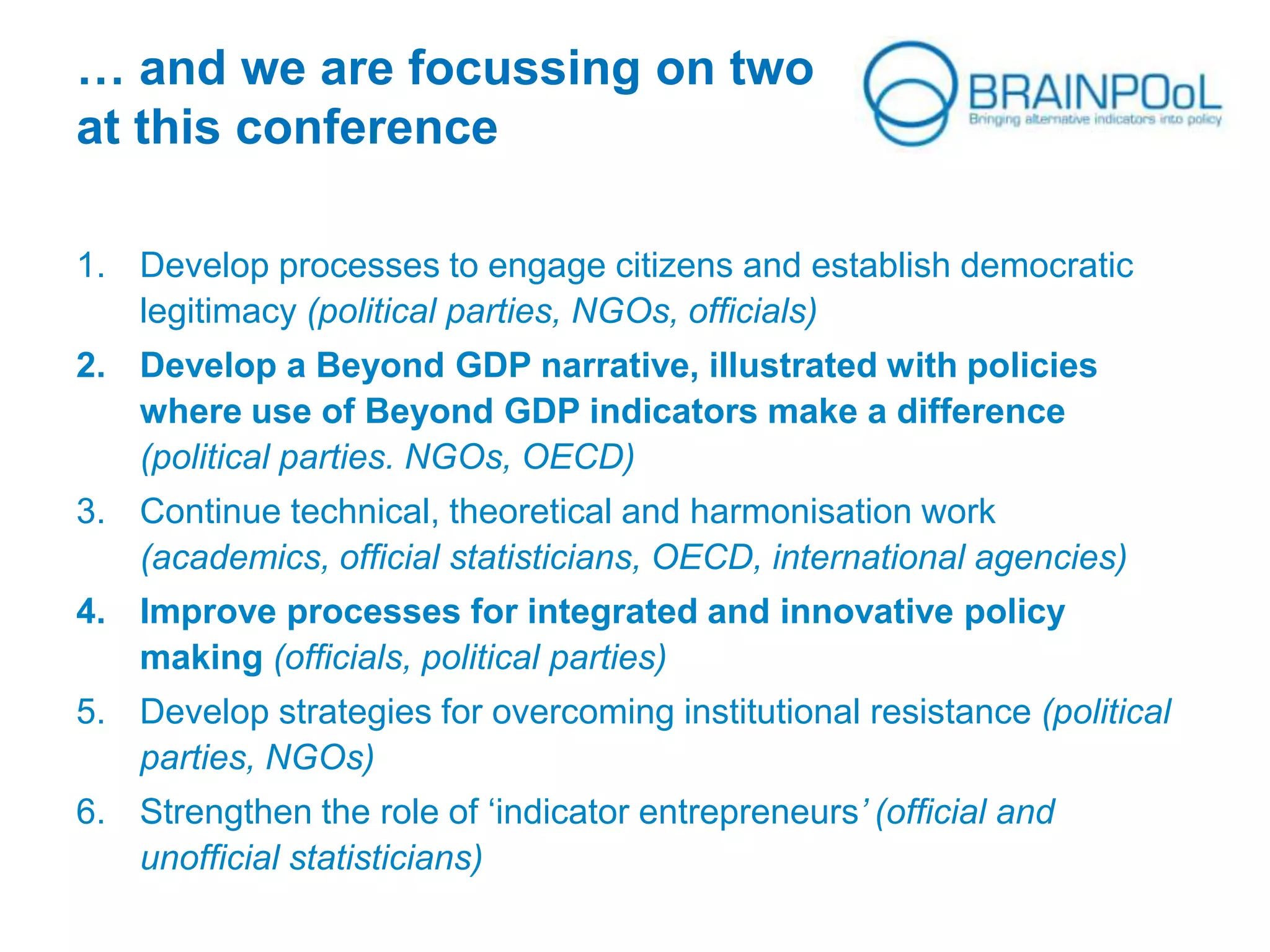
… and we are focussing on two
at this conference
1. Develop processes to engage citizens and establish democratic
legitimacy (political parties, NGOs, officials)
2. Develop a Beyond GDP narrative, illustrated with policies
where use of Beyond GDP indicators make a difference
(political parties. NGOs, OECD)
3. Continue technical, theoretical and harmonisation work
(academics, official statisticians, OECD, international agencies)
4. Improve processes for integrated and innovative policy
making (officials, political parties)
5. Develop strategies for overcoming institutional resistance (political
parties, NGOs)
6. Strengthen the role of ‘indicator entrepreneurs’ (official and
unofficial statisticians)

BRAINPOoL Final Conference: Introduction to the Project

  • 1.
    Beyond GDP: FromMeasurement to Politics and Policy An introduction to BRAINPOoL Paris 24 March 2014
  • 2.
    BRAINPOoL is anEU funded project BRAINPOoL is an FP7 funded project aimed at identifying and overcoming the barriers to ‘alternative’ indicators being used in policy. During the project we have: • carried out research and interviews, • conducted seven action research case studies to explore ways to improve uptake of Beyond GDP indicators, • and organised a knowledge-brokerage event to jointly explore ways to overcome the barriers
  • 3.
    1. Objectives 2. Whatis the problem? 3. Findings 4. Recommendations
  • 4.
    What will ittake to get ‘Beyond GDP’ indicators used? • Maximising GDP and market efficiency no longer do the job – we need ‘good growth’ not just growth • New indicators that reduce the prominence of GDP are part of the answer – hence the Stiglitz Commission • But what else is needed to achieve change? That is, what will it take to get new indicators of this kind used in policy making? • BRAINPOoL set up to stimulate interactions between indicator developers and users to start to answer this question
  • 5.
    1. Objectives 2. Whatis the problem? 3. Findings 4. Recommendations
  • 6.
    We found theproblem needed clearer definition • The issue is not how do we get social and environmental indicators used in social and environmental policy making
  • 7.
    We found theproblem needed clearer definition • The issue is not how do we get social and environmental indicators used in social and environmental policy making • This happens now:- Economic Policy Intervention GDP Wellbeing as seen by economics depts. Other Policy Intervention Social / environmental indicators Wellbeing as understood by other policy depts.
  • 8.
    The challenge isintegrated policy - including economic policy… • Beyond GDP indicators used alongside GDP to assess policy as a whole, including economic policy • These may be indicators of intermediate objectives (‘drivers’) or indicators of end goals - wellbeing
  • 9.
    The challenge isintegrated policy - including economic policy… • Beyond GDP indicators used alongside GDP to assess policy as a whole, including economic policy • These may be indicators of intermediate objectives (‘drivers’) or indicators of end goals - wellbeing Policy Intervention GDP Indicators of Wellbeing – now and future Beyond GDP indicators - drivers
  • 10.
    …allowing policy makersto target good quality growth… Policy Intervention ↑ GDP ↑ Wellbeing indicators ↑ Beyond GDP driver indicators
  • 11.
    …not bad qualitygrowth Policy Intervention ↑ GDP ↓ Wellbeing indicators ↓ Beyond GDP driver indicators
  • 12.
    1. Objectives 2. Whatis the problem? 3. Findings 4. Recommendations
  • 13.
    We found 7main barriers in 3 groups Political barriers • Lack of democratic legitimacy of Beyond GDP objectives • Lack of appealing narrative • Lack of a clear political imperative for change Indicator barriers • Technical questions with indicators Process and structural barriers • No clear process for integrated, innovative economic policy making • Institutional resistance to change • A failure to connect with policy by some indicator promoters These barriers give rise to more superficial constraints: lack of resources, timely data, ignorance or confusion, and some badly designed indicators
  • 14.
    1. Objectives 2. Whatis the problem? 3. Findings 4. Recommendations
  • 15.
    Our recommendations loosely maponto the barriers… 1. Develop processes to engage citizens and establish democratic legitimacy (political parties, NGOs, officials) 2. Develop a Beyond GDP narrative, illustrated with policies where use of Beyond GDP indicators make a difference (political parties. NGOs, OECD) 3. Continue technical, theoretical and harmonisation work (academics, official statisticians, OECD, international agencies) 4. Improve processes for integrated and innovative policy making (officials, political parties) 5. Develop strategies for overcoming institutional resistance (political parties, NGOs) 6. Strengthen the role of ‘indicator entrepreneurs’ (official and unofficial statisticians)
  • 16.
    … and weare focussing on two at this conference 1. Develop processes to engage citizens and establish democratic legitimacy (political parties, NGOs, officials) 2. Develop a Beyond GDP narrative, illustrated with policies where use of Beyond GDP indicators make a difference (political parties. NGOs, OECD) 3. Continue technical, theoretical and harmonisation work (academics, official statisticians, OECD, international agencies) 4. Improve processes for integrated and innovative policy making (officials, political parties) 5. Develop strategies for overcoming institutional resistance (political parties, NGOs) 6. Strengthen the role of ‘indicator entrepreneurs’ (official and unofficial statisticians)