How to move Beyond-GDP?
from
Defining meta-questions on use
to
Working with barriers for influence
Géraldine THIRY
Tom BAULER
Université Libre de Bruxelles - BE

International knowledge brokerage workshop
October 28-29, 2013, Venice (IT)
From a contextual perspective
• Recently, much is officially said about renewing
indicators of wealth:
– Stiglitz, Sen, Fitoussi (2010)
– OECD (2011)

– CEC-COM (2009)
 ‘technically’, but also a recurrent question w/r to
indicators and their role as policy-tools

• Relatively few studies, explorations, analyses which
focus on the link between B-GDP indicators and…
– how indicators percolate in decisional and political spheres
– how indicators are anchored in decisional processes
From a definitional perspective
• B-GDP indicators define themselves via the
objective, use, meaning… that is projected or made
of them, and not solely by their content:
– “B-GDP are those indicators that have been proposed as
necessary and central to the measurement of societal
progress, other than those – such as GDP and
unemployment rate – that are already playing this role”
Brainpool’s WP1-report

• Brokerage activities on B-GDP - bring B-GDP into
policy - relate thus also to studying and working with
issues of “use”, i.e. representations, facts,
anecdotes…
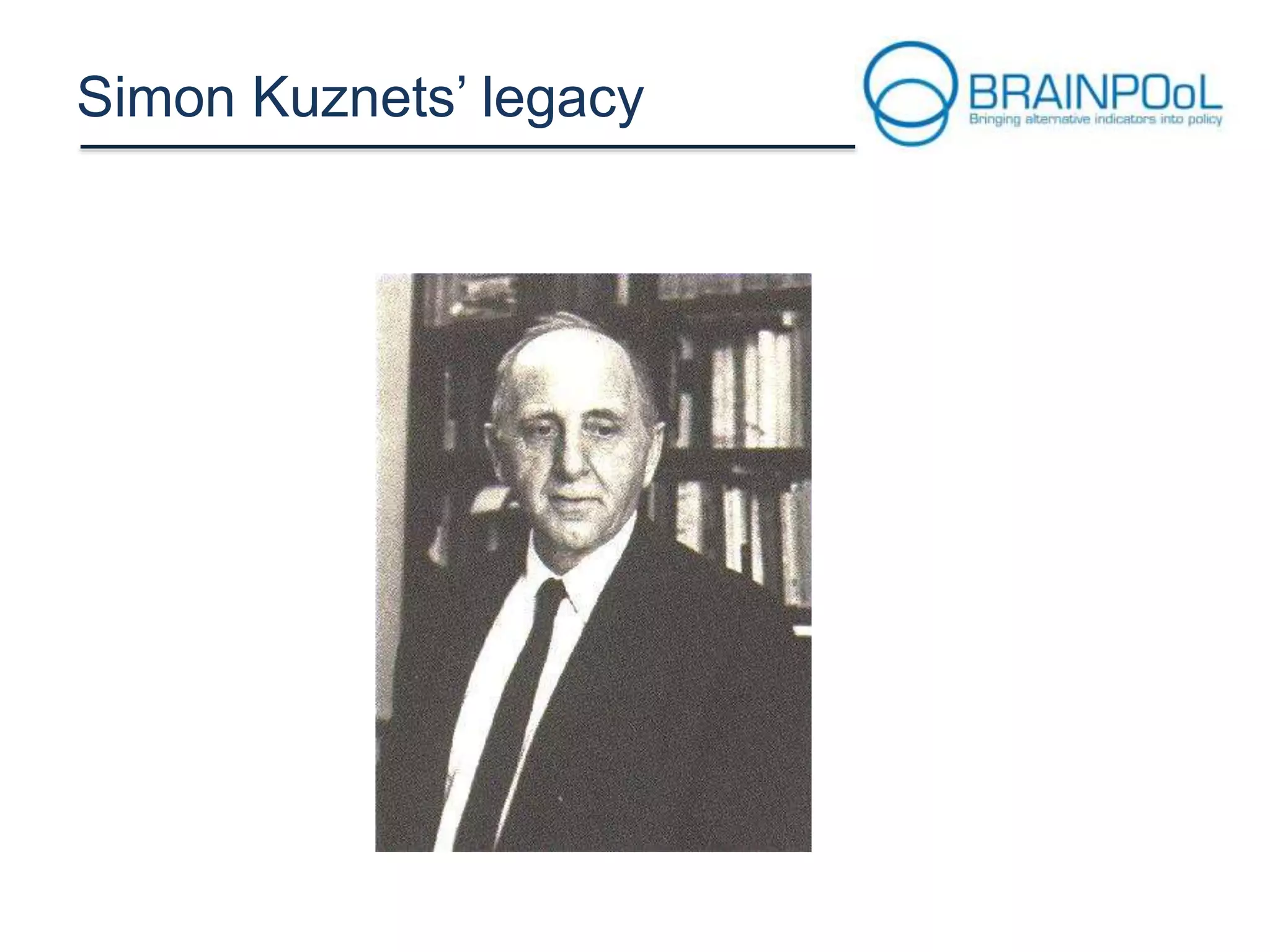
Simon Kuznets’ legacy
Our double objective
• Better understand demand/non-demand and the
policy debates around
• empirical analyses and their interpretation
• in many policy contexts and at different levels

• with a diversity of indicators

• Co-identify and discuss the levers and barriers to
the creation, institutionalisation, assessment of BGDP
– case studies with actors
– in many policy contexts and at different levels
– with a diversity of indicators
How to move Beyond-GDP?
On understanding “use”

Géraldine THIRY
Université Libre de Bruxelles - BE

International knowledge brokerage workshop
October 28-29, 2013, Venice (IT)
Structure
- Context
- Evolution of governance systems : why are indicators a
societal and political issue?

- Empirical exploration of the “use” of B-GDP
- At the European levels: an issue of scale(s)
- As perceived by Actors: an issue of confusion and of
legitimate expertise

- Framing our workshop discussions
Structure
- Context
- Evolution of governance systems : why are indicators
a societal and political issue?
Evolution of governance
• In the current western governance systems, indicators
have become the functional and political articulations of
a new mode of governmentality (Ogien 2010, Salais
2011)
• Functional : indicators are indispensable to the
comparison of quantified performances
• Political : indicators are new support of a political
legitimation register

9
Evolution of governance
• Quantifying is not only « measuring », it is first and
foremost « convening » of what has to be measured
• Because Quantifying = convening + measuring,…
• Indicators are a political issue : toward a governance of
expertise?
– towards a redefinition of the boundaries between « scientific »
and « citizen-based », between technocratic and democratic

10
Structure

- Empirical exploration of the “use” of B-GDP
- At the European levels: an issue of scale(s)
- As perceived by actors: an issue of confusion and of
legitimate expertise
Structure

- At the European levels: an issue of scale(s)
European levels
• Overall results stress the existence of a
chronological structure influenced by the
emergence of a series of concepts underlying the
subsequent measurement efforts…
• …accompanied by the emergence of a series of
new actors…
• …expressing needs to develop new scales of
measurements
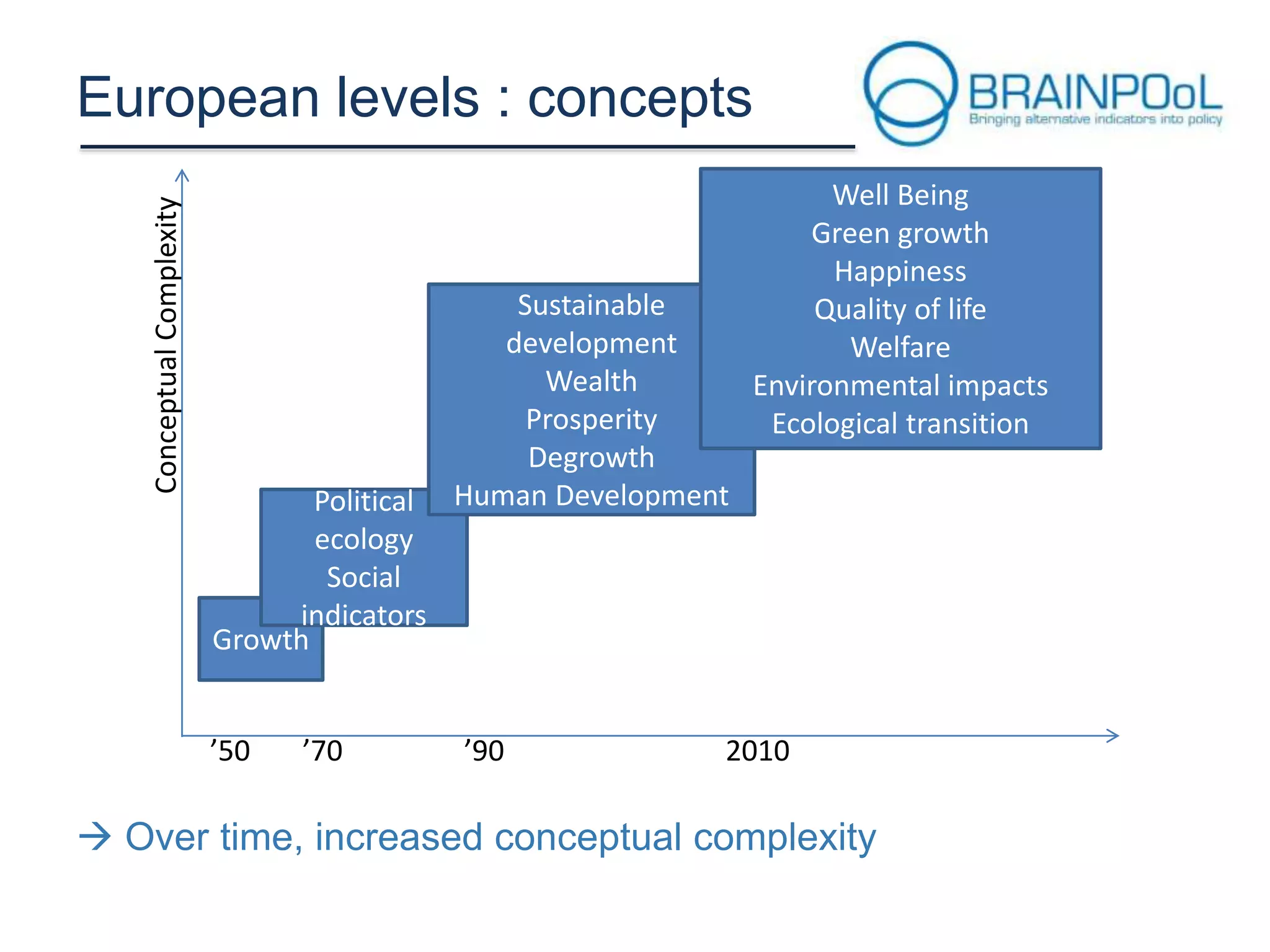
Conceptual Complexity

European levels : concepts

Political
ecology
Social
indicators
Growth
’50

’70

Sustainable
development
Wealth
Prosperity
Degrowth
Human Development

’90

Well Being
Green growth
Happiness
Quality of life
Welfare
Environmental impacts
Ecological transition

2010

 Over time, increased conceptual complexity
European levels : actors
• A complex system of actors where debate is also
revolving…
• …without citizens…

• …on how to integrate bottom-up perspectives
•  overall a very imprecise demand regarding BGDP (including a very imprecise understanding and
knowledge of B-GDP)
European levels : scales
• Local scale initiatives are also referring to global
initiatives of indicator critique and indicator
developments
– top-down percolation of conceptual necessity

• Difficult transmission of achievements of local
initiatives to national/supranational levels
– imprecise bottom-up percolation of hands-on
achievements

•  Compare the incomparable ?
Structure

- As perceived by actors: an issue of confusion and of
legitimate expertise
Actors’ Perceptions
• Confusions and divergences operating on 2 levels:
– on concepts and indicators
– on societal models
Actors’ Perceptions
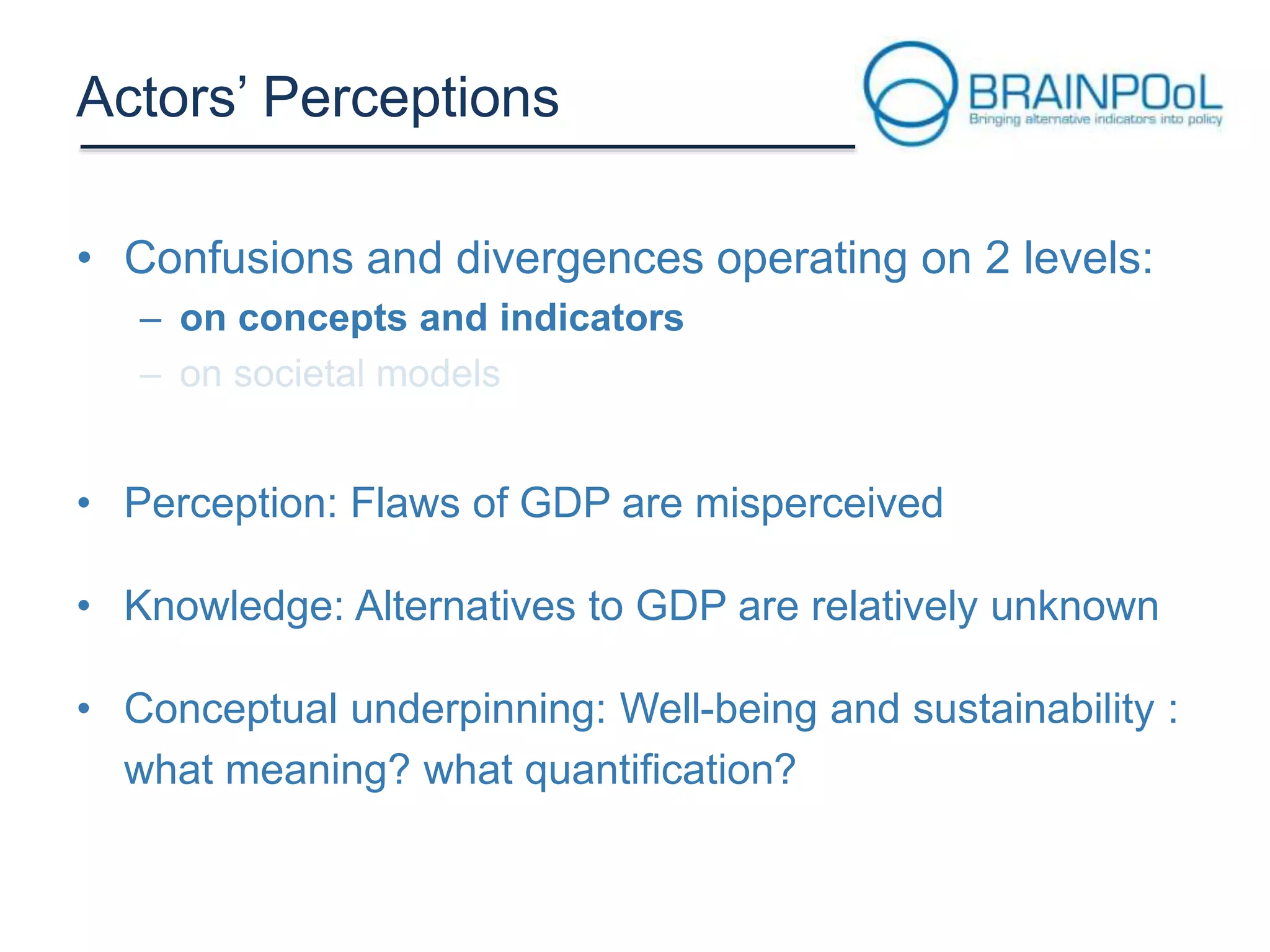
• Confusions and divergences operating on 2 levels:
– on concepts and indicators

• Perception: Flaws of GDP are misperceived
• Knowledge: Alternatives to GDP are relatively unknown

• Conceptual underpinning: Well-being and sustainability :
what meaning? what quantification?
Actors’ Perceptions
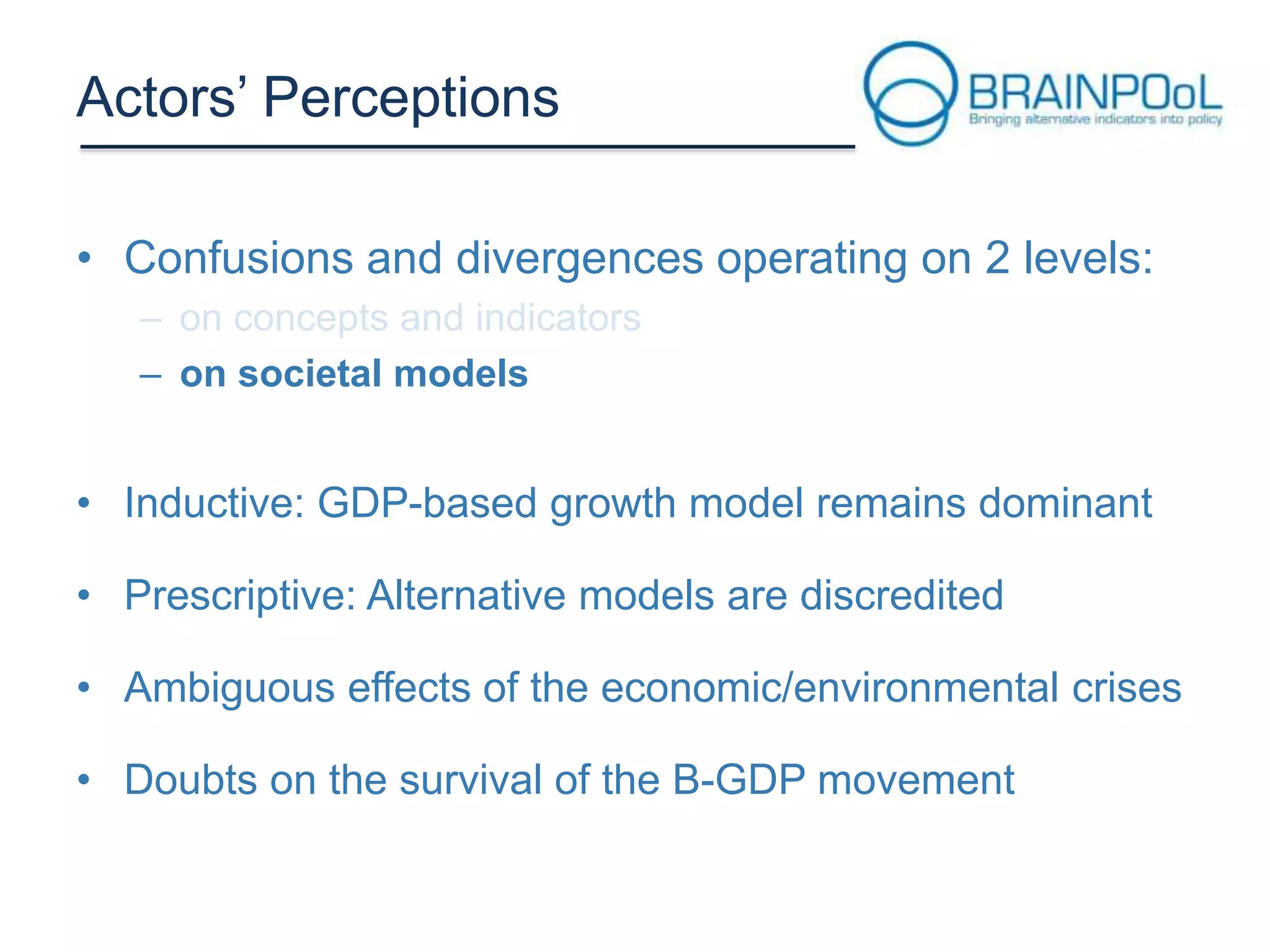
• Confusions and divergences operating on 2 levels:
– on societal models

• Inductive: GDP-based growth model remains dominant
• Prescriptive: Alternative models are discredited
• Ambiguous effects of the economic/environmental crises
• Doubts on the survival of the B-GDP movement
Actors’ Perceptions
• Apparent gap between discourses and practices
involves democratic risks at 2 levels:
– Well-being and competitiveness
– Difficulties to give effective weight to participation
Actors’ Perceptions
• Apparent gap between discourses and practices
involves democratic risks at 2 levels:
– Well-being and competitiveness

• w/r to participatory approaches, pragmatism seems to
imply conservatism
Actors’ Perceptions
• Apparent gap between discourses and practices
involves democratic risks at 2 levels:
– Difficulties to give effective weight to participation

• Credibility of the institution vs. intrinsic quality of
methodology
• How to combine effective (local) participation with
(global) comparability?
Structure

- Framing our workshop discussions
Discussion and framework
• From the discussion of these results flows a certain
framework of thought w/r to B-GDP indicators
– B-GDP indicators are multi-concept
– B-GDP indicators are multi-actor
– B-GDP indicators are multi-scale
– B-GDP indicators are multi-task
– B-GDP indicators are multi-vision

How to move Beyond-GDP? From defining meta-questions on use to working with barriers for influence

  • 1.
    How to moveBeyond-GDP? from Defining meta-questions on use to Working with barriers for influence Géraldine THIRY Tom BAULER Université Libre de Bruxelles - BE International knowledge brokerage workshop October 28-29, 2013, Venice (IT)
  • 2.
    From a contextualperspective • Recently, much is officially said about renewing indicators of wealth: – Stiglitz, Sen, Fitoussi (2010) – OECD (2011) – CEC-COM (2009)  ‘technically’, but also a recurrent question w/r to indicators and their role as policy-tools • Relatively few studies, explorations, analyses which focus on the link between B-GDP indicators and… – how indicators percolate in decisional and political spheres – how indicators are anchored in decisional processes
  • 3.
    From a definitionalperspective • B-GDP indicators define themselves via the objective, use, meaning… that is projected or made of them, and not solely by their content: – “B-GDP are those indicators that have been proposed as necessary and central to the measurement of societal progress, other than those – such as GDP and unemployment rate – that are already playing this role” Brainpool’s WP1-report • Brokerage activities on B-GDP - bring B-GDP into policy - relate thus also to studying and working with issues of “use”, i.e. representations, facts, anecdotes…
  • 4.
  • 5.
    Our double objective •Better understand demand/non-demand and the policy debates around • empirical analyses and their interpretation • in many policy contexts and at different levels • with a diversity of indicators • Co-identify and discuss the levers and barriers to the creation, institutionalisation, assessment of BGDP – case studies with actors – in many policy contexts and at different levels – with a diversity of indicators
  • 6.
    How to moveBeyond-GDP? On understanding “use” Géraldine THIRY Université Libre de Bruxelles - BE International knowledge brokerage workshop October 28-29, 2013, Venice (IT)
  • 7.
    Structure - Context - Evolutionof governance systems : why are indicators a societal and political issue? - Empirical exploration of the “use” of B-GDP - At the European levels: an issue of scale(s) - As perceived by Actors: an issue of confusion and of legitimate expertise - Framing our workshop discussions
  • 8.
    Structure - Context - Evolutionof governance systems : why are indicators a societal and political issue?
  • 9.
    Evolution of governance •In the current western governance systems, indicators have become the functional and political articulations of a new mode of governmentality (Ogien 2010, Salais 2011) • Functional : indicators are indispensable to the comparison of quantified performances • Political : indicators are new support of a political legitimation register 9
  • 10.
    Evolution of governance •Quantifying is not only « measuring », it is first and foremost « convening » of what has to be measured • Because Quantifying = convening + measuring,… • Indicators are a political issue : toward a governance of expertise? – towards a redefinition of the boundaries between « scientific » and « citizen-based », between technocratic and democratic 10
  • 11.
    Structure - Empirical explorationof the “use” of B-GDP - At the European levels: an issue of scale(s) - As perceived by actors: an issue of confusion and of legitimate expertise
  • 12.
    Structure - At theEuropean levels: an issue of scale(s)
  • 13.
    European levels • Overallresults stress the existence of a chronological structure influenced by the emergence of a series of concepts underlying the subsequent measurement efforts… • …accompanied by the emergence of a series of new actors… • …expressing needs to develop new scales of measurements
  • 14.
    Conceptual Complexity European levels: concepts Political ecology Social indicators Growth ’50 ’70 Sustainable development Wealth Prosperity Degrowth Human Development ’90 Well Being Green growth Happiness Quality of life Welfare Environmental impacts Ecological transition 2010  Over time, increased conceptual complexity
  • 15.
    European levels :actors • A complex system of actors where debate is also revolving… • …without citizens… • …on how to integrate bottom-up perspectives •  overall a very imprecise demand regarding BGDP (including a very imprecise understanding and knowledge of B-GDP)
  • 16.
    European levels :scales • Local scale initiatives are also referring to global initiatives of indicator critique and indicator developments – top-down percolation of conceptual necessity • Difficult transmission of achievements of local initiatives to national/supranational levels – imprecise bottom-up percolation of hands-on achievements •  Compare the incomparable ?
  • 17.
    Structure - As perceivedby actors: an issue of confusion and of legitimate expertise
  • 18.
    Actors’ Perceptions • Confusionsand divergences operating on 2 levels: – on concepts and indicators – on societal models
  • 19.
    Actors’ Perceptions • Confusionsand divergences operating on 2 levels: – on concepts and indicators • Perception: Flaws of GDP are misperceived • Knowledge: Alternatives to GDP are relatively unknown • Conceptual underpinning: Well-being and sustainability : what meaning? what quantification?
  • 20.
    Actors’ Perceptions • Confusionsand divergences operating on 2 levels: – on societal models • Inductive: GDP-based growth model remains dominant • Prescriptive: Alternative models are discredited • Ambiguous effects of the economic/environmental crises • Doubts on the survival of the B-GDP movement
  • 21.
    Actors’ Perceptions • Apparentgap between discourses and practices involves democratic risks at 2 levels: – Well-being and competitiveness – Difficulties to give effective weight to participation
  • 22.
    Actors’ Perceptions • Apparentgap between discourses and practices involves democratic risks at 2 levels: – Well-being and competitiveness • w/r to participatory approaches, pragmatism seems to imply conservatism
  • 23.
    Actors’ Perceptions • Apparentgap between discourses and practices involves democratic risks at 2 levels: – Difficulties to give effective weight to participation • Credibility of the institution vs. intrinsic quality of methodology • How to combine effective (local) participation with (global) comparability?
  • 24.
    Structure - Framing ourworkshop discussions
  • 25.
    Discussion and framework •From the discussion of these results flows a certain framework of thought w/r to B-GDP indicators – B-GDP indicators are multi-concept – B-GDP indicators are multi-actor – B-GDP indicators are multi-scale – B-GDP indicators are multi-task – B-GDP indicators are multi-vision