Seeley’s
ANATOMY &
PHYSIOLOGY
Twelfth Edition
VANPUTTE, REGAN,
RUSSO
©2020 McGraw-Hill Education. All rights reserved. Authorized only for instructor use in the classroom. No reproduction or further distribution permitted without the prior written consent of McGraw-Hill Education.
©2020 McGraw-Hill Education
28-2
Chapter 28
Reproductive System
Lecture Outline
©2020 McGraw-Hill Education
28-3
28.1 Functions of the Reproductive
System
1. Gametogenesis. Specialized organs of the reproductive system
produce gametes: sperm cells in males and oocytes (eggs) in females.
2. Fertilization. The reproductive system enhances fertilization of the
oocyte by the sperm. The duct system in males nourishes sperm cells
until they are mature and are deposited in the female reproductive
tract by the penis. The female reproductive system receives the sperm
cells from the male and transports them to the fertilization site.
3. Development and nourishment of a new individual. The female
reproductive system nurtures a new individual in the uterus until birth
and provides nourishment (milk) after birth.
4. Production of reproductive hormones. Hormones produced by the
reproductive system control its development and the development of
the gender-specific body form. These hormones are also essential for
the normal function of the reproductive system and for reproductive
behavior.
©2020 McGraw-Hill Education
28-4
28.2 Meiosis
Meiosis: cell division for sexual reproduction; one diploid cell
undergoes two cell divisions to produce four genetically different
haploid daughter cells.
• Diploid: cell has 46 chromosomes, 2 sets of homologous pairs.
• Haploid: cell has 23 chromosomes, 1 set of homologous pairs.
Meiosis I: chromosome number halved; reduction division.
• Before meiosis I, chromosomes consist of two chromatids connected at
centromere; homologous pairs come together during prophase I (synapsis)
to form tetrads; crossing over occurs.
Meiosis II: sister chromatids pulled apart.
Meiosis I and II both have prophase, metaphase, anaphase,
telophase.
©2020 McGraw-Hill Education
28-5
Meiosis
©2020 McGraw-Hill Education
28-6
28.3 Anatomy of Male Reproductive
System
Scrotum.
• 2 chambered sac that contains testes; separated by
raphe.
• Dartos and cremaster muscles help regulate
temperature.
Perineum.
• Diamond-shaped areas between thighs.
• Divided into anterior urogenital triangle (penis and
scrotum) and posterior anal triangle.
©2020 McGraw-Hill Education
28-7
Male Reproductive System
©2020 McGraw-Hill Education
28-8
Male Perineum
©2020 McGraw-Hill Education
28-9
Testes
Testes: small, oval-shaped organs where sperm develop.
Located outside the body cavity because sperm require lower-
than-body temperature for development.
Testis serve as both exocrine and endocrine functions.
• Exocrine: sperm cells are secreted.
• Endocrine: testosterone.
Coverings of testis.
• Tunica vaginalis. Originally peritoneum. Serous membrane.
• Tunica albuginea: thick white connective tissue. Penetrates testis to divide
it into lobules. Within lobules are seminiferous tubules and interstitial
(Leydig) cells that secrete testosterone.
Tubes through which sperm move.
• Seminiferous tubules. Site of sperm production.
• Tubuli recti and rete testis. Pathway to epididymis.
©2020 McGraw-Hill Education
28-10
Histology of the Testis1
(a) ©De Agostini Picture Library/Science Source
©2020 McGraw-Hill Education
28-11
Descent of Testes1
Descent.
• Pass from abdominal cavity through inguinal canal to
scrotum.
• Guided by fibromuscular gubernaculum.
• Pass through inguinal rings (bilateral oblique passageways in
the anterior abdominal wall). Openings in aponeuroses of
transversus abdominis, internal and external oblique. Weak
part in abdominal wall. Herniation.
Cryptorchidism.
• Failure of one or both of testes to descend into scrotum.
• Prevents normal sperm development.
©2020 McGraw-Hill Education
28-12
Descent of Testes2
©2020 McGraw-Hill Education
28-13
Spermatogenesis1
Spermatogenesis: spermatozoa produced in seminiferous
tubules.
• Spermatogonia divide (mitosis) to form primary spermatocytes
and daughter spermatagonia.
• Primary spermatocytes divide (first division of meiosis) to form
secondary spermatocytes.
• Secondary spermatocytes divide (second division of meiosis) to
form spermatids.
• Spermatids develop an acrosome and flagellum.
• Sustentacular (Sertoli, nurse) cells nourish sperm cells and form a
blood-testis barrier and produce hormones.
• Interstitial cells produce testosterone. Sustentacular cells convert it
to dihydrotestosterone (DHT) and estrogen. Probably active
hormones that cause sperm formation.
©2020 McGraw-Hill Education
28-14
Histology of the Testis2
(b) ©Ken Wagner/Phototake; (c) ©Dennis Kunkel Microscopy, Inc./Phototake
©2020 McGraw-Hill Education
28-15
Spermatogenesis2
©2020 McGraw-Hill Education
28-16
Ducts
Sperm cells in seminiferous tubules move through tubuli recti to rete
testis, efferent ductules lead to epididymis.
Epididymis.
• Site of sperm cell maturation; develop head, body, tail.
• Takes minimum of 1 to 2 days.
• Stereocilia: in pseudostratified columnar epithelium; increase surface area to
facilitate absorption of fluid from lumen of the duct.
Ductus deferens or vas deferens. Passes from epididymis into
abdominal cavity.
• Ductus, testicular artery and venous plexus, lymphatic vessels, nerves, fibrous
remains of process vaginalis (peritoneum) form the spermatic cord.
• Distal end of ductus deferens is enlarged as ampulla.
• Wall of ductus deferens has smooth muscle that exhibits peristalsis during
ejaculation.
Ejaculatory duct.
• Joining of ductus deferens and seminal vesicle.
• End at urethra within prostate gland.
©2020 McGraw-Hill Education
28-17
Male Reproductive Structures
©2020 McGraw-Hill Education
28-18
Urethra
Extends from urinary bladder to distal end of penis.
Passageway for urine and male reproductive fluids.
Three parts.
• Prostatic urethra. Connected to bladder, passes through
prostate.15 to 30 ducts from prostate empty into prostatic
urethra.
• Membranous urethra. Extends through perineum (muscular
floor of pelvis; urogenital diaphragm).
• Spongy or penile urethra. Passes through the penis. Several
minute mucus-secreting urethral glands empty into spongy
urethra.
©2020 McGraw-Hill Education
28-19
Penis1
Functions: urination, serves as vehicle for injecting sperm
into vagina: erection.
Three columns of erectile tissue that engorge with blood.
• Corpora cavernosa (2). Expanded at base to form crus.
Attached by ligaments to coxae.
• Corpus spongiosum (1) surrounding spongy urethra. Forms the
bulb.
• Crura and bulb = root of penis.
Glans penis: enlargement of corpus spongiosum.
• Prepuce or foreskin covers glans penis. Circumcision: surgical
removal.
External urethra orifice.
©2020 McGraw-Hill Education
28-20
Penis2
©2020 McGraw-Hill Education
28-21
Accessory Glands
Seminal vesicles.
• Empty into ejaculatory duct.
• Produce about 60% of semen.
• Secretion contains fibrinogen.
• High pH.
Prostate gland.
• Produces about 30% of semen.
• Thin, milky secretion, high pH.
• Contain clotting factors, and fibrinolysin.
Bulbourethral glands.
• Contribute about 5% to semen.
• Mucous secretion. Just before ejaculation.
• Helps neutralize pH of female vagina.
©2020 McGraw-Hill Education
28-22
Semen
Secretions of all three accessory glands plus sperm cells
referred to as semen.
Urethral mucosa produces mucus.
Emission: discharge of semen into prostatic urethra.
Ejaculation: forceful expulsion of semen from urethra.
Caused by peristalsis.
Temporary coagulation as fibrinogen becomes fibrin
then fibrinolysin breaks up the coagulation. Sperm
swim up vagina.
©2020 McGraw-Hill Education
28-23
28.4 Physiology of Male Reproduction
At puberty, GnRH secretion increases leading to
increased LH and FSH release.
• FSH levels promote sperm formation.
• LH levels promote interstitial cells to produce large
amounts of testosterone.
Inhibin secreted from sustentacular cells inhibits
FSH secretion.
©2020 McGraw-Hill Education
28-24
Regulation of Reproductive
Hormone Secretion In Males
©2020 McGraw-Hill Education
28-25
Puberty in Males
Before birth, placenta secretes human chorionic gonadotropin
hormone which stimulates secretion of testosterone by fetal
testes.
From birth to puberty, no stimulation of secretion of
testosterone.
Puberty: age at which individuals become capable of sexual
reproduction.
• Previous to puberty: small amounts of testosterone from adrenal
gland inhibits GnRH.
• At puberty, pituitary becomes less sensitive to testosterone inhibition.
Amount of GnRH increases, amount of LH and FSH increases.
• Elevated FSH causes sperm cell formation.
• Elevated LH causes interstitial cells to secrete larger amounts of
testosterone.
©2020 McGraw-Hill Education
28-26
Effects of Testosterone
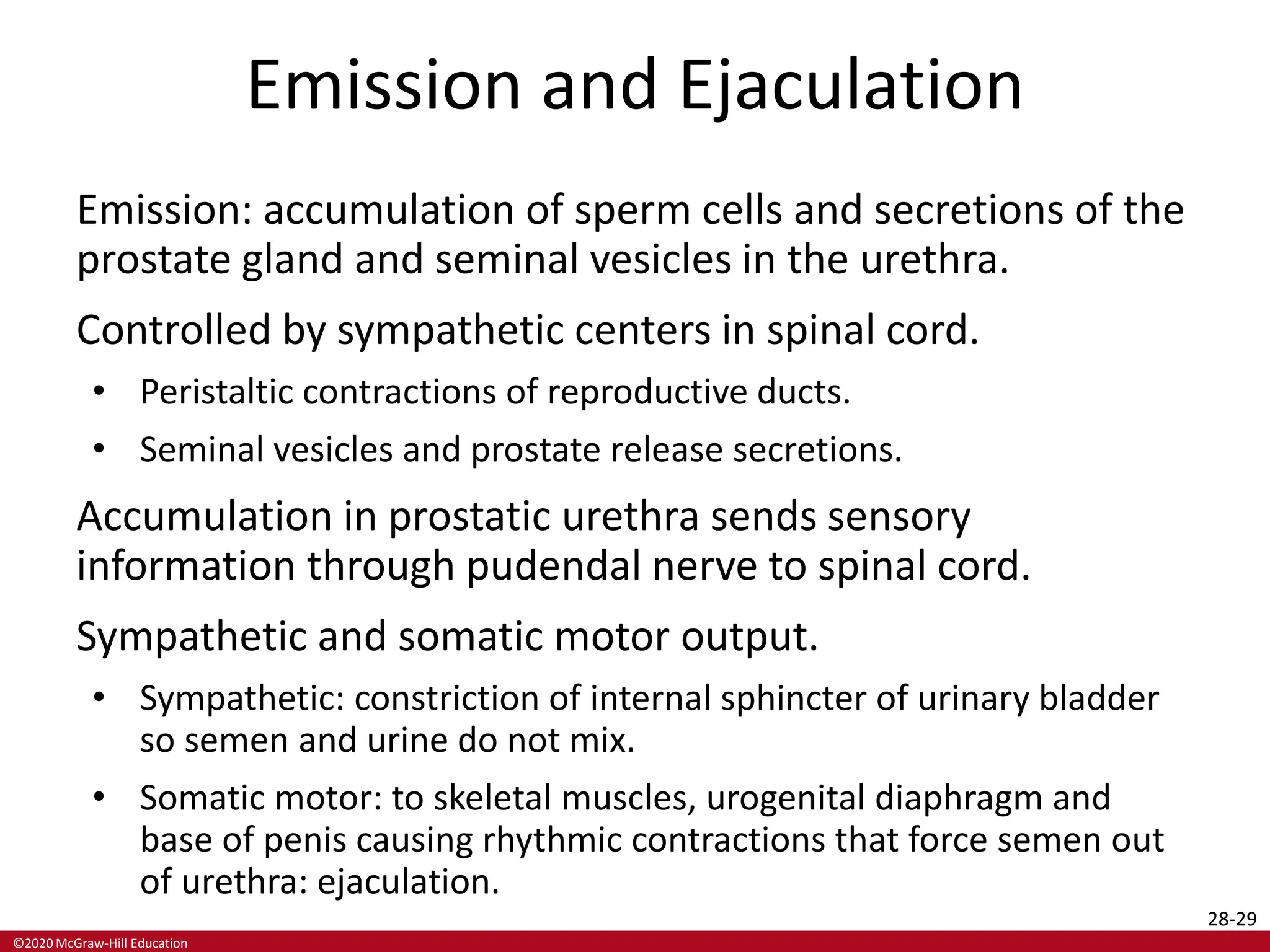
Most from interstitial cells of testes with small amounts from
adrenal glands and sustentacular cells.
Effects include:
• Enlargement and differentiation of male genitals and reproductive
duct system.
• Necessary for sperm cell formation.
• Required for descent of testes.
• Hair growth on certain parts of the body, skin is rougher and coarser,
quantity of melanin increases.
• Increases rate of secretion of sebaceous glands.
• Hypertrophy of larynx.
• Increases metabolic rate, red blood cell count, and protein synthesis.
• Rapid bone growth, causes closure of epiphyseal plates.
©2020 McGraw-Hill Education
28-27
Male Sexual Behavior and the Male
Sex Act
Male sexual behavior: testosterone required to
initiate and maintain.
Male sex act.
• Complex series of reflexes that result in erection of
penis, secretion of mucus into urethra, emission,
ejaculation.
• Sensations result in orgasm associated with
ejaculation, and then resolution.
©2020 McGraw-Hill Education
28-28
Nervous Control
of Erection
©2020 McGraw-Hill Education
28-29
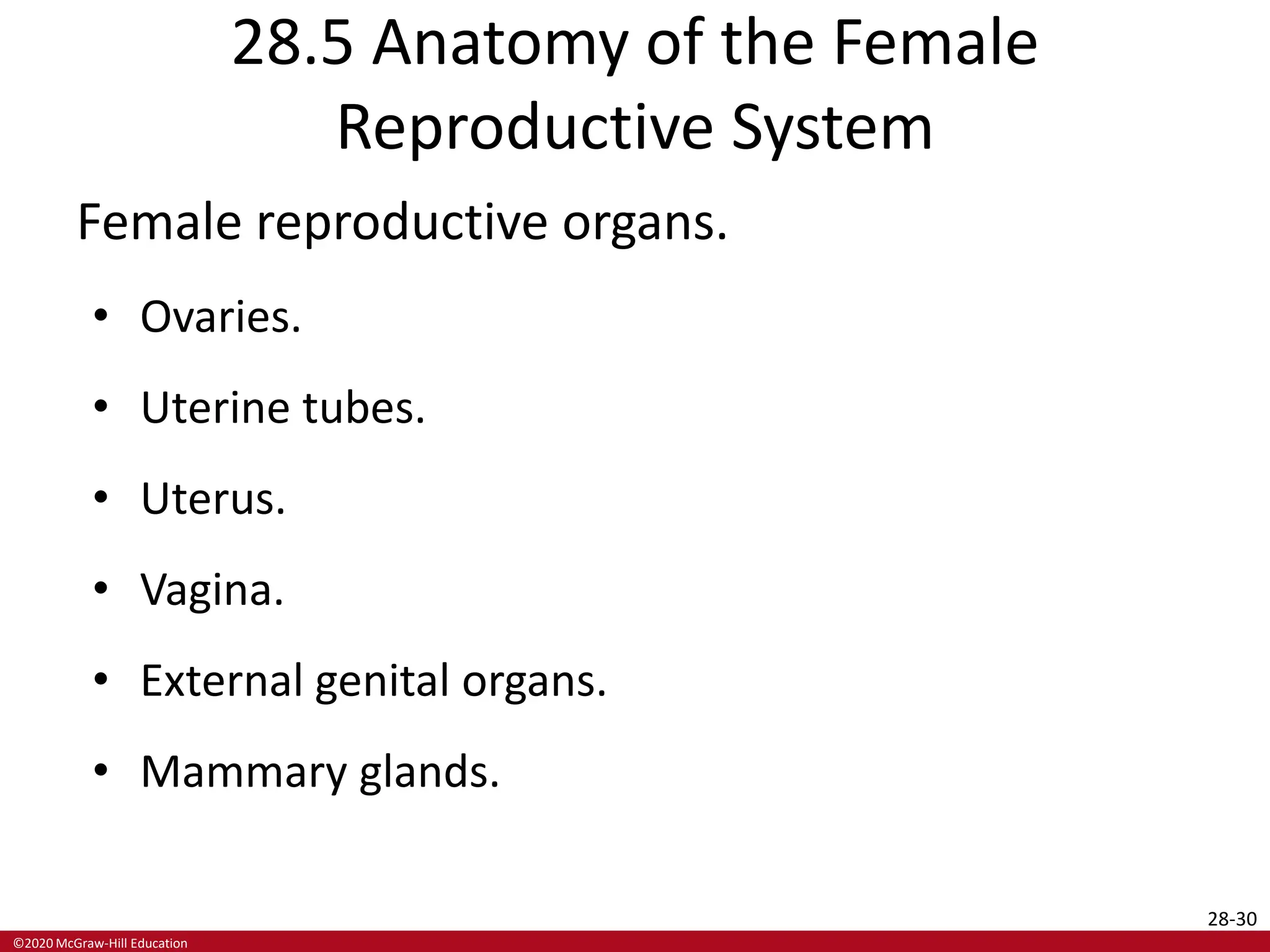
Emission and Ejaculation
Emission: accumulation of sperm cells and secretions of the
prostate gland and seminal vesicles in the urethra.
Controlled by sympathetic centers in spinal cord.
• Peristaltic contractions of reproductive ducts.
• Seminal vesicles and prostate release secretions.
Accumulation in prostatic urethra sends sensory
information through pudendal nerve to spinal cord.
Sympathetic and somatic motor output.
• Sympathetic: constriction of internal sphincter of urinary bladder
so semen and urine do not mix.
• Somatic motor: to skeletal muscles, urogenital diaphragm and
base of penis causing rhythmic contractions that force semen out
of urethra: ejaculation.
©2020 McGraw-Hill Education
28-30
28.5 Anatomy of the Female
Reproductive System
Female reproductive organs.
• Ovaries.
• Uterine tubes.
• Uterus.
• Vagina.
• External genital organs.
• Mammary glands.
©2020 McGraw-Hill Education
28-31
Female Reproductive Structures
©2020 McGraw-Hill Education
28-32
Ovaries
Broad ligament: extension of peritoneum,
spread out on both sides of uterus. Ovaries and
uterine tubes attached as well.
Ligaments of ovaries.
• Mesovarium: peritoneal fold attaches ovary to
posterior surface of broad ligament.
• Suspensory ligament: from mesovarium to body
wall. Contains ovarian arteries, veins, and nerves.
• Ovarian ligament: from ovary to superior margin of
uterus. Ovarian arteries, veins and nerves enter
ovary through this ligament.
©2020 McGraw-Hill Education
28-33
Uterus, Vagina, Uterine Tubes,
Ovaries, and Supporting Ligaments
©2020 McGraw-Hill Education
28-34
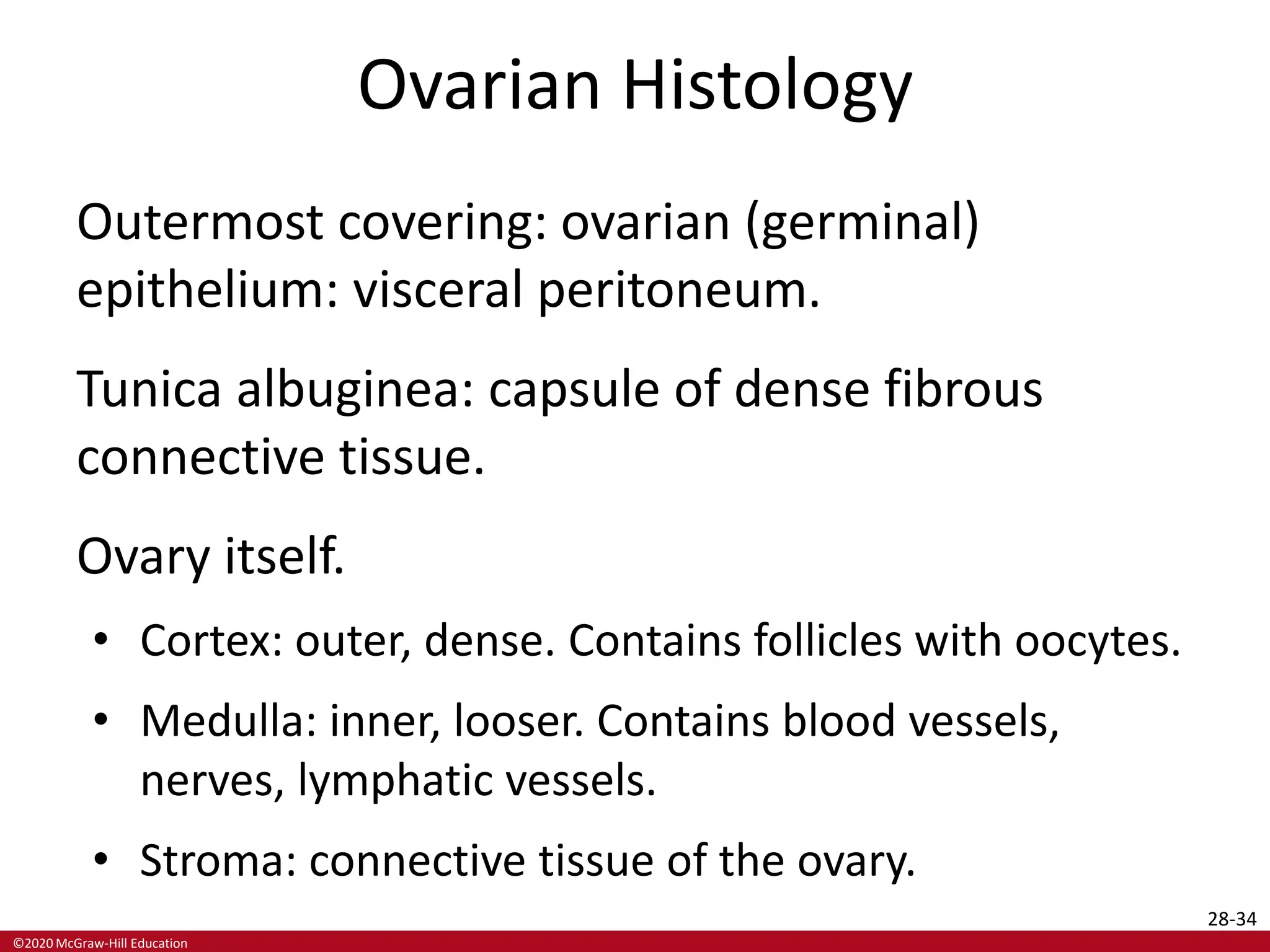
Ovarian Histology
Outermost covering: ovarian (germinal)
epithelium: visceral peritoneum.
Tunica albuginea: capsule of dense fibrous
connective tissue.
Ovary itself.
• Cortex: outer, dense. Contains follicles with oocytes.
• Medulla: inner, looser. Contains blood vessels,
nerves, lymphatic vessels.
• Stroma: connective tissue of the ovary.
©2020 McGraw-Hill Education
28-35
Histology of
the Ovary
©2020 McGraw-Hill Education
28-36
Oogenesis and Fertilization
Oogenesis is the production of a secondary oocyte in ovaries.
Oogonia are cells from which oocytes develop. The oogonia divide
by mitosis to produce other oogonia and primary oocytes.
Five million oocytes produced by the fourth month of prenatal
life. About 2 million begin first meiotic division but stop at
prophase. All remain at this state until puberty.
Primary oocytes are surrounded by granulosa cells and called a
primordial follicle.
Primordial follicle becomes a primary follicle when oocyte and
granular cells enlarge.
Primary follicle becomes secondary follicle and enlarges to form
mature or Graafian follicle.
• Usually only one is ovulated, others degenerate.
©2020 McGraw-Hill Education
28-37
Oogenesis
and Follicle
Development
©2020 McGraw-Hill Education
28-38
Ovulation, Fertilization, Follicle
Fate
Ovulation: release of a secondary oocyte from an ovary.
Unlike spermatogenesis, division of cytoplasm during meiosis
is uneven and polar bodies are very small, oocyte very large.
Graafian follicle become corpus luteum.
Fertilization: begins when a sperm cell binds the plasma
membrane of secondary oocytes and penetrates into
cytoplasm.
Secondary oocyte completes meiosis II forming one polar
body. Fertilized egg now a zygote.
Fate of corpus luteum.
• If fertilization occurs, corpus luteum persists.
• If no fertilization, becomes corpus albicans.
©2020 McGraw-Hill Education
28-39
Uterine Tubes
Uterine tube = fallopian tube = oviduct.
Mesosalpinx: part of broad ligament directly associated with
uterine tube.
Open directly into peritoneal cavity to receive oocyte from ovary.
Transport oocyte or zygote from ovary to uterus.
Fimbriae: long thin processes that extend from the
infundibulum. Inner surface is ciliated. Infundibulum is open to
peritoneal cavity.
Ampulla: widest part, where fertilization occurs.
Three layers: outer serosa, middle muscular layer and inner
mucosa. Mucosa: simple ciliated columnar epithelium with
longitudinal folds.
• Provides nutrients for oocyte/embryonic mass.
• Cilia moves fluid and oocyte/embryonic mass through the tube toward
uterus.
©2020 McGraw-Hill Education
28-40
Uterus, Vagina, Uterine Tubes,
Ovaries, and Supporting Ligaments2
©2020 McGraw-Hill Education
28-41
Uterus
Parts: body, isthmus, cervix, and fundus.
Ligaments: broad, round, uterosacral.
• Round: from uterus through inguinal canals to labia majora.
• Uterosacral: attach lateral wall of uterus to sacrum.
Composed of 3 layers.
• Perimetrium: Serous membrane.
• Myometrium: Smooth muscle.
• Endometrium: Mucous membrane.
• Simple tubular glands.
• Functional layer: innermost. Replaced during menstrual cycle.
• Basal layer: deepest.
Cervix. More rigid and less contractile than rest of uterus.
• Cervical canal. Lined with mucous glands. Mucous plug except near
ovulation when consistency of secretion changes to seromucous.
©2020 McGraw-Hill Education
28-42
Vagina
Female organ of copulation.
Allows menstrual flow and childbirth.
Hymen covers the vaginal opening or orifice.
Muscular walls with mucous membrane lining
(moist stratified squamous epithelium).
Longitudinal columns and transverse rugae.
Fornix: superior portion attached to sides of
cervix.
©2020 McGraw-Hill Education
28-43
Female External Genitalia1
Vulva or pudendum or external female genitalia.
• Vestibule: space.
• Labia minora: form borders on sides.
• Clitoris: erectile structure.
• Corpora cavernosa: expanded at bases to form crus of the clitoris.
• Corpora spongiosa.
• Labia majora: unite to form mons pubis.
• Vaginal orifice: in lateral margins, erectile tissue
called bulb of the vestibule (homologous to corpus
spongiosum of male).
©2020 McGraw-Hill Education
28-44
Female External Genitalia2
Within vestibule, glands that produce fluid to moisten.
• Greater vestibular gland.
• Lesser vestibular glands.
• Paraurethral glands.
Labia majora: rounded folds of skin on either side of
labia minora. Conceal contents of pudenda.
• Medial surfaces covered with numerous sebaceous and
sweat glands.
• Pudendal cleft: space between labia majora.
Mons pubis: anteriorly labia majora merge in an
elevated area over the symphysis pubis.
©2020 McGraw-Hill Education
28-45
Female External Genitalia3
©2020 McGraw-Hill Education
28-46
Perineum1
Like in the male, the female perineum is divided
into anterior urogenital triangle and posterior
anal triangle.
Clinical perineum: region between vagina and
anus.
• Skin here can tear during childbirth.
• Episiotomy: incision in clinical perineum to aid in
childbirth.
©2020 McGraw-Hill Education
28-47
Perineum2
©2020 McGraw-Hill Education
28-48
Mammary Glands
Organs of milk
production located
within mammae or
breasts.
• Consist of
glandular lobes
and adipose tissue.
• Cooper ligaments
support the
breasts.
©2020 McGraw-Hill Education
28-49
28.6 Physiology of Female
Reproduction
Puberty.
• Begins with menarche (first episode of menstrual
bleeding).
• Begins when GnRH levels increase.
Menstrual Cycle.
• About 28 days long on average.
• Ovarian cycle: changes in ovaries.
• Uterine cycle: changes in uterus.
• Amenorrhea: absence of a menstrual cycle.
• Menopause: cessation of menstrual cycles.
©2020 McGraw-Hill Education
28-50
Ovarian Cycle
Follicular phase occurs before ovulation (days 1 to 14).
• Primordial follicle develops into a mature follicle as primary oocyte
within undergoes meiosis I.
• Follicles develop in response to FSH from pituitary.
• Follicles release estrogen, leading to surge of LH and ovulation; also
causes uterine endometrium proliferation.
Luteal phase occurs after ovulation (days 15 to 28).
• Following ovulation, follicle forms corpus luteum which secretes
estrogen and progesterone; progesterone causes uterine
endometrium to thicken and secrete fluid.
• At end of luteal phase (if no fertilization), corpus luteum degenerates,
progesterone levels drop, and endometrium is shed (menses).
• Fertilization results in hCG production, keeping corpus luteum alive.
©2020 McGraw-Hill Education
28-51
Menstrual
Cycle
©2020 McGraw-Hill Education
28-52
Regulation
of Hormone
Secretion
During the
Ovarian
Cycle
©2020 McGraw-Hill Education
28-53
Uterine Cycle
(a) ©Educational Images Ltd./Custom Medical Stock Photo; (b, c) ©Biophoto Associates/Science Source
©2020 McGraw-Hill Education
28-54
Female Sexual Behavior and Sex
Act
Female sexual behavior.
• Depends on hormones: androgens and steroids.
• Depends on psychological factors.
Female sex act.
• Parasympathetic stimulation.
• Blood engorgement in clitoris and around vaginal opening.
• Erect nipples.
• Mucous-like fluid extruded into vagina and through wall.
• Orgasm not necessary for fertilization to occur.
©2020 McGraw-Hill Education
28-55
Female Fertility and Pregnancy
Female fertility.
• Sperm ejaculated into vagina during copulation and transported through
cervix and uterine tubes to ampulla.
• Sperm cells undergo capacitation, enabling them to release acrosomal
enzymes to digest away follicular cells.
Pregnancy.
• Oocyte can be fertilized up to 24 hours after ovulation.
• Sperm cells can be viable for up to 6 days in female tract.
• Ectopic pregnancy: Implantation occurs anywhere other than uterine cavity.
Fertilization.
• Occurs in uterine tube. Multiple mitoses occur after union of oocyte and
sperm nuclei, (pronuclei) forming an embryo. Outer layer of embryonic
mass is the trophoblast. It secretes proteolytic enzymes to digest the
thickened endometrium. Implantation. Trophoblast also secretes HCG.
©2020 McGraw-Hill Education
28-56
Sperm Cell Movement
©2020 McGraw-Hill Education
28-57
Hormone Changes During Pregnancy
Human chorionic gonadotropin (hCG) produced
by embryo soon after fertilization and
throughout first trimester.
Placenta develops and produces progesterone
and estrogen in increasing levels throughout
pregnancy.
©2020 McGraw-Hill Education
28-58
Changes in Hormones During Pregnancy
©2020 McGraw-Hill Education
28-59
Menopause
40 to 50 years old. Menstrual periods become less
regular, ovulation stops. Female climacteric
(perimenopause).
Cessation of menstrual cycles = menopause.
LH and FSH elevated, but the few remaining follicles
become insensitive to LH and FSH.
Ovaries stop producing estrogen and progesterone.
Symptoms: hot flashes, irritability, night sweats,
fatigue, anxiety, occasionally severe emotional
disturbances.
©2020 McGraw-Hill Education
28-60
28.6 Effects of Aging: Males
In some, testes decrease in size.
Decrease in number of interstitial cells, thinning of
walls of seminiferous tubules.
Decrease in rate of sperm cell production.
Prostate: decrease in blood flow, increase in thickness
of epithelial lining, decrease in functional smooth
muscle cells. Possibly benign prostatic hypertrophy.
Impotence or decrease in sexual performance/activity.
©2020 McGraw-Hill Education
28-61
28.6 Effects of Aging: Females
Menopause.
Uterine position changes and can lead to prolapse.
Uterus decreases 50% in size within 15 years after
menopause.
Vaginal wall: thinner, less elastic, less lubrication.
Increased incidence of vaginal infections.
Sexual excitement requires greater time to develop,
peak is lower, return to resting state is quicker.
Increased risk of breast, endometrial, cervical, and
ovarian cancer.

chapter 28 Reproductive System Power Point

  • 1.
    Seeley’s ANATOMY & PHYSIOLOGY Twelfth Edition VANPUTTE,REGAN, RUSSO ©2020 McGraw-Hill Education. All rights reserved. Authorized only for instructor use in the classroom. No reproduction or further distribution permitted without the prior written consent of McGraw-Hill Education.
  • 2.
    ©2020 McGraw-Hill Education 28-2 Chapter28 Reproductive System Lecture Outline
  • 3.
    ©2020 McGraw-Hill Education 28-3 28.1Functions of the Reproductive System 1. Gametogenesis. Specialized organs of the reproductive system produce gametes: sperm cells in males and oocytes (eggs) in females. 2. Fertilization. The reproductive system enhances fertilization of the oocyte by the sperm. The duct system in males nourishes sperm cells until they are mature and are deposited in the female reproductive tract by the penis. The female reproductive system receives the sperm cells from the male and transports them to the fertilization site. 3. Development and nourishment of a new individual. The female reproductive system nurtures a new individual in the uterus until birth and provides nourishment (milk) after birth. 4. Production of reproductive hormones. Hormones produced by the reproductive system control its development and the development of the gender-specific body form. These hormones are also essential for the normal function of the reproductive system and for reproductive behavior.
  • 4.
    ©2020 McGraw-Hill Education 28-4 28.2Meiosis Meiosis: cell division for sexual reproduction; one diploid cell undergoes two cell divisions to produce four genetically different haploid daughter cells. • Diploid: cell has 46 chromosomes, 2 sets of homologous pairs. • Haploid: cell has 23 chromosomes, 1 set of homologous pairs. Meiosis I: chromosome number halved; reduction division. • Before meiosis I, chromosomes consist of two chromatids connected at centromere; homologous pairs come together during prophase I (synapsis) to form tetrads; crossing over occurs. Meiosis II: sister chromatids pulled apart. Meiosis I and II both have prophase, metaphase, anaphase, telophase.
  • 5.
  • 6.
    ©2020 McGraw-Hill Education 28-6 28.3Anatomy of Male Reproductive System Scrotum. • 2 chambered sac that contains testes; separated by raphe. • Dartos and cremaster muscles help regulate temperature. Perineum. • Diamond-shaped areas between thighs. • Divided into anterior urogenital triangle (penis and scrotum) and posterior anal triangle.
  • 7.
  • 8.
  • 9.
    ©2020 McGraw-Hill Education 28-9 Testes Testes:small, oval-shaped organs where sperm develop. Located outside the body cavity because sperm require lower- than-body temperature for development. Testis serve as both exocrine and endocrine functions. • Exocrine: sperm cells are secreted. • Endocrine: testosterone. Coverings of testis. • Tunica vaginalis. Originally peritoneum. Serous membrane. • Tunica albuginea: thick white connective tissue. Penetrates testis to divide it into lobules. Within lobules are seminiferous tubules and interstitial (Leydig) cells that secrete testosterone. Tubes through which sperm move. • Seminiferous tubules. Site of sperm production. • Tubuli recti and rete testis. Pathway to epididymis.
  • 10.
    ©2020 McGraw-Hill Education 28-10 Histologyof the Testis1 (a) ©De Agostini Picture Library/Science Source
  • 11.
    ©2020 McGraw-Hill Education 28-11 Descentof Testes1 Descent. • Pass from abdominal cavity through inguinal canal to scrotum. • Guided by fibromuscular gubernaculum. • Pass through inguinal rings (bilateral oblique passageways in the anterior abdominal wall). Openings in aponeuroses of transversus abdominis, internal and external oblique. Weak part in abdominal wall. Herniation. Cryptorchidism. • Failure of one or both of testes to descend into scrotum. • Prevents normal sperm development.
  • 12.
  • 13.
    ©2020 McGraw-Hill Education 28-13 Spermatogenesis1 Spermatogenesis:spermatozoa produced in seminiferous tubules. • Spermatogonia divide (mitosis) to form primary spermatocytes and daughter spermatagonia. • Primary spermatocytes divide (first division of meiosis) to form secondary spermatocytes. • Secondary spermatocytes divide (second division of meiosis) to form spermatids. • Spermatids develop an acrosome and flagellum. • Sustentacular (Sertoli, nurse) cells nourish sperm cells and form a blood-testis barrier and produce hormones. • Interstitial cells produce testosterone. Sustentacular cells convert it to dihydrotestosterone (DHT) and estrogen. Probably active hormones that cause sperm formation.
  • 14.
    ©2020 McGraw-Hill Education 28-14 Histologyof the Testis2 (b) ©Ken Wagner/Phototake; (c) ©Dennis Kunkel Microscopy, Inc./Phototake
  • 15.
  • 16.
    ©2020 McGraw-Hill Education 28-16 Ducts Spermcells in seminiferous tubules move through tubuli recti to rete testis, efferent ductules lead to epididymis. Epididymis. • Site of sperm cell maturation; develop head, body, tail. • Takes minimum of 1 to 2 days. • Stereocilia: in pseudostratified columnar epithelium; increase surface area to facilitate absorption of fluid from lumen of the duct. Ductus deferens or vas deferens. Passes from epididymis into abdominal cavity. • Ductus, testicular artery and venous plexus, lymphatic vessels, nerves, fibrous remains of process vaginalis (peritoneum) form the spermatic cord. • Distal end of ductus deferens is enlarged as ampulla. • Wall of ductus deferens has smooth muscle that exhibits peristalsis during ejaculation. Ejaculatory duct. • Joining of ductus deferens and seminal vesicle. • End at urethra within prostate gland.
  • 17.
  • 18.
    ©2020 McGraw-Hill Education 28-18 Urethra Extendsfrom urinary bladder to distal end of penis. Passageway for urine and male reproductive fluids. Three parts. • Prostatic urethra. Connected to bladder, passes through prostate.15 to 30 ducts from prostate empty into prostatic urethra. • Membranous urethra. Extends through perineum (muscular floor of pelvis; urogenital diaphragm). • Spongy or penile urethra. Passes through the penis. Several minute mucus-secreting urethral glands empty into spongy urethra.
  • 19.
    ©2020 McGraw-Hill Education 28-19 Penis1 Functions:urination, serves as vehicle for injecting sperm into vagina: erection. Three columns of erectile tissue that engorge with blood. • Corpora cavernosa (2). Expanded at base to form crus. Attached by ligaments to coxae. • Corpus spongiosum (1) surrounding spongy urethra. Forms the bulb. • Crura and bulb = root of penis. Glans penis: enlargement of corpus spongiosum. • Prepuce or foreskin covers glans penis. Circumcision: surgical removal. External urethra orifice.
  • 20.
  • 21.
    ©2020 McGraw-Hill Education 28-21 AccessoryGlands Seminal vesicles. • Empty into ejaculatory duct. • Produce about 60% of semen. • Secretion contains fibrinogen. • High pH. Prostate gland. • Produces about 30% of semen. • Thin, milky secretion, high pH. • Contain clotting factors, and fibrinolysin. Bulbourethral glands. • Contribute about 5% to semen. • Mucous secretion. Just before ejaculation. • Helps neutralize pH of female vagina.
  • 22.
    ©2020 McGraw-Hill Education 28-22 Semen Secretionsof all three accessory glands plus sperm cells referred to as semen. Urethral mucosa produces mucus. Emission: discharge of semen into prostatic urethra. Ejaculation: forceful expulsion of semen from urethra. Caused by peristalsis. Temporary coagulation as fibrinogen becomes fibrin then fibrinolysin breaks up the coagulation. Sperm swim up vagina.
  • 23.
    ©2020 McGraw-Hill Education 28-23 28.4Physiology of Male Reproduction At puberty, GnRH secretion increases leading to increased LH and FSH release. • FSH levels promote sperm formation. • LH levels promote interstitial cells to produce large amounts of testosterone. Inhibin secreted from sustentacular cells inhibits FSH secretion.
  • 24.
    ©2020 McGraw-Hill Education 28-24 Regulationof Reproductive Hormone Secretion In Males
  • 25.
    ©2020 McGraw-Hill Education 28-25 Pubertyin Males Before birth, placenta secretes human chorionic gonadotropin hormone which stimulates secretion of testosterone by fetal testes. From birth to puberty, no stimulation of secretion of testosterone. Puberty: age at which individuals become capable of sexual reproduction. • Previous to puberty: small amounts of testosterone from adrenal gland inhibits GnRH. • At puberty, pituitary becomes less sensitive to testosterone inhibition. Amount of GnRH increases, amount of LH and FSH increases. • Elevated FSH causes sperm cell formation. • Elevated LH causes interstitial cells to secrete larger amounts of testosterone.
  • 26.
    ©2020 McGraw-Hill Education 28-26 Effectsof Testosterone Most from interstitial cells of testes with small amounts from adrenal glands and sustentacular cells. Effects include: • Enlargement and differentiation of male genitals and reproductive duct system. • Necessary for sperm cell formation. • Required for descent of testes. • Hair growth on certain parts of the body, skin is rougher and coarser, quantity of melanin increases. • Increases rate of secretion of sebaceous glands. • Hypertrophy of larynx. • Increases metabolic rate, red blood cell count, and protein synthesis. • Rapid bone growth, causes closure of epiphyseal plates.
  • 27.
    ©2020 McGraw-Hill Education 28-27 MaleSexual Behavior and the Male Sex Act Male sexual behavior: testosterone required to initiate and maintain. Male sex act. • Complex series of reflexes that result in erection of penis, secretion of mucus into urethra, emission, ejaculation. • Sensations result in orgasm associated with ejaculation, and then resolution.
  • 28.
  • 29.
    ©2020 McGraw-Hill Education 28-29 Emissionand Ejaculation Emission: accumulation of sperm cells and secretions of the prostate gland and seminal vesicles in the urethra. Controlled by sympathetic centers in spinal cord. • Peristaltic contractions of reproductive ducts. • Seminal vesicles and prostate release secretions. Accumulation in prostatic urethra sends sensory information through pudendal nerve to spinal cord. Sympathetic and somatic motor output. • Sympathetic: constriction of internal sphincter of urinary bladder so semen and urine do not mix. • Somatic motor: to skeletal muscles, urogenital diaphragm and base of penis causing rhythmic contractions that force semen out of urethra: ejaculation.
  • 30.
    ©2020 McGraw-Hill Education 28-30 28.5Anatomy of the Female Reproductive System Female reproductive organs. • Ovaries. • Uterine tubes. • Uterus. • Vagina. • External genital organs. • Mammary glands.
  • 31.
  • 32.
    ©2020 McGraw-Hill Education 28-32 Ovaries Broadligament: extension of peritoneum, spread out on both sides of uterus. Ovaries and uterine tubes attached as well. Ligaments of ovaries. • Mesovarium: peritoneal fold attaches ovary to posterior surface of broad ligament. • Suspensory ligament: from mesovarium to body wall. Contains ovarian arteries, veins, and nerves. • Ovarian ligament: from ovary to superior margin of uterus. Ovarian arteries, veins and nerves enter ovary through this ligament.
  • 33.
    ©2020 McGraw-Hill Education 28-33 Uterus,Vagina, Uterine Tubes, Ovaries, and Supporting Ligaments
  • 34.
    ©2020 McGraw-Hill Education 28-34 OvarianHistology Outermost covering: ovarian (germinal) epithelium: visceral peritoneum. Tunica albuginea: capsule of dense fibrous connective tissue. Ovary itself. • Cortex: outer, dense. Contains follicles with oocytes. • Medulla: inner, looser. Contains blood vessels, nerves, lymphatic vessels. • Stroma: connective tissue of the ovary.
  • 35.
  • 36.
    ©2020 McGraw-Hill Education 28-36 Oogenesisand Fertilization Oogenesis is the production of a secondary oocyte in ovaries. Oogonia are cells from which oocytes develop. The oogonia divide by mitosis to produce other oogonia and primary oocytes. Five million oocytes produced by the fourth month of prenatal life. About 2 million begin first meiotic division but stop at prophase. All remain at this state until puberty. Primary oocytes are surrounded by granulosa cells and called a primordial follicle. Primordial follicle becomes a primary follicle when oocyte and granular cells enlarge. Primary follicle becomes secondary follicle and enlarges to form mature or Graafian follicle. • Usually only one is ovulated, others degenerate.
  • 37.
  • 38.
    ©2020 McGraw-Hill Education 28-38 Ovulation,Fertilization, Follicle Fate Ovulation: release of a secondary oocyte from an ovary. Unlike spermatogenesis, division of cytoplasm during meiosis is uneven and polar bodies are very small, oocyte very large. Graafian follicle become corpus luteum. Fertilization: begins when a sperm cell binds the plasma membrane of secondary oocytes and penetrates into cytoplasm. Secondary oocyte completes meiosis II forming one polar body. Fertilized egg now a zygote. Fate of corpus luteum. • If fertilization occurs, corpus luteum persists. • If no fertilization, becomes corpus albicans.
  • 39.
    ©2020 McGraw-Hill Education 28-39 UterineTubes Uterine tube = fallopian tube = oviduct. Mesosalpinx: part of broad ligament directly associated with uterine tube. Open directly into peritoneal cavity to receive oocyte from ovary. Transport oocyte or zygote from ovary to uterus. Fimbriae: long thin processes that extend from the infundibulum. Inner surface is ciliated. Infundibulum is open to peritoneal cavity. Ampulla: widest part, where fertilization occurs. Three layers: outer serosa, middle muscular layer and inner mucosa. Mucosa: simple ciliated columnar epithelium with longitudinal folds. • Provides nutrients for oocyte/embryonic mass. • Cilia moves fluid and oocyte/embryonic mass through the tube toward uterus.
  • 40.
    ©2020 McGraw-Hill Education 28-40 Uterus,Vagina, Uterine Tubes, Ovaries, and Supporting Ligaments2
  • 41.
    ©2020 McGraw-Hill Education 28-41 Uterus Parts:body, isthmus, cervix, and fundus. Ligaments: broad, round, uterosacral. • Round: from uterus through inguinal canals to labia majora. • Uterosacral: attach lateral wall of uterus to sacrum. Composed of 3 layers. • Perimetrium: Serous membrane. • Myometrium: Smooth muscle. • Endometrium: Mucous membrane. • Simple tubular glands. • Functional layer: innermost. Replaced during menstrual cycle. • Basal layer: deepest. Cervix. More rigid and less contractile than rest of uterus. • Cervical canal. Lined with mucous glands. Mucous plug except near ovulation when consistency of secretion changes to seromucous.
  • 42.
    ©2020 McGraw-Hill Education 28-42 Vagina Femaleorgan of copulation. Allows menstrual flow and childbirth. Hymen covers the vaginal opening or orifice. Muscular walls with mucous membrane lining (moist stratified squamous epithelium). Longitudinal columns and transverse rugae. Fornix: superior portion attached to sides of cervix.
  • 43.
    ©2020 McGraw-Hill Education 28-43 FemaleExternal Genitalia1 Vulva or pudendum or external female genitalia. • Vestibule: space. • Labia minora: form borders on sides. • Clitoris: erectile structure. • Corpora cavernosa: expanded at bases to form crus of the clitoris. • Corpora spongiosa. • Labia majora: unite to form mons pubis. • Vaginal orifice: in lateral margins, erectile tissue called bulb of the vestibule (homologous to corpus spongiosum of male).
  • 44.
    ©2020 McGraw-Hill Education 28-44 FemaleExternal Genitalia2 Within vestibule, glands that produce fluid to moisten. • Greater vestibular gland. • Lesser vestibular glands. • Paraurethral glands. Labia majora: rounded folds of skin on either side of labia minora. Conceal contents of pudenda. • Medial surfaces covered with numerous sebaceous and sweat glands. • Pudendal cleft: space between labia majora. Mons pubis: anteriorly labia majora merge in an elevated area over the symphysis pubis.
  • 45.
  • 46.
    ©2020 McGraw-Hill Education 28-46 Perineum1 Likein the male, the female perineum is divided into anterior urogenital triangle and posterior anal triangle. Clinical perineum: region between vagina and anus. • Skin here can tear during childbirth. • Episiotomy: incision in clinical perineum to aid in childbirth.
  • 47.
  • 48.
    ©2020 McGraw-Hill Education 28-48 MammaryGlands Organs of milk production located within mammae or breasts. • Consist of glandular lobes and adipose tissue. • Cooper ligaments support the breasts.
  • 49.
    ©2020 McGraw-Hill Education 28-49 28.6Physiology of Female Reproduction Puberty. • Begins with menarche (first episode of menstrual bleeding). • Begins when GnRH levels increase. Menstrual Cycle. • About 28 days long on average. • Ovarian cycle: changes in ovaries. • Uterine cycle: changes in uterus. • Amenorrhea: absence of a menstrual cycle. • Menopause: cessation of menstrual cycles.
  • 50.
    ©2020 McGraw-Hill Education 28-50 OvarianCycle Follicular phase occurs before ovulation (days 1 to 14). • Primordial follicle develops into a mature follicle as primary oocyte within undergoes meiosis I. • Follicles develop in response to FSH from pituitary. • Follicles release estrogen, leading to surge of LH and ovulation; also causes uterine endometrium proliferation. Luteal phase occurs after ovulation (days 15 to 28). • Following ovulation, follicle forms corpus luteum which secretes estrogen and progesterone; progesterone causes uterine endometrium to thicken and secrete fluid. • At end of luteal phase (if no fertilization), corpus luteum degenerates, progesterone levels drop, and endometrium is shed (menses). • Fertilization results in hCG production, keeping corpus luteum alive.
  • 51.
  • 52.
    ©2020 McGraw-Hill Education 28-52 Regulation ofHormone Secretion During the Ovarian Cycle
  • 53.
    ©2020 McGraw-Hill Education 28-53 UterineCycle (a) ©Educational Images Ltd./Custom Medical Stock Photo; (b, c) ©Biophoto Associates/Science Source
  • 54.
    ©2020 McGraw-Hill Education 28-54 FemaleSexual Behavior and Sex Act Female sexual behavior. • Depends on hormones: androgens and steroids. • Depends on psychological factors. Female sex act. • Parasympathetic stimulation. • Blood engorgement in clitoris and around vaginal opening. • Erect nipples. • Mucous-like fluid extruded into vagina and through wall. • Orgasm not necessary for fertilization to occur.
  • 55.
    ©2020 McGraw-Hill Education 28-55 FemaleFertility and Pregnancy Female fertility. • Sperm ejaculated into vagina during copulation and transported through cervix and uterine tubes to ampulla. • Sperm cells undergo capacitation, enabling them to release acrosomal enzymes to digest away follicular cells. Pregnancy. • Oocyte can be fertilized up to 24 hours after ovulation. • Sperm cells can be viable for up to 6 days in female tract. • Ectopic pregnancy: Implantation occurs anywhere other than uterine cavity. Fertilization. • Occurs in uterine tube. Multiple mitoses occur after union of oocyte and sperm nuclei, (pronuclei) forming an embryo. Outer layer of embryonic mass is the trophoblast. It secretes proteolytic enzymes to digest the thickened endometrium. Implantation. Trophoblast also secretes HCG.
  • 56.
  • 57.
    ©2020 McGraw-Hill Education 28-57 HormoneChanges During Pregnancy Human chorionic gonadotropin (hCG) produced by embryo soon after fertilization and throughout first trimester. Placenta develops and produces progesterone and estrogen in increasing levels throughout pregnancy.
  • 58.
    ©2020 McGraw-Hill Education 28-58 Changesin Hormones During Pregnancy
  • 59.
    ©2020 McGraw-Hill Education 28-59 Menopause 40to 50 years old. Menstrual periods become less regular, ovulation stops. Female climacteric (perimenopause). Cessation of menstrual cycles = menopause. LH and FSH elevated, but the few remaining follicles become insensitive to LH and FSH. Ovaries stop producing estrogen and progesterone. Symptoms: hot flashes, irritability, night sweats, fatigue, anxiety, occasionally severe emotional disturbances.
  • 60.
    ©2020 McGraw-Hill Education 28-60 28.6Effects of Aging: Males In some, testes decrease in size. Decrease in number of interstitial cells, thinning of walls of seminiferous tubules. Decrease in rate of sperm cell production. Prostate: decrease in blood flow, increase in thickness of epithelial lining, decrease in functional smooth muscle cells. Possibly benign prostatic hypertrophy. Impotence or decrease in sexual performance/activity.
  • 61.
    ©2020 McGraw-Hill Education 28-61 28.6Effects of Aging: Females Menopause. Uterine position changes and can lead to prolapse. Uterus decreases 50% in size within 15 years after menopause. Vaginal wall: thinner, less elastic, less lubrication. Increased incidence of vaginal infections. Sexual excitement requires greater time to develop, peak is lower, return to resting state is quicker. Increased risk of breast, endometrial, cervical, and ovarian cancer.

Editor's Notes

  • #3 structure and function
  • #8 lab test pic 15 structures for male and female
  • #18 2nd pic chambers corpus spermatic cord
  • #32 lab test pic
  • #34 parts of uterus, uterus, fundus, body, cervix, uterine wall uterine wall, fimbria uterus shrinks 50% over time
  • #41 uterus, fundus, body, cervix, uterine wall