Ana’s Knee
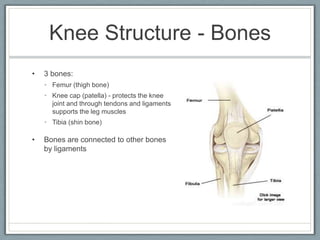
Knee Structure - Bones3 bones:Femur (thigh bone)Knee cap (patella) - protects the knee joint and through tendons and ligaments supports the leg musclesTibia (shin bone)Bones are connected to other bones by ligaments
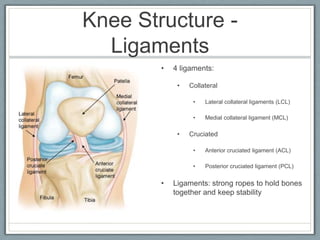
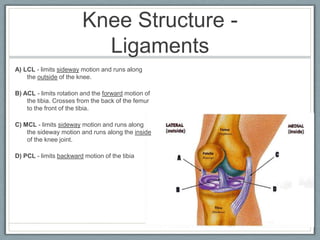
Knee Structure - Ligaments4 ligaments:
Collateral
Lateral collateral ligaments (LCL)
Medial collateral ligament (MCL)
Cruciated
Anterior cruciated ligament (ACL)
Posterior cruciated ligament (PCL)
Ligaments: strong ropes to hold bones together and keep stabilityKnee Structure - LigamentsA) LCL - limits sideway motion and runs along the outside of the knee. B) ACL - limits rotation and the forward motion of the tibia. Crosses from the back of the femur to the front of the tibia. C) MCL - limits sideway motion and runs along the sideway motion and runs along the inside of the knee joint. D) PCL - limits backward motion of the tibia
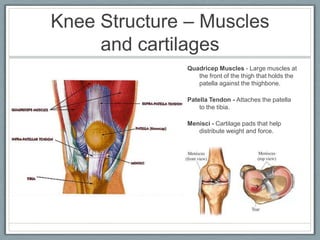
Knee Structure – Muscles and cartilagesQuadricep Muscles - Large muscles at the front of the thigh that holds the patella against the thighbone. Patella Tendon - Attaches the patella to the tibia.Menisci - Cartilage pads that help distribute weight and force.
Knee InjuriesInjured ligaments are considered "sprains" and are graded on a severity scale.Grade 1 Sprains. The ligament is mildly damaged in a Grade 1 Sprain. It has been slightly stretched, but is still able to help keep the knee joint stable.Grade 2 Sprains. A Grade 2 Sprain stretches the ligament to the point where it becomes loose. This is often referred to as a partial tear of the ligament.Grade 3 Sprains. This type of sprain is most commonly referred to as a complete tear of the ligament. The ligament has been split into two pieces, and the knee joint is unstable.If they're not treated at the time, ligament injuries may act up months or years later!!!!  (hmmm, quiet possibly my case)
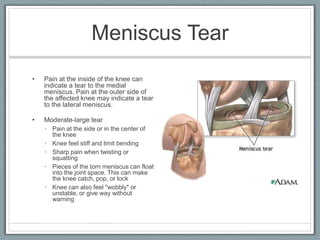
My SymptomsInstabilityPopping soundInside of the knee hurtsCrunching feeling when extend and flex my leg (right knee)Crack feeling when extend and contract leg (left knee)Pain in the middle of the knee, from the front (right knee)Limitation of motion caused by pain and swelling. Limitations were seen in flexion and extension of the leg.
Noticed this after the injured knee has been held in one position for a while. I attempted to move the knee and gradually gained motion (very painful I must say).
Not “locking” but “gelling or stiffness” feeling.My SymptomsPop or snap and knee abruptly goes out. The initial burst of pain is usually sharp, it then becomes dull and aching.Knee doesn’t feel right – INSTABILITY, hence a “give away” feeling.It hurts when: ascending/descending hills or stairs, squatting, weight bearing, ballet plie position, after sitting for long periods of time with knee flexed (theater symptom), someone kicks (sigh).
Injuries (that I remember) so far…1998 – left knee. Playing soccer, hurt it by just running.2000 – left knee. Soccer, abrupt stop.2002 – left knee. Kick on the back.2003 – left knee. Soccer, fast twist in motion while running.2004 – left knee. Gymnastics, hurdle (skip step) before front attempting to perform a silly handspring.2004 – right knee. Gymnastics, hit the inside of the knee with balance beam while falling off in an attempt to perform an aerial.2009 – right knee. Soccer, my foot kind of entangled to another girl’s.2010 – right knee. Soccer side tackle.2010 – right knee. Uneven sidewalk, miss stepped and ankle rolled (no ankle sprain).2011 – left knee. While stretching in a split position (right leg in front), popped, it hurt but nothing compared to other times.2011 – right knee. Gave away while squatting to pick up something. So far the most stupid way of hurting it.WORST one ever!
Interesting FactsAcute knee injuries in sports include: contusions, sprains, strains, fractures, and dislocations.90% of the time ACL tear is misdiagnosed.Severe ligament injuries: hallmark sign of which is instability.Unanticipated moves can result in dynamic (musclotendinous) or static (capsilar, meniscal, ligament).A snapping, popping, ripping, or tearing sensation at the time of injury is generally indicative of a severe injury.After an injury knowing that full extension of the knee was possible practically preludes the possibility of a dislocation, locked, buckle-handed meniscus tear.
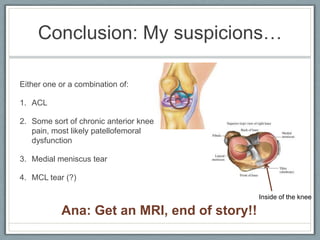
ACL InjuryLargest numbers are sustained in the running/jumping sports: football, basketball, soccer, gymnastics.Usually is a result of a cutting, or turning maneuver or abrupt deceleration. Isolated tears of the menisci or ACL are usually a result of deceleration or rotational forces on the weight-bearing knee as may occur in any running or jumping activity.In jumping activities the injury is caused by a mislanding (not my case but worth to take a note).Isolated sprains or anterior cruciate ligament are almost never the result of contact or collision (contradicts with my right knee’s first and most devastating injury)A snap or pop during a deceleration or cutting maneuver implies ACL or meniscal injury until proven otherwise.

Ana's knee

  • 1.
  • 2.
    Knee Structure -Bones3 bones:Femur (thigh bone)Knee cap (patella) - protects the knee joint and through tendons and ligaments supports the leg musclesTibia (shin bone)Bones are connected to other bones by ligaments
  • 3.
    Knee Structure -Ligaments4 ligaments:
  • 4.
  • 5.
  • 6.
  • 7.
  • 8.
  • 9.
  • 10.
    Ligaments: strong ropesto hold bones together and keep stabilityKnee Structure - LigamentsA) LCL - limits sideway motion and runs along the outside of the knee. B) ACL - limits rotation and the forward motion of the tibia. Crosses from the back of the femur to the front of the tibia. C) MCL - limits sideway motion and runs along the sideway motion and runs along the inside of the knee joint. D) PCL - limits backward motion of the tibia
  • 11.
    Knee Structure –Muscles and cartilagesQuadricep Muscles - Large muscles at the front of the thigh that holds the patella against the thighbone. Patella Tendon - Attaches the patella to the tibia.Menisci - Cartilage pads that help distribute weight and force.
  • 12.
    Knee InjuriesInjured ligamentsare considered "sprains" and are graded on a severity scale.Grade 1 Sprains. The ligament is mildly damaged in a Grade 1 Sprain. It has been slightly stretched, but is still able to help keep the knee joint stable.Grade 2 Sprains. A Grade 2 Sprain stretches the ligament to the point where it becomes loose. This is often referred to as a partial tear of the ligament.Grade 3 Sprains. This type of sprain is most commonly referred to as a complete tear of the ligament. The ligament has been split into two pieces, and the knee joint is unstable.If they're not treated at the time, ligament injuries may act up months or years later!!!! (hmmm, quiet possibly my case)
  • 13.
    My SymptomsInstabilityPopping soundInsideof the knee hurtsCrunching feeling when extend and flex my leg (right knee)Crack feeling when extend and contract leg (left knee)Pain in the middle of the knee, from the front (right knee)Limitation of motion caused by pain and swelling. Limitations were seen in flexion and extension of the leg.
  • 14.
    Noticed this afterthe injured knee has been held in one position for a while. I attempted to move the knee and gradually gained motion (very painful I must say).
  • 15.
    Not “locking” but“gelling or stiffness” feeling.My SymptomsPop or snap and knee abruptly goes out. The initial burst of pain is usually sharp, it then becomes dull and aching.Knee doesn’t feel right – INSTABILITY, hence a “give away” feeling.It hurts when: ascending/descending hills or stairs, squatting, weight bearing, ballet plie position, after sitting for long periods of time with knee flexed (theater symptom), someone kicks (sigh).
  • 16.
    Injuries (that Iremember) so far…1998 – left knee. Playing soccer, hurt it by just running.2000 – left knee. Soccer, abrupt stop.2002 – left knee. Kick on the back.2003 – left knee. Soccer, fast twist in motion while running.2004 – left knee. Gymnastics, hurdle (skip step) before front attempting to perform a silly handspring.2004 – right knee. Gymnastics, hit the inside of the knee with balance beam while falling off in an attempt to perform an aerial.2009 – right knee. Soccer, my foot kind of entangled to another girl’s.2010 – right knee. Soccer side tackle.2010 – right knee. Uneven sidewalk, miss stepped and ankle rolled (no ankle sprain).2011 – left knee. While stretching in a split position (right leg in front), popped, it hurt but nothing compared to other times.2011 – right knee. Gave away while squatting to pick up something. So far the most stupid way of hurting it.WORST one ever!
  • 17.
    Interesting FactsAcute kneeinjuries in sports include: contusions, sprains, strains, fractures, and dislocations.90% of the time ACL tear is misdiagnosed.Severe ligament injuries: hallmark sign of which is instability.Unanticipated moves can result in dynamic (musclotendinous) or static (capsilar, meniscal, ligament).A snapping, popping, ripping, or tearing sensation at the time of injury is generally indicative of a severe injury.After an injury knowing that full extension of the knee was possible practically preludes the possibility of a dislocation, locked, buckle-handed meniscus tear.
  • 18.
    ACL InjuryLargest numbersare sustained in the running/jumping sports: football, basketball, soccer, gymnastics.Usually is a result of a cutting, or turning maneuver or abrupt deceleration. Isolated tears of the menisci or ACL are usually a result of deceleration or rotational forces on the weight-bearing knee as may occur in any running or jumping activity.In jumping activities the injury is caused by a mislanding (not my case but worth to take a note).Isolated sprains or anterior cruciate ligament are almost never the result of contact or collision (contradicts with my right knee’s first and most devastating injury)A snap or pop during a deceleration or cutting maneuver implies ACL or meniscal injury until proven otherwise.