STIP Lab
SCI-TECH INNOVATION POLICY LAB
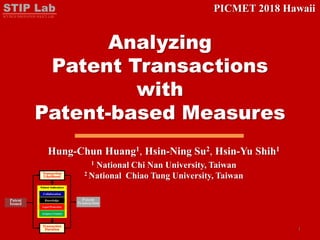
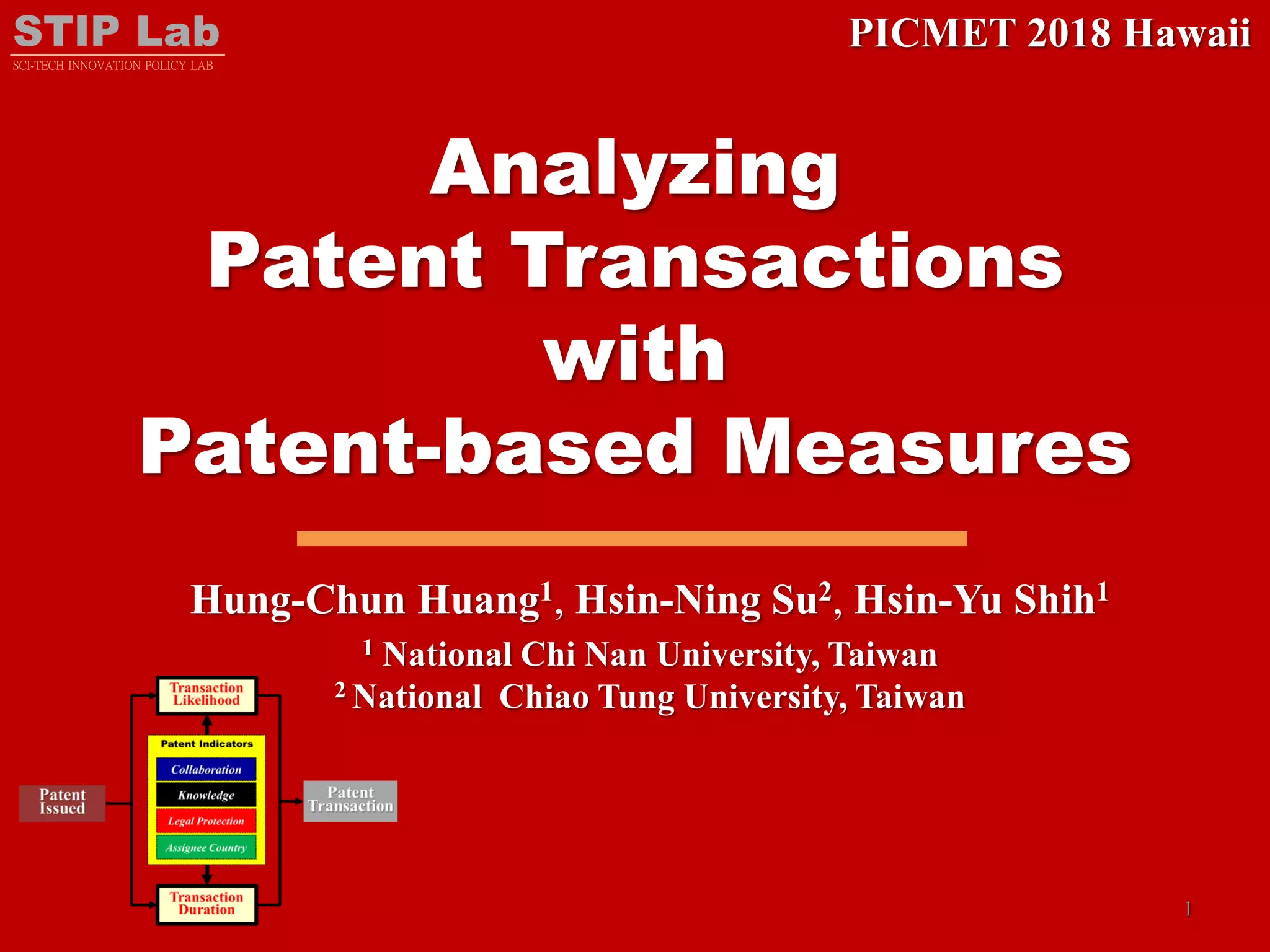
Analyzing
Patent Transactions
with
Patent-based Measures
Hung-Chun Huang1, Hsin-Ning Su2, Hsin-Yu Shih1
1 National Chi Nan University, Taiwan
2 National Chiao Tung University, Taiwan
1
PICMET 2018 Hawaii
STIP Lab
SCI-TECH INNOVATION POLICY LAB
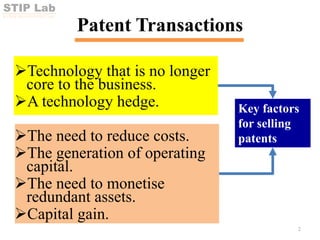
Patent Transactions
Technology that is no longer
core to the business.
A technology hedge.
The need to reduce costs.
The generation of operating
capital.
The need to monetise
redundant assets.
Capital gain.
2
Key factors
for selling
patents
STIP Lab
SCI-TECH INNOVATION POLICY LAB
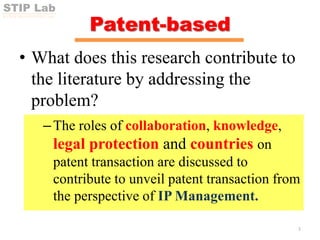
Patent-based
• What does this research contribute to
the literature by addressing the
problem?
–The roles of collaboration, knowledge,
legal protection and countries on
patent transaction are discussed to
contribute to unveil patent transaction from
the perspective of IP Management.
3
STIP Lab
SCI-TECH INNOVATION POLICY LAB
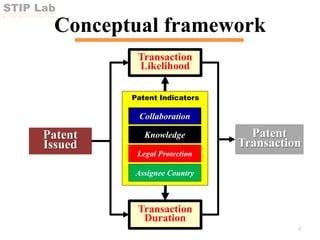
Conceptual framework
4
Patent
Issued
Patent
Transaction
Transaction
Likelihood
Transaction
Duration
Collaboration
Knowledge
Legal Protection
Patent Indicators
Assignee Country
STIP Lab
SCI-TECH INNOVATION POLICY LAB
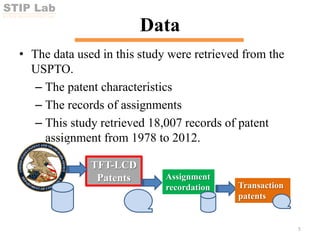
Data
• The data used in this study were retrieved from the
USPTO.
– The patent characteristics
– The records of assignments
– This study retrieved 18,007 records of patent
assignment from 1978 to 2012.
5
Assignment
recordation
TFT-LCD
Patents
Transaction
patents
STIP Lab
SCI-TECH INNOVATION POLICY LAB
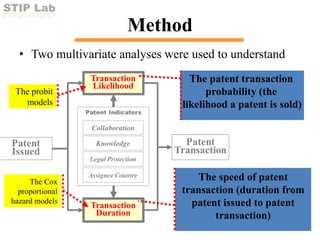
Method
• Two multivariate analyses were used to understand
6
The patent transaction
probability (the
likelihood a patent is sold)
The speed of patent
transaction (duration from
patent issued to patent
transaction)
The probit
models
The Cox
proportional
hazard models
STIP Lab
SCI-TECH INNOVATION POLICY LAB
Method (cont’d)
• Independent variables
7
Collaboration
Knowledge
Legal Protection
Assignee Country
[C] 1. Assignee count [C] 2. Assignee country count
[C] 3. Inventor count [C] 4. Inventor country count
[K] 5. Reference count [K]6. Non-patent reference count
[K] 7. Foreign reference count [K] 8. Cited count (5 yrs)
[K] 9. Cited count (10 yrs) [K] 10. IPC count
[K] 11. Originality index [K] 12. Generality index (5 yrs)
[K] 13. Generality index (10 yrs)
[L] 14. Claim count [L] 15. Litigation probability index
[N] 16.~20 The first assignee country
STIP Lab
SCI-TECH INNOVATION POLICY LAB
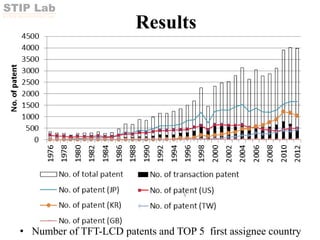
• Number of TFT-LCD patents and TOP 5 first assignee country
8
Results
STIP Lab
SCI-TECH INNOVATION POLICY LAB
Results -Transaction likelihood
9
Transaction probability
Negatively Positive
[C] 4. Inventor country count
[K] 6. Non-patent reference count
[K] 7. Foreign reference count
[K] 11. Originality index
[L] 14. Claim count
[L] 15. Litigation probability index
[N] 17. JPAssignee
[N] 19. TW Assignee
[C] 1. Assignee count
[C] 2. Assignee country count
[C] 3. Inventor count
[K] 5. Reference count
[K] 9. Cited count (10 yrs)
[K] 8. Cited count (5 yrs)
[K] 10. IPC count
[K] 12. Generality index (5 yrs)
[K] 13. Generality index (10 yrs)
[L] 15. Litigation probability index
[N] 16. US Assignee
[N]18. KR Assignee
[N] 20. GB Assignee
STIP Lab
SCI-TECH INNOVATION POLICY LAB
Results -Transaction duration
10
Transaction speed
Decelerate Accelerate
[C] 2. Assignee country count
[K] 6. Non-patent reference count
[K] 8. Cited count (5 yrs)
[K] 10. IPC count
[K] 12. Generality index (5 yrs)
[K] 13. Generality index (10 yrs)
[L] 15. Litigation probability index
[N] 16. US Assignee
[N] 20. GB Assignee
[N] 17. JPAssignee
[N] 19. TW Assignee
[C] 1. Assignee count
[C] 3. Inventor count
[C] 4. Inventor country count
[K] 5. Reference count
[K] 9. Cited count (10 yrs)
[K] 7. Foreign reference count
[K] 11. Originality index
[L] 14. Claim count
[N]18. KR Assignee
STIP Lab
SCI-TECH INNOVATION POLICY LAB
Discussion
Important findings of this research
11
Firm’s appropriability
Reluctant to transact Compliant to transact
Market
liquidity
Accelerate
to
transact
III
[C] 4. Inventor country count
[K] 7. Foreign reference count
[K] 11. Originality index
[L] 14. Claim count
I
[C] 1. Assignee count
[C] 3. Inventor count
[K] 5. Reference count
[K] 9. Cited count (10 yrs)
[N]18. KR Assignee
Decelerate
to
transact
[K] 6. Non-patent reference count
[L] 15. Litigation probability index
[N] 17. JPAssignee
[N] 19. TW Assignee
IV
[C] 2. Assignee country count
[K] 8. Cited count (5 years)
[K] 10. IPC count
[K] 12. Generality index (5 yrs)
[K] 13. Generality index (10 yrs)
[L] 15. Litigation probability index
[N] 16. US Assignee
[N] 20. GB Assignee II
Note: [C] expressed as collaboration indicator. [K]expressed as knowledge indicator.
[L]expressed as legal indicator. [N]expressed as assignee country indicator.
STIP Lab
SCI-TECH INNOVATION POLICY LAB
Conclusion
• Contribution to the theory
1. This paper used a wide range of patent to
evaluate the link between patents and patent
transaction in the market.
2. This is one of the few studies to have used probit
and duration models to analyze patent transaction
probability and transaction speed.
3. This study used patents as a proxy for
understanding patent transaction and can
strengthen the link between existing patent
transaction research and IP management.
12
View publication stats

Analyzing patent transactions with patent based measures

  • 1.
    STIP Lab SCI-TECH INNOVATIONPOLICY LAB Analyzing Patent Transactions with Patent-based Measures Hung-Chun Huang1, Hsin-Ning Su2, Hsin-Yu Shih1 1 National Chi Nan University, Taiwan 2 National Chiao Tung University, Taiwan 1 PICMET 2018 Hawaii
  • 2.
    STIP Lab SCI-TECH INNOVATIONPOLICY LAB Patent Transactions Technology that is no longer core to the business. A technology hedge. The need to reduce costs. The generation of operating capital. The need to monetise redundant assets. Capital gain. 2 Key factors for selling patents
  • 3.
    STIP Lab SCI-TECH INNOVATIONPOLICY LAB Patent-based • What does this research contribute to the literature by addressing the problem? –The roles of collaboration, knowledge, legal protection and countries on patent transaction are discussed to contribute to unveil patent transaction from the perspective of IP Management. 3
  • 4.
    STIP Lab SCI-TECH INNOVATIONPOLICY LAB Conceptual framework 4 Patent Issued Patent Transaction Transaction Likelihood Transaction Duration Collaboration Knowledge Legal Protection Patent Indicators Assignee Country
  • 5.
    STIP Lab SCI-TECH INNOVATIONPOLICY LAB Data • The data used in this study were retrieved from the USPTO. – The patent characteristics – The records of assignments – This study retrieved 18,007 records of patent assignment from 1978 to 2012. 5 Assignment recordation TFT-LCD Patents Transaction patents
  • 6.
    STIP Lab SCI-TECH INNOVATIONPOLICY LAB Method • Two multivariate analyses were used to understand 6 The patent transaction probability (the likelihood a patent is sold) The speed of patent transaction (duration from patent issued to patent transaction) The probit models The Cox proportional hazard models
  • 7.
    STIP Lab SCI-TECH INNOVATIONPOLICY LAB Method (cont’d) • Independent variables 7 Collaboration Knowledge Legal Protection Assignee Country [C] 1. Assignee count [C] 2. Assignee country count [C] 3. Inventor count [C] 4. Inventor country count [K] 5. Reference count [K]6. Non-patent reference count [K] 7. Foreign reference count [K] 8. Cited count (5 yrs) [K] 9. Cited count (10 yrs) [K] 10. IPC count [K] 11. Originality index [K] 12. Generality index (5 yrs) [K] 13. Generality index (10 yrs) [L] 14. Claim count [L] 15. Litigation probability index [N] 16.~20 The first assignee country
  • 8.
    STIP Lab SCI-TECH INNOVATIONPOLICY LAB • Number of TFT-LCD patents and TOP 5 first assignee country 8 Results
  • 9.
    STIP Lab SCI-TECH INNOVATIONPOLICY LAB Results -Transaction likelihood 9 Transaction probability Negatively Positive [C] 4. Inventor country count [K] 6. Non-patent reference count [K] 7. Foreign reference count [K] 11. Originality index [L] 14. Claim count [L] 15. Litigation probability index [N] 17. JPAssignee [N] 19. TW Assignee [C] 1. Assignee count [C] 2. Assignee country count [C] 3. Inventor count [K] 5. Reference count [K] 9. Cited count (10 yrs) [K] 8. Cited count (5 yrs) [K] 10. IPC count [K] 12. Generality index (5 yrs) [K] 13. Generality index (10 yrs) [L] 15. Litigation probability index [N] 16. US Assignee [N]18. KR Assignee [N] 20. GB Assignee
  • 10.
    STIP Lab SCI-TECH INNOVATIONPOLICY LAB Results -Transaction duration 10 Transaction speed Decelerate Accelerate [C] 2. Assignee country count [K] 6. Non-patent reference count [K] 8. Cited count (5 yrs) [K] 10. IPC count [K] 12. Generality index (5 yrs) [K] 13. Generality index (10 yrs) [L] 15. Litigation probability index [N] 16. US Assignee [N] 20. GB Assignee [N] 17. JPAssignee [N] 19. TW Assignee [C] 1. Assignee count [C] 3. Inventor count [C] 4. Inventor country count [K] 5. Reference count [K] 9. Cited count (10 yrs) [K] 7. Foreign reference count [K] 11. Originality index [L] 14. Claim count [N]18. KR Assignee
  • 11.
    STIP Lab SCI-TECH INNOVATIONPOLICY LAB Discussion Important findings of this research 11 Firm’s appropriability Reluctant to transact Compliant to transact Market liquidity Accelerate to transact III [C] 4. Inventor country count [K] 7. Foreign reference count [K] 11. Originality index [L] 14. Claim count I [C] 1. Assignee count [C] 3. Inventor count [K] 5. Reference count [K] 9. Cited count (10 yrs) [N]18. KR Assignee Decelerate to transact [K] 6. Non-patent reference count [L] 15. Litigation probability index [N] 17. JPAssignee [N] 19. TW Assignee IV [C] 2. Assignee country count [K] 8. Cited count (5 years) [K] 10. IPC count [K] 12. Generality index (5 yrs) [K] 13. Generality index (10 yrs) [L] 15. Litigation probability index [N] 16. US Assignee [N] 20. GB Assignee II Note: [C] expressed as collaboration indicator. [K]expressed as knowledge indicator. [L]expressed as legal indicator. [N]expressed as assignee country indicator.
  • 12.
    STIP Lab SCI-TECH INNOVATIONPOLICY LAB Conclusion • Contribution to the theory 1. This paper used a wide range of patent to evaluate the link between patents and patent transaction in the market. 2. This is one of the few studies to have used probit and duration models to analyze patent transaction probability and transaction speed. 3. This study used patents as a proxy for understanding patent transaction and can strengthen the link between existing patent transaction research and IP management. 12 View publication stats View publication stats