Examples of good practices in integrating IP into
innovation policies
…or better: The ‘disease’ of hunting best practices
Alfred Radauer (Senior Consultant, Technopolis)
African Conference on the Strategic Importance of IP Policies to Foster Innovation
Dar-Es-Salaam, March 12/13, 2013
2
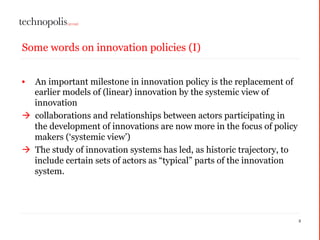
Some words on innovation policies (I)
• An important milestone in innovation policy is the replacement of
earlier models of (linear) innovation by the systemic view of
innovation
à collaborations and relationships between actors participating in
the development of innovations are now more in the focus of policy
makers (‘systemic view’)
à The study of innovation systems has led, as historic trajectory, to
include certain sets of actors as “typical” parts of the innovation
system.
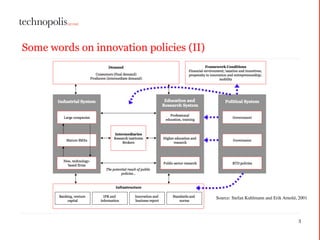
Some words on innovation policies (II)
3
Source: Stefan Kuhlmann and Erik Arnold, 2001
Some words on innovation policies (III)
• Innovation policy can happen at different levels
• At the level of overarching country-wide policies
• At the level of sector policies (health, agriculture, transport,…)
• At the level of individual institutions (universities, firms, etc.)
• At the level of support programmes and (intermediary) services
• At the individual RTDI project level
à Each level will carry its own IPR components and corresponding
IPR policies
4
Some words on innovation policies (IV)
• Three other important trends to consider
• There is an increasing trend, based on observations of successful
innovations, away from the notion of purely technological innovation
à Innovations can be of different types such as service sector, public sector,
organisational, or – perhaps most importantly – business model
innovations
• IPR is increasingly recognised as being more than just patents
à There is a whole range of IPR to consider from formal IPR like patents,
trademarks, GIs, designs and copyrights to informal IP such as trade
secrets
• There is an increasing trend and expectation from the policy side that
innovation should solve societal (grand) challenges
à Rationale for the design of new types of policy intervention such as in the
European “Horizon2020” programme
5
Expectations regarding IP policies as part of innovation
policies...
• One would expect many attempts and many strong examples of how
IP policies can be integrated into innovation policies at various levels
• Reasons
• In fact, IPR (or, more precisely, the patent system) is seen as one of the
earliest attempts to foster innovation
• IPR and its management are important means in making innovations
commercially successful
• IP management/policies are hence an integral part of innovation
management/policies
• There is institutional “ownership” of the topic (IP offices)
• There is an increasing supply of various types of IPR services (grants for
IP filings, trainings, awareness raising, search services etc…)
à Several studies looking for best practices, such as for supporting SMEs
in the field of IPR, e.g. in EU-27, the U.S., Japan, Switzerland, Germany,
South-East Europe and Central Asia paint a different picture...
6
..are hardly met in practice in any country
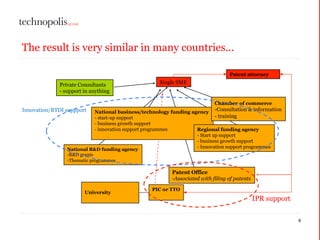
• The IPR world and the innovation policy world are in most
countries separated universes which hardly talk to each other
• The main reason is historical:
• Innovation policies focus on technological R&D issues and
institutions
• Patent offices are traditionally only administrative bodies for
gauging patent and other IPR applications
• From the point of view of innovation policy makers, IPR appears
• As a mostly poorly understood metric to measure innovation
performance (i.e., patent counts)
• As a topic for technology transfer from universities to industry, also
often badly understood
• As a (legal) “framework” condition
7
The result is very similar in many countries...
8
Single SME
National R&D funding agency
-R&D grants
-Thematic programmes
National business/technology funding agency
- start-up support
- business growth support
- innovation support programmes Regional funding agency
- Start up support
- business growth support
- Innovation support programmes
Chamber of commerce
-Consultation & information
- training
Private Consultants
- support in anything
Patent Office
-Associated with filing of patents
PIC or TTO
Patent attorney
University
Innovation/RTDI suppport
IPR support
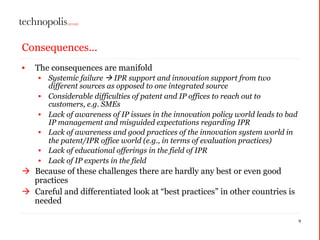
Consequences...
• The consequences are manifold
• Systemic failure  IPR support and innovation support from two
different sources as opposed to one integrated source
• Considerable difficulties of patent and IP offices to reach out to
customers, e.g. SMEs
• Lack of awareness of IP issues in the innovation policy world leads to bad
IP management and misguided expectations regarding IPR
• Lack of awareness and good practices of the innovation system world in
the patent/IPR office world (e.g., in terms of evaluation practices)
• Lack of educational offerings in the field of IPR
• Lack of IP experts in the field
à Because of these challenges there are hardly any best or even good
practices
à Careful and differentiated look at “best practices” in other countries is
needed
9
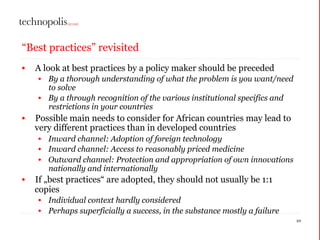
“Best practices” revisited
• A look at best practices by a policy maker should be preceded
• By a thorough understanding of what the problem is you want/need
to solve
• By a through recognition of the various institutional specifics and
restrictions in your countries
• Possible main needs to consider for African countries may lead to
very different practices than in developed countries
• Inward channel: Adoption of foreign technology
• Inward channel: Access to reasonably priced medicine
• Outward channel: Protection and appropriation of own innovations
nationally and internationally
• If „best practices“ are adopted, they should not usually be 1:1
copies
• Individual context hardly considered
• Perhaps superficially a success, in the substance mostly a failure
10
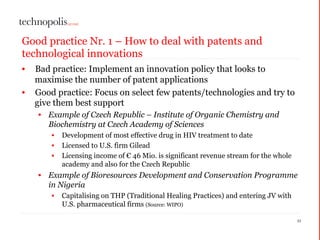
Good practice Nr. 1 – How to deal with patents and
technological innovations
• Bad practice: Implement an innovation policy that looks to
maximise the number of patent applications
• Good practice: Focus on select few patents/technologies and try to
give them best support
• Example of Czech Republic – Institute of Organic Chemistry and
Biochemistry at Czech Academy of Sciences
• Development of most effective drug in HIV treatment to date
• Licensed to U.S. firm Gilead
• Licensing income of € 46 Mio. is significant revenue stream for the whole
academy and also for the Czech Republic
• Example of Bioresources Development and Conservation Programme
in Nigeria
• Capitalising on THP (Traditional Healing Practices) and entering JV with
U.S. pharmaceutical firms (Source: WIPO)
11
Good practice Nr. 2 –
Implement patent/IP search services
• Bad practice: A (small) patent office implements a patent search
service and waits for customers
• Good practice: Collaboration with other business intermediaries to
attract customers
• Example: Dutch IOI programme
• Collaboration between patent office and a business support/innovation
agency
• Trained members of business support agency signpost, where necessary, to
patent office service and patent office places some staff at business agency
• Feasibility for African countries
• Are there enough potential customers?
• Is there a sufficient number of well equipped and trained members of staff?
à Possible option: One well-equipped office centrally serving a larger region/
multiple countries?
à Possible area for technological innovations: access to patent information
services via mobile phones?
12
Good practice Nr. 3 – Integrating innovation, IP policies
and sectorial policies
• Bad practice: IPR and innovation policies are isolated from each
other, and both do not address sectoral needs
• Good practice: IPR and innovation policies are part of sectoral policies
which tackle country-wide challenges
• Example for a good concept: Botswana Technology Centre (Source: WIPO)
• Established in 1979 with the goal to transform Botswana into a globally
competitive nation and operating under the government
• Research, development AND Commercialisation AND use of
technological solutions in specific sectors that tackle the problems of the
country (e.g. in the energy sector: development of solar power
technologies used in powering local schools, hospitals,…)
• Integrated approach to IP
• Collaborations with foreign NGOs and research institutions
• Areas that hold huge potential for sectoral policies: agriculture,
health, ...
13
Lessons learned: Elements of good practice
• Careful analysis of individual problem and possible means to solve
them
• Use broader concepts of innovation and IPR
• Realistic assessment of restrictions
• Pool scarce expertise and make IP professionals talk to members of
the „classic“ innovation system
• Invest in IP education
• Find the gold nuggets in terms of technological innovations
• Foster sectoral policies which tackle specific country needs and
integrate innovation and IP policies accordingly
14
15
Thank you
For further questions, please contact
alfred.radauer@technopolis-group.com
technopolis |group| has offices in Amsterdam, Ankara, Brighton,
Brussels, Frankfurt/Main, Paris, Stockholm, Tallinn and Vienna

wipo_ip_dar_13_d_radauer.pdf

  • 1.
    Examples of goodpractices in integrating IP into innovation policies …or better: The ‘disease’ of hunting best practices Alfred Radauer (Senior Consultant, Technopolis) African Conference on the Strategic Importance of IP Policies to Foster Innovation Dar-Es-Salaam, March 12/13, 2013
  • 2.
    2 Some words oninnovation policies (I) • An important milestone in innovation policy is the replacement of earlier models of (linear) innovation by the systemic view of innovation à collaborations and relationships between actors participating in the development of innovations are now more in the focus of policy makers (‘systemic view’) à The study of innovation systems has led, as historic trajectory, to include certain sets of actors as “typical” parts of the innovation system.
  • 3.
    Some words oninnovation policies (II) 3 Source: Stefan Kuhlmann and Erik Arnold, 2001
  • 4.
    Some words oninnovation policies (III) • Innovation policy can happen at different levels • At the level of overarching country-wide policies • At the level of sector policies (health, agriculture, transport,…) • At the level of individual institutions (universities, firms, etc.) • At the level of support programmes and (intermediary) services • At the individual RTDI project level à Each level will carry its own IPR components and corresponding IPR policies 4
  • 5.
    Some words oninnovation policies (IV) • Three other important trends to consider • There is an increasing trend, based on observations of successful innovations, away from the notion of purely technological innovation à Innovations can be of different types such as service sector, public sector, organisational, or – perhaps most importantly – business model innovations • IPR is increasingly recognised as being more than just patents à There is a whole range of IPR to consider from formal IPR like patents, trademarks, GIs, designs and copyrights to informal IP such as trade secrets • There is an increasing trend and expectation from the policy side that innovation should solve societal (grand) challenges à Rationale for the design of new types of policy intervention such as in the European “Horizon2020” programme 5
  • 6.
    Expectations regarding IPpolicies as part of innovation policies... • One would expect many attempts and many strong examples of how IP policies can be integrated into innovation policies at various levels • Reasons • In fact, IPR (or, more precisely, the patent system) is seen as one of the earliest attempts to foster innovation • IPR and its management are important means in making innovations commercially successful • IP management/policies are hence an integral part of innovation management/policies • There is institutional “ownership” of the topic (IP offices) • There is an increasing supply of various types of IPR services (grants for IP filings, trainings, awareness raising, search services etc…) à Several studies looking for best practices, such as for supporting SMEs in the field of IPR, e.g. in EU-27, the U.S., Japan, Switzerland, Germany, South-East Europe and Central Asia paint a different picture... 6
  • 7.
    ..are hardly metin practice in any country • The IPR world and the innovation policy world are in most countries separated universes which hardly talk to each other • The main reason is historical: • Innovation policies focus on technological R&D issues and institutions • Patent offices are traditionally only administrative bodies for gauging patent and other IPR applications • From the point of view of innovation policy makers, IPR appears • As a mostly poorly understood metric to measure innovation performance (i.e., patent counts) • As a topic for technology transfer from universities to industry, also often badly understood • As a (legal) “framework” condition 7
  • 8.
    The result isvery similar in many countries... 8 Single SME National R&D funding agency -R&D grants -Thematic programmes National business/technology funding agency - start-up support - business growth support - innovation support programmes Regional funding agency - Start up support - business growth support - Innovation support programmes Chamber of commerce -Consultation & information - training Private Consultants - support in anything Patent Office -Associated with filing of patents PIC or TTO Patent attorney University Innovation/RTDI suppport IPR support
  • 9.
    Consequences... • The consequencesare manifold • Systemic failure  IPR support and innovation support from two different sources as opposed to one integrated source • Considerable difficulties of patent and IP offices to reach out to customers, e.g. SMEs • Lack of awareness of IP issues in the innovation policy world leads to bad IP management and misguided expectations regarding IPR • Lack of awareness and good practices of the innovation system world in the patent/IPR office world (e.g., in terms of evaluation practices) • Lack of educational offerings in the field of IPR • Lack of IP experts in the field à Because of these challenges there are hardly any best or even good practices à Careful and differentiated look at “best practices” in other countries is needed 9
  • 10.
    “Best practices” revisited •A look at best practices by a policy maker should be preceded • By a thorough understanding of what the problem is you want/need to solve • By a through recognition of the various institutional specifics and restrictions in your countries • Possible main needs to consider for African countries may lead to very different practices than in developed countries • Inward channel: Adoption of foreign technology • Inward channel: Access to reasonably priced medicine • Outward channel: Protection and appropriation of own innovations nationally and internationally • If „best practices“ are adopted, they should not usually be 1:1 copies • Individual context hardly considered • Perhaps superficially a success, in the substance mostly a failure 10
  • 11.
    Good practice Nr.1 – How to deal with patents and technological innovations • Bad practice: Implement an innovation policy that looks to maximise the number of patent applications • Good practice: Focus on select few patents/technologies and try to give them best support • Example of Czech Republic – Institute of Organic Chemistry and Biochemistry at Czech Academy of Sciences • Development of most effective drug in HIV treatment to date • Licensed to U.S. firm Gilead • Licensing income of € 46 Mio. is significant revenue stream for the whole academy and also for the Czech Republic • Example of Bioresources Development and Conservation Programme in Nigeria • Capitalising on THP (Traditional Healing Practices) and entering JV with U.S. pharmaceutical firms (Source: WIPO) 11
  • 12.
    Good practice Nr.2 – Implement patent/IP search services • Bad practice: A (small) patent office implements a patent search service and waits for customers • Good practice: Collaboration with other business intermediaries to attract customers • Example: Dutch IOI programme • Collaboration between patent office and a business support/innovation agency • Trained members of business support agency signpost, where necessary, to patent office service and patent office places some staff at business agency • Feasibility for African countries • Are there enough potential customers? • Is there a sufficient number of well equipped and trained members of staff? à Possible option: One well-equipped office centrally serving a larger region/ multiple countries? à Possible area for technological innovations: access to patent information services via mobile phones? 12
  • 13.
    Good practice Nr.3 – Integrating innovation, IP policies and sectorial policies • Bad practice: IPR and innovation policies are isolated from each other, and both do not address sectoral needs • Good practice: IPR and innovation policies are part of sectoral policies which tackle country-wide challenges • Example for a good concept: Botswana Technology Centre (Source: WIPO) • Established in 1979 with the goal to transform Botswana into a globally competitive nation and operating under the government • Research, development AND Commercialisation AND use of technological solutions in specific sectors that tackle the problems of the country (e.g. in the energy sector: development of solar power technologies used in powering local schools, hospitals,…) • Integrated approach to IP • Collaborations with foreign NGOs and research institutions • Areas that hold huge potential for sectoral policies: agriculture, health, ... 13
  • 14.
    Lessons learned: Elementsof good practice • Careful analysis of individual problem and possible means to solve them • Use broader concepts of innovation and IPR • Realistic assessment of restrictions • Pool scarce expertise and make IP professionals talk to members of the „classic“ innovation system • Invest in IP education • Find the gold nuggets in terms of technological innovations • Foster sectoral policies which tackle specific country needs and integrate innovation and IP policies accordingly 14
  • 15.
    15 Thank you For furtherquestions, please contact alfred.radauer@technopolis-group.com technopolis |group| has offices in Amsterdam, Ankara, Brighton, Brussels, Frankfurt/Main, Paris, Stockholm, Tallinn and Vienna