UNIVERSITY of CALIFORNIA
SANTA CRUZ
Patent Trends in Applied Physics Industry:
A qualitative analysis of mathematical economic models
and patent citation data
A thesis submitted in partial satisfaction of the
requirements for the degree of
BACHELOR OF SCIENCE
In
APPLIED PHYSICS
By
Jordan P. Bentley
May 18, 2016
–––––––––––––––––––––––––––– ––––––––––––––––––––––––––––
David P. Belanger David P. Belanger
Thesis Coordinator Chair, Department of Physics
Acknowledgements
The process of developing this thesis has spanned many years and was close to futility
many times. I feel blessed and thankful to have produced a piece of work I am genuinely
proud of. I would like to thank the University of California Physics Department, David
Belanger, and Fred Kuttner for allowing and encouraging the opportunity to explore a
non-traditional topic in physics that I believe are important for the breadth of subjects in
the department.
This thesis is dedicated to my late mother, Mary Ellen Yates, who consistently inspired
me to follow my educational goals and always think critically, act responsibly, and live
with compassion.
Bentley 1
ABSTRACT
This thesis utilizes a mathematical economic model that predicts responses to changes in patent
policy between developed and emerging countries. The results of this analysis are used to
propose an alternative, more dynamic patent policy in applied physics industry. In applying this
model to a diverse, global economy, an assumption is introduced that relates emerging and
developed countries to emerging and developed producers, given that the two producers can
adopt distinct patent protection. The model is then backed by empirical evidence from applied
physics industry, in the form of patent citation network analysis, and applied to three case
studies: emerging producers in the Chinese photovoltaic industry; the case of large developers in
the electric car industry adopting weaker patent protection; the advent of the open-source
movement and the problem of patent trolling among software producers. In each case, the model
presented successfully predicts the standard “one size fits all” patent protection is insufficient in
encouraging innovation and technological progress. The policy proposed by this work suggests
specific patent protection depending on the size and growth pattern of an industry, as well as the
size and capability of an individual producer, which addresses many of the challenges and
hindrances to technological progress in applied physics industry. It is found that both larger and
smaller producers in high-growth technologies benefit from similar patent protection, while in
low-growth industries, there is an inverse relationship between the patent strength of developing
and emerging producers. This also implies a developed industry in stagnant growth can see a
boost in innovation by lowering patent strength.
Bentley 2
INTRODUCTION
The application of current research in physics to a modern free market economy is
complicated at best, in which myriad inventions and innovations in applied physics are
transitioned into the industrial and commercial domains through intricate policy that governs the
Intellectual Property (IP) of industrial progress. The relationship between theoretical research in
physics and industrial consumer products is a necessary part of modern technological economies.
The policies through which theory makes the transition to technology are governed by patents,
which not only record and document an invention’s purpose and process, but simultaneously
protect its inventor from duplication. Duplication and replication can potentially remove value
from the inventor by increasing a process’s market competition, leading to disenfranchisement of
the inventor. Therefore, the protection a patent gives an inventor serves to further incentivize
innovation.
The patent process is therefore inherent to and essential for dependable innovation and
development in modern economies, however, the intricacies of patent law often times inhibit,
rather than propel, innovative research and development (R&D) conducted through both
universities as well as in the private sector. Recent patent reform in the U.S. congress adopted a
first to file, “one size fits all” model for patent policy, which causes misunderstood innovation
issues that cannot account for differences between industries or less developed producers.1
Furthermore, patent litigators that prey on emerging producers, the so-called “patent trolls,”
punish innovation at all levels of industry2
. Universities, on the other hand, produce fundamental
1
Schacht, Wendy, and John Thomas. "Patent Reform in the 112th Congress: Innovation Issues." Congressional
Research Service (June 30, 2011): 38. Print.
2
Georgiades, Eugenia. "Resolving Conflicting Interests: Software Patents Versus Open Source." Information &
Communications Technology Law 20.3 (2011): 225-252. Academic Search Complete.
Bentley 3
academic papers that function outside the restrictions of patents, yet do not have the resources to
pursue large scale R&D3
.
It is essential, then, in the field of applied physics to understand the patent process at its
most effective and efficient level, such that innovations in physics may be seamlessly integrated
into development and production, with ample protection for their inventors. However, even
within applied physics industries there are large discrepancies between the innovation needs of
developed economies and those just incubating their development cycle4
. These discrepancies
are further complicated by the global nature of modern industries in applied physics. Fortunately,
the continued expansion and reworking of separate government’s patent policies provides a
template through which the patent process may be scrutinized by those in the academic
community.
Thus, the research presented here aims to facilitate an understanding of applied physics
innovation with respect to patent policy in two specific ways; 1) to analyze current research on
national and international patent policy, providing a model that demonstrates a non-linear
relationship between patent protection and R&D at different stages of economic development;
and 2) to investigate the patent process through case-studies of applied physics innovations at
both the academic and industrial levels. Utilizing these two perspectives, a more efficient and
functional patent process may be presented, providing a basis for the optimal application of the
physical sciences to industry.
BACKGROUND
3
“Patents and Higher Education’s Entry into the Market” ASHE Higher Education Report 34.4 (2008): 77-91. Print
4
Shibata, Naoki, Yuya Kajikawa, and Ichiro Sakata. "Extracting the Commercialization Gap between Science and
Technology — Case Study of a Solar Cell." Technological Forecasting and Social Change 77.7 (2010): 1147-155.
Print.
Bentley 4
It is indeed fitting that an exploration of the patent process from the perspective of
university research institutions should be centralized around the University of California. It was,
interestingly, the University of California at Berkeley that initially supported the concept of
commercializing academic research through patent activity in 1907. The invention was, notably,
in the arena of Applied Physics—an electrostatic precipitator—the inventor, a man named
Frederick Cottrell. Cottrell’s subsequent patent and research institution, named the “Research
Corporation,” were rolled out in 1912. Fast-forward nearly one hundred years in the future, and
the system at the University of California is surprisingly similar.
The University of California Santa Cruz Center for Entrepreneurship is now the closest
thing to Cottrell’s initial vision for the industrialization of academic research. The Center’s “goal
is to develop business models that bring an innovation to market. In this case, one specifically set
up to commercialize intellectual property developed within UCSC.”5
This institution is central
to the evaluation of the patent process undertaken by UCSC faculty, and is instrumental in
facilitating the market influence of academic research conducted at UC.
The Center for Entrepreneurship at UCSC is one of many institutions that come face to
face with IP and patents while bridging the gap between burgeoning technologies and the
implementation of technology in industry. Many of those in Silicon Valley are at the center of an
IP battleground, where the issues surrounding technology ownership are a daily concern. Tech
giants like Google and Apple, who own myriad patents ranging from fundamental to futuristic,
hold a number of undeveloped technologies hostage. Using a trove of overly protected yet weak
patents, the ever-vigilant “patent trolls” search tirelessly for industry newcomers, only to use
their enormous range of patents to strong arm young industries into shutting down. Yet both the
academic and the industrial face a similar problem with new technologies, which is how to
5
"Center for Entrepreneurship." Http://c4e.ucsc.edu/home. Web. <http://c4e.ucsc.edu/home>.
Bentley 5
incentivize new tech, protect that technology while R&D is at its most effective, and then ensure
it is eventually retired to a status of accessibility for streamlined use in society.
Historical references also infer that a dynamic patent policy is more beneficial to
development than the linear system that has become the norm in most economies. The great
innovation that took Japan by storm after WWII is an example of this, as post-war policy
provided very little patent protection, driving forward innovation and invention (along with
imitation.)6
Yet, this was only temporary, as the weak patent laws became more disastrous as the
economy grew. Weak patents lead to high competition, which in economic down times can cause
industries to become devalued, and thus when industrial technologies took hold in Japan during
the 1980s, many of them buckled under their own size and operating costs.7
This thesis will deal specifically with current research into the topic of academic patent
policy, with the expectation that a greater understanding of the specific needs of invention will
present a more dynamic picture of patent protection and innovation, i.e., one that is not simply of
the form: more innovation equates to more patent strength. Indeed, a significant problem with the
current policy is the de facto patent protection across multiple industries and technologies,
regardless of their place in their own development and innovation cycle, or their place within the
greater evolution of a particular industry.
Therefore, the goal of this writing, with the aid of contemporary research, is that patent
policy must evolve in a non-linear fashion as innovation and the ‘maturity’ of an economy
grows. That is, when industry is in its infancy, a weak patent policy that is tolerant of imitation
must be present to drive innovation, competition, and cheap-production. However, as the
industry grows so must the protection of invention to promote the necessary competition for a
6
Sakakibara, Mariko. "Assessing the Role of University Patent Rights: U.S.-Japan Comparison of University-Industry
Knowledge Transfer." University of California, Los Angeles, May 2007. Web.
7
Ibid.
Bentley 6
market economy. Finally, once a technology has reached the end of its life-cycle, the protection
of the technology through patents is equalized among producers in order to avoid the
monopolizing of technology that is rampant in developed market economies. The difficulty is
identifying what stage specifically an industry is in; an underdeveloped industry facing strong
patent strength will be underutilized in a crawl to develop a market of scale and efficient
production, while a mature industry with no IP protection will become devalued with imitation.
Furthermore, defenders of the current “one-size-fits-all” patent policy can cite the
economic origins of intellectual property: to drive the capital investment of creative and
innovative technologies which otherwise would be very dangerous investments to recoup. The
purpose, therefore, of giving immediate protection of rights to the inventor, is to incentivize the
early stage development of technology. Yet, a change in patent policy to reflect dynamic
protection over time can address these concerns in two ways: the first is in the defense and
support of the academic system itself as a government subsidized incubator for infant
technology; the second, is in the argument that many early stage technologies require
marketability and competition to allow them to develop to a point where R&D costs level off.
METHODS
Several methods can be used to describe trends in applied physics innovation, but the
methods used here will specifically address patents as a way of describing, through economic
models as well as patent citation analysis, the implementation of applied physics concepts in
industry. Indeed, contemporary academic evidence and economic models have done a good job
in describing current innovation trends in industry using complex mathematical correlation and
Bentley 7
vast databases of patent citation data8
. This paper utilizes current research and models, described
by the following: 1) a recent mathematical economic model published in 2011 that uses
economic principles to model patent strength based on the relationship between two countries; 2)
a database of citation data including both patents and academic papers; and 3) analysis of
industry and academic groups working to function within current patent laws to maximize their
innovation efforts and invention protection.
This research involved looking at published models of patent trending in order to draw
conclusions about the ideal methods of maximizing productivity and innovation in applied
physics industry. The first such model, entitled Endogenous Research and Development and
Intellectual Property Laws in Developed and Emerging Economies authored by Bagchi and Roy,
is based in mathematical economics and relates the so-called response function between two
countries to determine the effect of incremental research and development (R & D) on patent
strength and patent breath9
. The work analyzes how changes in the IP laws of a developed
economy affect those of an emerging economy. The first model uses well known and correlated
economic equations to determine a new model for the response between emerging and
developing “countries” and their patent strength.
In Bagchi and Roy’s analysis, their response function maximizes a welfare function,
which incorporates the concepts of the following economic principles; incremental research,
profit, consumer surplus, and patent length and patent breadth. Therefore, a determination can
be made of a shift in consumer surplus based on an initial push in incremental research. Also,
because patent strength can be related to the response function for both industries, we will be
8
Yoon, Byungun, and Sungioo Lee. "Applicability of Patent Information in Technological Forecasting: A Sector-
specific Approach." Journal of Intellectual Property Rights 17 (2012): 37-45. Print.
9
Bagchi, Aniruddha, and Abuts Roy. "Endogenous Research and Development and Intellectual Property Laws in
Developed and Emerging Economies." Southern Economic Journal 78.3 (2012): 895-930. Print.
Bentley 8
able to see how an incremental research push provided by a developed “country” will affect an
emerging “country” with the ability to “free-ride” on stronger patent strength of the developed
industry—patent restrictions the emerging economy is free from. These trends, outlined through
mathematical models, are vital in the understanding of how emerging industries in applied
physics can benefit from a revitalized patent policy.
The term “country” in the above description is parenthesized because an important
assumption made in this research is that the term “country” can be effectively converted to
“economy,” “industry,” or “producer.” This is necessary in order to use the model to outline a
dynamic patent policy among producers within one country. This can be accomplished because
Bagchi’s definition of “countries” merely has the constraint that they need only be able to control
their own R&D and have independent functioning of their supply and demand, and have the
ability to maintain separate and distinct patent protection. Furthermore, according to Bagchi,
“the most important differences between developed and emerging economies is that emerging
economies have lower incomes and a lower level of research capability.”10
This description can,
without much elaboration, be applied to emerging producers in an applied physics industry such
as photovoltaics, as much of the core research is being conducted at the university level11
, or in
the “startup” economy, where both incomes and research capability is limited. Since the patent
trends of emerging and developing industries is what this paper focuses on, this is a helpful
assumption to translate the model for use in applied physics industry.
The assumption outlined above also requires that the two “countries,” now being
interpreted as “producers,” must be allowed to have fluid patent laws in which the two
10
Bagchi, Aniruddha, and Abuts Roy. "Endogenous Research and Development and Intellectual Property Laws in
Developed and Emerging Economies." Southern Economic Journal 78.3 (2012): 895-930. Print.
11
Tijssen, Robert J.w. "Science Dependence of Technologies: Evidence from Inventions and Their
Inventors." Research Policy 31.4 (2002): 509-26.
Bentley 9
producers, whether emerging or developed, are not required to have the same degree of patent
protection. Yet, in most industrialize nations or the world, patent policy is not dynamic enough to
attribute separate patent protection to different producers or stages of development. In this
current “one size fits all” patent system, all types of industries and inventions share identical
patent protection, which can hinder innovation specific to a unique technology or a more basic
stage of development. However, as we will see, adopting a non-conforming, dynamic patent
system that allows separate protection depending on industry has far-reaching benefits, not only
for the development of crucial applied physics technologies, but also for the optimal relationship
between primary research institutions and applied physics industries.
The second model uses patent citation data to show the commercialization discrepancies
between total patent citations and those patents that are connected in working components in
industry12
. An important stage that is accomplished by this writing is also applying some
necessary empirical backing to Bagchi and Roy’s purely mathematical model through citation
network analysis of international producers. We use varying sources of citation data and look
and the connections of “clusters” of different patent groups that pertain to similar fields in
applied physics. We can do this simply by looking through a database of patent and papers and
just searching by title, then using several different models to algorithmically analyze patents
based on keywords and relatable factors within commons technologies. It has been shown
through similar research that, while this method is simple, it is accurate in showing patent trends
for specific industries. The mathematical patent models will then be applied to current event case
studies, giving insight and explanation to recent advances in the landscape of applied physics
industry.
12
Shibata, Naoki, Yuya Kajikawa, and Ichiro Sakata. "Extracting the Commercialization Gap between Science and
Technology — Case Study of a Solar Cell." Technological Forecasting and Social Change 77.7 (2010): 1147-155.
Print.
Bentley 10
EQUATIONS
We may start by assessing the kinds of functions currently used to model patent
protection, summarized by Bagchi and Roy in their paper. Here, we begin with a “production
function” P(R), where 𝑅1 indicates an incremental increase in R&D from “firm 1”, and increases
the probability of success P(R) as a function of increased research and development. Further,
𝑃′(∙) > 0 and 𝑃′′(∙) < 0 , where 𝑃′(∙) is the marginal change in productivity of R&D and 𝑃′′(∙)
is the curvature in the marginal productivity function of total R&D, due to small changes in 𝑅1.
We can then identify, in economic terms, the flow of profits to a firm as π, and develop
the following equation that relates patent length 𝑇1—the amount of time a firm can hold a
monopoly over a certain technology—as a determinant of profits:
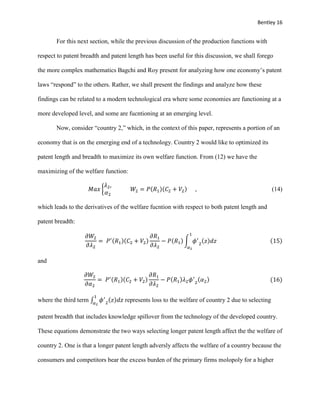
∫ 𝜋𝑒−1
𝑑𝑡 = 𝜋(1 − 𝑒−𝑇1)
𝑇1
0
(1)
It then follows, from the fact that (1 − 𝑒−𝑇1) and 𝑇1 are monotonically related, that we can
measure patent length in “country,” or producer, i by
𝜆𝑖 ≡ 1 − 𝑒−𝑇1 (2)
An important aspect of this model’s analysis is the concept that there will be “spillover”
of knowledge from the developed industry to the emerging one. This becomes clear when we
think of a long standing industry such as solar cells, in which the basic technology is broadcast
through academic and private institution papers13
, as well as the public availability of patented
research. Therefore, the necessary definition of patent breadth 𝛽𝑖 is normalized and reduced by
any knowledge spillover from an invented product to an imitated product. Patent breadth of
economy i is measured by
𝛽𝑖 ≡ (1 − 𝛼𝑖) (3)
13
Yoon, Janghyeok, Sungchui Chui, and Kwangsoo Kim. "Invention Property-function Network Analysis of Patents:
A Case of Silicon-based Thin Film Solar Cells." Scienometrics 86 (2011): 687-703. Print.
Bentley 11
where 𝛼𝑖=0 represents the least amount of knowledge spillover, i.e. “the imitator cannot use any
of the incremental knowledge embodied in the invention and hence is equivalent to the
maximum possible patent breadth.”14
However, we can determine that knowledge spillover and
patent breadth have a one-to-one relationship, meaning we only need to define one such variable.
Thus, in this analysis, as it is described in Bagchi and Denicolό15
, we will focus on the degree of
knowledge spillover 𝛼𝑖 and the patent length 𝜆𝑖.
The instantaneous profit of firm i in country j (recall that “country” in this case is
assumed to be analogous with “producer”) conditional on a successful innovation is
𝜋𝑖𝑗(𝛼𝑖); 𝑖, 𝑗 = 1,2. (4)
For example, if there is a high degree of knowledge spillover in the early stage of a long term
applied physics industry, such as photovoltaics, robotics, or semiconductors, there is a reduction
in firm 1’s profit:
𝜋′1𝑗(𝛼𝑖) < 0.
Thus, the payoff of firm 1 with an R&D effort of 𝑅1is
𝛱1 = 𝑃(𝑅1)𝑉1 − 𝑅1, (5)
where
𝑉1 = 𝜆1 𝜋11(𝛼1) + (1 − 𝜆1)𝜋11(1)+𝜆2 𝜋12(𝛼2) + (1 − 𝜆1)𝜋12(1) (6)
is the gross profit obtained by firm 1 based on the completion to market of a successful
invention. This expression values an invention’s profit based on four terms: 𝜆1 𝜋11(𝛼1), which
describes the profit of an firm 1’s invention (dependent on the breath of patented information)
times the patent length; (1 − 𝜆1)𝜋11(1), which reduces to just 𝜋11(1) after the patent expires
14
Bagchi, Aniruddha, and Abuts Roy. "Endogenous Research and Development and Intellectual Property Laws in
Developed and Emerging Economies." Southern Economic Journal 78.3 (2012): 895-930. Print.
15
Denicolo, Vincenzo. "Patent Races and Optimal Patent Breadth and Length. “The Journal of Industrial
Economics 44.3 (1996): 249. Web.
Bentley 12
(𝜆1 = 0); the final two terms are the same, only based around “country 2,” which in this case is
an emerging sector of that industry. It is important to note that in Bagchi’s model success in the
emerging economy’s growth only comes after the original patent on the original technology has
expired. Therefore, this formula gives value to the invention, or certain stage of technology,
during and after the patent is in effect—further mapping this equation will entitle us to an
understanding of the changes patent length and breadth has on differing industries.
For the purpose of expressing equation (5) graphically as a function of patent length and
breadth, we can rewrite 𝑉1in the following form:
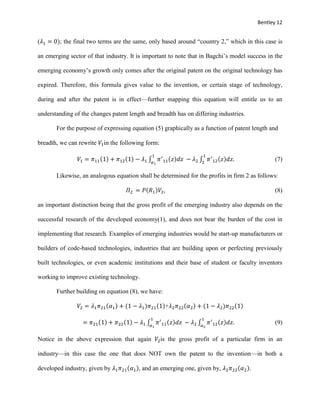
𝑉1 = 𝜋11(1) + 𝜋12(1) − 𝜆1 ∫ 𝜋′
11(𝑧)𝑑𝑧
1
𝛼1
− 𝜆2 ∫ 𝜋′
12(𝑧)𝑑𝑧.
1
2
(7)
Likewise, an analogous equation shall be determined for the profits in firm 2 as follows:
𝛱2 = 𝑃(𝑅1)𝑉2, (8)
an important distinction being that the gross profit of the emerging industry also depends on the
successful research of the developed economy(1), and does not bear the burden of the cost in
implementing that research. Examples of emerging industries would be start-up manufacturers or
builders of code-based technologies, industries that are building upon or perfecting previously
built technologies, or even academic institutions and their base of student or faculty inventors
working to improve existing technology.
Further building on equation (8), we have:
𝑉2 = 𝜆1 𝜋21(𝛼1) + (1 − 𝜆1)𝜋21(1)+𝜆2 𝜋22(𝛼2) + (1 − 𝜆2)𝜋22(1)
= 𝜋21(1) + 𝜋22(1) − 𝜆1 ∫ 𝜋′
11(𝑧)𝑑𝑧
1
𝛼1
− 𝜆2 ∫ 𝜋′
12(𝑧)𝑑𝑧.
1
𝛼2
(9)
Notice in the above expression that again 𝑉2is the gross profit of a particular firm in an
industry—in this case the one that does NOT own the patent to the invention—in both a
developed industry, given by 𝜆1 𝜋21(𝛼1), and an emerging one, given by, 𝜆2 𝜋22(𝛼2).
Bentley 13
The next factor Bagchi and Roy develop to construct their model is consumer surplus,
which will define valuable drivers in the R&D later on in this analysis. For now, Bagchi defines
the total consumer surplus in “country 1,” the developed economy, “conditional on a successful
invention”, as
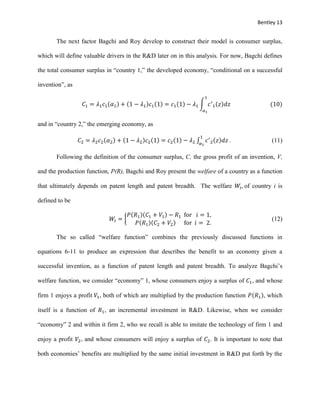
𝐶1 = 𝜆1 𝑐1(𝛼1) + (1 − 𝜆1)𝑐1(1) = 𝑐1(1) − 𝜆1 ∫ 𝑐′
1(𝑧)𝑑𝑧
1
𝛼1
(10)
and in “country 2,” the emerging economy, as
𝐶2 = 𝜆2 𝑐2(𝛼2) + (1 − 𝜆2)𝑐2(1) = 𝑐2(1) − 𝜆2 ∫ 𝑐′
2(𝑧)𝑑𝑧
1
𝛼2
. (11)
Following the definition of the consumer surplus, C, the gross profit of an invention, V,
and the production function, P(R), Bagchi and Roy present the welfare of a country as a function
that ultimately depends on patent length and patent breadth. The welfare 𝑊𝑖, of country i is
defined to be
𝑊𝑖 = {
𝑃(𝑅1)(𝐶1 + 𝑉1) − 𝑅1 for 𝑖 = 1,
𝑃(𝑅1)(𝐶2 + 𝑉2) for 𝑖 = 2.
(12)
The so called “welfare function” combines the previously discussed functions in
equations 6-11 to produce an expression that describes the benefit to an economy given a
successful invention, as a function of patent length and patent breadth. To analyze Bagchi’s
welfare function, we consider “economy” 1, whose consumers enjoy a surplus of 𝐶1, and whose
firm 1 enjoys a profit 𝑉1, both of which are multiplied by the production function 𝑃(𝑅1), which
itself is a function of 𝑅1, an incremental investment in R&D. Likewise, when we consider
“economy” 2 and within it firm 2, who we recall is able to imitate the technology of firm 1 and
enjoy a profit 𝑉2, and whose consumers will enjoy a surplus of 𝐶2. It is important to note that
both economies’ benefits are multiplied by the same initial investment in R&D put forth by the
Bentley 14
developed economy. To summarize the effects of this model, I will refer to Bagchi and Roy’s
own words:
In the model, country i maximizes 𝑊𝑖 by selecting the patent length 𝜆1 and the
patent breadth (1 − 𝛼𝑖); 𝑖 = 1, 2. In country 1, there is tension between
consumers in country 1 (who prefer a shorter patent length) and firm 1 (the
innovating firm). The optimal patent length in country 1 therefore balances the
tension between the consumers of firm 1. In country 2, the benefits from a strong
patent regime do not accrue directly to its citizens, and therefore it might seem
that country 2 would free-ride on country 1’s innovation by selecting excessively
weak patent laws.16
Thus, economies with little financial power, such as academic institutions, start-up
companies, and independent inventors working to develop emerging technologies are analogous
with the developing “country,” and large industrial complexes and corporations, which are
working to perfect and capitalize on developed technologies, are analogous with the developed
“country.” We see in this model an incentive for the developing economies to enjoy weaker
patent laws, while the incentive still exists for the developed economy to maintain strong patent
protection. This is true as long as the incremental R&D produces a significant change in the
technology. As we will see in the next section, there naturally comes a point during the lifetime
of a technology when an incremental change in R&D does not have a significant change in the
technology’s use, at which point both economies share the same patent protection for the life of
the technology.
In order to analyze the above situation, we must discuss the rate at which incremental
changes in R&D approach their limit towards the end of a technology’s lifetime. To do this, we
return to the production function 𝑃(𝑅1), except this time during a period following an initial
change in the technology. In period 2, firm 1 selects its R&D to maximize its expected profit 𝛱1 ,
therefore the R&D, 𝑅1 that maximizes this profit satisfies the equation:
16
Bagchi, Aniruddha, and Abuts Roy. "Endogenous Research and Development and Intellectual Property Laws in
Developed and Emerging Economies." Southern Economic Journal 78.3 (2012): 895-930. Print. p911.
Bentley 15
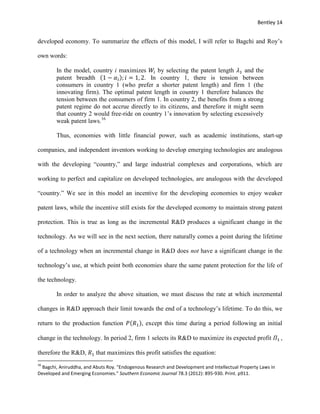
𝑃′(𝑅1) =
1
𝑉1
, (13)
where (𝑅1) is a function of both patent length and patent breadth of both countries, such that
(𝑅1) = 𝑅1(𝜆1, 𝜆2, 𝛼1, 𝛼2)
As we are attempting to analyze the rate of change of this marginal investment in R&D, a
function 𝜎(𝑅1) is presented as the derivative of the production function with respect to the R&D
investment (𝑅1), where 𝜎(𝑅1) is as follows:
𝜎(𝑅1) = −
𝑑
𝑑𝑅1
ln 𝑃′
1(𝑅1) = −
𝑃′′(𝑅1)
𝑃′(𝑅1)
𝜎(𝑅1) is therefore positively related to the curvature of the R&D production function P’(R).
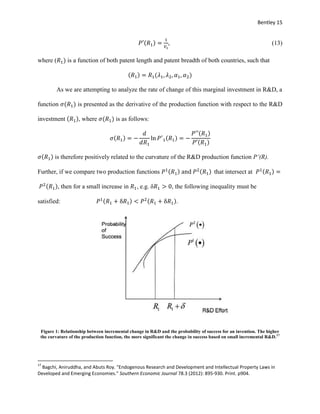
Further, if we compare two production functions 𝑃1(𝑅1) and 𝑃2(𝑅1) that intersect at 𝑃1(𝑅1) =
𝑃2(𝑅1), then for a small increase in 𝑅1, e.g. δ𝑅1 > 0, the following inequality must be
satisfied: 𝑃1(𝑅1 + δ𝑅1) < 𝑃2(𝑅1 + δ𝑅1).
Figure 1: Relationship between incremental change in R&D and the probability of success for an invention. The higher
the curvature of the production function, the more significant the change in success based on small incremental R&D.17
17
Bagchi, Aniruddha, and Abuts Roy. "Endogenous Research and Development and Intellectual Property Laws in
Developed and Emerging Economies." Southern Economic Journal 78.3 (2012): 895-930. Print. p904.
Bentley 16
For this next section, while the previous discussion of the production functions with
respect to patent breadth and patent length has been useful for this discussion, we shall forego
the more complex mathematics Bagchi and Roy present for analyzing how one economy’s patent
laws “respond” to the others. Rather, we shall present the findings and analyze how these
findings can be related to a modern technological era where some economies are functioning at a
more developed level, and some are fucntioning at an emerging level.
Now, consider “country 2,” which, in the context of this paper, represents a portion of an
economy that is on the emerging end of a technology. Country 2 would like to optimized its
patent length and breadth to maximize its own welfare function. From (12) we have the
maximizing of the welfare function:
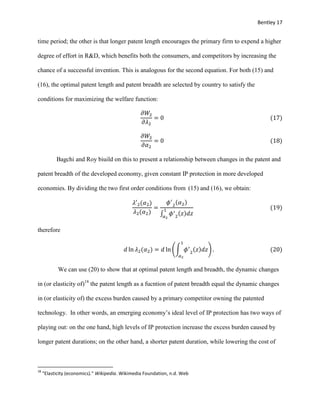
𝑀𝑎𝑥 {
𝜆2,
𝛼2
𝑊2 = 𝑃(𝑅1)(𝐶2 + 𝑉2) , (14)
which leads to the derivatives of the welfare fucntion with respect to both patent length and
patent breadth:
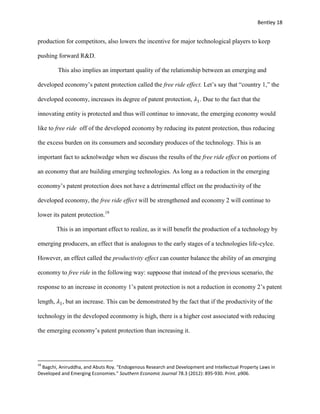
𝜕𝑊2
𝜕𝜆2
= 𝑃′(𝑅1)(𝐶2 + 𝑉2)
𝜕𝑅1
𝜕𝜆2
− 𝑃(𝑅1) ∫ 𝜙′
2
(𝑧)𝑑𝑧
1
𝛼2
(15)
and
𝜕𝑊2
𝜕𝛼2
= 𝑃′(𝑅1)(𝐶2 + 𝑉2)
𝜕𝑅1
𝜕𝜆2
− 𝑃(𝑅1)𝜆2 𝜙′
2
(𝛼2) (16)
where the third term ∫ 𝜙′
2
(𝑧)𝑑𝑧
1
𝛼2
represents loss to the welfare of country 2 due to selecting
patent breadth that includes knowledge spillover from the technology of the developed country.
These equations demonstrate the two ways selecting longer patent length affect the the welfare of
country 2. One is that a longer patent length adversly affects the welfare of a country because the
consumers and competitors bear the excess burden of the primary firms molopoly for a higher
Bentley 17
time period; the other is that longer patent length encourages the primary firm to expend a higher
degree of effort in R&D, which benefits both the consumers, and competitors by increasing the
chance of a successful invention. This is analogous for the second equation. For both (15) and
(16), the optimal patent length and patent breadth are selected by country to satisfy the
conditions for maximizing the welfare function:
𝜕𝑊2
𝜕𝜆2
= 0 (17)
𝜕𝑊2
𝜕𝛼2
= 0 (18)
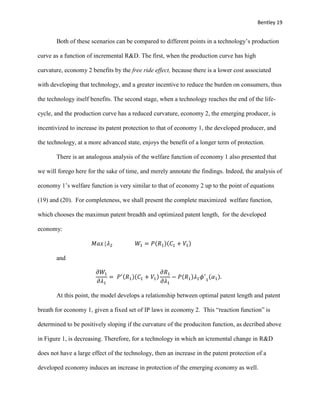
Bagchi and Roy biuild on this to present a relationship between changes in the patent and
patent breadth of the developed economy, given constant IP protection in more developed
economies. By dividing the two first order conditions from (15) and (16), we obtain:
𝜆′2(𝛼2)
𝜆2(𝛼2)
=
𝜙′
2
(𝛼2)
∫ 𝜙′
2
(𝑧)𝑑𝑧
1
𝛼2
(19)
therefore
𝑑 ln 𝜆2(𝛼2) = 𝑑 ln (∫ 𝜙′
2
(𝑧)𝑑𝑧
1
𝛼2
) . (20)
We can use (20) to show that at optimal patent length and breadth, the dynamic changes
in (or elasticity of)18
the patent length as a fucntion of patent breadth equal the dynamic changes
in (or elasticity of) the excess burden caused by a primary competitor owning the patented
technology. In other words, an emerging economy’s ideal level of IP protection has two ways of
playing out: on the one hand, high levels of IP protection increase the excess burden caused by
longer patent durations; on the other hand, a shorter patent duration, while lowering the cost of
18
"Elasticity (economics)." Wikipedia. Wikimedia Foundation, n.d. Web
Bentley 18
production for competitors, also lowers the incentive for major technological players to keep
pushing forward R&D.
This also implies an important quality of the relationship between an emerging and
developed economy’s patent protection called the free ride effect. Let’s say that “country 1,” the
developed economy, increases its degree of patent protection, 𝜆1. Due to the fact that the
innovating entity is protected and thus will continue to innovate, the emerging economy would
like to free ride off of the developed economy by reducing its patent protection, thus reducing
the excess burden on its consumers and secondary produces of the technology. This is an
important fact to acknolwedge when we discuss the results of the free ride effect on portions of
an economy that are building emerging technologies. As long as a reduction in the emerging
economy’s patent protection does not have a detrimental effect on the productivity of the
developed economy, the free ride effect will be strengthened and economy 2 will continue to
lower its patent protection.19
This is an important effect to realize, as it will benefit the production of a technology by
emerging producers, an effect that is analogous to the early stages of a technologies life-cylce.
However, an effect called the productivity effect can counter balance the ability of an emerging
economy to free ride in the following way: suppoose that instead of the previous scenario, the
response to an increase in economy 1’s patent protection is not a reduction in economy 2’s patent
length, 𝜆1, but an increase. This can be demonstrated by the fact that if the productivity of the
technology in the developed econmomy is high, there is a higher cost associated with reducing
the emerging economy’s patent protection than increasing it.
19
Bagchi, Aniruddha, and Abuts Roy. "Endogenous Research and Development and Intellectual Property Laws in
Developed and Emerging Economies." Southern Economic Journal 78.3 (2012): 895-930. Print. p906.
Bentley 19
Both of these scenarios can be compared to different points in a technology’s production
curve as a function of incremental R&D. The first, when the production curve has high
curvature, economy 2 benefits by the free ride effect, because there is a lower cost associated
with developing that technology, and a greater incentive to reduce the burden on consumers, thus
the technology itself benefits. The second stage, when a technology reaches the end of the life-
cycle, and the production curve has a reduced curvature, economy 2, the emerging producer, is
incentivized to increase its patent protection to that of economy 1, the developed producer, and
the technology, at a more advanced state, enjoys the benefit of a longer term of protection.
There is an analogous analysis of the welfare function of economy 1 also presented that
we will forego here for the sake of time, and merely annotate the findings. Indeed, the analysis of
economy 1’s welfare function is very similar to that of economy 2 up to the point of equations
(19) and (20). For completeness, we shall present the complete maximized welfare function,
which chooses the maximun patent breadth and optimized patent length, for the developed
economy:
𝑀𝑎𝑥{𝜆2 𝑊1 = 𝑃(𝑅1)(𝐶1 + 𝑉1)
and
𝜕𝑊1
𝜕𝜆1
= 𝑃′(𝑅1)(𝐶1 + 𝑉1)
𝜕𝑅1
𝜕𝜆1
− 𝑃(𝑅1)𝜆1 𝜙′
1
(𝛼1).
At this point, the model develops a relationship between optimal patent length and patent
breath for economy 1, given a fixed set of IP laws in economy 2. This “reaction function” is
determined to be positively sloping if the curvature of the produciton function, as decribed above
in Figure 1, is decreasing. Therefore, for a technology in which an icremental change in R&D
does not have a large effect of the technology, then an increase in the patent protection of a
developed economy induces an increase in protection of the emerging economy as well.
Bentley 20
Conversely, for a technology in which a marginal increase in R&D has a large effect on the
successful invention, the response function is negatively correlated and downward sloping,
implying that decreased patent protection in the developed economy will lead to increased patent
protection for smaller, emerging producers of the technology.
Thus, we can, with the help of Bagchi and Roy, devise a complex system in which both
economies each have a “response function” at equilibrium, where both “countries”
simultaneuously choose their patent policy in “period 1,” while firm 1, an innovating firm in the
developed economy, employs its R&D in “period 2.” The resulting response function
equilibrium produces some notable results for the subject matter of this paper, esspecially when
analyzed within the variable of “willingness to pay” in the emerging economy, presented in
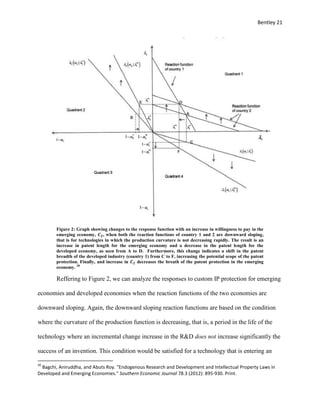
equations (15) and (16) as 𝐶2. Mapping the response functions on a four-way graph with axes for
pantent length in both economy 1 and 2, and patent breadth in economy 1 and 2 [𝜆1, 𝜆2(1 − 𝛼1),
and (1 − 𝛼2) respectively], we arrive at the following graph depicted in figure 2:
Bentley 21
Figure 2: Graph showing changes to the response function with an increase in willingness to pay in the
emerging economy, 𝑪 𝟐, when both the reaction functions of country 1 and 2 are downward sloping,
that is for technologies in which the production curvature is not decreasing rapidly. The result is an
increase in patent length for the emerging economy and a decrease in the patent length for the
developed economy, as seen from A to D. Furthermore, this change indicates a shift in the patent
breadth of the developed industry (country 1) from C to F, increasing the potential scope of the patent
protection. Finally, and increase in 𝑪 𝟐 decreases the breath of the patent protection in the emerging
economy. 20
Reffering to Figure 2, we can analyze the responses to custom IP protection for emerging
economies and developed economies when the reaction functions of the two economies are
downward sloping. Again, the downward sloping reaction functions are based on the condition
where the curvature of the production function is decreasing, that is, a period in the life of the
technology where an incremental change increase in the R&D does not increase significantly the
success of an invention. This condition would be satisfied for a technology that is entering an
20
Bagchi, Aniruddha, and Abuts Roy. "Endogenous Research and Development and Intellectual Property Laws in
Developed and Emerging Economies." Southern Economic Journal 78.3 (2012): 895-930. Print.
Bentley 22
ideal state given current production methods, where that technology is being produced by large
producers at a minimized cost, or where there is an over-saturation of patents. The response of
the IP protection to this condition is that any emerging producers of the technology will enjoy
relatively longer patent length while developed producers show a relatively reduced patent
length—essentially equalizing patent protection across a market for both emerging producers and
developed producers of the technology.
Also illustrated by Figure 2 is the inverse relationship between patent length in emerging
economies and patent length developed economies; for example, the case in which emerging
producers benefit from the “free ride effect” by lowering patent protection cannot occur in later
stages of technological development because the developed producer’s patent protection will
increase. In addition to patent length equalizing, we see a trend towards greater patent breadth in
both countries during this period. While this is an indication that a “one size fits all” patent
protection is appropriate when a specific technology is towards the end of its growth and life
cycle, it does not, however, show that equal patent protection among producers is beneficial
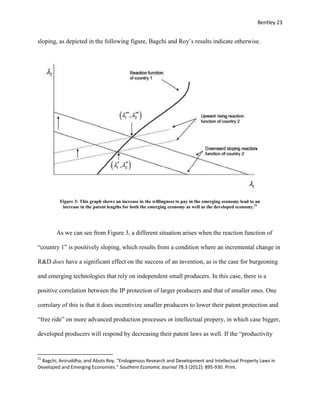
when technologies are in their infancy. Indeed, given that the reaction function is positively
Bentley 23
sloping, as depicted in the following figure, Bagchi and Roy’s results indicate otherwise.
Figure 3: This graph shows an increase in the willingness to pay in the emerging economy lead to an
increase in the patent lengths for both the emerging economy as well as the developed economy.21
As we can see from Figure 3, a different situation arises when the reaction function of
“country 1” is positively sloping, which results from a condition where an incremental change in
R&D does have a significant effect on the success of an invention, as is the case for burgeoning
and emerging technologies that rely on independent small producers. In this case, there is a
positive correlation between the IP protection of larger producers and that of smaller ones. One
corrolary of this is that it does incentivize smaller producers to lower their patent protection and
“free ride” on more advanced production processes or intellectual propery, in which case bigger,
developed producers will respond by decreasing their patent laws as well. If the “productivity
21
Bagchi, Aniruddha, and Abuts Roy. "Endogenous Research and Development and Intellectual Property Laws in
Developed and Emerging Economies." Southern Economic Journal 78.3 (2012): 895-930. Print.
Bentley 24
effect” replaces the free ride effect, then both economies see an increase in patent protection,
although we can assume the optimization of production in developed sectors will push the
production curve towards decreased curvature, changing the direction of the reaction function.
Finally, in the case that patent protection is fixed in the developed economy, an increase in the
willingness to pay of the emerging economy leads unambiguously to an increase in the patent
protection of the emerging economy.
Thus, to summarize the conclusions made by Bagchi and Roy that will ground the
following analysis of patent protection in emerging industries of applied physics industries: “(i)
Under plausible conditions, the optimal patent and the optimal patent breadth in a country
[economy] have a positive relationship with one another when the structure of IP laws is fixed in
other countries [economies]. (ii) Patent length across countries may be positively or negatively
related, depending on the manner in which the curvature of the R&D production function
changes. (iii) An increase in the willingness to pay in the emerging economy need not always
lead to an improvement in both dimensions of IP protection, that is, the patent length and patent
breadth.” Bagchi and Roy acknowledge the need for empirical research and applications of their
model, which the following section of this paper will attempt to provide.
These remarkable findings lead to some quite notable analysis when giving the
perspective of international technological relations between emerging and developed countries in
the realm of applied physics, which will be discussed. However, more importantly are the results
when we continue with the assumption that the differing economies present in Bagchi and Roy’s
work can be models for separate sectors of one country’s economy. This reinforces this paper’s
claim that when both emerging and developed producers are allowed custom patent protection
based on the development of the technology they produce, they will adopt patent protection that
Bentley 25
optimizes their production. In the next section, we will analyze several technologies in the
applied physics industry that show this form of dynamic patent policy results in the potential for
greater innovation, more equity among small and large producers, and prohibits misuse and
abuse of an antiquated “one size fits all” patent system. Here, we will use patent citation
analysis and the commercialization of academic research as foundations for a dynamic patent
system, customized to optimize the growth, innovation, and development of applied physics
technology at all stages of development.
Discussion
The application of the model detailed in the above section to the applied physics industry
is potentially meaningful in terms of technological forecasting and patent policy reform, but
requires additional empirical analysis and the justification of certain assumptions. In this section,
we will explore the empirical and qualitative endorsement of Bagchi and Roy’s mathematical
economic model and demonstrate the potential for a dynamic patent policy that encourages a
departure from the “one size fits all” patent policy that is commonplace in today’s major
industrialized nations. In order to accomplish this, a justification of some important assumptions
in bringing this model to industrial application is necessary. The most basic of these
assumptions are (i) whether the analysis of patents is a viable method for technological
forecasting and (ii) whether the analogy of Bagchi’s emerging and developed “countries” into
emerging and developed “economies,” operating within a nation’s specific patent policies, is
appropriate.
It is important to address how we can identify emerging and developing producers of
technology. For this we can adopt patent—as well as academic—citation analysis to detect the
Bentley 26
differences between emerging producers and developed ones. In some cases, gaps exist in the
number and influence of patented technology, while in others, such as is the case with academic
institutions, the number of patents is lower but there is a greater tendency that specific
technologies are in valid and installed components.
Following an empirical justification of these important assumptions, an analysis of three
separate national and international industries in applied physics will be presented: the case of the
bourgeoning industry of solar cells and photovoltaics in China; the case of American automaker
Tesla, and why the company eliminated nearly all of its patents filed with the USPTO; and the
case of the software and robotics industry’s debate between IP protection and open source
development, in which long development, weak patents, and the prevalence of “patent trolls”
loom over industry innovation. In these examples, a patent policy that dynamically attributes
separate protection to emerging producers and developed producers, or at separate stages of a
technology, results in the potential improvement in the productiveness of innovation, the
representation of smaller producers in the market, and proper protection timeline for fully
developed technologies in the applied physics.
In order to build some empirical support for the economic model described in the
previous section, some literature on patent based technological forecasting must be presented,
many of which derive their results through patent citation network analysis. Patent citation
analysis is a technique that involves network algorithms to create a model in which close
associations in title or content of a patent can be described. In addition to analyzing patents,
Yoon (2011) presents additional methods for relating patents to technological forecasting such as
bibliometric analysis, trend exploration, and “S-curve” fitting data with patent citations. Using
these techniques we can identify the industries in which have strong associations between growth
Bentley 27
patterns in patent citations and advances in technology and R&D roadmaps. According to a
sector-specific approach, the industries in which patent forecasting trends are strongly
representative of R&D production are Information Technology, Biotechnology, and the Specialty
Supplies sectors.22
In each of these sectors, the applied physics can have a dramatic impact,
through semi-conductors and microchip technology in IT, imaging and measuring instruments in
Biotech, and in specialized supplies sector, which includes high tech medical instruments and
measuring devices.
In addition to associating the technological forecasting ability with growth in patent
citations, it is also necessary to build an empirical basis for the production and R&D functions
that make up Bagchi and Roy’s model. In this respect, Yoon (2011) has analyzed the relationship
between R&D and income functions, again in a sector-specific approach. First the value of
patents is analyzed, to “distinguish high-quality patents from value-less patents.” Second, it is
shown that the industries with a strong basis in technology, including the applied physics, have
the strongest correlation between income functions and additional increases in R&D
development. In fact, it is again the information technology, biotechnology, and specialized
supplier industries that have the highest correlation between the forecasting ability of patent
analysis and positive R&D investment.23
This is a necessary conclusion for granting sector-
specific evidence in support of applying Bagchi and Roy’s model, which is based in large part
the connection between potential R&D investment and patent characteristics. With these studies,
we have some basis for the correlation between patents and technological forecasting that is a
major assumption of Bagchi and Roy’s mathematical model, but we have yet to address the
22
Yoon, Janghyeok, Sungchui Chui, and Kwangsoo Kim. "Invention Property-function Network Analysis of Patents:
A Case of Silicon-based Thin Film Solar Cells." Scienometrics 86 (2011): 687-703. Print.
23
Ibid.
Bentley 28
assumption comparing separate countries with separate producers within a single country’s
economy.
A major assumption that supports this paper’s claim is that Bagchi and Roy’s model can
be understood not only between emerging and developed countries, but emerging and developed
producers of technology with a country. One argument for this is the definition Bagchi and Roy
made as the distinction between the two countries in the model, i.e., “the most important
differences between developed and emerging economies is that emerging economies have lower
incomes and a lower level of research capability.”24
This description can easily be attributed to a
smaller, emerging producer of a technology, with less manufacturing support, in an emerging
sector of a national or global economy. Given that in this paper, individual producers are
proposed to maintain separate patent policy, there should be no problem adopting their model in
this broader context. However, addition empirical evidence that the distinction proposed is valid
and valuable. In the next example, we will see that within the field of organic photovoltaic cells
acting within a global economy make little difference whether the network association between
producers is global or local.
An important realization with respect to constructing improved patent policy is that with
an international globalized economy, identifying which country a producer originates, and thus
what the patent protection is, becomes blurred. Yet, there is little doubt to who the “big players”
or big producers of a specific technology are. In the case of the organic photovoltaic cell, a
premier example of applied physics technology, researchers have used patent citation network
models to “understand the structure and characteristics of technological knowledge flows
24
Bagchi, Aniruddha, and Abuts Roy. "Endogenous Research and Development and Intellectual Property Laws in
Developed and Emerging Economies." Southern Economic Journal 78.3 (2012): 895-930. Print.
Bentley 29
between countries, institutions, and technology fields.”25
While the study does recognize the US,
Japan, and Germany as network centers, based on the number of citations within the patent
institutions of those countries, they recognized a more valuable representation for the network of
technology knowledge, which is based on “network nodes” that centralized around bigger
producers and smaller producers. Interestingly, the study finds that there while the locality of the
“brokering” of technology transfer is focused in the US, Japan, and Canada, the global citation
network ranks of developed vs emerging producers look the same as the localized results.26
This
implies the determination of emerging and developed producers has much more to do with an
institutions rank in a technological network analysis than whether that producer is part of an
emerging or developing economy. In this sense, it may be possible to use citation network
analysis to identify weaknesses in technology, as well as emerging producers and attribute them
with specific patent protection that will boost innovation and technological development.
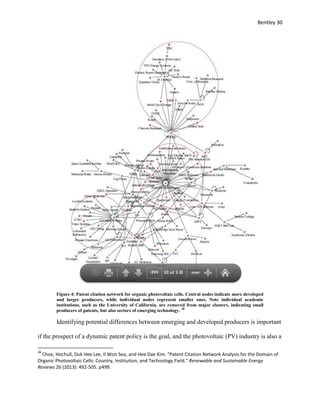
Figure 4 below presents a graphical interpretation of the network citation clusters in the
field organic photovoltaic (PV) cell production. The clusters show a global non-localized picture
of major producers of patents, and by association, major producers of technology. Small
institutions and producers are present, but only in very small cluster mostly removed from the
influence of the main group. These separations could be helpful in the identification of emerging
producers and developed ones. However, it is important to note that more patents does not
necessarily indicate better innovation, but it does show innovative activity.27
25
Choe, Hochull, Duk Hee Lee, Il Won Seo, and Hee Dae Kim. "Patent Citation Network Analysis for the Domain of
Organic Photovoltaic Cells: Country, Institution, and Technology Field." Renewable and Sustainable Energy
Reviews 26 (2013): 492-505. p499.
26
Ibid. p499.
27
De La Tour, Arnaud, Matthieu Glachant, and Yann Meniere. "Innovation and International Technology Transfer:
The Case of the Chinese Photovoltaic Industry." Energy Policy 39 (2011): 761-70. Print. p768.
Bentley 30
Figure 4: Patent citation network for organic photovoltaic cells. Central nodes indicate more developed
and larger producers, while individual nodes represent smaller ones. Note individual academic
institutions, such as the University of California, are removed from major clusters, indicating small
producers of patents, but also sectors of emerging technology. 28
Identifying potential differences between emerging and developed producers is important
if the prospect of a dynamic patent policy is the goal, and the photovoltaic (PV) industry is also a
28
Choe, Hochull, Duk Hee Lee, Il Won Seo, and Hee Dae Kim. "Patent Citation Network Analysis for the Domain of
Organic Photovoltaic Cells: Country, Institution, and Technology Field." Renewable and Sustainable Energy
Reviews 26 (2013): 492-505. p499.
Bentley 31
good field to apply some of these concepts. Specifically, Shibata (2010) presents a method for
analyzing gaps between the patents and academic papers in the case of the solar cell. The method
is similar to the one described above, except instead of focusing on the number of patents filed
and by whom, the focus is on the patents regarding specific install components, compared with
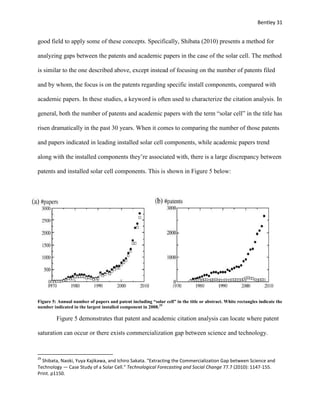
academic papers. In these studies, a keyword is often used to characterize the citation analysis. In
general, both the number of patents and academic papers with the term “solar cell” in the title has
risen dramatically in the past 30 years. When it comes to comparing the number of those patents
and papers indicated in leading installed solar cell components, while academic papers trend
along with the installed components they’re associated with, there is a large discrepancy between
patents and installed solar cell components. This is shown in Figure 5 below:
Figure 5: Annual number of papers and patent including “solar cell” in the title or abstract. White rectangles indicate the
number indicated in the largest installed component in 2008.29
Figure 5 demonstrates that patent and academic citation analysis can locate where patent
saturation can occur or there exists commercialization gap between science and technology.
29
Shibata, Naoki, Yuya Kajikawa, and Ichiro Sakata. "Extracting the Commercialization Gap between Science and
Technology — Case Study of a Solar Cell." Technological Forecasting and Social Change 77.7 (2010): 1147-155.
Print. p1150.
Bentley 32
While it has been found that scientific papers focus more on the basics of cell design while
patents focus on the application of new technology30
, it is also possible that weak patent breadth
has allowed for over-saturation of patents that have little to no future as installed components. As
we could see from Figure 4, the major producers of patents are larger producers, yet according to
Shibata, it is smaller institutions that are developing the research which will be applied to
technology more readily. In addition, Shibata shows through citation analyses, which
technologies within a solar cell are being focused on, and which are being overlooked. One
reason for this could be that the area over-saturated with patents are that way because they are at
a point in the production curve P(R) that has little curvature, and thus little movement in R&D
investment. According the model presented in this paper, there is an opportunity to identify
emerging producers with the commercialization gaps associated with gaps in technology patents,
and developed producers with technologies over-saturated with patents.
Therefore, we can suggest patent length is increased to incentivize producers of
emerging technology, while patent length is reduced for producers of patent-saturated
components. The result is that in saturated industries, such as the panel, battery, and diodes,
smaller producers will free-ride due to reduced patent strength, and innovation will improve; or
larger producers will invest in greater R&D to ensure their technology remains competitive. On
the other hand better patent protection for emerging producers such as academic institution will
ensure stronger, more valuable patents that have a better chance of being installed as improved
solar cell components.
30
Shibata, Naoki, Yuya Kajikawa, and Ichiro Sakata. "Extracting the Commercialization Gap between Science and
Technology — Case Study of a Solar Cell." Technological Forecasting and Social Change 77.7 (2010): 1147-1155.
p1150.
Bentley 33
Case #1: International Emerging Economies and China’s Photovoltaic Industry
Now that we have established a method for applying a mathematical model to real-life
situations using empirical patent citation analysis, we shall use these to develop insights into
specific cases where patent protection can have a strong impact on the rate of innovation in an
economy. It was previously shown by the author that in the case of post-WWII Japan, the lack of
strong patent protection drove lighting quick innovation as Japanese producers were small and
numerous, at a time when the production function of many industries had large curvature
(meaning a small increase in R&D meant a large innovation.)31
In addition, low patent breadth
encouraged the free-ride effect, allowing small producers to free-ride on better technologies,
including manufacturing philosophies carried by the occupying US forces. This changed when
industries became more productive, and the weak patent laws became detrimental to the
developed technologies. Now, in the China’s photovoltaic industry, we see a similar trend, and
another opportunity to demonstrate and correlation with Bagchi and Roy’s dynamic description
of patent law.
China’s economy has been the focus of many papers on innovation and technology
transfer, as it is a microcosm of emerging yet booming industrial nations. De la Tour (2011)
presents a valuable analysis of China’s photovoltaic industry, first by acknowledging China’s
place as an emerging producer of photovoltaic technology, and second by “understand[ing] the
drivers and limitations of this Chinese success in mastering a production technology that had
initially been developed in industrialized countries.”32
In much the same way that Japan’s
automotive and IT technology made a transformation in post-WWII Japan, China’s current
31
Bentley, 2012
32
De La Tour, Arnaud, Matthieu Glachant, and Yann Meniere. "Innovation and International Technology Transfer:
The Case of the Chinese Photovoltaic Industry." Energy Policy 39 (2011): 761-770.
Bentley 34
position in the global PV market suggests a scenario that follows Bagchi and Roy’s model of
emerging and developed producers.
The first characteristic we can acknowledge, based on Shibata’s report above, is that
there are certain areas of solar cell design that are over-saturated with US patents, suggesting
those areas are characterized by developed producers of that technology. If we take the same
scope of those patents, specifically for the silicone covering of the cell, the ingot or wafer
manufacturing, and the PV cell production, but analyze them from smaller, emerging producers
in China, we find an opportunity these smaller producers to “free-ride” on the better technology.
This is corroborated by de la Tour, who describes the necessity for weaker patent policies in
emerging sectors of Chinese PV production: “As measured by patent statistics, the innovative
performance of China denotes a policy-driven effort to catch up rather than the inventive
dynamism local [US] companies.”33
He goes on to note that as emerging producers Chinese
companies invests less in R&D, and instead reduce patent strength to allow for the free-ride
effect to drive innovation in sectors that would be highly competitive in an industry of developed
producers.
The study goes on to find that in more competitive sections of PV manufacturing, “that
the rapid development of the Chinese PV industry has been made possible by the successful
transfer of technologies from industrialized countries during the last decade.”34
This implies that
the free-ride effect can supplement emerging producers of technology in sectors of the economy
where patent saturation by developed producers has made it difficult to get a noticeable return on
R&D investment. Furthermore, de la Tour (2011) admits that many of the technological
advances addressed by an emerging economy are “largely accounted for by public research
33
De La Tour, Arnaud, Matthieu Glachant, and Yann Meniere. "Innovation and International Technology Transfer:
The Case of the Chinese Photovoltaic Industry." Energy Policy 39 (2011): 761-70. Print.
34
Ibid.
Bentley 35
institutions.” This fundamental research, if done in a developed economy in which numerous
patents have saturated the market, puts producers in danger of legal proceedings that make
improving technology a risky business. This ultimately begs the question of whether Bagchi
and Roy’s model can be retroactively instituted through patent policy such that it reinvigorates
stagnant technological innovation, i.e., by intentionally lowering patent protection in specific
sectors in order to return the production curve to a more fruitful and innovative production. As
we will see in the next case, this is a condition that is exploited by some of the biggest producers
of technology in the world.
Case #2: The case of Tesla and the release of privately held patents.
On June 12, 2014 CEO Elon Musk of Tesla Motor Company shocked the technology
world by releasing all of Tesla’s privately held patents with a promise not to pursue any legal
action against those using the patents to further the development of the electric vehicle. In a
statement by Musk, he justified the move by saying the patents “have been removed, in the spirit
of the open source movement, for the advancement of electric vehicle technology.”35
Analyzing
this bold move in the context of this paper may illuminate some important reasons and results of
the decision. First, we need to identify where Tesla exists in the production curve, determine
whether it is a developed producer or not, and analyze the effect of the response function on an
immediate reduction of its patent strength.
Tesla Motors is considered to be one of the biggest producers of electric car components
in the world. Tesla’s lithium-ion batteries are supplied by Panasonic, a company that definitively
defines a developed producer with access to massive R&D funds, as well as the authoring of
many patents. With the creation of the proposed “Gigafactory,” a joint Tesla/Panasonic battery
35
Musk, Elon. "All Our Patent Are Belong To You." Tesla Motors. N.p., 12 June 2014.
Bentley 36
factory in Nevada, the two companies together can easily be defined as developed producers.36
Next, we can relate Tesla’s success in the market with its production function, which we can
recall is a function of incremental R&D. If we relate Tesla trading price on the New York Stock
exchange with its production function, we would see a decline in the curvature of the production
function since early 2014, meaning that production is at a point where small incremental R&D
does not result in a large increase in profitability.
Thus, given that Tesla represented a developed producer at the low curvature end of its
production function as defined in this paper, we can analyze the response to a reduction in patent
strength based on Bagchi and Roy’s model in order to determine the motivation or outcome of
Tesla’s strange decision. According to that model, the response to a reduction of patent strength
is that emerging producers have a higher potential patent strength, can “free-ride” of Tesla
technology, and are therefore incentivized to invest in R&D and production. Furthermore, based
on the case of the Chinese PV industry, a reduction in patent strength could retroactively push a
technology back into a regime where the curvature of the production function is greater, and
innovation can occur at a higher rate and lower cost. Therefore, a presumable motivation for
Tesla to reduce its patent strength is to drive emerging producers to increase the effectiveness of
a technology. As an eventual developed producer of that technology, Tesla may still increase its
patent strength when it feels it can capitalize best on patented technology, thereby instituting the
so-called “production effect” which, as shown in Bagchi and Roy’s model, will override any
previous “free-ride” effect.
This scenario shows a real world situation where a dynamic patent policy based on the
production characteristics of a specific technology can affect both emerging and developed
producers to drive innovation of that technology. This model can be adopted in situations of
36
"Tesla Motors." Wikipedia. N.p., n.d. Web.
Bentley 37
emerging and developed countries, but more importantly, shows that it can be adopted for
emerging and developed producers of a technology in a global marketplace given dynamic patent
policy. As we will see in the next section, the open-source movement and the nature of software
patents lends itself well to this dynamic patent model, specifically in the elimination of the
detrimental effects of patent trolling, and the potential for smaller, emerging producers like
universities and public researchers, to incentivize core R&D in the applied physics.
Case #3: The case of universities, open-source, and the prominence of patent trolls.
Many authors have analyzed the pace and push of innovation through the lens of public
research institutions and universities, mostly because the availability of public data but also due
to the fact that the transfer of information among universities is fluid and lacking many of the
complications that arise when privatizing innovation. For example, as is demonstrated in this
paper, large producers in private industrial sectors can over-saturate a technology with weak
patents that lack the applied technical basis that is common among university patents. This
leaves the door open for the nefarious “patent trolls,” legal organizations that use broad patent
breadth and weak patents to litigate patent infringement by mostly independent, emerging
producers. This kind of commercial profiteering by legal entities at the expense of innovating
producers clearly presents a problem for technological development as a whole37
. Academic
papers, judged through peer-review in open networks of information sharing, do not have to
manage the ill effects of patent trolling. However, when public research is implemented into
industry, which accounts for at least 20 percent of industrial innovation38
, emerging producers do
not have the funds required to support the legal defense to patent trolling. This becomes a
37
Schacht, Wendy, and John Thomas. "Patent Reform in the 112th Congress: Innovation Issues." Congressional
Research Service (June 30, 2011): 38. Print.
38
Tijssen, Robert J.w. "Science Dependence of Technologies: Evidence from Inventions and Their
Inventors." Research Policy 31.4 (2002): 509-526.
Bentley 38
problem when a leading quantifier of university-industry interaction has been shown to be a
substantial transfer of knowledge in both directions,39
which can be hindered by the prominence
of patent trolling.40
The problem of patent trolling with respect to emerging producers of technology has been
addressed by companies before; the above example of Tesla’s release of its patents is an example
of this. The scenario also brings to light how the concept of “open-source”, which was originally
based upon the open availability of a software’s source code to the public. In the context of
Bagchi and Roy’s model, the open-source movement represents the reduction of patent breadth
for developed producers, to which emerging producers in a high-growth industry respond by also
maintaining weak patent strength. In this situation, the technology itself is grown, the “free-ride
effect” is diminished, and the producer that can implement the technology to its best function
will lead the market. This has important implications for the software industry, including open-
source applications, which are perpetually in a state of high-growth on the production curve. In
the short lifetimes of software technology, there is a conflict between the owners of patents, who
encourage patent policy with greater breadth, and open-source developers, who prefer weaker
patent breadth.41
Conclusion
In this paper, an analysis of alternative methods for determining patent policy in applied
physics industry is presented. A mathematical economic model has been used that shows the
response between two countries with distict patent policies —one a developed country, the other
an emerging country—depends on whether the technology in question is either 1) in a high-
39
Meyer-Krahmer, Frieder, and Ulrich Schmoch. "Science-based Technologies: University–industry Interactions in
Four Fields." Research Policy 27.8 (1998): 835-51. Web.
40
Georgiades, Eugenia. "Resolving Conflicting Interests: Software Patents Versus Open Source." Information &
Communications Technology Law 20.3 (2011): 225-252. Academic Search Complete.
41
Ibid.
Bentley 39
innovation state, in which an inverse relationship exists between patent strength in the developed
and emerging countries; or 2) in a low-innovation state, in which a direct correlation exists
between patent strength in the developed and emerging countries. We then included an assuption
that made it possible to model these separate countries as developed or emerging producers, due
to the attributes of a globalized economy and non-localized networks of knowledge tranfser
based on patent citation analysis. This alternative method predicts separate and distinct patent
protection that depends on the innovation potential of the technolgy, and the size and capability
of the producer of a technology. The model demostrates that when a technology is a high-
innovation state, both emerging and developing producers benefit from either a weakened patent
policy that encourages both producers to improve the core technolgy. Alternatively, for
technologies in a low-innovation state, the policy responds to patent-saturation among developed
producers by lowering patent strength for emerging producers, encouraging a “free-ride effect”
that equalizes production of key components of a technology across an industry. This is
esspecially applicable when analysing the disparity between patents and academic papers in
installed tehcnological components, which can highlight areas of patent-saturation and
oppoutunities for emerging producers, such as academic institutions, public research entities, and
start-up companies to build on the basic technologies of components without fearing patent
infringement.
Specifically in the applied physics industry of the photovoltaic cell, patent citation
network analysis can identify the differentiators between developed and emerging producers by
following the larger nodes of interconnectivity between patent content. Additionally, gaps
between patents and academic papers can highlight the specific components of an industrial PV
cell that are potential areas where reducing patent strength would benefit emerging producers in
Bentley 40
providing basic reseach implementation. Further, this paper implies that a backwards
implementation of the patent trends model can stimulate a technology to move towards a more
innovative state, i.e., in a situation where high patent strength among developed producers
ecourages weak patenting of over-developed components. In this case, lowering the patent
strength of the developed producer increases the patent strength among emerging producers,
incentivizing further improvement of a technology that has become stagnant. These situations
were highlighted and supported empirically through the analysis of case studies within the
applied physics industry.
In the case of the Chinese PV industry, a low patent strength among emerging PV
producers in China encouraged quick and dynamic innovation over a short time, due to industrial
technology adoption from developed producers. The Chinese companies also focused on PV
components that were in emerging sectors of the PV industry, channeling knowledge from public
research entities and universities. Indeed, the case of emerging Chinese PV producers gives
substatial backing to the characteristics of the “free-ride effect” on the global economic scale. It
also implies shifting a technology, or components of a technology, to a sector that is full of
numerous, emerging firms, and encouraging weak patent protection, can shift an otherwise
stagnant tehcnology into a high-growth industry.
In the case of auto-maker Tesla, who absolved many of their privately held patents, the
model presented predicts this behavoir as a method of reducing patent strength among developed
producers to stimulate innovation among emerging companies. This encourages the “free-ride
effect,” bringing emerging producers into the fray and transferring the technology—in this case
electric car powertrain components and batteries—into a more productive and innovative
segment segment of the production curve. Additioinal study would be needed in this case to
Bentley 41
determine the long-term effects of this change on the industry; the model presented predicts an
equalization of patent policy as the technology enters into the low-innovation regime of the
production fucntion, where the “productivity effect” dominates the level of patent protection, a
condition very similar to our current patent policy.
Finally, the case of software and open source develoment in considered, which has
implications for the robotics industry among most other applied sciences, along with being
anologous to the open sharing of technological knowledge that is present in academic
institutions. In these cases, we again see that reducing patent strength among emerging producers
not only keeps technology in the high-innovation regime of the production function, but also
helps control some of the more detrimental sides of a “one-size-fits-all” patent policy, such as the
prominence of patent trolls, who retard innovation for the profit of companies indirectly related
to applied physics industry. In the case of open-source software development, it can be shown to
that emerging companies have a much higher likelihood of eventual payoff if they capitalize
their technology after it has reached a pinnacle of development, at which point the model
presented predicts patent length is increased and companies can monopolize and profit off their
IP.
Further empirical analyses of the resolution of these cases is necessary to validate the use
of the model presented here in predicting proper patent policy over the range of emerging and
developed industries and producers. Additional justification for the analogous connection
between “countries” and “producers” would further validate the use of the model either within
the policy of a single country, or as a basis for global patent laws that focus on the size and
condition of a producer rather than its country of origin to determine the protection necessary to
best encourage the development and innovation of applied physics technology. Of course, it is
Bentley 42
important to admit here that the purpose of this paper is to encourage patent law that benefits the
innovation of the technology, rather than the prosperity of the inventor. Further study would need
to be done to account for the commercial effects of lowering patent protection among emerging
producers, which may have some dissentors in a capitalist, free-market economy.
Nonetheless, the potential for an updated, innovation specific patent policy has far-
reaching implications for both emerging and developed producers in applied physics industry,
and could set up a more econmical and egalitarian relationship between academic institutions
and industrial technology. Models such as that utilized by Bagchi and Roy could further be used,
along with patent citation network analysis, to identify and distinguish emerging and developed
producers as well as high-growth technologies. Clealry, adopting such as producer-specific
patent law would need more government oversight and regulation, yet hopefully models such as
these can take much of the guesswork out of what kind of patent strength needs to be
implemented across applied physics industries.
Bentley 43
Works Cited
1) “Patents and Higher Education’s Entry into the Market” ASHE Higher Education Report 34.4
(2008): 77-91. Print
2) "Center for Entrepreneurship." Http://c4e.ucsc.edu/home. Web. <http://c4e.ucsc.edu/home>.
3) Georgiades, Eugenia. "Resolving Conflicting Interests: Software Patents Versus Open
Source." Information & Communications Technology Law 20.3 (2011): 225-252. Academic
Search Complete.
4) Choe, Hochull, Duk Hee Lee, Il Won Seo, and Hee Dae Kim. "Patent Citation Network
Analysis for the Domain of Organic Photovoltaic Cells: Country, Institution, and Technology
Field." Renewable and Sustainable Energy Reviews 26 (2013): 492-505.
5) Bagchi, Aniruddha, and Abuts Roy. "Endogenous Research and Development and Intellectual
Property Laws in Developed and Emerging Economies." Southern Economic Journal 78.3
(2012): 895-930. Print.
6) De La Tour, Arnaud, Matthieu Glachant, and Yann Meniere. "Innovation and International
Technology Transfer: The Case of the Chinese Photovoltaic Industry." Energy Policy 39 (2011):
761-70. Print.
7) Goldenberg, David, and Jonathan Linton. "The Patent Paradox - New Insights through
Support Using Compound Options." Technological Forecasting & Social Change 79 (2012):
180-85. Print.
8) Meyer-Krahmer, Frieder, and Ulrich Schmoch. "Science-based Technologies: University–
industry Interactions in Four Fields." Research Policy 27.8 (1998): 835-51. Web.
9) Raasch, Christina, Cornelius Herstatt, and Phillip Lock. "The Dynamics Of User Innovation:
Drivers And Impediments Of Innovation Activities." International Journal of Innovation
Management 12.03 (2008): 377. Print.
10) Schacht, Wendy, and John Thomas. "Patent Reform in the 112th Congress: Innovation
Issues." Congressional Research Service (June 30, 2011): 38. Print.
Bentley 44
12) Shibata, Naoki, Yuya Kajikawa, and Ichiro Sakata. "Extracting the Commercialization Gap
between Science and Technology — Case Study of a Solar Cell." Technological Forecasting and
Social Change 77.7 (2010): 1147-1155.
13)Spears, Brian. "Robots and Patents." World Patent Information 23 (2001): 333-38. Print.
14) Tijssen, Robert J.w. "Science Dependence of Technologies: Evidence from Inventions and
Their Inventors." Research Policy 31.4 (2002): 509-526.
15) Yoon, Byungun, and Sungioo Lee. "Applicability of Patent Information in Technological
Forecasting: A Sector-specific Approach." Journal of Intellectual Property Rights 17 (2012): 37-
45. Print.
16) Yoon, Janghyeok, Sungchui Chui, and Kwangsoo Kim. "Invention Property-function
Network Analysis of Patents: A Case of Silicon-based Thin Film Solar Cells." Scienometrics 86
(2011): 687-703. Print.
17) "Elasticity (economics)." Wikipedia. Wikimedia Foundation, n.d. Web
18) Denicolo, Vincenzo. "Patent Races and Optimal Patent Breadth and Length. “The Journal of
Industrial Economics 44.3 (1996): 249. Web.

JordanBentley_SENIORTHESIS_PatentTrendsinAppliedPhysicsIndustry

  • 1.
    UNIVERSITY of CALIFORNIA SANTACRUZ Patent Trends in Applied Physics Industry: A qualitative analysis of mathematical economic models and patent citation data A thesis submitted in partial satisfaction of the requirements for the degree of BACHELOR OF SCIENCE In APPLIED PHYSICS By Jordan P. Bentley May 18, 2016 –––––––––––––––––––––––––––– –––––––––––––––––––––––––––– David P. Belanger David P. Belanger Thesis Coordinator Chair, Department of Physics
  • 2.
    Acknowledgements The process ofdeveloping this thesis has spanned many years and was close to futility many times. I feel blessed and thankful to have produced a piece of work I am genuinely proud of. I would like to thank the University of California Physics Department, David Belanger, and Fred Kuttner for allowing and encouraging the opportunity to explore a non-traditional topic in physics that I believe are important for the breadth of subjects in the department. This thesis is dedicated to my late mother, Mary Ellen Yates, who consistently inspired me to follow my educational goals and always think critically, act responsibly, and live with compassion.
  • 3.
    Bentley 1 ABSTRACT This thesisutilizes a mathematical economic model that predicts responses to changes in patent policy between developed and emerging countries. The results of this analysis are used to propose an alternative, more dynamic patent policy in applied physics industry. In applying this model to a diverse, global economy, an assumption is introduced that relates emerging and developed countries to emerging and developed producers, given that the two producers can adopt distinct patent protection. The model is then backed by empirical evidence from applied physics industry, in the form of patent citation network analysis, and applied to three case studies: emerging producers in the Chinese photovoltaic industry; the case of large developers in the electric car industry adopting weaker patent protection; the advent of the open-source movement and the problem of patent trolling among software producers. In each case, the model presented successfully predicts the standard “one size fits all” patent protection is insufficient in encouraging innovation and technological progress. The policy proposed by this work suggests specific patent protection depending on the size and growth pattern of an industry, as well as the size and capability of an individual producer, which addresses many of the challenges and hindrances to technological progress in applied physics industry. It is found that both larger and smaller producers in high-growth technologies benefit from similar patent protection, while in low-growth industries, there is an inverse relationship between the patent strength of developing and emerging producers. This also implies a developed industry in stagnant growth can see a boost in innovation by lowering patent strength.
  • 4.
    Bentley 2 INTRODUCTION The applicationof current research in physics to a modern free market economy is complicated at best, in which myriad inventions and innovations in applied physics are transitioned into the industrial and commercial domains through intricate policy that governs the Intellectual Property (IP) of industrial progress. The relationship between theoretical research in physics and industrial consumer products is a necessary part of modern technological economies. The policies through which theory makes the transition to technology are governed by patents, which not only record and document an invention’s purpose and process, but simultaneously protect its inventor from duplication. Duplication and replication can potentially remove value from the inventor by increasing a process’s market competition, leading to disenfranchisement of the inventor. Therefore, the protection a patent gives an inventor serves to further incentivize innovation. The patent process is therefore inherent to and essential for dependable innovation and development in modern economies, however, the intricacies of patent law often times inhibit, rather than propel, innovative research and development (R&D) conducted through both universities as well as in the private sector. Recent patent reform in the U.S. congress adopted a first to file, “one size fits all” model for patent policy, which causes misunderstood innovation issues that cannot account for differences between industries or less developed producers.1 Furthermore, patent litigators that prey on emerging producers, the so-called “patent trolls,” punish innovation at all levels of industry2 . Universities, on the other hand, produce fundamental 1 Schacht, Wendy, and John Thomas. "Patent Reform in the 112th Congress: Innovation Issues." Congressional Research Service (June 30, 2011): 38. Print. 2 Georgiades, Eugenia. "Resolving Conflicting Interests: Software Patents Versus Open Source." Information & Communications Technology Law 20.3 (2011): 225-252. Academic Search Complete.
  • 5.
    Bentley 3 academic papersthat function outside the restrictions of patents, yet do not have the resources to pursue large scale R&D3 . It is essential, then, in the field of applied physics to understand the patent process at its most effective and efficient level, such that innovations in physics may be seamlessly integrated into development and production, with ample protection for their inventors. However, even within applied physics industries there are large discrepancies between the innovation needs of developed economies and those just incubating their development cycle4 . These discrepancies are further complicated by the global nature of modern industries in applied physics. Fortunately, the continued expansion and reworking of separate government’s patent policies provides a template through which the patent process may be scrutinized by those in the academic community. Thus, the research presented here aims to facilitate an understanding of applied physics innovation with respect to patent policy in two specific ways; 1) to analyze current research on national and international patent policy, providing a model that demonstrates a non-linear relationship between patent protection and R&D at different stages of economic development; and 2) to investigate the patent process through case-studies of applied physics innovations at both the academic and industrial levels. Utilizing these two perspectives, a more efficient and functional patent process may be presented, providing a basis for the optimal application of the physical sciences to industry. BACKGROUND 3 “Patents and Higher Education’s Entry into the Market” ASHE Higher Education Report 34.4 (2008): 77-91. Print 4 Shibata, Naoki, Yuya Kajikawa, and Ichiro Sakata. "Extracting the Commercialization Gap between Science and Technology — Case Study of a Solar Cell." Technological Forecasting and Social Change 77.7 (2010): 1147-155. Print.
  • 6.
    Bentley 4 It isindeed fitting that an exploration of the patent process from the perspective of university research institutions should be centralized around the University of California. It was, interestingly, the University of California at Berkeley that initially supported the concept of commercializing academic research through patent activity in 1907. The invention was, notably, in the arena of Applied Physics—an electrostatic precipitator—the inventor, a man named Frederick Cottrell. Cottrell’s subsequent patent and research institution, named the “Research Corporation,” were rolled out in 1912. Fast-forward nearly one hundred years in the future, and the system at the University of California is surprisingly similar. The University of California Santa Cruz Center for Entrepreneurship is now the closest thing to Cottrell’s initial vision for the industrialization of academic research. The Center’s “goal is to develop business models that bring an innovation to market. In this case, one specifically set up to commercialize intellectual property developed within UCSC.”5 This institution is central to the evaluation of the patent process undertaken by UCSC faculty, and is instrumental in facilitating the market influence of academic research conducted at UC. The Center for Entrepreneurship at UCSC is one of many institutions that come face to face with IP and patents while bridging the gap between burgeoning technologies and the implementation of technology in industry. Many of those in Silicon Valley are at the center of an IP battleground, where the issues surrounding technology ownership are a daily concern. Tech giants like Google and Apple, who own myriad patents ranging from fundamental to futuristic, hold a number of undeveloped technologies hostage. Using a trove of overly protected yet weak patents, the ever-vigilant “patent trolls” search tirelessly for industry newcomers, only to use their enormous range of patents to strong arm young industries into shutting down. Yet both the academic and the industrial face a similar problem with new technologies, which is how to 5 "Center for Entrepreneurship." Http://c4e.ucsc.edu/home. Web. <http://c4e.ucsc.edu/home>.
  • 7.
    Bentley 5 incentivize newtech, protect that technology while R&D is at its most effective, and then ensure it is eventually retired to a status of accessibility for streamlined use in society. Historical references also infer that a dynamic patent policy is more beneficial to development than the linear system that has become the norm in most economies. The great innovation that took Japan by storm after WWII is an example of this, as post-war policy provided very little patent protection, driving forward innovation and invention (along with imitation.)6 Yet, this was only temporary, as the weak patent laws became more disastrous as the economy grew. Weak patents lead to high competition, which in economic down times can cause industries to become devalued, and thus when industrial technologies took hold in Japan during the 1980s, many of them buckled under their own size and operating costs.7 This thesis will deal specifically with current research into the topic of academic patent policy, with the expectation that a greater understanding of the specific needs of invention will present a more dynamic picture of patent protection and innovation, i.e., one that is not simply of the form: more innovation equates to more patent strength. Indeed, a significant problem with the current policy is the de facto patent protection across multiple industries and technologies, regardless of their place in their own development and innovation cycle, or their place within the greater evolution of a particular industry. Therefore, the goal of this writing, with the aid of contemporary research, is that patent policy must evolve in a non-linear fashion as innovation and the ‘maturity’ of an economy grows. That is, when industry is in its infancy, a weak patent policy that is tolerant of imitation must be present to drive innovation, competition, and cheap-production. However, as the industry grows so must the protection of invention to promote the necessary competition for a 6 Sakakibara, Mariko. "Assessing the Role of University Patent Rights: U.S.-Japan Comparison of University-Industry Knowledge Transfer." University of California, Los Angeles, May 2007. Web. 7 Ibid.
  • 8.
    Bentley 6 market economy.Finally, once a technology has reached the end of its life-cycle, the protection of the technology through patents is equalized among producers in order to avoid the monopolizing of technology that is rampant in developed market economies. The difficulty is identifying what stage specifically an industry is in; an underdeveloped industry facing strong patent strength will be underutilized in a crawl to develop a market of scale and efficient production, while a mature industry with no IP protection will become devalued with imitation. Furthermore, defenders of the current “one-size-fits-all” patent policy can cite the economic origins of intellectual property: to drive the capital investment of creative and innovative technologies which otherwise would be very dangerous investments to recoup. The purpose, therefore, of giving immediate protection of rights to the inventor, is to incentivize the early stage development of technology. Yet, a change in patent policy to reflect dynamic protection over time can address these concerns in two ways: the first is in the defense and support of the academic system itself as a government subsidized incubator for infant technology; the second, is in the argument that many early stage technologies require marketability and competition to allow them to develop to a point where R&D costs level off. METHODS Several methods can be used to describe trends in applied physics innovation, but the methods used here will specifically address patents as a way of describing, through economic models as well as patent citation analysis, the implementation of applied physics concepts in industry. Indeed, contemporary academic evidence and economic models have done a good job in describing current innovation trends in industry using complex mathematical correlation and
  • 9.
    Bentley 7 vast databasesof patent citation data8 . This paper utilizes current research and models, described by the following: 1) a recent mathematical economic model published in 2011 that uses economic principles to model patent strength based on the relationship between two countries; 2) a database of citation data including both patents and academic papers; and 3) analysis of industry and academic groups working to function within current patent laws to maximize their innovation efforts and invention protection. This research involved looking at published models of patent trending in order to draw conclusions about the ideal methods of maximizing productivity and innovation in applied physics industry. The first such model, entitled Endogenous Research and Development and Intellectual Property Laws in Developed and Emerging Economies authored by Bagchi and Roy, is based in mathematical economics and relates the so-called response function between two countries to determine the effect of incremental research and development (R & D) on patent strength and patent breath9 . The work analyzes how changes in the IP laws of a developed economy affect those of an emerging economy. The first model uses well known and correlated economic equations to determine a new model for the response between emerging and developing “countries” and their patent strength. In Bagchi and Roy’s analysis, their response function maximizes a welfare function, which incorporates the concepts of the following economic principles; incremental research, profit, consumer surplus, and patent length and patent breadth. Therefore, a determination can be made of a shift in consumer surplus based on an initial push in incremental research. Also, because patent strength can be related to the response function for both industries, we will be 8 Yoon, Byungun, and Sungioo Lee. "Applicability of Patent Information in Technological Forecasting: A Sector- specific Approach." Journal of Intellectual Property Rights 17 (2012): 37-45. Print. 9 Bagchi, Aniruddha, and Abuts Roy. "Endogenous Research and Development and Intellectual Property Laws in Developed and Emerging Economies." Southern Economic Journal 78.3 (2012): 895-930. Print.
  • 10.
    Bentley 8 able tosee how an incremental research push provided by a developed “country” will affect an emerging “country” with the ability to “free-ride” on stronger patent strength of the developed industry—patent restrictions the emerging economy is free from. These trends, outlined through mathematical models, are vital in the understanding of how emerging industries in applied physics can benefit from a revitalized patent policy. The term “country” in the above description is parenthesized because an important assumption made in this research is that the term “country” can be effectively converted to “economy,” “industry,” or “producer.” This is necessary in order to use the model to outline a dynamic patent policy among producers within one country. This can be accomplished because Bagchi’s definition of “countries” merely has the constraint that they need only be able to control their own R&D and have independent functioning of their supply and demand, and have the ability to maintain separate and distinct patent protection. Furthermore, according to Bagchi, “the most important differences between developed and emerging economies is that emerging economies have lower incomes and a lower level of research capability.”10 This description can, without much elaboration, be applied to emerging producers in an applied physics industry such as photovoltaics, as much of the core research is being conducted at the university level11 , or in the “startup” economy, where both incomes and research capability is limited. Since the patent trends of emerging and developing industries is what this paper focuses on, this is a helpful assumption to translate the model for use in applied physics industry. The assumption outlined above also requires that the two “countries,” now being interpreted as “producers,” must be allowed to have fluid patent laws in which the two 10 Bagchi, Aniruddha, and Abuts Roy. "Endogenous Research and Development and Intellectual Property Laws in Developed and Emerging Economies." Southern Economic Journal 78.3 (2012): 895-930. Print. 11 Tijssen, Robert J.w. "Science Dependence of Technologies: Evidence from Inventions and Their Inventors." Research Policy 31.4 (2002): 509-26.
  • 11.
    Bentley 9 producers, whetheremerging or developed, are not required to have the same degree of patent protection. Yet, in most industrialize nations or the world, patent policy is not dynamic enough to attribute separate patent protection to different producers or stages of development. In this current “one size fits all” patent system, all types of industries and inventions share identical patent protection, which can hinder innovation specific to a unique technology or a more basic stage of development. However, as we will see, adopting a non-conforming, dynamic patent system that allows separate protection depending on industry has far-reaching benefits, not only for the development of crucial applied physics technologies, but also for the optimal relationship between primary research institutions and applied physics industries. The second model uses patent citation data to show the commercialization discrepancies between total patent citations and those patents that are connected in working components in industry12 . An important stage that is accomplished by this writing is also applying some necessary empirical backing to Bagchi and Roy’s purely mathematical model through citation network analysis of international producers. We use varying sources of citation data and look and the connections of “clusters” of different patent groups that pertain to similar fields in applied physics. We can do this simply by looking through a database of patent and papers and just searching by title, then using several different models to algorithmically analyze patents based on keywords and relatable factors within commons technologies. It has been shown through similar research that, while this method is simple, it is accurate in showing patent trends for specific industries. The mathematical patent models will then be applied to current event case studies, giving insight and explanation to recent advances in the landscape of applied physics industry. 12 Shibata, Naoki, Yuya Kajikawa, and Ichiro Sakata. "Extracting the Commercialization Gap between Science and Technology — Case Study of a Solar Cell." Technological Forecasting and Social Change 77.7 (2010): 1147-155. Print.
  • 12.
    Bentley 10 EQUATIONS We maystart by assessing the kinds of functions currently used to model patent protection, summarized by Bagchi and Roy in their paper. Here, we begin with a “production function” P(R), where 𝑅1 indicates an incremental increase in R&D from “firm 1”, and increases the probability of success P(R) as a function of increased research and development. Further, 𝑃′(∙) > 0 and 𝑃′′(∙) < 0 , where 𝑃′(∙) is the marginal change in productivity of R&D and 𝑃′′(∙) is the curvature in the marginal productivity function of total R&D, due to small changes in 𝑅1. We can then identify, in economic terms, the flow of profits to a firm as π, and develop the following equation that relates patent length 𝑇1—the amount of time a firm can hold a monopoly over a certain technology—as a determinant of profits: ∫ 𝜋𝑒−1 𝑑𝑡 = 𝜋(1 − 𝑒−𝑇1) 𝑇1 0 (1) It then follows, from the fact that (1 − 𝑒−𝑇1) and 𝑇1 are monotonically related, that we can measure patent length in “country,” or producer, i by 𝜆𝑖 ≡ 1 − 𝑒−𝑇1 (2) An important aspect of this model’s analysis is the concept that there will be “spillover” of knowledge from the developed industry to the emerging one. This becomes clear when we think of a long standing industry such as solar cells, in which the basic technology is broadcast through academic and private institution papers13 , as well as the public availability of patented research. Therefore, the necessary definition of patent breadth 𝛽𝑖 is normalized and reduced by any knowledge spillover from an invented product to an imitated product. Patent breadth of economy i is measured by 𝛽𝑖 ≡ (1 − 𝛼𝑖) (3) 13 Yoon, Janghyeok, Sungchui Chui, and Kwangsoo Kim. "Invention Property-function Network Analysis of Patents: A Case of Silicon-based Thin Film Solar Cells." Scienometrics 86 (2011): 687-703. Print.
  • 13.
    Bentley 11 where 𝛼𝑖=0represents the least amount of knowledge spillover, i.e. “the imitator cannot use any of the incremental knowledge embodied in the invention and hence is equivalent to the maximum possible patent breadth.”14 However, we can determine that knowledge spillover and patent breadth have a one-to-one relationship, meaning we only need to define one such variable. Thus, in this analysis, as it is described in Bagchi and Denicolό15 , we will focus on the degree of knowledge spillover 𝛼𝑖 and the patent length 𝜆𝑖. The instantaneous profit of firm i in country j (recall that “country” in this case is assumed to be analogous with “producer”) conditional on a successful innovation is 𝜋𝑖𝑗(𝛼𝑖); 𝑖, 𝑗 = 1,2. (4) For example, if there is a high degree of knowledge spillover in the early stage of a long term applied physics industry, such as photovoltaics, robotics, or semiconductors, there is a reduction in firm 1’s profit: 𝜋′1𝑗(𝛼𝑖) < 0. Thus, the payoff of firm 1 with an R&D effort of 𝑅1is 𝛱1 = 𝑃(𝑅1)𝑉1 − 𝑅1, (5) where 𝑉1 = 𝜆1 𝜋11(𝛼1) + (1 − 𝜆1)𝜋11(1)+𝜆2 𝜋12(𝛼2) + (1 − 𝜆1)𝜋12(1) (6) is the gross profit obtained by firm 1 based on the completion to market of a successful invention. This expression values an invention’s profit based on four terms: 𝜆1 𝜋11(𝛼1), which describes the profit of an firm 1’s invention (dependent on the breath of patented information) times the patent length; (1 − 𝜆1)𝜋11(1), which reduces to just 𝜋11(1) after the patent expires 14 Bagchi, Aniruddha, and Abuts Roy. "Endogenous Research and Development and Intellectual Property Laws in Developed and Emerging Economies." Southern Economic Journal 78.3 (2012): 895-930. Print. 15 Denicolo, Vincenzo. "Patent Races and Optimal Patent Breadth and Length. “The Journal of Industrial Economics 44.3 (1996): 249. Web.
  • 14.
    Bentley 12 (𝜆1 =0); the final two terms are the same, only based around “country 2,” which in this case is an emerging sector of that industry. It is important to note that in Bagchi’s model success in the emerging economy’s growth only comes after the original patent on the original technology has expired. Therefore, this formula gives value to the invention, or certain stage of technology, during and after the patent is in effect—further mapping this equation will entitle us to an understanding of the changes patent length and breadth has on differing industries. For the purpose of expressing equation (5) graphically as a function of patent length and breadth, we can rewrite 𝑉1in the following form: 𝑉1 = 𝜋11(1) + 𝜋12(1) − 𝜆1 ∫ 𝜋′ 11(𝑧)𝑑𝑧 1 𝛼1 − 𝜆2 ∫ 𝜋′ 12(𝑧)𝑑𝑧. 1 2 (7) Likewise, an analogous equation shall be determined for the profits in firm 2 as follows: 𝛱2 = 𝑃(𝑅1)𝑉2, (8) an important distinction being that the gross profit of the emerging industry also depends on the successful research of the developed economy(1), and does not bear the burden of the cost in implementing that research. Examples of emerging industries would be start-up manufacturers or builders of code-based technologies, industries that are building upon or perfecting previously built technologies, or even academic institutions and their base of student or faculty inventors working to improve existing technology. Further building on equation (8), we have: 𝑉2 = 𝜆1 𝜋21(𝛼1) + (1 − 𝜆1)𝜋21(1)+𝜆2 𝜋22(𝛼2) + (1 − 𝜆2)𝜋22(1) = 𝜋21(1) + 𝜋22(1) − 𝜆1 ∫ 𝜋′ 11(𝑧)𝑑𝑧 1 𝛼1 − 𝜆2 ∫ 𝜋′ 12(𝑧)𝑑𝑧. 1 𝛼2 (9) Notice in the above expression that again 𝑉2is the gross profit of a particular firm in an industry—in this case the one that does NOT own the patent to the invention—in both a developed industry, given by 𝜆1 𝜋21(𝛼1), and an emerging one, given by, 𝜆2 𝜋22(𝛼2).
  • 15.
    Bentley 13 The nextfactor Bagchi and Roy develop to construct their model is consumer surplus, which will define valuable drivers in the R&D later on in this analysis. For now, Bagchi defines the total consumer surplus in “country 1,” the developed economy, “conditional on a successful invention”, as 𝐶1 = 𝜆1 𝑐1(𝛼1) + (1 − 𝜆1)𝑐1(1) = 𝑐1(1) − 𝜆1 ∫ 𝑐′ 1(𝑧)𝑑𝑧 1 𝛼1 (10) and in “country 2,” the emerging economy, as 𝐶2 = 𝜆2 𝑐2(𝛼2) + (1 − 𝜆2)𝑐2(1) = 𝑐2(1) − 𝜆2 ∫ 𝑐′ 2(𝑧)𝑑𝑧 1 𝛼2 . (11) Following the definition of the consumer surplus, C, the gross profit of an invention, V, and the production function, P(R), Bagchi and Roy present the welfare of a country as a function that ultimately depends on patent length and patent breadth. The welfare 𝑊𝑖, of country i is defined to be 𝑊𝑖 = { 𝑃(𝑅1)(𝐶1 + 𝑉1) − 𝑅1 for 𝑖 = 1, 𝑃(𝑅1)(𝐶2 + 𝑉2) for 𝑖 = 2. (12) The so called “welfare function” combines the previously discussed functions in equations 6-11 to produce an expression that describes the benefit to an economy given a successful invention, as a function of patent length and patent breadth. To analyze Bagchi’s welfare function, we consider “economy” 1, whose consumers enjoy a surplus of 𝐶1, and whose firm 1 enjoys a profit 𝑉1, both of which are multiplied by the production function 𝑃(𝑅1), which itself is a function of 𝑅1, an incremental investment in R&D. Likewise, when we consider “economy” 2 and within it firm 2, who we recall is able to imitate the technology of firm 1 and enjoy a profit 𝑉2, and whose consumers will enjoy a surplus of 𝐶2. It is important to note that both economies’ benefits are multiplied by the same initial investment in R&D put forth by the
  • 16.
    Bentley 14 developed economy.To summarize the effects of this model, I will refer to Bagchi and Roy’s own words: In the model, country i maximizes 𝑊𝑖 by selecting the patent length 𝜆1 and the patent breadth (1 − 𝛼𝑖); 𝑖 = 1, 2. In country 1, there is tension between consumers in country 1 (who prefer a shorter patent length) and firm 1 (the innovating firm). The optimal patent length in country 1 therefore balances the tension between the consumers of firm 1. In country 2, the benefits from a strong patent regime do not accrue directly to its citizens, and therefore it might seem that country 2 would free-ride on country 1’s innovation by selecting excessively weak patent laws.16 Thus, economies with little financial power, such as academic institutions, start-up companies, and independent inventors working to develop emerging technologies are analogous with the developing “country,” and large industrial complexes and corporations, which are working to perfect and capitalize on developed technologies, are analogous with the developed “country.” We see in this model an incentive for the developing economies to enjoy weaker patent laws, while the incentive still exists for the developed economy to maintain strong patent protection. This is true as long as the incremental R&D produces a significant change in the technology. As we will see in the next section, there naturally comes a point during the lifetime of a technology when an incremental change in R&D does not have a significant change in the technology’s use, at which point both economies share the same patent protection for the life of the technology. In order to analyze the above situation, we must discuss the rate at which incremental changes in R&D approach their limit towards the end of a technology’s lifetime. To do this, we return to the production function 𝑃(𝑅1), except this time during a period following an initial change in the technology. In period 2, firm 1 selects its R&D to maximize its expected profit 𝛱1 , therefore the R&D, 𝑅1 that maximizes this profit satisfies the equation: 16 Bagchi, Aniruddha, and Abuts Roy. "Endogenous Research and Development and Intellectual Property Laws in Developed and Emerging Economies." Southern Economic Journal 78.3 (2012): 895-930. Print. p911.
  • 17.
    Bentley 15 𝑃′(𝑅1) = 1 𝑉1 ,(13) where (𝑅1) is a function of both patent length and patent breadth of both countries, such that (𝑅1) = 𝑅1(𝜆1, 𝜆2, 𝛼1, 𝛼2) As we are attempting to analyze the rate of change of this marginal investment in R&D, a function 𝜎(𝑅1) is presented as the derivative of the production function with respect to the R&D investment (𝑅1), where 𝜎(𝑅1) is as follows: 𝜎(𝑅1) = − 𝑑 𝑑𝑅1 ln 𝑃′ 1(𝑅1) = − 𝑃′′(𝑅1) 𝑃′(𝑅1) 𝜎(𝑅1) is therefore positively related to the curvature of the R&D production function P’(R). Further, if we compare two production functions 𝑃1(𝑅1) and 𝑃2(𝑅1) that intersect at 𝑃1(𝑅1) = 𝑃2(𝑅1), then for a small increase in 𝑅1, e.g. δ𝑅1 > 0, the following inequality must be satisfied: 𝑃1(𝑅1 + δ𝑅1) < 𝑃2(𝑅1 + δ𝑅1). Figure 1: Relationship between incremental change in R&D and the probability of success for an invention. The higher the curvature of the production function, the more significant the change in success based on small incremental R&D.17 17 Bagchi, Aniruddha, and Abuts Roy. "Endogenous Research and Development and Intellectual Property Laws in Developed and Emerging Economies." Southern Economic Journal 78.3 (2012): 895-930. Print. p904.
  • 18.
    Bentley 16 For thisnext section, while the previous discussion of the production functions with respect to patent breadth and patent length has been useful for this discussion, we shall forego the more complex mathematics Bagchi and Roy present for analyzing how one economy’s patent laws “respond” to the others. Rather, we shall present the findings and analyze how these findings can be related to a modern technological era where some economies are functioning at a more developed level, and some are fucntioning at an emerging level. Now, consider “country 2,” which, in the context of this paper, represents a portion of an economy that is on the emerging end of a technology. Country 2 would like to optimized its patent length and breadth to maximize its own welfare function. From (12) we have the maximizing of the welfare function: 𝑀𝑎𝑥 { 𝜆2, 𝛼2 𝑊2 = 𝑃(𝑅1)(𝐶2 + 𝑉2) , (14) which leads to the derivatives of the welfare fucntion with respect to both patent length and patent breadth: 𝜕𝑊2 𝜕𝜆2 = 𝑃′(𝑅1)(𝐶2 + 𝑉2) 𝜕𝑅1 𝜕𝜆2 − 𝑃(𝑅1) ∫ 𝜙′ 2 (𝑧)𝑑𝑧 1 𝛼2 (15) and 𝜕𝑊2 𝜕𝛼2 = 𝑃′(𝑅1)(𝐶2 + 𝑉2) 𝜕𝑅1 𝜕𝜆2 − 𝑃(𝑅1)𝜆2 𝜙′ 2 (𝛼2) (16) where the third term ∫ 𝜙′ 2 (𝑧)𝑑𝑧 1 𝛼2 represents loss to the welfare of country 2 due to selecting patent breadth that includes knowledge spillover from the technology of the developed country. These equations demonstrate the two ways selecting longer patent length affect the the welfare of country 2. One is that a longer patent length adversly affects the welfare of a country because the consumers and competitors bear the excess burden of the primary firms molopoly for a higher
  • 19.
    Bentley 17 time period;the other is that longer patent length encourages the primary firm to expend a higher degree of effort in R&D, which benefits both the consumers, and competitors by increasing the chance of a successful invention. This is analogous for the second equation. For both (15) and (16), the optimal patent length and patent breadth are selected by country to satisfy the conditions for maximizing the welfare function: 𝜕𝑊2 𝜕𝜆2 = 0 (17) 𝜕𝑊2 𝜕𝛼2 = 0 (18) Bagchi and Roy biuild on this to present a relationship between changes in the patent and patent breadth of the developed economy, given constant IP protection in more developed economies. By dividing the two first order conditions from (15) and (16), we obtain: 𝜆′2(𝛼2) 𝜆2(𝛼2) = 𝜙′ 2 (𝛼2) ∫ 𝜙′ 2 (𝑧)𝑑𝑧 1 𝛼2 (19) therefore 𝑑 ln 𝜆2(𝛼2) = 𝑑 ln (∫ 𝜙′ 2 (𝑧)𝑑𝑧 1 𝛼2 ) . (20) We can use (20) to show that at optimal patent length and breadth, the dynamic changes in (or elasticity of)18 the patent length as a fucntion of patent breadth equal the dynamic changes in (or elasticity of) the excess burden caused by a primary competitor owning the patented technology. In other words, an emerging economy’s ideal level of IP protection has two ways of playing out: on the one hand, high levels of IP protection increase the excess burden caused by longer patent durations; on the other hand, a shorter patent duration, while lowering the cost of 18 "Elasticity (economics)." Wikipedia. Wikimedia Foundation, n.d. Web
  • 20.
    Bentley 18 production forcompetitors, also lowers the incentive for major technological players to keep pushing forward R&D. This also implies an important quality of the relationship between an emerging and developed economy’s patent protection called the free ride effect. Let’s say that “country 1,” the developed economy, increases its degree of patent protection, 𝜆1. Due to the fact that the innovating entity is protected and thus will continue to innovate, the emerging economy would like to free ride off of the developed economy by reducing its patent protection, thus reducing the excess burden on its consumers and secondary produces of the technology. This is an important fact to acknolwedge when we discuss the results of the free ride effect on portions of an economy that are building emerging technologies. As long as a reduction in the emerging economy’s patent protection does not have a detrimental effect on the productivity of the developed economy, the free ride effect will be strengthened and economy 2 will continue to lower its patent protection.19 This is an important effect to realize, as it will benefit the production of a technology by emerging producers, an effect that is analogous to the early stages of a technologies life-cylce. However, an effect called the productivity effect can counter balance the ability of an emerging economy to free ride in the following way: suppoose that instead of the previous scenario, the response to an increase in economy 1’s patent protection is not a reduction in economy 2’s patent length, 𝜆1, but an increase. This can be demonstrated by the fact that if the productivity of the technology in the developed econmomy is high, there is a higher cost associated with reducing the emerging economy’s patent protection than increasing it. 19 Bagchi, Aniruddha, and Abuts Roy. "Endogenous Research and Development and Intellectual Property Laws in Developed and Emerging Economies." Southern Economic Journal 78.3 (2012): 895-930. Print. p906.
  • 21.
    Bentley 19 Both ofthese scenarios can be compared to different points in a technology’s production curve as a function of incremental R&D. The first, when the production curve has high curvature, economy 2 benefits by the free ride effect, because there is a lower cost associated with developing that technology, and a greater incentive to reduce the burden on consumers, thus the technology itself benefits. The second stage, when a technology reaches the end of the life- cycle, and the production curve has a reduced curvature, economy 2, the emerging producer, is incentivized to increase its patent protection to that of economy 1, the developed producer, and the technology, at a more advanced state, enjoys the benefit of a longer term of protection. There is an analogous analysis of the welfare function of economy 1 also presented that we will forego here for the sake of time, and merely annotate the findings. Indeed, the analysis of economy 1’s welfare function is very similar to that of economy 2 up to the point of equations (19) and (20). For completeness, we shall present the complete maximized welfare function, which chooses the maximun patent breadth and optimized patent length, for the developed economy: 𝑀𝑎𝑥{𝜆2 𝑊1 = 𝑃(𝑅1)(𝐶1 + 𝑉1) and 𝜕𝑊1 𝜕𝜆1 = 𝑃′(𝑅1)(𝐶1 + 𝑉1) 𝜕𝑅1 𝜕𝜆1 − 𝑃(𝑅1)𝜆1 𝜙′ 1 (𝛼1). At this point, the model develops a relationship between optimal patent length and patent breath for economy 1, given a fixed set of IP laws in economy 2. This “reaction function” is determined to be positively sloping if the curvature of the produciton function, as decribed above in Figure 1, is decreasing. Therefore, for a technology in which an icremental change in R&D does not have a large effect of the technology, then an increase in the patent protection of a developed economy induces an increase in protection of the emerging economy as well.
  • 22.
    Bentley 20 Conversely, fora technology in which a marginal increase in R&D has a large effect on the successful invention, the response function is negatively correlated and downward sloping, implying that decreased patent protection in the developed economy will lead to increased patent protection for smaller, emerging producers of the technology. Thus, we can, with the help of Bagchi and Roy, devise a complex system in which both economies each have a “response function” at equilibrium, where both “countries” simultaneuously choose their patent policy in “period 1,” while firm 1, an innovating firm in the developed economy, employs its R&D in “period 2.” The resulting response function equilibrium produces some notable results for the subject matter of this paper, esspecially when analyzed within the variable of “willingness to pay” in the emerging economy, presented in equations (15) and (16) as 𝐶2. Mapping the response functions on a four-way graph with axes for pantent length in both economy 1 and 2, and patent breadth in economy 1 and 2 [𝜆1, 𝜆2(1 − 𝛼1), and (1 − 𝛼2) respectively], we arrive at the following graph depicted in figure 2:
  • 23.
    Bentley 21 Figure 2:Graph showing changes to the response function with an increase in willingness to pay in the emerging economy, 𝑪 𝟐, when both the reaction functions of country 1 and 2 are downward sloping, that is for technologies in which the production curvature is not decreasing rapidly. The result is an increase in patent length for the emerging economy and a decrease in the patent length for the developed economy, as seen from A to D. Furthermore, this change indicates a shift in the patent breadth of the developed industry (country 1) from C to F, increasing the potential scope of the patent protection. Finally, and increase in 𝑪 𝟐 decreases the breath of the patent protection in the emerging economy. 20 Reffering to Figure 2, we can analyze the responses to custom IP protection for emerging economies and developed economies when the reaction functions of the two economies are downward sloping. Again, the downward sloping reaction functions are based on the condition where the curvature of the production function is decreasing, that is, a period in the life of the technology where an incremental change increase in the R&D does not increase significantly the success of an invention. This condition would be satisfied for a technology that is entering an 20 Bagchi, Aniruddha, and Abuts Roy. "Endogenous Research and Development and Intellectual Property Laws in Developed and Emerging Economies." Southern Economic Journal 78.3 (2012): 895-930. Print.
  • 24.
    Bentley 22 ideal stategiven current production methods, where that technology is being produced by large producers at a minimized cost, or where there is an over-saturation of patents. The response of the IP protection to this condition is that any emerging producers of the technology will enjoy relatively longer patent length while developed producers show a relatively reduced patent length—essentially equalizing patent protection across a market for both emerging producers and developed producers of the technology. Also illustrated by Figure 2 is the inverse relationship between patent length in emerging economies and patent length developed economies; for example, the case in which emerging producers benefit from the “free ride effect” by lowering patent protection cannot occur in later stages of technological development because the developed producer’s patent protection will increase. In addition to patent length equalizing, we see a trend towards greater patent breadth in both countries during this period. While this is an indication that a “one size fits all” patent protection is appropriate when a specific technology is towards the end of its growth and life cycle, it does not, however, show that equal patent protection among producers is beneficial when technologies are in their infancy. Indeed, given that the reaction function is positively
  • 25.
    Bentley 23 sloping, asdepicted in the following figure, Bagchi and Roy’s results indicate otherwise. Figure 3: This graph shows an increase in the willingness to pay in the emerging economy lead to an increase in the patent lengths for both the emerging economy as well as the developed economy.21 As we can see from Figure 3, a different situation arises when the reaction function of “country 1” is positively sloping, which results from a condition where an incremental change in R&D does have a significant effect on the success of an invention, as is the case for burgeoning and emerging technologies that rely on independent small producers. In this case, there is a positive correlation between the IP protection of larger producers and that of smaller ones. One corrolary of this is that it does incentivize smaller producers to lower their patent protection and “free ride” on more advanced production processes or intellectual propery, in which case bigger, developed producers will respond by decreasing their patent laws as well. If the “productivity 21 Bagchi, Aniruddha, and Abuts Roy. "Endogenous Research and Development and Intellectual Property Laws in Developed and Emerging Economies." Southern Economic Journal 78.3 (2012): 895-930. Print.
  • 26.
    Bentley 24 effect” replacesthe free ride effect, then both economies see an increase in patent protection, although we can assume the optimization of production in developed sectors will push the production curve towards decreased curvature, changing the direction of the reaction function. Finally, in the case that patent protection is fixed in the developed economy, an increase in the willingness to pay of the emerging economy leads unambiguously to an increase in the patent protection of the emerging economy. Thus, to summarize the conclusions made by Bagchi and Roy that will ground the following analysis of patent protection in emerging industries of applied physics industries: “(i) Under plausible conditions, the optimal patent and the optimal patent breadth in a country [economy] have a positive relationship with one another when the structure of IP laws is fixed in other countries [economies]. (ii) Patent length across countries may be positively or negatively related, depending on the manner in which the curvature of the R&D production function changes. (iii) An increase in the willingness to pay in the emerging economy need not always lead to an improvement in both dimensions of IP protection, that is, the patent length and patent breadth.” Bagchi and Roy acknowledge the need for empirical research and applications of their model, which the following section of this paper will attempt to provide. These remarkable findings lead to some quite notable analysis when giving the perspective of international technological relations between emerging and developed countries in the realm of applied physics, which will be discussed. However, more importantly are the results when we continue with the assumption that the differing economies present in Bagchi and Roy’s work can be models for separate sectors of one country’s economy. This reinforces this paper’s claim that when both emerging and developed producers are allowed custom patent protection based on the development of the technology they produce, they will adopt patent protection that
  • 27.
    Bentley 25 optimizes theirproduction. In the next section, we will analyze several technologies in the applied physics industry that show this form of dynamic patent policy results in the potential for greater innovation, more equity among small and large producers, and prohibits misuse and abuse of an antiquated “one size fits all” patent system. Here, we will use patent citation analysis and the commercialization of academic research as foundations for a dynamic patent system, customized to optimize the growth, innovation, and development of applied physics technology at all stages of development. Discussion The application of the model detailed in the above section to the applied physics industry is potentially meaningful in terms of technological forecasting and patent policy reform, but requires additional empirical analysis and the justification of certain assumptions. In this section, we will explore the empirical and qualitative endorsement of Bagchi and Roy’s mathematical economic model and demonstrate the potential for a dynamic patent policy that encourages a departure from the “one size fits all” patent policy that is commonplace in today’s major industrialized nations. In order to accomplish this, a justification of some important assumptions in bringing this model to industrial application is necessary. The most basic of these assumptions are (i) whether the analysis of patents is a viable method for technological forecasting and (ii) whether the analogy of Bagchi’s emerging and developed “countries” into emerging and developed “economies,” operating within a nation’s specific patent policies, is appropriate. It is important to address how we can identify emerging and developing producers of technology. For this we can adopt patent—as well as academic—citation analysis to detect the
  • 28.
    Bentley 26 differences betweenemerging producers and developed ones. In some cases, gaps exist in the number and influence of patented technology, while in others, such as is the case with academic institutions, the number of patents is lower but there is a greater tendency that specific technologies are in valid and installed components. Following an empirical justification of these important assumptions, an analysis of three separate national and international industries in applied physics will be presented: the case of the bourgeoning industry of solar cells and photovoltaics in China; the case of American automaker Tesla, and why the company eliminated nearly all of its patents filed with the USPTO; and the case of the software and robotics industry’s debate between IP protection and open source development, in which long development, weak patents, and the prevalence of “patent trolls” loom over industry innovation. In these examples, a patent policy that dynamically attributes separate protection to emerging producers and developed producers, or at separate stages of a technology, results in the potential improvement in the productiveness of innovation, the representation of smaller producers in the market, and proper protection timeline for fully developed technologies in the applied physics. In order to build some empirical support for the economic model described in the previous section, some literature on patent based technological forecasting must be presented, many of which derive their results through patent citation network analysis. Patent citation analysis is a technique that involves network algorithms to create a model in which close associations in title or content of a patent can be described. In addition to analyzing patents, Yoon (2011) presents additional methods for relating patents to technological forecasting such as bibliometric analysis, trend exploration, and “S-curve” fitting data with patent citations. Using these techniques we can identify the industries in which have strong associations between growth
  • 29.
    Bentley 27 patterns inpatent citations and advances in technology and R&D roadmaps. According to a sector-specific approach, the industries in which patent forecasting trends are strongly representative of R&D production are Information Technology, Biotechnology, and the Specialty Supplies sectors.22 In each of these sectors, the applied physics can have a dramatic impact, through semi-conductors and microchip technology in IT, imaging and measuring instruments in Biotech, and in specialized supplies sector, which includes high tech medical instruments and measuring devices. In addition to associating the technological forecasting ability with growth in patent citations, it is also necessary to build an empirical basis for the production and R&D functions that make up Bagchi and Roy’s model. In this respect, Yoon (2011) has analyzed the relationship between R&D and income functions, again in a sector-specific approach. First the value of patents is analyzed, to “distinguish high-quality patents from value-less patents.” Second, it is shown that the industries with a strong basis in technology, including the applied physics, have the strongest correlation between income functions and additional increases in R&D development. In fact, it is again the information technology, biotechnology, and specialized supplier industries that have the highest correlation between the forecasting ability of patent analysis and positive R&D investment.23 This is a necessary conclusion for granting sector- specific evidence in support of applying Bagchi and Roy’s model, which is based in large part the connection between potential R&D investment and patent characteristics. With these studies, we have some basis for the correlation between patents and technological forecasting that is a major assumption of Bagchi and Roy’s mathematical model, but we have yet to address the 22 Yoon, Janghyeok, Sungchui Chui, and Kwangsoo Kim. "Invention Property-function Network Analysis of Patents: A Case of Silicon-based Thin Film Solar Cells." Scienometrics 86 (2011): 687-703. Print. 23 Ibid.
  • 30.
    Bentley 28 assumption comparingseparate countries with separate producers within a single country’s economy. A major assumption that supports this paper’s claim is that Bagchi and Roy’s model can be understood not only between emerging and developed countries, but emerging and developed producers of technology with a country. One argument for this is the definition Bagchi and Roy made as the distinction between the two countries in the model, i.e., “the most important differences between developed and emerging economies is that emerging economies have lower incomes and a lower level of research capability.”24 This description can easily be attributed to a smaller, emerging producer of a technology, with less manufacturing support, in an emerging sector of a national or global economy. Given that in this paper, individual producers are proposed to maintain separate patent policy, there should be no problem adopting their model in this broader context. However, addition empirical evidence that the distinction proposed is valid and valuable. In the next example, we will see that within the field of organic photovoltaic cells acting within a global economy make little difference whether the network association between producers is global or local. An important realization with respect to constructing improved patent policy is that with an international globalized economy, identifying which country a producer originates, and thus what the patent protection is, becomes blurred. Yet, there is little doubt to who the “big players” or big producers of a specific technology are. In the case of the organic photovoltaic cell, a premier example of applied physics technology, researchers have used patent citation network models to “understand the structure and characteristics of technological knowledge flows 24 Bagchi, Aniruddha, and Abuts Roy. "Endogenous Research and Development and Intellectual Property Laws in Developed and Emerging Economies." Southern Economic Journal 78.3 (2012): 895-930. Print.
  • 31.
    Bentley 29 between countries,institutions, and technology fields.”25 While the study does recognize the US, Japan, and Germany as network centers, based on the number of citations within the patent institutions of those countries, they recognized a more valuable representation for the network of technology knowledge, which is based on “network nodes” that centralized around bigger producers and smaller producers. Interestingly, the study finds that there while the locality of the “brokering” of technology transfer is focused in the US, Japan, and Canada, the global citation network ranks of developed vs emerging producers look the same as the localized results.26 This implies the determination of emerging and developed producers has much more to do with an institutions rank in a technological network analysis than whether that producer is part of an emerging or developing economy. In this sense, it may be possible to use citation network analysis to identify weaknesses in technology, as well as emerging producers and attribute them with specific patent protection that will boost innovation and technological development. Figure 4 below presents a graphical interpretation of the network citation clusters in the field organic photovoltaic (PV) cell production. The clusters show a global non-localized picture of major producers of patents, and by association, major producers of technology. Small institutions and producers are present, but only in very small cluster mostly removed from the influence of the main group. These separations could be helpful in the identification of emerging producers and developed ones. However, it is important to note that more patents does not necessarily indicate better innovation, but it does show innovative activity.27 25 Choe, Hochull, Duk Hee Lee, Il Won Seo, and Hee Dae Kim. "Patent Citation Network Analysis for the Domain of Organic Photovoltaic Cells: Country, Institution, and Technology Field." Renewable and Sustainable Energy Reviews 26 (2013): 492-505. p499. 26 Ibid. p499. 27 De La Tour, Arnaud, Matthieu Glachant, and Yann Meniere. "Innovation and International Technology Transfer: The Case of the Chinese Photovoltaic Industry." Energy Policy 39 (2011): 761-70. Print. p768.
  • 32.
    Bentley 30 Figure 4:Patent citation network for organic photovoltaic cells. Central nodes indicate more developed and larger producers, while individual nodes represent smaller ones. Note individual academic institutions, such as the University of California, are removed from major clusters, indicating small producers of patents, but also sectors of emerging technology. 28 Identifying potential differences between emerging and developed producers is important if the prospect of a dynamic patent policy is the goal, and the photovoltaic (PV) industry is also a 28 Choe, Hochull, Duk Hee Lee, Il Won Seo, and Hee Dae Kim. "Patent Citation Network Analysis for the Domain of Organic Photovoltaic Cells: Country, Institution, and Technology Field." Renewable and Sustainable Energy Reviews 26 (2013): 492-505. p499.
  • 33.
    Bentley 31 good fieldto apply some of these concepts. Specifically, Shibata (2010) presents a method for analyzing gaps between the patents and academic papers in the case of the solar cell. The method is similar to the one described above, except instead of focusing on the number of patents filed and by whom, the focus is on the patents regarding specific install components, compared with academic papers. In these studies, a keyword is often used to characterize the citation analysis. In general, both the number of patents and academic papers with the term “solar cell” in the title has risen dramatically in the past 30 years. When it comes to comparing the number of those patents and papers indicated in leading installed solar cell components, while academic papers trend along with the installed components they’re associated with, there is a large discrepancy between patents and installed solar cell components. This is shown in Figure 5 below: Figure 5: Annual number of papers and patent including “solar cell” in the title or abstract. White rectangles indicate the number indicated in the largest installed component in 2008.29 Figure 5 demonstrates that patent and academic citation analysis can locate where patent saturation can occur or there exists commercialization gap between science and technology. 29 Shibata, Naoki, Yuya Kajikawa, and Ichiro Sakata. "Extracting the Commercialization Gap between Science and Technology — Case Study of a Solar Cell." Technological Forecasting and Social Change 77.7 (2010): 1147-155. Print. p1150.
  • 34.
    Bentley 32 While ithas been found that scientific papers focus more on the basics of cell design while patents focus on the application of new technology30 , it is also possible that weak patent breadth has allowed for over-saturation of patents that have little to no future as installed components. As we could see from Figure 4, the major producers of patents are larger producers, yet according to Shibata, it is smaller institutions that are developing the research which will be applied to technology more readily. In addition, Shibata shows through citation analyses, which technologies within a solar cell are being focused on, and which are being overlooked. One reason for this could be that the area over-saturated with patents are that way because they are at a point in the production curve P(R) that has little curvature, and thus little movement in R&D investment. According the model presented in this paper, there is an opportunity to identify emerging producers with the commercialization gaps associated with gaps in technology patents, and developed producers with technologies over-saturated with patents. Therefore, we can suggest patent length is increased to incentivize producers of emerging technology, while patent length is reduced for producers of patent-saturated components. The result is that in saturated industries, such as the panel, battery, and diodes, smaller producers will free-ride due to reduced patent strength, and innovation will improve; or larger producers will invest in greater R&D to ensure their technology remains competitive. On the other hand better patent protection for emerging producers such as academic institution will ensure stronger, more valuable patents that have a better chance of being installed as improved solar cell components. 30 Shibata, Naoki, Yuya Kajikawa, and Ichiro Sakata. "Extracting the Commercialization Gap between Science and Technology — Case Study of a Solar Cell." Technological Forecasting and Social Change 77.7 (2010): 1147-1155. p1150.
  • 35.
    Bentley 33 Case #1:International Emerging Economies and China’s Photovoltaic Industry Now that we have established a method for applying a mathematical model to real-life situations using empirical patent citation analysis, we shall use these to develop insights into specific cases where patent protection can have a strong impact on the rate of innovation in an economy. It was previously shown by the author that in the case of post-WWII Japan, the lack of strong patent protection drove lighting quick innovation as Japanese producers were small and numerous, at a time when the production function of many industries had large curvature (meaning a small increase in R&D meant a large innovation.)31 In addition, low patent breadth encouraged the free-ride effect, allowing small producers to free-ride on better technologies, including manufacturing philosophies carried by the occupying US forces. This changed when industries became more productive, and the weak patent laws became detrimental to the developed technologies. Now, in the China’s photovoltaic industry, we see a similar trend, and another opportunity to demonstrate and correlation with Bagchi and Roy’s dynamic description of patent law. China’s economy has been the focus of many papers on innovation and technology transfer, as it is a microcosm of emerging yet booming industrial nations. De la Tour (2011) presents a valuable analysis of China’s photovoltaic industry, first by acknowledging China’s place as an emerging producer of photovoltaic technology, and second by “understand[ing] the drivers and limitations of this Chinese success in mastering a production technology that had initially been developed in industrialized countries.”32 In much the same way that Japan’s automotive and IT technology made a transformation in post-WWII Japan, China’s current 31 Bentley, 2012 32 De La Tour, Arnaud, Matthieu Glachant, and Yann Meniere. "Innovation and International Technology Transfer: The Case of the Chinese Photovoltaic Industry." Energy Policy 39 (2011): 761-770.
  • 36.
    Bentley 34 position inthe global PV market suggests a scenario that follows Bagchi and Roy’s model of emerging and developed producers. The first characteristic we can acknowledge, based on Shibata’s report above, is that there are certain areas of solar cell design that are over-saturated with US patents, suggesting those areas are characterized by developed producers of that technology. If we take the same scope of those patents, specifically for the silicone covering of the cell, the ingot or wafer manufacturing, and the PV cell production, but analyze them from smaller, emerging producers in China, we find an opportunity these smaller producers to “free-ride” on the better technology. This is corroborated by de la Tour, who describes the necessity for weaker patent policies in emerging sectors of Chinese PV production: “As measured by patent statistics, the innovative performance of China denotes a policy-driven effort to catch up rather than the inventive dynamism local [US] companies.”33 He goes on to note that as emerging producers Chinese companies invests less in R&D, and instead reduce patent strength to allow for the free-ride effect to drive innovation in sectors that would be highly competitive in an industry of developed producers. The study goes on to find that in more competitive sections of PV manufacturing, “that the rapid development of the Chinese PV industry has been made possible by the successful transfer of technologies from industrialized countries during the last decade.”34 This implies that the free-ride effect can supplement emerging producers of technology in sectors of the economy where patent saturation by developed producers has made it difficult to get a noticeable return on R&D investment. Furthermore, de la Tour (2011) admits that many of the technological advances addressed by an emerging economy are “largely accounted for by public research 33 De La Tour, Arnaud, Matthieu Glachant, and Yann Meniere. "Innovation and International Technology Transfer: The Case of the Chinese Photovoltaic Industry." Energy Policy 39 (2011): 761-70. Print. 34 Ibid.
  • 37.
    Bentley 35 institutions.” Thisfundamental research, if done in a developed economy in which numerous patents have saturated the market, puts producers in danger of legal proceedings that make improving technology a risky business. This ultimately begs the question of whether Bagchi and Roy’s model can be retroactively instituted through patent policy such that it reinvigorates stagnant technological innovation, i.e., by intentionally lowering patent protection in specific sectors in order to return the production curve to a more fruitful and innovative production. As we will see in the next case, this is a condition that is exploited by some of the biggest producers of technology in the world. Case #2: The case of Tesla and the release of privately held patents. On June 12, 2014 CEO Elon Musk of Tesla Motor Company shocked the technology world by releasing all of Tesla’s privately held patents with a promise not to pursue any legal action against those using the patents to further the development of the electric vehicle. In a statement by Musk, he justified the move by saying the patents “have been removed, in the spirit of the open source movement, for the advancement of electric vehicle technology.”35 Analyzing this bold move in the context of this paper may illuminate some important reasons and results of the decision. First, we need to identify where Tesla exists in the production curve, determine whether it is a developed producer or not, and analyze the effect of the response function on an immediate reduction of its patent strength. Tesla Motors is considered to be one of the biggest producers of electric car components in the world. Tesla’s lithium-ion batteries are supplied by Panasonic, a company that definitively defines a developed producer with access to massive R&D funds, as well as the authoring of many patents. With the creation of the proposed “Gigafactory,” a joint Tesla/Panasonic battery 35 Musk, Elon. "All Our Patent Are Belong To You." Tesla Motors. N.p., 12 June 2014.
  • 38.
    Bentley 36 factory inNevada, the two companies together can easily be defined as developed producers.36 Next, we can relate Tesla’s success in the market with its production function, which we can recall is a function of incremental R&D. If we relate Tesla trading price on the New York Stock exchange with its production function, we would see a decline in the curvature of the production function since early 2014, meaning that production is at a point where small incremental R&D does not result in a large increase in profitability. Thus, given that Tesla represented a developed producer at the low curvature end of its production function as defined in this paper, we can analyze the response to a reduction in patent strength based on Bagchi and Roy’s model in order to determine the motivation or outcome of Tesla’s strange decision. According to that model, the response to a reduction of patent strength is that emerging producers have a higher potential patent strength, can “free-ride” of Tesla technology, and are therefore incentivized to invest in R&D and production. Furthermore, based on the case of the Chinese PV industry, a reduction in patent strength could retroactively push a technology back into a regime where the curvature of the production function is greater, and innovation can occur at a higher rate and lower cost. Therefore, a presumable motivation for Tesla to reduce its patent strength is to drive emerging producers to increase the effectiveness of a technology. As an eventual developed producer of that technology, Tesla may still increase its patent strength when it feels it can capitalize best on patented technology, thereby instituting the so-called “production effect” which, as shown in Bagchi and Roy’s model, will override any previous “free-ride” effect. This scenario shows a real world situation where a dynamic patent policy based on the production characteristics of a specific technology can affect both emerging and developed producers to drive innovation of that technology. This model can be adopted in situations of 36 "Tesla Motors." Wikipedia. N.p., n.d. Web.
  • 39.
    Bentley 37 emerging anddeveloped countries, but more importantly, shows that it can be adopted for emerging and developed producers of a technology in a global marketplace given dynamic patent policy. As we will see in the next section, the open-source movement and the nature of software patents lends itself well to this dynamic patent model, specifically in the elimination of the detrimental effects of patent trolling, and the potential for smaller, emerging producers like universities and public researchers, to incentivize core R&D in the applied physics. Case #3: The case of universities, open-source, and the prominence of patent trolls. Many authors have analyzed the pace and push of innovation through the lens of public research institutions and universities, mostly because the availability of public data but also due to the fact that the transfer of information among universities is fluid and lacking many of the complications that arise when privatizing innovation. For example, as is demonstrated in this paper, large producers in private industrial sectors can over-saturate a technology with weak patents that lack the applied technical basis that is common among university patents. This leaves the door open for the nefarious “patent trolls,” legal organizations that use broad patent breadth and weak patents to litigate patent infringement by mostly independent, emerging producers. This kind of commercial profiteering by legal entities at the expense of innovating producers clearly presents a problem for technological development as a whole37 . Academic papers, judged through peer-review in open networks of information sharing, do not have to manage the ill effects of patent trolling. However, when public research is implemented into industry, which accounts for at least 20 percent of industrial innovation38 , emerging producers do not have the funds required to support the legal defense to patent trolling. This becomes a 37 Schacht, Wendy, and John Thomas. "Patent Reform in the 112th Congress: Innovation Issues." Congressional Research Service (June 30, 2011): 38. Print. 38 Tijssen, Robert J.w. "Science Dependence of Technologies: Evidence from Inventions and Their Inventors." Research Policy 31.4 (2002): 509-526.
  • 40.
    Bentley 38 problem whena leading quantifier of university-industry interaction has been shown to be a substantial transfer of knowledge in both directions,39 which can be hindered by the prominence of patent trolling.40 The problem of patent trolling with respect to emerging producers of technology has been addressed by companies before; the above example of Tesla’s release of its patents is an example of this. The scenario also brings to light how the concept of “open-source”, which was originally based upon the open availability of a software’s source code to the public. In the context of Bagchi and Roy’s model, the open-source movement represents the reduction of patent breadth for developed producers, to which emerging producers in a high-growth industry respond by also maintaining weak patent strength. In this situation, the technology itself is grown, the “free-ride effect” is diminished, and the producer that can implement the technology to its best function will lead the market. This has important implications for the software industry, including open- source applications, which are perpetually in a state of high-growth on the production curve. In the short lifetimes of software technology, there is a conflict between the owners of patents, who encourage patent policy with greater breadth, and open-source developers, who prefer weaker patent breadth.41 Conclusion In this paper, an analysis of alternative methods for determining patent policy in applied physics industry is presented. A mathematical economic model has been used that shows the response between two countries with distict patent policies —one a developed country, the other an emerging country—depends on whether the technology in question is either 1) in a high- 39 Meyer-Krahmer, Frieder, and Ulrich Schmoch. "Science-based Technologies: University–industry Interactions in Four Fields." Research Policy 27.8 (1998): 835-51. Web. 40 Georgiades, Eugenia. "Resolving Conflicting Interests: Software Patents Versus Open Source." Information & Communications Technology Law 20.3 (2011): 225-252. Academic Search Complete. 41 Ibid.
  • 41.
    Bentley 39 innovation state,in which an inverse relationship exists between patent strength in the developed and emerging countries; or 2) in a low-innovation state, in which a direct correlation exists between patent strength in the developed and emerging countries. We then included an assuption that made it possible to model these separate countries as developed or emerging producers, due to the attributes of a globalized economy and non-localized networks of knowledge tranfser based on patent citation analysis. This alternative method predicts separate and distinct patent protection that depends on the innovation potential of the technolgy, and the size and capability of the producer of a technology. The model demostrates that when a technology is a high- innovation state, both emerging and developing producers benefit from either a weakened patent policy that encourages both producers to improve the core technolgy. Alternatively, for technologies in a low-innovation state, the policy responds to patent-saturation among developed producers by lowering patent strength for emerging producers, encouraging a “free-ride effect” that equalizes production of key components of a technology across an industry. This is esspecially applicable when analysing the disparity between patents and academic papers in installed tehcnological components, which can highlight areas of patent-saturation and oppoutunities for emerging producers, such as academic institutions, public research entities, and start-up companies to build on the basic technologies of components without fearing patent infringement. Specifically in the applied physics industry of the photovoltaic cell, patent citation network analysis can identify the differentiators between developed and emerging producers by following the larger nodes of interconnectivity between patent content. Additionally, gaps between patents and academic papers can highlight the specific components of an industrial PV cell that are potential areas where reducing patent strength would benefit emerging producers in
  • 42.
    Bentley 40 providing basicreseach implementation. Further, this paper implies that a backwards implementation of the patent trends model can stimulate a technology to move towards a more innovative state, i.e., in a situation where high patent strength among developed producers ecourages weak patenting of over-developed components. In this case, lowering the patent strength of the developed producer increases the patent strength among emerging producers, incentivizing further improvement of a technology that has become stagnant. These situations were highlighted and supported empirically through the analysis of case studies within the applied physics industry. In the case of the Chinese PV industry, a low patent strength among emerging PV producers in China encouraged quick and dynamic innovation over a short time, due to industrial technology adoption from developed producers. The Chinese companies also focused on PV components that were in emerging sectors of the PV industry, channeling knowledge from public research entities and universities. Indeed, the case of emerging Chinese PV producers gives substatial backing to the characteristics of the “free-ride effect” on the global economic scale. It also implies shifting a technology, or components of a technology, to a sector that is full of numerous, emerging firms, and encouraging weak patent protection, can shift an otherwise stagnant tehcnology into a high-growth industry. In the case of auto-maker Tesla, who absolved many of their privately held patents, the model presented predicts this behavoir as a method of reducing patent strength among developed producers to stimulate innovation among emerging companies. This encourages the “free-ride effect,” bringing emerging producers into the fray and transferring the technology—in this case electric car powertrain components and batteries—into a more productive and innovative segment segment of the production curve. Additioinal study would be needed in this case to
  • 43.
    Bentley 41 determine thelong-term effects of this change on the industry; the model presented predicts an equalization of patent policy as the technology enters into the low-innovation regime of the production fucntion, where the “productivity effect” dominates the level of patent protection, a condition very similar to our current patent policy. Finally, the case of software and open source develoment in considered, which has implications for the robotics industry among most other applied sciences, along with being anologous to the open sharing of technological knowledge that is present in academic institutions. In these cases, we again see that reducing patent strength among emerging producers not only keeps technology in the high-innovation regime of the production function, but also helps control some of the more detrimental sides of a “one-size-fits-all” patent policy, such as the prominence of patent trolls, who retard innovation for the profit of companies indirectly related to applied physics industry. In the case of open-source software development, it can be shown to that emerging companies have a much higher likelihood of eventual payoff if they capitalize their technology after it has reached a pinnacle of development, at which point the model presented predicts patent length is increased and companies can monopolize and profit off their IP. Further empirical analyses of the resolution of these cases is necessary to validate the use of the model presented here in predicting proper patent policy over the range of emerging and developed industries and producers. Additional justification for the analogous connection between “countries” and “producers” would further validate the use of the model either within the policy of a single country, or as a basis for global patent laws that focus on the size and condition of a producer rather than its country of origin to determine the protection necessary to best encourage the development and innovation of applied physics technology. Of course, it is
  • 44.
    Bentley 42 important toadmit here that the purpose of this paper is to encourage patent law that benefits the innovation of the technology, rather than the prosperity of the inventor. Further study would need to be done to account for the commercial effects of lowering patent protection among emerging producers, which may have some dissentors in a capitalist, free-market economy. Nonetheless, the potential for an updated, innovation specific patent policy has far- reaching implications for both emerging and developed producers in applied physics industry, and could set up a more econmical and egalitarian relationship between academic institutions and industrial technology. Models such as that utilized by Bagchi and Roy could further be used, along with patent citation network analysis, to identify and distinguish emerging and developed producers as well as high-growth technologies. Clealry, adopting such as producer-specific patent law would need more government oversight and regulation, yet hopefully models such as these can take much of the guesswork out of what kind of patent strength needs to be implemented across applied physics industries.
  • 45.
    Bentley 43 Works Cited 1)“Patents and Higher Education’s Entry into the Market” ASHE Higher Education Report 34.4 (2008): 77-91. Print 2) "Center for Entrepreneurship." Http://c4e.ucsc.edu/home. Web. <http://c4e.ucsc.edu/home>. 3) Georgiades, Eugenia. "Resolving Conflicting Interests: Software Patents Versus Open Source." Information & Communications Technology Law 20.3 (2011): 225-252. Academic Search Complete. 4) Choe, Hochull, Duk Hee Lee, Il Won Seo, and Hee Dae Kim. "Patent Citation Network Analysis for the Domain of Organic Photovoltaic Cells: Country, Institution, and Technology Field." Renewable and Sustainable Energy Reviews 26 (2013): 492-505. 5) Bagchi, Aniruddha, and Abuts Roy. "Endogenous Research and Development and Intellectual Property Laws in Developed and Emerging Economies." Southern Economic Journal 78.3 (2012): 895-930. Print. 6) De La Tour, Arnaud, Matthieu Glachant, and Yann Meniere. "Innovation and International Technology Transfer: The Case of the Chinese Photovoltaic Industry." Energy Policy 39 (2011): 761-70. Print. 7) Goldenberg, David, and Jonathan Linton. "The Patent Paradox - New Insights through Support Using Compound Options." Technological Forecasting & Social Change 79 (2012): 180-85. Print. 8) Meyer-Krahmer, Frieder, and Ulrich Schmoch. "Science-based Technologies: University– industry Interactions in Four Fields." Research Policy 27.8 (1998): 835-51. Web. 9) Raasch, Christina, Cornelius Herstatt, and Phillip Lock. "The Dynamics Of User Innovation: Drivers And Impediments Of Innovation Activities." International Journal of Innovation Management 12.03 (2008): 377. Print. 10) Schacht, Wendy, and John Thomas. "Patent Reform in the 112th Congress: Innovation Issues." Congressional Research Service (June 30, 2011): 38. Print.
  • 46.
    Bentley 44 12) Shibata,Naoki, Yuya Kajikawa, and Ichiro Sakata. "Extracting the Commercialization Gap between Science and Technology — Case Study of a Solar Cell." Technological Forecasting and Social Change 77.7 (2010): 1147-1155. 13)Spears, Brian. "Robots and Patents." World Patent Information 23 (2001): 333-38. Print. 14) Tijssen, Robert J.w. "Science Dependence of Technologies: Evidence from Inventions and Their Inventors." Research Policy 31.4 (2002): 509-526. 15) Yoon, Byungun, and Sungioo Lee. "Applicability of Patent Information in Technological Forecasting: A Sector-specific Approach." Journal of Intellectual Property Rights 17 (2012): 37- 45. Print. 16) Yoon, Janghyeok, Sungchui Chui, and Kwangsoo Kim. "Invention Property-function Network Analysis of Patents: A Case of Silicon-based Thin Film Solar Cells." Scienometrics 86 (2011): 687-703. Print. 17) "Elasticity (economics)." Wikipedia. Wikimedia Foundation, n.d. Web 18) Denicolo, Vincenzo. "Patent Races and Optimal Patent Breadth and Length. “The Journal of Industrial Economics 44.3 (1996): 249. Web.