Analyzing a Commercial Real Estate Investment   Westfield North Building, 2730 University Blvd, Ste. 200, Wheaton, Maryland 20902 301-949-1771 (Phone) 301-949-5441 (Fax)  www.pditraining.net Presents: By D. Scott Smith, CCIM 443.691.8153 www.expertcre.com [email_address]
Class Room, DLLR, and MREC Rules!!!   You must sign in and out to get CE (show ID) No eating, sleeping, or using electronics You must be on time  Raise your hand to ask questions Be polite
Analyzing a Commercial Real Estate Investment   Review 4 basic steps to find a pulse on an investment. Part 1. Determine Net Operating Income (NOI) Part 2. Loan Selection Part 3. Determine Cash Flow Before Tax (CFBT) Part 4. Calculate Returns NOTE: There are many additional steps needed to  fine-tune each analysis. Today We Will:
Analyzing a Commercial Real Estate Investment A few things first: Analysis Paralysis   is over analyzing a deal to attempt to remove risk. The only way to completely avoid risk is to not invest. Different methods often provide different results.  “ Garbage in, garbage out”
Analyzing a Commercial Real Estate Investment Some  Industry Standards for Analysis Internal Rate of Return (IRR) Cash-on-Cash Return (COC) Financial Management Rate of Return And Cap Rate, to name a few
Analyzing a Commercial Real Estate Investment The Key to a successful investment is to be able to answer : What is your risk tolerance? Does the investment make sense to you?  Does it meet your goals?
Analyzing a Commercial Real Estate Investment Step 1.  Net Operating Income (NOI)
Analyzing a Commercial Real Estate Investment Step 1.  Net Operating Income (NOI)  Potential Rental Income -  Vacancy and Credit Loss =  Effective Income    +  Other Income   =  Gross Operating Income    -  Operating Expenses    = NOI
Analyzing a Commercial Real Estate Investment Step 1.  Net Operating Income (NOI)  Operating expenses consist of: Real estate taxes Property insurance Property management and maintenance Utilities Legal fees Advertising And accounting, to name a few
Analyzing a Commercial Real Estate Investment Step 1.  Net Operating Income (NOI)  A few more things … BOMA Expense Ratios for each asset class in each market Income statements – may include many additional income streams for the current owner
Analyzing a Commercial Real Estate Investment Step 1.  Net Operating Income (NOI)  A few more things … A Cap Rate as a Way of  Measuring  an Investment and is not THE RETURN of the investment.  Cap Rate is a measurement rate of the first year NOI as it relates to the current value of the investment.  Is a Cap Rate complete?
Analyzing a Commercial Real Estate Investment Step 1.  Net Operating Income (NOI)  IRV Formula Note: A Cap Rate does not account for debt  service and income tax for the investment.  INCOME RATE VALUE X ÷ ÷
Analyzing a Commercial Real Estate Investment Step 2.  Loan Selection
Analyzing a Commercial Real Estate Investment Step 2.  Loan Selection What you need to know: Types of loans available Types of loan structures (Hard Money, Swap, Equity) Which lenders offer the loans you need/want Always have your own trusted lender for custom packages.
Analyzing a Commercial Real Estate Investment Step 2.  Loan Selection Consider the Debt Service Coverage Ratio (DSCR) when evaluating loan options. DSCR will be provided by your lender. DSCR is the net operating income divided by the annual debt service. You will need to reflect and negotiate what loan structure will be available and achievable for the asset.
Analyzing a Commercial Real Estate Investment Step 2.  Loan Selection It’s important to do the following: Build relationships with lenders. Find a mentor. Ask questions.
Analyzing a Commercial Real Estate Investment Step 2.  Loan Selection We will use the following loan structure for the remainder of the steps and analysis today. 25-year mortgage, fully amortized 8% interest Monthly payments Debt Service Coverage Ratio (DSCR) of 1.25
Analyzing a Commercial Real Estate Investment Step 3.  Cash Flow Before Tax (CFBT)
Analyzing a Commercial Real Estate Investment Step 3.  Cash Flow Before Tax (CFBT) CFBT is the heart of the analysis.  This will give you the amount of income before tax your property is providing.  This is the benchmark to calculate your return.
Analyzing a Commercial Real Estate Investment Step 3.  Cash Flow Before Tax (CFBT) NOI of $50,000 / DSCR or 1.25 = $40,000 This means that $40,000 is the max annual debt a NOI of $50,000 can cover. If the NOI drops below $50,000, DSCR will change and increase the lender’s risk of losing on the investment.
Analyzing a Commercial Real Estate Investment Step 3.  Cash Flow Before Tax (CFBT) NOI of $50,000 / DSCR of 1.25 = $40,000 The above analysis will have a result of: $10,000 a year CFBT (NOI of $50,000 – ADS of $40,000 = $10,000 CFBT) or NOI of $4166.67 a month Mortgage payment of $3,333 a month CFBT of $833.33 a month
Analyzing a Commercial Real Estate Investment Based on an NOI of $50,000, with a DSCR of 1.25, the max loan amount would be $431,838.  With an asking price of $500,000 (or a 10% Cap Rate), you would have to put down $68,161.45.
Analyzing a Commercial Real Estate Investment Step 4. Calculating Returns
Analyzing a Commercial Real Estate Investment Step 4. Calculating Returns   Determine the maximum loan amount and down payment based on: Net Operating Income (NOI) of $50,000 Debt Service Coverage Ratio (DSCR) of 1.25 Annual Debt Service (ADS) of $40,000 Loan – 8% interest, fully amortized over 25 years Current asking price of $500,000
Analyzing a Commercial Real Estate Investment Step 4. Calculating Returns   Compare the $10,000 CFBT you receive against the down payment amount of $68,161.45. Which is called…
Analyzing a Commercial Real Estate Investment Step 4. Calculating Returns   Cash-on-Cash Return (COC) is: The first year’s Cash Flow Before Tax (CFBT) / Initial Capital $10,000/$68,161.45 = 15% Return on Equity Investors usually think of this percentage as  “ THE” return!
Analyzing a Commercial Real Estate Investment Step 4. Calculating Returns   Internal Rate of Return (IRR):  A rate of return earned on each dollar, for as long as it stays inside the investment.  More appropriately, the discount rate, if you add up all the future cash flows, reduced to present value where that total equals the initial capital investment. That percentage would be the Internal Rate of Return.
Analyzing a Commercial Real Estate Investment Step 4. Calculating Returns   In order to achieve a desired IRR of 10%, determine: Amount at which you need to sell the property When you would need to sell (Assuming all things remained the same inside the investment over the holding period.)
Analyzing a Commercial Real Estate Investment Step 4. Calculating Returns   Suggestion: You may want to use  the HP10BII to complete this  advanced step. 1.   (-$68,161) down  CFJ  key 2.  $10,000 CFBT in  CFJ  1-4 3.  $10,000 + $50,000    a. $550,000 sales price in 5 years –  $500,000 of initial purchase)    in the  CFJ  5 key.
Analyzing a Commercial Real Estate Investment Step 4. Calculating Returns   4. Push Gold key then IRR key 5. IRR = 10.34 You could also achieve this result by putting down $50,000 less of initial capital.
Analyzing a Commercial Real Estate Investment Case Study
Analyzing a Commercial Real Estate Investment A property is currently on the market for a sales price of $750,000 with a Cap Rate of 9%.  What purchase price would you need to achieve to receive a 9% COC return?  Case Study
Analyzing a Commercial Real Estate Investment Step 1: The NOI (if real) should be ________ based on a 9% Cap Rate and market price of $750,000. Step 2: If the NOI is $67,500 and you know that your lender has a loan program of 8% interest, fully amortized   over 25 years, no points, and a DSCR of 1.25, your max Annual Debt Service (ADS) will be: $67,500 / 1.25 =  ___________ ADS Case Study
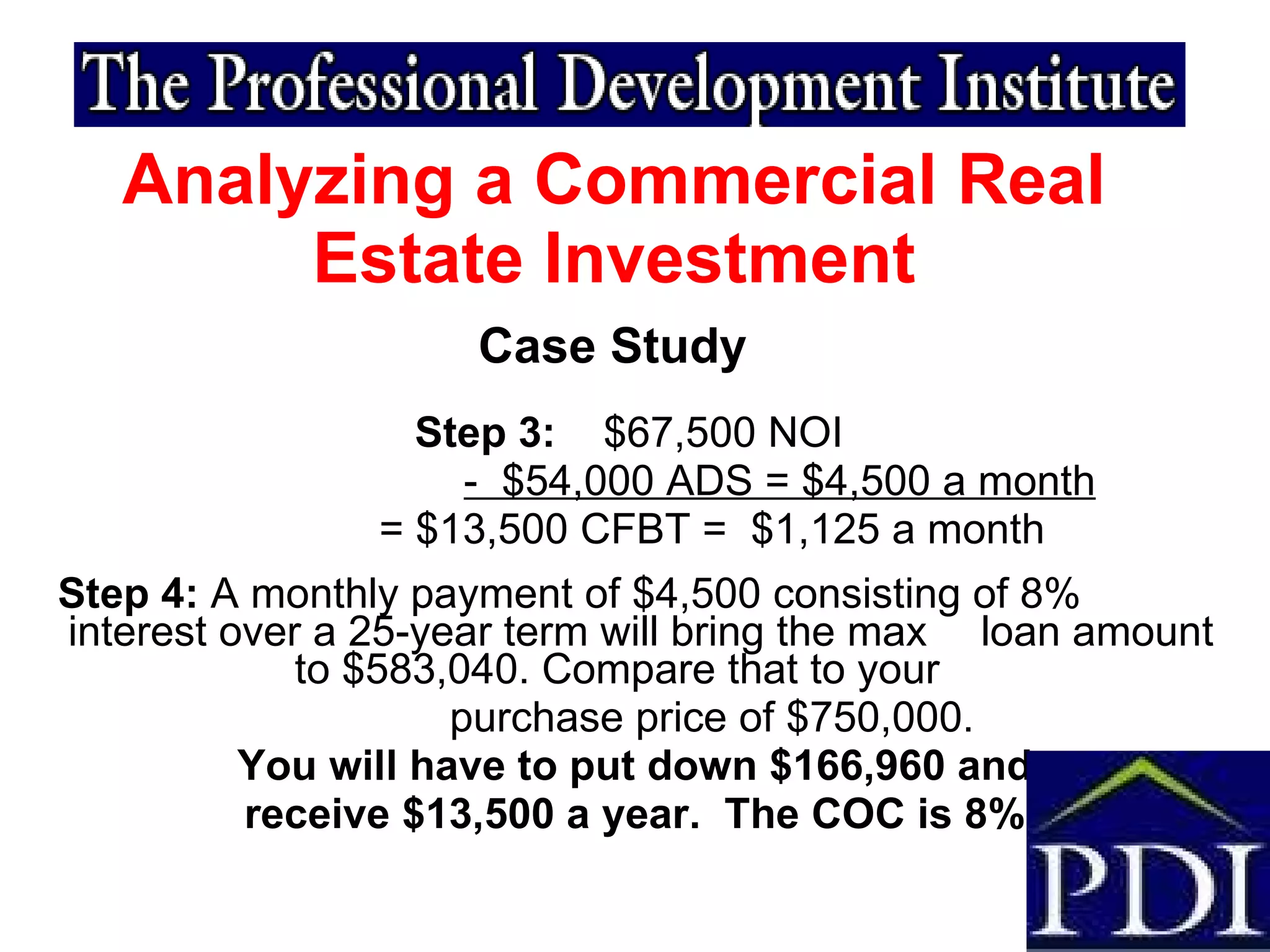
Analyzing a Commercial Real Estate Investment Step 3:  $67,500 NOI    -  $54,000 ADS = $4,500 a month = $13,500 CFBT =  $1,125 a month Step 4:  A monthly payment of $4,500 consisting of 8%    interest over a 25-year term will bring the max    loan amount to $583,040. Compare that to your  purchase price of $750,000. You will have to put down $166,960 and receive $13,500 a year.  The COC is 8%. Case Study
Analyzing a Commercial Real Estate Investment You could look at the following to achieve 9% COC: 1. Lower your asking price. 2. Achieve a higher NOI. 3. Get a lower interest rate. 4. Any combination of the above. All of these will get you there! Let’s look!   Case Study
Analyzing a Commercial Real Estate Investment By reducing the asking price to $735,000 or by 2%, a COC of 9% can be achieved. If you increase the NOI by 2% a year ($1,350), your NOI would be $14,850, giving you a COC of 9%. An interest rate of 7.75%, but keeping monthly payments at $4,500, would produce a COC of 9%. Case Study
Analyzing a Commercial Real Estate Investment GOT QUESTIONS? Case Study
Westfield North Building, 2730 University Blvd, Ste. 200, Wheaton, Maryland 20902 301-949-1771 (Phone) 301-949-5441 (Fax)  www.pditraining.net We Thank You and hope to see you again! By D. Scott Smith, CCIM 443.691.8153 www.expertcre.com [email_address]

Analyzing a commercial real estate investment

  • 1.
    Analyzing a CommercialReal Estate Investment Westfield North Building, 2730 University Blvd, Ste. 200, Wheaton, Maryland 20902 301-949-1771 (Phone) 301-949-5441 (Fax) www.pditraining.net Presents: By D. Scott Smith, CCIM 443.691.8153 www.expertcre.com [email_address]
  • 2.
    Class Room, DLLR,and MREC Rules!!! You must sign in and out to get CE (show ID) No eating, sleeping, or using electronics You must be on time Raise your hand to ask questions Be polite
  • 3.
    Analyzing a CommercialReal Estate Investment Review 4 basic steps to find a pulse on an investment. Part 1. Determine Net Operating Income (NOI) Part 2. Loan Selection Part 3. Determine Cash Flow Before Tax (CFBT) Part 4. Calculate Returns NOTE: There are many additional steps needed to fine-tune each analysis. Today We Will:
  • 4.
    Analyzing a CommercialReal Estate Investment A few things first: Analysis Paralysis is over analyzing a deal to attempt to remove risk. The only way to completely avoid risk is to not invest. Different methods often provide different results. “ Garbage in, garbage out”
  • 5.
    Analyzing a CommercialReal Estate Investment Some Industry Standards for Analysis Internal Rate of Return (IRR) Cash-on-Cash Return (COC) Financial Management Rate of Return And Cap Rate, to name a few
  • 6.
    Analyzing a CommercialReal Estate Investment The Key to a successful investment is to be able to answer : What is your risk tolerance? Does the investment make sense to you? Does it meet your goals?
  • 7.
    Analyzing a CommercialReal Estate Investment Step 1. Net Operating Income (NOI)
  • 8.
    Analyzing a CommercialReal Estate Investment Step 1. Net Operating Income (NOI) Potential Rental Income - Vacancy and Credit Loss = Effective Income + Other Income = Gross Operating Income - Operating Expenses = NOI
  • 9.
    Analyzing a CommercialReal Estate Investment Step 1. Net Operating Income (NOI) Operating expenses consist of: Real estate taxes Property insurance Property management and maintenance Utilities Legal fees Advertising And accounting, to name a few
  • 10.
    Analyzing a CommercialReal Estate Investment Step 1. Net Operating Income (NOI) A few more things … BOMA Expense Ratios for each asset class in each market Income statements – may include many additional income streams for the current owner
  • 11.
    Analyzing a CommercialReal Estate Investment Step 1. Net Operating Income (NOI) A few more things … A Cap Rate as a Way of Measuring an Investment and is not THE RETURN of the investment. Cap Rate is a measurement rate of the first year NOI as it relates to the current value of the investment. Is a Cap Rate complete?
  • 12.
    Analyzing a CommercialReal Estate Investment Step 1. Net Operating Income (NOI) IRV Formula Note: A Cap Rate does not account for debt service and income tax for the investment. INCOME RATE VALUE X ÷ ÷
  • 13.
    Analyzing a CommercialReal Estate Investment Step 2. Loan Selection
  • 14.
    Analyzing a CommercialReal Estate Investment Step 2. Loan Selection What you need to know: Types of loans available Types of loan structures (Hard Money, Swap, Equity) Which lenders offer the loans you need/want Always have your own trusted lender for custom packages.
  • 15.
    Analyzing a CommercialReal Estate Investment Step 2. Loan Selection Consider the Debt Service Coverage Ratio (DSCR) when evaluating loan options. DSCR will be provided by your lender. DSCR is the net operating income divided by the annual debt service. You will need to reflect and negotiate what loan structure will be available and achievable for the asset.
  • 16.
    Analyzing a CommercialReal Estate Investment Step 2. Loan Selection It’s important to do the following: Build relationships with lenders. Find a mentor. Ask questions.
  • 17.
    Analyzing a CommercialReal Estate Investment Step 2. Loan Selection We will use the following loan structure for the remainder of the steps and analysis today. 25-year mortgage, fully amortized 8% interest Monthly payments Debt Service Coverage Ratio (DSCR) of 1.25
  • 18.
    Analyzing a CommercialReal Estate Investment Step 3. Cash Flow Before Tax (CFBT)
  • 19.
    Analyzing a CommercialReal Estate Investment Step 3. Cash Flow Before Tax (CFBT) CFBT is the heart of the analysis. This will give you the amount of income before tax your property is providing. This is the benchmark to calculate your return.
  • 20.
    Analyzing a CommercialReal Estate Investment Step 3. Cash Flow Before Tax (CFBT) NOI of $50,000 / DSCR or 1.25 = $40,000 This means that $40,000 is the max annual debt a NOI of $50,000 can cover. If the NOI drops below $50,000, DSCR will change and increase the lender’s risk of losing on the investment.
  • 21.
    Analyzing a CommercialReal Estate Investment Step 3. Cash Flow Before Tax (CFBT) NOI of $50,000 / DSCR of 1.25 = $40,000 The above analysis will have a result of: $10,000 a year CFBT (NOI of $50,000 – ADS of $40,000 = $10,000 CFBT) or NOI of $4166.67 a month Mortgage payment of $3,333 a month CFBT of $833.33 a month
  • 22.
    Analyzing a CommercialReal Estate Investment Based on an NOI of $50,000, with a DSCR of 1.25, the max loan amount would be $431,838. With an asking price of $500,000 (or a 10% Cap Rate), you would have to put down $68,161.45.
  • 23.
    Analyzing a CommercialReal Estate Investment Step 4. Calculating Returns
  • 24.
    Analyzing a CommercialReal Estate Investment Step 4. Calculating Returns Determine the maximum loan amount and down payment based on: Net Operating Income (NOI) of $50,000 Debt Service Coverage Ratio (DSCR) of 1.25 Annual Debt Service (ADS) of $40,000 Loan – 8% interest, fully amortized over 25 years Current asking price of $500,000
  • 25.
    Analyzing a CommercialReal Estate Investment Step 4. Calculating Returns Compare the $10,000 CFBT you receive against the down payment amount of $68,161.45. Which is called…
  • 26.
    Analyzing a CommercialReal Estate Investment Step 4. Calculating Returns Cash-on-Cash Return (COC) is: The first year’s Cash Flow Before Tax (CFBT) / Initial Capital $10,000/$68,161.45 = 15% Return on Equity Investors usually think of this percentage as “ THE” return!
  • 27.
    Analyzing a CommercialReal Estate Investment Step 4. Calculating Returns Internal Rate of Return (IRR): A rate of return earned on each dollar, for as long as it stays inside the investment. More appropriately, the discount rate, if you add up all the future cash flows, reduced to present value where that total equals the initial capital investment. That percentage would be the Internal Rate of Return.
  • 28.
    Analyzing a CommercialReal Estate Investment Step 4. Calculating Returns In order to achieve a desired IRR of 10%, determine: Amount at which you need to sell the property When you would need to sell (Assuming all things remained the same inside the investment over the holding period.)
  • 29.
    Analyzing a CommercialReal Estate Investment Step 4. Calculating Returns Suggestion: You may want to use the HP10BII to complete this advanced step. 1. (-$68,161) down CFJ key 2. $10,000 CFBT in CFJ 1-4 3. $10,000 + $50,000 a. $550,000 sales price in 5 years – $500,000 of initial purchase) in the CFJ 5 key.
  • 30.
    Analyzing a CommercialReal Estate Investment Step 4. Calculating Returns 4. Push Gold key then IRR key 5. IRR = 10.34 You could also achieve this result by putting down $50,000 less of initial capital.
  • 31.
    Analyzing a CommercialReal Estate Investment Case Study
  • 32.
    Analyzing a CommercialReal Estate Investment A property is currently on the market for a sales price of $750,000 with a Cap Rate of 9%. What purchase price would you need to achieve to receive a 9% COC return? Case Study
  • 33.
    Analyzing a CommercialReal Estate Investment Step 1: The NOI (if real) should be ________ based on a 9% Cap Rate and market price of $750,000. Step 2: If the NOI is $67,500 and you know that your lender has a loan program of 8% interest, fully amortized over 25 years, no points, and a DSCR of 1.25, your max Annual Debt Service (ADS) will be: $67,500 / 1.25 = ___________ ADS Case Study
  • 34.
    Analyzing a CommercialReal Estate Investment Step 3: $67,500 NOI - $54,000 ADS = $4,500 a month = $13,500 CFBT = $1,125 a month Step 4: A monthly payment of $4,500 consisting of 8% interest over a 25-year term will bring the max loan amount to $583,040. Compare that to your purchase price of $750,000. You will have to put down $166,960 and receive $13,500 a year. The COC is 8%. Case Study
  • 35.
    Analyzing a CommercialReal Estate Investment Step 3: $67,500 NOI - $54,000 ADS = $4,500 a month = $13,500 CFBT = $1,125 a month Step 4: A monthly payment of $4,500 consisting of 8% interest over a 25-year term will bring the max loan amount to $583,040. Compare that to your purchase price of $750,000. You will have to put down $166,960 and receive $13,500 a year. The COC is 8%. Case Study
  • 36.
    Analyzing a CommercialReal Estate Investment You could look at the following to achieve 9% COC: 1. Lower your asking price. 2. Achieve a higher NOI. 3. Get a lower interest rate. 4. Any combination of the above. All of these will get you there! Let’s look! Case Study
  • 37.
    Analyzing a CommercialReal Estate Investment By reducing the asking price to $735,000 or by 2%, a COC of 9% can be achieved. If you increase the NOI by 2% a year ($1,350), your NOI would be $14,850, giving you a COC of 9%. An interest rate of 7.75%, but keeping monthly payments at $4,500, would produce a COC of 9%. Case Study
  • 38.
    Analyzing a CommercialReal Estate Investment GOT QUESTIONS? Case Study
  • 39.
    Westfield North Building,2730 University Blvd, Ste. 200, Wheaton, Maryland 20902 301-949-1771 (Phone) 301-949-5441 (Fax) www.pditraining.net We Thank You and hope to see you again! By D. Scott Smith, CCIM 443.691.8153 www.expertcre.com [email_address]