Real Estate Development Modeling Basics Real Estate Financial Modeling
Goals 1. Build your confidence in your modeling capabilities 2. Enable you to analyze potential investments better 3. Increase your credibility with potential partners, lenders and investors 4. Make you more knowledgeable and valuable as a student or real estate professional
What is Financial Modeling? Forecasting of  future  financial outcomes based on  current   assumptions .
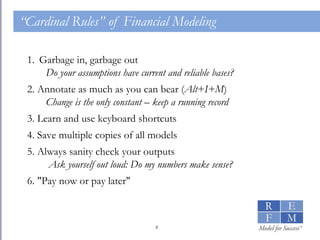
“ Cardinal Rules” of Financial Modeling Garbage in, garbage out  Do your assumptions have current and reliable bases? 2. Annotate as much as you can bear ( Alt+I+M ) Change is the only constant – keep a running record 3. Learn and use keyboard shortcuts 4. Save multiple copies of all models 5. Always sanity check your outputs Ask yourself out loud: Do my numbers make sense? 6. "Pay now or pay later"
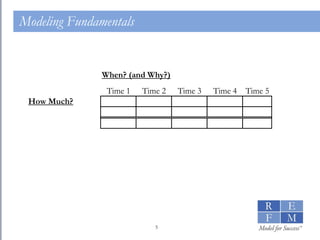
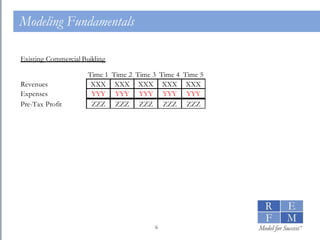
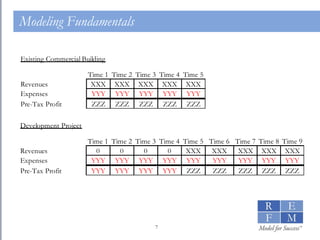
Modeling Fundamentals
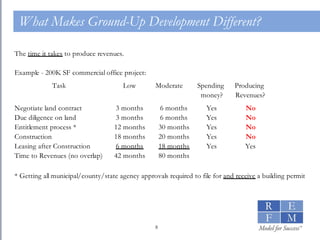
What Makes Ground-Up Development Different?
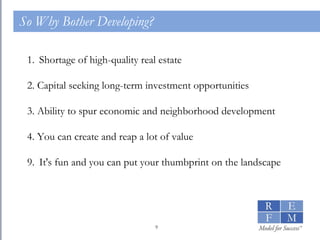
So Why Bother Developing? Shortage of high-quality real estate 2. Capital seeking long-term investment opportunities 3. Ability to spur economic and neighborhood development 4. You can create and reap a lot of value It's fun and you can put your thumbprint on the landscape
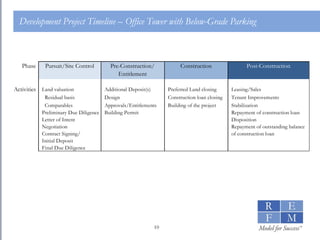
Development Project Timeline – Office Tower with Below-Grade Parking
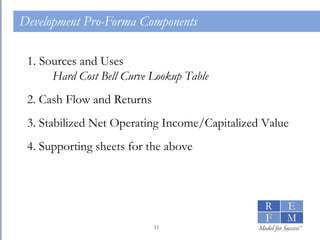
Development Pro-Forma Components Sources and Uses Hard Cost Bell Curve Lookup Table 2. Cash Flow and Returns 3. Stabilized Net Operating Income/Capitalized Value 4. Supporting sheets for the above
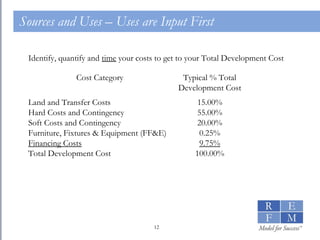
Sources and Uses – Uses are Input First
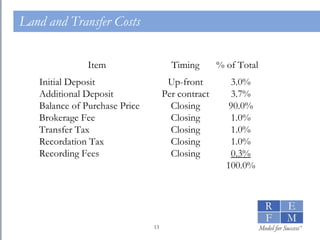
Land and Transfer Costs
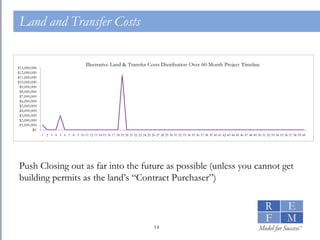
Land and Transfer Costs Push Closing out as far into the future as possible (unless you cannot get building permits as the land’s “Contract Purchaser”)
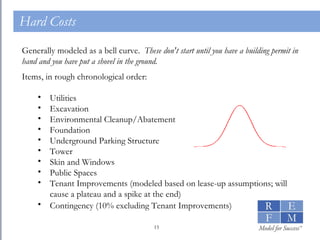
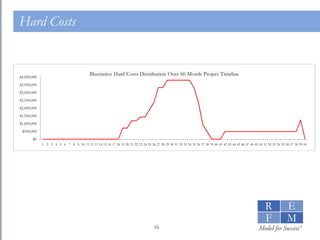
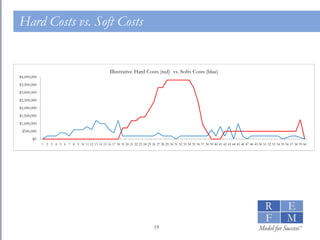
Hard Costs Generally modeled as a bell curve.  These don't start until you have a building permit in hand and you have put a shovel in the ground. Items, in rough chronological order: Utilities Excavation Environmental Cleanup/Abatement Foundation Underground Parking Structure Tower Skin and Windows Public Spaces Tenant Improvements (modeled based on lease-up assumptions; will cause a plateau and a spike at the end) Contingency (10% excluding Tenant Improvements)
Hard Costs
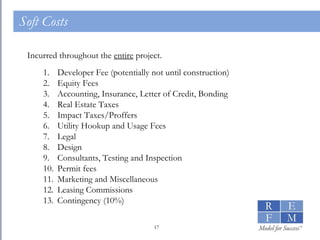
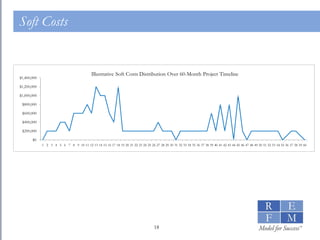
Soft Costs Incurred throughout the  entire  project. Developer Fee (potentially not until construction) Equity Fees Accounting, Insurance, Letter of Credit, Bonding Real Estate Taxes Impact Taxes/Proffers Utility Hookup and Usage Fees Legal Design Consultants, Testing and Inspection Permit fees Marketing and Miscellaneous Leasing Commissions Contingency (10%)
Soft Costs
Hard Costs vs. Soft Costs
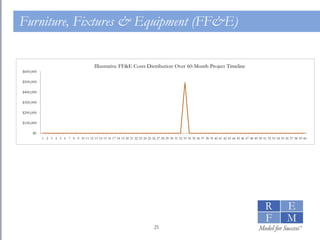
Furniture, Fixtures & Equipment (FF&E) Near the very end of construction. Remember, we are dealing with physical space and logistics.
Furniture, Fixtures & Equipment (FF&E)
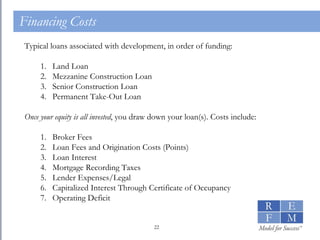
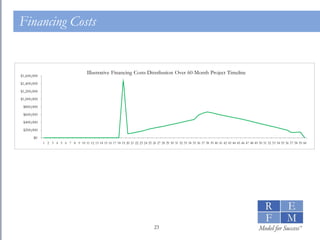
Financing Costs Typical loans associated with development, in order of funding: Land Loan Mezzanine Construction Loan Senior Construction Loan Permanent Take-Out Loan Once your equity is all invested , you draw down your loan(s). Costs include: Broker Fees Loan Fees and Origination Costs (Points) Loan Interest Mortgage Recording Taxes Lender Expenses/Legal Capitalized Interest Through Certificate of Occupancy Operating Deficit
Financing Costs
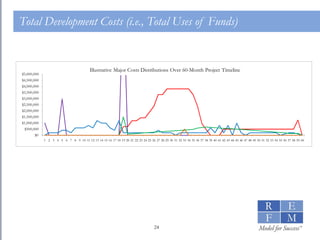
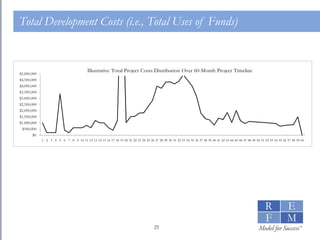
Total Development Costs (i.e., Total Uses of Funds)

Real Estate Development Modeling Basics

  • 1.
    Real Estate DevelopmentModeling Basics Real Estate Financial Modeling
  • 2.
    Goals 1. Buildyour confidence in your modeling capabilities 2. Enable you to analyze potential investments better 3. Increase your credibility with potential partners, lenders and investors 4. Make you more knowledgeable and valuable as a student or real estate professional
  • 3.
    What is FinancialModeling? Forecasting of future financial outcomes based on current assumptions .
  • 4.
    “ Cardinal Rules”of Financial Modeling Garbage in, garbage out Do your assumptions have current and reliable bases? 2. Annotate as much as you can bear ( Alt+I+M ) Change is the only constant – keep a running record 3. Learn and use keyboard shortcuts 4. Save multiple copies of all models 5. Always sanity check your outputs Ask yourself out loud: Do my numbers make sense? 6. "Pay now or pay later"
  • 5.
  • 6.
  • 7.
  • 8.
    What Makes Ground-UpDevelopment Different?
  • 9.
    So Why BotherDeveloping? Shortage of high-quality real estate 2. Capital seeking long-term investment opportunities 3. Ability to spur economic and neighborhood development 4. You can create and reap a lot of value It's fun and you can put your thumbprint on the landscape
  • 10.
    Development Project Timeline– Office Tower with Below-Grade Parking
  • 11.
    Development Pro-Forma ComponentsSources and Uses Hard Cost Bell Curve Lookup Table 2. Cash Flow and Returns 3. Stabilized Net Operating Income/Capitalized Value 4. Supporting sheets for the above
  • 12.
    Sources and Uses– Uses are Input First
  • 13.
  • 14.
    Land and TransferCosts Push Closing out as far into the future as possible (unless you cannot get building permits as the land’s “Contract Purchaser”)
  • 15.
    Hard Costs Generallymodeled as a bell curve. These don't start until you have a building permit in hand and you have put a shovel in the ground. Items, in rough chronological order: Utilities Excavation Environmental Cleanup/Abatement Foundation Underground Parking Structure Tower Skin and Windows Public Spaces Tenant Improvements (modeled based on lease-up assumptions; will cause a plateau and a spike at the end) Contingency (10% excluding Tenant Improvements)
  • 16.
  • 17.
    Soft Costs Incurredthroughout the entire project. Developer Fee (potentially not until construction) Equity Fees Accounting, Insurance, Letter of Credit, Bonding Real Estate Taxes Impact Taxes/Proffers Utility Hookup and Usage Fees Legal Design Consultants, Testing and Inspection Permit fees Marketing and Miscellaneous Leasing Commissions Contingency (10%)
  • 18.
  • 19.
    Hard Costs vs.Soft Costs
  • 20.
    Furniture, Fixtures &Equipment (FF&E) Near the very end of construction. Remember, we are dealing with physical space and logistics.
  • 21.
    Furniture, Fixtures &Equipment (FF&E)
  • 22.
    Financing Costs Typicalloans associated with development, in order of funding: Land Loan Mezzanine Construction Loan Senior Construction Loan Permanent Take-Out Loan Once your equity is all invested , you draw down your loan(s). Costs include: Broker Fees Loan Fees and Origination Costs (Points) Loan Interest Mortgage Recording Taxes Lender Expenses/Legal Capitalized Interest Through Certificate of Occupancy Operating Deficit
  • 23.
  • 24.
    Total Development Costs(i.e., Total Uses of Funds)
  • 25.
    Total Development Costs(i.e., Total Uses of Funds)