INTERPRETATIVE READING
ANALYTICAL EXPOSITON TEXT
LECTURER:
IMA CHUSNUL CHOTIMAH M.PD.
4th GROUP
RISMO ARY PRAYOGI (167114)
DHEA ADELINA (167109)
CHILYATUS SARIROH (167111)
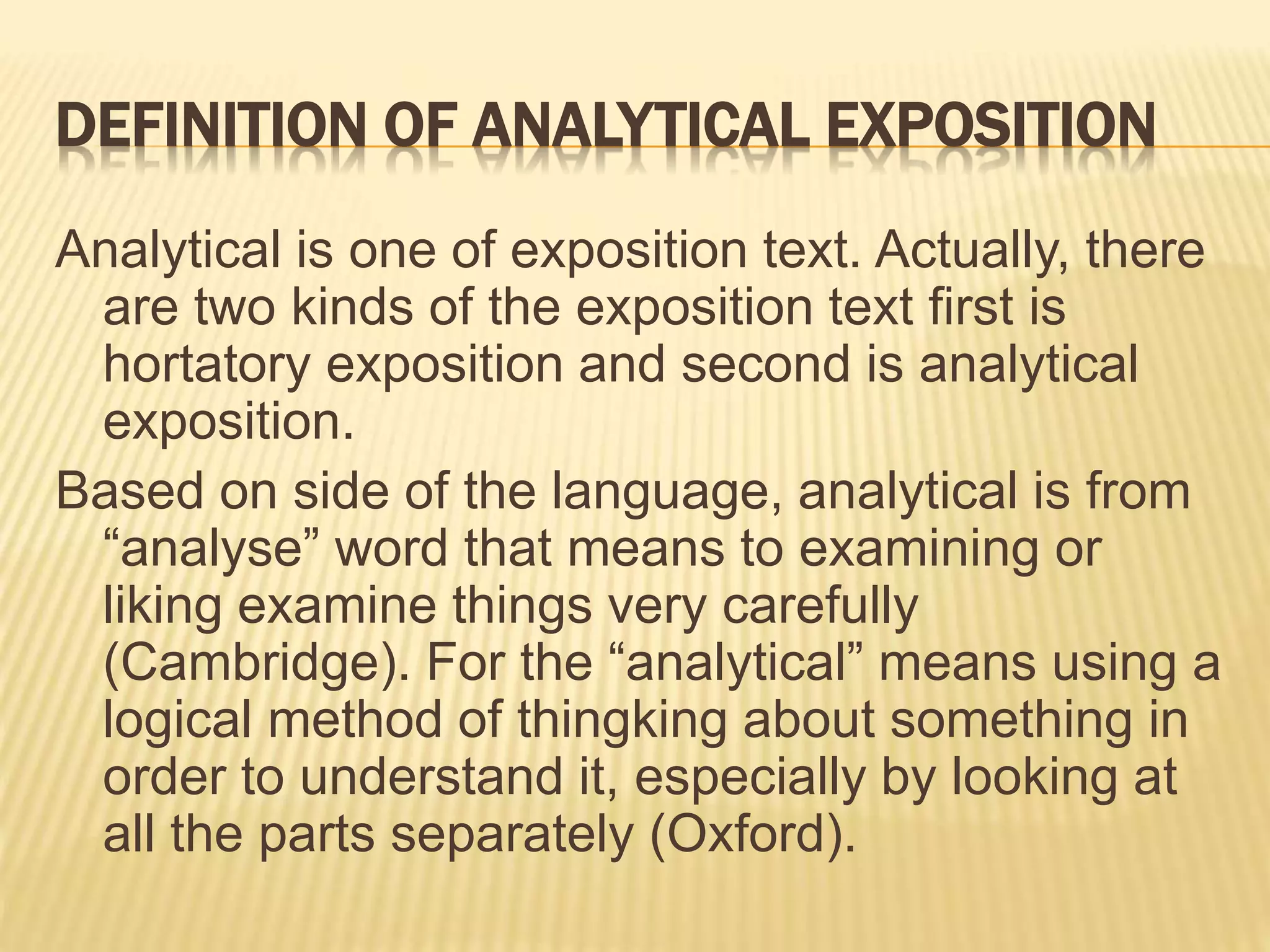
DEFINITION OF ANALYTICAL EXPOSITION
Analytical is one of exposition text. Actually, there
are two kinds of the exposition text first is
hortatory exposition and second is analytical
exposition.
Based on side of the language, analytical is from
“analyse” word that means to examining or
liking examine things very carefully
(Cambridge). For the “analytical” means using a
logical method of thingking about something in
order to understand it, especially by looking at
all the parts separately (Oxford).
Usually analytical exposition use in types:
 Letters to the editor
 Plead in trial case
 Speeches
 Adversiting
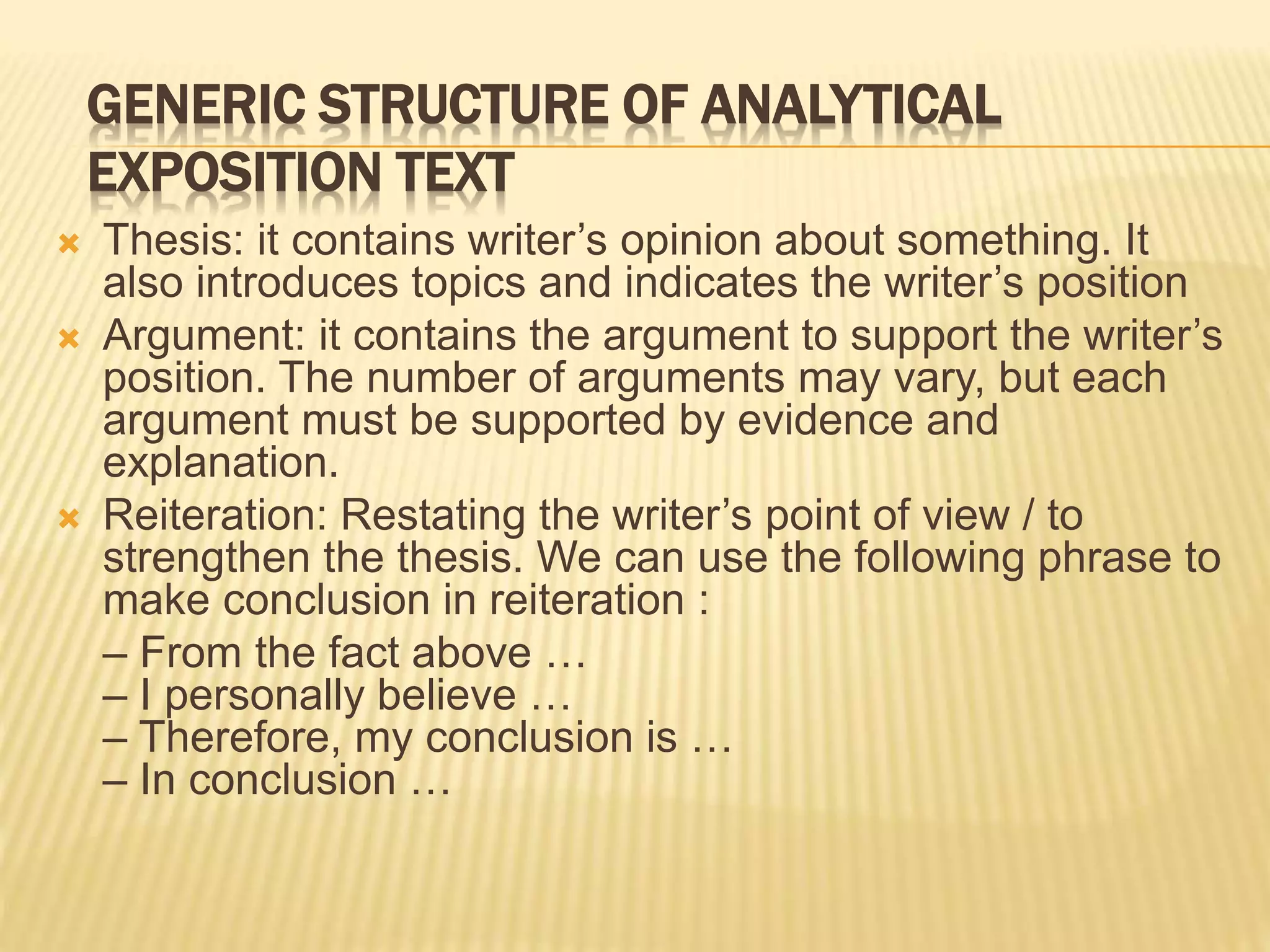
GENERIC STRUCTURE OF ANALYTICAL
EXPOSITION TEXT
 Thesis: it contains writer’s opinion about something. It
also introduces topics and indicates the writer’s position
 Argument: it contains the argument to support the writer’s
position. The number of arguments may vary, but each
argument must be supported by evidence and
explanation.
 Reiteration: Restating the writer’s point of view / to
strengthen the thesis. We can use the following phrase to
make conclusion in reiteration :
– From the fact above …
– I personally believe …
– Therefore, my conclusion is …
– In conclusion …
PURPOSE OF ANALYTICAL EXPOSITION TEXT
 To analyze the topic and to convince or
influence the reader that this opinion is
correct and supported by arguments.
 To convince the reader that the topics
presented was an important topic to be
discussed or gained attention by way of
providing arguments or opinions that support
the main idea or topic.
LANGUAGE FEATURES OF AN ANALYTICAL
EXPOSITION
 General nouns, for example: car, pollution, leaded petrol
car, etc.
 Abstract nouns, for example: policy, government, etc.
 Action verbs, for example : she must save, etc.
 Relating verbs, for example: it is important, etc.
 Thinking verbs, for example: many people believe, etc.
 Modal verbs, for example: we must preserve, etc.
 Connectives, for example: firstly, second, etc.
 Modal adverbs, for example : certainly,surely,really,likely,etc
 Technical verbs, for example : species of animal, etc
 Passive voice/sentences
EXAMPLE OF ANALYTICAL EXPOSITION
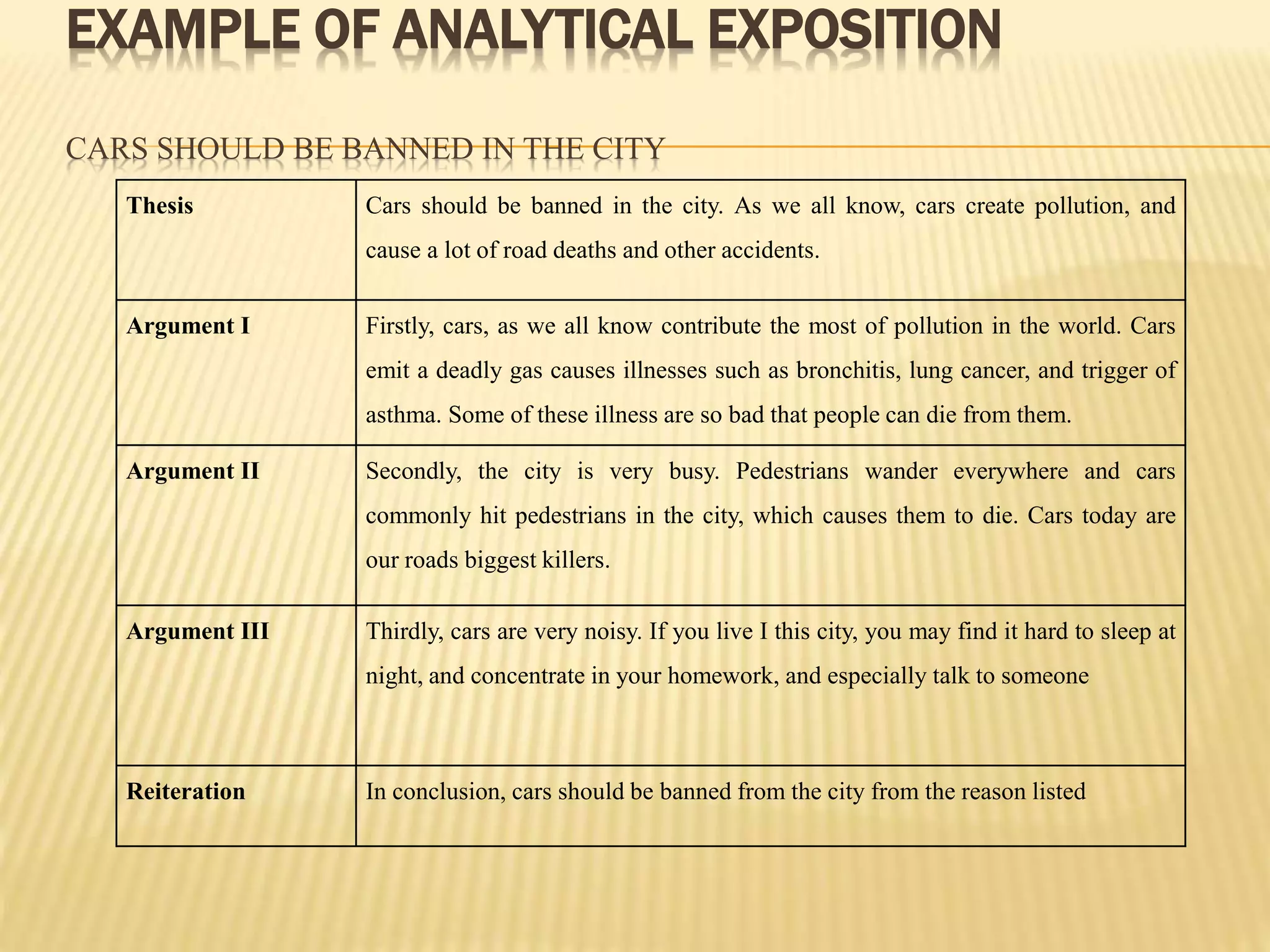
CARS SHOULD BE BANNED IN THE CITY
Thesis Cars should be banned in the city. As we all know, cars create pollution, and
cause a lot of road deaths and other accidents.
Argument I Firstly, cars, as we all know contribute the most of pollution in the world. Cars
emit a deadly gas causes illnesses such as bronchitis, lung cancer, and trigger of
asthma. Some of these illness are so bad that people can die from them.
Argument II Secondly, the city is very busy. Pedestrians wander everywhere and cars
commonly hit pedestrians in the city, which causes them to die. Cars today are
our roads biggest killers.
Argument III Thirdly, cars are very noisy. If you live I this city, you may find it hard to sleep at
night, and concentrate in your homework, and especially talk to someone
Reiteration In conclusion, cars should be banned from the city from the reason listed
THE DIFFERENCES BETWEEN HORTATORY AND
ANALYTICAL EXPOTION
 What makes analytical different from hortatory
exposition is the last finalizing step which
analytical is ended by reiteration while hortatory
is finalized by certain a recommendation
Analytical >Reiteration, contains the conclusion
from thesis and argument inside that. The words
usually used are: In my conclusion, Based on
the arguments above, etc
Hortatory >Recommendation, contains of
suggestion from the writer. Usually the words
use are: should, should not, ought to, ought
not to
CONCLUSION
The analytical exposition is a text to persuade
by presenting arguments and to analyze or
explain something. This text is conclude of
thesis, argument, and reiteration
THANK YOU

Analytical expositon text

  • 1.
    INTERPRETATIVE READING ANALYTICAL EXPOSITONTEXT LECTURER: IMA CHUSNUL CHOTIMAH M.PD. 4th GROUP RISMO ARY PRAYOGI (167114) DHEA ADELINA (167109) CHILYATUS SARIROH (167111)
  • 2.
    DEFINITION OF ANALYTICALEXPOSITION Analytical is one of exposition text. Actually, there are two kinds of the exposition text first is hortatory exposition and second is analytical exposition. Based on side of the language, analytical is from “analyse” word that means to examining or liking examine things very carefully (Cambridge). For the “analytical” means using a logical method of thingking about something in order to understand it, especially by looking at all the parts separately (Oxford).
  • 3.
    Usually analytical expositionuse in types:  Letters to the editor  Plead in trial case  Speeches  Adversiting
  • 4.
    GENERIC STRUCTURE OFANALYTICAL EXPOSITION TEXT  Thesis: it contains writer’s opinion about something. It also introduces topics and indicates the writer’s position  Argument: it contains the argument to support the writer’s position. The number of arguments may vary, but each argument must be supported by evidence and explanation.  Reiteration: Restating the writer’s point of view / to strengthen the thesis. We can use the following phrase to make conclusion in reiteration : – From the fact above … – I personally believe … – Therefore, my conclusion is … – In conclusion …
  • 5.
    PURPOSE OF ANALYTICALEXPOSITION TEXT  To analyze the topic and to convince or influence the reader that this opinion is correct and supported by arguments.  To convince the reader that the topics presented was an important topic to be discussed or gained attention by way of providing arguments or opinions that support the main idea or topic.
  • 6.
    LANGUAGE FEATURES OFAN ANALYTICAL EXPOSITION  General nouns, for example: car, pollution, leaded petrol car, etc.  Abstract nouns, for example: policy, government, etc.  Action verbs, for example : she must save, etc.  Relating verbs, for example: it is important, etc.  Thinking verbs, for example: many people believe, etc.  Modal verbs, for example: we must preserve, etc.  Connectives, for example: firstly, second, etc.  Modal adverbs, for example : certainly,surely,really,likely,etc  Technical verbs, for example : species of animal, etc  Passive voice/sentences
  • 7.
    EXAMPLE OF ANALYTICALEXPOSITION CARS SHOULD BE BANNED IN THE CITY Thesis Cars should be banned in the city. As we all know, cars create pollution, and cause a lot of road deaths and other accidents. Argument I Firstly, cars, as we all know contribute the most of pollution in the world. Cars emit a deadly gas causes illnesses such as bronchitis, lung cancer, and trigger of asthma. Some of these illness are so bad that people can die from them. Argument II Secondly, the city is very busy. Pedestrians wander everywhere and cars commonly hit pedestrians in the city, which causes them to die. Cars today are our roads biggest killers. Argument III Thirdly, cars are very noisy. If you live I this city, you may find it hard to sleep at night, and concentrate in your homework, and especially talk to someone Reiteration In conclusion, cars should be banned from the city from the reason listed
  • 8.
    THE DIFFERENCES BETWEENHORTATORY AND ANALYTICAL EXPOTION  What makes analytical different from hortatory exposition is the last finalizing step which analytical is ended by reiteration while hortatory is finalized by certain a recommendation Analytical >Reiteration, contains the conclusion from thesis and argument inside that. The words usually used are: In my conclusion, Based on the arguments above, etc Hortatory >Recommendation, contains of suggestion from the writer. Usually the words use are: should, should not, ought to, ought not to
  • 9.
    CONCLUSION The analytical expositionis a text to persuade by presenting arguments and to analyze or explain something. This text is conclude of thesis, argument, and reiteration
  • 10.