Maria Bramona Collet 2 nd  B Rosa Mª Martí Almirón Friday, 10 th  November 2010
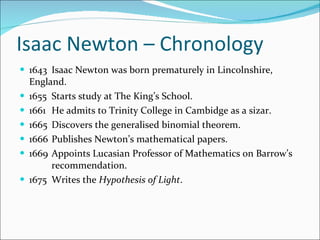
Isaac Newton – Chronology  1643 Isaac Newton was born prematurely in Lincolnshire,  England. 1655 Starts study at The King’s School. 1661 He admits to Trinity College in Cambidge as a sizar. 1665 Discovers the generalised binomial theorem. 1666 Publishes Newton’s mathematical papers. 1669 Appoints Lucasian Professor of Mathematics on Barrow’s  recommendation. 1675 Writes the  Hypothesis of Light .
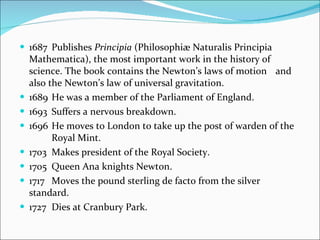
1687 Publishes  Principia  (Philosophiæ Naturalis Principia  Mathematica), the most important work in the history of  science. The book contains the Newton’s laws of motion  and also the Newton’s law of universal gravitation. 1689 He was a member of the Parliament of England. 1693 Suffers a nervous breakdown. 1696 He moves to London to take up the post of warden of the  Royal Mint. 1703 Makes president of the Royal Society. 1705 Queen Ana knights Newton. 1717 Moves the pound sterling de facto from the silver standard. 1727 Dies at Cranbury Park.
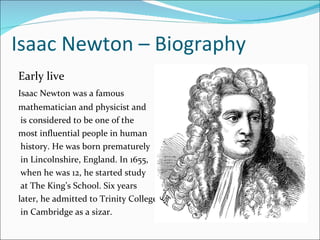
Isaac Newton – Biography  Early live Isaac Newton was a famous  mathematician and physicist and   is considered to be one of the  most influential people in human   history. He was born prematurely   in Lincolnshire, England. In 1655,   when he was 12, he started study   at The King’s School. Six years  later, he admitted to Trinity College   in Cambridge as a  sizar .
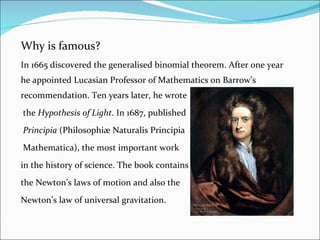
Why is famous? In 1665 discovered the generalised binomial theorem. After one year he appointed Lucasian Professor of Mathematics on Barrow’s recommendation. Ten years later, he wrote   the  Hypothesis of Light . In 1687, published   Principia  (Philosophiæ Naturalis Principia   Mathematica), the most important work  in the history of science. The book contains  the Newton’s laws of motion and also the  Newton’s law of universal gravitation.
Later live In 1689 was a member of the Parliament of England. Four years afterwards suffered a nervous breakdown. In 1696 moved to London to take up the post of warden of the Royal Mint. Seven years later, made president of the Royal Society. In 1705 Queen Ana knights Newton, the first scientist. Twelve years later, created the pound sterling de facto from the silver standard. After ten years he died at Cranbury Park.
Tim Berners-Lee – Chronology  1955 Tim was born in London, England.  1973 He studies at The Queen’s College where he received his  first-class degree in Physics. 1980 He works on a project : a real-time remote procedure call. 1989 Writes his initial proposal of the Transmission Control  Protocol and domain name system ideas: The World  Wide Web (www). 1991 The first web site built by him and was putted on line on  6 August.
1994 Berners-Lee founds the World Wide Web Consortium. 1999 Time Magazine  names Berners-Lee one of the 100 Most  Important People of the 20 th  Century. 2000- Receives very important awards: Computer History 2009  Museum, Knight Commander of the Order of the      British Empire, honorary doctorate of some      universities, Order of Merit, Doctor of Science... 2009 Was elected as a member of the United States National  Academy of Sciences.
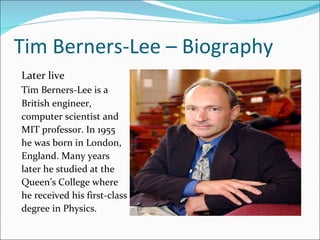
Tim Berners-Lee – Biography Later live Tim Berners-Lee is a  British engineer,  computer scientist and MIT professor. In 1955  he was born in London, England. Many years  later he studied at the  Queen’s College where  he received his first-class  degree in Physics.
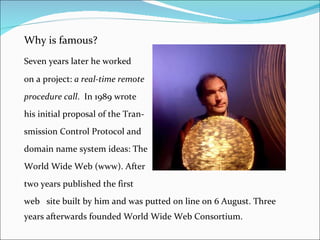
Why is famous? Seven years later he worked  on a project:  a real-time remote  procedure call .  In 1989 wrote  his initial proposal of the Tran- smission Control Protocol and  domain name system ideas: The  World Wide Web (www). After  two years published the first  web site built by him and was putted on line on 6 August. Three years afterwards founded World Wide Web Consortium.
In 1999  Time Magazine  named names Berners-Lee one of the 100 Most Important People of the 20 th  Century. Between 2000 and 2009 received very important awards: Computer History Museum, Knight Commander of the order of the British Empire, honorary doctorate of some universities, Order of Merit, Doctor of Science... Last year was elected as a member of the United States National Academy of Sciences.

AN2_LONDON_PERSONALITIES

  • 1.
    Maria Bramona Collet2 nd B Rosa Mª Martí Almirón Friday, 10 th November 2010
  • 2.
    Isaac Newton –Chronology 1643 Isaac Newton was born prematurely in Lincolnshire, England. 1655 Starts study at The King’s School. 1661 He admits to Trinity College in Cambidge as a sizar. 1665 Discovers the generalised binomial theorem. 1666 Publishes Newton’s mathematical papers. 1669 Appoints Lucasian Professor of Mathematics on Barrow’s recommendation. 1675 Writes the Hypothesis of Light .
  • 3.
    1687 Publishes Principia (Philosophiæ Naturalis Principia Mathematica), the most important work in the history of science. The book contains the Newton’s laws of motion and also the Newton’s law of universal gravitation. 1689 He was a member of the Parliament of England. 1693 Suffers a nervous breakdown. 1696 He moves to London to take up the post of warden of the Royal Mint. 1703 Makes president of the Royal Society. 1705 Queen Ana knights Newton. 1717 Moves the pound sterling de facto from the silver standard. 1727 Dies at Cranbury Park.
  • 4.
    Isaac Newton –Biography Early live Isaac Newton was a famous mathematician and physicist and is considered to be one of the most influential people in human history. He was born prematurely in Lincolnshire, England. In 1655, when he was 12, he started study at The King’s School. Six years later, he admitted to Trinity College in Cambridge as a sizar .
  • 5.
    Why is famous?In 1665 discovered the generalised binomial theorem. After one year he appointed Lucasian Professor of Mathematics on Barrow’s recommendation. Ten years later, he wrote the Hypothesis of Light . In 1687, published Principia (Philosophiæ Naturalis Principia Mathematica), the most important work in the history of science. The book contains the Newton’s laws of motion and also the Newton’s law of universal gravitation.
  • 6.
    Later live In1689 was a member of the Parliament of England. Four years afterwards suffered a nervous breakdown. In 1696 moved to London to take up the post of warden of the Royal Mint. Seven years later, made president of the Royal Society. In 1705 Queen Ana knights Newton, the first scientist. Twelve years later, created the pound sterling de facto from the silver standard. After ten years he died at Cranbury Park.
  • 7.
    Tim Berners-Lee –Chronology 1955 Tim was born in London, England. 1973 He studies at The Queen’s College where he received his first-class degree in Physics. 1980 He works on a project : a real-time remote procedure call. 1989 Writes his initial proposal of the Transmission Control Protocol and domain name system ideas: The World Wide Web (www). 1991 The first web site built by him and was putted on line on 6 August.
  • 8.
    1994 Berners-Lee foundsthe World Wide Web Consortium. 1999 Time Magazine names Berners-Lee one of the 100 Most Important People of the 20 th Century. 2000- Receives very important awards: Computer History 2009 Museum, Knight Commander of the Order of the British Empire, honorary doctorate of some universities, Order of Merit, Doctor of Science... 2009 Was elected as a member of the United States National Academy of Sciences.
  • 9.
    Tim Berners-Lee –Biography Later live Tim Berners-Lee is a  British engineer,  computer scientist and MIT professor. In 1955 he was born in London, England. Many years later he studied at the Queen’s College where he received his first-class degree in Physics.
  • 10.
    Why is famous?Seven years later he worked on a project: a real-time remote procedure call . In 1989 wrote his initial proposal of the Tran- smission Control Protocol and  domain name system ideas: The World Wide Web (www). After two years published the first web site built by him and was putted on line on 6 August. Three years afterwards founded World Wide Web Consortium.
  • 11.
    In 1999 Time Magazine named names Berners-Lee one of the 100 Most Important People of the 20 th Century. Between 2000 and 2009 received very important awards: Computer History Museum, Knight Commander of the order of the British Empire, honorary doctorate of some universities, Order of Merit, Doctor of Science... Last year was elected as a member of the United States National Academy of Sciences.