Maria  Skłodowska-Curie
Hi , We’re Sylwia  And Marta . We are going to travel back in time to visit Marie Curie . Let’s meet her now. Hi !!!
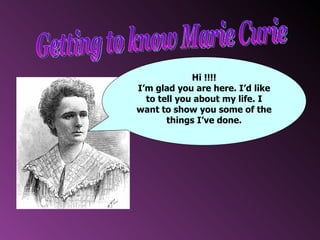
Getting to know Marie Curie Hi !!!! I’m glad you are here. I’d like to tell you about my life. I want to show you some of the things I’ve done.
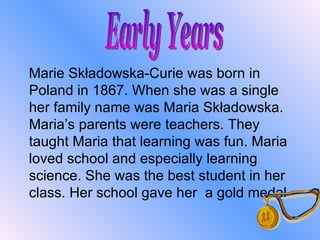
Marie Składowska-Curie was born in Poland in 1867. When she was a single her family name was Maria Składowska. Maria’s parents were teachers. They taught Maria that learning was fun. Maria loved school and especially learning science. She was the best student in her class. Her school gave her  a  gold medal.  Early Years
When Maria finished high school, she become a teacher.  S he liked reading books about science  a t night. All the time she wanted to learn more and more. Maria we n t to a university in France. She loved studying math and science at the university .
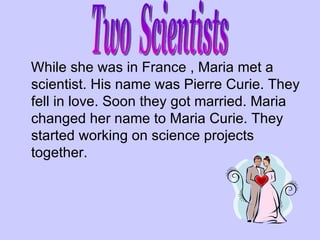
While she was in France , Maria met a scientist. His name was Pierre Curie. They fell in love. Soon they got married. Maria changed her name to Maria Curie. They started working on science projects together. Two  Scientists
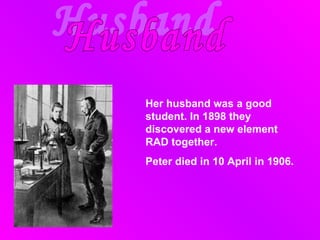
Husband Her husband was  a  good student. In 1898 they discovered  a new element RAD together .  Peter  died in 10 April in 1906.
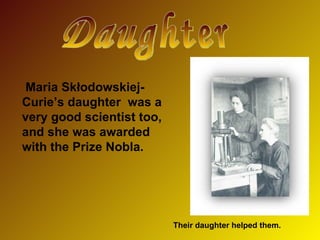
Their daughter helped them. Daughter Mari a  Skłodowskiej-Curie ’s daughter   was  a very  good scientist too, a n d she  was awarded with the  Prize Nobla.
Marie Curie learned about the work of another scientist. This scientist had discovered strange rays. These rays were not bright, but they were powerful and these rays were called X RAYS. Maria and her husband could find out that the  X rays could pass through skin and could be used to take pictures of bones in the human body.  Strong Rays
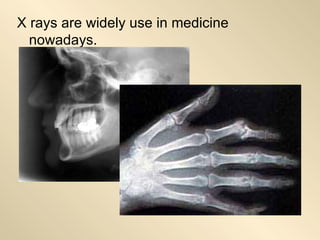
X rays are widely use in medicine nowadays.
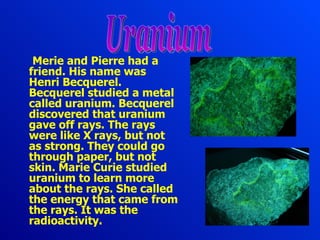
Merie and Pierre had a friend . His  name  was  Henri Becquerel. Becquerel studied a metal called uranium. Becquerel discovered that uranium gave off rays. The rays were like X rays, but not as strong. They could go through paper, but not skin. Marie Curie studied uranium to learn more about the rays. She called the energy that came from the rays . It was the  radioactivity. Uranium
Uranium is an element. Everything in nature is made out of elements. Gold and iron are also exampels of elements. Marie wande d  to find out what other elements gave off rays. Marie and Pierre worked together. They discovered new elements. One of these elements was radium. Radium gives off very strong rays. These rays can be used to cure people who are sick with cancer. The rays can also be used to cure other sicknesses. Radium
Marie and Pierre Curie won a big prize in  1903. It was the Nobel Prize. They won it for their work with radioactivity. Their friend Henri also won the prize with them. The Nobel Prize is one of the world’s top science award. Leter, in 1911,  M arie Curie again won it for her work with radium. She was the first person  who  w o n the  Nobel  prize twice. A Big Prize
After Marie Curie won her first Nobel Prize, she became a professor. A professor is a teacher at a university. Marie was a professor at the Sorbonne University in France. She was the first woman to teach at a university in Fra nce . Marie Curie was an important  Polish and European  scientist. She discovered new things. And she showed that women could be great scientists, too.   A Professor
Cancer  –  a disease than makes people very sick  In Polish - rak poważna, silna osłabiająca choroba In Romanian: cancer Elements  –  the basic materials or substances that make up everythings in the world. There are over 100 known elements  In Polish - pierwiastki podstawowe materiały In Romanian:elemente chimice Glossary
Radium  – a radioactive metal that Marie Curie discovered In Polish - metal radioaktywny odkryty przez Marię Składowską-Curie In Romanian: Radiu Rays  – Beams of energy In Polish – Promienie, wiązki energii In Romanian: raze de energie Glossary
Uranium-  a radioactive metal that Marie Curie studied. In Polish –  Uran  radioaktywny metal, który badała Maria Curie. In Romani a n:  Uraniu X rays-  rays that can pass through things that ordinary light cannot pass though. X rays can pass through skin. They can be used to take pictures of parts of the body that cannot be seen from the outside. In Polish – promienie rentgenowskie (przenikają przez skórę, można je wykorzystać do sfotografowania części ciała, której z zewnątrz nie widać. In Romani a n:  Raze x Glossary
Marta Linka  and Sylwia Zimnoch Primary School No 5,  Bielsk Podlaski, Poland Produced by

Maria Sklodowska Curie

  • 1.
  • 2.
    Hi , We’reSylwia And Marta . We are going to travel back in time to visit Marie Curie . Let’s meet her now. Hi !!!
  • 3.
    Getting to knowMarie Curie Hi !!!! I’m glad you are here. I’d like to tell you about my life. I want to show you some of the things I’ve done.
  • 4.
    Marie Składowska-Curie wasborn in Poland in 1867. When she was a single her family name was Maria Składowska. Maria’s parents were teachers. They taught Maria that learning was fun. Maria loved school and especially learning science. She was the best student in her class. Her school gave her a gold medal. Early Years
  • 5.
    When Maria finishedhigh school, she become a teacher. S he liked reading books about science a t night. All the time she wanted to learn more and more. Maria we n t to a university in France. She loved studying math and science at the university .
  • 6.
    While she wasin France , Maria met a scientist. His name was Pierre Curie. They fell in love. Soon they got married. Maria changed her name to Maria Curie. They started working on science projects together. Two Scientists
  • 7.
    Husband Her husbandwas a good student. In 1898 they discovered a new element RAD together . Peter died in 10 April in 1906.
  • 8.
    Their daughter helpedthem. Daughter Mari a Skłodowskiej-Curie ’s daughter was a very good scientist too, a n d she was awarded with the Prize Nobla.
  • 9.
    Marie Curie learnedabout the work of another scientist. This scientist had discovered strange rays. These rays were not bright, but they were powerful and these rays were called X RAYS. Maria and her husband could find out that the X rays could pass through skin and could be used to take pictures of bones in the human body. Strong Rays
  • 10.
    X rays arewidely use in medicine nowadays.
  • 11.
    Merie and Pierrehad a friend . His name was Henri Becquerel. Becquerel studied a metal called uranium. Becquerel discovered that uranium gave off rays. The rays were like X rays, but not as strong. They could go through paper, but not skin. Marie Curie studied uranium to learn more about the rays. She called the energy that came from the rays . It was the radioactivity. Uranium
  • 12.
    Uranium is anelement. Everything in nature is made out of elements. Gold and iron are also exampels of elements. Marie wande d to find out what other elements gave off rays. Marie and Pierre worked together. They discovered new elements. One of these elements was radium. Radium gives off very strong rays. These rays can be used to cure people who are sick with cancer. The rays can also be used to cure other sicknesses. Radium
  • 13.
    Marie and PierreCurie won a big prize in 1903. It was the Nobel Prize. They won it for their work with radioactivity. Their friend Henri also won the prize with them. The Nobel Prize is one of the world’s top science award. Leter, in 1911, M arie Curie again won it for her work with radium. She was the first person who w o n the Nobel prize twice. A Big Prize
  • 14.
    After Marie Curiewon her first Nobel Prize, she became a professor. A professor is a teacher at a university. Marie was a professor at the Sorbonne University in France. She was the first woman to teach at a university in Fra nce . Marie Curie was an important Polish and European scientist. She discovered new things. And she showed that women could be great scientists, too. A Professor
  • 15.
    Cancer – a disease than makes people very sick In Polish - rak poważna, silna osłabiająca choroba In Romanian: cancer Elements – the basic materials or substances that make up everythings in the world. There are over 100 known elements In Polish - pierwiastki podstawowe materiały In Romanian:elemente chimice Glossary
  • 16.
    Radium –a radioactive metal that Marie Curie discovered In Polish - metal radioaktywny odkryty przez Marię Składowską-Curie In Romanian: Radiu Rays – Beams of energy In Polish – Promienie, wiązki energii In Romanian: raze de energie Glossary
  • 17.
    Uranium- aradioactive metal that Marie Curie studied. In Polish – Uran radioaktywny metal, który badała Maria Curie. In Romani a n: Uraniu X rays- rays that can pass through things that ordinary light cannot pass though. X rays can pass through skin. They can be used to take pictures of parts of the body that cannot be seen from the outside. In Polish – promienie rentgenowskie (przenikają przez skórę, można je wykorzystać do sfotografowania części ciała, której z zewnątrz nie widać. In Romani a n: Raze x Glossary
  • 18.
    Marta Linka and Sylwia Zimnoch Primary School No 5, Bielsk Podlaski, Poland Produced by