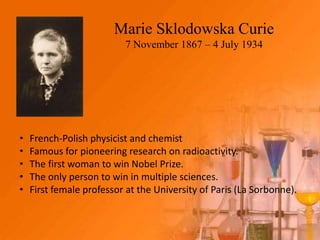
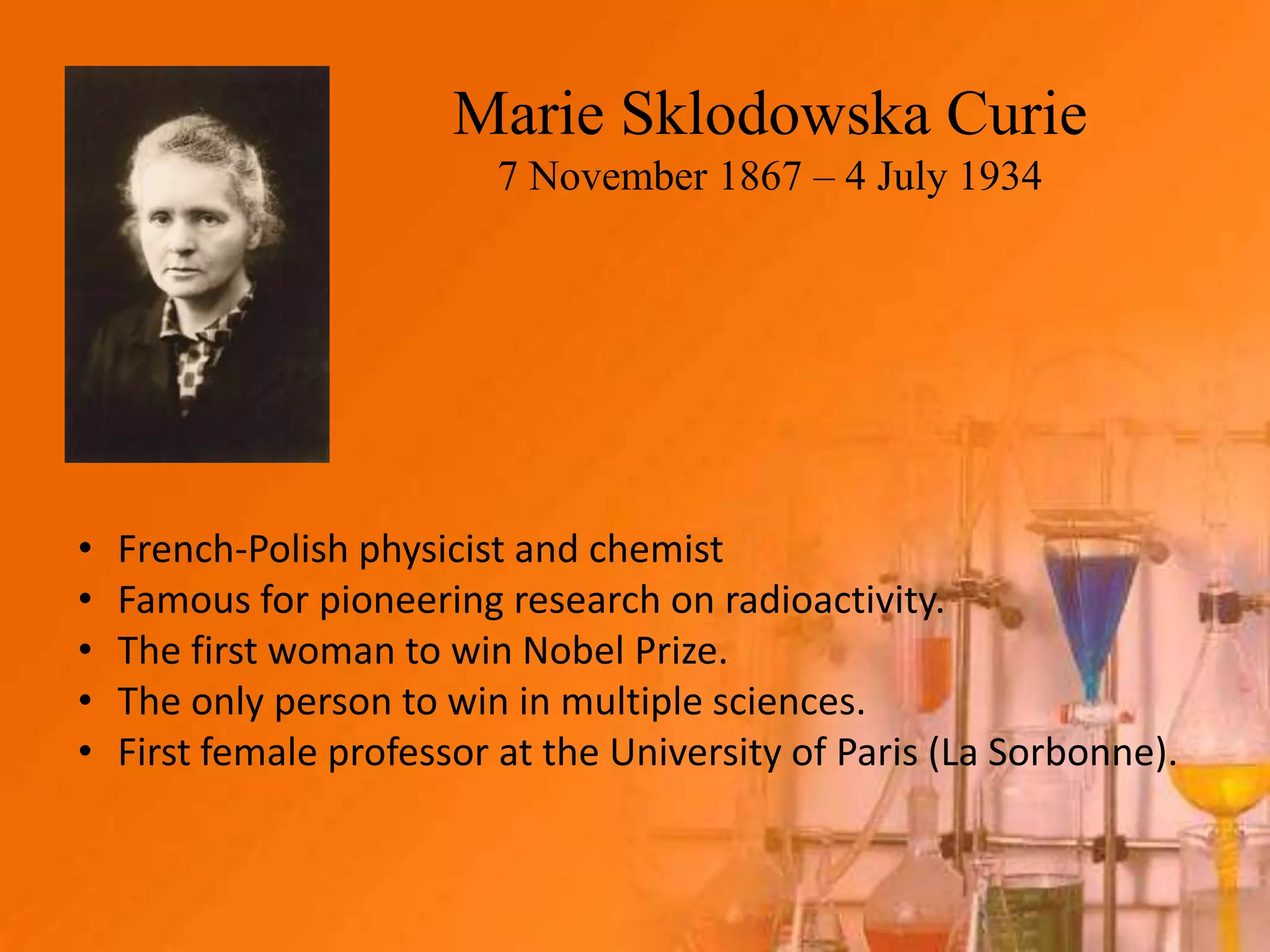

Marie Sklodowska Curie
                          7 November 1867 – 4 July 1934


•   French-Polish physicist and chemist
•   Famous for pioneering research on radioactivity.
•   The first woman to win Nobel Prize.
•   The only person to win in multiple sciences.
•   First female professor at the University of Paris (La Sorbonne).
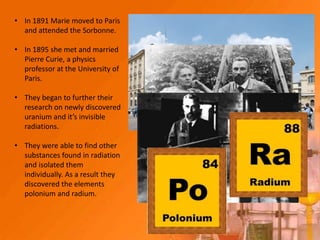
• In 1891 Marie moved to Paris
  and attended the Sorbonne.

• In 1895 she met and married
  Pierre Curie, a physics
  professor at the University of
  Paris.

• They began to further their
  research on newly discovered
  uranium and it’s invisible
  radiations.

• They were able to find other
  substances found in radiation
  and isolated them
  individually. As a result they
  discovered the elements
  polonium and radium.
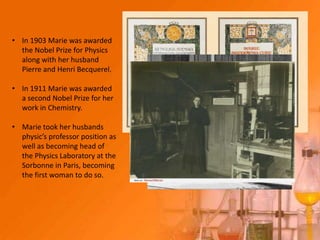
• In 1903 Marie was awarded
  the Nobel Prize for Physics
  along with her husband
  Pierre and Henri Becquerel.

• In 1911 Marie was awarded
  a second Nobel Prize for her
  work in Chemistry.

• Marie took her husbands
  physic’s professor position as
  well as becoming head of
  the Physics Laboratory at the
  Sorbonne in Paris, becoming
  the first woman to do so.
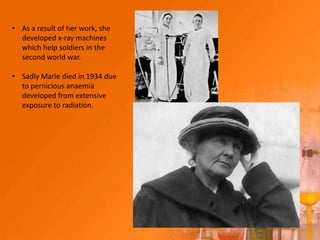
• As a result of her work, she
  developed x-ray machines
  which help soldiers in the
  second world war.

• Sadly Marie died in 1934 due
  to pernicious anaemia
  developed from extensive
  exposure to radiation.

Marie Curie

  • 1.
    Marie Sklodowska Curie 7 November 1867 – 4 July 1934 • French-Polish physicist and chemist • Famous for pioneering research on radioactivity. • The first woman to win Nobel Prize. • The only person to win in multiple sciences. • First female professor at the University of Paris (La Sorbonne).
  • 3.
    • In 1891Marie moved to Paris and attended the Sorbonne. • In 1895 she met and married Pierre Curie, a physics professor at the University of Paris. • They began to further their research on newly discovered uranium and it’s invisible radiations. • They were able to find other substances found in radiation and isolated them individually. As a result they discovered the elements polonium and radium.
  • 4.
    • In 1903Marie was awarded the Nobel Prize for Physics along with her husband Pierre and Henri Becquerel. • In 1911 Marie was awarded a second Nobel Prize for her work in Chemistry. • Marie took her husbands physic’s professor position as well as becoming head of the Physics Laboratory at the Sorbonne in Paris, becoming the first woman to do so.
  • 5.
    • As aresult of her work, she developed x-ray machines which help soldiers in the second world war. • Sadly Marie died in 1934 due to pernicious anaemia developed from extensive exposure to radiation.