International Journal of Electrical and Computer Engineering (IJECE)
Vol. 7, No. 6, December 2017, pp. 3217~3225
ISSN: 2088-8708, DOI: 10.11591/ijece.v7i6.pp3217-3225  3217
Journal homepage: http://iaesjournal.com/online/index.php/IJECE
An Optimal LFC in Two-Area Power Systems Using
a Meta-heuristic Optimization Algorithm
Mushtaq Najeeb1
, Muhamad Mansor2
, Hameed Feyad3
, Esam Taha4
, Ghassan Abdullah5
1,3
Electrical Engineering Department, College of Engineering, University of Anbar, Ramadi, Iraq
2
Department of Electrical Power Engineering, Universiti Tenaga Nasional, Selangor, Malaysia
4
Computer and Information Technology Center, University of Anbar, Ramadi, Iraq
5
Electrical Power and Machines Department, Collage of Engineering, Diyala University, Iraq
Article Info ABSTRACT
Article history:
Received Apr 5, 2017
Revised May 20, 2017
Accepted Jun 15, 2017
In this study, an optimal meta-heuristic optimization algorithm for load
frequency control (LFC) is utilized in two-area power systems. This meta-
heuristic algorithm is called harmony search (HS), it is used to tune PI
controller parameters (𝐾𝑝, 𝐾𝑖) automatically. The developed controller (HS-
PI) with LFC loop is very important to minimize the system frequency and
keep the system power is maintained at scheduled values under sudden loads
changes. Integral absolute error (IAE) is used as an objective function to
enhance the overall system performance in terms of settling time, maximum
deviation, and peak time. The two-area power systems and developed
controller are modelled using MATLAB software (Simulink/Code). As a
result, the developed control algorithm (HS-PI) is more robustness and
efficient as compared to PSO-PI control algorithm under same operation
conditions.
Keyword:
LFC
Meta-heuristic optimization
Algorithm (HS)
Integral absolute error (IAE)
MATLAB environment
Copyright © 2017 Institute of Advanced Engineering and Science.
All rights reserved.
Corresponding Author:
Mushtaq Najeeb,
Electrical Engineering Department, College of Engineering,
University of Anbar,
Ramadi, Iraq.
Email: eng.mushtaq2004@gmail.com
1. INTRODUCTION
In parallel power systems operations, load frequency control is in reality one of the most important
parts which used to minimize area frequency deviation and keep stable tie-line power [1]. The main matter is
how to keep the balance between the active and reactive powers which are transported from the generators to
utilizers during a wild grid. The balance between both the active and reactive powers at the two ends of the
power system effects directly the frequency and the voltage magnitude at the load side. The objectives of
load frequency control (LFC) are to minimize the transient deviations in these variables (area frequency and
tie-line power interchange) and to ensure their steady state errors to be zeros [2]. The frequency is highly
dependent on the active power while the voltage is highly dependent on the reactive power.
In last decades, a lot of researchers are applied several strategies to give a solution for the load
frequency control (LFC) problems [3],[4]. The performance of LFC depends on the feedback controller
design in order to maintain the tie line power flow and the system frequency at their scheduled values [5].
The area control error (ACE) is very important part with the LFC loop which is considered as the control
output [6]. The output error of ACE in each power system area demonstrates the relative error feedback in
the frequency with respect to the flow of tie-line power. To design a proper controller to minimize the ACE
value to be zero, PI controller has been used in different fields due to its simplicity. But, the big obstacle of
PI controller is tuning its parameters (𝐾𝑝, 𝐾𝑖). The methods are used to tune (𝐾𝑝, 𝐾𝑖) parameters are the
Ziegler Nichol’s method [7] and trial-and-error approach [8],[9], but these are not efficient with systems have
 ISSN: 2088-8708
IJECE Vol. 7, No. 6, December 2017 : 3217 – 3225
3218
different load changes in term of multiple interconnected power systems. For this reason and according to the
literature survey, Soft-computing techniques such as such as differential evolution [10], practical swarm
optimizations [11]-[15], ant colony optimization [16], and genetic algorithms [17],[18] have been widely
applied for PI controller tuning in parallel-interconnected power systems.
This research presents an optimal load frequency control (LFC) using PI controller based on
harmony search optimization (HS) technique for parallel two-area power system. The two-area power system
and LFC loop including the proposed HS-PI controller are modelled using Matlab environment. The integral
absolute error (IAE) function is used to determine its minimum value for a step load change. For a good
dynamic performance, the robustness of the proposed HS-PI control algorithm is compared with the PI
controller based particle swarm optimization (PSO) named PSO-PI controller in terms of time settling,
maximum deviation, and peak time.
2. LFC SIMULINK MODEL WITH PROPOSED CONTROLLER
The overall power system of two-area power systems including the LFC model and the PI controller
is investigated as shown in Figure 1. Each power system has primary and secondary loops respectively and
feedback controller. 𝑂𝑈𝑇1 and 𝑂𝑈𝑇2 are the control outputs of the proposed PI controllers respectively;
𝐷𝑃𝐿1and 𝐷𝑃𝐿2 are the disturbance load changes; 𝐷𝑊1and 𝐷𝑊2 are represented the frequency changes in
each power system. The nominal parameters of the overall power system are given in [19]. An area control
error (ACE) is used for each area to reduce its own value to be zero [20], which is defined as:
𝐴𝐶𝐸1 = 𝐵1∆𝜔1 + ∆𝑃12 (1)
𝐴𝐶𝐸2 = 𝐵2∆𝜔2 − ∆𝑃12 (2)
where ∆𝑃12 represents the change in the tie line power plant, 𝐵1and 𝐵2 are the bias frequencies for each
area, ∆𝜔1 and ∆𝜔2 represent the frequency deviation for each area.
Kps1
-------------
(1+S Kps1)
Δω1
Kps2
-------------
(1+S Kps2)
1
-------------
(1+S Tg1)
1
------------
(1+S Tg2)
1
------------
(1+S Tt1)
1
------------
(1+S Tt2)
1
---
R1
1
----
R2
B1
B2
Δω2
Optimal Values
Optimal Values

Ps1
----
s
DP12
ACE1
Area 1
Area 2
Primary Loop 1
Primary Loop 2
Secondary Loop 1
Secondary Loop 2
Ki
Kp + ----
s
HS_Algorithm
Ki
Kp + ----
s
HS_Algorithm


Kp Ki

ACE2

ΔPL2
ΔPL1
OUT1
OUT2
Figure 1. LFC Simulink model with proposed controller
PI controller is one of the popular feedback controller used with the load frequency control for
providing an excellent control performance and higher stability. The transfer function of the PI consists of
two basic parameters; Proportional (P) and Integral (I). According to [21] and [22], the typical transfer
function of the classical PI controller in terms of Laplace domain is described below:
𝐺 𝑃𝐼𝐷(𝑠) =
𝑈(𝑠)
𝐸(𝑠)
= 𝐾𝑝 +
𝐾 𝑖
𝑠
(3)
IJECE ISSN: 2088-8708 
An Optimal LFC in Two Area Power Systems Using a Meta-heuristic Optimization .... (Mushtaq Najeeb)
3219
where, 𝑈(𝑠)and 𝐸(𝑠)are the control signal and the error signal which is the difference between the input and
the feedback correspondingly. 𝐾𝑝 is the proportional gain and 𝐾𝑖 is the integration gain. Moreover, the output
value of the proposed PID controller is given below which generates the proper control signal to keep the
system parameters within the nominal values;
𝑜𝑢𝑡(𝑡) = 𝐾𝑝 𝑒(𝑡) + 𝐾𝑖 ∫ 𝑒(𝑡)𝑑𝑡
𝑡
0
(4)
where 𝑜𝑢𝑡(𝑡)and 𝑒(𝑡) are the control and tracking error signal which is in the form of time domain.
For area1:
𝑜𝑢𝑡1(𝑡) = 𝐾𝑝1 𝐴𝐶𝐸1(𝑡) + 𝐾𝑖1 ∫ 𝐴𝐶𝐸1(𝑡)𝑑𝑡
𝑡
0
(5)
For area2:
𝑜𝑢𝑡2(𝑡) = 𝐾𝑝2 𝐴𝐶𝐸2(𝑡) + 𝐾𝑖2 ∫ 𝐴𝐶𝐸2(𝑡)𝑑𝑡
𝑡
0
(6)
3. HS ALGORITHM CONCEPT
Harmony search (HS) is a well-known meta-heuristic optimization algorithm inspired by the modern
natural phenomena, which was proposed by [23]. The basic process of this algorithm is to produce music
tunes through pitching the musical instruments in order to search for a harmony. For the harmony
improvisation, musicians try various musical combinations stored in their memory to get an excellent quality.
Meanwhile, it is similar to the optimization process by creating a new solution using an objective function in
order to improve the quality of the generated solutions. In brief, the optimization process of the harmony
search algorithm is shown in Figure 2 which can be concluded in five steps [24],[25]: (1) the HS algorithm
parameters are initialized such as the harmony memory size (HMS) which is used to specify the solution
vectors number, harmony memory considering rate (HMCR, its range between [0,1]) which is used for the
solution vector improvement in the harmony memory as well as the pitch adjusting rate (PAR, its range
between [0,1]), and the maximum number of improvisation (MaxI) is used to check the stopping criteria; (2)
the harmony memory (HM) is initialized by generating a random set of solutions vectors which are identical
to the harmony memory size (HMS); (3) A new solution (harmony) is produced in the improvisation process;
(4) the harmony memory is updated to check the new generated solution either it is better or worse than the
previous one; (5) the stopping criteria process is tested in this step to check whether the maximum iterations
number is satisfied or not. If yes, the HS process will stop and the best selected solution ( 𝑙𝑎𝑡𝑒𝑠𝑡 𝑘 𝑝,𝑘𝑖) is
returned back. Otherwise, the procedures in steps 3 and 4 are repeated respectively.
Start
Initialization the HS parameters
(HMS, HMCR, PAR, MaxI)
Harmony Memory (HM) Initialization
New improvisation process
(a new harmony improvised )
Update the Harmony Memory
End
No
Yes
Return the best solution found
Satisfaction of stopping criteria
Figure 2. Harmony search algorithm flowchart
 ISSN: 2088-8708
IJECE Vol. 7, No. 6, December 2017 : 3217 – 3225
3220
4. HS IMPLEMENTATION TO OBTAIN OPTIMAL PI PARAMETERS
In any optimization algorithm, the input vector formula to find the optimal solutions can be defined
as;
𝑀𝑖𝑛. 𝑜𝑟 𝑀𝑎𝑥. = 𝑍(𝑘), 𝑘 𝑛 ∈ 𝑲 𝒏; (𝑛 = 1,2, … … . . 𝑀) (7)
where 𝑍(𝑘) is the input vector to the optimization algorithm, 𝑘 𝑛 is the decision parameter, 𝑲 𝒏 is the lower
and upper values of each decision parameter (𝐿 𝑘 𝑛
 𝑲 𝒏  𝑈𝑘 𝑛
), and 𝑀 is the total number of decision
parameters. Based on equation (7), two decision parameters (𝑘 𝑝,𝑘𝑖) of the input vector 𝑍(𝑘) are used in this
research to provide the optimal solutions from the HS optimization algorithm as shown in Figure 2. In
addition, an objective function is required to evaluate the performance of the input vector 𝑍(𝑘). Therefore,
the integral absolute error (IAE) shown below is applied as an optimization problem at the Simulink time.
𝐼𝐴𝐸 (𝑚𝑖𝑛. ) = ∫ |𝑒|
𝑇
0
𝑑𝑡 + ∫ |𝐴𝐶𝐸1 + 𝐴𝐶𝐸2|𝑑𝑡
𝑠𝑖𝑚𝑢𝑙𝑖𝑛𝑘 𝑡𝑖𝑚𝑒
0
(8)
A more explanation of the optimization process for the harmony search algorithm based PI
controller is presented as follows:
Control flow of Harmony Search Algorithm based PI Controller: pseudo code
Start program:
Definition of 𝑖𝑛𝑝𝑢𝑡 𝑣𝑒𝑐𝑡𝑜𝑟 𝑓𝑜𝑟𝑚𝑢𝑙𝑎 = 𝑍(𝑘), 𝑘 𝑛 ∈ 𝑲 𝒏; (𝑛 = 1,2, … … . . 𝑀);
Definition of HMS, HMCR, PAR, and MaxI;
Definition the upper and lower boundaries of the decision parameters (𝑘 𝑝,𝑘𝑖);
Harmony memory (HM) initialization;
𝒇𝒐𝒓 𝑖 ≤ 𝑀𝑎𝑥𝐼, if satisfied 𝒅𝒐
𝒇𝒐𝒓 𝑗 ≤ 𝑛𝑢𝑚𝑏𝑒𝑟 𝑜𝑓 decision parameters, if satisfied 𝒅𝒐
𝒊𝒇 HMCR  𝑟1, if satisfied 𝒅𝒐
Choose a decision parameter from the HM;
𝑘′
= [𝑘 𝑝
1
… 𝑘 𝑝
𝐻𝑀𝑆
𝑜𝑟 𝑘𝑖
1
… 𝑘𝑖
𝐻𝑀𝑆
];
𝒊𝒇 PAR  𝑟2, if satisfied 𝒅𝒐
Adjust the decision parameter by;
𝑘 𝑛𝑒𝑤
′
= (𝑘selected
′
+ 𝑟𝑎𝑛𝑑);
𝒆𝒏𝒅
𝒆𝒍𝒔𝒆
Choose a new random decision parameter by;
𝑘′
= 𝑟𝑎𝑛𝑑 ∗ [(𝑢𝑝𝑝𝑒𝑟 − 𝑙𝑜𝑤𝑒𝑟) + 𝑙𝑜𝑤𝑒𝑟];
𝒆𝒏𝒅
𝒆𝒏𝒅 𝒇𝒐𝒓 𝒋
𝒊𝒇 the fitness value 𝑓(𝑘′) of the new solution vector 
the worst fitness value stored in the HM, 𝒅𝒐
Accept the new solution vector and replaced by the old one,
then added it to the HM;
𝒆𝒏𝒅
𝒆𝒏𝒅 𝒇𝒐𝒓 𝒊
Return back the best solution found (𝑙𝑎𝑡𝑒𝑠𝑡 𝑘 𝑝,𝑘𝑖);
End Program
discussion).
5. RESULTS AND DISCUSSION
The objective of this study is to test the proposed HS-PI control algorithm for LFC in two-area
power system and compared it with the results obtained by PSO-PI. MATLAB program has been used to
model the overall system shown in Figure 1. To check the effectiveness and robustness of the proposed
control algorithm, the step load disturbance 𝐷𝑃𝐿1 is selected to be 0.2 𝑝𝑢 while 𝐷𝑃𝐿2 is 0.3 𝑝𝑢 for both
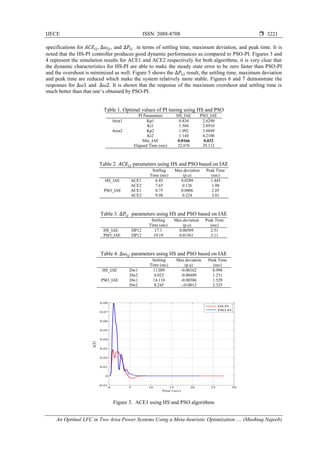
area1 and area 2 respectively. Table 1 shows the optimal values (𝐾𝑝 ,𝐾𝑖 ) of the optimization process obtained
by both algorithms using the objective function (IAE). Tables 2, 3, and 4 give the transient response
IJECE ISSN: 2088-8708 
An Optimal LFC in Two Area Power Systems Using a Meta-heuristic Optimization .... (Mushtaq Najeeb)
3221
specifications for 𝐴𝐶𝐸𝑖𝑗, ∆𝜔𝑖𝑗, and ∆𝑃𝑖𝑗 in terms of settling time, maximum deviation, and peak time. It is
noted that the HS-PI controller produces good dynamic performances as compared to PSO-PI. Figures 3 and
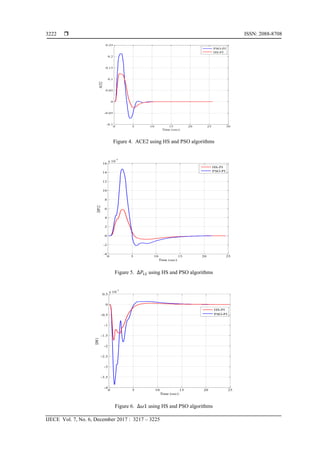
4 represent the simulation results for ACE1 and ACE2 respectively for both algorithms, it is very clear that
the dynamic characteristics for HS-PI are able to make the steady state error to be zero faster than PSO-PI
and the overshoot is minimized as well. Figure 5 shows the ∆𝑃12 result, the settling time, maximum deviation
and peak time are reduced which make the system relatively more stable. Figures 6 and 7 demonstrate the
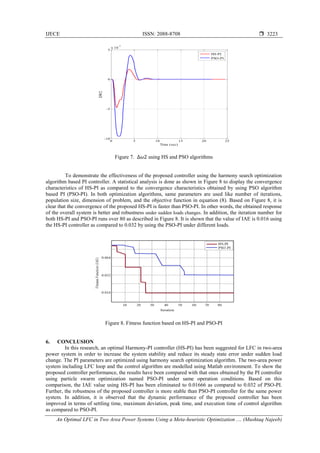
responses for ∆𝜔1 and ∆𝜔2. It is shown that the response of the maximum overshoot and settling time is
much better than that one’s obtained by PSO-PI.
Table 1. Optimal values of PI tuning using HS and PSO
PI Parameters HS_IAE PSO_IAE
Area1 Kp1 0.434 2.6290
Ki1 1.504 2.8910
Area2 Kp2 1.092 3.8849
Ki2 1.144 4.2106
Min_IAE 0.0166 0.032
Elapsed Time (sec) 22.676 29.112
Table 2. 𝐴𝐶𝐸𝑖𝑗 parameters using HS and PSO based on IAE
Settling
Time (sec)
Max.deviation
(p.u)
Peak Time
(sec)
HS_IAE ACE1 6.45 0.0289 1.445
ACE2 7.65 0.126 1.98
PSO_IAE ACE1 8.75 0.0806 2.05
ACE2 9.98 0.224 3.01
Table 3. ∆𝑃𝑖𝑗 parameters using HS and PSO based on IAE
Settling
Time (sec)
Max.deviation
(p.u)
Peak Time
(sec)
HS_IAE DP12 17.1 0.00589 2.51
PSO_IAE DP12 19.19 0.01561 3.11
Table 4. ∆𝜔𝑖𝑗 parameters using HS and PSO based on IAE
Settling
Time (sec)
Max.deviation
(p.u)
Peak Time
(sec)
HS_IAE Dw1 11.089 -0.00162 0.998
Dw2 6.023 -0.00489 1.231
PSO_IAE Dw1 14.118 -0.00386 1.529
Dw2 8.245 -.010012 2.325
Figure 3. ACE1 using HS and PSO algorithms
0 5 10 15 20 25 30
-0.01
0
0.01
0.02
0.03
0.04
0.05
0.06
0.07
0.08
Time (sec)
ACE1
HS-PI
PSO-PI
 ISSN: 2088-8708
IJECE Vol. 7, No. 6, December 2017 : 3217 – 3225
3222
Figure 4. ACE2 using HS and PSO algorithms
Figure 5. ∆𝑃12 using HS and PSO algorithms
Figure 6. ∆𝜔1 using HS and PSO algorithms
0 5 10 15 20 25 30
-0.1
-0.05
0
0.05
0.1
0.15
0.2
0.25
Time (sec)
ACE2
PSO-PI
HS-PI
0 5 10 15 20 25
-4
-2
0
2
4
6
8
10
12
14
16
x 10
-3
Time (sec)
DP12
HS-PI
PSO-PI
0 5 10 15 20 25
-4
-3.5
-3
-2.5
-2
-1.5
-1
-0.5
0
0.5
x 10
-3
Time (sec)
DW1
HS-PI
PSO-PI
IJECE ISSN: 2088-8708 
An Optimal LFC in Two Area Power Systems Using a Meta-heuristic Optimization .... (Mushtaq Najeeb)
3223
Figure 7. ∆𝜔2 using HS and PSO algorithms
To demonstrate the effectiveness of the proposed controller using the harmony search optimization
algorithm based PI controller. A statistical analysis is done as shown in Figure 8 to display the convergence
characteristics of HS-PI as compared to the convergence characteristics obtained by using PSO algorithm
based PI (PSO-PI). In both optimization algorithms, same parameters are used like number of iterations,
population size, dimension of problem, and the objective function in equation (8). Based on Figure 8, it is
clear that the convergence of the proposed HS-PI is faster than PSO-PI. In other words, the obtained response
of the overall system is better and robustness under sudden loads changes. In addition, the iteration number for
both HS-PI and PSO-PI runs over 80 as described in Figure 8. It is shown that the value of IAE is 0.016 using
the HS-PI controller as compared to 0.032 by using the PSO-PI under different loads.
Figure 8. Fitness function based on HS-PI and PSO-PI
6. CONCLUSION
In this research, an optimal Harmony-PI controller (HS-PI) has been suggested for LFC in two-area
power system in order to increase the system stability and reduce its steady state error under sudden load
change. The PI parameters are optimized using harmony search optimization algorithm. The two-area power
system including LFC loop and the control algorithm are modelled using Matlab environment. To show the
proposed controller performance, the results have been compared with that ones obtained by the PI controller
using particle swarm optimization named PSO-PI under same operation conditions. Based on this
comparison, the IAE value using HS-PI has been eliminated to 0.01666 as compared to 0.032 of PSO-PI.
Further, the robustness of the proposed controller is more stable than PSO-PI controller for the same power
system. In addition, it is observed that the dynamic performance of the proposed controller has been
improved in terms of settling time, maximum deviation, peak time, and execution time of control algorithm
as compared to PSO-PI.
0 5 10 15 20 25
-10
-5
0
5
x 10
-3
Time (sec)
DW2
HS-PI
PSO-PI
 ISSN: 2088-8708
IJECE Vol. 7, No. 6, December 2017 : 3217 – 3225
3224
REFERENCES
[1] J. Venkatachalam, et al., “A Particle Swarm Optimization Algorithm for Automatic Generation Control of Two
Area Interconnected Power System,” International Journal of Engineering Research  Technology, vol/issue: 2(6),
2013.
[2] M. Najeeb, et al., “PID Parameters Improvement for AGC in Three Parallel Connected power Systems,” The
National Conference for Postgraduate Research, Universiti Malaysia Pahang, vol. P075. pp. 544-551, 2016.
[3] Ibraheem, et al., “Recent philosophies of automatic generation control strategies in power systems,” IEEE
Transactions on Power Systems, vol/issue: 20(1), pp. 346–357, 2005.
[4] G. A. Salman, “Automatic Generation Control in Multi Area Interconnected Power System Using PID Controller
Based on GA and PSO,” Second Engineering Scientific Conference, College of Engineering, University of Diyala,
pp. 297-310, 2015.
[5] J. Venkatachalam, et al., “Automatic generation control of two area interconnected power system using particle
swarm optimization,” Journal of Electrical and Electronics Engineering, vol/issue: 6(1), pp. 28-36, 2013.
[6] S. Prakash, et al., “Load frequency control of three area interconnected hydro-thermal reheat power system using
artificial intelligence and PI controllers,” International Journal of Engineering, Science and Technology, vol/issue:
4(1), pp. 23-37, 2011.
[7] J. G. Ziegler and N. B. Nichols, “Optimum settings for automatic controllers,” Transactions of the ASME,
vol/issue: 64(8), pp. 759/768–759/768, 1942.
[8] T. C. Yang, et al., “Decentralized Power System load frequency control beyond the limit of diagonal dominance,”
International Journal of Electrical Power  Energy Systems, vol/issue: 24(3), pp. 173-184, 2002.
[9] V. Donde, et al., “Simulation and Optimization in an AGC System after Deregulation,” IEEE Transactions on
Power Systems, vol/issue: 16(3), pp. 481–489, 2001.
[10] C. H. Liang, et al., “Study of Differential Evolution for Optimal Reactive Power Dispatch,” IET Generation
Transmission and Distribution, vol/issue: 1(2), pp. 253-260, 2007.
[11] L. X. Long, et al., “A Bacterial Foraging Global Optimization Algorithm Based On the Particle Swarm
Optimization,” IEEE International Conference on Intelligent Computing and Intelligent Systems, vol. 2, pp. 22-27,
2010.
[12] A. M. Jadhav, et al., “Performance Verification of PID Controller in an Interconnected Power System Using
Particle Swarm Optimization,” 2nd
International Conference on Advances in Energy Engineering (ICAEE), Energy
Procedia, vol. 14, pp. 2075-2080, 2012.
[13] A. J. Sharmili, et al., “Particle Swarm Optimization based PID controller for two area Load Frequency Control
System,” International Journal of Engineering Research and General Science, vol/issue: 3(2), pp. 772-778, 2015.
[14] R. Chaudhary, et al., “A Novel Approach to PID Controller Design for Improvement of Transient Stability and
Voltage Regulation of Nonlinear Power System,” International Journal of Electrical and Computer Engineering
(IJECE), vol/issue: 6(5), pp. 2225-2238, 2016.
[15] N. R. Raju, et al., “Robustness Study of Fractional Order PID Controller Optimized by Particle Swarm
Optimization in AVR System,” International Journal of Electrical and Computer Engineering (IJECE), vol/issue:
6(5), pp. 2033-2040, 2016.
[16] M. Dorigo, et al., “Ant Colony optimization: artificial ants as a computational intelligence technique,” IEEE
Computational Intelligence Magazine, vol/issue: 1(4), pp. 28-39, 2007.
[17] V. Jain, et al., “Modeling and simulation of Load Frequency Control in Automatic Generation Control using
Genetic Algorithms Technique,” International Journal of Innovative Science, Engineering  Technology,
vol/issue: 1(8), pp. 356-362, 2014.
[18] G. Konar, et al., “Two Area Load Frequency Control Using GA Tuned PID Controller in Deregulated
Environment,” Proceedings of the International Multi Conference of Engineers and Computer Scientists, vol. 2, pp.
1-6, 2014.
[19] M. M. Ismail, et al., “Load Frequency Control Adaptation Using Artificial Intelligent Techniques for One and Two
Different Areas Power System,” International Journal of Control, Automation and Systems, vol/issue: 1(1), pp. 12-
23, 2012.
[20] Ganesh V., et al., “LQR Based Load Frequency Controller for Two Area Power System,” International Journal of
Advanced Research in Electrical, Electronics and Instrumentation Engineering, vol/issue: 1(4), pp. 262-269, 2012.
[21] M. Shahooth, et al., “An optimized PID parameters for LFC in interconnected power systems using MLSL
optimization algorithm,” ARPN Journal of Engineering and Applied Sciences, vol/issue: 11(19), pp. 11770-11781,
2016.
[22] M. Hojabri, et al., “An Overview on Microgrid Control Strategies,” International Journal of Engineering and
Advanced Technology, vol/issue: 4(5), pp. 93-98, 2015.
[23] Z. W. Geen, et al., “A New Heuristic Optimization Algorithm: Harmony Search,” Simulation, vol. 76, pp. 60- 69,
2001.
[24] H. Daniyal, et al., “An Efficient Control Implementation for Voltage Source Inverter based Harmony Search
Algorithm,” International Journal of Power Electronics and Drive Systems, vol/issue: 8(1), pp. 279-289, 2017.
[25] M. Mansor, et al., “An Intelligent Voltage Controller for a PV Inverter System using Simulated Annealing
Algorithm-based PI Tuning Approach,” Journal of Engineering and Applied Sciences, vol/issue: 12(3), pp. 660-
669, 2017.
IJECE ISSN: 2088-8708 
An Optimal LFC in Two Area Power Systems Using a Meta-heuristic Optimization .... (Mushtaq Najeeb)
3225
BIOGRAPHIES OF AUTHORS
Mushtaq Najeeb was born in 1982. He is received his Bachelor degree in Control Engineering
(2004) from University of Technology, Baghdad, Iraq. He also has got his Master degree in
electrical engineering (2012) from University Tenaga Nasional (UNITEN), Selangor, Malaysia.
From 2005 to 2009, he worked as laboratory assistant and tutor at University of Anbar, electrical
engineering department, Ramadi, Iraq. Later in 2012, he worked as a lecturer and the coordinator
of the same department. His research interests are renewable energy resources, control of power
electronics devices, microgrids systems, and optimization algorithms. He is a member of Iraqi
Engineers Union since 2005.
Dr. Muhamad Bin Mansor received his Bachelor of Electrical Engineering (Hons) from
Universiti Teknologi Malaysia, Master of Electrical Engineering Degrees in Electrical Power from
Universiti Tenaga Nasional, Malaysia, and Ph.D in Power Electronics from University of Malaya,
Malaysia in 2000, 2006 and 2012 respectively. He is currently a senior lecturer in the department
of Electrical Power, Universiti Tenaga Nasional (UNITEN), Malaysia. His research interests are
Power Electronics (Voltage Sags Compensator, solar, electric vehicle).
Ghassan Abdullah Salman was born in Diyala –Iraq 1983. He completed his B.Sc. Electrical
power and machines department Diyala University College of Engineering, Iraq in 2005, M. Sc.
(Power Systems) from university of technology-Baghdad in 2011. He has working as assistant
lecturer in Electrical power and machines department, College of Engineering, Diyala University.
His research interests are optimal power system, FACTS  Power Quality.

An Optimal LFC in Two-Area Power Systems Using a Meta-heuristic Optimization Algorithm

  • 1.
    International Journal ofElectrical and Computer Engineering (IJECE) Vol. 7, No. 6, December 2017, pp. 3217~3225 ISSN: 2088-8708, DOI: 10.11591/ijece.v7i6.pp3217-3225  3217 Journal homepage: http://iaesjournal.com/online/index.php/IJECE An Optimal LFC in Two-Area Power Systems Using a Meta-heuristic Optimization Algorithm Mushtaq Najeeb1 , Muhamad Mansor2 , Hameed Feyad3 , Esam Taha4 , Ghassan Abdullah5 1,3 Electrical Engineering Department, College of Engineering, University of Anbar, Ramadi, Iraq 2 Department of Electrical Power Engineering, Universiti Tenaga Nasional, Selangor, Malaysia 4 Computer and Information Technology Center, University of Anbar, Ramadi, Iraq 5 Electrical Power and Machines Department, Collage of Engineering, Diyala University, Iraq Article Info ABSTRACT Article history: Received Apr 5, 2017 Revised May 20, 2017 Accepted Jun 15, 2017 In this study, an optimal meta-heuristic optimization algorithm for load frequency control (LFC) is utilized in two-area power systems. This meta- heuristic algorithm is called harmony search (HS), it is used to tune PI controller parameters (𝐾𝑝, 𝐾𝑖) automatically. The developed controller (HS- PI) with LFC loop is very important to minimize the system frequency and keep the system power is maintained at scheduled values under sudden loads changes. Integral absolute error (IAE) is used as an objective function to enhance the overall system performance in terms of settling time, maximum deviation, and peak time. The two-area power systems and developed controller are modelled using MATLAB software (Simulink/Code). As a result, the developed control algorithm (HS-PI) is more robustness and efficient as compared to PSO-PI control algorithm under same operation conditions. Keyword: LFC Meta-heuristic optimization Algorithm (HS) Integral absolute error (IAE) MATLAB environment Copyright © 2017 Institute of Advanced Engineering and Science. All rights reserved. Corresponding Author: Mushtaq Najeeb, Electrical Engineering Department, College of Engineering, University of Anbar, Ramadi, Iraq. Email: eng.mushtaq2004@gmail.com 1. INTRODUCTION In parallel power systems operations, load frequency control is in reality one of the most important parts which used to minimize area frequency deviation and keep stable tie-line power [1]. The main matter is how to keep the balance between the active and reactive powers which are transported from the generators to utilizers during a wild grid. The balance between both the active and reactive powers at the two ends of the power system effects directly the frequency and the voltage magnitude at the load side. The objectives of load frequency control (LFC) are to minimize the transient deviations in these variables (area frequency and tie-line power interchange) and to ensure their steady state errors to be zeros [2]. The frequency is highly dependent on the active power while the voltage is highly dependent on the reactive power. In last decades, a lot of researchers are applied several strategies to give a solution for the load frequency control (LFC) problems [3],[4]. The performance of LFC depends on the feedback controller design in order to maintain the tie line power flow and the system frequency at their scheduled values [5]. The area control error (ACE) is very important part with the LFC loop which is considered as the control output [6]. The output error of ACE in each power system area demonstrates the relative error feedback in the frequency with respect to the flow of tie-line power. To design a proper controller to minimize the ACE value to be zero, PI controller has been used in different fields due to its simplicity. But, the big obstacle of PI controller is tuning its parameters (𝐾𝑝, 𝐾𝑖). The methods are used to tune (𝐾𝑝, 𝐾𝑖) parameters are the Ziegler Nichol’s method [7] and trial-and-error approach [8],[9], but these are not efficient with systems have
  • 2.
     ISSN: 2088-8708 IJECEVol. 7, No. 6, December 2017 : 3217 – 3225 3218 different load changes in term of multiple interconnected power systems. For this reason and according to the literature survey, Soft-computing techniques such as such as differential evolution [10], practical swarm optimizations [11]-[15], ant colony optimization [16], and genetic algorithms [17],[18] have been widely applied for PI controller tuning in parallel-interconnected power systems. This research presents an optimal load frequency control (LFC) using PI controller based on harmony search optimization (HS) technique for parallel two-area power system. The two-area power system and LFC loop including the proposed HS-PI controller are modelled using Matlab environment. The integral absolute error (IAE) function is used to determine its minimum value for a step load change. For a good dynamic performance, the robustness of the proposed HS-PI control algorithm is compared with the PI controller based particle swarm optimization (PSO) named PSO-PI controller in terms of time settling, maximum deviation, and peak time. 2. LFC SIMULINK MODEL WITH PROPOSED CONTROLLER The overall power system of two-area power systems including the LFC model and the PI controller is investigated as shown in Figure 1. Each power system has primary and secondary loops respectively and feedback controller. 𝑂𝑈𝑇1 and 𝑂𝑈𝑇2 are the control outputs of the proposed PI controllers respectively; 𝐷𝑃𝐿1and 𝐷𝑃𝐿2 are the disturbance load changes; 𝐷𝑊1and 𝐷𝑊2 are represented the frequency changes in each power system. The nominal parameters of the overall power system are given in [19]. An area control error (ACE) is used for each area to reduce its own value to be zero [20], which is defined as: 𝐴𝐶𝐸1 = 𝐵1∆𝜔1 + ∆𝑃12 (1) 𝐴𝐶𝐸2 = 𝐵2∆𝜔2 − ∆𝑃12 (2) where ∆𝑃12 represents the change in the tie line power plant, 𝐵1and 𝐵2 are the bias frequencies for each area, ∆𝜔1 and ∆𝜔2 represent the frequency deviation for each area. Kps1 ------------- (1+S Kps1) Δω1 Kps2 ------------- (1+S Kps2) 1 ------------- (1+S Tg1) 1 ------------ (1+S Tg2) 1 ------------ (1+S Tt1) 1 ------------ (1+S Tt2) 1 --- R1 1 ---- R2 B1 B2 Δω2 Optimal Values Optimal Values Ps1 ---- s DP12 ACE1 Area 1 Area 2 Primary Loop 1 Primary Loop 2 Secondary Loop 1 Secondary Loop 2 Ki Kp + ---- s HS_Algorithm Ki Kp + ---- s HS_Algorithm Kp Ki ACE2 ΔPL2 ΔPL1 OUT1 OUT2 Figure 1. LFC Simulink model with proposed controller PI controller is one of the popular feedback controller used with the load frequency control for providing an excellent control performance and higher stability. The transfer function of the PI consists of two basic parameters; Proportional (P) and Integral (I). According to [21] and [22], the typical transfer function of the classical PI controller in terms of Laplace domain is described below: 𝐺 𝑃𝐼𝐷(𝑠) = 𝑈(𝑠) 𝐸(𝑠) = 𝐾𝑝 + 𝐾 𝑖 𝑠 (3)
  • 3.
    IJECE ISSN: 2088-8708 An Optimal LFC in Two Area Power Systems Using a Meta-heuristic Optimization .... (Mushtaq Najeeb) 3219 where, 𝑈(𝑠)and 𝐸(𝑠)are the control signal and the error signal which is the difference between the input and the feedback correspondingly. 𝐾𝑝 is the proportional gain and 𝐾𝑖 is the integration gain. Moreover, the output value of the proposed PID controller is given below which generates the proper control signal to keep the system parameters within the nominal values; 𝑜𝑢𝑡(𝑡) = 𝐾𝑝 𝑒(𝑡) + 𝐾𝑖 ∫ 𝑒(𝑡)𝑑𝑡 𝑡 0 (4) where 𝑜𝑢𝑡(𝑡)and 𝑒(𝑡) are the control and tracking error signal which is in the form of time domain. For area1: 𝑜𝑢𝑡1(𝑡) = 𝐾𝑝1 𝐴𝐶𝐸1(𝑡) + 𝐾𝑖1 ∫ 𝐴𝐶𝐸1(𝑡)𝑑𝑡 𝑡 0 (5) For area2: 𝑜𝑢𝑡2(𝑡) = 𝐾𝑝2 𝐴𝐶𝐸2(𝑡) + 𝐾𝑖2 ∫ 𝐴𝐶𝐸2(𝑡)𝑑𝑡 𝑡 0 (6) 3. HS ALGORITHM CONCEPT Harmony search (HS) is a well-known meta-heuristic optimization algorithm inspired by the modern natural phenomena, which was proposed by [23]. The basic process of this algorithm is to produce music tunes through pitching the musical instruments in order to search for a harmony. For the harmony improvisation, musicians try various musical combinations stored in their memory to get an excellent quality. Meanwhile, it is similar to the optimization process by creating a new solution using an objective function in order to improve the quality of the generated solutions. In brief, the optimization process of the harmony search algorithm is shown in Figure 2 which can be concluded in five steps [24],[25]: (1) the HS algorithm parameters are initialized such as the harmony memory size (HMS) which is used to specify the solution vectors number, harmony memory considering rate (HMCR, its range between [0,1]) which is used for the solution vector improvement in the harmony memory as well as the pitch adjusting rate (PAR, its range between [0,1]), and the maximum number of improvisation (MaxI) is used to check the stopping criteria; (2) the harmony memory (HM) is initialized by generating a random set of solutions vectors which are identical to the harmony memory size (HMS); (3) A new solution (harmony) is produced in the improvisation process; (4) the harmony memory is updated to check the new generated solution either it is better or worse than the previous one; (5) the stopping criteria process is tested in this step to check whether the maximum iterations number is satisfied or not. If yes, the HS process will stop and the best selected solution ( 𝑙𝑎𝑡𝑒𝑠𝑡 𝑘 𝑝,𝑘𝑖) is returned back. Otherwise, the procedures in steps 3 and 4 are repeated respectively. Start Initialization the HS parameters (HMS, HMCR, PAR, MaxI) Harmony Memory (HM) Initialization New improvisation process (a new harmony improvised ) Update the Harmony Memory End No Yes Return the best solution found Satisfaction of stopping criteria Figure 2. Harmony search algorithm flowchart
  • 4.
     ISSN: 2088-8708 IJECEVol. 7, No. 6, December 2017 : 3217 – 3225 3220 4. HS IMPLEMENTATION TO OBTAIN OPTIMAL PI PARAMETERS In any optimization algorithm, the input vector formula to find the optimal solutions can be defined as; 𝑀𝑖𝑛. 𝑜𝑟 𝑀𝑎𝑥. = 𝑍(𝑘), 𝑘 𝑛 ∈ 𝑲 𝒏; (𝑛 = 1,2, … … . . 𝑀) (7) where 𝑍(𝑘) is the input vector to the optimization algorithm, 𝑘 𝑛 is the decision parameter, 𝑲 𝒏 is the lower and upper values of each decision parameter (𝐿 𝑘 𝑛 𝑲 𝒏 𝑈𝑘 𝑛 ), and 𝑀 is the total number of decision parameters. Based on equation (7), two decision parameters (𝑘 𝑝,𝑘𝑖) of the input vector 𝑍(𝑘) are used in this research to provide the optimal solutions from the HS optimization algorithm as shown in Figure 2. In addition, an objective function is required to evaluate the performance of the input vector 𝑍(𝑘). Therefore, the integral absolute error (IAE) shown below is applied as an optimization problem at the Simulink time. 𝐼𝐴𝐸 (𝑚𝑖𝑛. ) = ∫ |𝑒| 𝑇 0 𝑑𝑡 + ∫ |𝐴𝐶𝐸1 + 𝐴𝐶𝐸2|𝑑𝑡 𝑠𝑖𝑚𝑢𝑙𝑖𝑛𝑘 𝑡𝑖𝑚𝑒 0 (8) A more explanation of the optimization process for the harmony search algorithm based PI controller is presented as follows: Control flow of Harmony Search Algorithm based PI Controller: pseudo code Start program: Definition of 𝑖𝑛𝑝𝑢𝑡 𝑣𝑒𝑐𝑡𝑜𝑟 𝑓𝑜𝑟𝑚𝑢𝑙𝑎 = 𝑍(𝑘), 𝑘 𝑛 ∈ 𝑲 𝒏; (𝑛 = 1,2, … … . . 𝑀); Definition of HMS, HMCR, PAR, and MaxI; Definition the upper and lower boundaries of the decision parameters (𝑘 𝑝,𝑘𝑖); Harmony memory (HM) initialization; 𝒇𝒐𝒓 𝑖 ≤ 𝑀𝑎𝑥𝐼, if satisfied 𝒅𝒐 𝒇𝒐𝒓 𝑗 ≤ 𝑛𝑢𝑚𝑏𝑒𝑟 𝑜𝑓 decision parameters, if satisfied 𝒅𝒐 𝒊𝒇 HMCR 𝑟1, if satisfied 𝒅𝒐 Choose a decision parameter from the HM; 𝑘′ = [𝑘 𝑝 1 … 𝑘 𝑝 𝐻𝑀𝑆 𝑜𝑟 𝑘𝑖 1 … 𝑘𝑖 𝐻𝑀𝑆 ]; 𝒊𝒇 PAR 𝑟2, if satisfied 𝒅𝒐 Adjust the decision parameter by; 𝑘 𝑛𝑒𝑤 ′ = (𝑘selected ′ + 𝑟𝑎𝑛𝑑); 𝒆𝒏𝒅 𝒆𝒍𝒔𝒆 Choose a new random decision parameter by; 𝑘′ = 𝑟𝑎𝑛𝑑 ∗ [(𝑢𝑝𝑝𝑒𝑟 − 𝑙𝑜𝑤𝑒𝑟) + 𝑙𝑜𝑤𝑒𝑟]; 𝒆𝒏𝒅 𝒆𝒏𝒅 𝒇𝒐𝒓 𝒋 𝒊𝒇 the fitness value 𝑓(𝑘′) of the new solution vector the worst fitness value stored in the HM, 𝒅𝒐 Accept the new solution vector and replaced by the old one, then added it to the HM; 𝒆𝒏𝒅 𝒆𝒏𝒅 𝒇𝒐𝒓 𝒊 Return back the best solution found (𝑙𝑎𝑡𝑒𝑠𝑡 𝑘 𝑝,𝑘𝑖); End Program discussion). 5. RESULTS AND DISCUSSION The objective of this study is to test the proposed HS-PI control algorithm for LFC in two-area power system and compared it with the results obtained by PSO-PI. MATLAB program has been used to model the overall system shown in Figure 1. To check the effectiveness and robustness of the proposed control algorithm, the step load disturbance 𝐷𝑃𝐿1 is selected to be 0.2 𝑝𝑢 while 𝐷𝑃𝐿2 is 0.3 𝑝𝑢 for both area1 and area 2 respectively. Table 1 shows the optimal values (𝐾𝑝 ,𝐾𝑖 ) of the optimization process obtained by both algorithms using the objective function (IAE). Tables 2, 3, and 4 give the transient response
  • 5.
    IJECE ISSN: 2088-8708 An Optimal LFC in Two Area Power Systems Using a Meta-heuristic Optimization .... (Mushtaq Najeeb) 3221 specifications for 𝐴𝐶𝐸𝑖𝑗, ∆𝜔𝑖𝑗, and ∆𝑃𝑖𝑗 in terms of settling time, maximum deviation, and peak time. It is noted that the HS-PI controller produces good dynamic performances as compared to PSO-PI. Figures 3 and 4 represent the simulation results for ACE1 and ACE2 respectively for both algorithms, it is very clear that the dynamic characteristics for HS-PI are able to make the steady state error to be zero faster than PSO-PI and the overshoot is minimized as well. Figure 5 shows the ∆𝑃12 result, the settling time, maximum deviation and peak time are reduced which make the system relatively more stable. Figures 6 and 7 demonstrate the responses for ∆𝜔1 and ∆𝜔2. It is shown that the response of the maximum overshoot and settling time is much better than that one’s obtained by PSO-PI. Table 1. Optimal values of PI tuning using HS and PSO PI Parameters HS_IAE PSO_IAE Area1 Kp1 0.434 2.6290 Ki1 1.504 2.8910 Area2 Kp2 1.092 3.8849 Ki2 1.144 4.2106 Min_IAE 0.0166 0.032 Elapsed Time (sec) 22.676 29.112 Table 2. 𝐴𝐶𝐸𝑖𝑗 parameters using HS and PSO based on IAE Settling Time (sec) Max.deviation (p.u) Peak Time (sec) HS_IAE ACE1 6.45 0.0289 1.445 ACE2 7.65 0.126 1.98 PSO_IAE ACE1 8.75 0.0806 2.05 ACE2 9.98 0.224 3.01 Table 3. ∆𝑃𝑖𝑗 parameters using HS and PSO based on IAE Settling Time (sec) Max.deviation (p.u) Peak Time (sec) HS_IAE DP12 17.1 0.00589 2.51 PSO_IAE DP12 19.19 0.01561 3.11 Table 4. ∆𝜔𝑖𝑗 parameters using HS and PSO based on IAE Settling Time (sec) Max.deviation (p.u) Peak Time (sec) HS_IAE Dw1 11.089 -0.00162 0.998 Dw2 6.023 -0.00489 1.231 PSO_IAE Dw1 14.118 -0.00386 1.529 Dw2 8.245 -.010012 2.325 Figure 3. ACE1 using HS and PSO algorithms 0 5 10 15 20 25 30 -0.01 0 0.01 0.02 0.03 0.04 0.05 0.06 0.07 0.08 Time (sec) ACE1 HS-PI PSO-PI
  • 6.
     ISSN: 2088-8708 IJECEVol. 7, No. 6, December 2017 : 3217 – 3225 3222 Figure 4. ACE2 using HS and PSO algorithms Figure 5. ∆𝑃12 using HS and PSO algorithms Figure 6. ∆𝜔1 using HS and PSO algorithms 0 5 10 15 20 25 30 -0.1 -0.05 0 0.05 0.1 0.15 0.2 0.25 Time (sec) ACE2 PSO-PI HS-PI 0 5 10 15 20 25 -4 -2 0 2 4 6 8 10 12 14 16 x 10 -3 Time (sec) DP12 HS-PI PSO-PI 0 5 10 15 20 25 -4 -3.5 -3 -2.5 -2 -1.5 -1 -0.5 0 0.5 x 10 -3 Time (sec) DW1 HS-PI PSO-PI
  • 7.
    IJECE ISSN: 2088-8708 An Optimal LFC in Two Area Power Systems Using a Meta-heuristic Optimization .... (Mushtaq Najeeb) 3223 Figure 7. ∆𝜔2 using HS and PSO algorithms To demonstrate the effectiveness of the proposed controller using the harmony search optimization algorithm based PI controller. A statistical analysis is done as shown in Figure 8 to display the convergence characteristics of HS-PI as compared to the convergence characteristics obtained by using PSO algorithm based PI (PSO-PI). In both optimization algorithms, same parameters are used like number of iterations, population size, dimension of problem, and the objective function in equation (8). Based on Figure 8, it is clear that the convergence of the proposed HS-PI is faster than PSO-PI. In other words, the obtained response of the overall system is better and robustness under sudden loads changes. In addition, the iteration number for both HS-PI and PSO-PI runs over 80 as described in Figure 8. It is shown that the value of IAE is 0.016 using the HS-PI controller as compared to 0.032 by using the PSO-PI under different loads. Figure 8. Fitness function based on HS-PI and PSO-PI 6. CONCLUSION In this research, an optimal Harmony-PI controller (HS-PI) has been suggested for LFC in two-area power system in order to increase the system stability and reduce its steady state error under sudden load change. The PI parameters are optimized using harmony search optimization algorithm. The two-area power system including LFC loop and the control algorithm are modelled using Matlab environment. To show the proposed controller performance, the results have been compared with that ones obtained by the PI controller using particle swarm optimization named PSO-PI under same operation conditions. Based on this comparison, the IAE value using HS-PI has been eliminated to 0.01666 as compared to 0.032 of PSO-PI. Further, the robustness of the proposed controller is more stable than PSO-PI controller for the same power system. In addition, it is observed that the dynamic performance of the proposed controller has been improved in terms of settling time, maximum deviation, peak time, and execution time of control algorithm as compared to PSO-PI. 0 5 10 15 20 25 -10 -5 0 5 x 10 -3 Time (sec) DW2 HS-PI PSO-PI
  • 8.
     ISSN: 2088-8708 IJECEVol. 7, No. 6, December 2017 : 3217 – 3225 3224 REFERENCES [1] J. Venkatachalam, et al., “A Particle Swarm Optimization Algorithm for Automatic Generation Control of Two Area Interconnected Power System,” International Journal of Engineering Research Technology, vol/issue: 2(6), 2013. [2] M. Najeeb, et al., “PID Parameters Improvement for AGC in Three Parallel Connected power Systems,” The National Conference for Postgraduate Research, Universiti Malaysia Pahang, vol. P075. pp. 544-551, 2016. [3] Ibraheem, et al., “Recent philosophies of automatic generation control strategies in power systems,” IEEE Transactions on Power Systems, vol/issue: 20(1), pp. 346–357, 2005. [4] G. A. Salman, “Automatic Generation Control in Multi Area Interconnected Power System Using PID Controller Based on GA and PSO,” Second Engineering Scientific Conference, College of Engineering, University of Diyala, pp. 297-310, 2015. [5] J. Venkatachalam, et al., “Automatic generation control of two area interconnected power system using particle swarm optimization,” Journal of Electrical and Electronics Engineering, vol/issue: 6(1), pp. 28-36, 2013. [6] S. Prakash, et al., “Load frequency control of three area interconnected hydro-thermal reheat power system using artificial intelligence and PI controllers,” International Journal of Engineering, Science and Technology, vol/issue: 4(1), pp. 23-37, 2011. [7] J. G. Ziegler and N. B. Nichols, “Optimum settings for automatic controllers,” Transactions of the ASME, vol/issue: 64(8), pp. 759/768–759/768, 1942. [8] T. C. Yang, et al., “Decentralized Power System load frequency control beyond the limit of diagonal dominance,” International Journal of Electrical Power Energy Systems, vol/issue: 24(3), pp. 173-184, 2002. [9] V. Donde, et al., “Simulation and Optimization in an AGC System after Deregulation,” IEEE Transactions on Power Systems, vol/issue: 16(3), pp. 481–489, 2001. [10] C. H. Liang, et al., “Study of Differential Evolution for Optimal Reactive Power Dispatch,” IET Generation Transmission and Distribution, vol/issue: 1(2), pp. 253-260, 2007. [11] L. X. Long, et al., “A Bacterial Foraging Global Optimization Algorithm Based On the Particle Swarm Optimization,” IEEE International Conference on Intelligent Computing and Intelligent Systems, vol. 2, pp. 22-27, 2010. [12] A. M. Jadhav, et al., “Performance Verification of PID Controller in an Interconnected Power System Using Particle Swarm Optimization,” 2nd International Conference on Advances in Energy Engineering (ICAEE), Energy Procedia, vol. 14, pp. 2075-2080, 2012. [13] A. J. Sharmili, et al., “Particle Swarm Optimization based PID controller for two area Load Frequency Control System,” International Journal of Engineering Research and General Science, vol/issue: 3(2), pp. 772-778, 2015. [14] R. Chaudhary, et al., “A Novel Approach to PID Controller Design for Improvement of Transient Stability and Voltage Regulation of Nonlinear Power System,” International Journal of Electrical and Computer Engineering (IJECE), vol/issue: 6(5), pp. 2225-2238, 2016. [15] N. R. Raju, et al., “Robustness Study of Fractional Order PID Controller Optimized by Particle Swarm Optimization in AVR System,” International Journal of Electrical and Computer Engineering (IJECE), vol/issue: 6(5), pp. 2033-2040, 2016. [16] M. Dorigo, et al., “Ant Colony optimization: artificial ants as a computational intelligence technique,” IEEE Computational Intelligence Magazine, vol/issue: 1(4), pp. 28-39, 2007. [17] V. Jain, et al., “Modeling and simulation of Load Frequency Control in Automatic Generation Control using Genetic Algorithms Technique,” International Journal of Innovative Science, Engineering Technology, vol/issue: 1(8), pp. 356-362, 2014. [18] G. Konar, et al., “Two Area Load Frequency Control Using GA Tuned PID Controller in Deregulated Environment,” Proceedings of the International Multi Conference of Engineers and Computer Scientists, vol. 2, pp. 1-6, 2014. [19] M. M. Ismail, et al., “Load Frequency Control Adaptation Using Artificial Intelligent Techniques for One and Two Different Areas Power System,” International Journal of Control, Automation and Systems, vol/issue: 1(1), pp. 12- 23, 2012. [20] Ganesh V., et al., “LQR Based Load Frequency Controller for Two Area Power System,” International Journal of Advanced Research in Electrical, Electronics and Instrumentation Engineering, vol/issue: 1(4), pp. 262-269, 2012. [21] M. Shahooth, et al., “An optimized PID parameters for LFC in interconnected power systems using MLSL optimization algorithm,” ARPN Journal of Engineering and Applied Sciences, vol/issue: 11(19), pp. 11770-11781, 2016. [22] M. Hojabri, et al., “An Overview on Microgrid Control Strategies,” International Journal of Engineering and Advanced Technology, vol/issue: 4(5), pp. 93-98, 2015. [23] Z. W. Geen, et al., “A New Heuristic Optimization Algorithm: Harmony Search,” Simulation, vol. 76, pp. 60- 69, 2001. [24] H. Daniyal, et al., “An Efficient Control Implementation for Voltage Source Inverter based Harmony Search Algorithm,” International Journal of Power Electronics and Drive Systems, vol/issue: 8(1), pp. 279-289, 2017. [25] M. Mansor, et al., “An Intelligent Voltage Controller for a PV Inverter System using Simulated Annealing Algorithm-based PI Tuning Approach,” Journal of Engineering and Applied Sciences, vol/issue: 12(3), pp. 660- 669, 2017.
  • 9.
    IJECE ISSN: 2088-8708 An Optimal LFC in Two Area Power Systems Using a Meta-heuristic Optimization .... (Mushtaq Najeeb) 3225 BIOGRAPHIES OF AUTHORS Mushtaq Najeeb was born in 1982. He is received his Bachelor degree in Control Engineering (2004) from University of Technology, Baghdad, Iraq. He also has got his Master degree in electrical engineering (2012) from University Tenaga Nasional (UNITEN), Selangor, Malaysia. From 2005 to 2009, he worked as laboratory assistant and tutor at University of Anbar, electrical engineering department, Ramadi, Iraq. Later in 2012, he worked as a lecturer and the coordinator of the same department. His research interests are renewable energy resources, control of power electronics devices, microgrids systems, and optimization algorithms. He is a member of Iraqi Engineers Union since 2005. Dr. Muhamad Bin Mansor received his Bachelor of Electrical Engineering (Hons) from Universiti Teknologi Malaysia, Master of Electrical Engineering Degrees in Electrical Power from Universiti Tenaga Nasional, Malaysia, and Ph.D in Power Electronics from University of Malaya, Malaysia in 2000, 2006 and 2012 respectively. He is currently a senior lecturer in the department of Electrical Power, Universiti Tenaga Nasional (UNITEN), Malaysia. His research interests are Power Electronics (Voltage Sags Compensator, solar, electric vehicle). Ghassan Abdullah Salman was born in Diyala –Iraq 1983. He completed his B.Sc. Electrical power and machines department Diyala University College of Engineering, Iraq in 2005, M. Sc. (Power Systems) from university of technology-Baghdad in 2011. He has working as assistant lecturer in Electrical power and machines department, College of Engineering, Diyala University. His research interests are optimal power system, FACTS Power Quality.