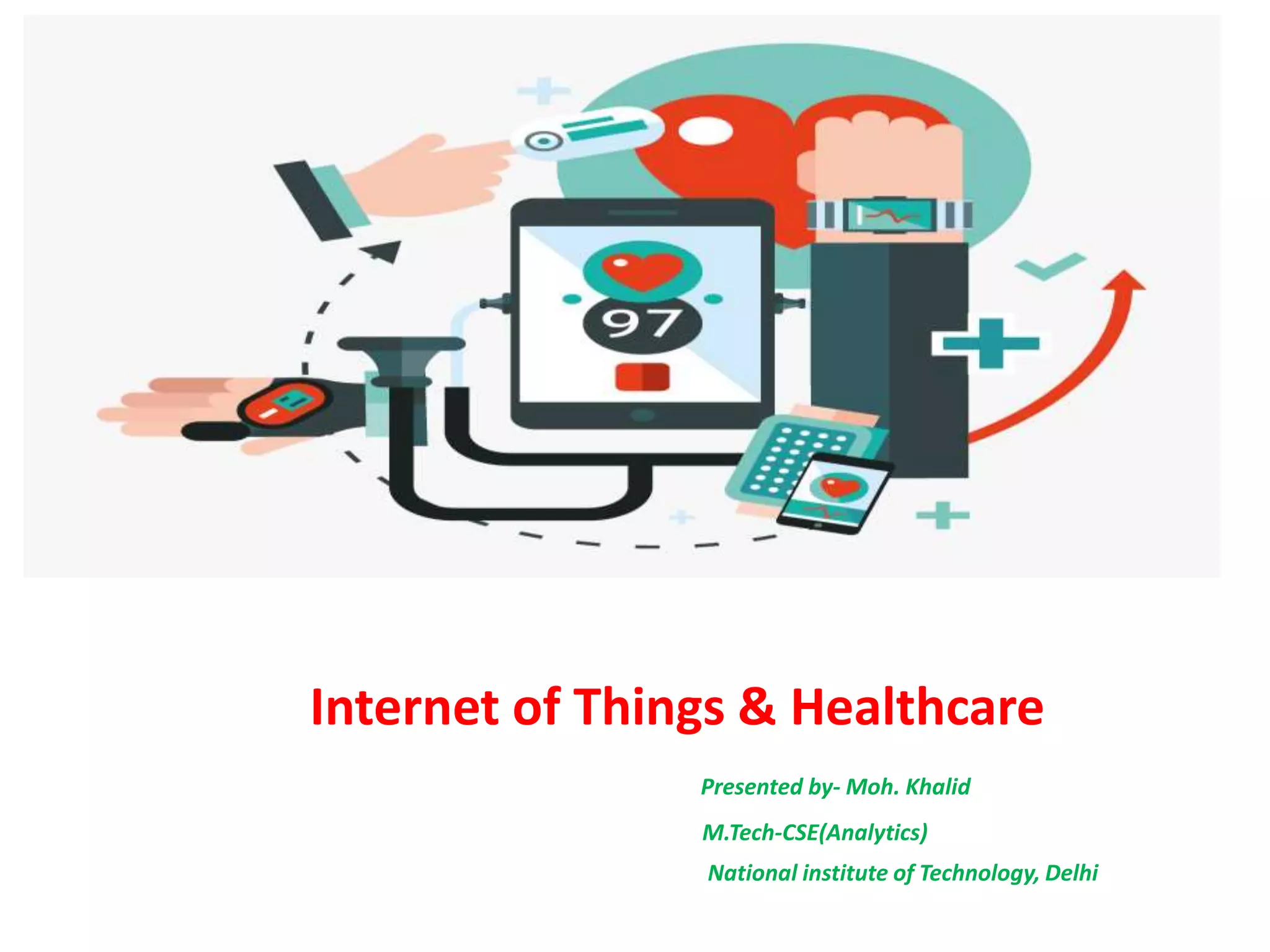
Internet of Things & Healthcare
Presented by- Moh. Khalid
M.Tech-CSE(Analytics)
National institute of Technology, Delhi
Plan of Presentation
 Introduction
 Dimensions of Internet of things.
 7 Vs in IoT
 Healthcare networks
 Healthcare and healthcare technologies.
 Healthcare security
 Healthcare services
 Healthcare applications
 Advantage and disadvantage
 Scope
 Conclusion
 References
Introduction
 The Internet of things describe the network of physical object – ”things”
that are embedded with sensors , software , and other technologies for
purpose of connecting and exchanging data with other devices and systems
over the internet.
 It lead s to an exchange of data between all things, and bring users
information in a more secure way .
 Medical care and health care are represent one of the most attractive
application areas for Internet of things.
 In health care Internet of Things device collects and transfer health data:
blood pressure, oxygen and blood sugar level, and weight and ECGs.
Dimensions of internet of things
Figure : reference [4]
7 Vs of IoT
Figure : reference [4]
Healthcare networks
 Topology: Physical configurations , application scenarios , activity and use-
case.
 Architecture : Software organization of the system as a whole and
hierarchical model reflecting.
 Framework: Library framework , and environment.
Topology
 It refers to the arrangement of different element of an IoT healthcare
network and indicates representative scenarios of seamless healthcare
environment.
Figure: topology with an intelligent healthcare gateway[1]
Architecture
 Architecture refers to an outline for the specification of
the IoThNet’s physical elements , their functional
organization , and its working principles and techniques.
Figure: Architecture [1]
Platform
 Platform refers to both the network platform model and the computing
platform.
 Framework shows a systematic hierarchical model of how caregivers or
agents can access various database from the application layer with the
help of support layer.
 There are basically four layer in framework
1. Accessing layer
2. Business implementation layer
3. Support layer
4. Data persistent layer
Healthcare Technology
 Cloud computing.
 Grid Computing.
 Big Data.
 Networks.
 Ambient intelligence.
 Augmented Reality.
Healthcare security
 Confidentiality
 Integrity
 Authentication
 Availability
 Data freshness
 Non-Repudiation
 Authorization
 Resiliency
 Interoperability
 Privacy
Healthcare Services
 Ambient assisted living
 Internet of m-health
 Adverse drug reaction
 Community health
 Children health information
 Indirect emergency healthcare
Healthcare Applications
 Glucose level sensing
 Blood pressure monitoring
 Body temperature monitoring
 Oxygen saturation monitoring
 ECG monitoring
 Wheelchair management
 Healthcare solutions using smart phone
Advantage
 Coast reduction: It enables patient monitoring in real time , thus
significantly cutting down unnecessary visits to doctors , hospitals stays
and readmission
 Improved treatment: It enables physician to make evidence-based
informed decisions and bring absolute transparency.
 Faster disease diagnosis: Continuous patient monitoring and real time
data helps in diagnosing diseases at an early stage or even before the
disease based on symptoms
 Proactive treatment: Continuous health monitoring opens doors for
providing proactive medical treatment.
Disadvantage
 Privacy: As we know system get hacked . Lots of attention will need to be
focused on data security.
 Unauthorized access: There is a chance that dishonest person can access
and realize some cruel intention.
 Global healthcare regulation: There are some guidelines that must be
strictly followed by governmental medical establishments integrating the
IoT in their workflow
Scope
Healthcare is getting smarter with tech innovations — from robots-surgeons to
smart hospitals. A lot of hospitals have already started investing money in
technology adoption. To help doctors and patients, the medical IoT is being
actively integrated into hardware and software for healthcare.
Technologies that use data from sensors offer a lot of benefits on all levels,
starting from in-patient treatment and health condition monitoring to disease
prevention and early diagnosis. IoT healthcare software can gather data from
patients and process it automatically, detecting precursors of disease and helping
to prevent its progression in the early stages.
Conclusion:
 The Internet of things changed the healthcare industry ,
increasing efficiency, lowering costs and putting the focus
back on better patient care.
 Cooperation and collaboration between vendors is essential
for a secure future internet of thing.
 The main benefits of autonomous capabilities in the future
internet of things is to extend and compliment human
performance.
 As the number of device continues to increase more
automation required for both the consumer and industrial
environment.
References:
 S. M. R. Islam, D. Kwak, M. H. Kabir, M. Hossain and K.
Kwak, "The Internet of Things for Health Care: A
Comprehensive Survey," in IEEE Access, vol. 3, pp. 678-
708, 2015, doi: 10.1109/ACCESS.2015.2437951.
 S. B. Baker, W. Xiang and I. Atkinson, "Internet of Things
for Smart Healthcare: Technologies, Challenges, and
Opportunities," in IEEE Access, vol. 5, pp. 26521-26544,
2017, doi: 10.1109/ACCESS.2017.2775180.
 K. E. Jeon, J. She, P. Soonsawad and P. C. Ng, "BLE Beacons
for Internet of Things Applications: Survey, Challenges, and
Opportunities," in IEEE Internet of Things Journal, vol. 5,
no. 2, pp. 811-828, April 2018, doi:
10.1109/JIOT.2017.2788449.
References:
 https://www.google.com/search?q=7+Vs+of+iot&tbm=isch&v
ed=2ahUKEwjb9MDY58btAhXSjuYKHftzAM8Q2-
cCegQIABAA&oq=7+VsQsQM6CAgAELEDEIMBOgIIADoECAAQ
QzoGCAAQBRAeOgQIABAYUPweWOuPAWD8lQFoAHAAeASAA
bwFiAGCJpIBDTAuNy40LjIuMi4xLjGYAQCgAQGqAQtnd3Mtd2l
6LWltZ7ABAMABAQ&sclient=img&ei=ONzTX9v4KtKdmgf754H
4DA&bih=630&biw=1294&client=ubuntu&hs=a8X#imgrc=BJo
SQleF_Ti9ZM
Thankyou

Internet of things & healthcare

  • 1.
    Internet of Things& Healthcare Presented by- Moh. Khalid M.Tech-CSE(Analytics) National institute of Technology, Delhi
  • 2.
    Plan of Presentation Introduction  Dimensions of Internet of things.  7 Vs in IoT  Healthcare networks  Healthcare and healthcare technologies.  Healthcare security  Healthcare services  Healthcare applications  Advantage and disadvantage  Scope  Conclusion  References
  • 3.
    Introduction  The Internetof things describe the network of physical object – ”things” that are embedded with sensors , software , and other technologies for purpose of connecting and exchanging data with other devices and systems over the internet.  It lead s to an exchange of data between all things, and bring users information in a more secure way .  Medical care and health care are represent one of the most attractive application areas for Internet of things.  In health care Internet of Things device collects and transfer health data: blood pressure, oxygen and blood sugar level, and weight and ECGs.
  • 4.
    Dimensions of internetof things Figure : reference [4]
  • 5.
    7 Vs ofIoT Figure : reference [4]
  • 6.
    Healthcare networks  Topology:Physical configurations , application scenarios , activity and use- case.  Architecture : Software organization of the system as a whole and hierarchical model reflecting.  Framework: Library framework , and environment.
  • 7.
    Topology  It refersto the arrangement of different element of an IoT healthcare network and indicates representative scenarios of seamless healthcare environment. Figure: topology with an intelligent healthcare gateway[1]
  • 8.
    Architecture  Architecture refersto an outline for the specification of the IoThNet’s physical elements , their functional organization , and its working principles and techniques. Figure: Architecture [1]
  • 9.
    Platform  Platform refersto both the network platform model and the computing platform.  Framework shows a systematic hierarchical model of how caregivers or agents can access various database from the application layer with the help of support layer.  There are basically four layer in framework 1. Accessing layer 2. Business implementation layer 3. Support layer 4. Data persistent layer
  • 10.
    Healthcare Technology  Cloudcomputing.  Grid Computing.  Big Data.  Networks.  Ambient intelligence.  Augmented Reality.
  • 11.
    Healthcare security  Confidentiality Integrity  Authentication  Availability  Data freshness  Non-Repudiation  Authorization  Resiliency  Interoperability  Privacy
  • 12.
    Healthcare Services  Ambientassisted living  Internet of m-health  Adverse drug reaction  Community health  Children health information  Indirect emergency healthcare
  • 13.
    Healthcare Applications  Glucoselevel sensing  Blood pressure monitoring  Body temperature monitoring  Oxygen saturation monitoring  ECG monitoring  Wheelchair management  Healthcare solutions using smart phone
  • 14.
    Advantage  Coast reduction:It enables patient monitoring in real time , thus significantly cutting down unnecessary visits to doctors , hospitals stays and readmission  Improved treatment: It enables physician to make evidence-based informed decisions and bring absolute transparency.  Faster disease diagnosis: Continuous patient monitoring and real time data helps in diagnosing diseases at an early stage or even before the disease based on symptoms  Proactive treatment: Continuous health monitoring opens doors for providing proactive medical treatment.
  • 15.
    Disadvantage  Privacy: Aswe know system get hacked . Lots of attention will need to be focused on data security.  Unauthorized access: There is a chance that dishonest person can access and realize some cruel intention.  Global healthcare regulation: There are some guidelines that must be strictly followed by governmental medical establishments integrating the IoT in their workflow
  • 16.
    Scope Healthcare is gettingsmarter with tech innovations — from robots-surgeons to smart hospitals. A lot of hospitals have already started investing money in technology adoption. To help doctors and patients, the medical IoT is being actively integrated into hardware and software for healthcare. Technologies that use data from sensors offer a lot of benefits on all levels, starting from in-patient treatment and health condition monitoring to disease prevention and early diagnosis. IoT healthcare software can gather data from patients and process it automatically, detecting precursors of disease and helping to prevent its progression in the early stages.
  • 17.
    Conclusion:  The Internetof things changed the healthcare industry , increasing efficiency, lowering costs and putting the focus back on better patient care.  Cooperation and collaboration between vendors is essential for a secure future internet of thing.  The main benefits of autonomous capabilities in the future internet of things is to extend and compliment human performance.  As the number of device continues to increase more automation required for both the consumer and industrial environment.
  • 18.
    References:  S. M.R. Islam, D. Kwak, M. H. Kabir, M. Hossain and K. Kwak, "The Internet of Things for Health Care: A Comprehensive Survey," in IEEE Access, vol. 3, pp. 678- 708, 2015, doi: 10.1109/ACCESS.2015.2437951.  S. B. Baker, W. Xiang and I. Atkinson, "Internet of Things for Smart Healthcare: Technologies, Challenges, and Opportunities," in IEEE Access, vol. 5, pp. 26521-26544, 2017, doi: 10.1109/ACCESS.2017.2775180.  K. E. Jeon, J. She, P. Soonsawad and P. C. Ng, "BLE Beacons for Internet of Things Applications: Survey, Challenges, and Opportunities," in IEEE Internet of Things Journal, vol. 5, no. 2, pp. 811-828, April 2018, doi: 10.1109/JIOT.2017.2788449.
  • 19.
  • 20.