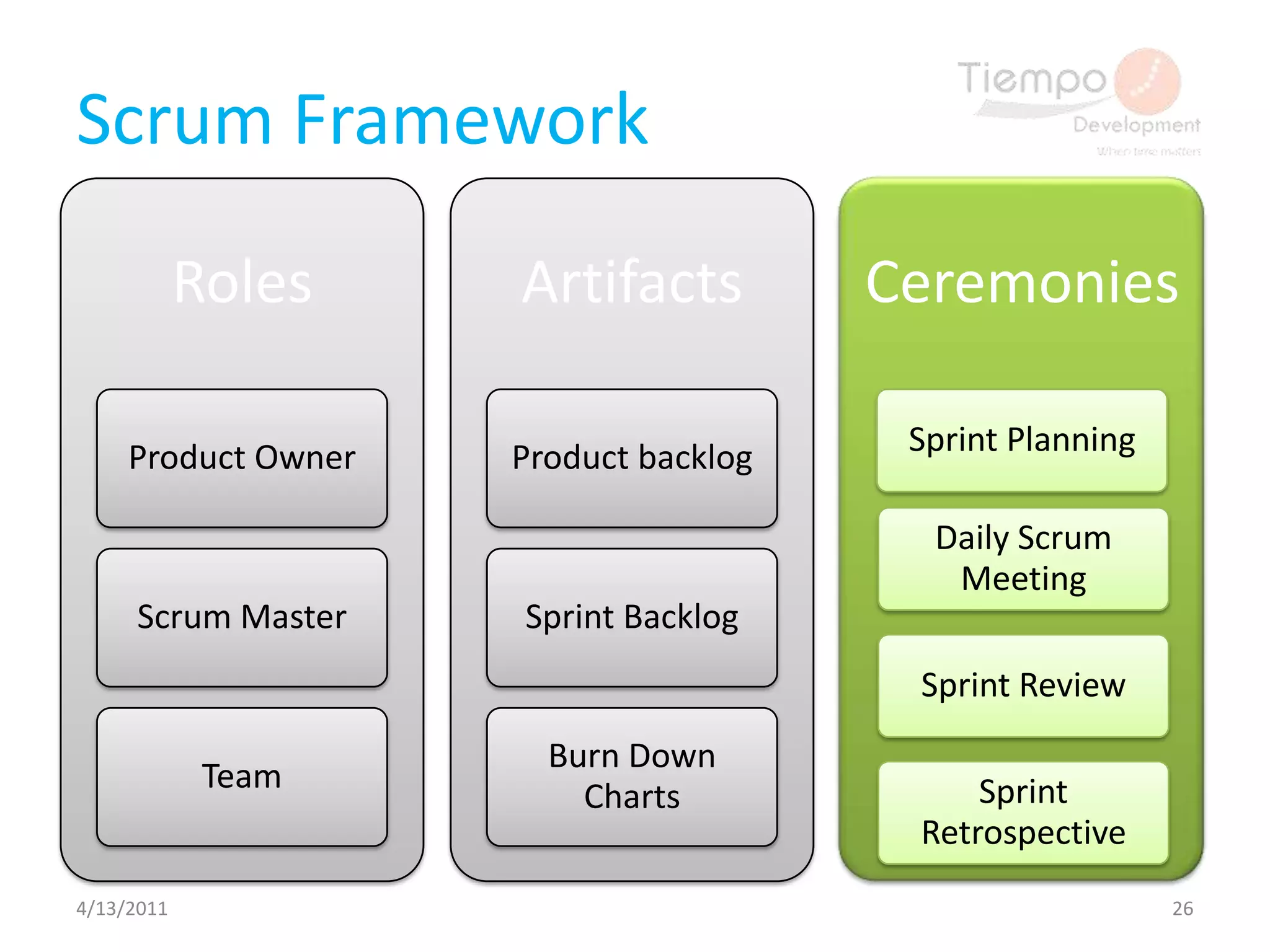
An Introduction to SCRUMManuel BernalDevelopment ManagerTiempo Development, LLCPh: +1(602)910-4647 • Cell: +1 521(662)290-0854Email: mbernal@tiempodevelopment.com4/13/20111© 2010- Tiempo Development, LLC.  all Rights Reserved
4/13/20112“The only constant is change”Jack Welch, Former GE CEO
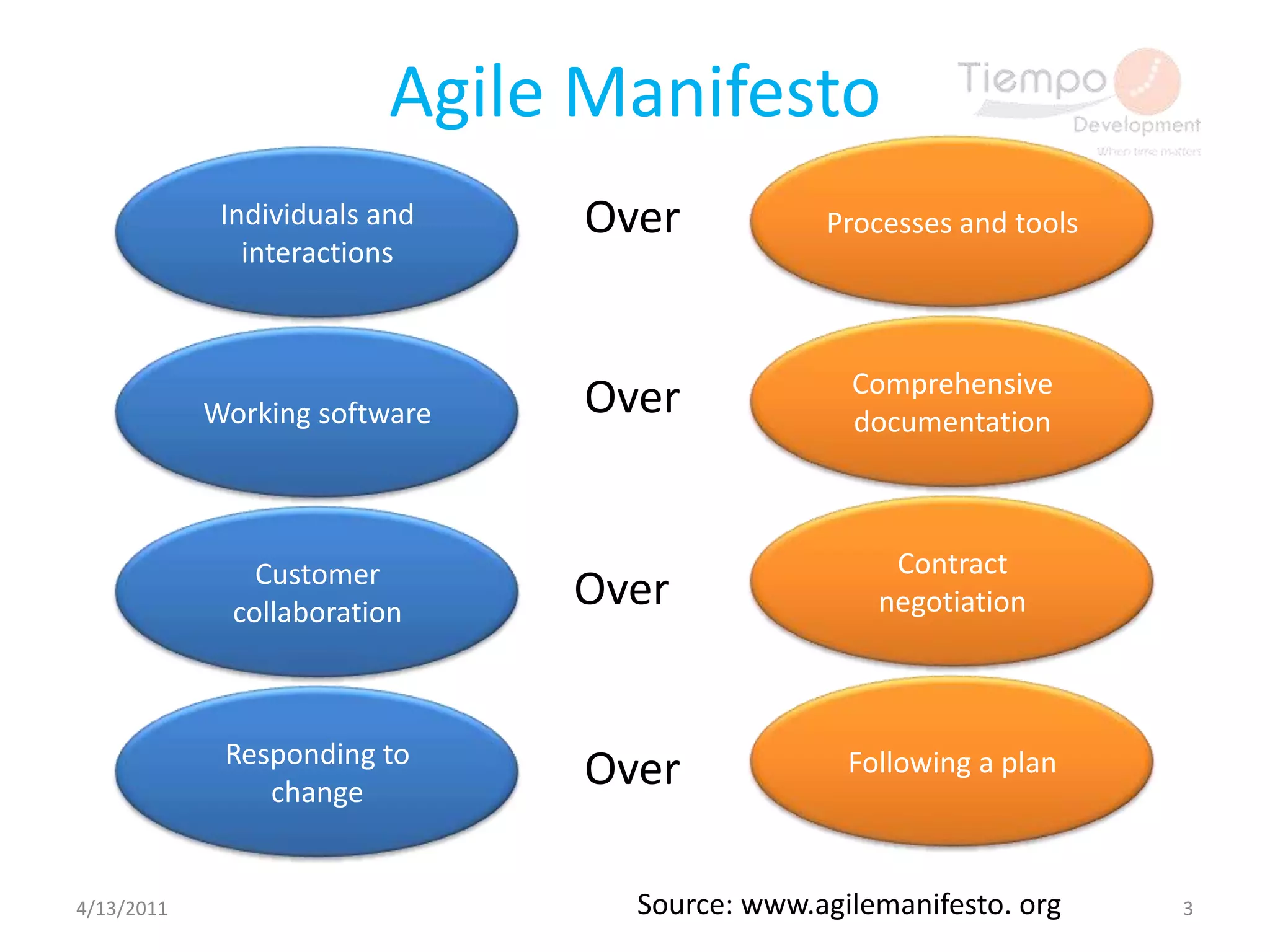
Agile Manifesto4/13/20113Processes and toolsIndividuals and interactionsOverComprehensive documentationWorking software OverContract negotiationCustomer collaboration OverFollowing a planResponding to change OverSource: www.agilemanifesto. org
Agile PrinciplesWelcome changeOur project is constantly changingOptimize the project around that environmentWorking software is the primary measure of progressNothing is complete until we have working software“Just Enough” Process and ArtifactsSufficient to achieve iteration goals and readily maintain the resultsSelf-Organizing TeamsThe team actively participates in managing the iterationTeams develop low level plans to achieve iteration goalsKnowledge transfer via conversation . . .Is the most effective communication method, written words / Models leave too much open to interpretationCollective Ownership4/13/20114Source: Scaling Software Agility – Best Practices for Large Enterprises by Dean Leffingwell
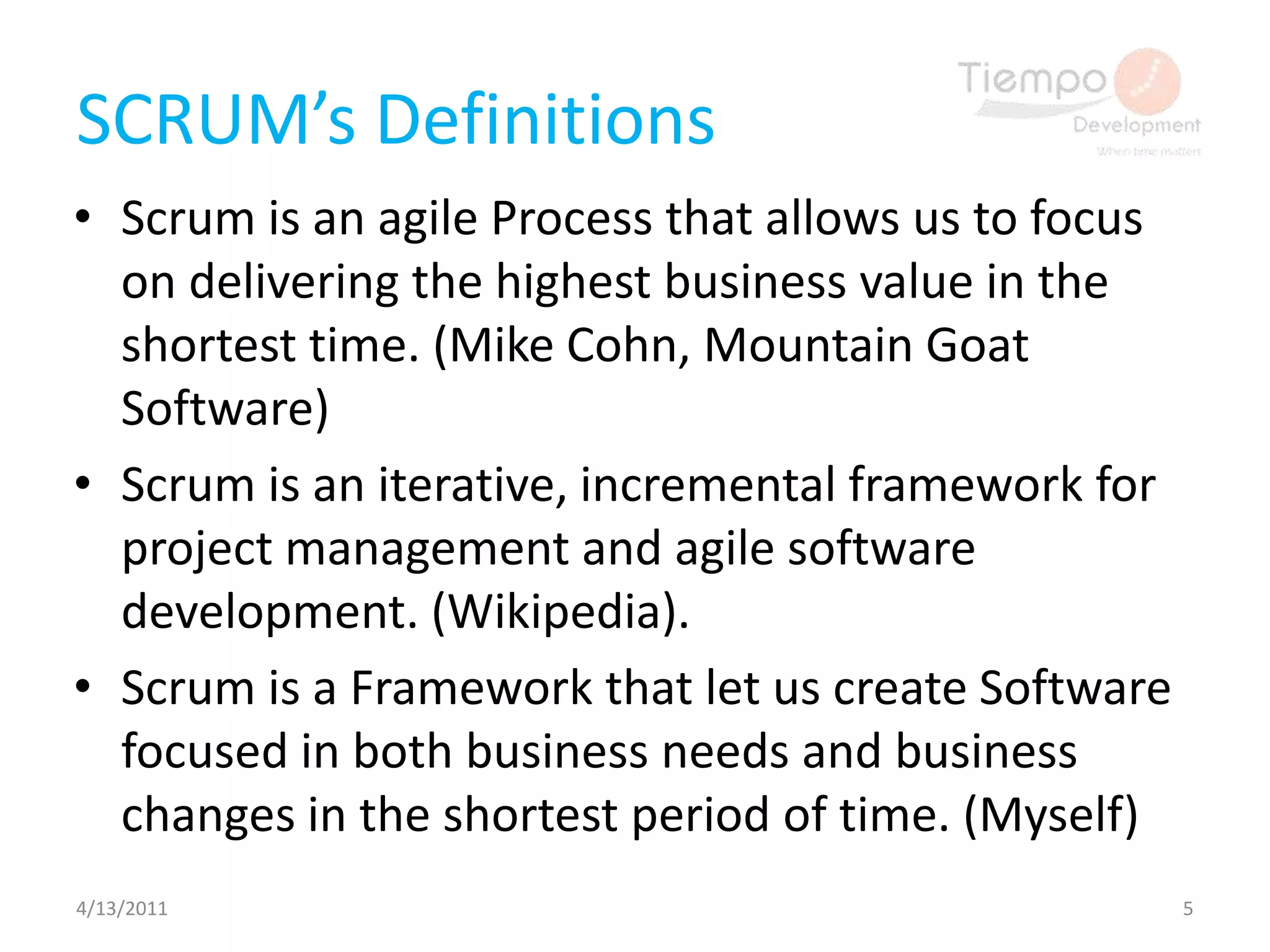
SCRUM’s DefinitionsScrum is an agile Process that allows us to focus on delivering the highest business value in the shortest time. (Mike Cohn, Mountain Goat Software)Scrum is an iterative, incremental framework for project management and agile software development. (Wikipedia).Scrum is a Framework that let us create Software focused in both business needs and business changes in the shortest period of time. (Myself)4/13/20115
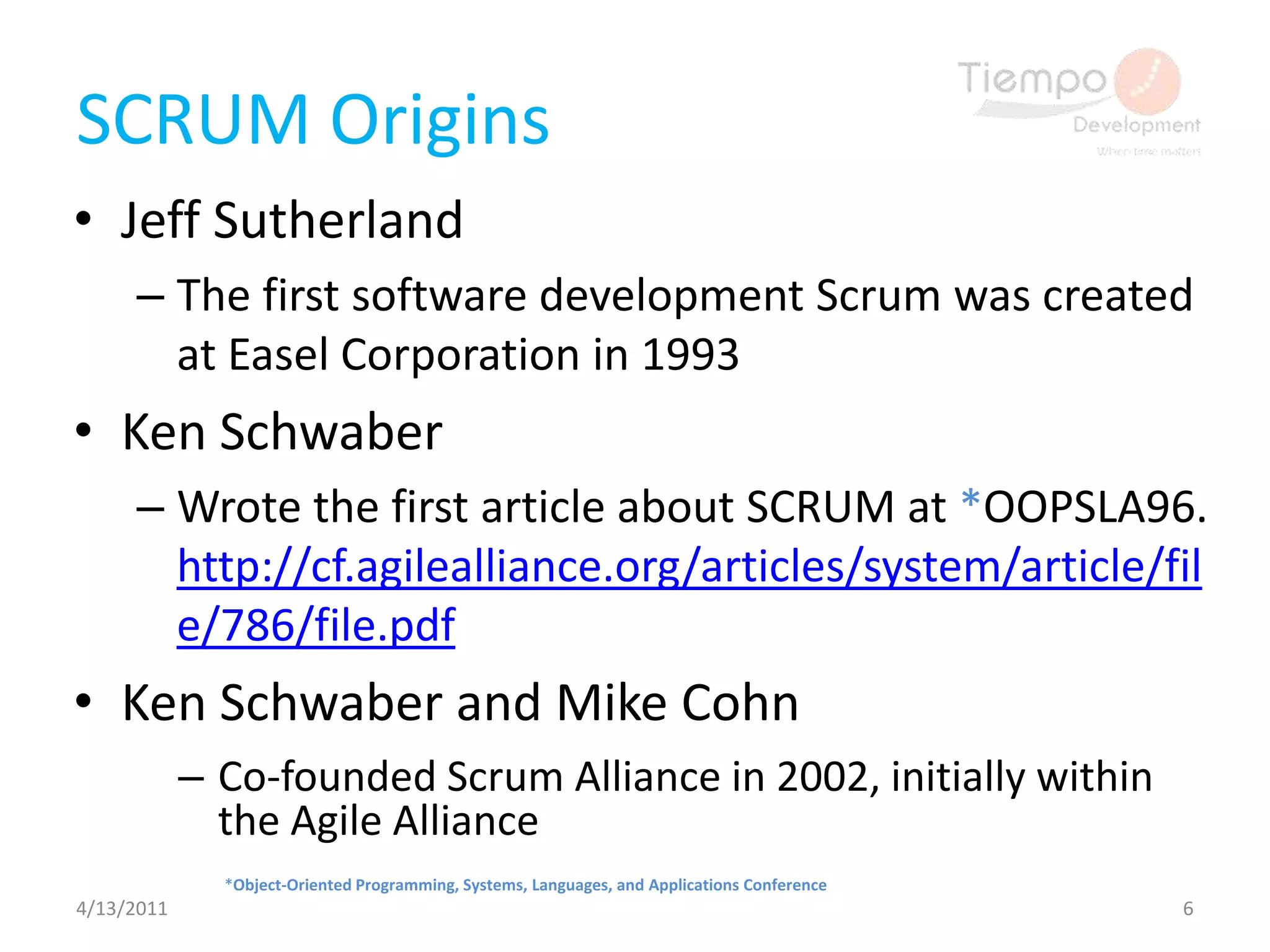
SCRUM Origins Jeff SutherlandThe first software development Scrum was created at Easel Corporation in 1993Ken SchwaberWrote the first article about SCRUM at *OOPSLA96. http://cf.agilealliance.org/articles/system/article/file/786/file.pdfKen Schwaber and Mike CohnCo-founded Scrum Alliance in 2002, initially within the Agile Alliance4/13/20116*Object-Oriented Programming, Systems, Languages, and Applications Conference
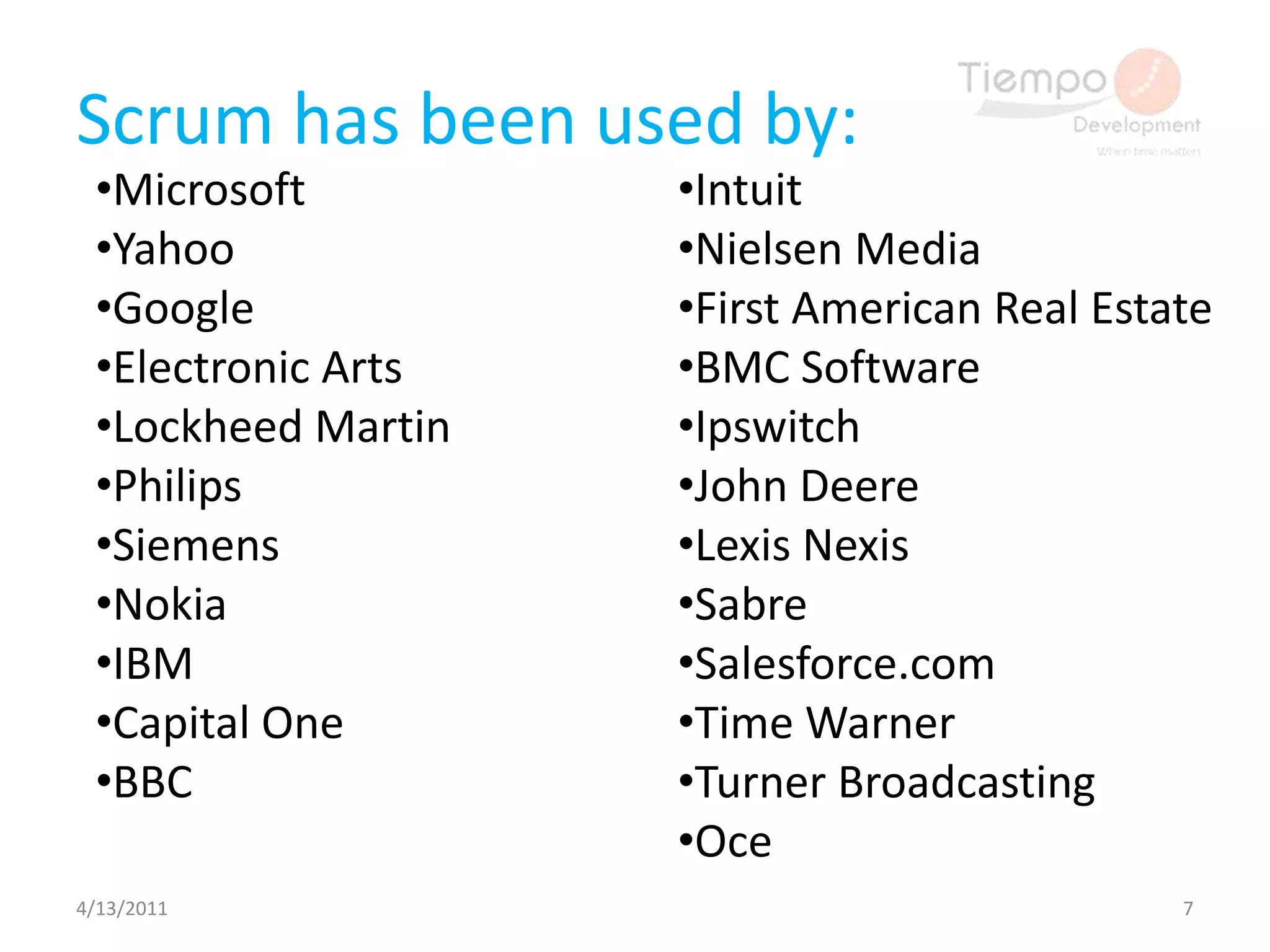
Scrum has been used by:4/13/20117Microsoft
Yahoo
Google
Electronic Arts
Lockheed Martin
Philips
Siemens
Nokia
IBM
Capital One
BBC
Intuit
Nielsen Media
First American Real Estate
BMC Software
Ipswitch
John Deere
Lexis Nexis
Sabre
Salesforce.com
Time Warner
Turner Broadcasting
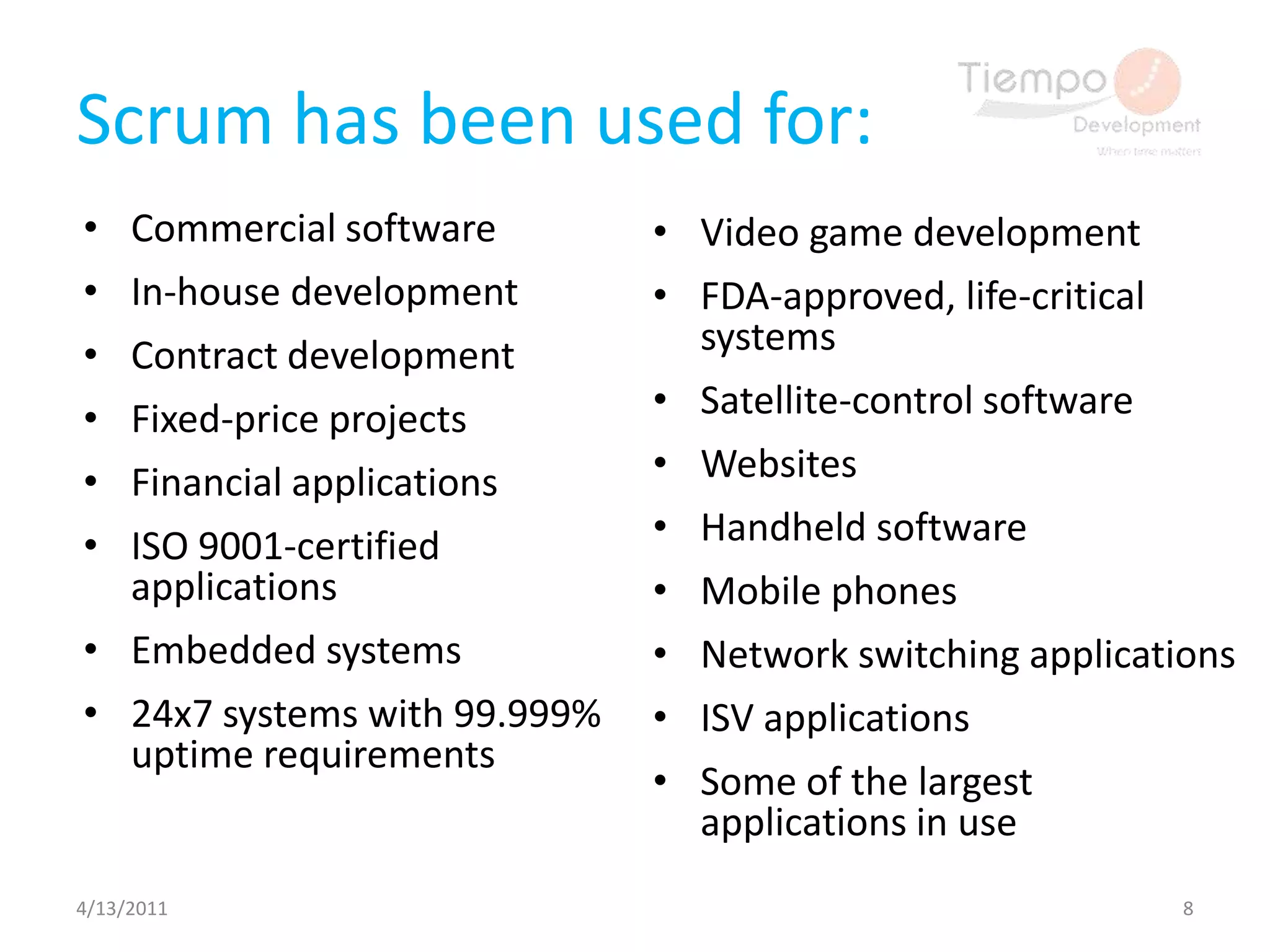
OceScrum has been used for:4/13/20118Commercial software
In-house development
Contract development
Fixed-price projects
Financial applications
ISO 9001-certified applications
Embedded systems
24x7 systems with 99.999% uptime requirements

An introduction to scrum 2.0

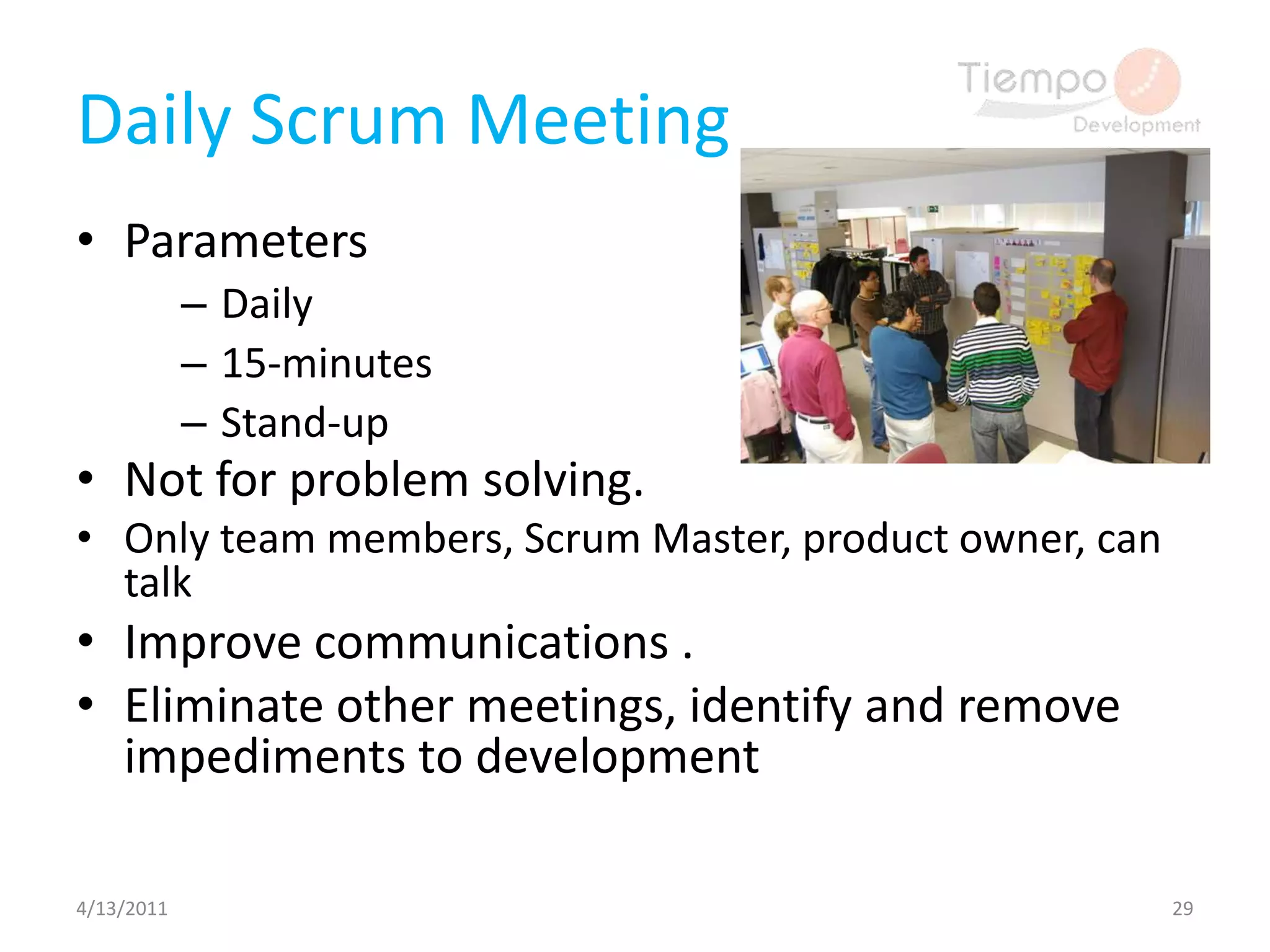
  • 1.
    An Introduction toSCRUMManuel BernalDevelopment ManagerTiempo Development, LLCPh: +1(602)910-4647 • Cell: +1 521(662)290-0854Email: mbernal@tiempodevelopment.com4/13/20111© 2010- Tiempo Development, LLC. all Rights Reserved
  • 2.
    4/13/20112“The only constantis change”Jack Welch, Former GE CEO
  • 3.
    Agile Manifesto4/13/20113Processes andtoolsIndividuals and interactionsOverComprehensive documentationWorking software OverContract negotiationCustomer collaboration OverFollowing a planResponding to change OverSource: www.agilemanifesto. org
  • 4.
    Agile PrinciplesWelcome changeOurproject is constantly changingOptimize the project around that environmentWorking software is the primary measure of progressNothing is complete until we have working software“Just Enough” Process and ArtifactsSufficient to achieve iteration goals and readily maintain the resultsSelf-Organizing TeamsThe team actively participates in managing the iterationTeams develop low level plans to achieve iteration goalsKnowledge transfer via conversation . . .Is the most effective communication method, written words / Models leave too much open to interpretationCollective Ownership4/13/20114Source: Scaling Software Agility – Best Practices for Large Enterprises by Dean Leffingwell
  • 5.
    SCRUM’s DefinitionsScrum isan agile Process that allows us to focus on delivering the highest business value in the shortest time. (Mike Cohn, Mountain Goat Software)Scrum is an iterative, incremental framework for project management and agile software development. (Wikipedia).Scrum is a Framework that let us create Software focused in both business needs and business changes in the shortest period of time. (Myself)4/13/20115
  • 6.
    SCRUM Origins JeffSutherlandThe first software development Scrum was created at Easel Corporation in 1993Ken SchwaberWrote the first article about SCRUM at *OOPSLA96. http://cf.agilealliance.org/articles/system/article/file/786/file.pdfKen Schwaber and Mike CohnCo-founded Scrum Alliance in 2002, initially within the Agile Alliance4/13/20116*Object-Oriented Programming, Systems, Languages, and Applications Conference
  • 7.
    Scrum has beenused by:4/13/20117Microsoft
  • 8.
  • 9.
  • 10.
  • 11.
  • 12.
  • 13.
  • 14.
  • 15.
  • 16.
  • 17.
  • 18.
  • 19.
  • 20.
  • 21.
  • 22.
  • 23.
  • 24.
  • 25.
  • 26.
  • 27.
  • 28.
  • 29.
    OceScrum has beenused for:4/13/20118Commercial software
  • 30.
  • 31.
  • 32.
  • 33.
  • 34.
  • 35.
  • 36.
    24x7 systems with99.999% uptime requirements
  • 37.
  • 38.
  • 39.
  • 40.
  • 41.
  • 42.
  • 43.
  • 44.
  • 45.
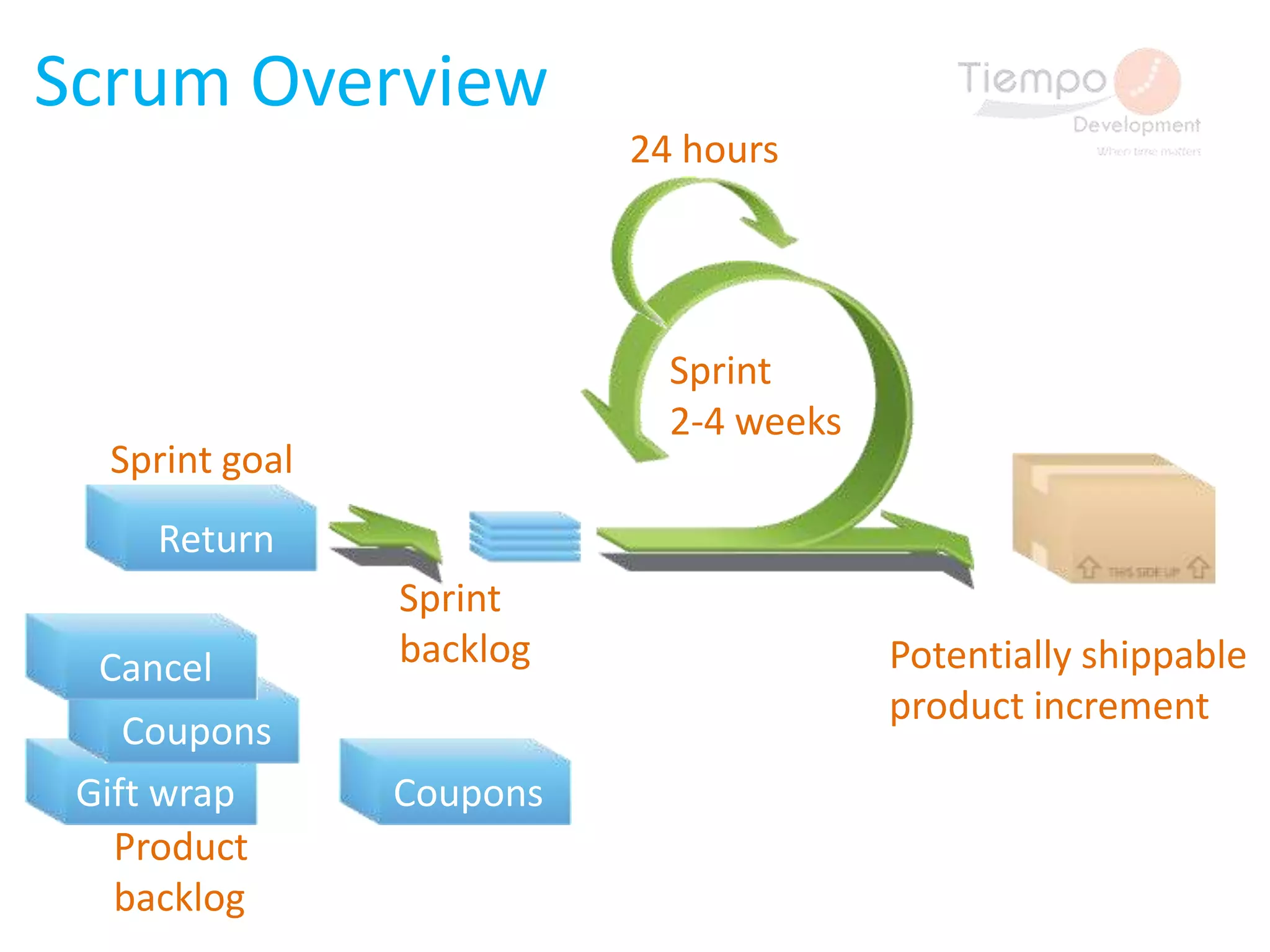
    Some of thelargest applications in useScrum OverviewSprint goal24 hoursCouponsGift wrapCouponsCancelCancelGift wrapReturnSprint backlogSprint2-4 weeksReturnPotentially shippableproduct incrementProductbacklog
  • 46.
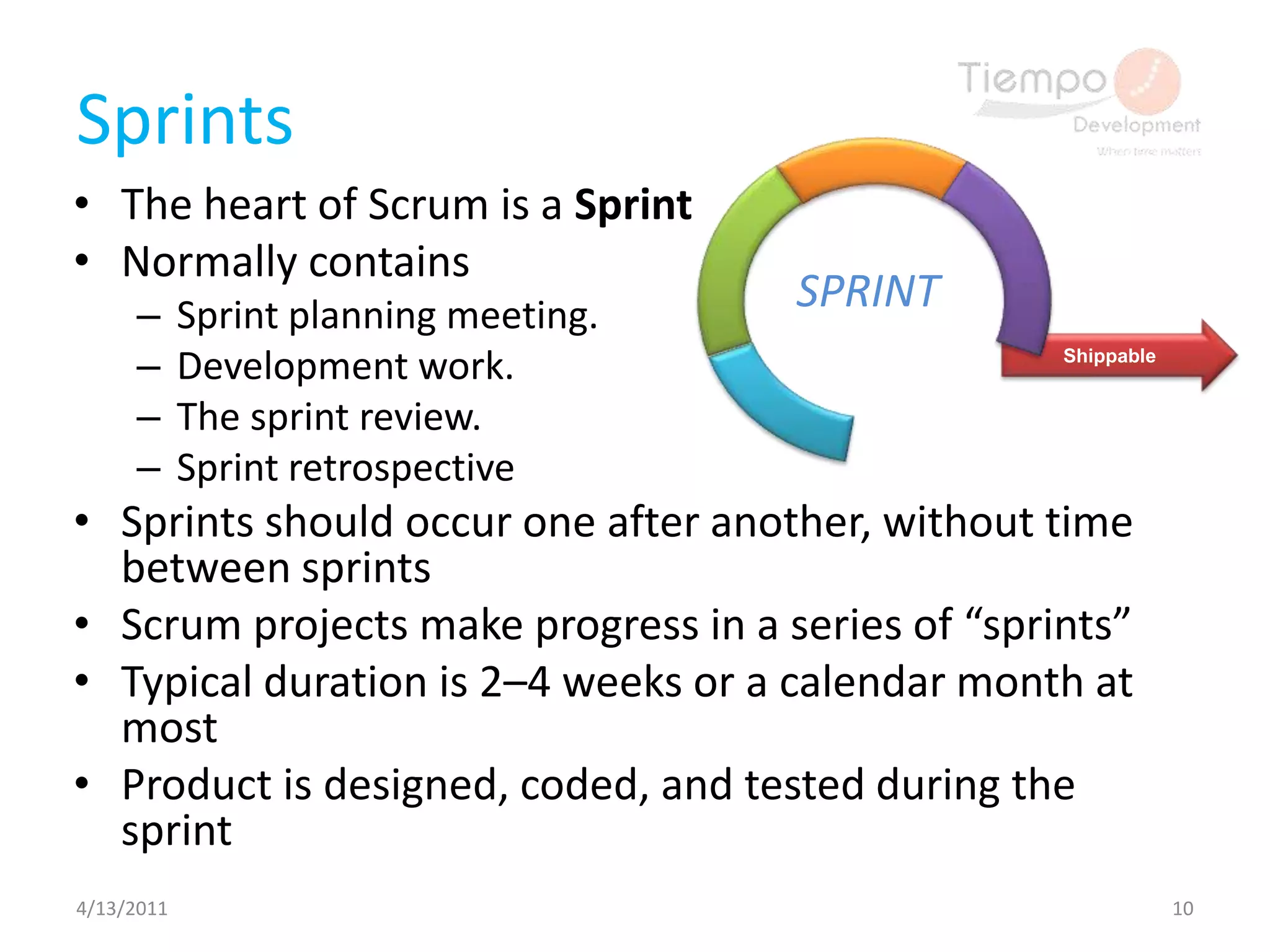
    SprintsThe heart ofScrum is a SprintNormally containsSprint planning meeting.Development work.The sprint review.Sprint retrospectiveSprints should occur one after another, without time between sprintsScrum projects make progress in a series of “sprints”Typical duration is 2–4 weeks or a calendar month at mostProduct is designed, coded, and tested during the sprint4/13/201110SPRINTShippable
  • 47.
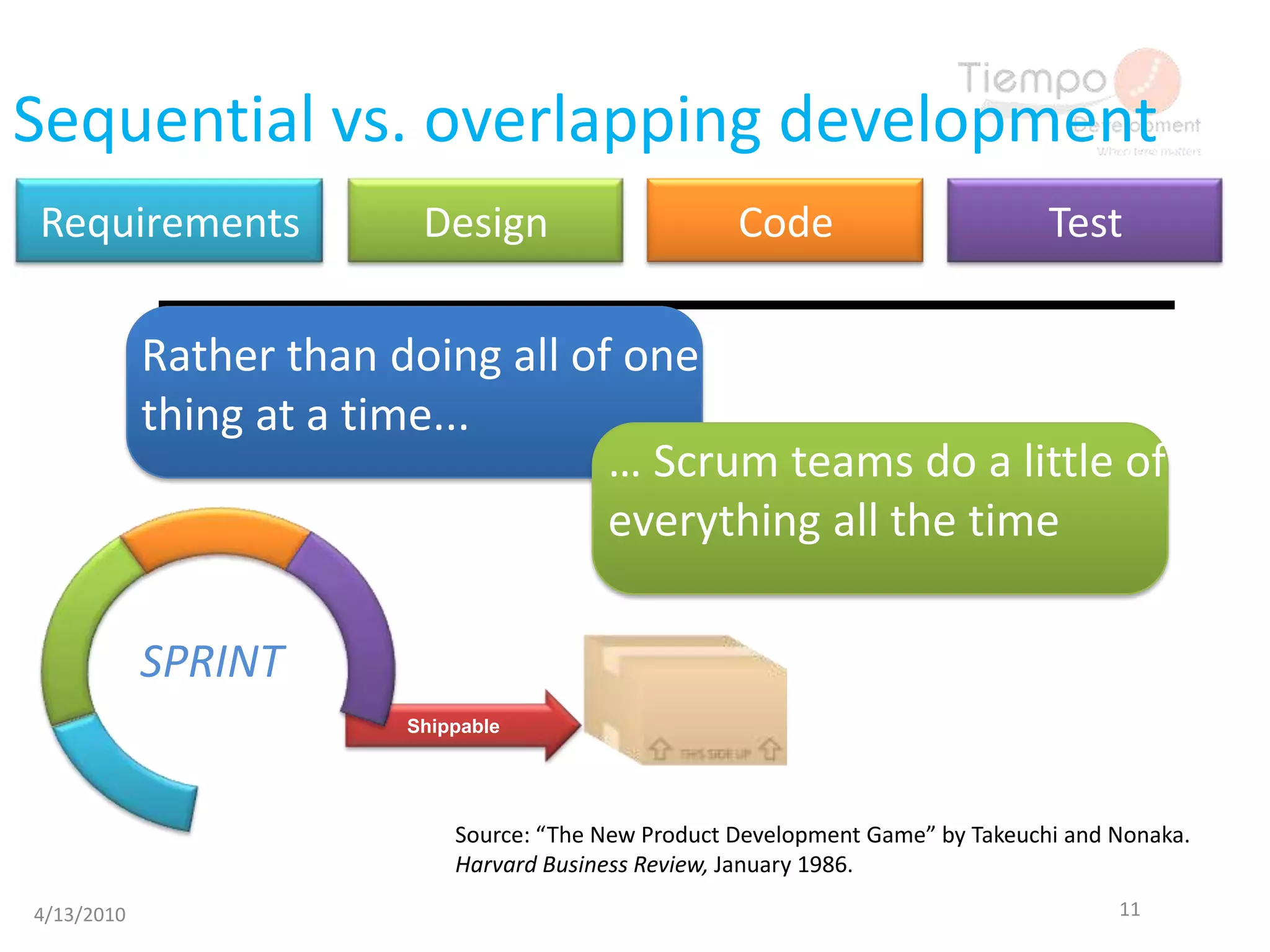
    Sequential vs. overlappingdevelopmentRequirementsDesignCodeTestRather than doing all of one thing at a time... … Scrum teams do a little of everything all the timeSPRINTShippableSource: “The New Product Development Game” by Takeuchi and Nonaka. Harvard Business Review, January 1986.114/13/2010
  • 48.
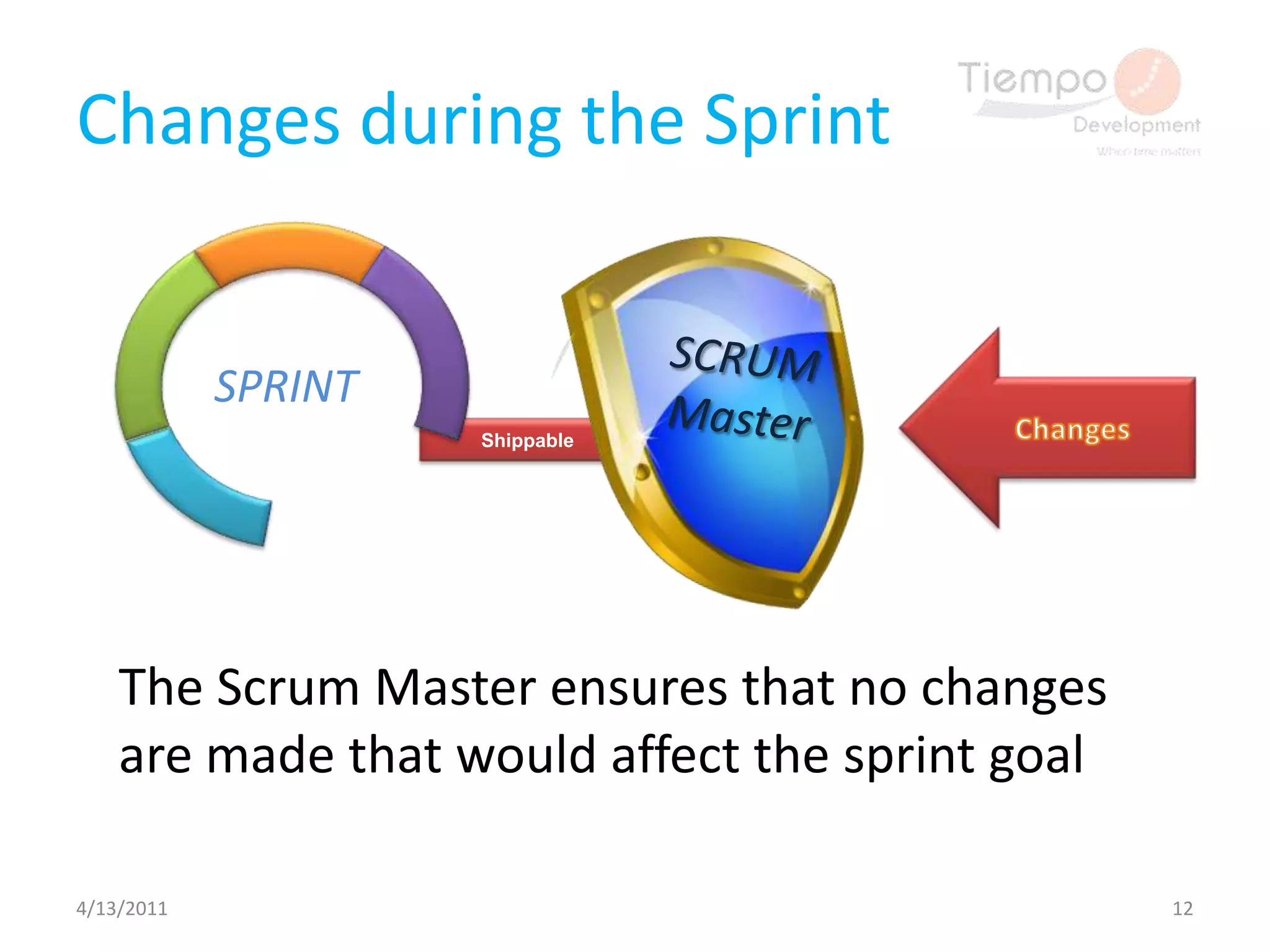
    Changes during theSprint4/13/201112SCRUM MasterChangesSPRINTShippableThe Scrum Master ensures that no changes are made that would affect the sprint goal
  • 49.
  • 50.
  • 51.
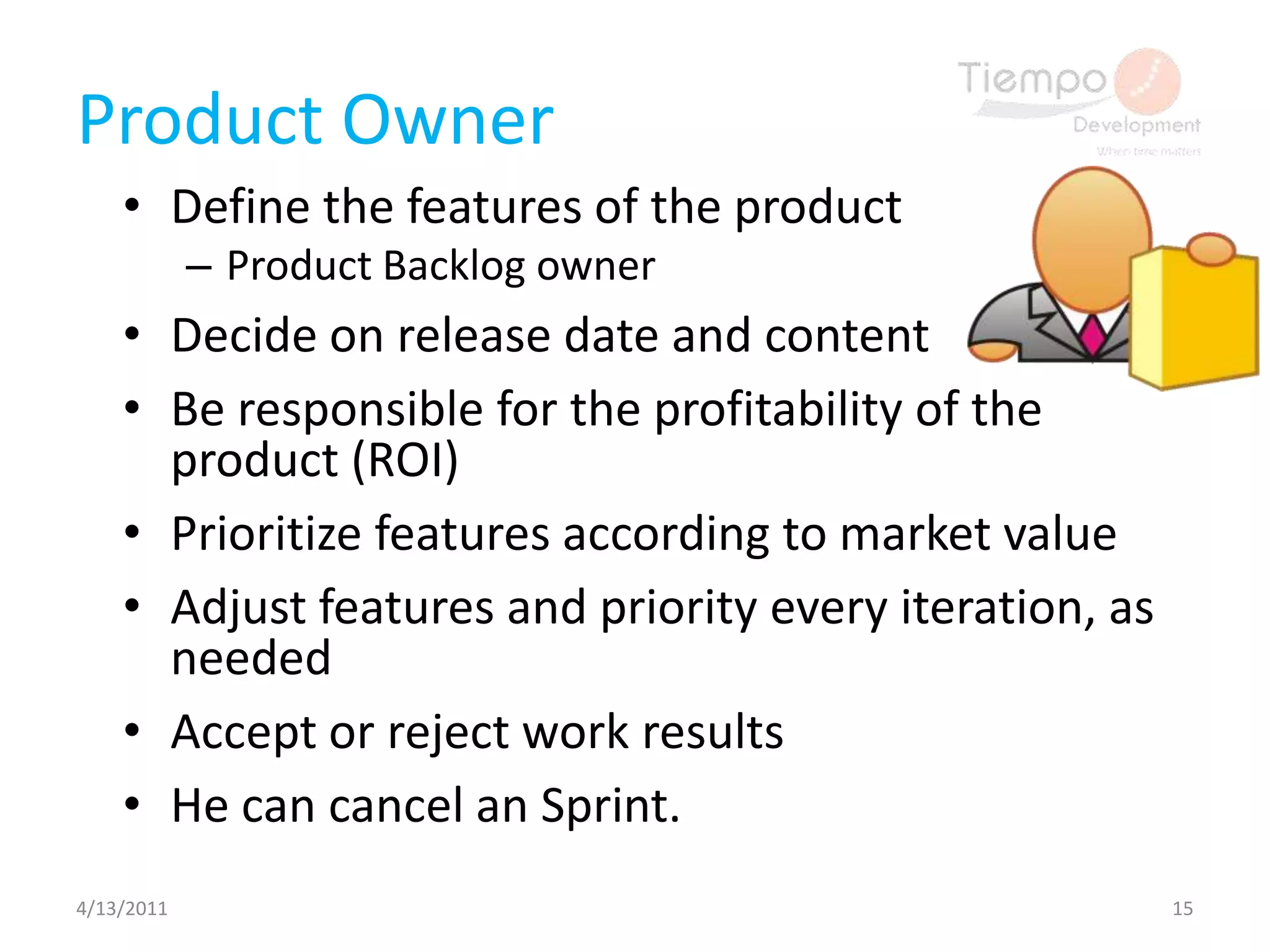
    Product OwnerDefine thefeatures of the productProduct Backlog ownerDecide on release date and contentBe responsible for the profitability of the product (ROI)Prioritize features according to market value Adjust features and priority every iteration, as needed  Accept or reject work resultsHe can cancel an Sprint.4/13/201115
  • 52.
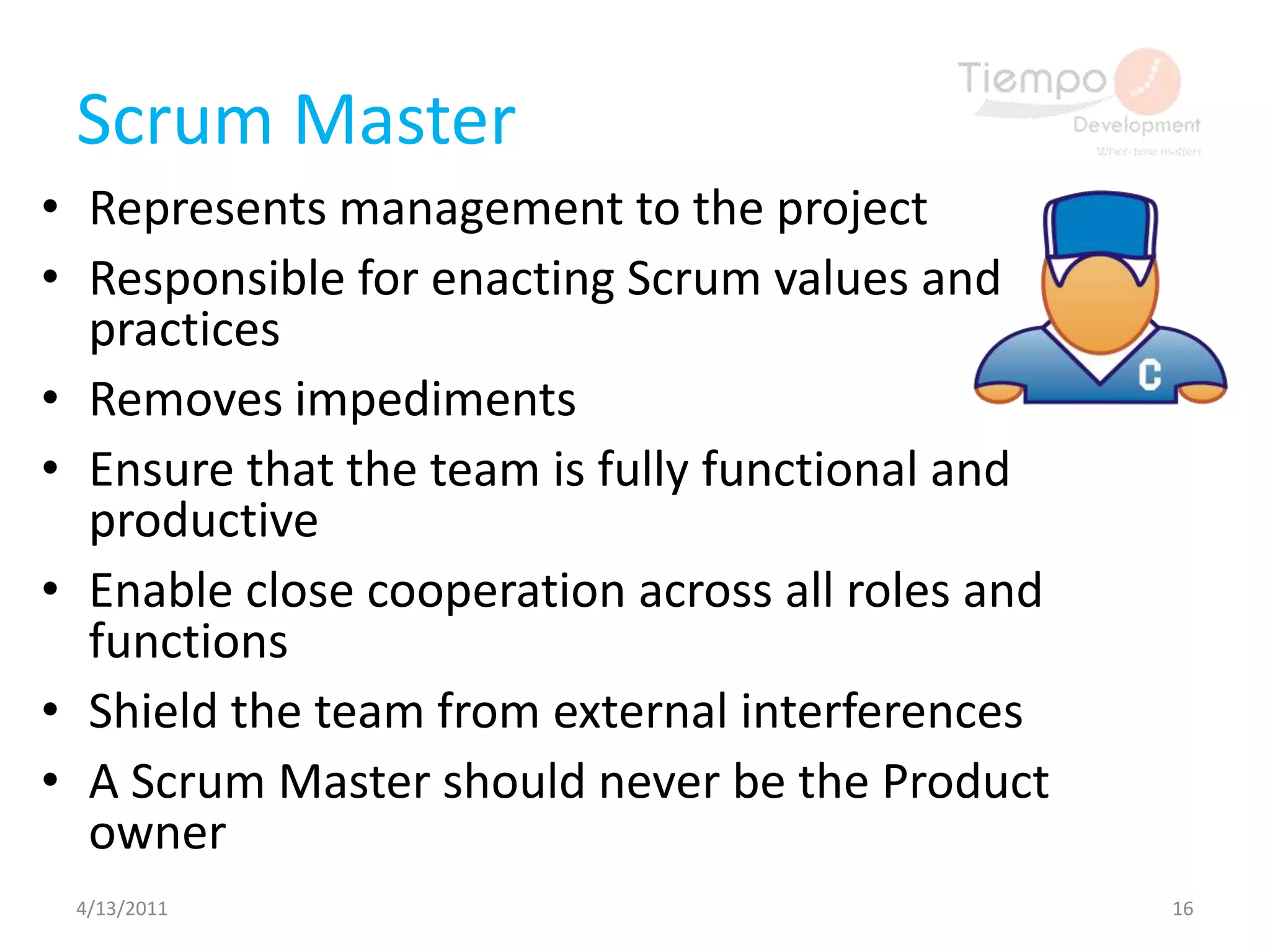
    Scrum MasterRepresents managementto the projectResponsible for enacting Scrum values and practicesRemoves impediments Ensure that the team is fully functional and productiveEnable close cooperation across all roles and functionsShield the team from external interferences A Scrum Master should never be the Product owner4/13/201116
  • 53.
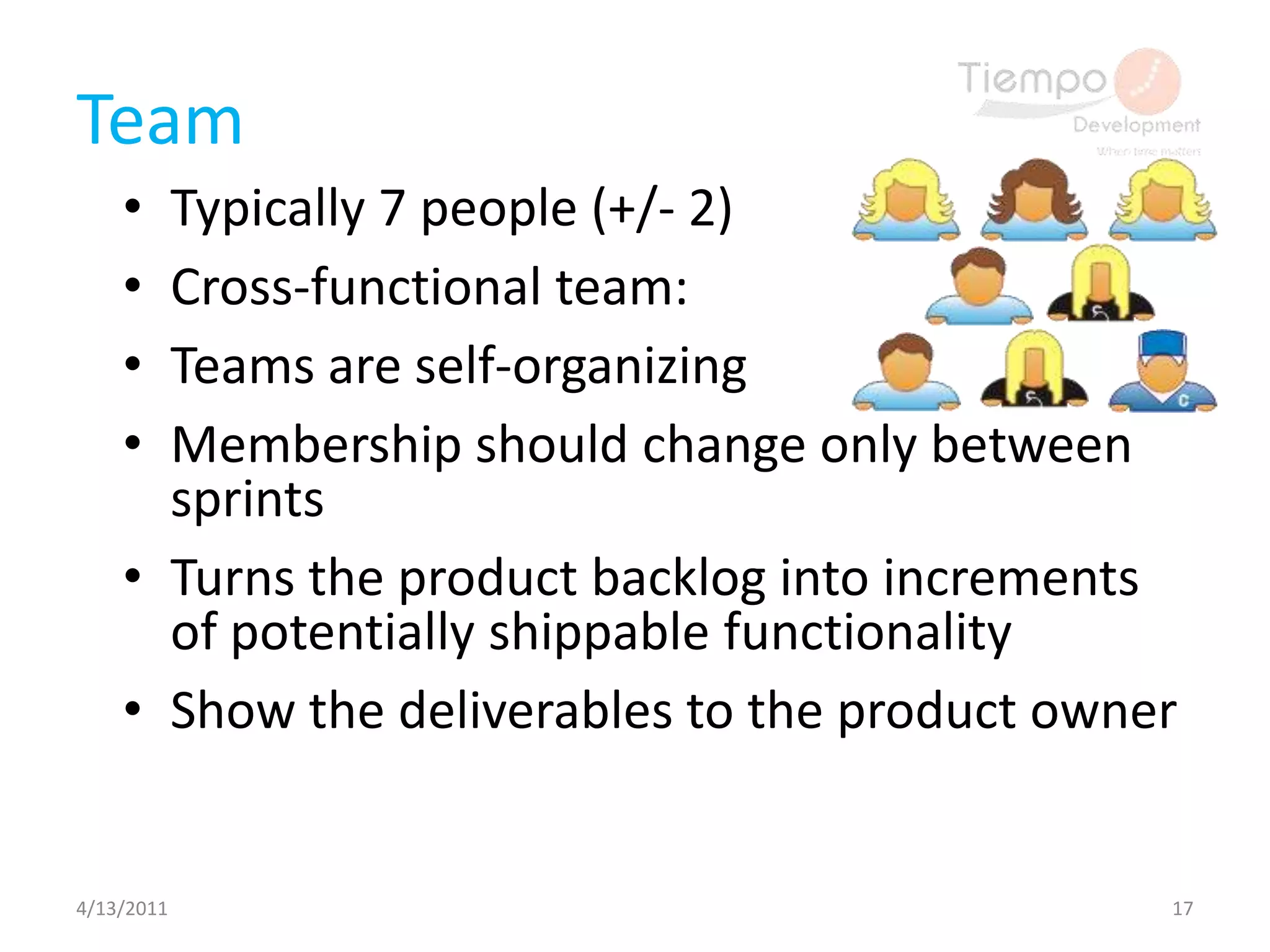
    TeamTypically 7 people(+/- 2)Cross-functional team:Teams are self-organizingMembership should change only between sprintsTurns the product backlog into increments of potentially shippable functionalityShow the deliverables to the product owner4/13/201117
  • 54.
  • 55.
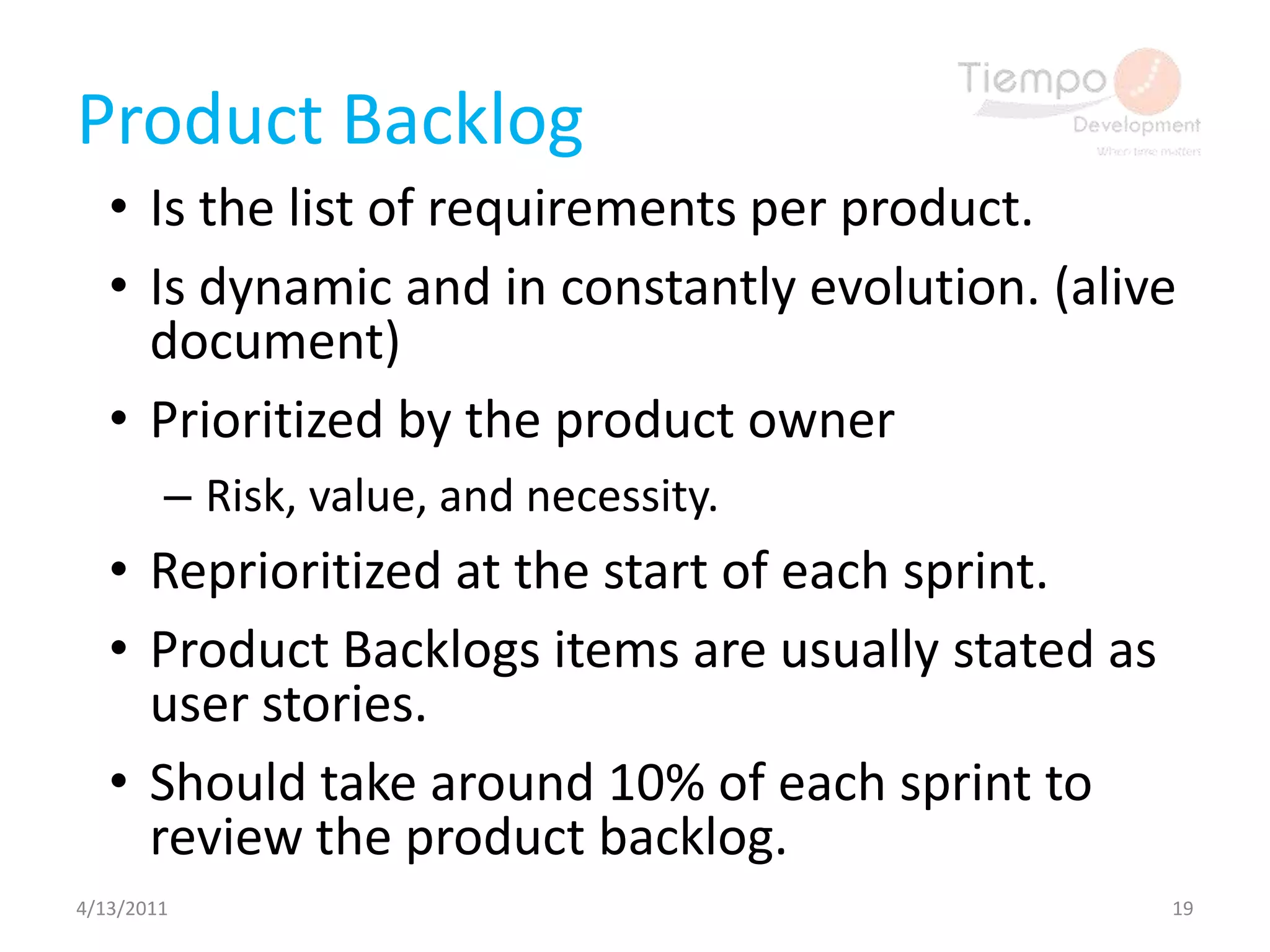
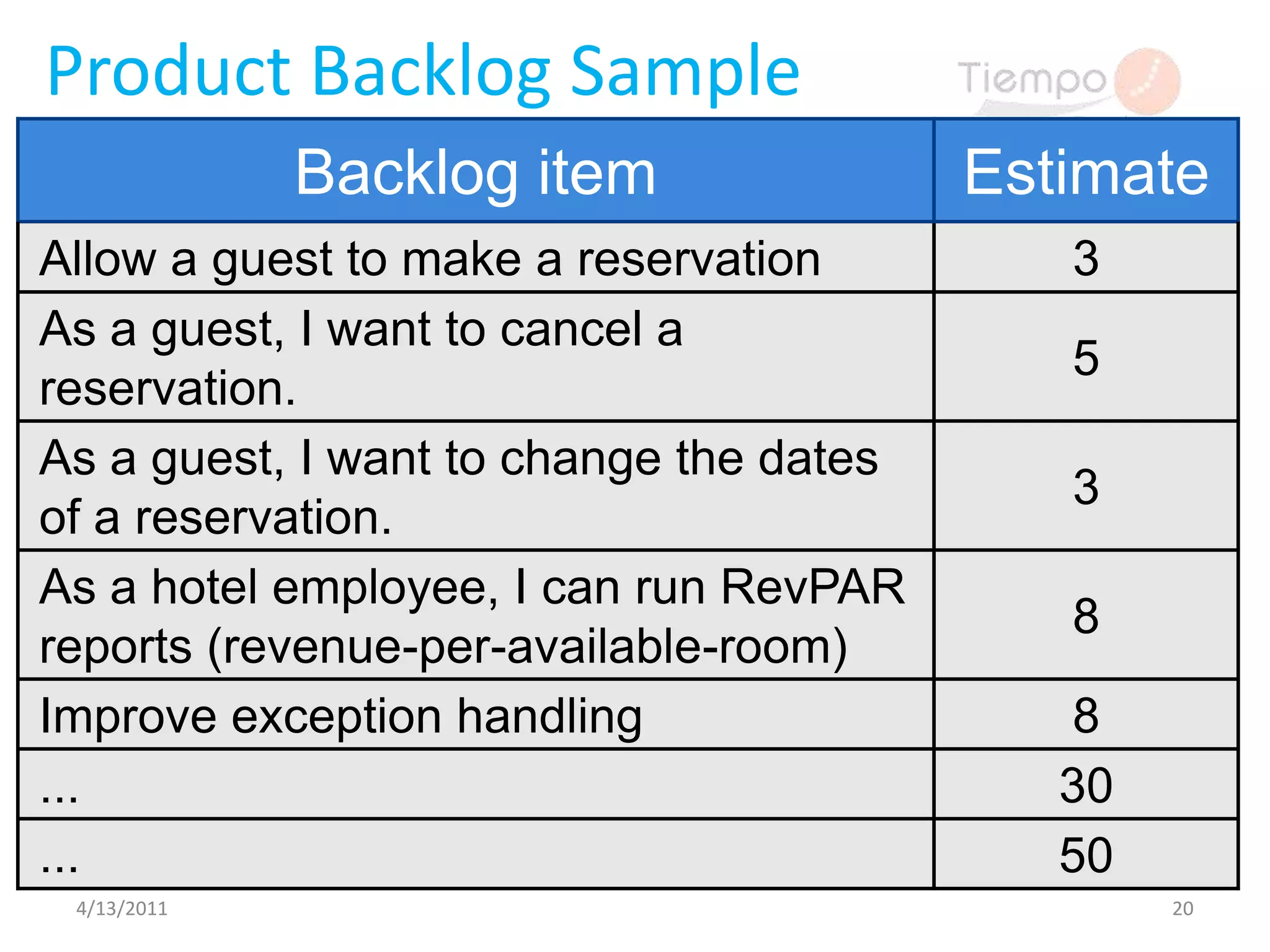
    Product BacklogIs thelist of requirements per product.Is dynamic and in constantly evolution. (alive document)Prioritized by the product ownerRisk, value, and necessity. Reprioritized at the start of each sprint.Product Backlogs items are usually stated as user stories.Should take around 10% of each sprint to review the product backlog.4/13/201119
  • 56.
  • 57.
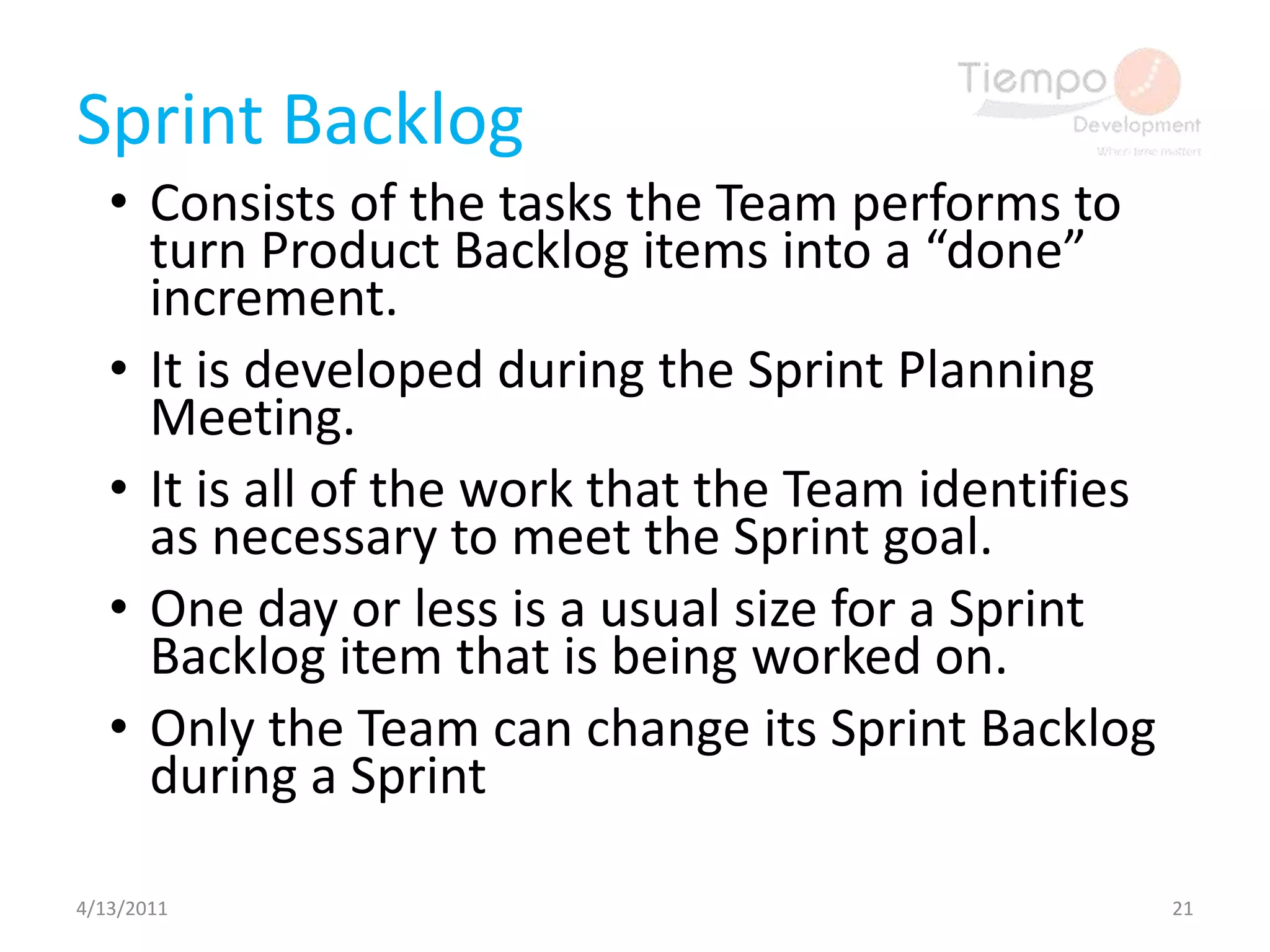
    Sprint BacklogConsists ofthe tasks the Team performs to turn Product Backlog items into a “done” increment.It is developed during the Sprint Planning Meeting.It is all of the work that the Team identifies as necessary to meet the Sprint goal.One day or less is a usual size for a Sprint Backlog item that is being worked on.Only the Team can change its Sprint Backlog during a Sprint4/13/201121
  • 58.
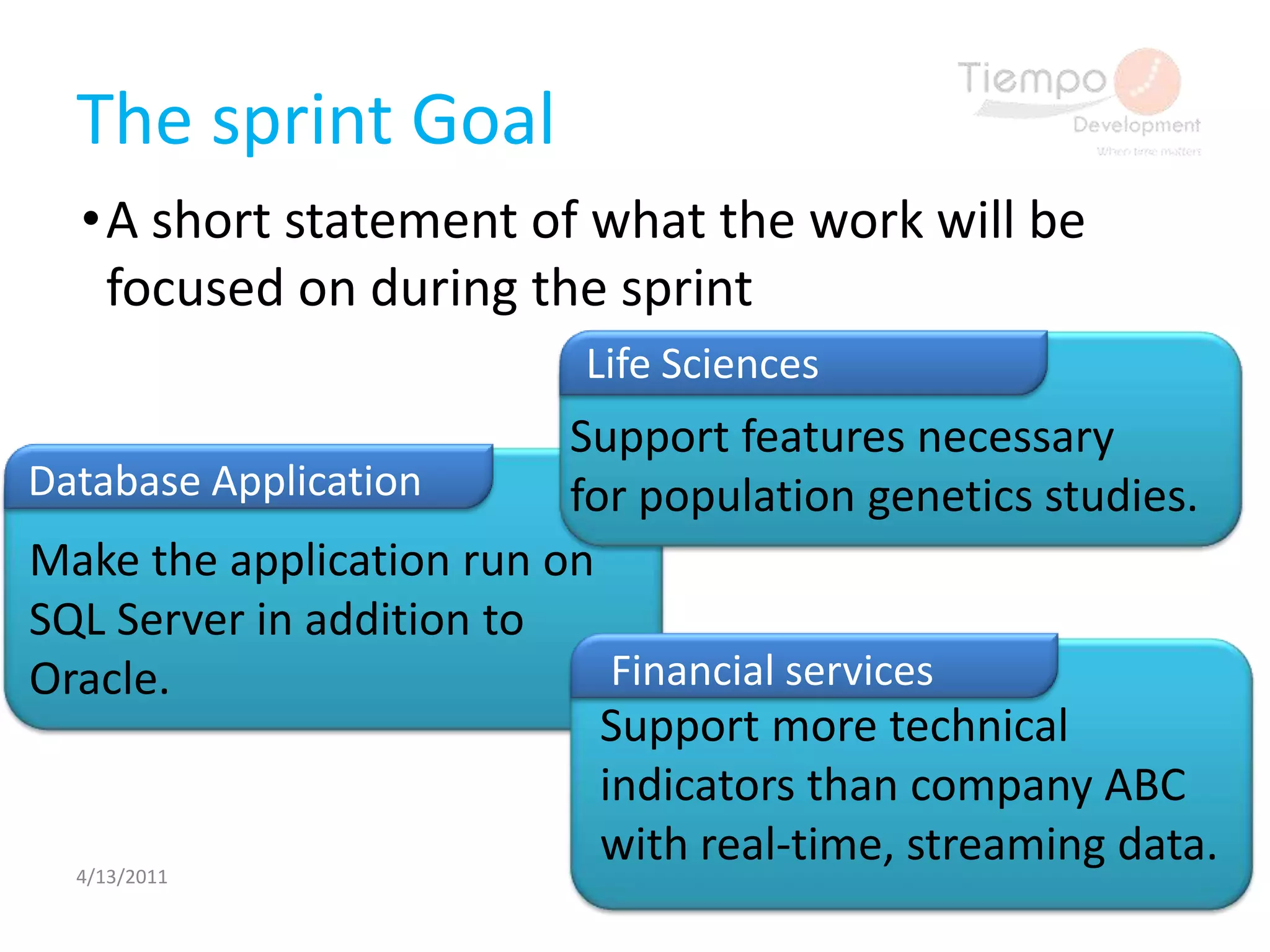
    The sprint GoalAshort statement of what the work will be focused on during the sprintLife SciencesSupport features necessary for population genetics studies.Database ApplicationMake the application run on SQL Server in addition to Oracle.Financial servicesSupport more technical indicators than company ABC with real-time, streaming data.224/13/2011
  • 59.
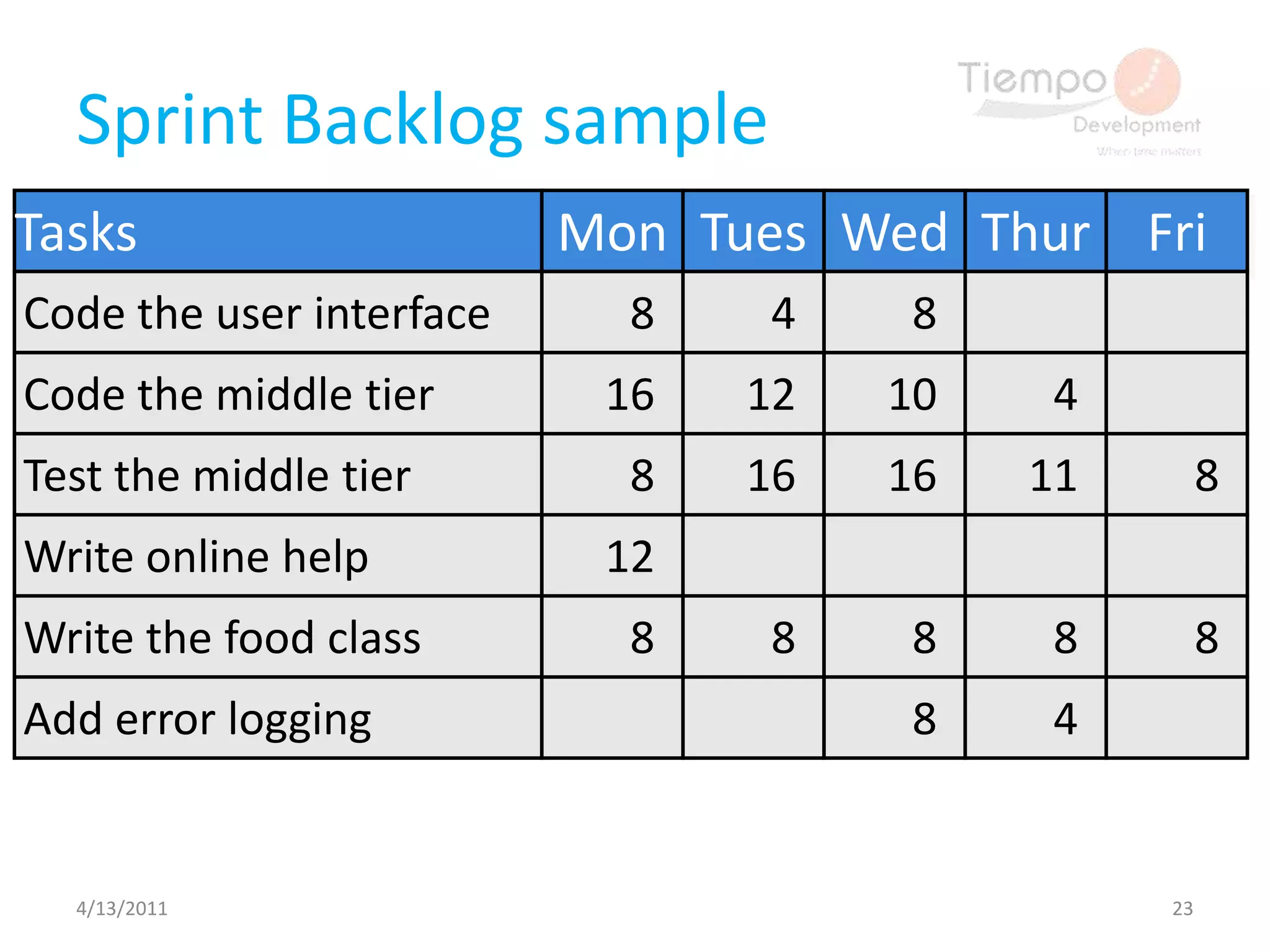
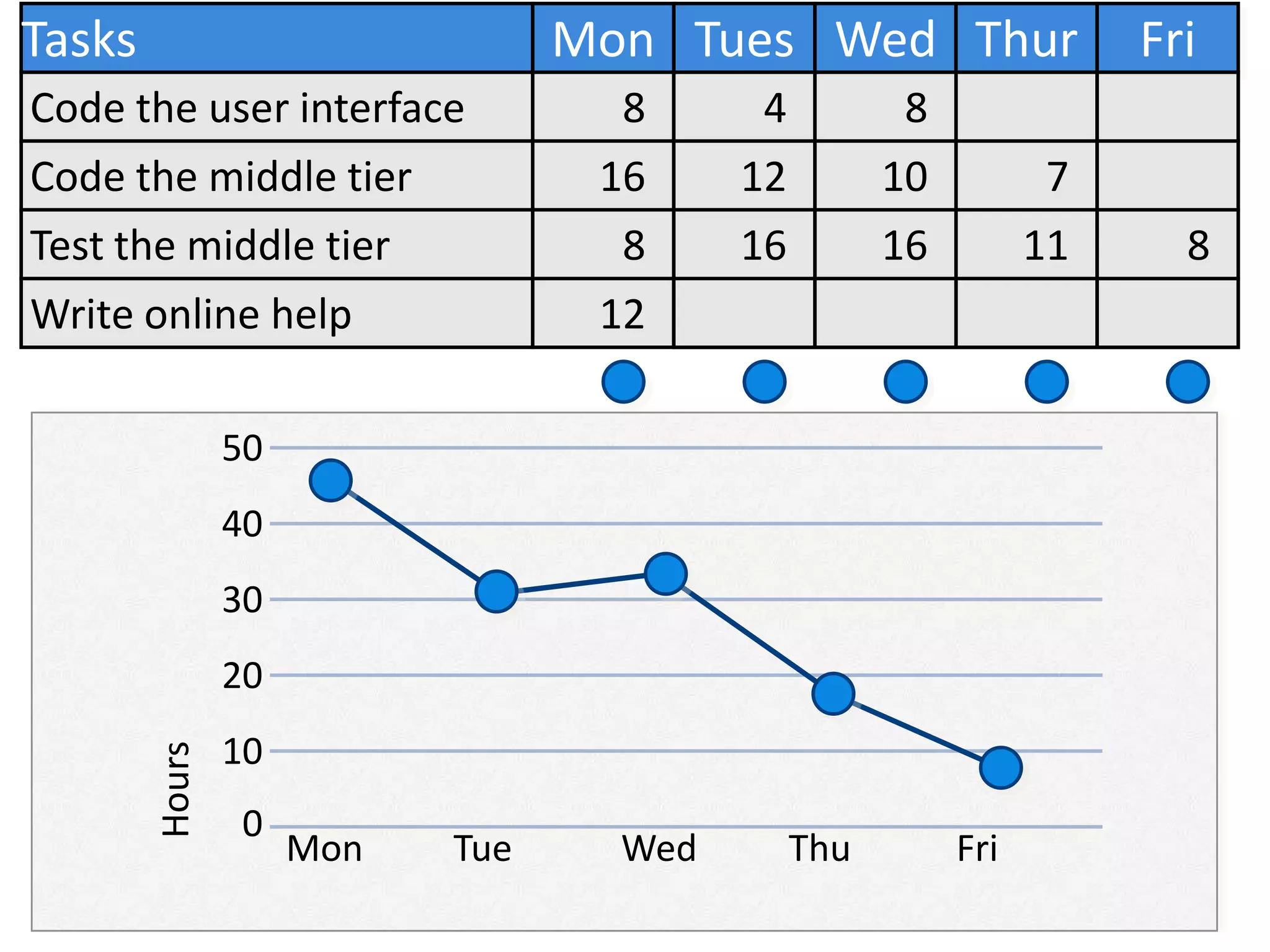
    Sprint Backlog sample4/13/20112384816124108161181612888884Adderror logging8TasksMonTuesWedThurFriCode the user interfaceCode the middle tierTest the middle tierWrite online helpWrite the food class
  • 60.
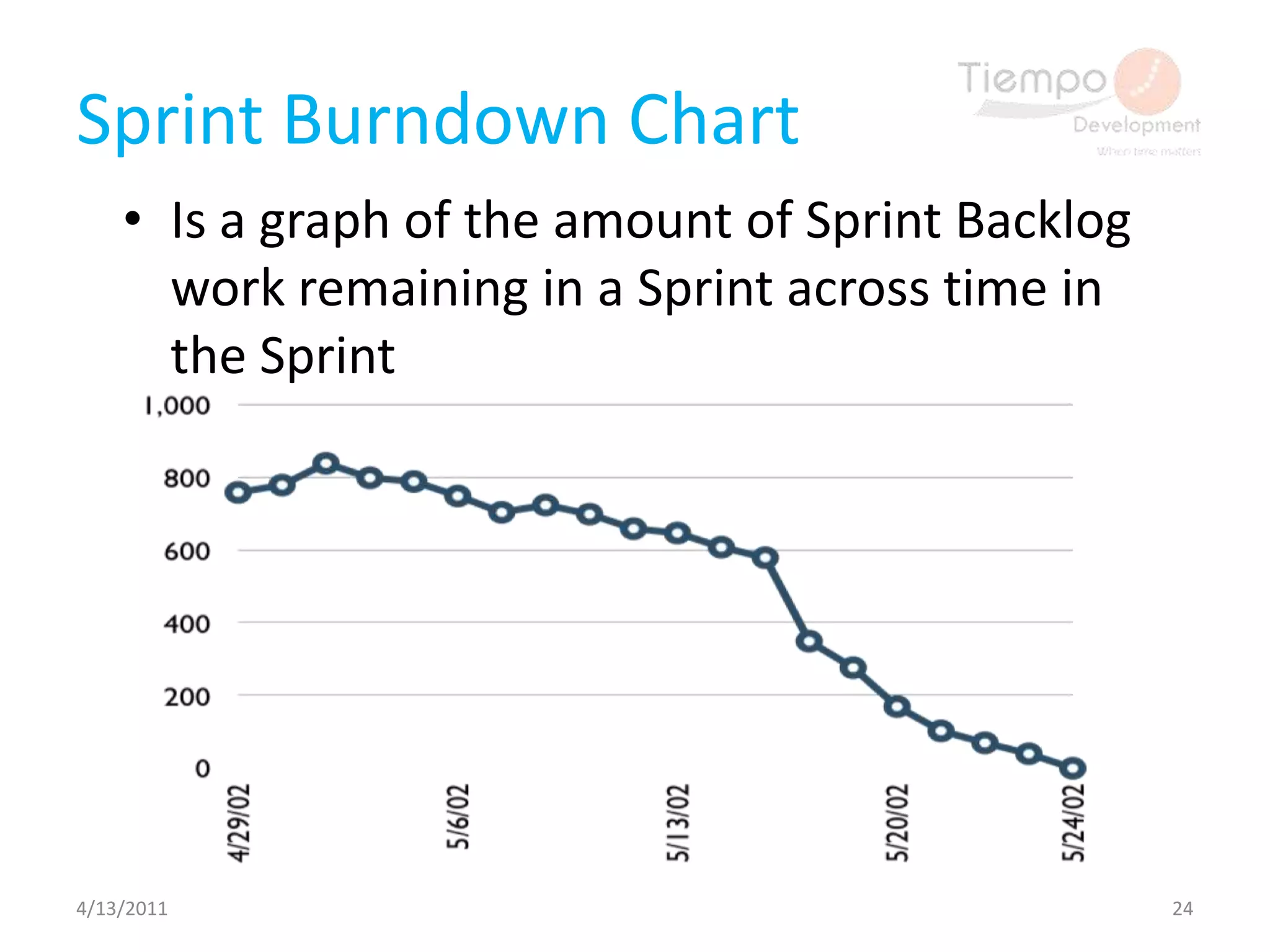
    Sprint Burndown ChartIsa graph of the amount of Sprint Backlog work remaining in a Sprint across time in the Sprint4/13/201124
  • 61.
    4/21/20102548127101611168TasksMonTuesWedThurFriCode the userinterface8Code the middle tier16Test the middle tier8Write online help12504030Hours20100MonTueWedThuFri
  • 62.
  • 63.
  • 64.
  • 65.
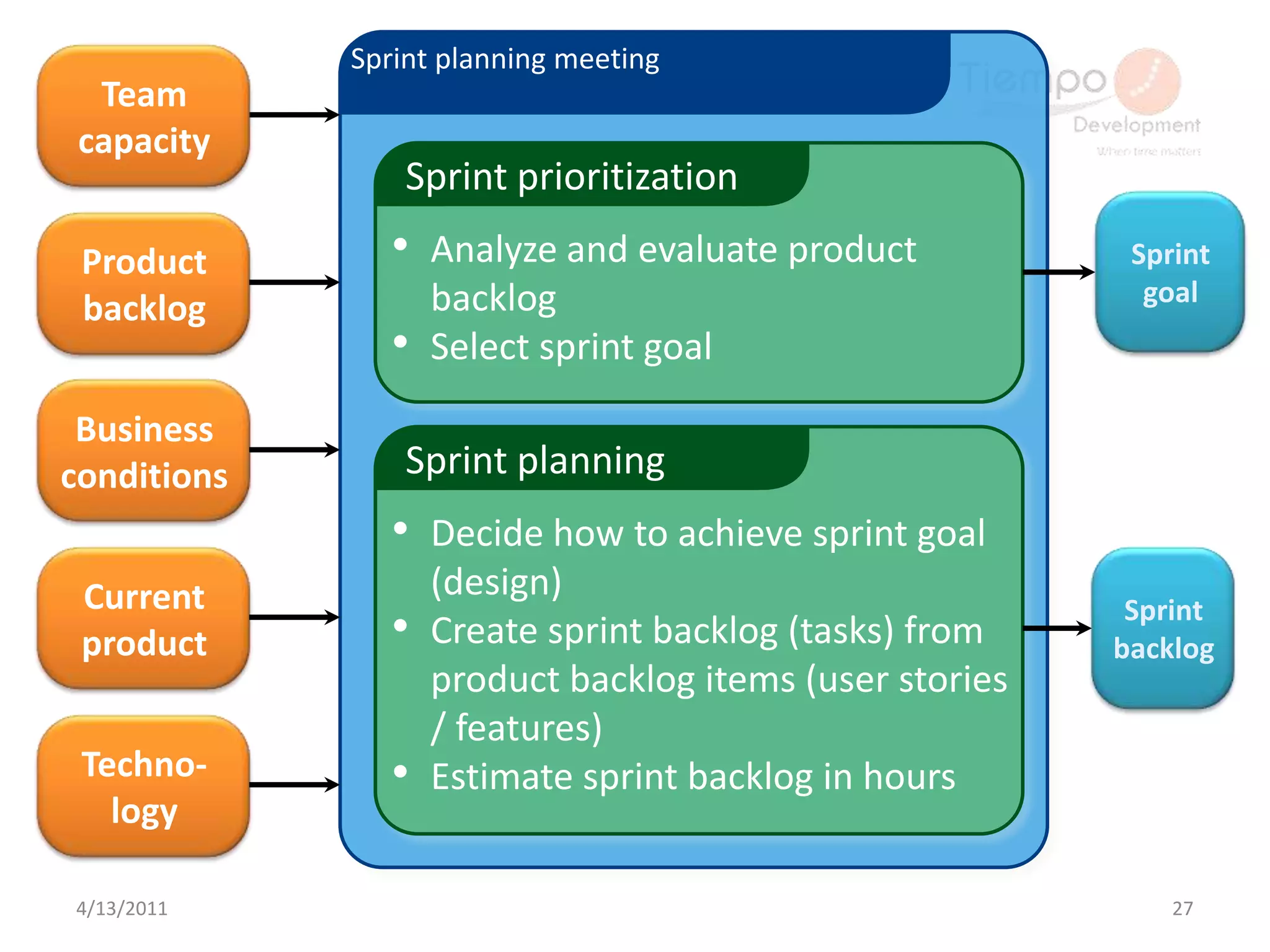
    Decide how toachieve sprint goal (design)
  • 66.
    Create sprint backlog(tasks) from product backlog items (user stories / features)
  • 67.
    Estimate sprint backlogin hoursSprint planning meetingTeam capacityProduct backlogBusiness conditionsCurrent productTechno-logy
  • 68.
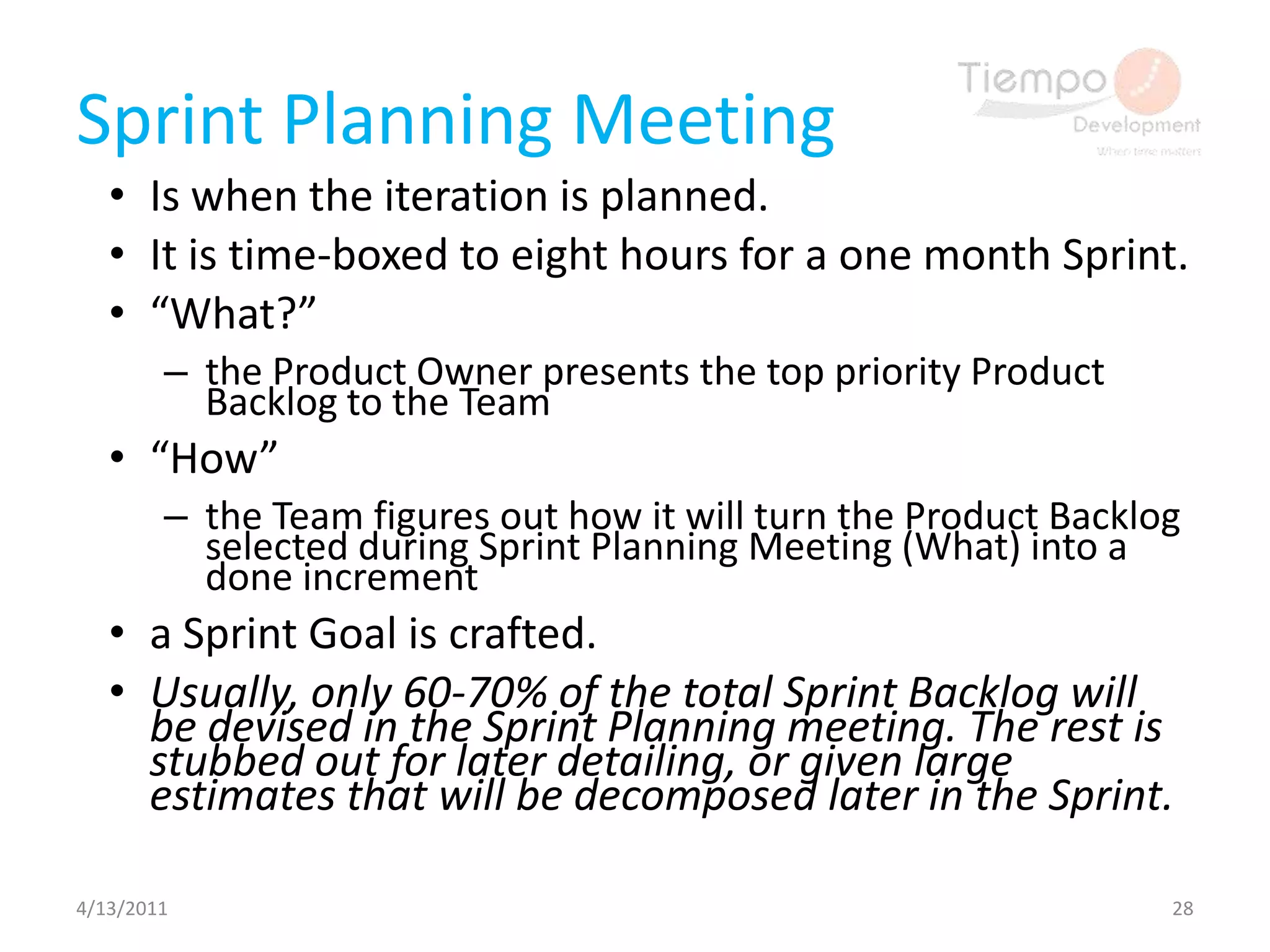
    Sprint Planning MeetingIswhen the iteration is planned.It is time-boxed to eight hours for a one month Sprint.“What?”the Product Owner presents the top priority Product Backlog to the Team“How”the Team figures out how it will turn the Product Backlog selected during Sprint Planning Meeting (What) into a done incrementa Sprint Goal is crafted.Usually, only 60-70% of the total Sprint Backlog will be devised in the Sprint Planning meeting. The rest is stubbed out for later detailing, or given large estimates that will be decomposed later in the Sprint.4/13/201128
  • 69.
    Daily Scrum Meeting4/13/201129ParametersDaily15-minutesStand-upNotfor problem solving.Only team members, Scrum Master, product owner, can talkImprove communications .Eliminate other meetings, identify and remove impediments to development
  • 70.
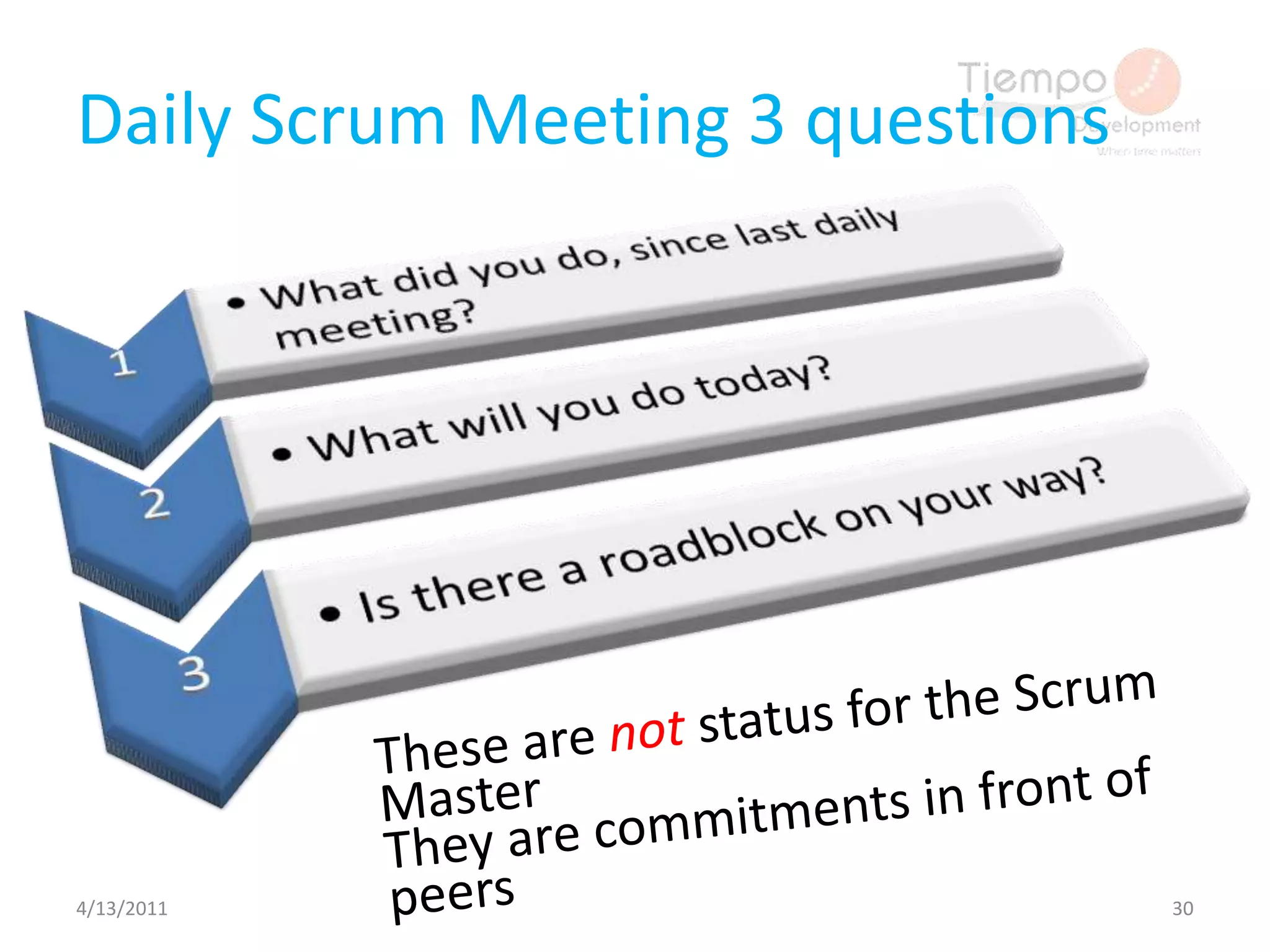
    Daily Scrum Meeting3 questions4/13/201130These are not status for the Scrum MasterThey are commitments in front of peers
  • 71.
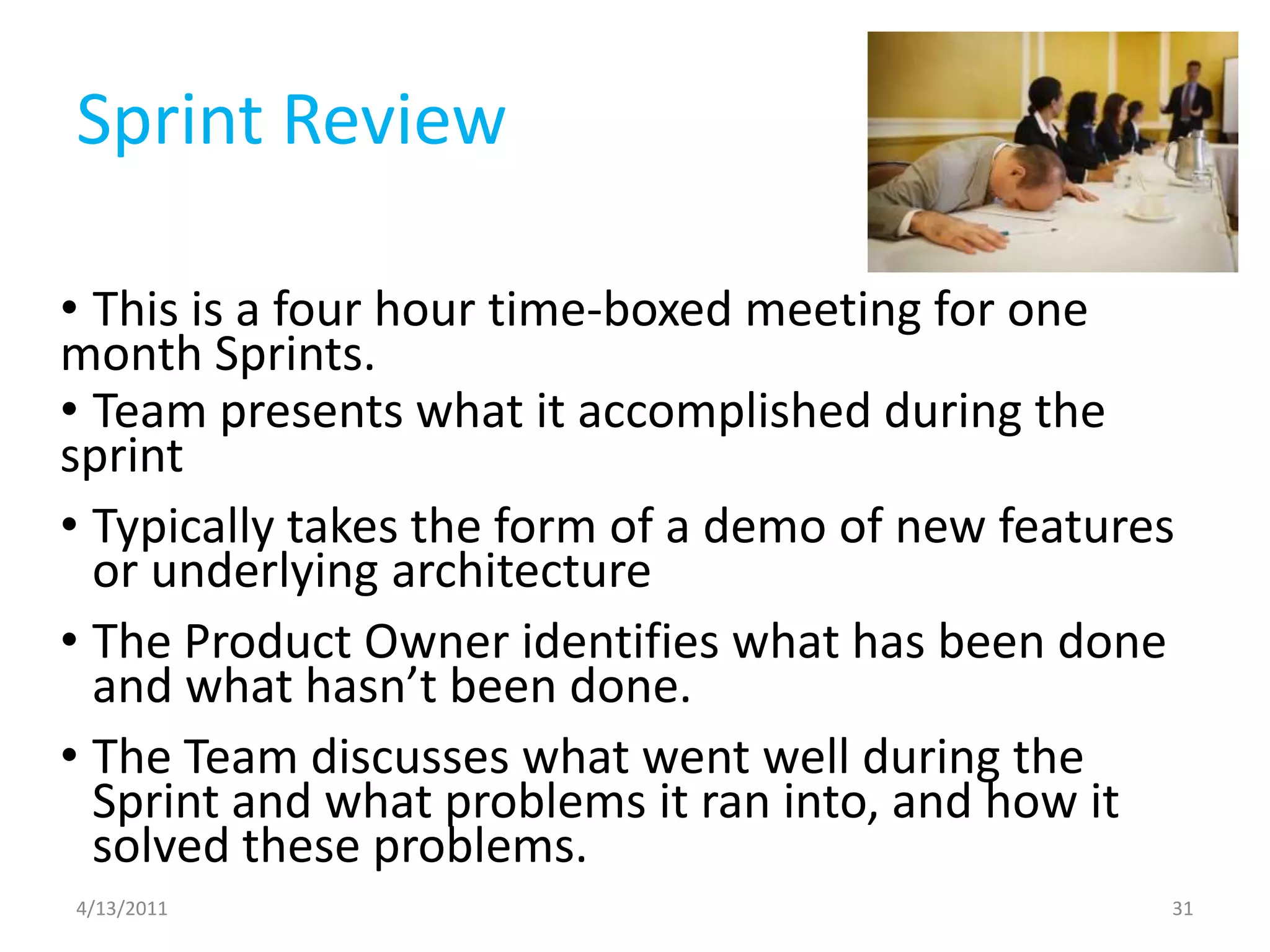
    Sprint Review4/13/201131This isa four hour time-boxed meeting for one month Sprints. Team presents what it accomplished during the sprintTypically takes the form of a demo of new features or underlying architectureThe Product Owner identifies what has been done and what hasn’t been done.The Team discusses what went well during the Sprint and what problems it ran into, and how it solved these problems.
  • 72.
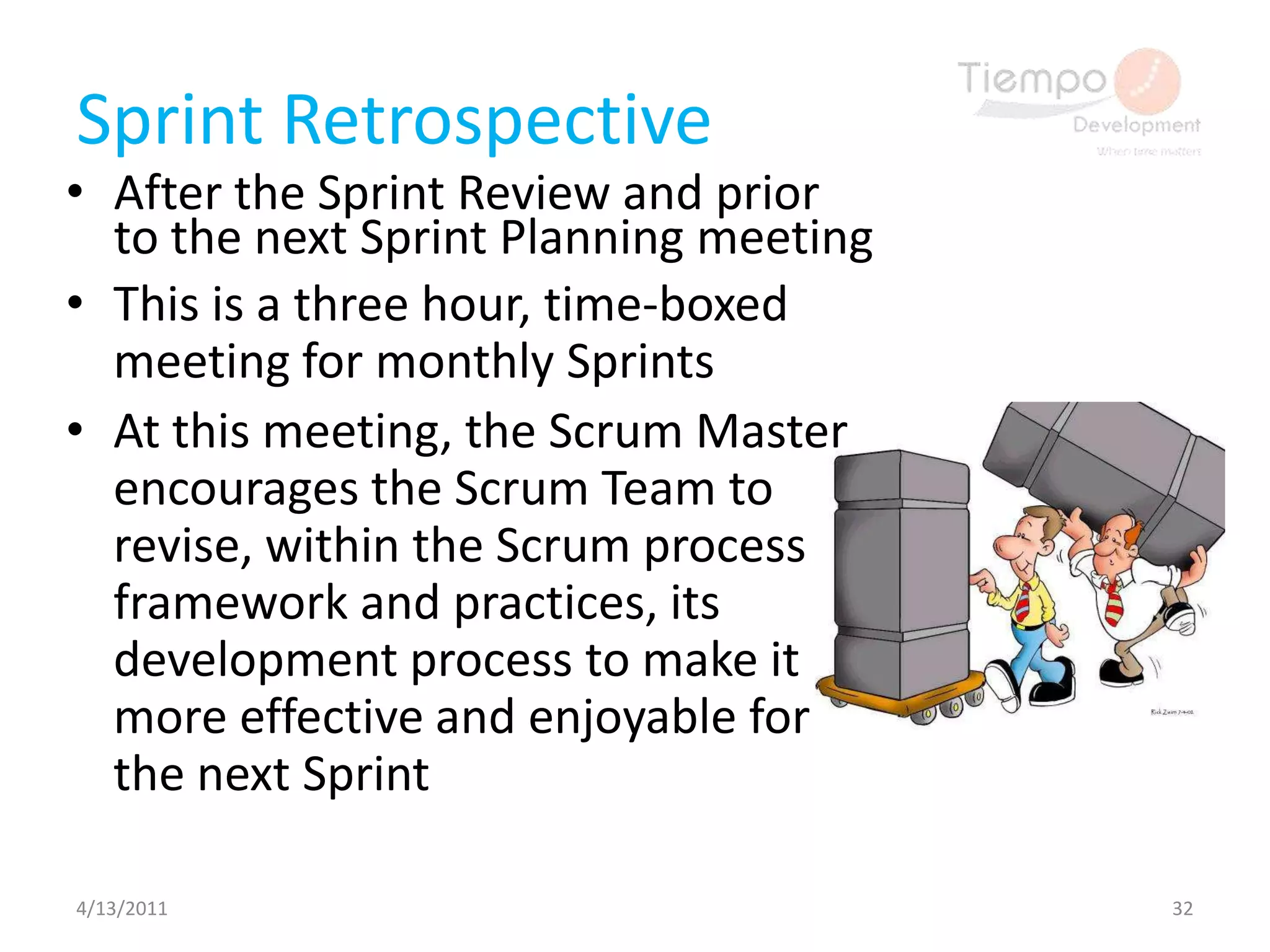
    Sprint Retrospective4/13/201132After theSprint Review and prior to the next Sprint Planning meeting This is a three hour, time-boxed meeting for monthly SprintsAt this meeting, the Scrum Master encourages the Scrum Team to revise, within the Scrum process framework and practices, its development process to make it more effective and enjoyable for the next Sprint
  • 73.
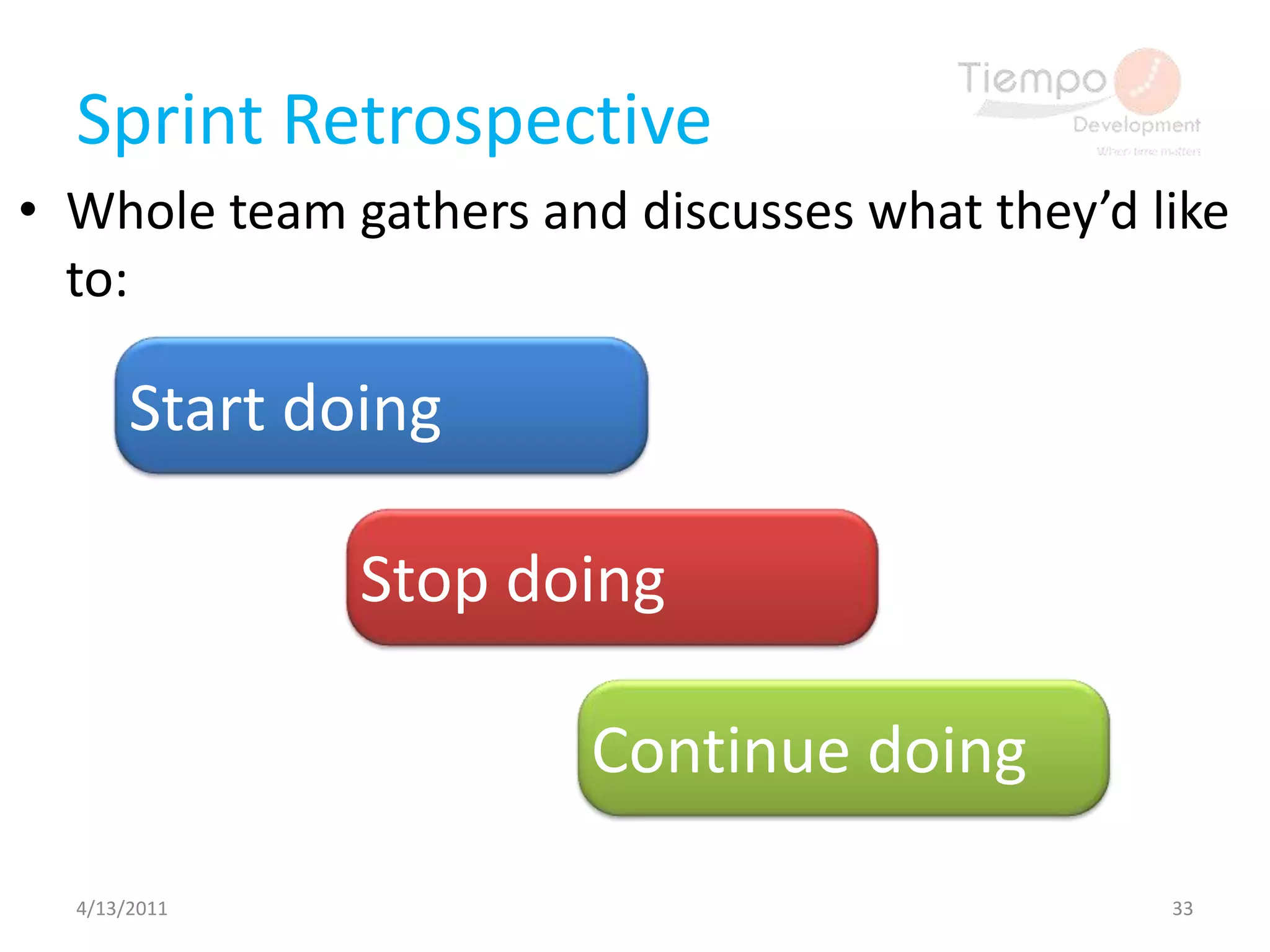
    Sprint Retrospective4/13/201133Whole teamgathers and discusses what they’d like to:Start doingStop doingContinue doing
  • 74.
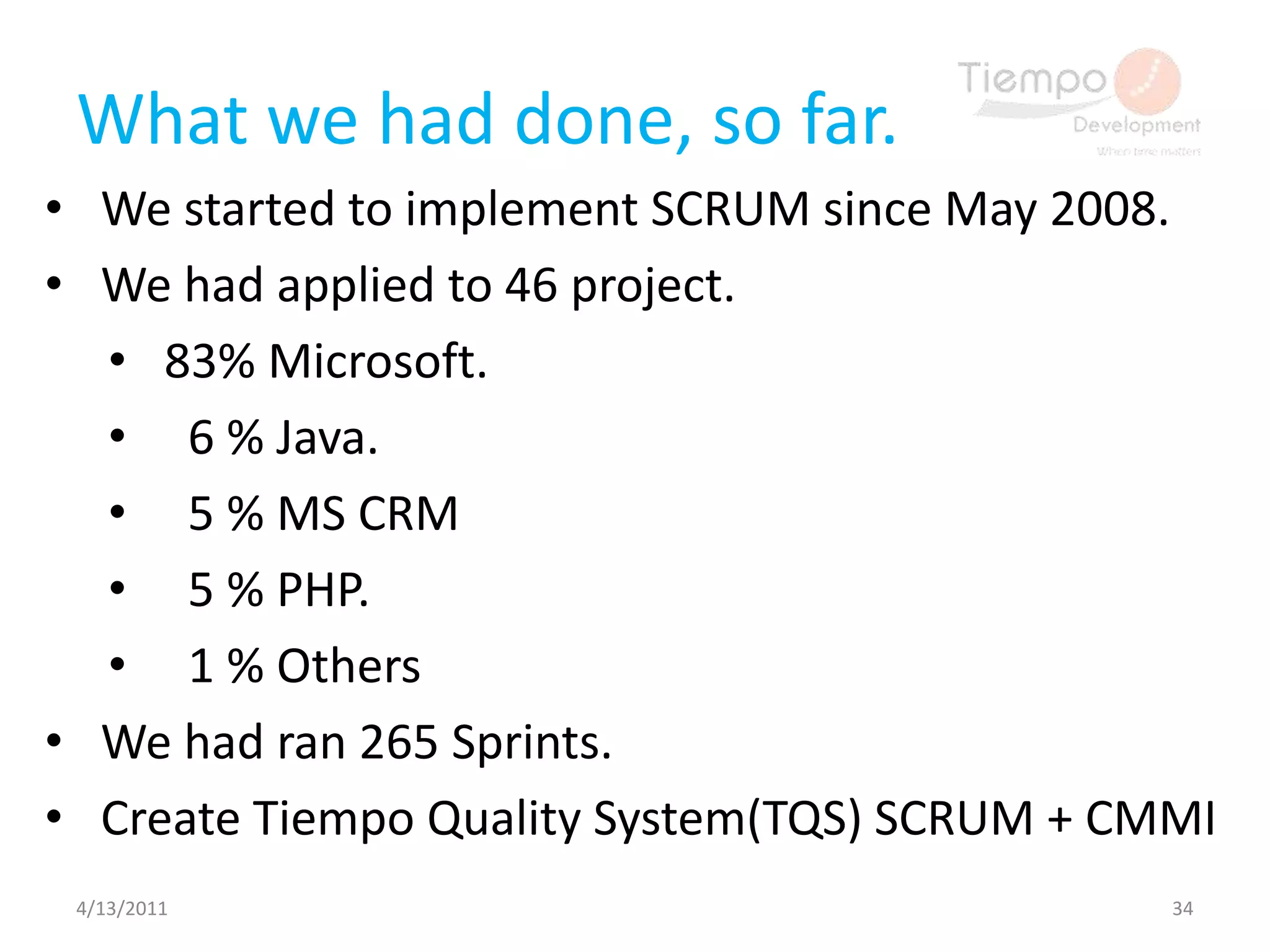
    What we haddone, so far.4/13/201134We started to implement SCRUM since May 2008.
  • 75.
    We had appliedto 46 project.
  • 76.
  • 77.
    6% Java.
  • 78.
    5% MS CRM
  • 79.
    5% PHP.
  • 80.
    1% Others
  • 81.
    We had ran265 Sprints.
  • 82.
    Create Tiempo QualitySystem(TQS) SCRUM + CMMISome portions of this presentation where taken from the distributable introduction to Scrum of Mountain Goat Software.
  • 83.