
The document provides an overview of Agile and Scrum frameworks. It describes the key challenges with traditional software development approaches and how Agile and Scrum address these challenges through incremental delivery, frequent feedback, and transparency. It outlines the core components of Scrum including roles, ceremonies, and artifacts like product backlog, sprint backlog and burn down charts. Scrum uses short iterative cycles called sprints to incrementally develop working software and gather feedback to continuously improve.
In this document
Powered by AI
Introduction to Agile/Scrum with agenda covering concepts like roles, process, and artifacts.
Traditional software development faces issues like late feedback and lack of flexibility, necessitating agile.
Agile promotes rapid delivery and collaboration, focusing on incremental improvements and business value.
The Agile Manifesto emphasizes values like collaboration and responsiveness over strict process adherence.
Scrum is an Agile framework focusing on delivering high business value in short iterations or sprints.
Scrum characteristics include self-organizing teams, sprints, and artifacts like backlogs; Key scrum roles defined.
Roles in Scrum: Product Owner, Scrum Master, and Scrum Team with responsibilities for project success.
Scrum ceremonies include Sprint Planning, Daily Scrum, Sprint Review, and Retrospectives for continuous improvement.
Key artifacts in Scrum include Product Backlog, Sprint Backlog, Burn down Charts, facilitating project transparency.
Advantages of Scrum include productivity and flexibility; drawbacks include risks of insufficient documentation.
Agile / ScrumOverview
Date – March 6th , 2016
Madan Upadhyay, Scrum Master |Agile Coach PMP, CSM, SAFe
2.
Take AwayTake Away
Agile Overview
Why Scrum?
Functionality of Scrum
Components of Scrum
Scrum Roles
The Process
Scrum Artifacts
Q & A Session
3.
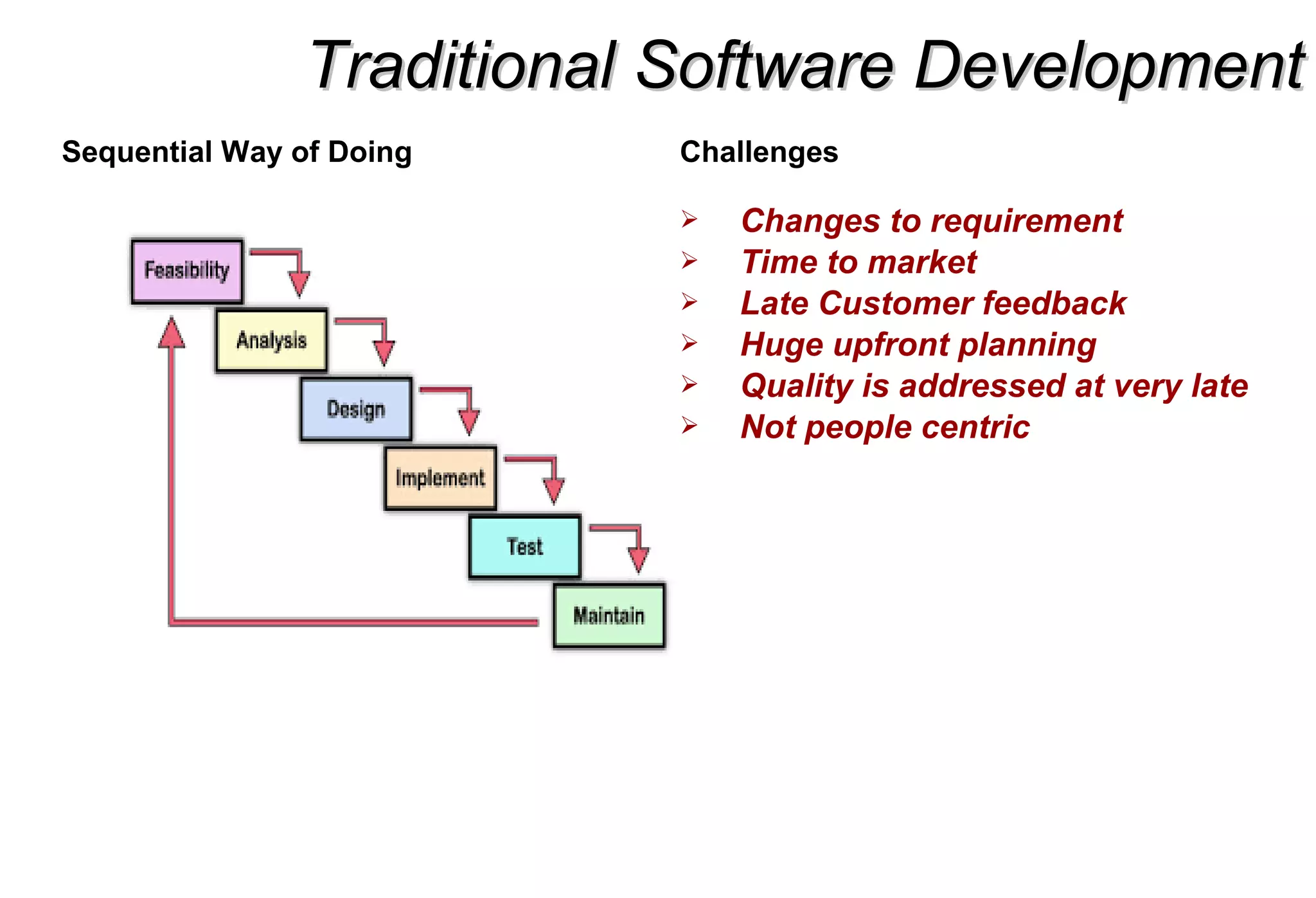
Traditional Software DevelopmentTraditionalSoftware Development
Sequential Way of Doing Challenges
Changes to requirement
Time to market
Late Customer feedback
Huge upfront planning
Quality is addressed at very late
Not people centric
AgileAgile
Agile a wayof delivering greatest business value by fastest
way that make sense to business by a group of motivated
cross functional people in highly collaborative environment
Communication, Communication, and Communication
Collaboration, Collaboration, and Collaboration
Interaction, Interaction, and Interaction
7.
AgileAgile
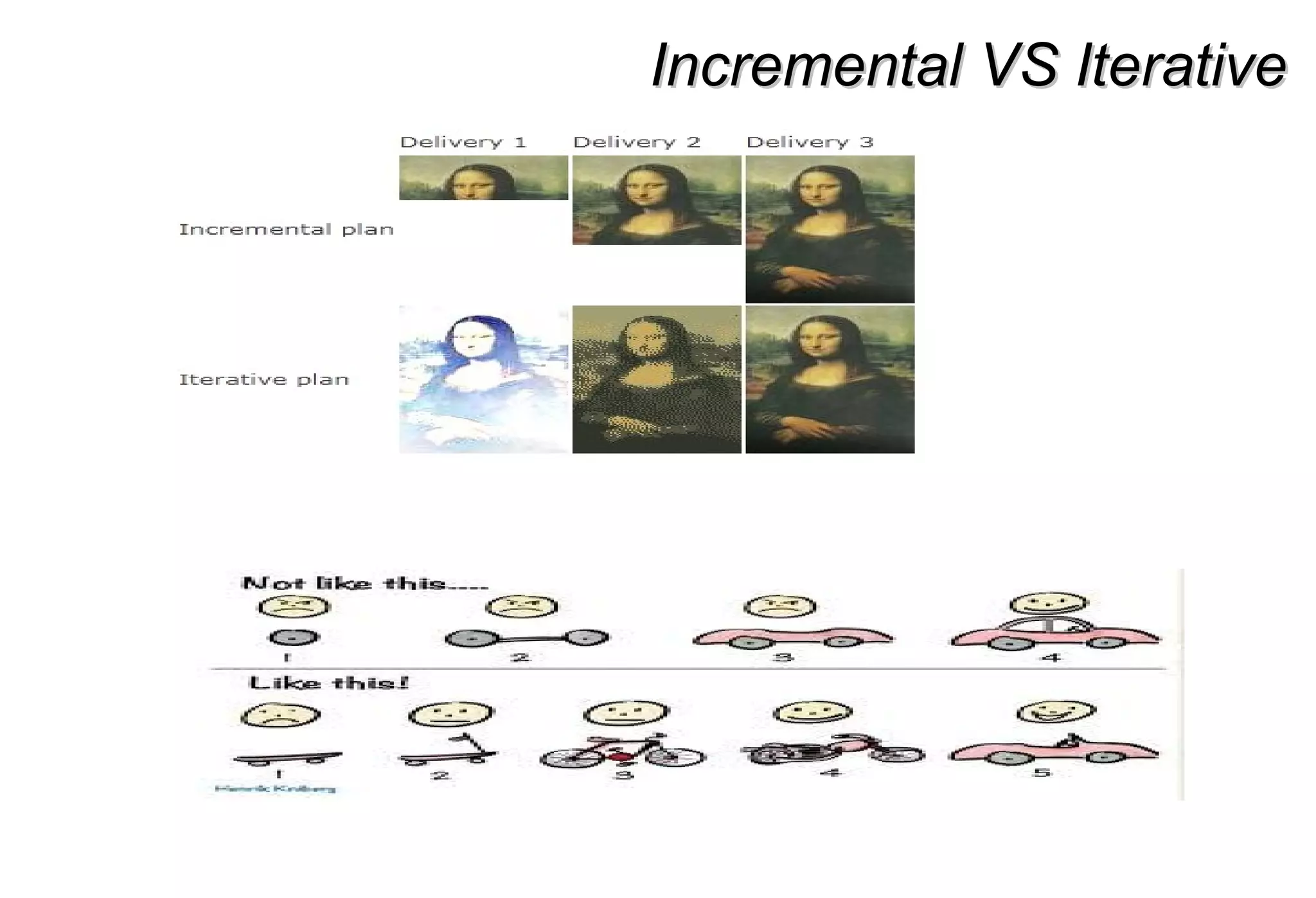
Incremental / IterativeOpportunities
Responding to change
Time to Market
Frequent Feedback
Continuous Improvement
Highly Transparent
People Centric
Deliver value fast
Faster, cheaper, better
8.
More FactsMore Facts
WhyPeople Choose – Top 3 Reasons
IT project Success rate
Three key motivators
Software development paradigm
9.
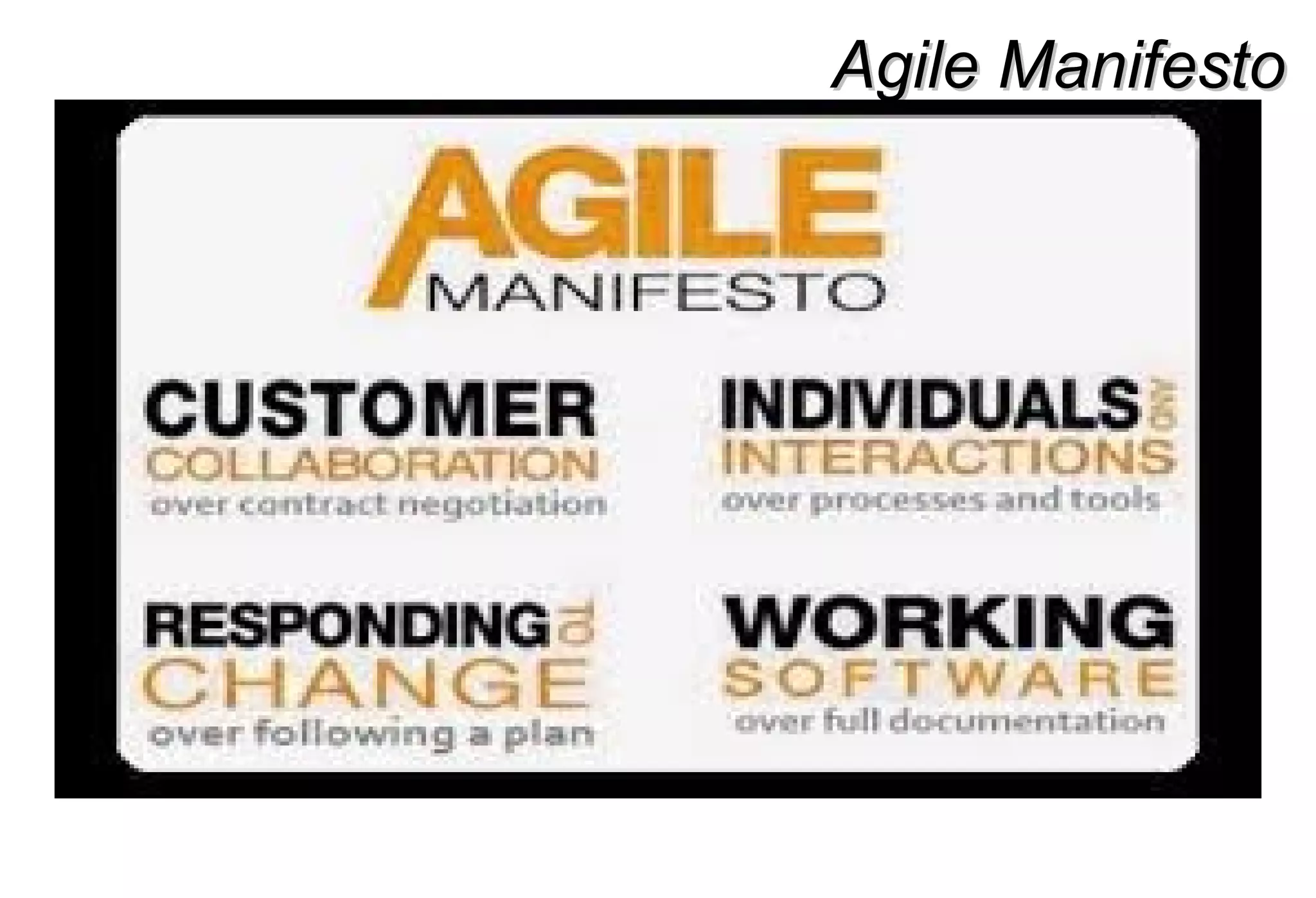
Agile ManifestoAgile Manifesto
AStatement of Values
Individuals and interactions over processes and tools
Working software over comprehensive documentation
Customer collaboration over contract negotiation
Responding to change over following a plan
http://www.agilemanifesto.org
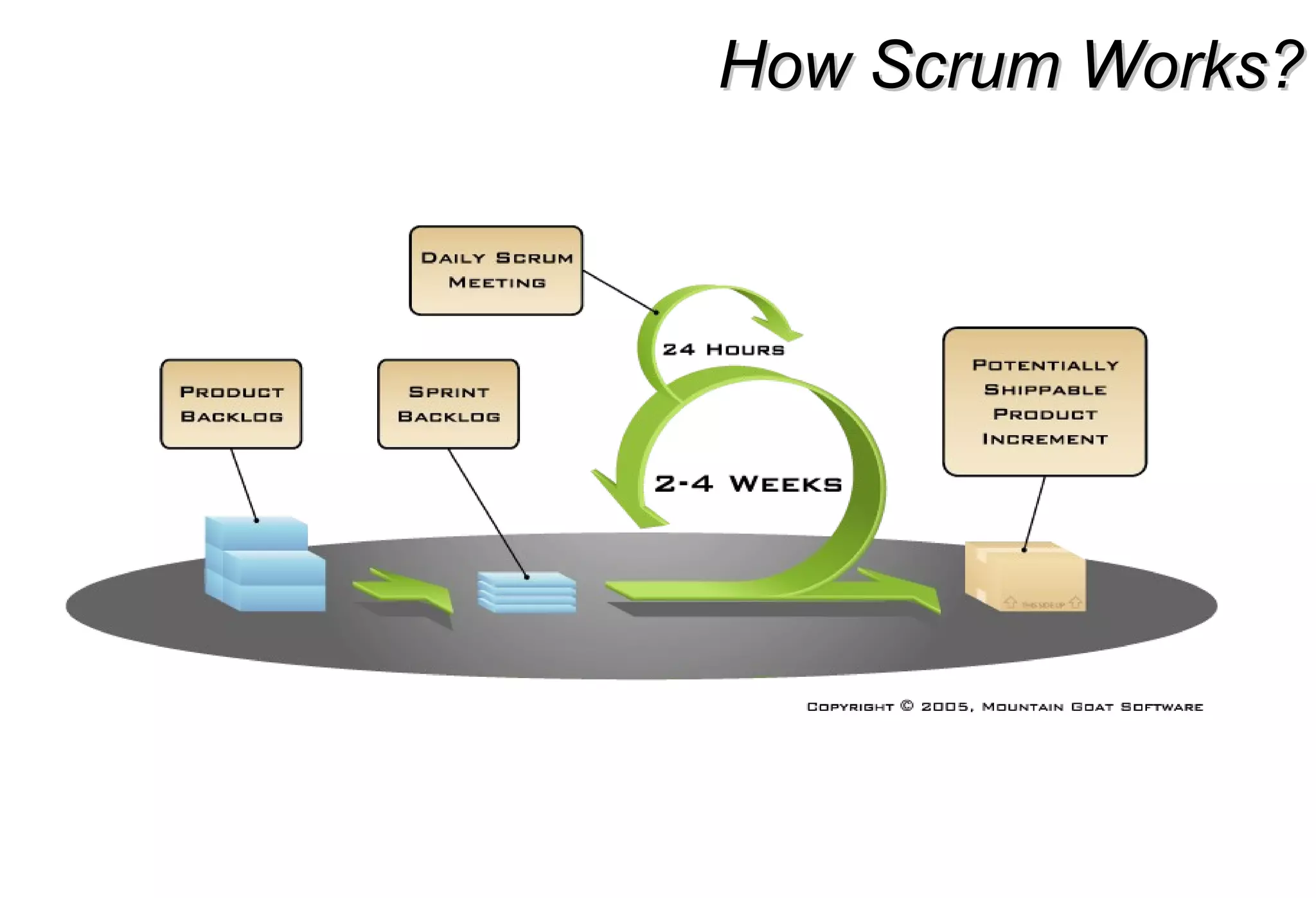
Scrum in 100wordsScrum in 100 words
Scrum is an agile process that allows us to focus on delivering
the highest business value in the shortest time.
It allows us to rapidly and repeatedly inspect actual working
software (every two weeks to one month).
The business sets the priorities. Our teams self-manage to
determine the best way to deliver the highest priority
features.
Every two weeks to a month anyone can see real working
software and decide to release it as is or continue to
enhance for another iteration.
13.
CharacteristicsCharacteristics
Self-organizing teams
Product progresses in a series of month-long “sprints”
Requirements are captured as items in a list of “product
backlog”
No specific engineering practices prescribed
Cross function team
SprintsSprints
Scrum projectsmake progress in a series of
“sprints”
Analogous to XP iterations
Target duration is one month
+/- a week or two
But, a constant duration leads to a better rhythm
Product is designed, coded, and tested during the
sprint
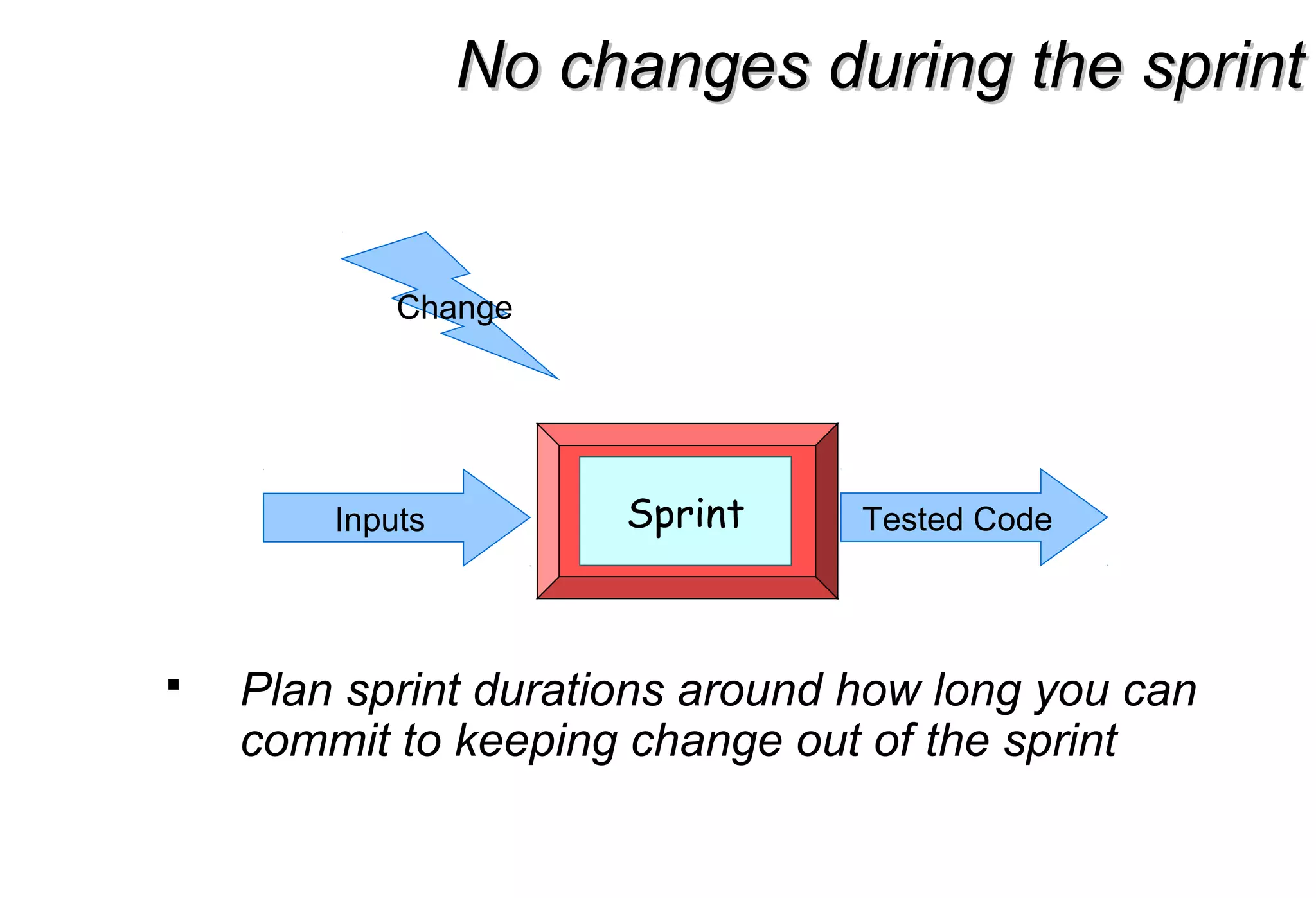
No changes duringthe sprintNo changes during the sprint
SprintInputs Tested Code
Change
Plan sprint durations around how long you can
commit to keeping change out of the sprint
Product OwnerProduct Owner
Define the features of the product
Decide on release date and content
Be responsible for the profitability of the product
(ROI)
Prioritize features according to market value
Adjust features and priority every iteration, as
needed
Accept or reject work results.
22.
The Scrum MasterTheScrum Master
Represents management to the project
Responsible for enacting Scrum values and practices
Removes impediments
Ensure that the team is fully functional and productive
Enable close cooperation across all roles and functions
Shield the team from external interferences
23.
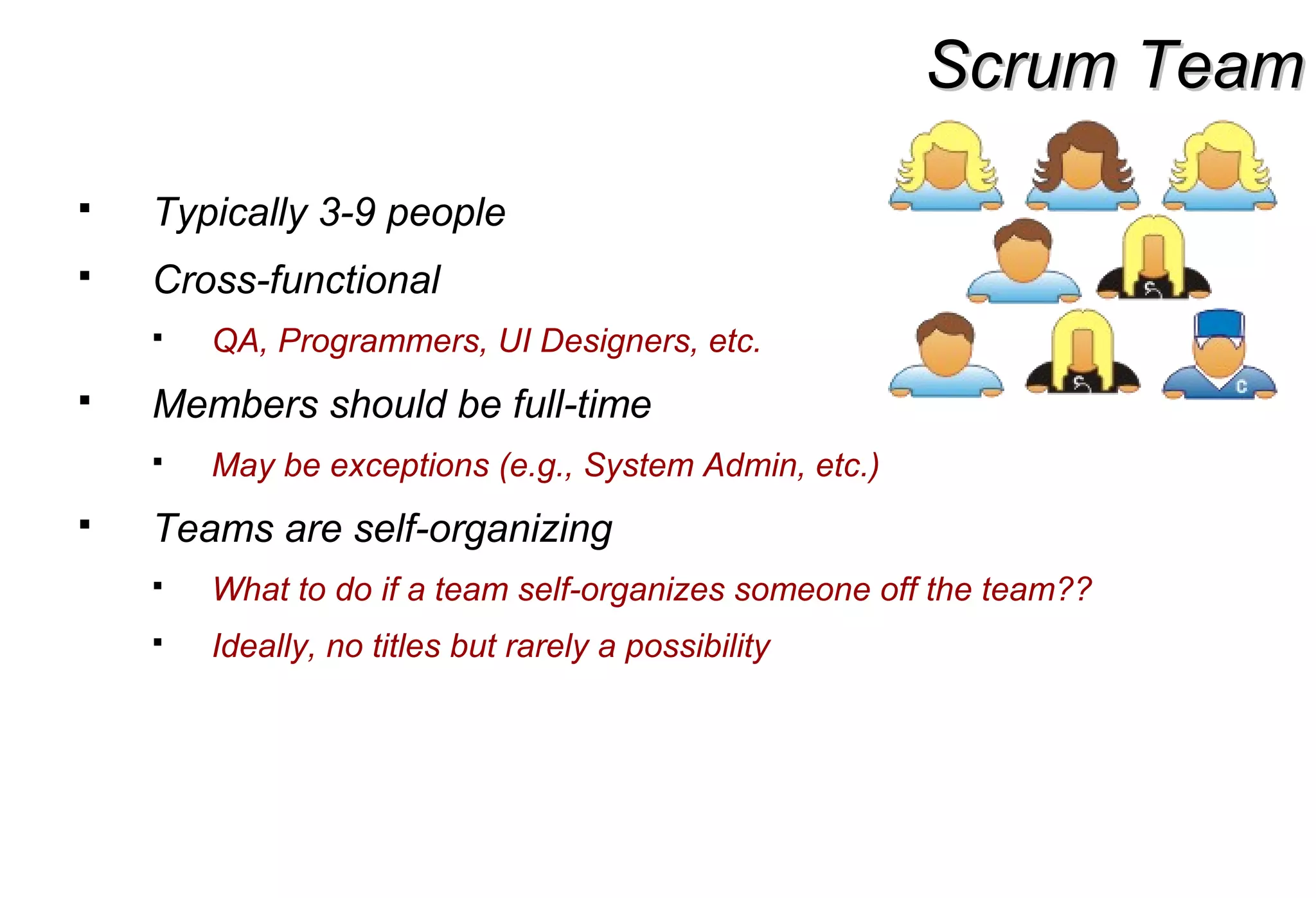
Scrum TeamScrum Team
Typically 3-9 people
Cross-functional
QA, Programmers, UI Designers, etc.
Members should be full-time
May be exceptions (e.g., System Admin, etc.)
Teams are self-organizing
What to do if a team self-organizes someone off the team??
Ideally, no titles but rarely a possibility
Spring Planning MeetingSpringPlanning Meeting
Sprint Planning
Meeting
Prioritization
Planning
Product Backlog
Team Capabilities
Business Conditions
Technology
Current Product
Sprint Backlog
ProductO
wnerScrum
Team
M
anagem
ent
Custom
ers
Sprint Goal
26.
Parts of SprintPlanning MeetingParts of Sprint Planning Meeting
1st
Part:
Selection from Product Backlog
Determining the Sprint Goal.
Commitment
2nd
Part:
Creating Sprint Backlog
Tasking
Participants: Product Owner, Scrum Master, Scrum Team
27.
Daily ScrumDaily Scrum
Parameters
Daily
15-minutes
Stand-up
Not for problem solving
Three questions:
1. What did you do yesterday
2. What will you do today?
3. What obstacles are in your way?
Chickens and pigs are invited
Help avoid other unnecessary meetings
Only pigs can talk
28.
Daily ScrumDaily Scrum
Is NOT a problem solving session
Is NOT a way to collect information about WHO is
behind the schedule
Is a meeting in which team members make
commitments to each other and to the Scrum
Master
Is a good way for a Scrum Master to track the
progress of the Team
29.
Sprint Review MeetingSprintReview Meeting
Team presents what it accomplished
during the sprint
Typically takes the form of a demo of
new features or underlying
architecture
Informal
2-hour prep time rule
Participants
Customers
Management
Product Owner
Other engineers
30.
Sprint Retrospective MeetingSprintRetrospective Meeting
Continuous Improvement
Feedback meeting
Three questions
Start
Stop
Continue
Small Improvement and action items
Product BacklogProduct Backlog
Alist of all desired work on the project
Wish list for product owner
All the work come from Product backlog.
List is prioritized by the Product Owner
PO always groom the list to ensure maximum business
value is delivered
Product backlog contains list of stories i.e. requirement
Product backlog is estimated in story points
33.
User StoriesUser Stories
Usedto capture a description of a software feature
from an end-user perspective.
Template
As a <type of user>,
I want <some goal>
so that <some reason>.
As a user
I want an email notification
So that I safeguard my account
34.
From Sprint Goalto Sprint BacklogFrom Sprint Goal to Sprint Backlog
Scrum team takes the Sprint Goal and decides
what tasks are necessary
Team self-organizes around how they’ll meet the
Sprint Goal
Manager doesn’t assign tasks to individuals
Managers don’t make decisions for the team
Sprint Backlog is created
35.
Stories PointsStories Points
Isan estimate of the relative complexity of a story.
effort required to implement a story
Not In hours/Days rather abstract / relative
T-Shirt sizing, Fibonacci series used
Defer commitment
Sprint Burn downChartSprint Burn down Chart
Depicts the total Sprint Backlog hours remaining
per day
Shows the estimated amount of time to release
Ideally should burn down to zero to the end of the
Sprint
Actually is not a straight line
Can bump UP
Pros/ConsPros/Cons
Advantages
Completelydeveloped and
tested features in short
iterations
Simplicity of the process
Clearly defined rules
Increasing productivity
Self-organizing
each team member carries
a lot of responsibility
Improved communication
Combination with Extreme
Programming
Drawbacks
“Undisciplined hacking” (no
written documentation)
Violation of responsibility
Current mainly carried by
the inventors
#5 Agile development is an alternative to traditional project management where emphasis is placed on empowering people to collaborate and make team decisions in addition to continuous planning, continuous testing and continuous integration.
It helps teams respond to unpredictability through incremental, iterative work cadences, known as sprints. Agile methodologies are an alternative to waterfall, or traditional sequential development.
#6 Agile development is an alternative to traditional project management where emphasis is placed on empowering people to collaborate and make team decisions in addition to continuous planning, continuous testing and continuous integration.
It helps teams respond to unpredictability through incremental, iterative work cadences, known as sprints. Agile methodologies are an alternative to waterfall, or traditional sequential development.
#7 Agile development is an alternative to traditional project management where emphasis is placed on empowering people to collaborate and make team decisions in addition to continuous planning, continuous testing and continuous integration.
It helps teams respond to unpredictability through incremental, iterative work cadences, known as sprints. Agile methodologies are an alternative to waterfall, or traditional sequential development.
#18 Incremental build – build one part of completely at a time based on the original idea
Iterative – build a rough version , validate this and continue building blinding more quality and functionality in it.