Research Inventy: International Journal of Engineering And Science 
Vol.4, Issue 8 (August 2014), PP 61-69 
Issn (e): 2278-4721, Issn (p):2319-6483, www.researchinventy.com 
61 
Common Fixed Theorems Using Random Implicit Iterative 
Schemes 
Renu Chugh1 Rekha Rani2 and Satish Narwal3 
1, 2Department of Mathematics, MDU, Rohtak-124001. 
3S. J. K. College, Kalanaur, Rohtak 
Corressponding author:rekhadalal93@gmail.com 
ABSTRACT : The aim of this paper is to prove two convergence theorems of two random implicit iterative 
schemes to a common random fixed point in Banach spaces. 
MATHEMATICS SUBJECT CLASSIFICATION: 47H10, 54H25 
KEY WORDS: Contractive Mappings, Implicit Iterative Schemes, Measurable Mappings, Separable Banach 
Spaces. 
I. INTRODUCTION AND PRELIMINARIES 
Random approximations and random fixed point theorems are stochastic generalizations of classical 
approximations and fixed point theorems. Random fixed point theory was initiated by the Prague school of 
probabilities in the works of Hans [12] and Spacek [2]. Fixed point iterative schemes for nonlinear operators on 
Banach and Hilbert spaces were studied and improved by many authors in recent times. The development of 
random fixed point iterative schemes was initiated by Choudhary in [4] where random Ishikawa iterative 
scheme was defined and its strong convergence to a random fixed point in Hilbert spaces was discussed. After 
that several authors [1, 9, 13, 14, 15, 19] have worked on random fixed point iterations to obtain fixed points in 
deterministic operator theory. Then Chugh et al.[16] defined and proved the convergence of random SP iterative 
scheme 
The following iterative schemes are now well known: 
Random Mann iterative scheme [3]: 
          1 1 , , n n n n n x w x w T w x w       fo r n  0 , w   , (1.1) 
where 0 1 n    and 0 x :   F is an arbitrary measurable mapping. 
Random Ishikawa iterative scheme [4]: 
    1 (1 ) ( ) , ( ) , n n n n n x w x w T w y w       
  1     ,    , n n n n n y w    x w   T w x w fo r n  0 , w   , (1.2) 
where 0 , 1 n n     and 0 x :   F is an arbitrary measurable mapping. 
Random SP iterative scheme [16]: 
          
          
            
1 1 , , 
1 , , 
1 , fo r 0 , , 1 .3 
n n n n n 
n n n n n 
n n n n n 
x w y w T w y w 
y w z w T w z w 
z w x w T w x w n w 
      
     
       
Common Fixed Theorems Using Random… 
62 
where { n  }, { n  } and { n  } are sequences of positive numbers in [0,1] and x0 :   F is an arbitrary 
measurable mapping. 
In 2001, Xu and Ori [7], introduced the following implicit iterative scheme for a finite family of nonexpansive 
mappings {T1, T2, …., TN} from K to K, where K is a nonempty closed convex subset of a Hilbert space E. Let 
{αn} be a real sequence in (0, 1) and an initial point x1 ∈ C, 
1 1 0 1 1 1 
2 2 1 2 2 2 
N N N 1 N N N 
N 1 N 1 N N 1 1 N 1 
x x (1 ) T x , 
x x (1 ) T x , 
... 
x x (1 ) T x , 
x x (1 ) T x , 
... 
 
    
     
     
     
     
(1.4) 
It can also be written as 
n n n 1 n n n x x (1 ) T x ,       n ≥ 1, where n n (m o d N ) T  T (mod N takes the values in the set {1, 2, … , 
N}). They proved the weak convergence of the sequence {xn} defined by (1.4) to a common fixed point 
N 
i 
i 1 
p F F (T ) 
 
   
Corresponding to this, I. Beg and B. S. Thakur [8] defined general composite random implicit iterative scheme 
as follows: 
Let , :   i i S T C C , i = 1, 2, …, N be operators on a nonempty convex subset C of a separable 
Banach space X. Then the sequence   n x generated by random implicit scheme associated with Si or Ti is 
defined as follows: 
Let 0 x :   C be any given measurable mapping. 
  
  
  
1 1 0 1 1 1 
2 2 1 2 2 2 
N N N 1 N N N 
x ( t ) (1 ) x t S ( t , x ( t ) ) 
. 
. 
. 
x ( t ) (1 ) x t S ( t , x ( t ) )  
     
     
     
  
  
N 1 N 1 N N 1 1 N 1 
2 N 2 N 2 N 1 2 N N 2 N 
x ( t ) (1 ) x t S ( t , x ( t ) ) 
. 
. 
. 
x ( t ) (1 ) x t S ( t , x ( t ) ) 
. 
. 
    
 
     
     
(1.5) 
or
Common Fixed Theorems Using Random… 
63 
  
  
  
  
  
1 1 0 1 1 1 
2 2 1 2 2 2 
N N N 1 N N N 
N 1 N 1 N N 1 1 N 1 
2 N 2 N 2 N 1 2 N N 2 N 
x ( t ) (1 ) x t T ( t , x ( t ) ) 
. 
. 
. 
x ( t ) (1 ) x t T ( t , x ( t ) ) 
. 
. 
. 
x ( t ) (1 ) x t T ( t , x ( t ) ) 
. 
. 
 
    
 
     
     
     
     
     
(1.6) 
where { n }  [0,1] . 
Definition Let { 1 2 N T , T , ..., T } be a family of random asymptotically nonexpansive operators from 
  K  K , where K is a closed, convex subset of a separable Banach space E. Let 
N 
i 
i 1 
F R F (T ) 
 
    , 
where i R F (T ) is the set of all random fixed points of a random operator Ti for each i ∈ {1, 2,…, N}. Let 
0 :   K be any fixed measurable mapping and n { }  [0,1], then modified implicit random iterative 
scheme associated with Si is defined as follows: 
  
  
  
  
  
  
1 1 0 1 1 1 
2 2 1 2 2 2 
N N N 1 N N N 
2 
N 1 N 1 N N 1 1 N 1 
2 
2 N 2 N 2 N 1 2 N N 2 N 
2 N 1 2 N 1 2 N 2 N 1 1 
x ( t ) (1 ) x t S ( t , x ( t ) ) 
. 
. 
. 
x ( t ) (1 ) x t S ( t , x ( t ) ) 
. 
. 
. 
x ( t ) (1 ) x t S ( t , x ( t ) ) 
x ( t ) (1 ) x t S 
 
    
 
   
     
     
     
     
     
     
3 
2 N 1 ( t , x ( t ) ) , (1 .7 ) 
. 
. 
 
Similarly, modified implicit random iterative scheme associated with Ti, is defined as follows:
Common Fixed Theorems Using Random… 
64 
  
  
  
  
  
  
1 1 0 1 1 1 
2 2 1 2 2 2 
N N N 1 N N N 
2 
N 1 N 1 N N 1 1 N 1 
2 
2 N 2 N 2 N 1 2 N N 2 N 
2 N 1 2 N 1 2 N 2 
x ( t ) (1 ) x t T ( t , x ( t ) ) 
. 
. 
. 
x ( t ) (1 ) x t T ( t , x ( t ) ) 
. 
. 
. 
x ( t ) (1 ) x t T ( t , x ( t ) ) (1 .8 ) 
x ( t ) (1 ) x t 
 
    
 
  
     
     
     
     
     
     
3 
N 1 1 2 N 1 T ( t , x ( t ) ) , 
. 
. 
  
In this paper, we prove the convergence of two random implicit iterative schemes to a random common fixed 
point . Our result is generalization of the results in [16] and some other known results [10, 20] in the literature of 
fixed point theory. Firstly we give some definitions. 
Through this paper, ( , ) denotes a measurable space and X denotes a real Banach space. For any function 
T :  X  X we denote the n-th iterate T ( t , T ( t , . . . , T ( t , x ) ) ) of T by n 
T ( t , x ) . The letter I denotes the 
random mapping I :   X  X defined by I  , x   x and 0 
T  I . 
Definition 1.1 Let C be a nonempty subset of a separable Banach space X and T :   C  C be a random 
operator. Then T is said to be an asymptotically nonexpansive random operator if there exists a sequence of 
measurable functions : 1,  n r    with l im   1 n 
n 
r t 
  
 such that 
 ,   ,    
n n 
n T t x  T t y  r t x  y 
for all x , y  C , n  N and for each t   . 
Definition 1.2 A mapping f :   C is called measurable if   1 
f B C 
 
   for every Boral subset B 
of X. 
Definition 1.3 A function F :   C  C is called a random operator if F  . , x  :   C is measurable for 
every x  C . 
Definition 1.4 A measurable mapping g :   C is said to be random fixed point of the random operator 
F :   C  C , if F  w , g  w    g  w  for all w   . 
Definition 1.5 A random operator F :   C  C is said to be continuous if, for fixed w   , 
F  w , .  : C  C is continuous. 
Now, we prove our main results.
Common Fixed Theorems Using Random… 
65 
II. MAIN RESULTS 
Theorem 2.1 Let X be a separable Banach space and C be a nonempty, closed and convex subset of X . Let 
, :   i j S T C C , i, j ∈ {1, 2,…, N} be random operators defined on C such that at least one of the 
following conditions hold for all x , y  C and t   : 
    
        
      
          
( i ) t , t , 
t , t , t , t , , 
0 , 0 , 0 ,1 0 . 
i i t , t , 
m a x , t , t , , t , t , , 
0 1 . 
  
             
    
      
  
       
  
i j 
i j j i 
i j 
i j j i 
S x T y 
a x y b x S x y T y c x T y y S x 
a b c b c 
S x T y 
q x y x S x y T y x T y y S x 
q 
      
          
      
          
i i i t , t , 
m a x , t , , t , , t , , t , , 
, 0 , 0 1 . 
iv t , t , 
m a x , t , , t , , t , , t , , 
0 1 . 
  
       
      
  
     
  
i j 
i j j i 
i j 
i j j i 
S x T y 
x y x S x y T y x T y y S x 
S x T y 
q x y x S x y T y x T y y S x 
q 
If the random implicit iterative scheme associated with (1.5) or (1.6), satisfying (i)-(iii) converges, then it 
converges to a common random fixed point of Si and Tj. Further, if (iv) holds, then this common fixed point will 
be unique. 
Proof. Let us assume that the sequence  n x defined by (1.5) has a pointwise limit, that is, 
lim     , 
  
 n 
n 
x t u t for all t   . As X is a separable Banach space, the mapping x  t   A  t , f  t   is 
measurable mapping [6] for any random operator A :   C  X and any measurable mapping f :   C . 
Now, the sequence   n x constructed by the random implicit iterative schemes (1.5) and (1.6) is a 
sequence of measurable mappings as x  t  
is measurable and C is convex. Therefore, x :   C is also 
measurable, being limit of a sequence measurable mappings. 
First of all we assume that  t ,       i S x t x t for x  t   C . Then after putting x  t   y  t   u  t  
into any of the inequalities  i    iv  , it is easy to see that  t ,       . j T u t u t In a similar manner 
 t , ( )     j T u t u t implies  t , ( )     i S u t u t 
Suppose the sequence   n x generated by implicit iterative scheme associated with i S converges to u, that is, 
lim     . 
  
 n 
n 
x t u t Then, from (1.5), we have 
          1 1 1 1 1 t , x        n n n n i n x t  x t  S t . Since n 
n 
lim x ( t ) u ( t ) , 
  
 so we have 
n 1 n x ( t ) x ( t ) 0 .    Using it, we obtain       1 t , x 0    n i n x t S t . From which, it follows that 
      1 t , x 0    i n u t S t 
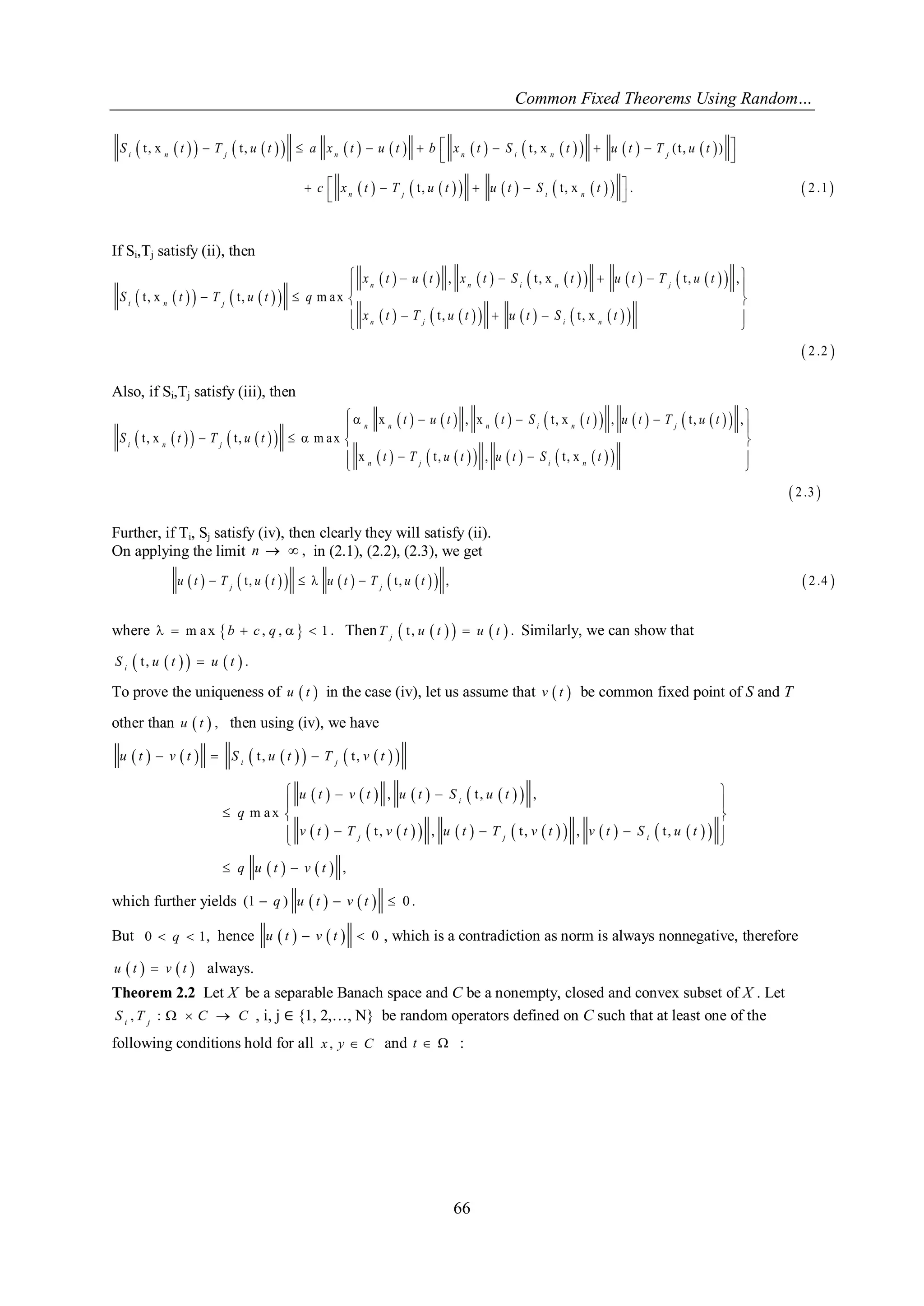
If Si, Tj satisfy (i), then
Common Fixed Theorems Using Random… 
66 
                      
              
t , x t , t , x ( t , ) 
t , t , x . 2 .1 
         
  
      
  
i n j n n i n j 
n j i n 
S t T u t a x t u t b x t S t u t T u t 
c x t T u t u t S t 
If Si,Tj satisfy (ii), then 
        
                
            
  
, t , x t , , 
t , x t , m a x 
t , t , x 
2 .2 
      
  
    
     
  
n n i n j 
i n j 
n j i n 
x t u t x t S t u t T u t 
S t T u t q 
x t T u t u t S t 
Also, if Si,Tj satisfy (iii), then 
        
                
            
  
x , x t , x , t , , 
t , x t , m a x 
x t , , t , x 
2 .3 
      
  
     
    
  
n n n i n j 
i n j 
n j i n 
t u t t S t u t T u t 
S t T u t 
t T u t u t S t 
Further, if Ti, Sj satisfy (iv), then clearly they will satisfy (ii). 
On applying the limit n   , in (2.1), (2.2), (2.3), we get 
    t ,          t ,    ,  2 .4  j j u t T u t u t T u t 
where   m a x b  c , q ,    1 . Then  t ,       . j T u t u t Similarly, we can show that 
 t ,       . i S u t u t 
To prove the uniqueness of u  t  in the case (iv), let us assume that v  t  be common fixed point of S and T 
other than u  t  , then using (iv), we have 
            
          
                  
    
t , t , 
, t , , 
m a x 
t , , t , , t , 
, 
   
    
  
   
     
  
  
i j 
i 
j j i 
u t v t S u t T v t 
u t v t u t S u t 
q 
v t T v t u t T v t v t S u t 
q u t v t 
which further yields (1  q ) u  t   v  t   0 . 
But 0  q  1, hence u  t   v  t   0 , which is a contradiction as norm is always nonnegative, therefore 
u  t   v  t  always. 
Theorem 2.2 Let X be a separable Banach space and C be a nonempty, closed and convex subset of X . Let 
, :   i j S T C C , i, j ∈ {1, 2,…, N} be random operators defined on C such that at least one of the 
following conditions hold for all x , y  C and t   :
Common Fixed Theorems Using Random… 
67 
    
        
      
          
( i ) t , t , 
t , t , t , t , , 
0 , 0 , 0 ,1 0 . 
i i t , t , 
m a x , t , t , , t , t , , 
0 1 . 
  
             
    
      
  
       
  
i j 
i j j i 
i j 
i j j i 
S x T y 
a x y b x S x y T y c x T y y S x 
a b c b c 
S x T y 
q x y x S x y T y x T y y S x 
q 
      
          
      
          
i i i t , t , 
m a x , t , , t , , t , , t , , 
, 0 , 0 1 . 
iv t , t , 
m a x , t , , t , , t , , t , , 
0 1 . 
  
       
      
  
     
  
i j 
i j j i 
i j 
i j j i 
S x T y 
x y x S x y T y x T y y S x 
S x T y 
q x y x S x y T y x T y y S x 
q 
If the random implicit iterative scheme associated with (1.7) or (1.8) satisfying (i)-(iii) converges, then it 
converges to a common random fixed point of Si and Tj. Further, if (iv) holds, then this common fixed point will 
be unique. 
Proof. Let us assume that the sequence  n x defined by (1.7) has a pointwise limit, that is, 
lim     , 
  
 n 
n 
x t u t for all t   . As X is a separable Banach space, the mapping x  t   A  t , f  t   is 
measurable mapping [6] for any random operator A :   C  X and any measurable mapping f :   C . 
Now, the sequence   n x constructed by the random implicit iterative scheme (1.7) and (1.8) is a sequence 
of measurable mappings as x  t  
is measurable and C is convex. Therefore, x :   C is also measurable, 
being limit of a sequence measurable mappings. 
First of all we assume that  t ,       i S x t x t for x  t   C . Then after putting x  t   y  t   u  t  into 
any of the inequalities  i    iv  , it is easy to see that  t ,       . j T u t u t In a similar manner 
 t , ( )     j T u t u t implies  t , ( )     i S u t u t 
Suppose the sequence   n x generated by implicit iterative scheme associated with i S converges to u, that is, 
lim     . 
  
 n 
n 
x t u t Then, from (1.7) we have 
          1 1 1 1 1 t , x        
j 
n n n n i n x t  x t  S t . Since n 
n 
lim x ( t ) u ( t ) , 
  
 so we have 
n 1 n x ( t ) x ( t ) 0 .    Using it, we obtain       1 t , x 0    n i n x t S t . From which, it follows that 
      1 t , x 0    
j 
i n u t S t 
If Si, Tj satisfy (i), then 
                      
              
t , x t , t , x ( t , ) 
t , t , x . 2 .5 
         
  
      
  
i n j n n i n j 
n j i n 
S t T u t a x t u t b x t S t u t T u t 
c x t T u t u t S t 
If Si,Tj satisfy (ii), then
Common Fixed Theorems Using Random… 
68 
        
                
            
  
, t , x t , , 
t , x t , m a x 
t , t , x 
2 .6 
      
  
    
     
  
n n i n j 
i n j 
n j i n 
x t u t x t S t u t T u t 
S t T u t q 
x t T u t u t S t 
Also, if Si,Tj satisfy (iii), then 
        
                
            
  
x , x t , x , t , , 
t , x t , m a x 
x t , , t , x 
2 .7 
      
  
     
    
  
n n n i n j 
i n j 
n j i n 
t u t t S t u t T u t 
S t T u t 
t T u t u t S t 
Further, if Ti, Sj satisfy (iv), then clearly they will satisfy (ii). 
On applying the limit n   , in (2.5), (2.6), (2.7), we get 
    t ,          t ,    ,  2 .8  j j u t T u t u t T u t 
where   m a x b  c , q ,    1 . Then  t ,       . j T u t u t Similarly, we can show that 
 t ,       . i S u t u t 
To prove the uniqueness of u  t  in the case (iv), let us assume that v  t  be common fixed point of S and T 
other than u  t  , then using (iv) we have 
            
          
                  
    
t , t , 
, t , , 
m a x 
t , , t , , t , 
, 
   
    
  
   
     
  
  
i j 
i 
j j i 
u t v t S u t T v t 
u t v t u t S u t 
q 
v t T v t u t T v t v t S u t 
q u t v t 
which further yields (1  q ) u  t   v  t   0 . 
But 0  q  1, hence u  t   v  t   0 , which is a contradiction as norm is always nonnegative, therefore 
u  t   v  t  always. 
REFERENCES 
[1] A. R. Khan, A. B. Thaheem and N. Hussion, Random fixed points and random approximations in nonconvex domains, J. Appl. 
Math. Stoch. Anal.,15(2002), no. 3, 263-270. 
[2] A. Spacek, Zuffalige gleichungen, Czech. Math. Jour., 5(80) (1955), 462-466. 
[3] B. S. Choudhury, Random Mann iteration scheme, Appl. Math. Lett. 16 (2003), 93-96. 
[4] B. S Choudhury, Convergence of a random iteration scheme to a random fixed point, J. Appl. Math. Stochastic Anal. 8 (1995), no. 
2, 139–142. 
[5] B. S Choudhury,. and A. Upadhyay, An iteration leading to random solutions and fixed points of operators, Soochow J. Math. 25 
(1999), no. 4, 395–400. 
[6] C. J. Himmelberg, Measurable relations. Fund. Math., 87(1975), 53-72. 
[7] H.K. Xu, R.G. Ori, An implicit iteration process for nonexpansive mappings, Numer. Fuct. Anal. Optim. 22 (2001) 767–773. 
[8] I. Beg and B. S. Thakur, Solution of random operator equations using general composite implicit iteration process, International 
journal of mathematics, 4(1) (2009), 19-34. 
[9] I. Beg and M. Abbas, Iterative procedures for solution of random equations in Banach spaces, J. Math. Anal. Appl., 315(2006), 
181-201. 
[10] L. J. Ciric, Quasi-contractions in Banach spaces, Publ. Inst. Math.,21(35)(1977), 41-48. 
[11] M. Abbas, M. Jovanovic, S. Radenovic, A. Sretenovic and Suzana Simic, Abstract metric spaces and approximating fixed points of 
a pair of contractive type mappings, Journal of Computational Analysis and Applications, vol. 13, no. 2, (2011), 243-253. 
[12] O. Hans, Random fixed point theorems, Transactions of the 1st Prague Conf. on Information Theory, Statistics, Decision Eunctions 
and Random Processes, Czeschosl. Acad. Sci., Prague (1957), 105-125. 
[13] R. A. Rashwan, A Common Fixed Point Theorem Of Two Random Operators Using Random Ishikawa Iteration Scheme, Bulletin of 
International Mathematical Virtual Institute, Vol. 1(2011), 45-51.
Common Fixed Theorems Using Random… 
69 
[14] R. A. Rashwan, On the convergence of Mann iterates to a common fixed point for a pair of mappings, Demonstratio Math., Vol. XXIII, No. 3 (1990), 709- 712. 
[15] R. A. Rashwan, On the convergence of Ishikawa iterates to a common fixed point for a pair of mappings, Dcmonstratio Math., Vol. XXVIII No. 2 (1995), 271-274. 
[16] R. Chugh, , S. Narwal, and V. Kumar, , Convergence of Random SP Iterative Scheme, Applied Mathematical Sciences, Vol. 7, 2013, no. 46, 2283 – 2293. 
[17] R. Chugh and V. Kumar, Strong convergence of SP iterative scheme for quasi-contractive operators, International Journal of Computer Applications volume 31, no.5,October 2011. 
[18] R. Chugh and V. Kumar, Convergence of SP iterative scheme with mixed errors for accretive Lipschitzian and strongly accretive Lipschitzian operators in Banach space, International Journal of Computer Mathematics(Accepted). 
[19] R. Parsal, M. S. Rathore and R. S. Chandel, On a common fixed point of two Random operators using Random Mann iteration scheme, Fasciculi Math., No. 42(2009), 85-89. 
[20] S. S. Chang, On the approximating problem of fixed points for astmptotically nonexpansive mappings, Indian J. Pure Appl. 32 (2001), 1–11. 
[21] W. Phuengrattana and S. Suantai, On the rate of convergence of Mann,Ishikawa,Noor and SP iterations for continuous functions on an arbitrary interval, Journal of Computational and Applied Mathematics,235(2011),3006-3014.

Common Fixed Theorems Using Random Implicit Iterative Schemes

  • 1.
    Research Inventy: InternationalJournal of Engineering And Science Vol.4, Issue 8 (August 2014), PP 61-69 Issn (e): 2278-4721, Issn (p):2319-6483, www.researchinventy.com 61 Common Fixed Theorems Using Random Implicit Iterative Schemes Renu Chugh1 Rekha Rani2 and Satish Narwal3 1, 2Department of Mathematics, MDU, Rohtak-124001. 3S. J. K. College, Kalanaur, Rohtak Corressponding author:rekhadalal93@gmail.com ABSTRACT : The aim of this paper is to prove two convergence theorems of two random implicit iterative schemes to a common random fixed point in Banach spaces. MATHEMATICS SUBJECT CLASSIFICATION: 47H10, 54H25 KEY WORDS: Contractive Mappings, Implicit Iterative Schemes, Measurable Mappings, Separable Banach Spaces. I. INTRODUCTION AND PRELIMINARIES Random approximations and random fixed point theorems are stochastic generalizations of classical approximations and fixed point theorems. Random fixed point theory was initiated by the Prague school of probabilities in the works of Hans [12] and Spacek [2]. Fixed point iterative schemes for nonlinear operators on Banach and Hilbert spaces were studied and improved by many authors in recent times. The development of random fixed point iterative schemes was initiated by Choudhary in [4] where random Ishikawa iterative scheme was defined and its strong convergence to a random fixed point in Hilbert spaces was discussed. After that several authors [1, 9, 13, 14, 15, 19] have worked on random fixed point iterations to obtain fixed points in deterministic operator theory. Then Chugh et al.[16] defined and proved the convergence of random SP iterative scheme The following iterative schemes are now well known: Random Mann iterative scheme [3]:           1 1 , , n n n n n x w x w T w x w       fo r n  0 , w   , (1.1) where 0 1 n    and 0 x :   F is an arbitrary measurable mapping. Random Ishikawa iterative scheme [4]:     1 (1 ) ( ) , ( ) , n n n n n x w x w T w y w         1     ,    , n n n n n y w    x w   T w x w fo r n  0 , w   , (1.2) where 0 , 1 n n     and 0 x :   F is an arbitrary measurable mapping. Random SP iterative scheme [16]:                                 1 1 , , 1 , , 1 , fo r 0 , , 1 .3 n n n n n n n n n n n n n n n x w y w T w y w y w z w T w z w z w x w T w x w n w                   
  • 2.
    Common Fixed TheoremsUsing Random… 62 where { n  }, { n  } and { n  } are sequences of positive numbers in [0,1] and x0 :   F is an arbitrary measurable mapping. In 2001, Xu and Ori [7], introduced the following implicit iterative scheme for a finite family of nonexpansive mappings {T1, T2, …., TN} from K to K, where K is a nonempty closed convex subset of a Hilbert space E. Let {αn} be a real sequence in (0, 1) and an initial point x1 ∈ C, 1 1 0 1 1 1 2 2 1 2 2 2 N N N 1 N N N N 1 N 1 N N 1 1 N 1 x x (1 ) T x , x x (1 ) T x , ... x x (1 ) T x , x x (1 ) T x , ...                          (1.4) It can also be written as n n n 1 n n n x x (1 ) T x ,       n ≥ 1, where n n (m o d N ) T  T (mod N takes the values in the set {1, 2, … , N}). They proved the weak convergence of the sequence {xn} defined by (1.4) to a common fixed point N i i 1 p F F (T )     Corresponding to this, I. Beg and B. S. Thakur [8] defined general composite random implicit iterative scheme as follows: Let , :   i i S T C C , i = 1, 2, …, N be operators on a nonempty convex subset C of a separable Banach space X. Then the sequence   n x generated by random implicit scheme associated with Si or Ti is defined as follows: Let 0 x :   C be any given measurable mapping.       1 1 0 1 1 1 2 2 1 2 2 2 N N N 1 N N N x ( t ) (1 ) x t S ( t , x ( t ) ) x ( t ) (1 ) x t S ( t , x ( t ) ) . . . x ( t ) (1 ) x t S ( t , x ( t ) )                     N 1 N 1 N N 1 1 N 1 2 N 2 N 2 N 1 2 N N 2 N x ( t ) (1 ) x t S ( t , x ( t ) ) . . . x ( t ) (1 ) x t S ( t , x ( t ) ) . .                (1.5) or
  • 3.
    Common Fixed TheoremsUsing Random… 63           1 1 0 1 1 1 2 2 1 2 2 2 N N N 1 N N N N 1 N 1 N N 1 1 N 1 2 N 2 N 2 N 1 2 N N 2 N x ( t ) (1 ) x t T ( t , x ( t ) ) x ( t ) (1 ) x t T ( t , x ( t ) ) . . . x ( t ) (1 ) x t T ( t , x ( t ) ) x ( t ) (1 ) x t T ( t , x ( t ) ) . . . x ( t ) (1 ) x t T ( t , x ( t ) ) . .                                (1.6) where { n }  [0,1] . Definition Let { 1 2 N T , T , ..., T } be a family of random asymptotically nonexpansive operators from   K  K , where K is a closed, convex subset of a separable Banach space E. Let N i i 1 F R F (T )      , where i R F (T ) is the set of all random fixed points of a random operator Ti for each i ∈ {1, 2,…, N}. Let 0 :   K be any fixed measurable mapping and n { }  [0,1], then modified implicit random iterative scheme associated with Si is defined as follows:             1 1 0 1 1 1 2 2 1 2 2 2 N N N 1 N N N 2 N 1 N 1 N N 1 1 N 1 2 2 N 2 N 2 N 1 2 N N 2 N 2 N 1 2 N 1 2 N 2 N 1 1 x ( t ) (1 ) x t S ( t , x ( t ) ) x ( t ) (1 ) x t S ( t , x ( t ) ) . . . x ( t ) (1 ) x t S ( t , x ( t ) ) x ( t ) (1 ) x t S ( t , x ( t ) ) . . . x ( t ) (1 ) x t S ( t , x ( t ) ) x ( t ) (1 ) x t S                                        3 2 N 1 ( t , x ( t ) ) , (1 .7 ) . .  Similarly, modified implicit random iterative scheme associated with Ti, is defined as follows:
  • 4.
    Common Fixed TheoremsUsing Random… 64             1 1 0 1 1 1 2 2 1 2 2 2 N N N 1 N N N 2 N 1 N 1 N N 1 1 N 1 2 2 N 2 N 2 N 1 2 N N 2 N 2 N 1 2 N 1 2 N 2 x ( t ) (1 ) x t T ( t , x ( t ) ) x ( t ) (1 ) x t T ( t , x ( t ) ) . . . x ( t ) (1 ) x t T ( t , x ( t ) ) x ( t ) (1 ) x t T ( t , x ( t ) ) . . . x ( t ) (1 ) x t T ( t , x ( t ) ) (1 .8 ) x ( t ) (1 ) x t                                       3 N 1 1 2 N 1 T ( t , x ( t ) ) , . .   In this paper, we prove the convergence of two random implicit iterative schemes to a random common fixed point . Our result is generalization of the results in [16] and some other known results [10, 20] in the literature of fixed point theory. Firstly we give some definitions. Through this paper, ( , ) denotes a measurable space and X denotes a real Banach space. For any function T :  X  X we denote the n-th iterate T ( t , T ( t , . . . , T ( t , x ) ) ) of T by n T ( t , x ) . The letter I denotes the random mapping I :   X  X defined by I  , x   x and 0 T  I . Definition 1.1 Let C be a nonempty subset of a separable Banach space X and T :   C  C be a random operator. Then T is said to be an asymptotically nonexpansive random operator if there exists a sequence of measurable functions : 1,  n r    with l im   1 n n r t    such that  ,   ,    n n n T t x  T t y  r t x  y for all x , y  C , n  N and for each t   . Definition 1.2 A mapping f :   C is called measurable if   1 f B C     for every Boral subset B of X. Definition 1.3 A function F :   C  C is called a random operator if F  . , x  :   C is measurable for every x  C . Definition 1.4 A measurable mapping g :   C is said to be random fixed point of the random operator F :   C  C , if F  w , g  w    g  w  for all w   . Definition 1.5 A random operator F :   C  C is said to be continuous if, for fixed w   , F  w , .  : C  C is continuous. Now, we prove our main results.
  • 5.
    Common Fixed TheoremsUsing Random… 65 II. MAIN RESULTS Theorem 2.1 Let X be a separable Banach space and C be a nonempty, closed and convex subset of X . Let , :   i j S T C C , i, j ∈ {1, 2,…, N} be random operators defined on C such that at least one of the following conditions hold for all x , y  C and t   :                             ( i ) t , t , t , t , t , t , , 0 , 0 , 0 ,1 0 . i i t , t , m a x , t , t , , t , t , , 0 1 .                                     i j i j j i i j i j j i S x T y a x y b x S x y T y c x T y y S x a b c b c S x T y q x y x S x y T y x T y y S x q                                 i i i t , t , m a x , t , , t , , t , , t , , , 0 , 0 1 . iv t , t , m a x , t , , t , , t , , t , , 0 1 .                         i j i j j i i j i j j i S x T y x y x S x y T y x T y y S x S x T y q x y x S x y T y x T y y S x q If the random implicit iterative scheme associated with (1.5) or (1.6), satisfying (i)-(iii) converges, then it converges to a common random fixed point of Si and Tj. Further, if (iv) holds, then this common fixed point will be unique. Proof. Let us assume that the sequence  n x defined by (1.5) has a pointwise limit, that is, lim     ,    n n x t u t for all t   . As X is a separable Banach space, the mapping x  t   A  t , f  t   is measurable mapping [6] for any random operator A :   C  X and any measurable mapping f :   C . Now, the sequence   n x constructed by the random implicit iterative schemes (1.5) and (1.6) is a sequence of measurable mappings as x  t  is measurable and C is convex. Therefore, x :   C is also measurable, being limit of a sequence measurable mappings. First of all we assume that  t ,       i S x t x t for x  t   C . Then after putting x  t   y  t   u  t  into any of the inequalities  i    iv  , it is easy to see that  t ,       . j T u t u t In a similar manner  t , ( )     j T u t u t implies  t , ( )     i S u t u t Suppose the sequence   n x generated by implicit iterative scheme associated with i S converges to u, that is, lim     .    n n x t u t Then, from (1.5), we have           1 1 1 1 1 t , x        n n n n i n x t  x t  S t . Since n n lim x ( t ) u ( t ) ,    so we have n 1 n x ( t ) x ( t ) 0 .    Using it, we obtain       1 t , x 0    n i n x t S t . From which, it follows that       1 t , x 0    i n u t S t If Si, Tj satisfy (i), then
  • 6.
    Common Fixed TheoremsUsing Random… 66                                     t , x t , t , x ( t , ) t , t , x . 2 .1                    i n j n n i n j n j i n S t T u t a x t u t b x t S t u t T u t c x t T u t u t S t If Si,Tj satisfy (ii), then                                       , t , x t , , t , x t , m a x t , t , x 2 .2                    n n i n j i n j n j i n x t u t x t S t u t T u t S t T u t q x t T u t u t S t Also, if Si,Tj satisfy (iii), then                                       x , x t , x , t , , t , x t , m a x x t , , t , x 2 .3                    n n n i n j i n j n j i n t u t t S t u t T u t S t T u t t T u t u t S t Further, if Ti, Sj satisfy (iv), then clearly they will satisfy (ii). On applying the limit n   , in (2.1), (2.2), (2.3), we get     t ,          t ,    ,  2 .4  j j u t T u t u t T u t where   m a x b  c , q ,    1 . Then  t ,       . j T u t u t Similarly, we can show that  t ,       . i S u t u t To prove the uniqueness of u  t  in the case (iv), let us assume that v  t  be common fixed point of S and T other than u  t  , then using (iv), we have                                             t , t , , t , , m a x t , , t , , t , ,                      i j i j j i u t v t S u t T v t u t v t u t S u t q v t T v t u t T v t v t S u t q u t v t which further yields (1  q ) u  t   v  t   0 . But 0  q  1, hence u  t   v  t   0 , which is a contradiction as norm is always nonnegative, therefore u  t   v  t  always. Theorem 2.2 Let X be a separable Banach space and C be a nonempty, closed and convex subset of X . Let , :   i j S T C C , i, j ∈ {1, 2,…, N} be random operators defined on C such that at least one of the following conditions hold for all x , y  C and t   :
  • 7.
    Common Fixed TheoremsUsing Random… 67                             ( i ) t , t , t , t , t , t , , 0 , 0 , 0 ,1 0 . i i t , t , m a x , t , t , , t , t , , 0 1 .                                     i j i j j i i j i j j i S x T y a x y b x S x y T y c x T y y S x a b c b c S x T y q x y x S x y T y x T y y S x q                                 i i i t , t , m a x , t , , t , , t , , t , , , 0 , 0 1 . iv t , t , m a x , t , , t , , t , , t , , 0 1 .                         i j i j j i i j i j j i S x T y x y x S x y T y x T y y S x S x T y q x y x S x y T y x T y y S x q If the random implicit iterative scheme associated with (1.7) or (1.8) satisfying (i)-(iii) converges, then it converges to a common random fixed point of Si and Tj. Further, if (iv) holds, then this common fixed point will be unique. Proof. Let us assume that the sequence  n x defined by (1.7) has a pointwise limit, that is, lim     ,    n n x t u t for all t   . As X is a separable Banach space, the mapping x  t   A  t , f  t   is measurable mapping [6] for any random operator A :   C  X and any measurable mapping f :   C . Now, the sequence   n x constructed by the random implicit iterative scheme (1.7) and (1.8) is a sequence of measurable mappings as x  t  is measurable and C is convex. Therefore, x :   C is also measurable, being limit of a sequence measurable mappings. First of all we assume that  t ,       i S x t x t for x  t   C . Then after putting x  t   y  t   u  t  into any of the inequalities  i    iv  , it is easy to see that  t ,       . j T u t u t In a similar manner  t , ( )     j T u t u t implies  t , ( )     i S u t u t Suppose the sequence   n x generated by implicit iterative scheme associated with i S converges to u, that is, lim     .    n n x t u t Then, from (1.7) we have           1 1 1 1 1 t , x        j n n n n i n x t  x t  S t . Since n n lim x ( t ) u ( t ) ,    so we have n 1 n x ( t ) x ( t ) 0 .    Using it, we obtain       1 t , x 0    n i n x t S t . From which, it follows that       1 t , x 0    j i n u t S t If Si, Tj satisfy (i), then                                     t , x t , t , x ( t , ) t , t , x . 2 .5                    i n j n n i n j n j i n S t T u t a x t u t b x t S t u t T u t c x t T u t u t S t If Si,Tj satisfy (ii), then
  • 8.
    Common Fixed TheoremsUsing Random… 68                                       , t , x t , , t , x t , m a x t , t , x 2 .6                    n n i n j i n j n j i n x t u t x t S t u t T u t S t T u t q x t T u t u t S t Also, if Si,Tj satisfy (iii), then                                       x , x t , x , t , , t , x t , m a x x t , , t , x 2 .7                    n n n i n j i n j n j i n t u t t S t u t T u t S t T u t t T u t u t S t Further, if Ti, Sj satisfy (iv), then clearly they will satisfy (ii). On applying the limit n   , in (2.5), (2.6), (2.7), we get     t ,          t ,    ,  2 .8  j j u t T u t u t T u t where   m a x b  c , q ,    1 . Then  t ,       . j T u t u t Similarly, we can show that  t ,       . i S u t u t To prove the uniqueness of u  t  in the case (iv), let us assume that v  t  be common fixed point of S and T other than u  t  , then using (iv) we have                                             t , t , , t , , m a x t , , t , , t , ,                      i j i j j i u t v t S u t T v t u t v t u t S u t q v t T v t u t T v t v t S u t q u t v t which further yields (1  q ) u  t   v  t   0 . But 0  q  1, hence u  t   v  t   0 , which is a contradiction as norm is always nonnegative, therefore u  t   v  t  always. REFERENCES [1] A. R. Khan, A. B. Thaheem and N. Hussion, Random fixed points and random approximations in nonconvex domains, J. Appl. Math. Stoch. Anal.,15(2002), no. 3, 263-270. [2] A. Spacek, Zuffalige gleichungen, Czech. Math. Jour., 5(80) (1955), 462-466. [3] B. S. Choudhury, Random Mann iteration scheme, Appl. Math. Lett. 16 (2003), 93-96. [4] B. S Choudhury, Convergence of a random iteration scheme to a random fixed point, J. Appl. Math. Stochastic Anal. 8 (1995), no. 2, 139–142. [5] B. S Choudhury,. and A. Upadhyay, An iteration leading to random solutions and fixed points of operators, Soochow J. Math. 25 (1999), no. 4, 395–400. [6] C. J. Himmelberg, Measurable relations. Fund. Math., 87(1975), 53-72. [7] H.K. Xu, R.G. Ori, An implicit iteration process for nonexpansive mappings, Numer. Fuct. Anal. Optim. 22 (2001) 767–773. [8] I. Beg and B. S. Thakur, Solution of random operator equations using general composite implicit iteration process, International journal of mathematics, 4(1) (2009), 19-34. [9] I. Beg and M. Abbas, Iterative procedures for solution of random equations in Banach spaces, J. Math. Anal. Appl., 315(2006), 181-201. [10] L. J. Ciric, Quasi-contractions in Banach spaces, Publ. Inst. Math.,21(35)(1977), 41-48. [11] M. Abbas, M. Jovanovic, S. Radenovic, A. Sretenovic and Suzana Simic, Abstract metric spaces and approximating fixed points of a pair of contractive type mappings, Journal of Computational Analysis and Applications, vol. 13, no. 2, (2011), 243-253. [12] O. Hans, Random fixed point theorems, Transactions of the 1st Prague Conf. on Information Theory, Statistics, Decision Eunctions and Random Processes, Czeschosl. Acad. Sci., Prague (1957), 105-125. [13] R. A. Rashwan, A Common Fixed Point Theorem Of Two Random Operators Using Random Ishikawa Iteration Scheme, Bulletin of International Mathematical Virtual Institute, Vol. 1(2011), 45-51.
  • 9.
    Common Fixed TheoremsUsing Random… 69 [14] R. A. Rashwan, On the convergence of Mann iterates to a common fixed point for a pair of mappings, Demonstratio Math., Vol. XXIII, No. 3 (1990), 709- 712. [15] R. A. Rashwan, On the convergence of Ishikawa iterates to a common fixed point for a pair of mappings, Dcmonstratio Math., Vol. XXVIII No. 2 (1995), 271-274. [16] R. Chugh, , S. Narwal, and V. Kumar, , Convergence of Random SP Iterative Scheme, Applied Mathematical Sciences, Vol. 7, 2013, no. 46, 2283 – 2293. [17] R. Chugh and V. Kumar, Strong convergence of SP iterative scheme for quasi-contractive operators, International Journal of Computer Applications volume 31, no.5,October 2011. [18] R. Chugh and V. Kumar, Convergence of SP iterative scheme with mixed errors for accretive Lipschitzian and strongly accretive Lipschitzian operators in Banach space, International Journal of Computer Mathematics(Accepted). [19] R. Parsal, M. S. Rathore and R. S. Chandel, On a common fixed point of two Random operators using Random Mann iteration scheme, Fasciculi Math., No. 42(2009), 85-89. [20] S. S. Chang, On the approximating problem of fixed points for astmptotically nonexpansive mappings, Indian J. Pure Appl. 32 (2001), 1–11. [21] W. Phuengrattana and S. Suantai, On the rate of convergence of Mann,Ishikawa,Noor and SP iterations for continuous functions on an arbitrary interval, Journal of Computational and Applied Mathematics,235(2011),3006-3014.