DEA in Stata®
Data Envelopment Analysis in Stata
Choonjoo Lee (sarang90@kndu.ac.kr)
Yong-bae Ji (jyb7707@hanmail.net)
Korea National Defense University, Republic of Korea
Stata Conference DC09 (July 30-31, 2009)
DEA in Stata®
Outline
1. Why DEA in Stata?
2. The Basics of DEA
3. The Stata/DEA program
4. Stata/DEA Examples
5. DEA Frontiers in Stata?
6. References
DEA in Stata®
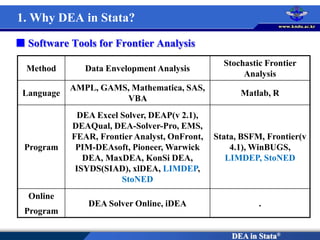
1. Why DEA in Stata?
 Software Tools for Frontier Analysis
Method Data Envelopment Analysis
Stochastic Frontier
Analysis
Language
AMPL, GAMS, Mathematica, SAS,
VBA
Matlab, R
Program
DEA Excel Solver, DEAP(v 2.1),
DEAQual, DEA-Solver-Pro, EMS,
FEAR, Frontier Analyst, OnFront,
PIM-DEAsoft, Pioneer, Warwick
DEA, MaxDEA, KonSi DEA,
ISYDS(SIAD), xlDEA, LIMDEP,
StoNED
Stata, BSFM, Frontier(v
4.1), WinBUGS,
LIMDEP, StoNED
Online
Program
DEA Solver Online, iDEA .
DEA in Stata®
1. Why DEA in Stata? (cont.)
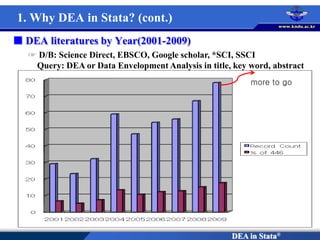
 DEA literatures by Year(2001-2009)
more to go
☞ D/B: Science Direct, EBSCO, Google scholar, *SCI, SSCI
Query: DEA or Data Envelopment Analysis in title, key word, abstract
DEA in Stata®
1. Why DEA in Stata? (cont.)
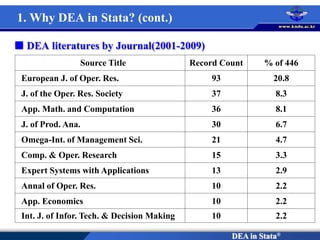
 DEA literatures by Journal(2001-2009)
Source Title Record Count % of 446
European J. of Oper. Res. 93 20.8
J. of the Oper. Res. Society 37 8.3
App. Math. and Computation 36 8.1
J. of Prod. Ana. 30 6.7
Omega-Int. of Management Sci. 21 4.7
Comp. & Oper. Research 15 3.3
Expert Systems with Applications 13 2.9
Annal of Oper. Res. 10 2.2
App. Economics 10 2.2
Int. J. of Infor. Tech. & Decision Making 10 2.2
DEA in Stata®
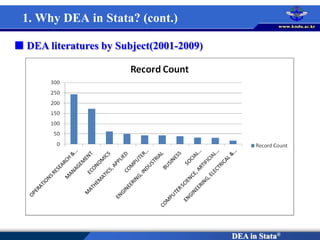
 DEA literatures by Subject(2001-2009)
1. Why DEA in Stata? (cont.)
DEA in Stata®
… Stata is easy to use and powerful statistical software;
Data Envelopment Analysis code in Stata will
promote the efficiency in data management for DEA
users and open new application areas in statistical
inference for Stata users.
1. Why DEA in Stata? (cont.)
DEA in Stata®
2. The Basics of DEA(cont.)
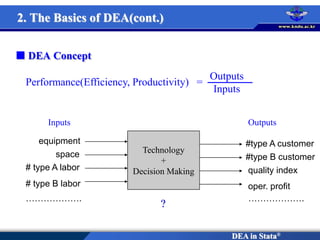
 DEA Concept
Technology
+
Decision Making
Inputs Outputs
equipment
space
# type B labor
#type A customer
#type B customer
quality index
oper. profit
Performance(Efficiency, Productivity) =
Outputs
Inputs
?
# type A labor
………………. ……………….
DEA in Stata®
2. The Basics of DEA(cont.)
 Assumptions to analyze the black box
 Economic Behaviors: No input, no output!
 (Free) Disposability
 Convexity
 Frontier Search: Piece-wise Linear Method
 Scale Economy
 Orientation: Input-based or Output-based Analysis
 …
 Interpretation of DEA Results
 X-inefficiency
 Rational Choice of Input-Output Mixes
 Performance
 …
DEA in Stata®
2. The Basics of DEA(cont.)
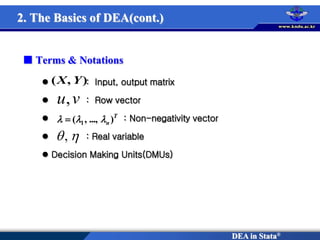
 Terms & Notations
 : Input, output matrix
 : Row vector
 : Non-negativity vector
 : Real variable
 Decision Making Units(DMUs)
)
,
( Y
X
,
u v
T
n )
...,
,
( 1 

 
,
 
DEA in Stata®
2. The Basics of DEA(cont.)
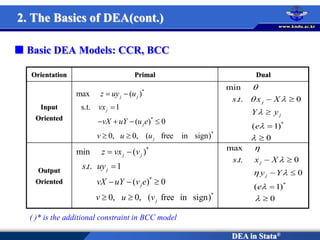
 Basic DEA Models: CCR, BCC
Orientation Primal Dual
Input
Oriented
Output
Oriented
( )* is the additional constraint in BCC model
*
*
*
max ( )
s.t. 1
( ) 0
0, 0, ( free in sign)
j j
j
j
j
z uy u
vx
vX uY u e
v u u
 

   
 
*
min
. . 0
( 1)
0
j
j
s t x X
Y y
e

 



 



*
*
*
min ( )
. . 1
( ) 0
0, 0, ( free in sign)
j j
j
j
j
z vx v
s t uy
vX uY v e
v u v
 

  
 
*
max
. . 0
0
( 1)
0
j
j
s t x X
y Y
e


 


 
 


DEA in Stata®
 Characteristics of DEA
 No assumption about Input-Output Function
 No limits to the number of inputs and outputs
 Not required to weight restrictions
 Provide reference sets for benchmarking
 Provide useful information for input-output mix decision
 n times computations for n DMUs
2. The Basics of DEA(cont.)
DEA in Stata®
3. The Stata/DEA program
 User Written Stata/DEA Description
Considered the basic DEA models (CCR & BCC)
Can handle both input minimization and output
maximization problems
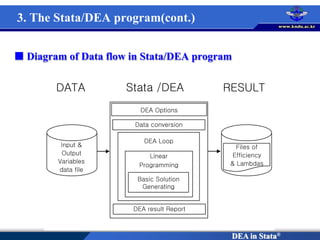
The data flow in the Stata/DEA program
 the input and output variables data sets required
 the DEA options define the model
 the “Stata/DEA” program consists of “basic” and “lp” subroutine
 the result data sets available for print or further analysis
DEA in Stata®
3. The Stata/DEA program(cont.)
Input &
Output
Variables
data file
DEA Options
Data conversion
DEA result Report
Linear
Programming
Files of
Efficiency
& Lambdas
Basic Solution
Generating
DEA Loop
DATA Stata /DEA RESULT
 Diagram of Data flow in Stata/DEA program
DEA in Stata®
3. The Stata/DEA program(cont.)
 Stata/DEA Syntax (program code under Stata journal review)
• dea [, data(string) iotype(string) model(string) lambda]
DEA in Stata®
4. Stata/DEA Examples
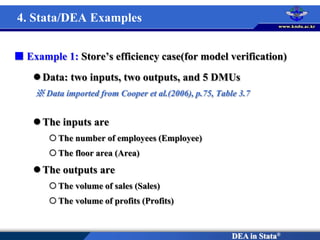
 Example 1: Store’s efficiency case(for model verification)
Data: two inputs, two outputs, and 5 DMUs
※ Data imported from Cooper et al.(2006), p.75, Table 3.7
The inputs are
 The number of employees (Employee)
 The floor area (Area)
The outputs are
 The volume of sales (Sales)
 The volume of profits (Profits)
DEA in Stata®
4. Stata/DEA Examples(cont.)
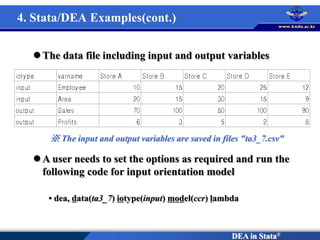
The data file including input and output variables
A user needs to set the options as required and run the
following code for input orientation model
• dea, data(ta3_7) iotype(input) model(ccr) lambda
※ The input and output variables are saved in files "ta3_7.csv"
DEA in Stata®
4. Stata/DEA Examples(cont.)
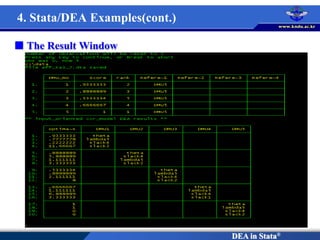
 The Result Window
DEA in Stata®
4. Stata/DEA Examples(cont.)
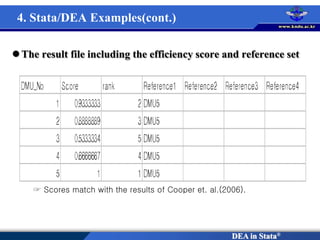
The result file including the efficiency score and reference set
☞ Scores match with the results of Cooper et. al.(2006).
DEA in Stata®
4. Stata/DEA Examples(cont.)
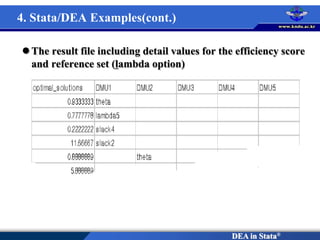
The result file including detail values for the efficiency score
and reference set (lambda option)
DEA in Stata®
4. Stata/DEA Examples(cont.)
 Example 2: Weapons system construction efficiency
two inputs, three outputs, and 10 DMUs
※ Data from JAA fr( Jane's Armour and Artillery)
The inputs are
 Combat weight
 Height
The outputs are
 Power-to-weight ratio
 Max road speed
 Main armament diameter
DEA in Stata®
4. Stata/DEA Examples(cont.)
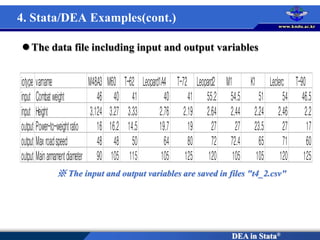
The data file including input and output variables
※ The input and output variables are saved in files "t4_2.csv"
iotype varname M48A3 M60 T-62 Leopard1A4 T-72 Leopard2 M1 K1 Leclerc T-90
input Combatweight 46 40 41 40 41 55.2 54.5 51 54 46.5
input Height 3.124 3.27 3.33 2.76 2.19 2.64 2.44 2.24 2.46 2.2
output Power-to-weightratio 16 16.2 14.5 19.7 19 27 27 23.5 27 17
output Maxroadspeed 48 48 50 64 80 72 72.4 65 71 60
output Mainarmamentdiameter 90 105 115 105 125 120 105 105 120 125
DEA in Stata®
4. Stata/DEA Examples(cont.)
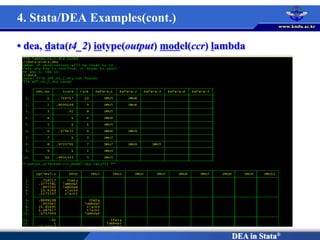
• dea, data(t4_2) iotype(output) model(ccr) lambda
DEA in Stata®
4. Stata/DEA Examples(cont.)
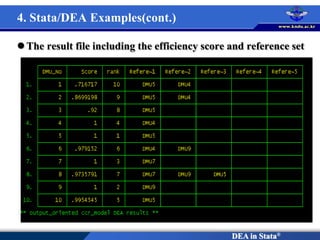
The result file including the efficiency score and reference set
DEA in Stata®
4. Stata/DEA Examples(cont.)
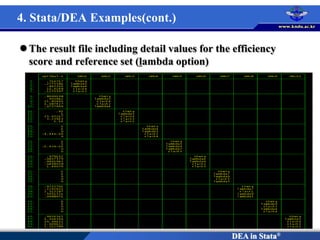
The result file including detail values for the efficiency
score and reference set (lambda option)
DEA in Stata®
5. DEA Frontiers in Stata?
 The Stata/DEA program is a new application in Stata.
 DEA is a prevalent and powerful managerial tool for measuring the performance.
 The Stata/DEA program will provide Stata users with several opportunities :
 No extra cost to access DEA
 Flexible DEA model extension and development
 A powerful managerial tool as well as data management, statistical analysis, and
optimization procedures
 The Stata/DEA program report's files can directly feed to other Stata routines for
further analysis.
 Further Extensions to 2nd Stage Regression Analysis, DGP of DEA, Statistical
Inferences of DEA, Case Specific DEA Models, and more are possible.
DEA in Stata®
6. References
 Lee, C., & Ji, Y. (2009). “Data Envelopment Analysis in Stata”, under
review by the Stata Journal.
 Cooper, W. W., Seiford, L. M., & Tone, A. (2006). Introduction to Data
Envelopment Analysis and Its Uses, Springer Science+Business Media.
 Charnes, A., Cooper, W. W., & Rhodes, E. (1981). "Evaluating Program
and Managerial Efficiency: An Application of Data Envelopment
Analysis to Program Follow Through." Management Science, Vol. 27.,
pp. 668-697.
 Banker, R. D., Charnes, A., & Coopers, A. A. (1984). “Some Models for
Estimating Technical and Scale Inefficiencies in Data Envelopment
Analysis”, Management Science Vol. 30, No. 9, pp.1078-1092.

METODOLOGIA DEA EN STATA

  • 1.
    DEA in Stata® DataEnvelopment Analysis in Stata Choonjoo Lee (sarang90@kndu.ac.kr) Yong-bae Ji (jyb7707@hanmail.net) Korea National Defense University, Republic of Korea Stata Conference DC09 (July 30-31, 2009)
  • 2.
    DEA in Stata® Outline 1.Why DEA in Stata? 2. The Basics of DEA 3. The Stata/DEA program 4. Stata/DEA Examples 5. DEA Frontiers in Stata? 6. References
  • 3.
    DEA in Stata® 1.Why DEA in Stata?  Software Tools for Frontier Analysis Method Data Envelopment Analysis Stochastic Frontier Analysis Language AMPL, GAMS, Mathematica, SAS, VBA Matlab, R Program DEA Excel Solver, DEAP(v 2.1), DEAQual, DEA-Solver-Pro, EMS, FEAR, Frontier Analyst, OnFront, PIM-DEAsoft, Pioneer, Warwick DEA, MaxDEA, KonSi DEA, ISYDS(SIAD), xlDEA, LIMDEP, StoNED Stata, BSFM, Frontier(v 4.1), WinBUGS, LIMDEP, StoNED Online Program DEA Solver Online, iDEA .
  • 4.
    DEA in Stata® 1.Why DEA in Stata? (cont.)  DEA literatures by Year(2001-2009) more to go ☞ D/B: Science Direct, EBSCO, Google scholar, *SCI, SSCI Query: DEA or Data Envelopment Analysis in title, key word, abstract
  • 5.
    DEA in Stata® 1.Why DEA in Stata? (cont.)  DEA literatures by Journal(2001-2009) Source Title Record Count % of 446 European J. of Oper. Res. 93 20.8 J. of the Oper. Res. Society 37 8.3 App. Math. and Computation 36 8.1 J. of Prod. Ana. 30 6.7 Omega-Int. of Management Sci. 21 4.7 Comp. & Oper. Research 15 3.3 Expert Systems with Applications 13 2.9 Annal of Oper. Res. 10 2.2 App. Economics 10 2.2 Int. J. of Infor. Tech. & Decision Making 10 2.2
  • 6.
    DEA in Stata® DEA literatures by Subject(2001-2009) 1. Why DEA in Stata? (cont.)
  • 7.
    DEA in Stata® …Stata is easy to use and powerful statistical software; Data Envelopment Analysis code in Stata will promote the efficiency in data management for DEA users and open new application areas in statistical inference for Stata users. 1. Why DEA in Stata? (cont.)
  • 8.
    DEA in Stata® 2.The Basics of DEA(cont.)  DEA Concept Technology + Decision Making Inputs Outputs equipment space # type B labor #type A customer #type B customer quality index oper. profit Performance(Efficiency, Productivity) = Outputs Inputs ? # type A labor ………………. ……………….
  • 9.
    DEA in Stata® 2.The Basics of DEA(cont.)  Assumptions to analyze the black box  Economic Behaviors: No input, no output!  (Free) Disposability  Convexity  Frontier Search: Piece-wise Linear Method  Scale Economy  Orientation: Input-based or Output-based Analysis  …  Interpretation of DEA Results  X-inefficiency  Rational Choice of Input-Output Mixes  Performance  …
  • 10.
    DEA in Stata® 2.The Basics of DEA(cont.)  Terms & Notations  : Input, output matrix  : Row vector  : Non-negativity vector  : Real variable  Decision Making Units(DMUs) ) , ( Y X , u v T n ) ..., , ( 1     ,  
  • 11.
    DEA in Stata® 2.The Basics of DEA(cont.)  Basic DEA Models: CCR, BCC Orientation Primal Dual Input Oriented Output Oriented ( )* is the additional constraint in BCC model * * * max ( ) s.t. 1 ( ) 0 0, 0, ( free in sign) j j j j j z uy u vx vX uY u e v u u          * min . . 0 ( 1) 0 j j s t x X Y y e            * * * min ( ) . . 1 ( ) 0 0, 0, ( free in sign) j j j j j z vx v s t uy vX uY v e v u v         * max . . 0 0 ( 1) 0 j j s t x X y Y e            
  • 12.
    DEA in Stata® Characteristics of DEA  No assumption about Input-Output Function  No limits to the number of inputs and outputs  Not required to weight restrictions  Provide reference sets for benchmarking  Provide useful information for input-output mix decision  n times computations for n DMUs 2. The Basics of DEA(cont.)
  • 13.
    DEA in Stata® 3.The Stata/DEA program  User Written Stata/DEA Description Considered the basic DEA models (CCR & BCC) Can handle both input minimization and output maximization problems The data flow in the Stata/DEA program  the input and output variables data sets required  the DEA options define the model  the “Stata/DEA” program consists of “basic” and “lp” subroutine  the result data sets available for print or further analysis
  • 14.
    DEA in Stata® 3.The Stata/DEA program(cont.) Input & Output Variables data file DEA Options Data conversion DEA result Report Linear Programming Files of Efficiency & Lambdas Basic Solution Generating DEA Loop DATA Stata /DEA RESULT  Diagram of Data flow in Stata/DEA program
  • 15.
    DEA in Stata® 3.The Stata/DEA program(cont.)  Stata/DEA Syntax (program code under Stata journal review) • dea [, data(string) iotype(string) model(string) lambda]
  • 16.
    DEA in Stata® 4.Stata/DEA Examples  Example 1: Store’s efficiency case(for model verification) Data: two inputs, two outputs, and 5 DMUs ※ Data imported from Cooper et al.(2006), p.75, Table 3.7 The inputs are  The number of employees (Employee)  The floor area (Area) The outputs are  The volume of sales (Sales)  The volume of profits (Profits)
  • 17.
    DEA in Stata® 4.Stata/DEA Examples(cont.) The data file including input and output variables A user needs to set the options as required and run the following code for input orientation model • dea, data(ta3_7) iotype(input) model(ccr) lambda ※ The input and output variables are saved in files "ta3_7.csv"
  • 18.
    DEA in Stata® 4.Stata/DEA Examples(cont.)  The Result Window
  • 19.
    DEA in Stata® 4.Stata/DEA Examples(cont.) The result file including the efficiency score and reference set ☞ Scores match with the results of Cooper et. al.(2006).
  • 20.
    DEA in Stata® 4.Stata/DEA Examples(cont.) The result file including detail values for the efficiency score and reference set (lambda option)
  • 21.
    DEA in Stata® 4.Stata/DEA Examples(cont.)  Example 2: Weapons system construction efficiency two inputs, three outputs, and 10 DMUs ※ Data from JAA fr( Jane's Armour and Artillery) The inputs are  Combat weight  Height The outputs are  Power-to-weight ratio  Max road speed  Main armament diameter
  • 22.
    DEA in Stata® 4.Stata/DEA Examples(cont.) The data file including input and output variables ※ The input and output variables are saved in files "t4_2.csv" iotype varname M48A3 M60 T-62 Leopard1A4 T-72 Leopard2 M1 K1 Leclerc T-90 input Combatweight 46 40 41 40 41 55.2 54.5 51 54 46.5 input Height 3.124 3.27 3.33 2.76 2.19 2.64 2.44 2.24 2.46 2.2 output Power-to-weightratio 16 16.2 14.5 19.7 19 27 27 23.5 27 17 output Maxroadspeed 48 48 50 64 80 72 72.4 65 71 60 output Mainarmamentdiameter 90 105 115 105 125 120 105 105 120 125
  • 23.
    DEA in Stata® 4.Stata/DEA Examples(cont.) • dea, data(t4_2) iotype(output) model(ccr) lambda
  • 24.
    DEA in Stata® 4.Stata/DEA Examples(cont.) The result file including the efficiency score and reference set
  • 25.
    DEA in Stata® 4.Stata/DEA Examples(cont.) The result file including detail values for the efficiency score and reference set (lambda option)
  • 26.
    DEA in Stata® 5.DEA Frontiers in Stata?  The Stata/DEA program is a new application in Stata.  DEA is a prevalent and powerful managerial tool for measuring the performance.  The Stata/DEA program will provide Stata users with several opportunities :  No extra cost to access DEA  Flexible DEA model extension and development  A powerful managerial tool as well as data management, statistical analysis, and optimization procedures  The Stata/DEA program report's files can directly feed to other Stata routines for further analysis.  Further Extensions to 2nd Stage Regression Analysis, DGP of DEA, Statistical Inferences of DEA, Case Specific DEA Models, and more are possible.
  • 27.
    DEA in Stata® 6.References  Lee, C., & Ji, Y. (2009). “Data Envelopment Analysis in Stata”, under review by the Stata Journal.  Cooper, W. W., Seiford, L. M., & Tone, A. (2006). Introduction to Data Envelopment Analysis and Its Uses, Springer Science+Business Media.  Charnes, A., Cooper, W. W., & Rhodes, E. (1981). "Evaluating Program and Managerial Efficiency: An Application of Data Envelopment Analysis to Program Follow Through." Management Science, Vol. 27., pp. 668-697.  Banker, R. D., Charnes, A., & Coopers, A. A. (1984). “Some Models for Estimating Technical and Scale Inefficiencies in Data Envelopment Analysis”, Management Science Vol. 30, No. 9, pp.1078-1092.