David Massart, EUNNov 2, 2009Budapest, HungaryBuilding a Learning Resource Exchange for Schools
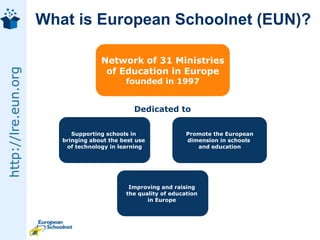
What is European Schoolnet (EUN)?Network of 31 Ministriesof Education in Europefounded in 1997Dedicated toSupporting schools in bringing about the best use of technology in learningPromote the Europeandimension in schools and educationImproving and raising the quality of education in Europe
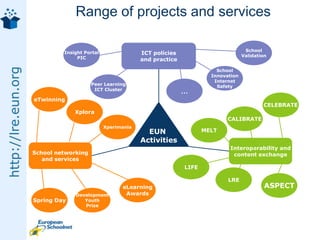
Range of projects and servicesSchoolValidationICT policiesand practiceInsight PortalPICSchoolInnovationInternetSafetyPeer LearningICT Cluster…eTwinningCELEBRATEXploraEUN ActivitiesCALIBRATEXperimaniaMELTInteroperability andcontent exchangeSchool networkingand servicesLIFELREASPECTeLearningAwardsSpring DayDevelopmentYouthPrize
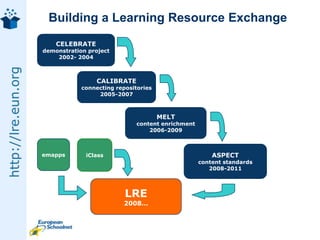
Building a Learning Resource ExchangeCELEBRATEdemonstration project2002- 2004CALIBRATEconnecting repositories2005-2007MELTcontent enrichment2006-2009emappsiClassASPECTcontent standards2008-2011LRE2008…
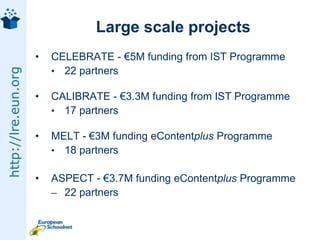
Large scale projectsCELEBRATE - €5M funding from IST Programme22 partners CALIBRATE - €3.3M funding from IST Programme17 partners MELT - €3M funding eContentplus Programme18 partnersASPECT - €3.7M funding eContentplus Programme22 partners
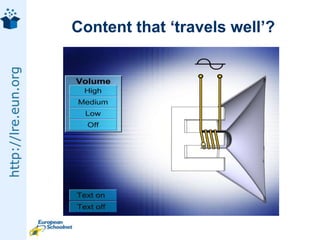
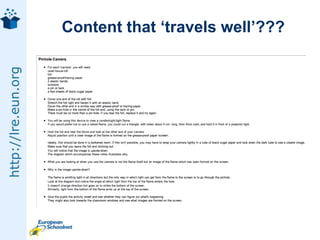
Content that ‘travels well’
Content that ‘travels well’?
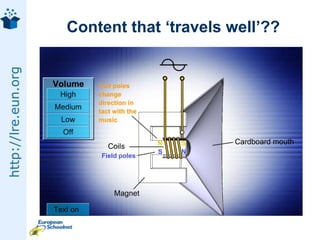
Content that ‘travels well’??
Content that ‘travels well’???
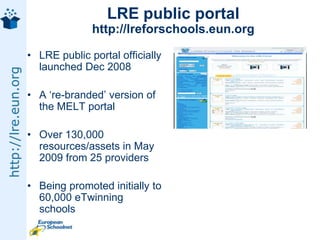
LRE public portalhttp://lreforschools.eun.orgLRE public portal officially launched Dec 2008A ‘re-branded’ version of the MELT portalOver 130,000 resources/assets in May 2009 from 25 providersBeing promoted initially to 60,000 eTwinning schools
What is the LRE Vision?LRE is a service for MoE driven by MoE and involves private sector partnersAim is to improve use and reuse of educational content in schoolsbetter technical interoperability between repositoriesimprove semantic interoperability of contentdevelop best practice in how to implement content-related standards
What is the LRE Vision?It is NOT a centralised portal… but a framework that supports semantic and technical interoperability of content repositoriesAdds value to national content strategies
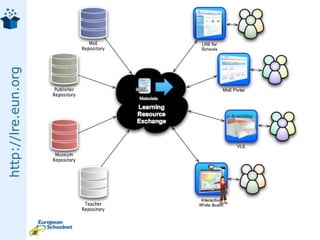
Learning Resource ExchangeAn infrastructure for:Federating applications/platforms that provide learning resources to schools (repositories, learning platforms, authoring environments)Providing seamless access to K-12 resources to applications that consume these (portals, VLEs)
Flexible technical solutionsConnect a repository, portal or VLE to the federationLet the LRE harvest your metadata using OAI-PMHPublish your metadata using SPI‘mass upload’ of your metadata - just complete an Excel spreadsheet
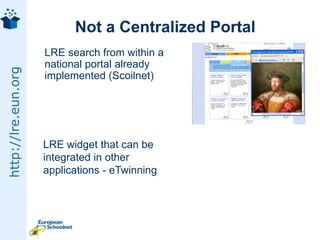
Not a Centralized Portal	LRE search from within a national portal already implemented (Scoilnet)LRE widget that can be integrated in other applications - eTwinning
Why join the LRE?The most important Europe-wide (and potential global) player in e-learning content may become the European Schoolnet (EUN) through their European Learning Resource Exchange which is currently under development.Open Educational Practices and Resources: OLCOS Roadmap 2012, January 2007
MoE LRE PartnersInitial LRE partners inc. partners in the CALIBRATE and MELT projects - 16 Ministries of Education in Europe: Austria, Belgium (Flemish community), Region of Catalonia (Spain), Estonia, Finland, Germany, Hungary, Iceland, Ireland, Israel, Italy, Lithuania, Poland, Slovenia, Spain, Sweden
plus Czech Republic repository April 2009 - 17 MoE
plus France and Portugal in ASPECT project - 2009 - 19 MoEMoE LRE Working Group defining strategy
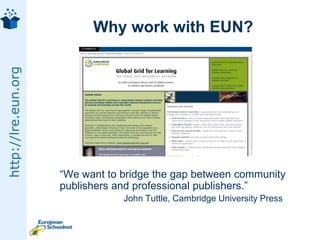
Why work with EUN?	“We want to bridge the gap between community publishers and professional publishers.”		                  John Tuttle, Cambridge University Press“
Content partner benefitsReach aglobal audience with your contentStandard-based metadata application profile for schoolsMultilingual thesaurus/vocabulariesFeedback on your resources - popularity, ratings, commentsDiscover which of your resources ‘travel well’Enrichment of your metadata - LRE social taggingAutomatic metadata generationAutomatic metadata translationExpert support on semantic interoperability and standards for content exchange
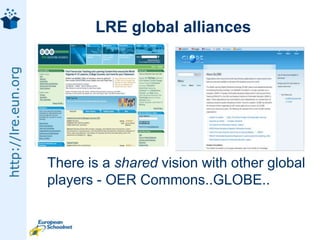
LRE global alliances	There is a shared vision with other global players - OER Commons..GLOBE..
Some LRE Associate Partners
How to Join?Send us an example of your metadata One-to-one meetings to discover your requirementsSend staff to a LRE technical workshop
http://lre.eun.org
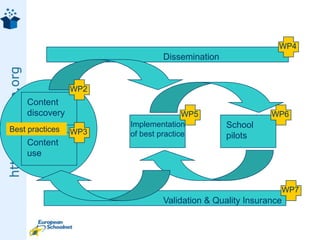
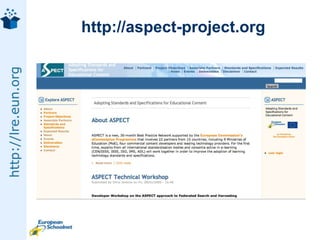
ASPECT Sept 08 - Feb 2011eContentplus Best Practice Network€4.6 million budget9 MoE - Denmark, Belgium, France, Germany, Hungary, Italy, Lithuania, Portugal, SloveniaCommercial partners - Cambridge University Press, Icodeon, Siveco, Young Digital Planet, Vocabulary Management GroupExperts from all international standardisation bodies and consortia active in eLearning: CEN/ISSS, IMS, IEEE, ISO, ADL...
ASPECT Rationale	The standards organisations are inherently top-down and reactive. There is no other way for them to be. Inevitably they have to work on historic data. They have to tend to the restrictive rather than the enabling - even though some will argue, correctly, there are some fine borders. I think they are doomed to fail or if they don’t fail we are doomed.Martin Owen, September 2007, Naace newsletter
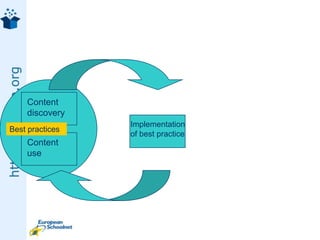
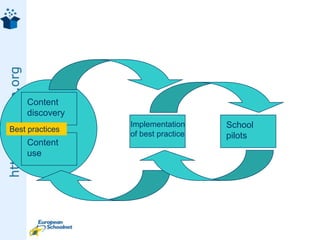
ASPECT AimsAssess standards and specifications through their implementation on a critical mass of educational content - plugfests and workshopsDevelop best practice in terms of implementing those standardsMake recommendations on the combination of a number of standards to ensure more transparent interoperability
LRE Service CentreRegistry for Learning Object RepositoriesVocabulary bank for educationApplication profile registryAutomatic translation service for metadataCompliance testingTransformer service (turn metadata and vocabularies into another format)Information on known interoperability issuesLearning Technology Standards Observatory
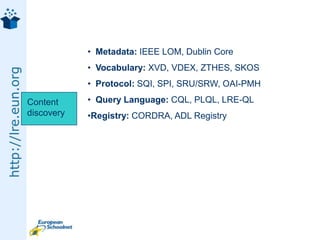
  Metadata: IEEE LOM, Dublin Core
  Vocabulary: XVD, VDEX, ZTHES, SKOS
  Protocol: SQI, SPI, SRU/SRW, OAI-PMH
  Query Language: CQL, PLQL, LRE-QL
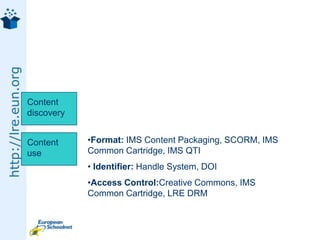
Registry: CORDRA, ADL RegistryContent discovery

Building a Learning Resource Exchange

  • 1.
    David Massart, EUNNov2, 2009Budapest, HungaryBuilding a Learning Resource Exchange for Schools
  • 2.
    What is EuropeanSchoolnet (EUN)?Network of 31 Ministriesof Education in Europefounded in 1997Dedicated toSupporting schools in bringing about the best use of technology in learningPromote the Europeandimension in schools and educationImproving and raising the quality of education in Europe
  • 3.
    Range of projectsand servicesSchoolValidationICT policiesand practiceInsight PortalPICSchoolInnovationInternetSafetyPeer LearningICT Cluster…eTwinningCELEBRATEXploraEUN ActivitiesCALIBRATEXperimaniaMELTInteroperability andcontent exchangeSchool networkingand servicesLIFELREASPECTeLearningAwardsSpring DayDevelopmentYouthPrize
  • 4.
    Building a LearningResource ExchangeCELEBRATEdemonstration project2002- 2004CALIBRATEconnecting repositories2005-2007MELTcontent enrichment2006-2009emappsiClassASPECTcontent standards2008-2011LRE2008…
  • 5.
    Large scale projectsCELEBRATE- €5M funding from IST Programme22 partners CALIBRATE - €3.3M funding from IST Programme17 partners MELT - €3M funding eContentplus Programme18 partnersASPECT - €3.7M funding eContentplus Programme22 partners
  • 6.
  • 7.
  • 8.
  • 9.
  • 10.
    LRE public portalhttp://lreforschools.eun.orgLREpublic portal officially launched Dec 2008A ‘re-branded’ version of the MELT portalOver 130,000 resources/assets in May 2009 from 25 providersBeing promoted initially to 60,000 eTwinning schools
  • 11.
    What is theLRE Vision?LRE is a service for MoE driven by MoE and involves private sector partnersAim is to improve use and reuse of educational content in schoolsbetter technical interoperability between repositoriesimprove semantic interoperability of contentdevelop best practice in how to implement content-related standards
  • 12.
    What is theLRE Vision?It is NOT a centralised portal… but a framework that supports semantic and technical interoperability of content repositoriesAdds value to national content strategies
  • 13.
    Learning Resource ExchangeAninfrastructure for:Federating applications/platforms that provide learning resources to schools (repositories, learning platforms, authoring environments)Providing seamless access to K-12 resources to applications that consume these (portals, VLEs)
  • 15.
    Flexible technical solutionsConnecta repository, portal or VLE to the federationLet the LRE harvest your metadata using OAI-PMHPublish your metadata using SPI‘mass upload’ of your metadata - just complete an Excel spreadsheet
  • 16.
    Not a CentralizedPortal LRE search from within a national portal already implemented (Scoilnet)LRE widget that can be integrated in other applications - eTwinning
  • 17.
    Why join theLRE?The most important Europe-wide (and potential global) player in e-learning content may become the European Schoolnet (EUN) through their European Learning Resource Exchange which is currently under development.Open Educational Practices and Resources: OLCOS Roadmap 2012, January 2007
  • 18.
    MoE LRE PartnersInitialLRE partners inc. partners in the CALIBRATE and MELT projects - 16 Ministries of Education in Europe: Austria, Belgium (Flemish community), Region of Catalonia (Spain), Estonia, Finland, Germany, Hungary, Iceland, Ireland, Israel, Italy, Lithuania, Poland, Slovenia, Spain, Sweden
  • 19.
    plus Czech Republicrepository April 2009 - 17 MoE
  • 20.
    plus France andPortugal in ASPECT project - 2009 - 19 MoEMoE LRE Working Group defining strategy
  • 21.
    Why work withEUN? “We want to bridge the gap between community publishers and professional publishers.” John Tuttle, Cambridge University Press“
  • 22.
    Content partner benefitsReachaglobal audience with your contentStandard-based metadata application profile for schoolsMultilingual thesaurus/vocabulariesFeedback on your resources - popularity, ratings, commentsDiscover which of your resources ‘travel well’Enrichment of your metadata - LRE social taggingAutomatic metadata generationAutomatic metadata translationExpert support on semantic interoperability and standards for content exchange
  • 23.
    LRE global alliances Thereis a shared vision with other global players - OER Commons..GLOBE..
  • 24.
  • 25.
    How to Join?Sendus an example of your metadata One-to-one meetings to discover your requirementsSend staff to a LRE technical workshop
  • 26.
  • 27.
    ASPECT Sept 08- Feb 2011eContentplus Best Practice Network€4.6 million budget9 MoE - Denmark, Belgium, France, Germany, Hungary, Italy, Lithuania, Portugal, SloveniaCommercial partners - Cambridge University Press, Icodeon, Siveco, Young Digital Planet, Vocabulary Management GroupExperts from all international standardisation bodies and consortia active in eLearning: CEN/ISSS, IMS, IEEE, ISO, ADL...
  • 28.
    ASPECT Rationale The standardsorganisations are inherently top-down and reactive. There is no other way for them to be. Inevitably they have to work on historic data. They have to tend to the restrictive rather than the enabling - even though some will argue, correctly, there are some fine borders. I think they are doomed to fail or if they don’t fail we are doomed.Martin Owen, September 2007, Naace newsletter
  • 29.
    ASPECT AimsAssess standardsand specifications through their implementation on a critical mass of educational content - plugfests and workshopsDevelop best practice in terms of implementing those standardsMake recommendations on the combination of a number of standards to ensure more transparent interoperability
  • 30.
    LRE Service CentreRegistryfor Learning Object RepositoriesVocabulary bank for educationApplication profile registryAutomatic translation service for metadataCompliance testingTransformer service (turn metadata and vocabularies into another format)Information on known interoperability issuesLearning Technology Standards Observatory
  • 31.
    Metadata:IEEE LOM, Dublin Core
  • 32.
    Vocabulary:XVD, VDEX, ZTHES, SKOS
  • 33.
    Protocol:SQI, SPI, SRU/SRW, OAI-PMH
  • 34.
    QueryLanguage: CQL, PLQL, LRE-QL
  • 35.
    Registry: CORDRA, ADLRegistryContent discovery